
(Gangani SHP on Yamuna river in Uttarkashi affected by June 2013 flash flood. Image: Yamuna Jiye Abhiyan/July 2013)
The Forest Advisory Committee of Union Ministry of Environment and Forests (MoEF) have rightly raised concerns about the impacts of so called small hydropower projects, that is hydropower projects with capacity below 25 MW. The MoEF assumes, following such unknown science or logic, that such projects have no environment and social impacts, they do not need environment and social impact assessments or management plan, they do not need any public consultation process, they do not need any monitoring or compliance and most significantly, they do not even need any clearances! A more unscientific thinking of the govt of India’s top environmental body would be difficult to find.
SANDRP has for decades been raising the issue of this incongruity in regulation of our rivers and demanding that these projects also have significant impacts and need clearances, plans and compliance.
Unfortunately, this issue should have been a concern of MoEF’s Expert Appraisal Committee on River Valley Projects, but they seem to be busy towing the govt line. One hopes the concerns of FAC would also be discussed in EAC and also MoEF should invite public comments on this, particularly the local communities affected by such projects and also bring about change in the EIA norms urgently.
MoEF Concern over increasing proposals for SHPs The ministry’s Forest Advisory Committee discussed the issue in a meeting on September 11, the minutes of which were recently made available. The panel recalled that the ministry had in 2011 directed all states to conduct Cumulative Impact Assessment Studies and carry out capacity studies for their river basins. It noted that such studies have been successfully completed for 13 river basins across five states so far. The panel highlighted that most Cumulative Impact Assessment Studies primarily emphasise hydropower projects with installed capacities exceeding 25 MW. However, they do cover projects with capacities of 5 MW and above.
The committee expressed concerns over the increasing number of proposals for smaller hydropower projects, particularly those with capacities below 5 MW, in hill states such as Himachal Pradesh, Uttarakhand, Arunachal Pradesh and Sikkim. Smaller tributaries and rivers have become focal points for such projects, it said. “Even smaller projects on third order tributaries may impede with the natural flow of rivulet and thereby impact the aquatic fauna as these projects are of smaller installed capacity but their number is relatively higher,” according to the minutes of the meeting.
The panel noted that these smaller projects have the potential to disrupt the natural flow of rivulets and adversely affect aquatic fauna, including species such as trout and masheer that rely on these waters for breeding, the committee noted. It also acknowledged the challenges in assessing the impact of these smaller projects due to the absence of long-term plans from state governments and credible assessments of their influence on hydrological regimes and aquatic ecosystems. Since the matter falls within the purview of the ministry’s Impact Assessment Division, the panel decided to seek expert opinion from it and revisit the issue in the upcoming committee meeting. https://theprint.in/india/environment-ministry-raises-concern-over-increasing-proposals-for-small-hydropower-projects-in-hill-states/1790072/ (04 Oct. 2023)
HYDRO POWER PROJECTS
Lower Subansiri 4 workers injured as terrace collapses Days after the main diversion tunnel reopened after a massive landslide at the Lower Subansiri Hydro Electric Power project of the National Hydro Electric Power Corporation (NHPC), reports of yet another mishap emerged on Friday (Oct. 6). According to sources, the terrace of the hydro electric project’s No. 8 Horse Race Tunnel collapsed while work was underway.
The incident had occurred on September 26, reports said. Allegations have been leveled against the NHPC authorities for trying to cover-up the issue. Meanwhile, further sources claimed that at least four labourers were injured in the incident. Notably, water to the power house of the project is supplied through the Horse Race Tunnel from the reserve. The incident which occurred at the tunnel has led to a very intense situation at the project. https://www.pratidintime.com/latest-assam-news-breaking-news-assam/4-labourers-injured-as-terrace-collapses-at-nhpcs-lower-subansiri (06 Oct. 2023)
Arunachal Pradesh ADC assesses hydropower project The Dirang ADC, along with other officials recently visited the 4×500 KW Dirang small hydropower project to assess the ongoing renovation and modernisation (R&M) work at the site. The project, in operation since 1978, plays a crucial role in providing hydroelectric power to West Kameng district. The ADC and his team reviewed the progress of the R&M project, which aims to extend the operational life of the power facility. The project encompasses work on various critical components, including the power channel, the desilting tank, the weir, and intake. Both civil and electromechanical work on the project have been tendered, with the execution being overseen by the Bomdila Hydropower Division-I. Upon completion, the power project is expected to have significantly increased power generation capacity. https://arunachaltimes.in/index.php/2023/10/06/adc-assesses-hydropower-project/ (06 Oct. 2023)
Meghalaya Govt seeks support for small hydro A high-level delegation led by Power Minister AT Mondal has sought more central support for small hydro projects (SHPs) and renewable energy, specifically solar. He also sought the review of the financial support or subsidy of Rs 7.5 crore per MW given to the SHPs for a project of 1-25 MW, which has been put on hold. Singh agreed to look into it soon.
The delegation participated in a crucial meeting organised by the Ministry of New and Renewable Energy to discuss the challenges and opportunities in promoting renewable energy in the northeastern states on Thursday (Oct. 05). Union Minister of Power and Renewable Energy, Raj Kumar Singh chaired the meeting. Mondal also underlined the feasibility of pump storage projects (PSPs) as “Meghalaya has a huge potential” and four PSPs with a total capacity of about 3,100 MW were identified with the technical support of NTPC. The only problem now is to fund such projects, he said. https://theshillongtimes.com/2023/10/06/state-seeks-new-delhis-support-for-small-hydro-solar-power/ (06 Oct. 2023)
Power Ministry Panel formed to study geological surprises in hydropower projects The Central Electricity Authority (CEA) will constitute a committee to study issues in the event of any geological surprise faced in hydroelectric projects and offer recommendations. The authority pointed out that development of hydroelectric projects has been impacted due to various issues including geological uncertainties or constraints, resulting in significant time and cost overruns.
In this regard, the Techno Economic Concurrence issued by the CEA, in general, provides that a project developer shall systematically maintain a record of geological surprises, which are encountered and treatment provided. At the same time, the developer shall request the Power Ministry to constitute an expert committee consisting of representatives from the State, Geological Survey of India (GSI), Central Water Commission (CWC) and CEA. Once this committee is constituted, the developer will submit the proposal for enhanced cost to the committee, which in turn shall examine and recommend the cost thereof.
“In order to obviate the need for creation of separate expert committees for each such case, it is decided to constitute a Standing Technical Committee to study issues in the event of any geological surprise faced in hydroelectric projects and to vet/ examine and recommend the additional time/ cost involved,” the authority said. https://www.thehindubusinessline.com/economy/cea-forms-panel-to-study-geological-surprises-in-hydropower-projects/article67376549.ece (08 Oct. 2023)
MoEF Relevant agenda of FAC meeting to be held on Oct 11 2023:
1. 406.79 HA. OF FOREST LAND IN FAVOUR OF HPPCL FOR THANA PLAUN HYDRO-ELECTRIC PROJECT (191 MW), in MANDI & JOGINDERNAGAR FOREST DIVISIONS, DISTRICT MANDI, HIMACHAL PRADESH
2. 12.8 ha forest land FOR HYDRO POWER PROJECT of MARSHAL SMALL HYDRO POWER PRIVATE LIMITED, IN REWA DISTRICT OF MADHYA PRADESH. https://forestsclearance.nic.in/AgendaDetail.aspx?id=291!dis1
DAMS
Jharkhand Centre hikes contribution to complete stalled North Koel project The Cabinet Committee on Economic Affairs (CCEA) approved a proposal by the Jal Shakti Ministry to increase its share of funding for the under-construction North Koel Reservoir, an inter-State irrigation project spanning Bihar and Jharkhand. The Centre committed to contribute ₹1,836 crore against the ₹1,378 crore approved in 2017. This increases the project’s total cost from ₹1,622 crore in 2017 to ₹2,430 crore at present. https://www.thehindu.com/news/national/centre-hikes-contribution-to-complete-stalled-north-koel-irrigation-project/article67380670.ece (05 Oct. 2023)
Gujarat Dhatarwadi-1 dam in Rajula taluka of Amreli Dist of Gujarat’s Saurashtra may be in danger due to indiscriminate quarrying and mining close by, posing threat to the downstream villages too.

INTERLINKING OF RIVERS
Ken Betwa Link Project has been given final forest clearance, but it will require fresh environmental clearance. The Wildlife clearance is also to be looked into by the Supreme Court in view of the CEC report. https://indianexpress.com/article/political-pulse/ken-betwa-river-linking-push-clear-project-mp-polls-8970586/ (06 Oct. 2023)
– विवादित नदी जोड़ो परियोजना पर सब्जबाग दिखा रही सरकार ने प्रभावितों की मांगों पर मौन साधा
– भूमि अधिग्रहण में मनमानी के खिलाफ 25 गांव के लोगों प्रस्तावित बांध क्षेत्र में किया जल सत्याग्रह
– भाजपा सरकार के खिलाफ महापंचायत में वोट बंदी, चूल्हा बंदी और ग्राम बंदी जैसे कठोर कदम की घोषणा https://radarnews.in/ken-betwa-link-project-due-to-the-anger-of-annadata-the-submerged-area-of-the-dam-started-burning-like-singur/ (06 Oct. 2023)
Study Massive infrastructural projects aimed at mitigating drought and floods may instead worsen water stress levels, a new study in Nature Communications finds. https://www.thehindu.com/sci-tech/energy-and-environment/the-climate-blindspot-in-indias-river-interlinking-projects/article67371327.ece (07 Oct. 2023)
INTERSTATE WATER DISPUTES
SYL Dispute Find solution or we’ll pass order: SC to Punjab With no solution in sight to the two-decade-old tussle between Punjab and Haryana over construction of Sutlej-Yamuna Link (SYL) canal, the Supreme Court on Wednesday (Oct. 04) told the Punjab government not to compel it to pass an order which would be “unpalatable” and told the state to come out with a solution. It also directed the Centre to continue its mediation to resolve the politically sensitive issue.
A bench of Justices Sanjay Kishan Kaul, C T Ravikumar and Sudhanshu Dhulia told Punjab that the apex’s court decree still stood and had to be executed. “Please find some solution. The ball is entirely in your court. You just cannot sit on it. Do not give a solution which would be implemented in 20 years,” the bench told senior advocate Rakesh Dwivedi who appeared for Punjab and submitted that the ground situation and the water level had changed over the years. “You find a solution or we will have to pass an order, which will be unpalatable to you. You cannot violate a court order, you cannot say that land (acquired by the state from farmers for the canal) is now in possession of farmers. Do not compel us to pass an order. We have so far restrained ourselves,” the bench said.
The SC has been hearing the dispute between the two states since 1996 and has passed several directions to construct a 214-km canal to link Sutlej in Punjab to Yamuna in Haryana. The canal was proposed in 1981 for effective allocation of water and the SC had passed an order in 2002 in favour of Haryana but the project remained in limbo due to opposition from the Punjab government and protests by people. Haryana has already constructed the portion of canal in its area but Punjab is yet to do so. https://timesofindia.indiatimes.com/india/find-syl-canal-row-solution-or-well-pass-order-supreme-court-to-punjab/articleshow/104168743.cms ; https://www.livelaw.in/top-stories/supreme-court-punjab-government-sutlej-yamuna-link-canal-dispute-239321 (05 Oct. 2023)
The ground reality is that nearly 90% of the land acquired for the SYL has been denotified and returned to original owners. The government denotifed the land via quasi-judicial orders, using specific provisions in the law stating that a land acquired for a project can be denotified if the project ceased to exist or was delayed indefinitely. The Punjab revenue department, in just next two weeks, completed the entire process of denotification and returned the land to the farmers after mutation. In March, 2016, the Punjab assembly even passed the Punjab SYL Land (Transfer of Proprietary Rights) Bill, 2016 but it never got the assent of the governor.
Farmers say most part of the canal is of no use as the mining mafia has dug it up at various places to make easy money. The incomplete canal became a money-minting venture for the Punjab mining mafia, which dug up earth and sold it, they said. In the fatehgarh Sahib and Patiala district, the canal area is totally damaged. Gursharan Virk, who got back 8 acres back in 2016, said he is tilling the land. “Many farmers got the land back. However, there was a problem. The SYL base was made of concrete and thus it was very difficult to dig it,” he added. “Levelling of the canal was a costly affair and farmers had neither adequate money nor machinery for it,” added Virk. https://www.hindustantimes.com/cities/chandigarh-news/ground-reality-90-of-land-acquired-for-syl-in-punjab-back-with-farmers-101696534342141.html (06 Oct. 2023)
Punjab CM Bhagwant Mann on Oct. 05 said not even a single drop of additional water will be shared with any other state at any cost. He further informed that the state cabinet has approved the name of Gurminder Singh for the advocate general’s (AG) post.
The meeting came a day after the Supreme Court asked the Centre to survey the portion of land in Punjab that was allocated for the construction of a part of the SYL canal. All political parties in Punjab asserted on Wednesday (Oct. 05) that the state does not have a single drop of additional water to share with any other state. However, political parties in Haryana welcomed the top court’s directions, saying the people of the state have been waiting to get SYL water for years. https://www.ndtv.com/india-news/not-a-single-drop-of-additional-water-punjab-chief-minister-on-syl-canal-4451714 (05 Oct. 2023)
According to a government statement, the Cabinet asserted that Punjab has no surplus water to share with Haryana, arguing that reassessment of the availability of water was required as per international norms. “It was also observed that Punjab’s 76.5% blocks (117 out of 153) are over-exploited where the stage of ground water extraction is more than 100%, whereas in Haryana only 61.5% (88 out of 143) are over-exploited,” the statement said. https://www.thehindu.com/news/national/other-states/emotive-issue-of-sutlej-yamuna-link-canal-takes-political-centre-stage-again-in-punjab-haryana/article67384648.ece (06 Oct. 2023)
This report presents chronology of SYL dispute https://www.tribuneindia.com/news/punjab/sutlej-yamuna-link-syl-canal-issue%E2%80%94whats-it-all-about-550399 (04 Oct. 2023)
Krishna Water Dispute Centre clears new terms to decide Telangana water share The Union cabinet chaired by PM Narendra Modi on Wednesday (Oct. 04) took two decisions related to water, clearing proposals to rework the water-sharing formula between Andhra Pradesh and Telangana from the river Krishna and completing an irrigation project that will benefit Bihar and Jharkhand, information and broadcasting minister Anurag Thakur said.
The council of ministers signed off on new terms of reference for the Krishna Water Disputes Tribunal-II to adjudicate on what should be the amount of water Telangana should be able to draw from the Krishna Basin. Under section 5(1) of the Inter State Water Dispute Act 1956, the Centre has called for the adjudication between Telangana and Andhra Pradesh on the basis of new terms of reference. The proposal was approved after the Union government sought legal opinion on the matter and following complaints raised by the Telangana government invoking provisions of the Act.
The tribunal was set up by the Centre on 2 April 2004. In 2014, after Telangana came into existence, the tenure of the tribunal was extended in accordance to section 89 of the Andhra Pradesh Reorganization Act (APRA), 2014. Telangana first complained to the Jal Shakti ministry over water-sharing on July 14 2014. It also filed a plea in the Supreme Court in 2015. In 2018, the state made a second complaint to the Centre, asking it to refer its complaint to the tribunal by confining the scope of reference between Telangana and Andhra Pradesh only, according to records of the Union Jal Shakti ministry. https://www.hindustantimes.com/india-news/union-cabinet-clears-new-terms-to-decide-telangana-water-share-101696423811591.html (04 Oct. 2023)
State Finance Minister T. Harish Rao said the Union government woke from deep slumber after nine years to take a decision on Telangana’s demand. He said the decision was taken with an eye on the upcoming elections. A project-wise allocation of water will be made by the tribunal. All projects including Palamuru-Rangareddy Lift Irrigation and Kalwakurthy will be allocated water, he said. While inaugurating the Palamuru Rangareddy Lift Irrigation Scheme (PRLIS) last month, KCR had slammed PM Modi for not deciding the state’s share in Krishna river waters. He had asked people to question BJP leaders why their government at the Centre was unable to determine Telangana’s share of Krishna waters. https://www.siasat.com/telanganas-victory-says-brs-over-centres-decision-on-krishna-waters-2712842/ (04 Oct. 2023)
Telangana has requested the Krishna River Management Board (KRMB) to restrain Andhra Pradesh from proceeding ahead with the first phase of works on the Rayalaseema Lift Irrigation Project (RLIP), stating that the AP government has issued orders recently to resume works to divert 59 tmc ft water in June-July by installing six pumps with 2,913 cusecs each. https://www.thehindu.com/news/national/telangana/telangana-urges-krmb-to-stop-ap-from-carrying-out-works-on-rayalaseema-lip/article67384783.ece (05 Oct. 2023)
Cauvery Water Dispute Resolution of dispute between Karnataka and Tamil Nadu can pave the way for addressing interstate river water conflicts. A key difference between the earlier escalations and the current one is the positive impact of CWMA. The authority is the first permanent interstate institutional mechanism of its kind to be created to resolve adversarial positions on river water disputes amongst states since 1980 — when Section 6A of the Interstate River Water Disputes Act 1956 (IRWDA) was inserted through an amendment to empower the Centre to constitute a mechanism to implement tribunal awards.
The Court’s decision of 2016 contradicts a long history of its own decisions. In more than 40 decisions, extending to those of Constitution Review Benches, the Court consistently maintained that it had no jurisdiction over interstate river water disputes. Yet, in 2016, it insisted on its appellate jurisdiction and took it upon itself to re-adjudicate the dispute. It did so with an apparent hope that states would comply if the decision were to come from the apex court. This episode of escalation proves the contrary and may even lead to an embarrassing debunking of the whole rationale. This is a moment of reckoning not only for the Court but also for the amendment to the Interstates River Water Disputes Act which is under Parliament’s consideration. (Srinivas Chokkakula) https://indianexpress.com/article/opinion/columns/drawing-lines-in-cauvery-waters-8968776/ (05 Oct. 2023)
After a gap of 11 years, Tamil Nadu’s realisation of Cauvery water during this year’s southwest monsoon did not exceed the 50 tmc ft [thousand million cubic feet] mark. This year’s realisation was 45.16 tmc ft. As per the data available for almost the last 50 years (with Biligundulu being the reference point for measurement), this was the fifth occasion that the season’s realisation did not cross the mark. https://www.thehindu.com/news/national/tamil-nadu/after-11-years-tns-realisation-of-cauvery-water-during-southwest-monsoon-does-not-cross-50-tmc-ft-mark/article67383554.ece (05 Oct. 2023)
URBAN RIVERS

Mula-Mutha; Pune Older than the Ganga The banks of the Mula-Mutha River in Pune were once verdant and boasted rich biodiversity. Rampant urbanisation, however, has destroyed the close relationship that Pune had with the river that was once its lifeline. https://indianexpress.com/article/cities/pune/older-ganga-pune-rivers-birth-myth-2-apsaras-curse-8972196/ (07 Oct. 2023)
RIVERS
GANGA Uttarakhand From Holy to a Smart Dham Transformation of Badrinath into a Smart Dham is being executed by people who neither have any knowledge about the Himalayas, nor about the environment or the geological structure of the local landscape. (Anoop Nautiyal) https://www.gaonconnection.com/lead-stories/badrinath-holy-dham-uttarakhand-smart-dham-geology-landscape-garhwal-himalayas-alaknanda-river-demonstration-chamoli-52779?32525 (09 Oct. 2023)
डाकघर से मिलने वाले गंगाजल पर अब 18 प्रतिशत जीएसटी लगा दिया गया है। 30 रुपये में मिलने वाली 250 एमएल की बोतल के लिए अब 35 रुपये चुकाने होंगे। केंद्र सरकार ने डाकघरों के लिए गंगाजल आपके द्वार योजना 2016 में शुरू हुई थी। शुरुआत में ऋषिकेश और गंगोत्री से आने वाली 200 और 500 मिलीलीटर गंगाजल की कीमत क्रमश: 28 और 38 रुपये थी।
गंगाजल ऑनलाइन मंगाने पर एक बोतल 125 रुपये की पड़ेगी। भारतीय डाक विभाग की वेबसाइट से अगर आप गंगाजल खरीदते हैं तो स्पीड पोस्ट चार्ज के साथ गंगोत्री के गंगाजल की 250 एमएल की एक बोतल 125 रुपये, दो बोतल 210 रुपये और चार बोतल 345 रुपये में मिलेंगी। आर्डर करने पर डाकिये घर तक पहुंचाएंगे। योजना के तहत डाक विभाग पहले गंगोत्री और ऋषिकेश का जल उपलब्ध कराता था। पिछले तीन साल से सिर्फ गंगोत्री का जल ही उपलब्ध कराया जा रहा है। https://thehillnews.in/archives/22745 (09 Oct. 2023)
YAMUNA Delhi NGT seeks report on illegal dyeing units within 5 weeks The NGT has sought a “fresh report” within five weeks from the Delhi Pollution Control Committee regarding the illegal operation of several dyeing units in the national capital. The tribunal was hearing a petition, which alleged that dyeing units in Bindapur, Matiala, Ranhola, Khyala, Meethapur, Badarpur, Mukundpur and Kirar are violating provisions of the Water (Prevention and Control of Pollution) Act and the Air (Prevention and Control of Pollution) Act.
The bench noted the Delhi Pollution Control Committee counsel’s submission that inspection teams visited 50 of the total 70 dyeing units. However, as several of these factories were found to be locked, these required re-inspection. The tribunal, in an order passed on October 4, noted that the committee’s counsel had sought four weeks to complete inspection of all the units. “Let the fresh report be submitted within five weeks,” the bench, also comprising Judicial Member Justice Sudhir Agarwal and Expert Member A Senthil Vel, said. The matter has been listed to November 29 for further proceedings. https://www.business-standard.com/india-news/illegal-dyeing-units-in-delhi-ngt-seeks-report-within-5-weeks-from-dpcc-123100601135_1.html (06 Oct. 2023)
RIVERS BIODIVERSITY
Study Climate change primary driver of amphibian decline Climate change has become the main factor driving amphibians towards extinction as they remained the most threatened vertebrates over the past two decades, according to research published on Wednesday (Oct. 04). Frogs, toads, newts, salamanders and other cold-blooded creatures living in moist settings are acutely vulnerable to changes in their environment. As they breathe through their skin and have no feathers, hair or scales for protection, extreme heat linked to climate change means they dehydrate quickly and lose breeding sites that need moisture. https://timesofindia.indiatimes.com/home/science/climate-change-primary-driver-of-amphibian-decline-study/articleshow/104179472.cms (05 Oct. 2023)
The study titled ‘Ongoing declines for the world’s amphibians in the face of emerging threats’ was published on October 4 in the scientific journal, Nature. https://www.thehindu.com/sci-tech/energy-and-environment/two-of-every-five-amphibians-threatened-with-extinction-reveals-study/article67383443.ece (05 Oct. 2023)
Report Outdated biosecurity measures letting invasive species thrive The African catfish (Clarias gariepinus) was introduced to east India from Bangladesh in the early 1990s as a source of food. Its breeding and import are now banned by India’s agriculture ministry because it harms aquatic biodiversity. These hardy fishes thrive in polluted water and feed on native fish. However, they continue to be reared clandestinely across the country because of their low-cost meat. These fish frequently escape unregulated aquaculture farms and enter waterbodies.
To trace their eDNA, a non-invasive alternative to traditional visual surveys, the scientists tested an eDNA assay in waterbodies of Hyderabad. They found that 11 of the 12 samples showed the catfish’s presence.
The African catfish is a case in point. Patchy enforcement of regulations, lack of legal oversight or crosstalk between government agencies, limited documentation of impacts and low public awareness hinder efforts to check such invasive alien species (IAS) in India. A recent report by the Intergovernmental Science Policy Platform on Biodiversity and Ecosystem Services (IPBES) said only 17% countries have national legislation specific to the control and management of IAS. India is among the countries that don’t, despite specific targets related to IAS mandated in its National Biodiversity Action Plan. https://www.nature.com/articles/d44151-023-00149-2 (03 Oct. 2023)
Uttar Pradesh CM Yogi Adityanath has declared the Gangetic Dolphin as the state aquatic animal. https://www.ndtv.com/india-news/uttar-pradesh-chief-minister-yogi-adityanath-declares-dolphin-as-state-aquatic-animal-4458124 (07 Oct. 2023)
FISH, FISHERIES, FISHERFOLKS
Pune Thousands of fish died after the chemicals released by some companies in the Kurkumbh industrial area in Daund taluka flowed into the lake at Malad located four kilometres away near the Pune Solapur highway. Since cranes and other birds have arrived in large numbers to eat the fish, this is posing a risk to these birds. Local farmers have demanded that the polluted water should not be released into the lake and action should be taken against erring firms. https://pune.news/city/pune/pune-waste-water-containing-chemicals-released-by-companies-in-lake-near-pune-solapur-highway-thousands-of-fish-die-66193/ (02 Oct. 2023)
SAND MINING
Tamil Nadu Officials of the Directorate of Enforcement (ED) on Sunday, October 8, 2023 visited sand quarry sites across the state to measure the sand available at stockyards and assess the quantum of sand mined in recent times. https://www.thehindu.com/news/national/tamil-nadu/ed-inspects-quarry-sites-across-tamil-nadu-begins-probe-into-illegal-sand-mining/article67395991.ece (08 Oct. 2023)
WATER OPTIONS
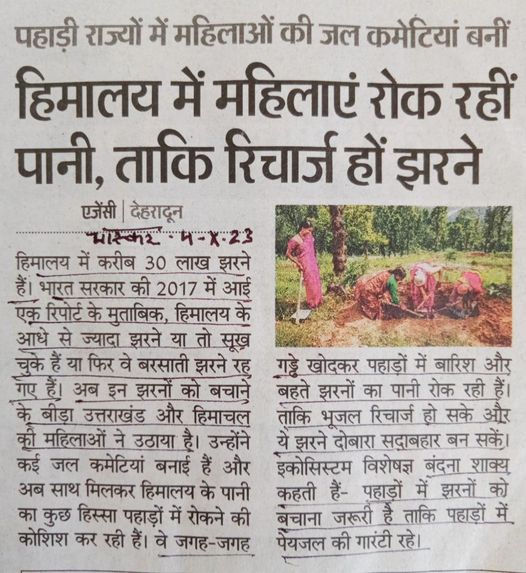
Not too many details, but welcome initiative.
GROUNDWATER
Punjab NGT directs govt to provide potable water to pollution-hit villages The NGT has directed the Punjab government to ensure safe drinking water in the villages near a private distillery at the Mansoorwal Kalan village in Ferozepur’s Zira which is lying shut after samples drawn from 29 borewells near it were found unfit for drinking and one recorded cyanide presence four times that of the permissible limit. Taking strong note of the reports of the CPCB and the CGWB, the NGT has ordered the SPCB to inspect all distilleries in Punjab for groundwater contamination and submit a report. The NGT order came on a plea filed by the Public Action Committee (PAC) on September 26. The CPCB had submitted its report before the NGT in May this year. https://indianexpress.com/article/cities/chandigarh/ngt-punjab-govt-safe-drinking-water-pollution-affected-villages-around-malbros-distillery-zira-8962770/ (01 Oct. 2023)
URBAN WATER
Bengaluru This reports says Bangalore lets 90% of rainwater drain away, only 10% of the rainwater is harvested. Many of the RWH systems do not harvest water and allow it to go to storm water drains. BWSSB collects fine for not installing RWH systems to the extent of Rs 1 Cr per month, but that do not seem to affect the fine payers. https://www.deccanherald.com/india/karnataka/bengaluru/harvesting-a-hit-but-bluru-lets-90-of-rainwater-go-waste-2709774 (03 Oct. 2023)
AGRICULTURE
Opinion Did the Green Revolution really make India self-sufficient? Glenn Davis Stone A wave of new analysis has spurred a critical rethinking of what Green Revolution-style farming really means for food supplies and self-sufficiency https://www.thehindu.com/sci-tech/science/why-indias-green-revolution-isnt-a-blueprint-to-feed-a-hungry-planet/article67392237.ece (07 Oct. 2023) GLENN DAVIS STONE
MONSOON 2023
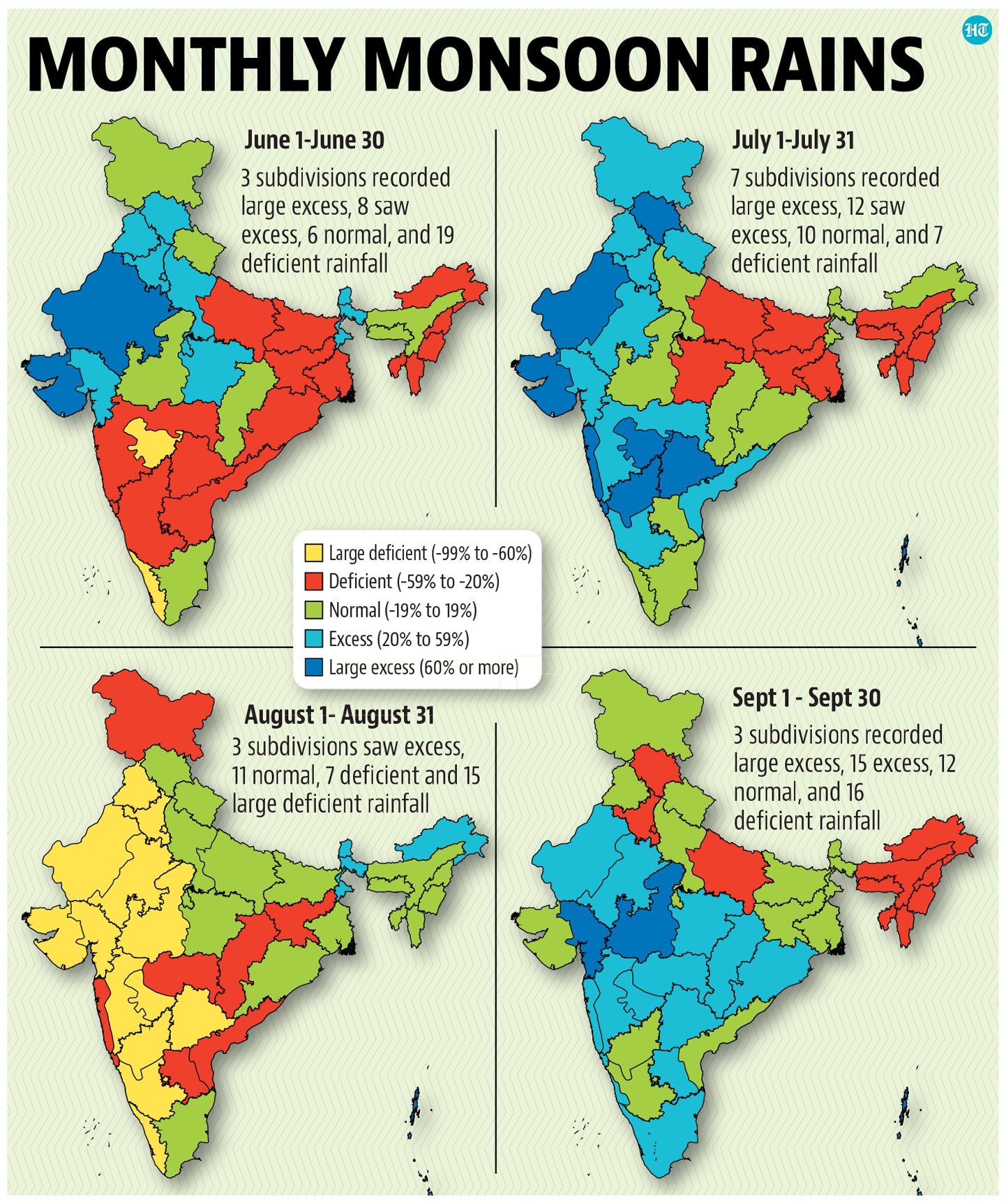
Report Month wise rainfall maps for SW Monsoon 2023 shows the wide variations in rainfall in different months. https://www.hindustantimes.com/india-news/below-normal-end-for-patchy-monsoon-imd-101696098414689.html (01 Oct. 2023)
IMD High Rainfall districts for 24 hrs ending at 0830 hrs on
Oct 8, 2023: 50-100 mm: Dhemaji (Assam) [1]
100-150 mm: E Jaintia Hills, E Khasi Hill, SW Khasi Hills (Meghalaya) [3]
Oct 7, 2023: 50-100 mm: Changlang (Arunachal Pradesh), SW Khasi Hills (Meghalaya) [2]
100-150 mm: E Khasi Hills (Meghalaya) [1]
Oct 6, 2023: 50-100 mm: Sibsagar (Assam), E Garo Hills, S Garo Hills, W Jaintia Hills (Meghalaya) [4]
100-150 mm: E Khasi Hills, SW Khasi Hills (Meghalaya) [2]
Oct 5, 2023: 50-100 mm: Papum-Pare (ArP), E Garo Hills, S Garo Hills (Meghalaya), Dakshin Dinajpur, Bardman (WB), Godda (Jharkhand), Banka, Purnia (Bihar) [8]
100-150 mm: Malda (WB), Sahebganj (Jharkhand), Bhagalpur (Bihar) [3]
Oct 4, 2023: 50-100 mm: Lakhimpur, Nalbari (Assam), E Sikkim (Sikkim), Darjeeling, E Medinipur, Howrah, Hugli, Kolkata, S 24 Parganas (WB), Jamtara, Khunti, Latehar (Jharkhand), Aurangabad, Rohtas (Bihar), Sonbhadra (E UP), Kanyakumari (TN) [16]
100-150 mm: S Sikkim (Sikkim) [1]
Oct 3, 2023: 50-100 mm: Papum-Pare (ArP), Barpeta, Dhemaji (Assam), Baleshwar, Dhenkanal, Jharusuguda, Kendujhar (Odisha), Garhwa (Jharkhand), Sonbhadra (E UP), Singrauli (E MP), Balarampur (CG), Kanyakumari (TN) [12]
Source: IMD’s daily district wise rainfall page
FLOOD 2023
SANDRP Blog Glacial Lake FLood destroys Teesta-3 Dam A Glacial Lake Outburst Flood (GLOF) that originated at South Lhonak Glacial Lake at around 00.40 hours on Oct 4, 2023, washed away the 60 m high dam of Sikkim’s biggest hydropower project, the 1200 MW Teesta 3 HEP. The flood has brought unprecedented disaster all along the river in Sikkim and further downstream in W Bengal and then Bangladesh. Central Water Commission (CWC) reported early in the morning of Oct 4 that there was cloud burst at the site of the lake burst, the cloud burst could have played the role in triggering the lake burst. https://sandrp.in/2023/10/04/glacial-lake-flood-destroys-teesta-3-dam-in-sikkim-brings-wide-spread-destruction/ (04 Oct. 2023)

Oct 2023: CWC Flood Forecast FAILS during Teesta Glacial Floods In recent past there have been many such occasions, when CWC flood monitoring and forecast has been found absent at crucial moments asking for a lot of independent review and improvement. The GLOF disaster is latest example of this where CWC has once again totally failed.
It is high time we, particularly our governments, but also civil society, media and judiciary take the flood forecasting much more seriously, note CWC’s repeated failures and the conflict of interest involved in its work. The first thing that must happen is an independent assessment of flood forecasting during this disaster, this monsoon and in general. https://sandrp.in/2023/10/09/oct-2023-cwc-flood-forecast-fails-during-teesta-glacial-floods/ (09 Oct. 2023)
A discussion on NDTV on Oct 5 2023 at 9 pm, anchored by Veera Raghav included Himanshu Thakkar of SANDRP, Karma Palior of East Mojo, Bikash Basant, Press secretary of Sikkim CM, Sikkim Tourism Minister, NDTV Correspondent Saurabh and NDRF person. https://www.ndtv.com/video/news/left-right-centre/sikkim-flash-floods-what-led-to-the-disaster-729560 (05 Oct. 2023)
But how could a dam, generating 1,200 MW of power, be washed away completely after just minutes of flash floods? Environmental activist and water expert Himanshu Thakkar explains.
“A number of reasons led to the dam getting washed away. It was known that the South Lhonak Lake was a potential source of GLOF. This has been known for decades. In such a situation, when known risk is there, there should have been at least an attempt to put an early-warning system. Now, after the disaster, the next day, NDMA says we are going to put in an early warning system. This system is not rocket science. What is the point of installing this system after a disaster?”
“So, first, they should have put an early warning system in place. Second, this dam was a rock-filled concrete dam, which is more disaster-prone than a concrete dam. Such a dam should have an adequate spillway capacity. A spillway is the most important thing for a dam to protect it in times of floods. And this dam had 7,000 cubic metres of water per second spillway capacity. It was highly inadequate considering the threat of both GLOF and high-intensity rainfall in the upstream. Third, these kinds of projects are supposed to have electrically-operated spillway gates, not the mechanical ones. This means that their electric spillway system wasn’t functioning – a major dam safety lapse,” Thakkar says.
“India is supposed to have a dam safety act and the Central Water Commission (CWC) is in charge of dam safety. The CWC has a national register of large dams which includes basic parameters of all large dams in India. This dam doesn’t even figure in this register of the CWC. It’s unknown whether it was included in the dam safety mechanism,” he adds.
According to Thakkar, the CWC itself is supposed to have a forecasting station. Twenty km upstream from Chungthang where this hydro-power project was, a CWC station’s basic purpose was to forewarn the downstream area of sudden/flash floods. This station had no reading after 10 pm on October 3 and the disaster struck a couple of hours later. Thakkar says even a 20 minute warning or heads up by the CWC station to the downstream areas would have mitigated the loss of life and property. This station wasn’t functioning when it was most required. “It speaks very poorly of the CWC, as a dam safety organisation and as a flood-forecasting organisation,” he says.
Could this have been avoided?: He proceeds to ask another important question – why was this dam allowed to be constructed with such a low spillway capacity? “Once you have such a dam in the path of a risky GLOF, you are supposed to take all these measures. None of the measures were in place. This tragedy could have been significantly averted,” Thakkar claims.
Reiterating his previous point, he goes on to say, “Suppose if a warning was issued 20 minutes before the flash floods from the CWC monitoring station, they had emptied the dam, and kept the dam spillway opened, maybe the project would have been saved. Not only that, the flood volume would have been lower, and the warning would have travelled downstream where loss of property and life would have been avoided, or at least lessened. There would have been enough time to evacuate.”
“You can have a cascading effect of being careful. India has 56 such places of potential GLOF. Early warning systems are urgently required at all these locations. We also need an independent institution for dam safety and flood forecasting. CWC not only has a poor record but is also suffering from a lot of conflicts of interests. In addition to that, the National Disaster Management Authority needs to be more proactive. Environmentally, socially, and economically, such hydro-power projects are, as it is, not desirable or viable in the Himalayan region. We must rethink about these plans in this particular region,” Thakkar sums up. https://www.news9live.com/india/sikkim-floods-can-early-warning-systems-prevent-such-disasters-2310910 (07 Oct. 2023)
“Despite being the biggest project in the state, there were no early warning systems installed even though the glacier overflowing was a known risk,” said Himanshu Thakkar of the non-governmental organization South Asian Network for Rivers, Dams and People (SANDRP).
According to a release from India’s National Disaster Management Agency Friday (Oct. 06), they plan to set up early warning systems for real-time alerts at most of India’s 56 known at-risk glacial lakes.
Thakkar said authorities failed to apply the lessons from a 2021 dam breach in Himalayan state of Uttarakhand that killed 81 people, allowing an “eerily similar” disaster to occur.
The dam’s operator, and local agencies responsible for dam safety, did not respond to requests for comment Friday (Oct. 06).
In 2021, the Indian federal government passed a dam safety law that requires operators and local governments to plan for emergencies, but the Teesta-3 dam is not listed as being monitored for safety by India’s chief dam regulator, the Central Water Commission. https://apnews.com/article/india-flood-hydroelectric-dam-sikkim-88d50fe08e8d8926a229c5fbedad9d95 (06 Oct. 2023)
Himanshu Thakkar, coordinator at the South Asia Network on Dams, Rivers and People, says that this was something that the monitoring stations should have caught. “Even after the Chamoli disaster of 2021, the government talked about an early warning system. The recommendation for the system has been there since 2013. This is typical of our government. This is major safety lapse. The CWC’s monitoring station at Lachen, 20 km upstream from Chungthang dam shows no reading after 10 pm on October 3, 2023. When it was required, there was no reading. This is the status of our forecasting,” said Thakkar. https://thewire.in/environment/sikkim-disaster-flood-warning (09 Oct. 2023)
SANDRP on Wednesday (Oct. 04) said the breach of the 60 metres high Teesta 3 hydropower project, also shows the failure of Central Water Commission (CWC)’s role under the Dam Safety Act. “The fact that South Lhonak lake is vulnerable to create Glacial Lake Outburst Flood was known and in fact an embankment has been built to protect the downstream areas. With this knowledge, it becomes even more imperative for CWC to have an early warning system along the Lachan and Lachung rivers,” it said. A compilation report by SANDRP in 2022 showed that hydropower projects act as force multipliers when disasters like cloud bursts happen close to them. In 2021, at least 11 hydropower projects (four each in Uttarakhand and Himachal, two in Jammu and Kashmir and one in Ladakh) had faced cloud burst-induced deluge and damages in lesser or greater degrees. https://www.downtoearth.org.in/news/climate-change/sikkim-chungthang-dam-breach-another-reminder-of-climate-risks-associated-with-hydropower-92118 (04 Oct. 2023)
The Expert Appraisal Committee (EAC) for River Valley and Hydroelectric Projects inspected the project site in April 2009 to observe “that a rockfill dam with inadequate spillway capacity faces the risk of overtopping, which leads to Dam Break: a catastrophic proposition.” Teesta-III reverted to the approved spillway capacity of 7000 cumec, which, as it turned out, was grossly insufficient to allow passage to the GLOF this week.
“Climate Change has once again knocked loudly on our doors. We must learn from this disaster and put a more credible dam safety governance in place. We must fix accountability for the lapses and create a credible, functioning early warning system,” said Himanshu Thakkar, coordinator of the SANDRP. https://indianexpress.com/article/india/glacial-lake-outburst-flood-red-flags-since-2005-teesta-iii-dam-may-not-survive-lake-outburst-8971782/ (07 Oct. 2023)
Sikkim Urja Limited, the company that developed and ran Teesta-III, is scrambling for damage control mode. On Saturday, it announced a financial relief package of Rs 70 crore for four GLOF-affected districts. This package, tweeted Tamang, was in addition to the relief aid provided by the state. As reported by The Indian Express on Friday, the Rs 13,965-crore project has a history of dodgy compromises. This includes an allocation of only Rs 2 crore, pointed out the CAG back in 2009, towards its mandatory disaster management plan. The GLOF warning, it is learnt, came from the ITBP between 12-40 and 1 am on October 4. While this gave time to move people away from the river in Chungthang before the waters reached the village, efforts to open the dam’s spillways apparently did not succeed.
– “A dam of this size does not involve mechanical spillways. At roughly 15 meters per second, the flood must have taken over an hour to reach the dam site from the lake and around half an hour from the flood monitoring station at Lachen. That’s enough time to operate the gates through remote control unless the spillways were damaged or stuck for some reason,” said an engineer with the Central Water Commission (CWC). Sunil Saraogi, the executive chairman of Sikkim Urja Limited, confirmed that Teesta-III’s spillways were indeed operated electronically.
– The GLOF overtopped the Teesta-V dam, obliterating the approach road and the control room for remote operation, knocking down multiple transmission towers and drowning the power station where one casualty was reported. All connecting roads to the project site and parts of the residential colony were severely damaged.
– Himanshu Thakkar, coordinator of the SANDRP, said that the Teesta-III dam was not included in the CWC’s National Register of Large Dams (NRLD). “Commissioned in 2017, it is inexplicably missing in the NRLD compiled in 2019. There is no information on the Dam Safety Mechanism of Teesta-III and the last inspection of the dam and its spillway gates,” he said. https://indianexpress.com/article/india/as-sikkim-picks-up-pieces-teesta-iii-reservoir-opening-of-its-gates-under-lens-8974047/ (09 Oct. 2023)
Experts also say the dam was not designed to withstand a GLOF-like event – evidenced by the fact that it was reportedly swept away within 10 minutes of the flood hitting. “The Teesta III project is a rock filled concrete dam, which is structurally more vulnerable to flooding compared to a concrete dam,” said Himanshu Thakkar, convener of the SANDRP. “The Teesta V dam, which is further downstream, was able to survive the deluge partly because it’s a concrete dam and sturdier.”
– “The CEA found that the company planned to reduce the dam’s spillway capacity from 7000 cumecs to 3000 cumecs. A spillway capacity of 7000 cumecs is itself a conservative figure, based on a probable maximum flood due to rainfall and not accounting for a GLOF event, even though the risk of one occurring was well known,” said Neeraj Vagholikar, member of environmental NGO Kalpavriksh who brought the CEA’s observations to the notice of the Expert Appraisal Committee on river valley and hydroelectric projects of the Environment Ministry. “The government accepted some of the design changes, but rejected the proposal to reduce the spillway capacity further.”
– Both Thakkar and Vagholikar say that the spillway capacity was too insufficient to withstand the force of the October 4 flood. “But had an EWS been in place, dam authorities would have had sufficient time to drain the water from the reservoir, which would have reduced impacts downstream,” said Thakkar. In a recent interview with the publication, Hindustan Times, Teesta Urja Limited’s CEO said the spillway gates could not be opened in time. An investigation is on to determine why the spillway gates could not be opened in time. https://india.mongabay.com/2023/10/no-early-warning-system-and-insufficient-dam-safety-turned-sikkim-flood-deadly/ (09 Oct. 2023)
Experts say the authorities failed to install early warning systems despite multiple warnings. A CWC official said on condition of anonymity: “Multiple studies, including one by the commission, had cautioned the state authorities about the GLOF hazard in the upper Teesta River region. We currently have one flood forecasting station 20 km upstream of Chungthang. More stations can be installed if the state submits a proposal.” Several occasions in the last two decades have seen government agencies and research studies warning about potential GLOFs in Sikkim.
According to the SANDRP, south Lhonak Lake is a glacial-moraine-dammed lake situated in Sikkim’s far northwestern region. It is one of the fastest-expanding lakes in the Sikkim Himalaya region and is classified as one of the 14 potentially dangerous lakes susceptible to GLOFs. https://www.telegraphindia.com/states/sikkim-disaster-cwc-report-alerted-sikkim-to-teesta-river-hydropower-projects-glacial-lake-outburst-flood-triggered-glof-peril-in-2015/cid/1971555 (06 Oct. 2023)
लेकिन नदी बांध के ऊपर लंबे समय से काम करते आ रहे पर्यावरण कार्यकर्ता और जल विशेषज्ञ हिमांशु ठक्कर का यह मानना है कि इस बाढ़ में बारिश की कोई खास भूमिका नहीं है. उन्होंने सिक्किम आपदा पर बीबीसी से बात करते हुए कहा, “जिस जगह यह हादसा हुआ है वो पाँच हज़ार मीटर से अधिक ऊँचाई पर स्थित है और वहाँ बादल फटने की संभावना बहुत कम होती है. केंद्र जल आयोग के कुछ शीर्ष अधिकारी ने भी बाद में बताया कि यह आपदा बादल फटने की वजह से नहीं आई है.”
“यह बाढ़ दक्षिण लोनाक झील के टूटने से आई है. क्योंकि यह झील काफ़ी नाज़ुक और असुरक्षित थी. इसे सूचीबद्ध किया गया था और इसके बारे में पता था कि यहाँ से ऐसी बाढ़ आ सकती है. ये ग्लेशियल लेक क़रीब तीन दशक से बढ़ रहा था. ” “इसका क्षेत्र पहले केवल 17 हेक्टेयर था जो अब उससे बढ़कर क़रीब 168 हेक्टेयर हो चुका था. लिहाजा जलवायु परिवर्तन और ग्लोबल वार्मिंग इसकी प्रमुख वजह है. अर्थात ग्लेशियर पिघल रहा था और झील का विस्तार हो रहा था.”
जल विशेषज्ञ हिमांशु ठक्कर बताते है कि सिक्किम के सुदूर उत्तर-पश्चिमी क्षेत्र में स्थित दक्षिण लोनाक झील एक हिमनद-मोराइन-बांध झील है. ये झील ग्लेशियल झील विस्फोट बाढ़ (जीएलओएफ) के लिए अतिसंवेदनशील 14 संभावित ख़तरनाक झीलों में से एक है जिसकी पहचान की गई थी. https://www.bbc.com/hindi/articles/cprx7y4nl2eo (06 Oct. 2023)
Dave Petley: A landslide into South Lhonak lake was the likely trigger for the 4 October 2023 GLOF, which killed 40 people. https://eos.org/thelandslideblog/sikkim-flood-1 (09 Oct. 2023)
The failure of Teesta III hopefully is too big to cover up and move on. There needs to be an objective probe of how this has happened. Our country cannot afford to lose national assets that are worth thousands of crores of rupees. Extreme events such as GLOF, landslides, and cloudbursts need to be urgently considered to engineer future projects, and mitigation measures need to be incorporated in existing projects. These concerns cannot be brushed aside anymore. (Anand Sankar) https://www.thequint.com/opinion/sikkim-flood-teesta-dam-breach-told-you-so-moment-hydropower-history#read-more (06 Oct. 2023)
The Chungthang Hydro-Dam breach underscores the importance of stringent safety measures and ongoing maintenance in the hydroelectric sector. It serves as a reminder of the potential risks associated with large-scale infrastructure projects and the need for robust disaster preparedness. https://www.eastmojo.com/sikkim/2023/10/04/sikkim-heres-why-the-chungthang-hydro-dam-breach-is-a-big-deal/ (04 Oct. 2023)
Kathmandu-based Ajaya Dixit, a Professor of Practice at the Kathmandu School of Law and an internationally renowned expert on water resources, argues for an overhaul in knowledge collection about the Himalayan river system — one which must take into account the very real consequences of climate change — before creating any further infrastructure for the residents of the region. https://www.hindustantimes.com/opinion/climatechange-sensitive-knowledge-gathering-for-himalayan-rivers-is-vital-101696594258845.html (06 Oct. 2023)
Sikkim’s Worst Flood: 14,000cr Dam Gone, 100+ Missing: Akash Banerjee. https://www.youtube.com/watch?v=JiVKNcxWkqo (06 Oct. 2023)
Hydropower Plant Destroyed in Teesta River Floods: Decisions in Focus https://www.youtube.com/watch?v=oORXiITsWmg (06 Oct. 2023)
Experts warned that the risk of such incidents will only rise as the planet continues to warm, stressing the need for proper monitoring systems. “We all know that in the warming world, the potential of cloudbursts, extreme rains, GLOF has gone up. Ocean warming has already increased moisture levels over the region. The low-pressure area near the region further increased the moisture, paving a conducive environment for torrential rains. Moreover, we do not have high-resolution monitoring systems that could tell us what happened, how it happened, and to what extent climate change aggravated the scenario. We know the Himalayan region is prone to cloudbursts, but we cannot identify the hotspot. Thus, a proper monitoring network is the need of the hour,” said Roxy Mathew Koll, Climate Scientist, Indian Institute of Tropical Meteorology in a statement on Friday (Oct. 06). https://www.hindustantimes.com/india-news/monsoon-extremes-retreating-glaciers-led-to-sikkim-disaster-say-experts-101696619986493.html (07 Oct. 2023)
Visuals from the spot show large portions of the dam’s wall missing as the rising Teesta water flowed through it unabated in North Sikkin’s Mangan district. https://www.ndtv.com/india-news/sikkim-flood-sikkim-flash-flood-teesta-river-dam-parts-of-teesta-river-dam-washed-away-after-cloudburst-in-sikkim-4448215 (04 Oct. 2023)
Live coverage of GLOF Disaster along Teesta in Sikkim by East Mojo. https://www.youtube.com/watch?v=jxsyLQPsRj0 (04 Oct. 2023)
Chungthang, Sikkim: A New Dam’s Potential Impact. https://pulitzercenter.org/stories/chungthang-sikkim-new-dams-potential-impact (03 Sept. 2014)
Teesta III river dam disaster: When neglect flows downstream. https://www.business-standard.com/india-news/sikkim-flash-flood-years-of-neglect-come-crashing-down-on-teesta-123100501000_1.html (05 Oct. 2023)
Despite the warning from researchers, the 1,200MW hydel project was commissioned in February 2017, which resulted in the erection of one of the biggest dams in the region. An academic said that governments were increasingly deciding to start projects on the assumption that the environment impact assessment (EIA) would be favourable towards them. https://www.telegraphindia.com/india/sikkim-flash-flood-researchers-outburst-warning-comes-true-20-years-on/cid/1971343 (06 Oct. 2023)
Sikkim’s biggest hydro power project Sikkim Urja (formerly Teesta Urja) has suffered massive damage due to the flash flood on Tuesday (Oct. 03) night as the dam and the bridge connecting the powerhouse have been washed away. https://www.hindustantimes.com/cities/others/sikkims-biggest-hydro-project-suffers-massive-damage-in-flash-flood-101696420752235.html (04 Oct. 2023)
Heavy monsoon rainfall and a GLOF that caused severe flooding downstream – that’s the cause of the human-aided natural disaster in Sikkim that washed away part of the Teesta 3 dam – damaged parts of Teesta 5, wrecked bridges and drowned roads. https://www.hindustantimes.com/india-news/vigorous-rainfall-lake-breach-behind-sikkim-tragedy-101696446315921.html (05 Oct. 2023)
Sikkim Flash Flood Happened: Explained In Graphics: https://www.ndtv.com/india-news/sikkim-flood-sikkim-floods-cloudburst-lake-burst-and-a-damaged-dam-how-sikkim-flash-flood-happened-4453285 (05 Oct. 2023)
Ecologists, however, caution against the adverse effects of dam construction — it increases the volatility of rocks in the Himalayan region. Wednesday’s (Oct. 04) disaster is a warning to take such caveats seriously and install robust safety mechanisms. https://indianexpress.com/article/opinion/editorials/sikkim-warning-hydroelectricity-push-must-be-accompanied-by-safety-measures-8970365/ (06 Oct. 2023)
There is no rainfall data available for this remote region from the IMD. Some Swiss scientists have also suggested that an earthquake yesterday may have triggered the GLOF. We are trying to assess possible triggers,” said a senior official of the Central Water Commission (CWC). “The region where GLOF occurred is extremely remote and we do not have automatic weather stations there, so it’s very difficult to tell how much it rained there,” IMD director general M Mohapatra added. https://www.hindustantimes.com/india-news/vigorous-rainfall-lake-breach-behind-sikkim-tragedy-101696446315921.html (05 Oct. 2023)
In the flood-hit Sikkim, the NHPC told the stock exchanges that its power projects, situated in Teesta Basin have been affected. NHPC’s Teesta-V power stations (510 MW) and Teesta-VI HE Project (500 MW) are the two affected projects due to floods in Sikkim. NHPC told in stock filing that it has shut down all units of its power stations.
“Power station/project of NHPC Limited (including its wholly-owned subsidiary) situated in Teesta Basin were affected due to flash flood in the region…It is also to inform you that considering the emergency, all units of the Teesta-V power station have been shut down. Detailed assessment of losses/damages suffered will be carried out after the water level recedes. The assets and loss of profit for the power station are fully insured under the Mega Insurance Policy. All assets of the Teesta-VI project are also insured under the Construction All Risk Policy,” NHPC told the stock exchange on Thursday (Oct. 05). https://www.livemint.com/news/india/sikkim-flood-updates-nhpc-shuts-all-power-stations-in-states-shares-fall-11696484818215.html (05 Oct. 2023)
The washing away of the dam of the Teesta-III project and damage to the Teesta-V dam in Sikkim because of Lhonak Lake in north-west Sikkim has again brought focus on the series of hydel projects that ‘have been built, are being built and are proposed’ on one of the most dammed rivers in the country.
Gyatso Lepcha, general secretary of Affected Citizens of Teesta (ACT), said the tall claim that the dam of Teesta Urja hydro-power project would be an engineering feat and would be amongst the strongest in the world has turned out to be a big joke jeopardising human lives and properties. “We knew that this was coming and this has finally proved true. We were warning about this for long but nobody listened,” he said. He added said the Teesta Urja dam could not withhold the water coming from the Lachen and Lachun rivers and burst. “The same can happen with other dams also,” he said, seeking a safety review of all dams in Sikkim. https://www.hindustantimes.com/india-news/concern-over-hydel-projects-in-sikkim-after-teesta-urja-dam-washed-away-101696497204094.html (05 Oct. 2023)
The Lepchas had warned everyone of this disaster. Exactly 20 years ago, in 2003, they had come together as ACT and protested against the Sikkim government’s grandiose plans to generate hydroelectricity by taming the Teesta and building a series of dams on their sacred land. The Lepchas elders had spoken of the consequences of disturbing the ecology of Khangchendzonga and the spirits that resided in its every creature and corner. Their protests were suppressed. Their warnings were ignored. The economic impact of the latest Himalayan tsunami is likely to be in billions of dollars based on the reports of the destruction of infrastructure like dams, bridges, roads, houses, vehicles, farms, and businesses. https://sandrp.in/2023/10/09/oct-2023-cwc-flood-forecast-fails-during-teesta-glacial-floods/ (08 Oct. 2023)
Parliament was told on March 29 Sikkim has 694 glacial lakes and eight flood forecasting stations; three for water levels and five for inflows. The report – “Glacier Management in the Country: Monitoring of Glaciers/Lakes, Including Glacial Lake Outbursts Leading to Flashfloods, in the Himalayan Region” – warned Parliament the Himalayan-Karakoram region is warming at a faster rate (by 0.5 degrees C) than the global mean. Parliament was therefore warned that this would lead to glaciers melting far quicker than normal. https://www.ndtv.com/india-news/sikkim-flash-floods-on-sikkim-flash-floods-parliamentary-committees-severe-shortage-warning-4457006 (06 Oct. 2023)
The Times of India Edit on Oct 6 2023 on Sikkim Disaster. https://timesofindia.indiatimes.com/blogs/new-in-toi/sos-from-mountains-loss-of-life-and-infra-in-sikkim-flash-floods-is-another-reminder-of-project-risks-in-himalayas/ (06 Oct. 2023)
To protect lives and livelihoods in this sensitive area, addressing this hazard requires a comprehensive strategy that includes monitoring, early warning systems, infrastructure development, and climate change mitigation. It is essential for efficient disaster management in the Himalayas to understand the continuous dangers of GLOFs. (Anjal Prakash) https://www.thequint.com/opinion/sikkim-glacial-lake-outburst-floods-disaster-early-warning-triggers (06 Oct. 2023)
Concerns raised over the construction of roads, large buildings and huge projects like dams are ignored or dubbed anti-national. Such warnings had been issued at the time of construction of the Urja dam. The Sikkim disaster is yet another reminder of the need to treat nature as part of all development plans anywhere. https://www.deccanherald.com/opinion/editorial/why-were-alerts-on-lhonak-lake-ignored-2716321 (07 Oct. 2023)
The authorities in Sikkim have started evacuating residents from the banks of Shako Cho lake near Lachen in Mangan district in Sikkim. The lake is on the verge of bursting, prompting the authorities to issue an alert. The Shako Cho glacial lake is above the village of Thangu. The is 1.3-km-long and the village is only 12 km away.
– Gangtok district magistrate Tushare Nikhare said satellite data showed abnormal increase in glacial temperature over Sako Chu. It won’t be an issue if the temperature stabilises, the officer said, adding they will check the condition of the area at 7.30 am (6 Oct 2023) again. “As a precautionary measure, however, an evacuation advisory is in place. Since silt has been deposited, any sudden discharge of water will be at an elevated level over deposited debris and can cause damage,” Mr Nikhare. https://www.ndtv.com/india-news/residents-near-sikkim-shako-cho-glacial-lake-evacuated-after-likely-breach-warning-4454428 (06 Oct. 2023)
New civil societies should be formed in the fields of research and development to forecast uncertainty in the future and develop tools to tackle it. https://www.eastmojo.com/sikkim/2023/10/06/sikkim-floods-reiterate-need-for-a-robust-civil-society/ (06 Oct. 2023)
In an unfortunate incident, two people died while five others were injured in West Bengal’s Jalpaiguri district as a mortar shell reportedly carried by the floodwaters of Teesta river exploded, police said on Friday (Oct. 06). It has been reported that the explosion took place at Champadanga village in Kranti block on Thursday (Oct. 05) evening when one person took the mortar shell home to sell it as scrap metal and tried to break it open. https://www.outlookindia.com/national/west-bengal-boy-killed-5-injured-as-mortar-shell-carried-by-floodwaters-explodes-news-322810 (06 Oct. 2023)
A huge cache of ammunition, reportedly belonging to the Army, exploded in Rangpo on the bank of River Teesta, resulting in a loud blast and thick cloud of smoke. A report in India Today quoted Army sources as saying that the ammunition was swept away by the river in the flash floods. However, there were no injuries. https://www.news18.com/india/sikkim-flash-floods-2023-watch-video-army-ammunition-blast-river-teesta-8606568.html (07 Oct. 2023)
It was only when a camp of the ITBP, located close to the South Lhonak lake at Janak, called officials at Chungthang around 11 pm on 3 October that the alarm was sounded. ITBP reported that the water in the Lachen river had risen drastically. SSDMA raised an alarm immediately, a senior official said, and sirens and hooters started blowing. Many people thought it was a drill. It wasn’t. It was a disaster foretold now unfolding. https://theprint.in/opinion/what-turned-teesta-into-a-killer-heres-proof-sikkim-flash-floods-are-a-man-made-disaster/1792214/ (06 Oct. 2023)
Glaciology and hydrology expert, IIT Indore associate professor Mohd Farooq Azam tells TOI that uncertain weather-events driven by climate change played a role in Sikkim, that existing and proposed hydel projects must be reviewed for risk exposure to natural hazards, and any new project in the Himalayas should be allowed only after assessing its impact on local geology and communities. https://timesofindia.indiatimes.com/india/sikkim-tells-us-to-be-very-careful-before-allowing-any-new-hydropower-project-in-the-himalayas/articleshow/104223784.cms (07 Oct. 2023)
There should also be a serious rethinking of the developmental models for the Himalayan states in the context of climate change and the earthquake potential, while also bringing the major stakeholders – the people – on board for their feedback. (C.P. Rajendran) https://science.thewire.in/environment/sikkim-flood-another-warning-greater-disaster-risk-himalayan-states/ (07 Oct. 2023)
The entire Himalyan Range doesn’t have Early Warning System: Sikkim MP. https://www.eastmojo.com/sikkim/2023/10/08/the-entire-himalyan-range-doesnt-have-early-warning-system-sikkim-mp/ (08 Oct. 2023)
This reports highlights how the Affected Citizens of Teesta has been raising question marks over the Teesta 3 and other dams in Sikkim since 17 years. https://scroll.in/article/1057269/ticking-time-bombs-sikkim-floods-a-reminder-of-why-locals-opposed-dams-in-the-himalayas-for-years (09 Oct. 2023)
Kerala Documentary on 2018 floods For a state that revels in its monsoon bounty, its 44 rivers crisscrossing the verdant vistas between the sea and the mountains, the events of August 15 in 2018 came like a bolt of lightning: the way Malayalis looked at rain changed that night. What the India Meteorological Department classified as “large excess” rainfall, triggered unprecedented dam openings and river breaches, claiming hundreds of lives and throwing millions of others into jeopardy. But what followed was a glorious saga of survival, where people literally waded to safer shores on the back of exceptional camaraderie.
The movie has heartrending moments of people losing lives and hopes in the flood fury. However, 2018 cannot be considered an authentic reflection of what transpired in Kerala in the month of August 2018 when the state received 821 mm of rainfall as against 419.3 mm in normal course. The tragedy still raises pertinent questions about dam management and early warning systems but what shows up primarily is the way the state machinery rose to the challenge when flash floods struck. The remarkable way in which the people’s representatives, transcending party affiliations, coordinated relief and rescue remains a lesson in democracy which the movie fails to highlight. https://thewire.in/film/how-a-deluge-in-kerala-in-2018-brought-out-humanity-and-resilience-among-its-people (01 Oct. 2023)
SSP Floods Women farmers narrate the losses they have suffered due to Sardar Sarovar brought disaster in Gujarat and demand full compensation from the govt. https://www.youtube.com/watch?v=8YzAY65fxf0 (04 Oct. 2023)
Punjab The impact of Sutlej Beas floods is still being felt in villages in Sultanpur Lodhi in Kapurthala district. https://www.tribuneindia.com/news/punjab/monsoon-fury-18k-acres-affected-zero-paddy-produce-expected-in-15-sultanpur-lodhi-villages-549502 (02 Oct. 2023)
HFL BREACH
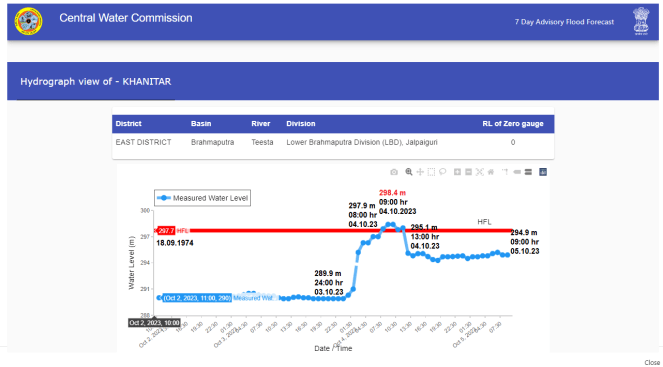
Sikkim Teesta river at Khanitar site in East district has crossed its Highest Flood Level (HFL) 297.7 meter dated 18.09.1974 and the river has also breached undated HFL 225.25 meter at Melli site in South District.

URBAN FLOODS
Nagpur Flood-hit residents demand Rs 5 lakh aid per family The letter underscores the urgent need to hold government officials accountable for negligence that resulted in the water-logging and overflow of Ambazari Lake, while also urging for increased compensation for the affected families. The residents also urged the State Government to order a judicial enquiry by a committee of three sitting High Court Judges for fact finding and fixing responsibility on government officials who have failed in their duties to protect, preserve, rejuvenate Ambazari Lake, Dam and Nag River even after getting a sanction of Rs 2,117 crore from the Central Government.
The residents’ grievances stem from the overflow of Ambazari Lake, which inundated a large part of Nagpur city. Despite the Central Government sanctioning a substantial budget of Rs 2,117 crore for the protection, preservation, and rejuvenation of Ambazari Lake, Dam, and Nag River, the disaster occurred, raising concerns about the utilization of these funds and the efficiency of the officials responsible. Illegal construction of a concrete wall of eight feet in height and hundred feet in length by Maha Metro on the Nag River within 100 metres from Ambazari Dam which is a no construction zone.
The citizens also raised the issue of illegal construction of Vivekanand Memorial within 50 metres of Ambazari overflow point by Nagpur Municipal Corporation (NMC) which is also a no construction zone, resulting in big obstacles to smooth water flow from Ambazari overflow point. The affected citizens also raised the demand to conduct immediate structural audit of Ambazari Lake and Nag River to check the condition of the water bodies and also to mitigate future such incidences during monsoon. They also urged to shift the Vivekanand Memorial from the overflow point for smooth flowing of water of the lake. https://www.nagpurtoday.in/nagpur-flood-hit-residents-send-letter-to-cm-dycm-demand-rs-5-lakh-aid-per-family/10061111 (06 Oct. 2023)
Guwahati Heavy downpour has caused severe waterlogging in the northeastern city, which has an intricate network of rivers and beels (wetlands) that form its natural drainage system. But encroachment on water bodies has increased the incidence of urban flooding. https://www.gaonconnection.com/lead-stories/assam-floods-guwahati-rainfall-encroachment-lakes-urban-planning-wetlands-drainage-system-52772 (07 Oct. 2023)
DISASTERS
Himachal Pradesh Floods expose need for climate adaptation-Environmentalist Sandeep Minhas told DW the devastation witnessed in Himachal was a “manmade disaster.” “A lot of factors contributed to the floods. The dams, the mega-projects, the vertical hill cuttings, illegal mining, the building of houses on riverbeds all contributed to the extensive damage seen,” Minhas said.
-Manshi Asher, of the Himdhara environment research and action collective, said that local authorities should have been prepared for the heavy flooding following the extreme rainfall. “It would be wrong to say that it was a sudden, unpredictable one-time event that has caught the system off-guard,” she told DW. https://www.dw.com/en/india-himachal-floods-expose-need-for-climate-adaptation/a-66996966 (04 Oct. 2023)
पिछले कुछ वर्षों में हिमालय क्षेत्र में बारिश, बाढ़, भूस्खलन आदि के कारण बड़े पैमाने पर विनाश हुआ है। लेकिन क्या इन सभी समस्याओं के लिए जलवायु परिवर्तन को जिम्मेदार ठहराना सही होगा? या क्या इसका संबंध शहरों की योजना बनाने के तरीके से है, जिसमें वहां रहने वाले लोगों को ध्यान में रखे बिना, केवल बेलगाम विकास पर ध्यान केंद्रित किया गया है। सिटी सेंस के इस एपिसोड में, टिकेंद्र सिंह पंवार ने सेवानिवृत्त आईएएस अधिकारी रमेश नेगी से इस सब के बारे में बात की। https://www.youtube.com/watch?v=zju54NHPkyI (08 oct. 2023)
The Gephang Gath lake in Himachal Pradesh is a disaster waiting to happen, glaciologists warned earlier this year. The lake is at high risk of breaking its banks and causing a flashflood because of its increasing size, local topography and melting permafrost, they warned in a scientific journal, a situation similar to the glacial lake outburst flood downstream of the Lhonak lake in Sikkim. https://www.hindustantimes.com/india-news/in-himachal-experts-warn-of-sikkim-like-lake-breach-101696705452326.html (08 Oct. 2023)
The GLOF that led to disaster in Sikkim may just be an indication of the danger such an event poses to the lives of three million Indians living in vulnerable areas of the six Himalayan states/UTs – J&K, Ladakh, Himachal Pradesh, Sikkim, Assam and Arunachal Pradesh. https://timesofindia.indiatimes.com/india/3-million-indians-at-risk-of-sikkim-like-disaster-international-study/articleshow/104199297.cms (06 Oct. 2023)
LANDSLIDES
Sikkim The stretch of National Highway 10, a key road connecting Sikkim and the rest of the country via West Bengal’s Siliguri, which was closed for over 24 hours due to a cave-in following a landslide, is likely to be opened by Tuesday as repairing work is on full swing, an official said. A large portion of the highway near Sethi Jhora, around 30 km from Siliguri which is a major commercial hub in the northern part of West Bengal, was washed away following heavy rain for the past several days. https://www.deccanherald.com/india/sikkim/nh-10-cave-in-road-repair-on-likely-to-be-opened-by-tuesday-2699918 (25 Sept. 2023)
Heavy rain was witnessed in Lachen, Lachung and Chungthang on Friday (May 19) and as a result of this, approximately 500 tourists, who were travelling to Lachung and Lachen Valley, were stranded at Chungthang due to landslides and roadblocks en route, a defence official said. https://economictimes.indiatimes.com/news/india/indian-army-rescues-500-stranded-tourists-from-landslide-hit-sikkim/articleshow/100371000.cms (20 May 2023)
The 65 kilometre stretch of the NH runs parallel to Teesta River, a mountainous river that originates in North Sikkim and flows through Bengal to join the Bay of Bengal in Bangladesh. “What we feared long ago came true. The Teesta Low Dam Projects III and IV at Rambi and Kalijhora generating 132 MW and 160 MW hydropower from the river respectively have caused erosion along a large section of the NH10,” said former wing commander Praful Rao, president of Save The Hills, an NGO working on erosions and landslides in the hills of Darjeeling, and Sikkim.
He further added that hydroelectric projects in the Himalayan region have always been risky and their viability questionable due to their adverse impact on the local ecology. “Another big factor for the landscape in the region is the water accumulated to run the turbines that has led to seepage of water into the highway,” Rao said. “The broadening of the highway without properly managing the rainwater and without putting in place the drainage system is another reason landslides hit the road regularly,” Rao said. https://www.firstpost.com/india/as-nh10-hit-by-repeated-landslides-environmentalists-voice-concern-and-experts-warn-of-security-threat-10364461.html (11 Feb. 2023)
NH10 is a precarious hilly road, particularly between Sevoke and Teesta Bazaar (a stretch of 32km). The highway has a number of landslide-prone zones and often gets blocked as debris come down the hillside during the monsoon. The road witnesses several accidents every year and in many cases, vehicles go off and plunge into the Teesta which flows parallel to the highway.
The central government has decided to revamp NH10, the principal highway that connects Sikkim with the rest of India, with slope restoration and landslide mitigation under the National Infrastructure Pipeline (NIP). The highway connects Sevoke — around 20km from Siliguri — in Bengal with Sikkim capital Gangtok via Rangpo, the town on the border of the two states. The road also connects Kalimpong with Siliguri. https://www.telegraphindia.com/west-bengal/centre-decides-to-revamp-nh10-with-stress-on-safety/cid/1818731 (14 June 2021)
Uttarakhand Nainital: Hillside survey planned after landslide Authorities are planning a technical survey of the hillside in Nainital where 24 families have been relocated to safer locations in the aftermath of the landslide and house collapse late last month. Preliminary inspection carried out by the district geologist revealed that the landslide was caused due to seepage of rain and sewerage water, Pramod Kumar, sub-divisional magistrate (SDM) Nainital, said.
The recent landslide followed by the house collapse put a spotlight on how Nainital has been showing signs of geological disturbances. Earlier this year, Nainital’s famous tourist site Tiffin Top was closed to tourists after it developed cracks. Similarly, the famous Band Stand on Nainital Lake was shut down after it started caving in towards the lake.
In a separate instance, last year, a landslide on one of the slopes around the lake in the “Saat Number “ area was another sign of trouble in the terrain. In 2021 other side of the lake area, known as the “Thandi Sadak”, witnessed a major landslide, with big boulders falling into the lake waters. The same year with parts of Nainital district receiving the highest-ever rainfall in the last 124 years, water from Naini Lake overflowed and excess discharge from the lake was drained into Baliyanala downstream, triggering landslides in the area.
In 2018, around 25-metre stretch of the famous Mall Road caved into the lake waters. The landslides in the Baliyanala site in Nainital and the geological rumblings in and around the Nainital lake have put a spotlight on the fact that geological disturbances are being witnessed in the hill station which houses over 48000 people living in over 7000 structures on its slopes.
Overall, Nainital is among the most landslide-prone areas in the state. In 1880, 151 people were killed in a major landslide in Nainital’s Sher Ka Danda area. The Baliyanala area in Nainital has witnessed frequent landslides for the last 20 years. But from 2018, this small hill station and the areas around it are again witnessing landslides and cracks on the roads with experts terming them as warning signs of geological disturbance in the terrain around the lake area. https://www.hindustantimes.com/cities/dehradun-news/fragile-nainital-hillside-survey-planned-after-landslide-house-collapse-101696252991973.html (02 Oct. 2023)
Himachal Pradesh 201 villages facing subsidence, finds study 201 villages across the state are experiencing land subsidence. Land subsidence refers to gradual settling or sudden sinking of the ground owing to subsurface movement of earth materials. Solan has the maximum, 51, villages where the land has reportedly sunk. It is followed by Mandi, which was the epicenter of the natural disasters in July and August, with 46 such villages and Chamba with 41. https://www.hindustantimes.com/cities/chandigarh-news/sinking-reality-201-himachal-villages-facing-subsidence-finds-study-101696596695982.html (06 Oct. 2023)
Report The Cooperative Open Online Landslide Repository (COOLR) project provides an open platform where scientists and citizen scientists around the world can share landslide reports to guide awareness of landslide hazards for improving scientific modeling and emergency response. Scientists and citizen scientists can submit landslides to the Landslide Reporter web application, or submit landslide inventories directly to us. All the data submitted is made available on the data portal Landslide Viewer, which shows referenced and imported landslide inventories from all over the world. https://gpm.nasa.gov/landslides/about.html
DROUGHT
Jharkhand With 37% deficit in rainfall, threats of drought loom large over Jharkhand second year in a row. https://themorningcontext.com/chaos/jharkhands-forest-communities-crumble-under-climate-change-and-government-apathy (06 Oct. 2023)
ENVIRONMENT GOVERNANCE
Report Govt approves oil extraction technique 500 m outside forests On Sept 12, the MOEF&CC issued a letter to all states saying that Extended Reach Drilling (ERD)– a form of oil and gas extraction – would be exempt from the forest clearance process, and that detailed regional guidelines for the extraction process would be issued by the WII. The Directorate General of Hydrocarbons (DGH), an arm under the Ministry of Petroleum and Natural Gas, has pushed for ERD to be exempt from the forest clearance process since 2020, arguing that the technology makes it possible to access reserves without entering forests or disturbing forest land.
So far, no studies evaluating the impacts of ERD on forests have been conducted in India. According to the WII, it will take three years to collect data, prepare a report and make recommendations on the use of this technology within forest areas. The environment ministry – the final authority on making changes to forest clearance regulation – granted the exemption, nonetheless, basing its decision on a report by the DGH that has not yet been made public. The ministry had granted “in principle” approval for ERD last year, paving the way for formal exemption.
Much of India’s crude oil reserves lie in forest rich states, like Assam and Arunachal Pradesh. In 2020, an OIL oil well in the Upper Assam region of Baghjan experienced a major blowout due to an uncontrolled release of gas. The fire from the blowout, which occurred less than a kilometer from the Dibru Saikhowa National Park (DSNP) and 500 meters from the Maguri-Motapung Beel wetland, burned for nearly five months. The ERD sites proposed by OIL India are close to where the Baghjan blowout occurred, according to a report by the state’s Chief Wildlife Warden. https://india.mongabay.com/2023/09/with-no-primary-data-on-impacts-government-approves-an-oil-extraction-technique-500-m-outside-forests/ (29 Sept. 2023)
Odisha Activists lambast Govt’s controversial land acquisition bill The Right to Fair Compensation and Transparency in Land Acquisition, Rehabilitation and Resettlement (Odisha Amendment) Bill (RFCTLAR&R), 2023, passed on September 27, empowers the government to exempt ‘strategic and development projects’ from social impact assessment (SIA) and special provisions to ensure food security – which were hitherto considered mandatory.
The new Bill will enable the state government to issue notifications exempting projects vital to national security or defence and infrastructure development from SIA and food security provisions. Projects like affordable housing, industrial corridors set up by the state government, infrastructure projects, including highways and railways, and industrial projects involving displacement of 100 families or less or acquisition of private land of 500 acres or less will be exempted from conducting mandatory SIA. According to the Bill, the RFCTLAR&R Act, 2013, a central law which makes SIA mandatory, “causes a delay in acquisition of land.” https://thewire.in/government/activists-lambast-odisha-governments-controversial-land-acquisition-bill (06 Oct. 2023)
Study 22% of green areas in India invaded by invasive species Invasive plant species have invaded 22% of the natural habitats and have the potential to reach up to 66% of green areas in India, a new study released on Thursday (Oct. 05) said, basing its findings on the study of 3,58,000 square km of tiger habitats across 20 Indian states. Biological invasions threaten biodiversity and human well-being, with developing tropical countries such as India being more vulnerable, according to the study done by two Wildlife Institute scientists Ninad Avinash Mungi and Omar Qureshi and the institute’s former dean Y V Jhala.
The five-year-long study published in the peer-reviewed Journal of Applied Ecology on Thursday studied 1.58 lakh plots covering 358,550 sq kilometre and focussed on spotting the 11 most prevalent invasive species in the country. The sampling covered 31% of savannas, 51% of dry deciduous forests, 40% of moist deciduous forests, 29% of semi-evergreen forests, 44% of evergreen forests and 33% of moist grassland savannas. https://www.hindustantimes.com/india-news/22-of-green-areas-in-india-invaded-by-invasive-species-study-101696515324867.html (05 Oct. 2023)
Tree-planting schemes threaten tropical biodiversity Amid a boom in the planting of single-species plantations to capture carbon, scientists have urged governments to prioritise the conservation and restoration of native forests over commercial monocultures, and cautioned that planting swathes of non-native trees in tropical regions threatens important flora and fauna for a negligible climate impact.
Writing in the journal Trends in Ecology & Evolution, ecologists said the increasing popularity of commercial pine, eucalyptus and teak plantations in the tropics for carbon offsetting is having unintended consequences, such as drying out native ecosystems, acidifying soils, crowding out native plants and turbocharging wildfires. https://www.theguardian.com/environment/2023/oct/03/carbon-tree-planting-schemes-threaten-tropical-biodiversity-aoe (03 Oct. 2023)
SOUTH ASIA
Book Review Empires of the Indus- The Story of a River Alice Albinia explores the regions around the Indus from its end point in the Arabian sea near Karachi to its source high in the Tibetan plateau.

She criss-crosses across countries, sometimes on foot, at times through illegal border crossings, trekking with outlanders exploring the diversity and culture of the region through which the Indus passes. Travelling across Afghanistan, Pakistan, India and Tibet through which the tributaries flow she finds a river ravaged by the land, its rulers and passing of time. https://urbangrouse.com/empires-of-the-indus-a-story-of-a-river-alice-albinia/ (05 Aug. 2023)
CHINA
Landslides triggered by Sept 2022 Earthquake Dave Petley Debris flows that remobilise material released by coseismic landslides are a major problem in an area such as this. These extend the impacts of the earthquake for years after the mainshock, with substantial impacts for the local population. https://eos.org/thelandslideblog/luding-earthquake-1 (03 Oct. 2023)
ASIA
The Vaiont (Vajont) landslide of 1963 Dave Petley: -The Vajont reservoir disaster is a classic example of the consequences of the failure of engineers and geologists to understand the nature of the problem that they were trying to deal with. During the filling of the reservoir a block of approximately 270 million cubic metres detached from one wall and slid into the lake at velocities of up to 30 m/sec (approx. 110 km/h). As a result a wave over topped the dam by 250 m and swept onto the valley below, with the loss of about 2500 lives. Remarkably the dam remained unbroken by the flood. https://blogs.agu.org/landslideblog/2008/12/11/the-vaiont-vajont-landslide-of-1963/ (11 Dec. 2008)
THE REST OF THE WORLD
Study How much microplastic is emitted into atmosphere by sea spray A new study quantifies the amount of microplastic exported into the atmosphere from sea spray. When bubbles burst on the surface of the sea, small particles, such as salt or bits of organic matter, can be flung into the air. This process moves significant amounts of matter, enough to affect global climate dynamics by influencing the radiative balance of the atmosphere and serving as cloud condensation nuclei. But can sea spray also toss microplastics, which are now ubiquitous in the ocean, into the atmosphere? https://phys.org/news/2023-10-quantifies-microplastic-emitted-atmosphere-sea.html (04 Oct. 2023)
SANDRP
Also see: DRP 02 Oct. 2023 & DRP 24 Sept. 2023
Follow us on: www.facebook.com/sandrp.in; https://twitter.com/Indian_Rivers

 SANDRP