Wetlands

Wetlands 2020: Positive Developments

Pondicherry Collector led the revival of over 300 waterbodies The then District Collector and present Secretary to the Chief Minister, A. Vikranth Raja, stepped in with the idea of digging into revenue records to locate the region’s traditional water bodies.  It all started with a query raised at the meeting. When someone asked if Karaikal had the capacity to store 7 tmcft of river water allotted by the Cauvery Water Disputes Tribunal, “the response from officials was an emphatic no,” says Selvaganesh, Assistant, District Collectorate of Karaikal.

In June 2019, in the tiny coastal enclave of Karaikal, administration officers brainstormed about putting in place a sustainable water resource management model for the town’s two lakh people. They found 549 ponds within a small territory spread over 157 sq. km. 40% of these water bodies were in various stages of extinction. Most of them turned out to be dumping yards.

Continue reading “Wetlands 2020: Positive Developments”
Wetlands

Maharashtra Wetlands Overview 2020

[The feature photo of Flamingos at NRI colony in Navi Mumbai above is by Vidyasagar Hariharan, from The Guardian Dated March 26, 2019.]

In 2020, Maharashtra has seen some interesting developments around wetlands, driven by initiatives by activists like D Stalin among many others, and at times supported by judiciary. After an example of some individuals’ courage to save an 80 ha of wetland, we look at state level wetlands issue, followed by some interesting developments around some specific wetlands like Dhamapur Lake (Sindhudurg dist) and Lonar (Buldana dist). Maharashtra govt claimed in High Court that in three districts of Nandurbar, Nagpur and Parbhani, there are no wetlands at all. The flip flops here is tragic as the ISRO report had shown over 2000 wetlands in these districts. Next is the Mumbai wetlands, Uran wetlands, Panje wetland and two other wetlands where CIDCO has been pushing real estate projects. The overview ends with some Supreme Court petitions. There is lot of action, but no very optimistic trends in spite of some individual actions and positive developments at some individual wetlands.

Continue reading “Maharashtra Wetlands Overview 2020”
DRP News Bulletin

DRP NB 4 Jan 2021: Bangladesh declares Halda River as Fisheries Heritage

Bangladesh has declared the whole 81 km long Halda River, a tributary of Karnaphuli River in Chittagong in South East Bangladesh. The Halda river is also famous for breeding pure Indian carp. This is the only pure Indian carp breeding field of Bangladesh, perhaps in South Asia. This is a remarkable river conservation decision that has a lot of lessons for much bigger India where no river has been protected as fisheries heritage. This is great way to begin the first weekly DRP Bulletin of 2021 and we hope the Indian government, civil society and judiciary will take due note of this.

Controversy is never far away from any such river conservation efforts as is evident from the news about proposal for a Halda River based water supply project for industrial estate that has been opposed by the Fisheries ministry, water resources ministry, the River Conservation Commission, the Department of Environment and independent researchers.

Continue reading “DRP NB 4 Jan 2021: Bangladesh declares Halda River as Fisheries Heritage”
Fish, Fisheries, Fisherfolk

Inland Fish, Fisheries, Fisher-folks: 2020 Overview

Inland fisheries support millions of people and remains a major source of nutrition for a very large number of poorest people. This includes riverine fisheries, reservoir fisheries, wetland and local water body fisheries. Here we try to provide an overview of developments in this sector during the year 2020.

The overview has following sections: Policy & Governance in Centre, followed by in States, some positive developments, Covid-19 & Fishing Community, Fisher folks’ struggles, New Fish Species, Invasive fish, Fish Deaths & Pollution, Over fishing & Extinction, Studies related to inland fisheries.

Continue reading “Inland Fish, Fisheries, Fisher-folks: 2020 Overview”
Rainfall

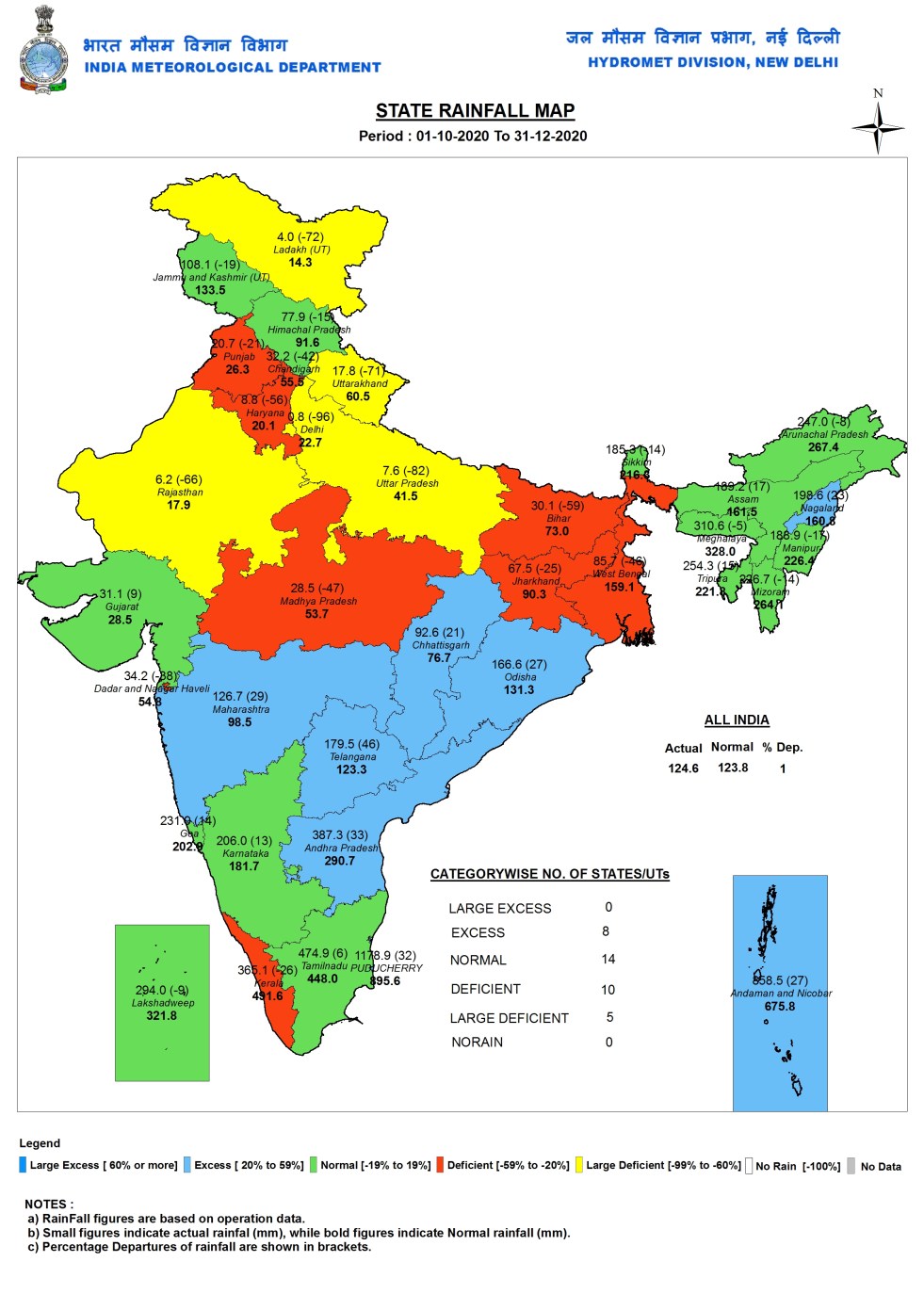
Post Monsoon 2020: State wise Rainfall

According to India Meteorological Department (IMD), during the just concluded Post Monsoon Rainfall for 2020, that included rainfall during Oct-Dec months, India received 124.6 mm rainfall, 0.64% above the normal rainfall of 123.8 mm during the period. As per IMD[i] definition, the rainfall was thus normal.

This three-month period from Oct 1, to Dec 31 includes the North East Monsoon that mainly affects parts of South India including Tamil Nadu, Puducherry, Rayalseema, parts of Karnataka and Kerala. IMD declared on Jan 1, 2021 that the of NE Monsoon ended on Dec 31, 2020 with normal overall rainfall: TN had 6% above normal, Karnatak 13% above normal, Puducherry 32% above normal, Andhra Pradesh 33% above normal. However, Lakshadweep had 9% below normal and Kerala 26% below normal. This monsoon provides 48% of the annual rainfall of TN so it is most imp for that state.

The rainfall revived only towards the end of November, mainly due to two consecutive cyclones — Nivar and Burevi — both of which developed in the Bay of Bengal. While Cyclone Nivar crossed the coast close to Karaikal near Puducherry and brought heavy showers for the east and coastal districts of Tamil Nadu, Cyclone Burevi weakened before it reached land.

Continue reading “Post Monsoon 2020: State wise Rainfall”