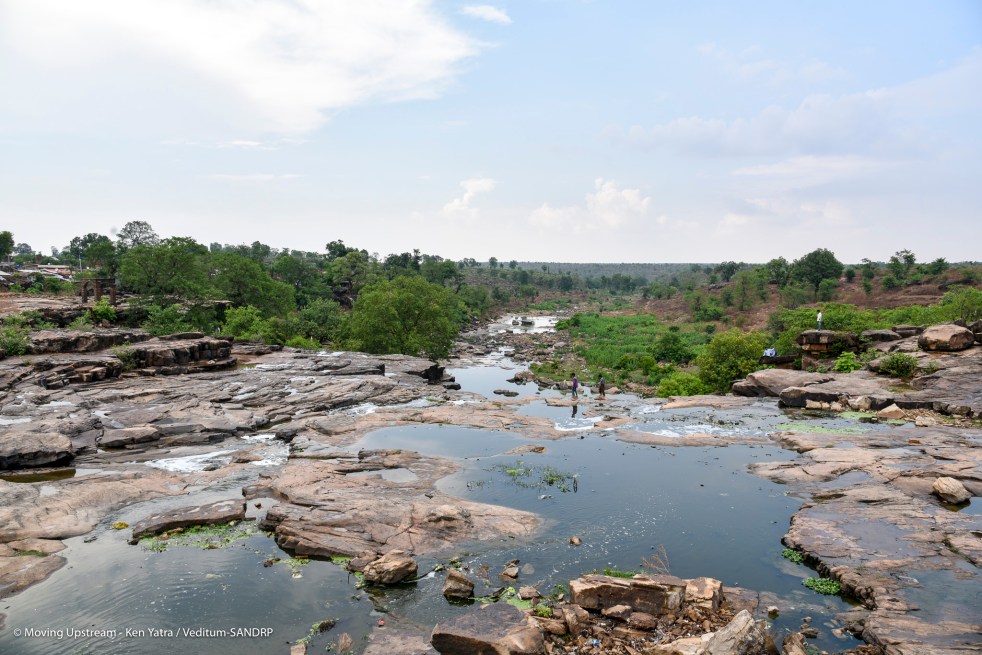
Small rivers make big rivers. The health of big rivers depends on them. While big rivers are discussed, small rivers are normally absent in public discourse. They often lack govt or society’s attention.
Smaller rivers, typically tributaries of bigger rivers, are essential part of river eco-system. They hold the key to rejuvenation of big rivers. These small rivers are under multiple threats. They are slowly succumbing to damming, growing pollution, encroachments, mining and water extraction threats among others.
Kilkila is one such small river, with a fascinating story of its own.
It feeds the Ken river in Panna district in Madhya Pradesh. Ken joins the Yamuna. Hence Kilkila is part of Ganga basin. But its story is interesting and long. It plays significant role in cultural and religious history of Panna.
About Kilkila River Kilkila river starts in Chhapar forest range of Take hills in Panna district, Madhya Pradesh. The length of Kilkila is 45 km. It flows through Panna city and buffer zone of Panna Tiger Reserve. About 2 km, upstream of Bariyarpur barrage, Kilkila joins Ken from right bank. Rather unusually, in lower part the river is known as Mohar Nadi.
In informal Hindi Kilkila translates as sweetly noisy. It is also Hindi name for Kingfisher bird.
However, in olden time the river was known as Kudhani Nadi. It was believed to be a crushed river. Later on it became pure and considered Ganga of Pranami sect.
About Pranami Sampradaya Pranami sect was founded by Shri Devchandra Ji Maharaj (1581–1655). He was born in Sindh province in Umarkot village in Pakistan. He formed a new stream of religion called Nijanand Sampradaya. He settled down in Jamnagar to explain Vedas and Vedantic knowledge in simple language. He was respected and followed by both Hindu and Muslims. His followers later were known as Sundarsaths or Pranami.
Saint Prannathji also known as Mehraj Thakur (1618–1694) was the dearest disciple of saint Devchandra Ji Maharaj. He was son of Keshav Thakur, Diwan of Jamnagar State. He traveled throughout the Indian subcontinent and the Arabian region to spread the teachings of his Guru.
Nijanand Sampradaya believes in the Supreme Truth God “Raj Ji”. The Muslim followers consider Prannath as the “Last Imam Mehndi” and Hindu followers as “Budh Nishkalank Kalki Avatar”. Mahatma Gandhi’s mother, Putlibai, belonged to Pranami sect. Gandhi in his book My Experiments with Truth mentions about this sect – “Pranami is a sect deriving the best of both the Quran and Gita, in search of one goal – God.”
Maharaja Chhatrasal (1649–1731) of Bundelkhand, was a fervent pupil of Saint Prannath and a follower of Pranami sect. The first meeting of both took place on the Amrai Ghat bank of Kilkila river in 1683 in erstwhile Mau province.
When a cursed river is transformed to Ganga At that time, Kilkila was believed to be a cursed river. As per legendary tale the water of river was so toxic that birds flying over it used to die. The river was known as Kudhani or Kodhin means Leprosy. Villagers supposed that if they bath in the river, they would suffer from the disease. Another strange belief about the poisonous quality of Kilkila water persisted then. As per this, if the horse would drink the river water the rider would die and vice a versa.
In 1683, while visiting Bundelkhand, the saint wished to take a bath in Kilkila. The Gond tribe made him aware of the issue and requested the saint not to enter in the river. But with the touch of Prannath toe the water colour changed and the river became pious forever. The saint and his pupils had bath in the river. Saint Prannath was enchanted with the beauty of place. He decided to settle down there.
There is a grand temple devoted to Saint Prannath in Panna. He is worshiped as incarnation of Lord Krishna. Every year, on occasion of Sharad Purnima (full moon night in September or October) month, a great fair is organized there. This year it would be on 18 October, 2018. Sharad Purnima also marks end of monsoon season and beginning of harvest season.
Thousands of disciple of Prannath and followers of Pranami sect from all over the world visit Panna for the event. It has become a pilgrimage event for the sect. For the Pranami sect, Kilkila river is as holy as Ganga. Hence, devotees fill and carry Kilkila water with them. They also bury the ashes and remains of dead followers on the bank of Kilkila to attain salvation.
Shrines and Temple along Kilkila Bank There are a number of temples and shrines on the bank of Kilkila river. Most of these belong to Pranami sect and Royal family of Panna. Mohangarhi, Purana Pani, Hanuman Temple, Mahamati Prannath Temple, Devchandra Temple, Rajvai Temple, Ganga-Jamuna (Keshav Kund, Chopra Ji) are located on the bank of Kilkila river in Panna. All these temples belong to Pranami sect.
Pranamis know Panna as Padamavati Puri shrine. This is oldest temple in Panna. It is believed to be built around 2000 years back. The river forms a 20 feet fall downstream of this shrine. The fall point is known as Amrai Ghat. This ghat holds special significance for Pranami sect. On this ghat Saint Prannath purified the Kilkila river in 1683.
Padma is main deity of Panna. Padma means Lotus flower. The deity is believed to dwell in water bodies full with Lotuses. As per local people Padma protects the Panna from evil forces and has blessed the town with prosperity.
The Prannath temple at Gummat is highly revered by all. It was built in 1689. It is also known as Muktidham temple. The holy scriptures of Pranami sect, Tartam and Kuljam are placed here. Saint Prannath is worshiped as child avtar of Lord Krishna in the temple. The temple was renovated by Hridya Shah and Sabha Singh, son and grandson of Maharaja Chhatarsal.
Bai Ju temple is also built on Kilkila bank. It was built in 1750. Bai Ju is worshiped as deity Radha avatar. She is believed to be wife of Saint Prannath. The birthday of Bai Ju is celebrated widely on the eighth day of no moon in July month.
A palace of Maharaja Chhatrasal is also located on the bank of Kilkila. The birth of Hirdya Shah took place in the palace. The Kheejda temple is another well known temple on the river bank. It is named after Kheejda tree. As per locals, Saint Prannath occasionally used to visit the place.
State of Kilkila River now Kilkila river is battling sewage pollution today. Many drains from Panna city falls in the river. As a result, sheet of water hyacinth covers the river surface for most part of a year. It has turned into muddy puddles. Panna city’s solid waste is also disposed on the banks of the Kilkila river.
There have been some efforts to clean the river. These efforts seem limited to removing of hyacinth which keep growing back. The drains polluting the rivers have not been stopped. Farmers on its bank have no option but to use polluted water to grow vegetables.
Recently one more effort has been initiated by youth of Panna to restore, Kilkila to its lost glory. The youth has also revived Dharam Sagar pond in Panna city. In first phase the hyacinth has been removed from large parts of the river. In second phase it is planned to be de-silted. The District Collector, Panna has also promised to install a Sewage Treatment Plant with the support from National Mineral Development Corporation to treat the sewage water entering in Kilkila river.
The Kilkila, it seems, is waiting for another Saint Prannathji to rejuvenate it from its current cursed state of polluted river.
Composed by Bhim Singh Rawat, SANDRP (bhim.sandrp@gmail.com)
PS: The information in this article has been sourced from below mentioned Hindi Reports.
- http://www.dudhwalive.com/2015/11/kilkila-river-is-in-danger.html(17 Nov 2015)
- https://hindi.oneindia.com/news/bhopal/madhya-pradesh-kilkila-river-gets-highly-polluted-362593.html (25 June 2015)
- http://hindi.indiawaterportal.org/node/37423 (3 August 2011)
- https://www.patrika.com/panna-news/dr-rajendra-singh-labor-donatinted-in-the-kilkila-river-1025510/
Post Script:


Excellent information, it seems that it was written after a sound research on the area as well of kilkila river. Very informatic . Govt.should preserve natural resources by having good civic plans.
LikeLike