Maharashtra

Open Letter to Maharashtra Chief Minister Devendra Fadnavis

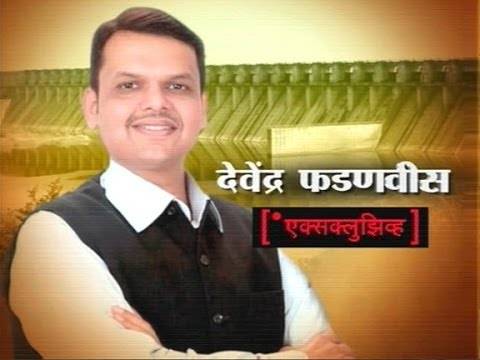
Above: CM Devendra Fadnavis Photo from: IBN Lokmat

Dear Chief Minister of Maharashtra,

Congratulations for becoming the Chief Minister of one of the progressive States in the country.

We would have felt better if this greeting was without the smudge of Voice Vote in confidence motion. We would have liked to see that while coming into power, you and your government had no links whatsoever with tainted politics of National Congress Party, which was named in a scam that affected Maharashtra’s weakest, but in many senses, its bravest populace: its farmers. But Voice vote has raised a question mark on this. Leader of your party had called NCP as Naturally Corrupt Party!

Nonetheless, you are known to have a great public image as a proactive, scholarly leader with integrity and intelligence.The last CM we had also had a scholarly and clean image, but after resigning from the CM’s post, which he held for more than four years, he admits to his mea culpa that he did not take the firm action in the irrigation scam because he wanted to save his government from collapsing. Maharashtra’s people, besides his own party, paid the price for this.

The crucial qualities the state seeks right now as it stands on the crossroad of political upheaval and natural calamities are not only a clean image, but forthrightness, commitment to democratic & accountable governance and, more importantly, capacity for an independent and clear judgement which is not swayed by the orders of higher ups or peers.

Natural calamities made worse by government’s mismanagement and inaction have racked Maharashtra in the past few years. Right on the heels of the dam scam, came the 2012-13 drought, dubbed by some (somewhat erroneously) as the worst drought in past forty years. After this came the delayed rains, droughts and excessive rainfall in Vidarbha, the hailstorms of February and March 2014, several agricultural diseases, crash of market prices of agricultural produce and fruits. In July 2014, the Malin Tragedy underlined how vulnerable, unprepared and fragile is our Western Ghats Region. Even now, Vidarbha region is reeling from late rains and extremely poor yield of soybean.

The calamities have affected the social and political milieu of the state; they have also literally broken the backs of its farmer. You have experience in disaster management and can appreciate how meagre our response has been to the natural calamities. To the manmade calamities, too, our response has been far from satisfactory. After more than two years after the so called exposé of the irrigation scam, we still have not brought a single irrigation official or politician or contractor to book. This scam and the sheer callousness of Congress-NCP government in handling the issue was one of the main factors behind its collapse. BJP did play an important role in following up with the issue in several parliament sessions and also with the media, but its actions and demands lacked conviction and seemed to save some of the culprits that were close to the BJP.

Irrigation Scam

Isn’t it surprising that being an opposition for 15 years, the BJP played such little real role in unearthing the scam? In fact, it was reported that when some people approached Nitin Gadkari with evidence of illegalities and irregularities, they were told that he is unable to take action against Congress–NCP as “Woh hamare char kaam karte hai, aur hum unke char kaam karte hai”.

The scam came into focus due to efforts of the then-serving chief engineer of Maharashtra Engineering Training Academy (META), Vijay Pandhare, media reports, CAG, courts, civil society and activists of the then-India Against Corruption (later renamed Aam Aadmi Party or AAP)—Anjali Damaniya, Mayank Gandhi, and others. The sheer extent and the impact of the unprecedented scam shocked the nation, after spending more than Rs 70,000 crore for over 10 years there was practically no increase in area under irrigation in Maharashtra. It needs to be remembered here that the scores of mega irrigation projects which were sanctioned and received their first administrative approval even without requisite water availability studies were initiated in the period when Sena-BJP was in power.

It needs to be acknowledged that Eknath Khadse, as the leader of opposition, and you, played a significant role in following up on the scam and pressurising the government.

At the same time, there were some notable contractors, close to BJP or even MPs and MLAs of BJP who were reportedly involved in the scam. Notable examples include Ajay Sancheti of SMS Infrastructure who is also the permanent National Executive Committee Member of the BJP. Media reports showed that Sancheti was not only implicated in Irrigation Scam, but in coal block allocation scam and Adarsh scam, too!

Damaniya, member of AAP, showed through RTI that Sancheti bagged 10 contracts from VIDC worth more than Rs 3,000 crore between his older company, new company and joint ventures with others (in 2005, Sancheti’s firm, Shaktikumar M Sancheti Ltd, changed its name to SMS Infrastructure Ltd and got a fresh certificate of incorporation, Vidarbha Irrigation Development Corporation was informed of this name change. But the two companies continued to exist together, bagging contractor between them and also additionally). These include almost all big projects in Vidarbha, including Gosi Khurd, Lower Penganga, Purna Barrage, Wardha Barrage, and Pedhi Project. This was when awarding more than three contracts to one contractor was illegal. Rules were bent, huge mobilisation advances were given, scope of work was increased and cost escalations were approved to help contractors. But BJP did not seem to take any action about this.

In case of BJP MLC Mitesh Bangadiya, it was his company MG Bangadiya Infrastructure which constructed the hugely flawed 23 left bank canal section of Gosi Khurd Project, which was recommended for complete demolition by Mendhegiri Committee in their report.

It is unfortunate that BJP took no action in this regard. It is also reported that in the midst of these exposures, it was Gadkari who specifically wrote to the water resources ministry at the Centre and sought early release of funds for these very contractors. It was stated that when BJP submitted “bullock cart full of evidence” to the Special Investigation Team headed by Madhav Rao Chitale to investigate the scam, incriminating evidence against these two groups were left out.

We hope that once in power, you will immediately order a judicial or CBI probe into the scam and full enquiry into the contractors who benefitted out of it, including the ones close to BJP, as also demanded by others.

SIT and White Paper

There was a need to reject the SIT Committee Report under the chairpersonship of Chitale as it was not an SIT—it had diluted TORs and Chitale is known to biased in favour of such projects, the department bureaucracy and status quo. The constitution of the committee was only a ploy to buy more time and show a semblance of taking action on the scam. We hope that you do order an immediate CBI probe into this or a judicially appointed SIT with independent members having track record of being able to take on issues upfront, with clear TORs and with power to summon and question.

The white paper brought out by the Water Resources Department (WRD) was also a shield for guilty to hide behind, and, unfortunately, other political parties, including BJP, failed to critically analyse it.

  • We hope that after coming to power, you will hold public consultations on the irrigation scam, white paper, at the dams in question to understand the local issues and real situation. There is also a need to include several dams left out of the white paper.
  • Post facto analysis of the performance and impacts of large dams is a need for the state as we continue to hanker behind more such projects for political and contractor benefit. Maharashtra, with the largest number of big dams in the country, has one of the lowest areas under irrigation.
  • We hope that you will take action against those involved in the projects named in the SIT Report (like Gosikhurd), responsible officials, ministers and contractors who benefitted unduly from the scam. Work on all such projects should be suspended till there is logical end to scam issue.
    Equity in water distribution

Maharashtra has the nation’s largest water infrastructure in terms of projects completed. There is a need to use this existing infrastructure in an optimum way for the benefit of the poorest, neediest, farmers and in a sustainable, equitable and democratic way.

  • We hope the new government will support equitable, sustainable cropping pattern, scrap secretive diversions to urban areas, industries and unplanned water intensive crops from dams meant for agriculture, and dismantle bodies like High Powered Committee immediately.

Environmental Governance

CAG report on irrigation projects in Maharashtra 2013-14 has exposed that works of more than Rs 7,000 crore were initiated by the WRD on nearly 249 projects without requisite forest and environmental clearances. Not only did it result in locking thousands of crores of public funds, it also damaged the meagre forest cover and environment of the state without justification or informed decision making process.

  • We hope the new government takes immediate action against projects mentioned unambiguously in CAG report and officials who initiated such projects.

Implement Gadgil report on Western Ghats

The Coalition’s stand on Western Ghats report under the leadership of Madhav Gadgil was escapist. The misinformation spread about Eco Sensitive Zone and the push for self-benefitting industries in the Konkan region seems to be one of the primary reasons for Narayan Rane’s defeat.

  • We hope the new government accepts the Gadgil report without losing more time and takes steps as per the report to democratise environmental governance in the Western Ghats. As Gadgil has reiterated many a time, the report is not a blueprint but a framework which can be modified by the people themselves.
    De-politicise sugar

Depoliticize Sugar

Water politics of Maharashtra is linked to the sugar politics. We grow sugarcane in the most drought affected regions, benefitting generations of political masters of NCP and Congress.

Maharashtra’s sugar crop is most inefficient user of water as per a study of Commission for Agricultural Costs and Prices (CACP). Although the sugar barons make the right noises about working for farmers’ benefit, that is a lame argument when you take into account thousands of poor farmers who are deprived of ANY irrigation benefits because of concentration of water in the hands of the sugar lobby. Apart from creating deep schisms in the social fabric of the state, it is also making the cane farmer vulnerable to climate change and the whims and fancies of sugar barons. Per tonne rates of cane are not commensurate with the cost of water, labour and fertilisers. Significant to note here that factories in Vidarbha belonging to politicians like Gadkari reportedly offer the lowest cane rates in the state to the farmer at around Rs 1,650 tonne when the average rate are about Rs 2,200 tonne.

  • There is a need to break the sugar shackles chaining the water and agriculture sector, to give more autonomy to the proposed Sugar Development Board, with more farmers on board, not sugar barons. There is also need to stop new licences of sugar industries in the drought belt; at present, the Sugar Commissioner has no such powers. Flow irrigation to sugarcane needs to be stopped, audit of sewage treatment of sugar factories needs to be carried out and the factories have to be made zero discharge, full water reuse models. SANDRP has witnessed that even factories of powerful politicians do not have functioning effluent treatment plants despite sugar industry being in the grossly polluting category (GPI).
    There was a time when the people concerned turned a blind eye towards ills of sugar factories as they were the engines of cooperative movement in Maharashtra. That is nearly in the past now. More and more cooperative sugar factories, set up with money from government, farmers and shareholders became dens of political manipulation and are being converted into private mills at a price which is a joke of their valuation. We have 168 cooperative sugar factories, but about 36 are being liquidated, 26 have been converted from cooperative to private entities and here too there is a strong political presence.
  • We hope that once in power, BJP conducts an audit of sugar industry including water efficiency of sugarcane in Maharashtra with respect to water use, release of water for sugarcane by dams, especially in drought affected Marathwada and western Maharashtra like Ujani, Lower Terna, Manjara, Mazalgao, lift irrigation schemes on Ujani and other scarcity-hit rivers, etc.
    Climate action plan

Action on Changing Climate?

While disasters like the February 2014 hailstorms affected more than 10,000 farmers in vulnerable Marathwada and Vidarbha, we still do not have a State Action Plan on Climate Change which should have been ready years ago through people’s participation.

  • We look forward to your government to complete work on State Action Plan for Climate Change in a community driven, bottom-up, transparent and democratic manner.

The problems of climate becoming more uncertain, extreme weather events increasing in frequency and rainfall failing when due, protective irrigation is becoming a dire need. Despite absence of irrigation, dryland farming and horticulture in limited water is thriving in Maharashtra. The recent example is of the phenomenal success of pomegranate cultivation which is nearly completely on drip and is grown in some of the driest regions of the state. However, the farmers still suffer losses in the absence of processing plants and state support, which is skewed in favor of sugarcane. Same is the case with oilseeds like groundnuts, coarse millets like jowar and bajra which offer livelihood and nutritional security.

We look to the new government in supporting marginal farmers and other farmers who grow such crops as ambassadors of climate change adaptation. We also hope your government will encourage system of rice intensification for various crops.
Urban areas continue to guzzle more water, polluting and killing rivers in their wake. Unfortunately, State Pollution Control Board (SPCB) does not have a single success story to its credit. It has not cleaned a single river since its inception although receiving hundreds of crores every year from state as well as the Centre.

  • We expect the new government to conduct an immediate and open audit of the work of Maharashtra SPCB and fix responsibility for this resounding failure, order complete change of the functioning of the SPCB to make its governance directly accountable to the victims of pollution and also involving participation of the vulnerable communities and independent groups.
    Revive rivers.

River Rejuvenation

In your city, Nagpur, too, the Nag River is chronically polluted and reduced to an open drain. It could not be rejuvenated although you were a Mayor of the city twice. Now there is a move to denotify the river, which will aid setting up category red industries at its very origin, killing the river. We don’t see any political party talking about this issue.

We hope you will stop this killing of rivers as your government at the Centre has been saying that river rejuvenation is their priority, we hope it is yours too.

Incidentally, Nagpur is one of the very few cities in the state with an operational PPP water supply model. There have been too many problems and protests on this issue, we will not go into the details here, but it is again notable that the Orange City Water Supply Limited is a joint venture between Veolia and Vishvaraj Infrastructure, which is closely linked to BJP leadership. There have been no post facto studies of the efficacy of this model and the way through which tendering was done was suspicious.

  • We hope the BJP Government will democratise the governance of water supply and waste water department of the municipal bodies rather than pushing for water privatisation.
    Innovative solutions

Encouraging Local Initiatives

The 2012 and 2014 drought saw some inspiring local initiatives from farmers across the state in terms of working on new watershed structures, desilting older structures and improving distribution systems. These emerged as more equitable and even efficient solutions than larger dams. A compilation of success stories with a clear view to support local led water conservation efforts will be a shot in the arm for the water sector in Maharashtra. Although the past government tried to support smaller structures by passing government resolutions (GRs) and building strings of cement nalla bunds, watershed management is more than just a quick fix solution.

There are several other issues ailing the water-environment-agriculture milieu of the state. The Congress-NCP alliance in power earlier was lampooned because of the absolute autocracy practised in the party, the insult of public opinion and concerns, and the leaders of the coalition proving too weak to steer the state into secure and transparent governance.

We hope that through you, Maharashtra will be astride on this path. We hope that together we can work towards equitable, sustainable, corruption-free, pro-people development and governance of Maharashtra.

All the very best.

Parineeta Dandekar parineeta.dandekar@gmail.com

(A slightly edited version of this was published in Down to Earth. Please find it here: http://www.downtoearth.org.in/content/open-letter-devendra-fadnavis)
Arunachal Pradesh · Environment Impact Assessment · Expert Appraisal Committee

Submerged – what to expect if the Dibang river is dammed

Guest Blog by: : Karthik Teegalapalli (kartix@gmail.com) a researcher with the Nature Conservation Foundation

In April 2014, the Forest Advisory Committee (FAC) decided to deny clearance to the 3000 MW Dibang Multipurpose Hydro-electric Project, the largest capacity hydro project in the country proposed to be developed by the National Hydropower Power Corporation (NHPC) in the biodiversity-rich Arunachal Pradesh State (Saikia 2014). The project was also denied clearance in July 2013. More recently though, the project has been recommended forest clearance by the FAC and Environment Clearance by the Expert Appraisal Committee. Therefore it is pertinent to look at the impacts the project may have in some detail.

Ecological impacts The project, in its earlier version involved diversion of more than 5000 hectares of relatively undisturbed grassland and tropical forest habitat. These and the adjoining forests harbour endangered species such as tiger, leopard, serow as well as the critically endangered takin, all of which are protected under Schedule I of the Wildlife (Protection) Act, 1972 (these species are also listed as present in the area in the Environmental Impact Assessment report of the project, undertaken by National Productivity Council, Guwahati). The grasslands in the area harbour the critically endangered Bengal Florican, a grassland habitat specialist (Sinha et al. 2014). Other species recorded from the area include the critically endangered white-rumped vulture, the slender-billed vulture and the white-winged wood duck. The project site lies in an area identified by the Bombay Natural History Society as a Ramsar site and an Important Bird Area (Islam & Rahmani 2004). The habitat of six endangered plants (Aconitum ferox, Coelogyne mossiae, Dendrobium aurantiacum, Paphiopedilum fairieanum, Paphiopedilum venustum and Vanda coerulea) will be submerged by the reservoir (Chernaik 2007).

The project will also affect aquatic species; the dam will block the breeding migration of four species of fish: the Vulnerable snow trout Schizothorax richardsonii, Endangered golden mahseer Tor putitora, Near-Threatened mahseer Tor tor, and chaguni Chagunius chagunio. The recommendation of the Environmental Management Plan of the Project to establish fish hatcheries for these species is impractical and can have further damaging effects on the species due to collection of eggs and spawn from the wild population.

The project will have other collateral damages such as through Compensatory Afforestation (CA) that often involves converting an area with diverse native species into monocultures, as has been shown for other dams such as the Sardar Sarovar Dam on the Narmada river (Bhatnagar 2004). The project involves CA of a relatively large area of over 100 sq. km (double the area of forest being affected by the project). The ill-effects of this conversion particularly for the project can be expected to be higher if tree-less natural grassland habitats in Dibang Forest Division, Namsai Forest Division and Anini Social Forestry that harbour grassland habitat specialists are planted with undesired native or non-native tree species. Perhaps the irreversible loss of biodiversity in the forests and grasslands that will be diverted for the project could never be ‘compensated’.

During the construction phase of the project, an estimated 32 lakh truckloads of boulders and 16 lakh truckloads of sand is to be extracted from the Dibang river basin. Unsustainable extraction of sand and boulders has significant negative effects on geomorphology, bank stability, flood character of the river, water quality, river flow, and the biodiversity in the river basin (Padmalal et al. 2008). The project during the construction is to generate 198 lakh cubic meters of muck which will be disposed in the river bank which will cause further loss of 120 ha of river habitat. Construction of new roads (64 km) and widening of existing roads (19.5 km) will also lead to removal of trees and increase the vulnerability of the region to landslides and erosion (Chernaik 2007).

Social impacts The Lower Dibang valley is currently a region of relatively low human population density (~14/km2); the entire population of the Idu-Mishmi tribe is about 12,000. The influx of approximately 6,000 project staff (which is very likely an underestimate) for a period of 8 years or more will affect their way of life, their culture and their tradition as well as open up access to relatively moderately disturbed habitat and biodiversity in the region.

Downstream effects include those on fisheries, agricultural lands and wetlands (beels) and the dam will also increase the vulnerability of the region to flash floods. For instance, in the year 2007, flash floods caused due to sudden release of water from the relatively smaller 405 MW Ranganadi project in the Lower Subansiri district in Arunachal Pradesh swamped 83 villages and caused huge loss of lives and property in the Assam State. The project will have a considerable impact on the Dibru-Saikhowa National Park in Assam which has not been studied in detail in the EIA.

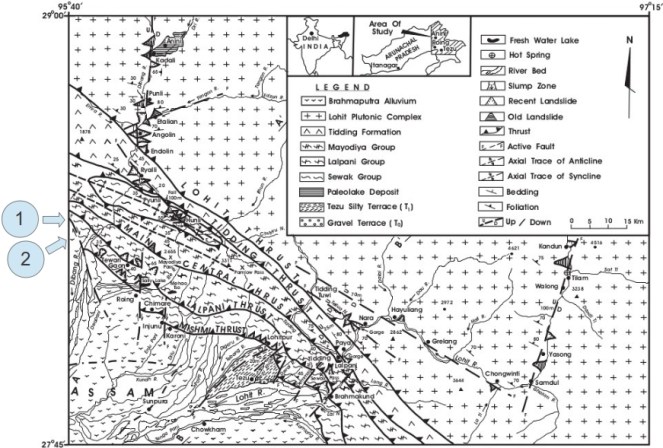
On shaky grounds A critical issue with the project is that the site lies close to an active Fault Line in the Mishmi Thrust of the Mayudia Group in Eastern Arunachal Pradesh with a history of several seismic activities including the Great Assam earthquake of 8.6 magnitude in 1950 (Figure 1, Misra 2009). In the event of an earthquake, the project poses a risk of catastrophic submergence of several villages and vast areas of forests downstream. The recommendations of the Environmental Impact Assessment (EIA) report of the project are cursory and suggest further research on the natural seismicity of the region as well as reservoir-induced seismicity, which should be the basis for the decision about the project.

Figure 1 (reproduced from Misra, 2009) showing the location of the fault lines around the proposed project site. 1 is the location of the Fault line and 2 is the location of the proposed site.
Figure 1 (Modified from Misra, 2009) showing the location of the fault lines around the proposed project site. 1 is the location of the Fault line and 2 is the location of the proposed site.

Notwithstanding these, in Oct 2014 the project was cleared by the FAC constituted by the new Government, although the committee still had four of the six members who had earlier twice recommended rejection of clearance. Is this decision driven by changes made by NHPC in their project plan? Clearly not. Diversion of forests has now been reduced by a mere 9% to about 4600 hectares; instead of 3.55 lakh trees, the felling has been reduced to 3.24 lakh trees, the power generation capacity has been reduced by 2.3% and the height of the proposed dam reduced by 10 m. In fact, the FAC rejection of April 2014 was for this 10 m rejection proposal!

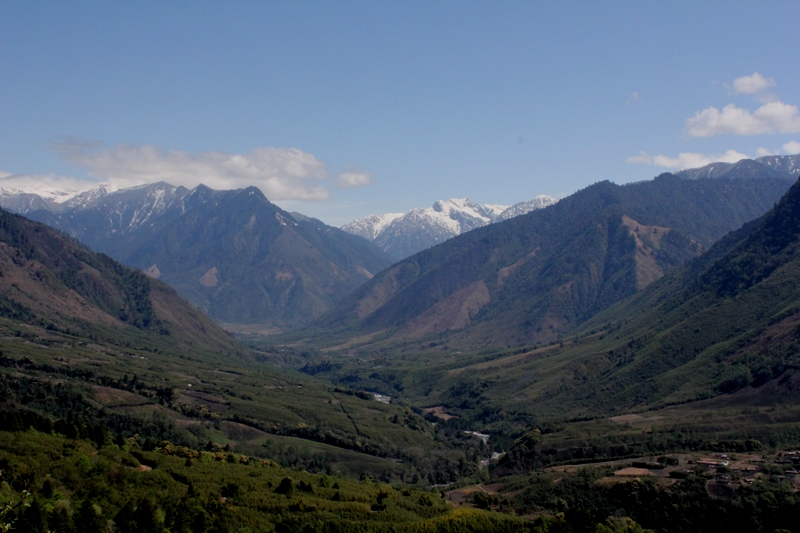
The beautiful Dibang valley, that faces the threat of submergence due to the Dibang Multipurpose Project (Photography by Soumya Dasgupta).

NHPC misleadingly and baselessly claimed that they ‘were not in a position to reduce the height of the dam any further, as it would significantly affect the power generation’. The decision to provide clearance to the project seems like a hasty one driven by the blinders of development and the consequences of such projects is evident from the fate of the Lower Subansiri Hydropower Project in the same State, also by NHPC. After 12 years since the LSHP was initiated and after an expenditure of over Rs. 5000 crores, the work has been on a standstill for the last 35 months as a result of India’s biggest anti-dam people’s movement (Dandekar & Thakkar 2014). Considering the economic, ecological, environmental and social costs of the project as well as the geophysical risk it poses, it would be prudent to withdraw the project till a credible, detailed cumulative study covering these aspects is undertaken in a transparent and participatory way. While the rest of the world is recognising the ill-effects of dams, with the largest dam removal project on the Elwha river in the United States completed just three months back, it is paradoxical that we are heading in the other direction; of building the highest dam in the country and largest capacity reservoir of the North East India without even basic studies, credible impact assessment and democratic decision making process.

References:

Bhatnagar, D. (2004) Uprooting Forests, Planting Trees: Success of Compensatory Afforestation Measures Mitigating the Deforestation for the Sardar Sarovar Dam, India. University of California at Berkeley.

Chernaik, M. (2007) Evaluation of the Environmental Impact Assessment Report & Environmental Management Plan for the Dibang Multipurpose Project (3000 MW) https://www.elaw.org/system/files/Evaluation+of+the+EIA+report+for+the+proposed+Dibang+dam.doc

Dandekar, P. & Thakkar, H. (2014). Manipulating Environment & Forest Clearances for Dibang Project: Déjà vu: LSHP History repeated: Will it be tragedy or comedy https://sandrp.wordpress.com/2014/10/06/manipulating-environment-forest-clearances-for-dibang-project-deja-vu-lshp-history-repeated-will-it-be-tragedy-or-comedy/

Islam, M. Z. & Rahmani, A. R. (2004) Important bird areas in India: priority sites for conservation. Indian Bird Conservation Network, Bombay Natural History Society and BirdLife International (UK).

Misra, D. K. (2009) Litho-tectonic sequence and their regional correlation along the Lohit and Dibang Valleys, Eastern Arunachal Pradesh. Journal of the Geological Society of India, 73: 213-219.

Padmalal, D., Maya, K., Sreebha, S. & Sreeja, R. (2008) Environmental effects of river sand mining: a case from the river catchments of Vembanad lake, Southwest coast of India. Environmental Geology, 54(4): 879-889.

Saikia, P. J. (2014). Six years after PM laying the foundation ston: No clearance, no work for 3000 MW Dibang Dam.

https://sandrp.wordpress.com/2014/01/31/six-years-after-pm-laying-foundation-stone-no-clearance-no-work-for-3000-mw-dibang-dam/

Sinha, A., Hoque, J., Pradhan, T., Bakshi, M. K., Pulu, J., Singh, A. K. & Ahmed, F. (2012) Sighting record of Bengal Florican Houbaropsis bengalensis (Gmelin, 1789) (Aves: Gruiformes: Otididae) in Lower Dibang Valley District, Arunachal Pradesh, India. Journal of Threatened Taxa, 4(14): 3375-3376.

Also see:
https://sandrp.wordpress.com/2014/10/23/insensitivity-analysis-of-dibang-multipurpose-project-fac-recommends-dibang-at-10-mt-height-reduction-will-destroy-4577-hectares-forest/

https://sandrp.wordpress.com/2014/05/17/dibang-project-rejected-forest-clearance-for-the-second-time/

Floods · Ramganga

Ramganga Project: A performance Review

The Ramganga multipurpose project[1], from the point of view of the government, is an eminently successful project. From the date of its commissioning in 1974, government reports declare that it has been fulfilling its stated objectives[2]. These were to bring an area of 5.90 lakh hectares under irrigation, control floods downstream, supply 5.5 cumecs to Delhi and generate 451 million units of power annually.

Map by SANDRP
Map by SANDRP

A data-based examination of each objective and whether it has actually been met by the project is outside the scope of this article, which presents the stories of people whose experience of the dam differs substantially from the ‘official’ version. These histories were gathered during several rounds of surveys and interviews with people living along the Ramganga at Kalagarh and Harewali.

Kalagarh is where the main storage dam of the Ramganga river valley project is located. The people of Kalagarh have only one reaction when it comes to the river- fear. Deveshwari Devi of Kalagarh described the situation of the people of her town as ‘The dam has brought us no benefits, only losses. Dia tale andhera. It is always darkest beneath the flame.’

Ramaganga raging fter water release from Kalagarh Photo: article.wn.com

The residents of Kalagarh and the neighbouring villages earlier approached the river for fishing, cutting grass, collecting wood, and farming. Since 2010, a fear of the river has brought all activities to a halt, says Nabab Ahmed who has not fished in the river for the last four years.

23 kilometers downstream of Kalagarh is Harewali barrage. The people near this barrage find their lives entirely governed by nebulous ‘authorities’ with total control over their lives and livelihoods.

Just a generation ago the farmers of Bhagota harvested three crops a year. These crops were a diverse array of grains such as wheat, rice and corn, along with sugarcane and vegetables. The Ramganga would bring in silt with its annual floods and replenish the fertility of the soil. The same floods would also recharge the soil’s moisture. In addition to the crops, people harvested the fish that made their way up and down the Ramganga as per their breeding cycle. This quiet and self-sufficient life was shared by many other villages including Parmawala and Shahajahanpur.

In the middle of the 1970s, life changed drastically. The villages were divided into ‘upstream’ and ‘downstream’ of the barrage. Like the world ‘through the looking-glass’, they now lead lives drastically opposed to each other.

The Harewali Barrage impounds the water let down by Kalagarh dam and diverts it to the Khoh river, from where it is taken to the Upper Ganga canal system. Confusing, isn’t it? This confusion pales in front of the upside-down river cycle that the people of Bhagota, upstream of the barrage, are subject to. From 15 November to 15 June, the barrage gates are closed and the people’s farmlands are flooded. This effectively does away with the Rabi and summer crop seasons. What is left is paddy cultivation during the Kharif season, and even that is at the mercy of the Dam gods. Often, the dam authorities do not open the dam gates till long after the scheduled 15 June date. This means that the farmers lose out on the sowing period. Similarly, often the gates are closed before the middle of November, which means that they lose the harvest.

Fishing is no longer as per the migratory cycle of the fish, but as per dam releases. When Kalagarh opens its gates, the fish from the reservoir are washed downstream, only to be trapped at Harewali. Thus, the fish upstream of Kalagarh are isolated, their breeding rhythms broken. Just a generation after the building of the dams, the fishers are already seeing the impact of this isolation of the fish breeding populations. Fish sizes have decreased, and the relative proportions of different species are changing.

The agricultural cycle of the downstream villages of Shahajahanpur and Parmawala is forced to move on a diametrically different level. For them, the months between June and November are a time of intense floods. They are well able to live full flows during the ‘chaumasa’, the monsoon. What causes them distress are the unannounced releases prior to and after the chaumasa. They confirmed the Bhagota residents’ claims that releases outside the scheduled dates cause great damage to crops.

‘Paalej’ farming is the cultivation of cucurbits- melons, gourds and cucumbers- along the silty banks of the river after it recedes post-monsoon. This crop is sown immediately after the monsoon as increasing areas of the banks emerge from the river, and harvested in the summer before the floods come. Now, often unexpected releases come in the late monsoon, or early in the season. Razia, a paalej farmer, sowed the fields she rents from a landed farmer three times in 2013- and lost the crop anyway. Further, the dam has altered the sediment characteristics so that instead of bringing in fine silt the river brings in coarse sand. This decreases yield even further. Razia is the last of the Paalej farmers in her village. People no longer practise what they term a gamble.

Inforgraphic_Kalagarh

Those farmers lucky enough to own land have gone in for growing sugarcane, withstands most flooding. It too can be flattened by the sand brought in during ’emergency’ releases. Om Prakash told me that such a release this  year took away both his fields in Parmawala, and also his 20-year old son. Three days after Raksha Bandhan, the young man had gone to the fields to strip the cane leaves  for fodder. There was a sudden release of water, and the young man was never seen again. A sign posted on the barrage relieves the dam authorities of any culpability in such incidents.

Where do our Technocrats stand on this issue? At a recent meeting in Kanpur, several authorities including Dr. Tare, IIT consortium and Mr. Singh, retired official of UP irrigation expressed their opinion it is the people that need to adapt to the situation. Progress is needed, they said.

Dubious progress in the canal command area, sure devastation along the river. Progress.

Chicu Lokgariwar, (chicu.l@gmail.com)

End Notes

[1]     UP Irrigation department. Ramganga- Asia’s highest earth and rock fill dam.  http://irrigation.up.nic.in/ptr/ramganga.htm

[2]     Agricultural Finance Corporation ltd. 2012. Report on environmental evaluation study of Ramganga major irrigation  project. Volume 1. Central Water Commission, Environmental impact assessment directorate. February 2012

Dams

Goda Park Riverfront Development Project: Violation of court order and destruction of fertile riparian zone

Godavari is the second longest river in India after the river Ganges. It is popularly known as “Dakshin Ganga”. It originates at Bramhagiri hills in Tryambakeshwar of Nashik District in Maharashtra. 13 KM stretch of the river flows through Nashik City. About 1.25 KM of this stretch is of religious significance. Kumbh Mela is a mass Hindu pilgrimage in which millions of pilgrims gather on banks of Godawari in Nashik city to bathe in a sacred river. It is one of the world’s largest religious gatherings which happens every 12 years. Next Kumbh Mela is scheduled in July­September 2015. About 1 crore pilgrims are expected to arrive[i].

The river that has a high cultural and religious significance has been routinely used as a dumping ground for city’s sewage and industrial effluent. There are around 20 locations where sewage and industrial effluent from 2 industrial estates is directly discharged into the river which have rendered the river water unfit for drinking and domestic use[ii].

A petition has been filed in the high court by few activists from the city against Nashik Municipal Corporation (NMC), Municipal Commissioner, Government of India (GoI), Government of Maharashtra (GoM), and Maharashtra Industrial Development Corporation (MIDC) for failure on their part to clean the pollution of the river[iii]. The court has acknowledged that the major factor contributing to the pollution is the human factor and that various religious and other activities are contributing to the pollution of the river for years. Court has appointed the National Environmental Engineering Research Institute (NEERI) for formulating a comprehensive action plan for the purposes of cleaning of the River Godavari and proper maintenance of the river. Considering the forthcoming Kumbh Mela in July­-September 2015, the Court has directed NEERI to submit an action plan to tackle with Kumbh Mela. The court has also appointed a committee to examine the action taken by all the concerned Authorities as regards the implementation of the recommendations in the first two reports submitted by NEERI and the directions contained in the court order.

While NEERI has submitted the two reports about cleaning of Godavari and plans for Green Kumbh are being heavily discussed, NMC has undertaken projects which are in stark contradiction with the court order.

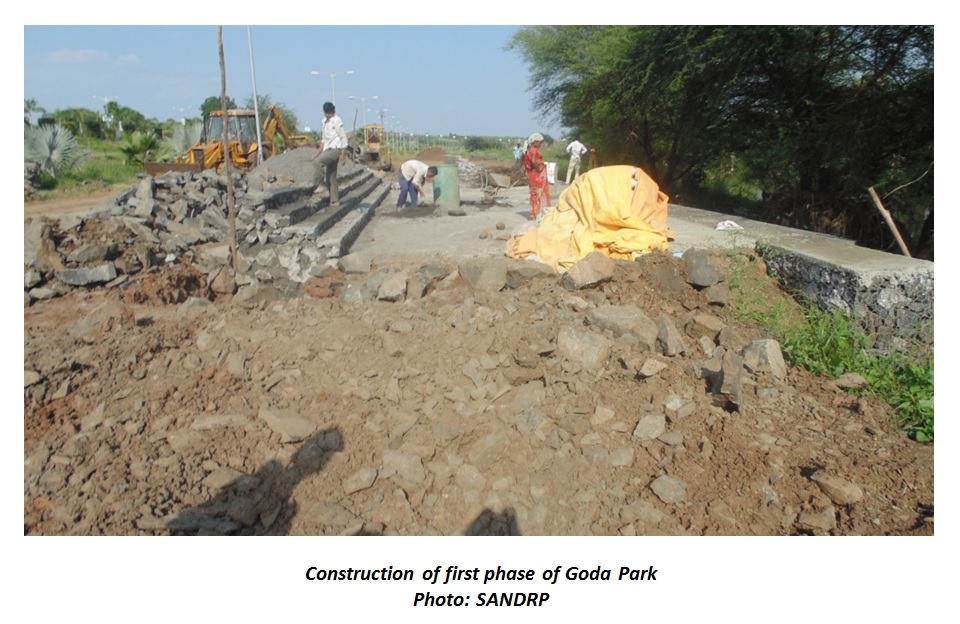
Concretization of river bank in the name of ‘Goda Park’

As SANDRP had highlighted in its article on Riverfront Development projects in India (https://sandrp.wordpress.com/2014/09/17/riverfront-development-in-india-cosmetic-make-up-on-deep-wounds/), NMC has taken up ‘Goda Park’ a riverfront project on Godavari flowing through municipal limits[iv]. Earliest version of Goda Park was implemented some 4 to 5 years back and consisted of a 2.5 KM walkway along the river. This project has been a failure on multiple grounds. The stretch of the walkway lined up with paved concrete blocks is severely underutilized as a result of less dense population. The walkway has also become a platform for host of illegal activities. “Citizens are facing safety issues as a result of these activities” says Mrs. Prajakta Baste, principal of College of Architecture Nashik. The walkway falls within the flood line. During monsoon it is completely under water. As a result it has been damaged at several places. Pipelines that discharge untreated sewage in Godavari run from bellow the walkway resulting in stench and filth.

While the earlier version of Goda Park has failed, the project has been revived this year with a fresh blue print. As experts and activists say it has been a dream project of Maharashtra Navnirman Sena (MNS) chief Raj Thackeray and MNS ruled NMC has resolved to materialize it. The 13.5 km long project (on both the banks making it 26KM in total) will be developed from Ahilyadevi bridge to Gangapurgaon, having facility of laser shows, musical fountains, rope-way, multi-purpose meeting hall, garden, place for exercise including yoga, water sports and plantation of herbal plants and a canteen. Due to lack of adequate funds with NMC the project has been handed over to Reliance India Foundation (RIF) for execution[v]. Apart from small coverage in print media, no information about the project is available in the public domain.

Goda Park 1

Goda Park 2

Not many people are aware that work for first 500 m stretch of Goda Park on left bank at Anandwalli has already been taken up by RIF and is in progress. This stretch includes Gym (Phase I: 60m x 18m, Phase II: 45m x 18m) and garden. The project is problematic on many fronts.

Constructions proposed within the blue line: Flood lines along Godavari in Nashik city have been re-demarcated after the city faced heavy downpour on 28th August 2008 and houses & buildings constructed within 125 to 200m from the river channel were under water for upto 10 to 15 hours[vi]. These newly defined lines which according to local people have been already tampered with and brought closer to the river channel so as to facilitate the real estate development are completely violated by the project.

Goda Park 3

The circular dated 21st September, 1989 issued by the Assistant Secretary, Irrigation Department; Government of Maharashtra prohibits any construction within blue line due to possibility of floods any time[vii]. The project readily violates this norm proposing structures for gym phase I & II within the blue line. The project thus is an illegal encroachment on the river bank. The project talks about several such features including multi-purpose meeting hall, restaurants, yoga centre, recreational centres etc.

Goda Park set to destroy the riparian zone: Riparian areas which are naturally vegetated lands along rivers and streams act as natural filters of nonpoint source pollutants, including sediment, nutrients, pathogens, and metals. It is important to preserve the riparian areas because these areas can play a significant role in managing adverse water quality impacts. These areas also act as buffers during floods and play an important role in flood absorption.

Goda Park 4

Goda Park 5

Riparian vegetation of full 18 M width of river bank has been cleared for length of 500 M for construction of gym and landscaped garden. Concretization of the cleared patch is in progress. Deputy Engineer from Construction Department of NMC Mr. Rajput said that stretch of 18 to 30M width will be ‘developed’ for entire 13 KM on both the banks. Goda Park is thus set to destroy the riparian area along the entire river. River has been fighting poor water quality and destruction of the riparian vegetation will only worsen the case.

Goda Park 6

Addressing water quality issues is not a part of the project: The city has around 20 locations where untreated sewage is discharged directly into the river. And shockingly one such discharge point is located barely 200 m from raw water sourcing location. NMC has not taken any action against this and has continued lifting this contaminated water.

Goda Park 7

Goda Park 8

At certain locations along the river water quality is in poorest condition. Godavari River has been designated as an A2 class river which means that the river is a source of drinking water. Water quality standards prescribed by CPCB for the A2 class river state that the permissible limit for Biological Oxygen Demand (BOD) is 2mg/l or less. In reality at certain locations along the river BOD is as high as 51mg/l. Similarly Dissolved Oxygen (DO) at certain locations is as low as zero to 3.5mg/l when the water quality standards demand it to be 6 mg/l or more[viii]. The high value of COD is indicator of pollution due to discharge of domestic and industrial effluent in the river water.

Cleaning up the river and restoring its water quality which is the prime need has gone unaddressed in Goda Park. While the project plan talks about several urban features; it does not talk of treatment of sewage. Petitioners of the ongoing PIL regarding the degraded water quality of the river are disappointed with the Goda Park. Activist Rajesh Pandit, one of the petitioners expresses his concern over the project saying “Godavari River is like our mother who is in ill health and is in intensive care unit (ICU). Instead of treating her and getting her out of ICU, NMC is trying to put some make up and beautify her. That is definitely not what she needs right now!” The group of petitioners has also corresponded with NEERI to obtain their views about the project. The reply is awaited.

Goda Park is in violation of the court order: The order issued by the High Court essentially directs the NMC to restore the health of the river back to the water quality standards prescribed for A2 Class River. The project will only cause further damage to the river and is far from compliance with the orders issued by High Court for rejuvenation of Godavari River. The petitioners in fact highlight the fact that implementing any project which causes damage to river is a punishable offence as per Indian Penal Code Section 431.

NMC ignorant of the impacts: Mr. Vanjari of Environment Department of NMC when contacted to discuss the environmental impacts of Goda Park project told SANDRP that he does not have any information about the project. It is shocking that the environment department does not have any information of a project that is set to alter character of 26KM bank of the river. Dy Engineer of Construction Department Mr. Rajput when contacted for discussing the environmental impact of the project was of opinion that the project causes no damage to the river and is very much in line with the court order. When asked if there has been any study to assess the impact of the project on ecology of the river the answer was negative and Dy Engineer was also of opinion that there was no need for such a study. He also said that the stretch which is being developed is under flood water only once or twice a year and thus it is not much of a problem.

This only shows that NMC is completely ignorant about the impact of the project and does not realize the seriousness of the issue.

While recommendations by NEERI are being discussed and debated with no concrete action taken as of now, Goda Park has been expedited both by NMC and RIF. There are several other grounds on which the project is unjust. The fertile and ecologically important land on the river banks has been handed over to a corporate without public consent. Both NMC and RIF have taken the public for granted. The citizens are being misled with promise of riverfront development on lines of Sabarmati. Public at large is unaware of these issues. Profit making by a corporation at the cost of natural resource stands clearly unjustified.

Amruta Pradhan

amrutapradhan@gmail.com

[i] http://zeenews.india.com/news/maharashtra/10-million-to-gather-for-2015-nashik-kumbh-mela_884065.html

[ii] As told by local people

[iii] Bombay High Court order issued on 07/03/2014 for PIl-176.12

[iv] https://sandrp.wordpress.com/2014/09/17/riverfront-development-in-india-cosmetic-make-up-on-deep-wounds/

[v] http://articles.economictimes.indiatimes.com/2013-09-20/news/42252355_1_goda-park-project-reliance-foundation-mns-chief-raj-thackeray

[vi] “Analysis and Mapping of Flood Line in Godavari River Basin within the Nasik Municipal Corporation Area” published in International Journal of Research in Social Sciences Volume 2- Issue 2 (ISSN: 2249-2496)

[vii] Bombay High Court order issues on 07/03/2014 for PIl-176.12

[viii] “Water Quality Assessment of Godavari River at Nashik, India: Impact of Sewage and Industrial Wastewater” Published in Universal Journal of Environmental Research and Technology 2013 Volume 3, Issue 4: 452- 457

Ganga · Hydropower · Uttarakhand

Why is the IIT Consortium acting like a hydropower lobby?

In a shocking development, Consortium of Indian Institute of Technology (IITC) has submitted a report that is a shot in the arm for the hydropower lobby in Ganga basin in Uttarakhand. This IITC report is being used by the Union Ministry of Environment, Forests and Climate Change (MoEF&CC) to push ahead 24 Hydropower Projects in Uttarakhand which were recommended to be cancelled by two official expert reports, both commissioned on the orders of the Supreme Court of India. It seems the authors of the IITC report are jeopardizing the formidable reputation of the IITs and over a dozen other institutes which are a part of IITC, possibly for some short term gains.

Sounds ridiculous? Read on..

WII report The first expert report mentioned above is the report of the Wildlife Institute of India (WII), commissioned by the MoEF & CC to assess the cumulative impact of some 70 hydropower projects in Alaknanda-Bhagirathi basin in Uttarakhand. WII submitted the report to MoEF&CC in April 2012 and among other recommendations, said that 24 of these projects should be dropped due to their irreversible & long term impact on aquatic and terrestrial biodiversity. At the outset it should be mentioned that the WII (“an internationally acclaimed”, “autonomous institute of MoEF&CC”, see: http://www.wii.gov.in/) recommendation of dropping 24 projects was based on assessment of aquatic and terrestrial biodiversity impacts of the series of hydropower projects in Bhagirathi-Alaknanda basins in Uttarakhand. WII was commissioned to do this study by the MoEF&CC following an earlier SC order based on CEC (Central Empowered Committee) recommendation.

MoEF&CC, did not want to take the recommended action, so it sat on the recommendation of the WII report.

EB report following SC directions to Ministry to take stand on WII report On Aug 13, 2013, following the Uttarakhand disaster of June 2013, the Supreme Court directions, among other things included, “MoEF is directed to examine, as noticed by WII in its report, as to whether the proposed 24 projects are causing significant impact on the biodiversity of Alaknanda and Bhagirath River basins.” Again, MoEF&CC did not want to do any such examination on its own. Since MoEF&CC was setting up an expert body to examine the role of hydropower projects in the Uttarakhand disaster as per other directions of the same SC order of Aug 13, 2013, the ministry included such examination also in the Terms of Reference of the Expert Body (EB) under chairmanship of Dr Ravi Chopra.

The EB terms of reference were even wider than that of WII study and the expertise available with EB was also wider. With such expertise and terms of reference, the EB report (by 11 of the 13 members of EB) submitted to MoEF&CC in April 2014 came to the conclusion that 23 of the 24 projects in WII list should be dropped and even the 24th project, namely the Kotli Bhel 1A should go ahead only after significant modifications. Thus, essentially, EB too endorsed the WII recommendation.

It should be noted here that the WII recommendations were peer reviewed (during the work of Expert Body in 2013-14) by renowned biodiversity expert Dr Brij Gopal. Dr Brij Gopal too endorsed WII recommendation that the 24 projects should be dropped. The peer review was sought by the Central Water Commission representative at the 2nd EB Meeting. Despite objections from some EB members, the Chairman agreed to such a review and proposed the name of Dr. Brij Gopal which was promptly seconded by the Vice-Chairman, Dr. B.P. Das – a former Chief Engineer (Irr), Govt of Odisha and former Vice Chairman of the MOEF&CC’s Expert Appraisal Committee on River Valley Projects. In fact Dr. Brij Gopal suggested that more projects needed to be dropped.

MoEF&CC still did not want to take action on the 24 projects. So using the dissenting report by two government agencies which were largely toeing their official position in EB, the MoEF&CC suggested to the Supreme Court of India on May 7, 2014 that it wants to set up another committee. Seeing no validity in this, the Honorable SC rejected this suggestion and asked MoEF&CC to take a stand. SC has also since then put a stay on any further work on these 24 projects.

Still not ready to take a stand, MoEF&CC, used the reason that since IITC was already working on Ganga River Basin Management Plan (GRBMP) for the ministry since 2010 went ahead and gave the task of reconciling the two EB reports to IITC. In effect this is tantamount to violating the SC directions of not appointing another committee. However, unlike the picture it tried to give to SC, this task was not part of GRBMP work, but given to IITC through a fresh TOR.

Perturbed at not receiving any serious required response from MoEF&CC after repeated orders, the apex court judges of the Supreme Court rightly said the ministry was behaving like Kumbhakarna and Rip Van Winkle.

On Oct 9, 2014, the MoEF&CC submitted an affidavit to the SC, relying entirely on a report from IITC. And lo and behold, IITC had provided a report to the MoEF&CC, certifying that with some vaguely defined criteria, all the 24 projects can go ahead and there is no need to cancel any project! Serendipitously, this is exactly what the MoEF&CC & the hydropower lobby wanted!

It needs to be stated here that IITC had no mandate to submit such a report and the report is unprofessional, inadequate, unwarranted and inconsistent.

Let us see how.

Authors of the IITC report IITC report was authored by eight persons: Dr Vinod Tare (Civil Engineering Dept, IIT Kanpur, see: http://www.iitk.ac.in/ce/CIVIL/faculty.htm), Dr I M Mishra (Department of Chemical Engineering, IIT Roorkee, see: http://www.iitr.ac.in/departments/CH/pages/People+Faculty+imishfch.html#), Dr Purnendu Bose (Civil Engineering Department, IIT Kanpur, see: http://www.iitk.ac.in/ce/CIVIL/faculty.htm), Dr Ligy Philip (Civil Engineering Dept, IIT Madras, see: http://www.civil.iitm.ac.in/people/faculty/ligy/about.html), Dr B S Murty (Civil Engineering Dept, IIT Madras, see: http://www.civil.iitm.ac.in/?q=murty_edu), Dr R P Mathur (formerly Prof of Civil Engineering, University of Roorkee), Dr M Jawed (Dept of Civil Engineering, IIT Guwahati, see: http://www.iitg.ac.in/jawed/homepage/index.html) & Dr Gautam Roy (Consultant GRBMP and former student of Civil Engineering Department at IIT Kanpur). A perusal of the available information on professional background of these persons shows that none of them have expertise on the aquatic and terrestrial biodiversity of the Bhagirathi-Alaknanda basin, to decide on the appropriateness of the WII recommendations. Hence at the outset it seems inappropriate for IITC to sit on judgment over recommendation of an expert body, on subject matter of which IITC has no expertise.

The IITC team of 8 persons listed above, all with essentially engineering background have now also reviewed the EB report and made their own recommendations, again without having the expertise that was available at EB command. It is thus inappropriate for IITC to comment on the recommendations of the EB which had two biodiversity experts from FRI (Forest Research Institute) and WII, besides experts from Uttarakhand in various other disciplines. IITC is thus being unprofessional.

What does IITC report say The IITC report essentially says that ALL the 24 projects can go ahead if they satisfy three criteria: Aviral Dhara, Environmental flows and longitudinal connectivity. The first thing that strikes about these three terms is that they are all vaguely defined and can have flexible interpretations. They are also interconnected and not necessarily independent of each other. Most importantly, they do not take care of the issues based on which the two expert reports said that these 23 projects should be dropped and even the 24th Project, namely the Kotli Bhel 1A may be dropped or modified. But first let us understand these three vaguely defined, flexible and interconnected terms.

Aviral Dhara: According to the IITC report para 2.1 (see also: “Ganga River Basin Management Plan Extended Summary” of June 2014 available at: http://gangapedia.iitk.ac.in/sites/default/files/2014-06-12_GRBMP_Extended%20Summary.pdf): “Aviral Dhara in this context means that the flow of water, sediments and other natural constituents are continuous and adequate over the entire length of the river throughout the year.” There is no definition of what is adequate here, nor it is clarified as to adequacy is from what point of view. Here it should be noted that Aviral literally means uninterrupted, but neither IITC nor MOEF&CC provide this interpretation. According to MOEF&CC affidavit of Oct 9, 2014 (para 8(c)), Aviral means “to flow round the clock” or “continuous flow”.

Environment Flows: For Environmental flows, the “objective” of GRBMP is (see p 9 of the GRMBP Extended Summary) “Environmental Flows shall be maintained in all rivers and tributaries of Ganga River System to fulfill their geological, ecological, socio‐economic and cultural functions.” The E-flows thus would than depend on identifying functions of the river from geology, ecology, socio-economic and cultural perspectives, which can vary. The GRMBP extended summary does not provide clarity on e-flows for any of these aspects and how to go about arriving at required environment flow. It should be mentioned here that to arrive at environment flows, there are about 200 methodologies available globally. The IITC report attached with the MOEF&CC affidavit remains even vaguer as it says maintenance of E-flow should lead “to river stability and ecological balance in the downstream areas.”

Clarity on environmental flows is crucial as the affidavit from MOEF&CC itself agrees that MOEF&CC did not address the issue of eflows adequately while granting environmental clearances in Uttarakhand. One of the basic reasons behind this was lack of clarity on the issue and the same mistake is being repeated in the IITC Report.

Longitudinal Connectivity: In MOEF&CC affidavit of Oct 9, 2014, it is stated (para 6(b)/ 8(b)) that longitudinal connectivity is necessary to ensure “non-disruptive biota movement and silt transportation along the river course that are essential ingredients of a river ecology and its wholesomeness. Otherwise, a fragmented river stands to lose its basic character along with its native aquatic bio-diversity and ecological integrity.”

One of the two places where the term longitudinal connectivity appears in the GRMBP Extended Summary quoted earlier, says: “For dams and barrages, a precondition is essential that they cannot violate the longitudinal connectivity in River Ganga and her major tributaries. Besides they must allow E‐Flows (Environmental Flows) all along the river. A potential method for ensuring river connectivity through dams/ barrages has been suggested.”

The only other place in the GRBMP Extended Summary where the term longitudinal connectivity appears is interesting as it connects all the three terms that IITC has used: “Thus, while longitudinal connectivity in river network is an essential first step to maintain “Aviral Dhara”, having adequate river flows depends much on basin’s overall water status.” This statement is thus also making all three terms even more flexible, subjective and vague since they are dependent on “basin’s overall water status”. This leaves the door open to later reduce the quantum of E-Flows.

It is thus clear that the IITC report annexed by the MOEF&CC with their Oct 9, 2014 affidavit says that if these three vaguely defined terms that are flexible and prone to subjective interpretations are satisfied, then all the 24 projects can go ahead.

While these three, when clearly defined and properly implemented, are necessary conditions for any hydropower project, to say that they are sufficient condition is not only misleading, but also showing lack of understanding of the environmental issues related to hydropower projects. The MOEF&CC affidavit of Oct 9, 2014 relies exclusively on this IITC report and wants to allow all 24 project based on these three vaguely defined, flexible criteria from IITC report.

However, these three criteria are not sufficient to take a decision about these 24 projects as they exclude large number of criteria that the two expert reports considered, including: terrestrial biodiversity (completely absent in IITC report), cumulative impact (completely absent in IITC report it only looks at project specific issues), projects’ location in hazardous zone, projects increasing the disaster potential of the area, among many others.

The SC’s original direction was to examine if the 24 projects would have significant impact on the biodiversity. So the examination for these 24 projects must be done from the total biodiversity aspect and not on the basis of flow alone. The IITC itself has said in the GRBMP Interim Report of Sept 2013 that if biodiversity impact is significant then the project should be disallowed. It is clear IITC has again been inconsistent.

IITC is inconsistent It should be added here that in table 4.2 of their “Interim GRBMP” of Sept 2013 (see: https://nmcg.nic.in/writereaddata/fileupload/25_GRBMPInterim_Rep.pdf), IITC provides larger set of criteria for deciding permissibility of dams and barrages in the Ganga Basin, which include criteria like threat to terrestrial biodiversity, rare, endangered and threatened (RET) species, geological hazards, loss of historical, religious and cultural sites, among others. But these are no longer considered by the IITC in their current report under discussion. The IITC is also being inconsistent, besides being unprofessional and vague.

IITC report shows lack of understanding on basic environmental issues It is also disturbing to read the IITC report saying (section 2.1, last but one para), “However, projects on streams/ rivers with negligible biota may be allowed to proceed as per the environmental and other clearances already given to such projects provided that adequate provision is made to ensure the mandated E-flows. The adverse environmental impacts of such projects on the Ganga river system as a whole are expected to be negligible. Such projects may, therefore, be kept out of Cumulative Environmental Impact Assessment (CEIA) for their approval.”

Firstly, this shows that IITC is out-rightly overruling the recommendation of the WII and EB on criteria of terrestrial biodiversity, geological stability and so on. IITC is doing that too without providing any reasoning or basis. Significant number of the 24 projects have been recommended for rejection by WII and EB based on these criteria. Such baseless rejection of the recommendation by IITC not only shows their poor understanding of environmental and geological issues, but also shows their pro hydro bias.

Secondly, IITC makes the contention that the adverse environment impacts of such projects on Ganga river system is expected to be negligible, without providing any basis or scientific logic or reasoning.

Thirdly, suggesting that all such projects may be kept out of the CEIA seems to show poor understanding of the basics CEIA by the authors of IITC report. Large number of even so called low impact interventions can also cumulatively have big impacts and to exclude them is against the very spirit of CEIA. It also then raises doubts about competence of IITC to prepare GRBMP, since GRBMP is supposed to also look at the cumulative impact assessment and carrying capacity of major interventions in the Ganga Basin. IITC authors do not seem to understand that even aquatic biota gets affected by geological and other factors, that fish is not the only aquatic biota and that there is upstream downstream linkages in lifecycle of the aquatic biota and that there are linkages between aquatic and terrestrial biota life cycles, affected by hydrology.

The above stated issues raise serious doubts about the appropriateness of the IITC report and MOEF&CC’s attempts to push ahead with the 24 hydropower projects in fragile and disaster prone Bhagirathi-Alaknanda basin based on the inappropriate IITC report. Particularly when these projects were to be cancelled as per two expert reports, both commissioned following two separate apex court orders.

Issue of cumulative impacts cannot be taken care of through project specific actions Here it should be noted that the WII report has made its recommendation about dropping 24 HEPs based on cumulative impact assessment of all the operating, under construction and planned projects in the Bhagirathi-Alaknanda River basins. The same is true with respect to EB recommendation. The conclusions arrived at based on cumulative impact assessment by the WII and EB cannot and should not be sought to be addressed by looking at project specific steps or actions as MOEF&CC affidavit and IITC reports are doing.

Did Project Management Board allow IITC to do this report? The IITC task of GRBMP is being overseen by a Project Management Board (PMB) comprising of senior persons of all the seven IITs and some invited members. The IITC report dated July 21, 2014 mentions, “The PMB in its fifth meeting held on Tuesday, June 24, 2014 at IIT Delhi agreed to examine the two reports in the broader framework developed for GRMBP.”

While this is what IITC claims in its July 21, 2014 report, this claim is not supported by the Minutes of the relevant meeting of PMB, as we see below. From the reading of the minutes, it seems that the IITC had no mandate or clearance to do this report.

In the minutes of the fifth meeting of PMB held on June 24, 2014, para 7 seems to be the only relevant para in this context, which reads as follows: “Project Coordinator sought the directions from PMB about the modus operandi for follow-up actions after submission of the final draft of GRBMP – such as responding to queries and comments on GRBMP and dealing with requests for other inputs on Ganga Basin received from government and other agencies. He mentioned that IITC is obliged to respond to such requests based on the work done in preparing GRBMP, and the help of only active contributors of IITC would be needed rather than the existing mechanism of going through PICC and PMB. Professor Manna, Director, IIT Kanpur stated that IIT Kanpur is willing to take the responsibility on behalf of IITC of such matters and Project Coordinator may take the help and advice of concerned IIT Team members as and when needed. It was opined that each IIT may compile the list of new faculty members who may have joined after GRBMP project was started and communicate the same to the Project Coordinator. Professor Khakhar suggested that Directors of the 7 IITs may discuss the matter and communicate the decision to the Project Coordinator on modus operandi for submission of first version of GRBMP, and responding to queries and comments on GRBMP and dealing with requests for other inputs on Ganga Basin received from government and other agencies.”

The first thing that strikes about this para is that the Project Coordinator (Dr Vinod Tare) raised this in the context of “follow-up actions after submission of the final draft of GRBMP”, which is not the case with respect to current issue, since the final draft of the GRBMP is yet to be submitted. There is nothing in this para to support the contention quoted above from the preface of the IITC report that PMB “agreed to examine the two reports in the broader framework developed for GRMBP.”

If this is the only para that is relevant in the context of IITC report to MOEF&CC dated July 21, 2014 and if this para is not applicable at this stage since it is applicable only after submission of final draft of GRBMP, then the question arises, if the IITC had the permission from PMB to submit such a report and if the MOEF&CC should have submitted this report as authorized IITC report? These questions can be answered by only the IITC, its PMB and MOEF&CC, but they are relevant since it is this report purportedly from IITC that is sought to be used by MOEF&CC to ensure that all the 24 projects under discussion go ahead. In fact PMB and all concerned from IITC should quickly clarify that this report cannot be called IITC report, but only from the specific 8 persons listed above. The authors should be asked to remove the claim that this is IITC report.

IITR has poor track record and conflict of interest Here it is pertinent to note that of the four IITs involved in this report of IITC, IIT Roorkee (IITR) has already proven to have a poor and biased track record and should not have been involved in any case. The IITR was in fact commissioned in July 2010 by MOEF&CC to do cumulative impact assessment of the hydropower projects in Bhagirathi-Alaknanda basin. The report submitted by IITR was so pathetic that it was not accepted and it invited adverse comments from official agencies like the Expert Appraisal Committee on River Valley Projects, the Inter Ministerial Group on Ganga Basin Projects and also the Supreme Court of India in Aug 2013 order. (The report was also criticized by other organisations[1].)

Thus, IITR stands discredited on the precise issue of cumulative impacts of hydropower projects in Bhagirathi-Alaknanda basin. To include such an institute for another IITC report now on the same issue not only brings discredit to the whole effort, but raises the issue of conflict of interest.

While some issues are based on procedures and propriety, other issues relate to merit of IITC recommendations as they do not hold the experience or expertise to deal with serious problems related to cumulative impacts, terrestrial biodiversity and RET species, deforestation, and disaster potential of the region.

Thus, on both these counts (technical and merit based), the IITC Report is under cloud and does not hold enough ground to base further informed decisions.

Conclusion In view of the above, it is clear that IITC report is not adequate, reliable, or consistent to take a decision about 23 hydropower projects which have been recommended to be dropped and 24th project, namely the Kotli Bhel 1A project which has been recommended to be dropped/ modified by the WII and EB. IITC had neither the expertise nor the mandate to submit such a report. The MOEF&CC should not be relying on this report and rather coming out with its own position as directed by the Supreme Court of India repeatedly, keeping in mind the issues and merits of the two expert reports, both submitted following two separate apex court orders.

It is unfortunate that IITC has submitted a report that is obviously music to both hydropower developers and government. MoEF&CC has already offered more such work to IITC. We hope IITC will go beyond such short term interests and be more consistent, professional and work towards rejuvenation of the Ganga and other rivers.

This current work is discrediting their future work of GRBMP too.

-Himanshu Thakkar, SANDRP (Being an IIT Mumbai alumni myself, I am writing this with a sense of sadness)

[1] For example, see: http://www.sandrp.in/hydropower/Pathetic_Cumulative_Impact_Assessment_of_Ganga_Hydro_projects.pdf

Dams

YAMUNA IS ‘HOT’: But JICA’s two decades of failure to rejuvenate Yamuna won’t be forgotten in a hurry

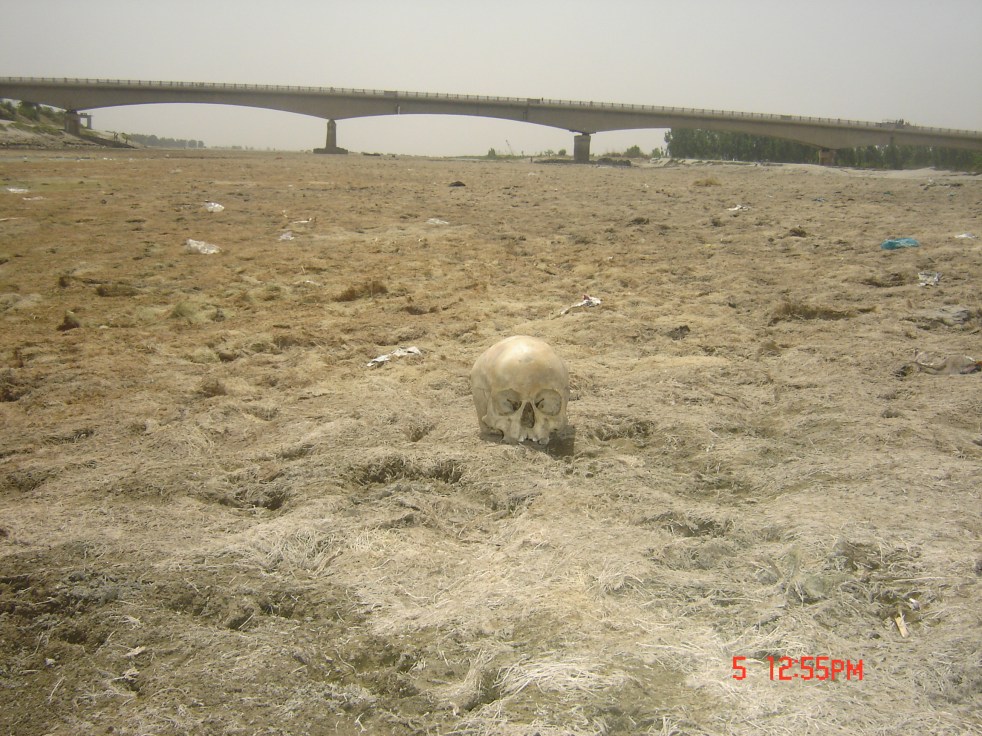
Above: Dead river Yamuna at Mawi, Panipat Photo: Yamuna Jiya Abhiyan

~ Guest Blog by Manoj Misra (yamunajiye@gmail.com)

Ganga is hotter but Yamuna is hot too, with a number of suitors now trying to chase it, thanks to Prime Minister Modi’s often expressed desire for a rejuvenated Ganga.

But Sinya Ejima, the JICA (Japan International Cooperation Agency) chief in India takes the cake, when he expects to swim and drink the Yamuna waters in Delhi in 2017 (thanks to JICA’s assistance to the Yamuna Action Plan, YAP)  [1].

But is there more to this public declaration of bravado by Mr Ejima than that meets the eye? Let us try and decipher..

It was way back in 1993-94 when Government of India launched Yamuna Action Plan with an objective to “bring the water quality of the river back to bathing level” with JICA’s (then called the JBIC) assistance. In popular scientific ‘pollution’ parlance, it meant achieving a BOD level of 3 mg per liter all through the length of the 1376 km river from Yamunotri till Allahabad.

Yamuna Action Plan was implemented like its predecessor Ganga Action Plan (GAP) as primarily a pollution abatement effort in 21 cities in Haryana and UP and the National Capital territory of Delhi and claimed to have created a total sewage treatment capacity of 753 MLD at a total cost of Rs 682 crores (1 Crore = 10 million).

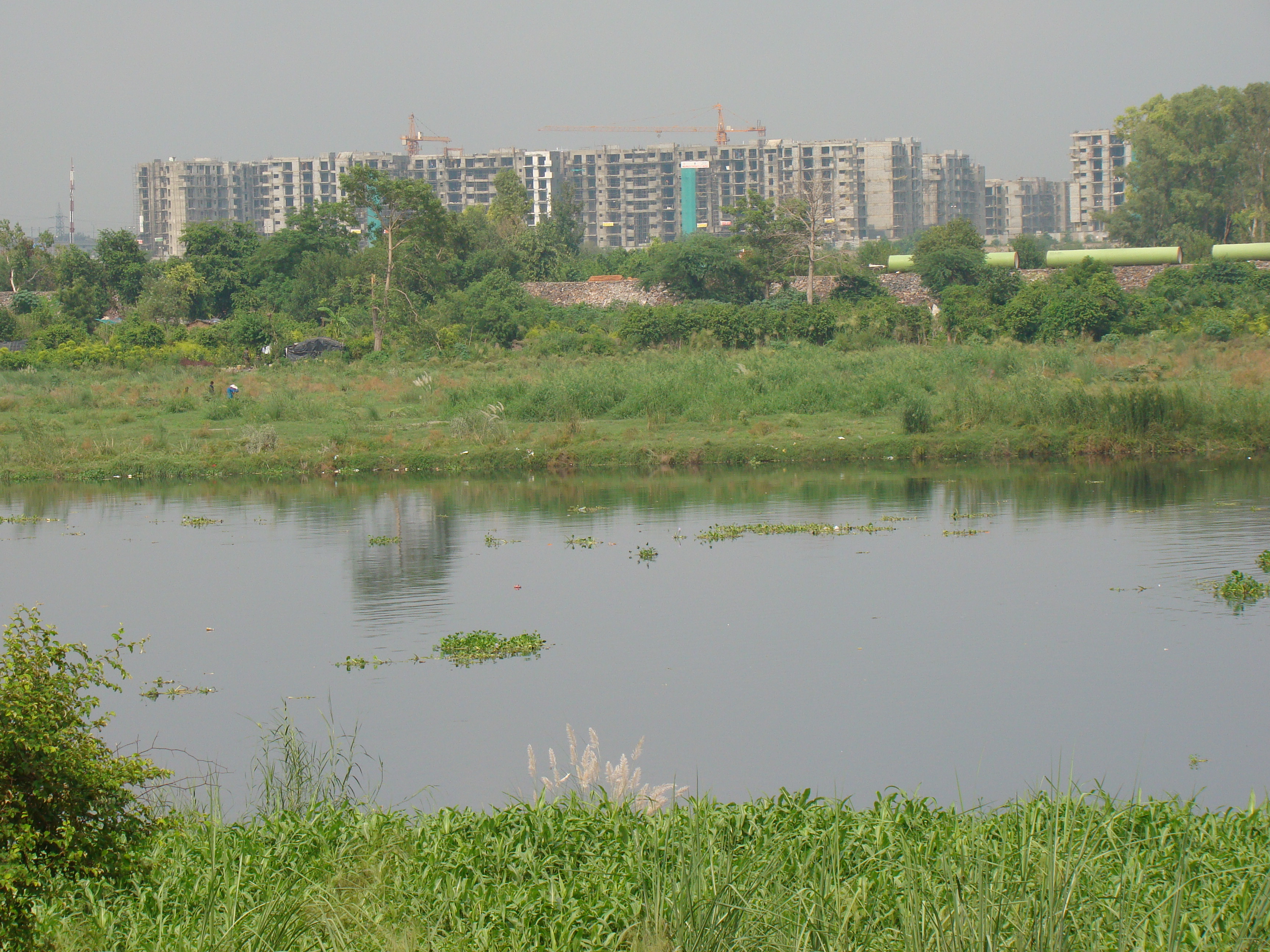
Listless and dying river in Delhi Photo: Yamuna Jiye Abhiyan

YAP II began, again with JICA assistance, in 2003 at a total cost of Rs 624 crore for abatement of pollution of river Yamuna in Delhi, UP (98 towns) and Haryana (6 towns). It claims to have created additional sewage treatment capacity of 189 MLD.

Yamuna Action Plan III, again with JICA assistance with a projected life span of 7 years is currently underway since 2012 and is aimed again at the pollution abatement in the city of Delhi. The cost estimate of YAP III is Rs 1656 crores and its components include rehabilitation of damaged trunk sewers in the Kondli and Rithala catchments;  rehabilitation and modernization of STPs at Okhla, Rithala and Kondli in tune with the under preparation sewerage master plan for the city.

Against all the above mentioned efforts, tall claims and money spent (largely national debt), the Central Pollution Control Board, in response to the Supreme Court of India, reported in March 2012:

River Yamuna is not conforming to the desired levels from Panipat downstream to Agra downstream due to higher concentration of one or the other criteria pollutants.”   The report added that “efforts of state governments of Haryana, Uttar Pradesh and the National Capital Territory of Delhi for collection and treatment of waste water are not showing improvement in the water quality of river Yamuna.”

Clearly, all the past efforts at the ‘cleaning’ of river Yamuna mostly with JICA assistance (read loan) have failed.

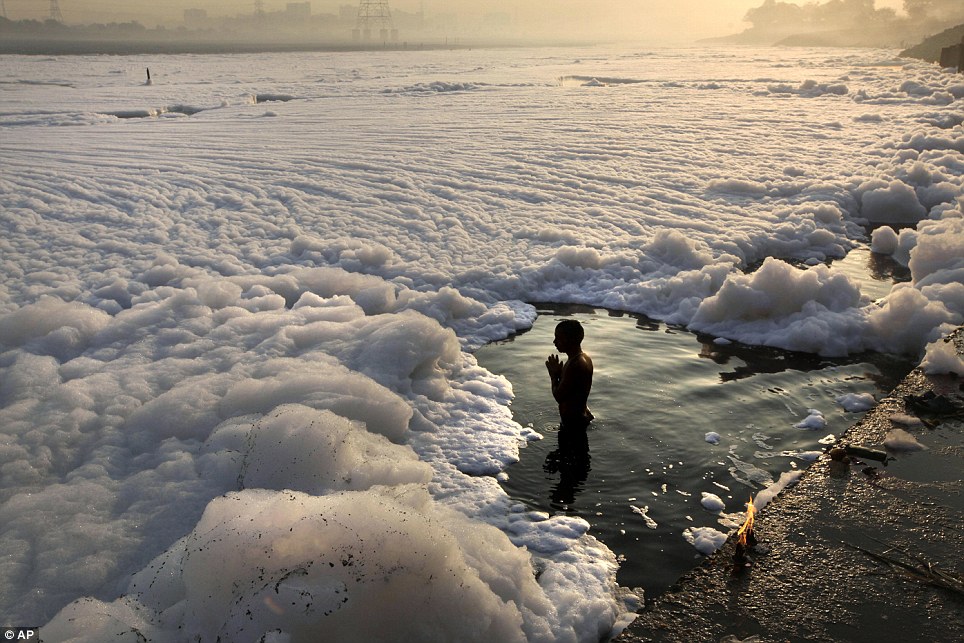
Wroshipping the polluted Yamuna. Photo from Daily Mail. co.uk

So, what could have prompted this new found source of energy and bravado as shown by Mr Ejima, the JICA chief in India at a presentation the other day at the India-Japan joint working group meet on Urban Development on ‘JICA’s Operations In Urban Sector in India’ in Delhi?

It is no longer a secret that following Prime Minister Modi’s clarion call from the ghats in Varanasi for the rejuvenation of river Ganga (and by implication its other tributaries like Yamuna), there has been a sudden and newly-found interest in rivers of India by countries like Holland, Germany, France and Australia (to name but a few) and a regular stream of experts/visitors (read consultants) there from can be found making the rounds of the corridors of power in New Delhi.

All this could be unnerving and a turf threat to any ‘established’ provider of goods and services in the name of river cleaning in India, say the likes of JICA, and possibly thus the said show of bravado by its chief in India.

However, the so-called river ‘cleaning’ route focused on pollution abatement as the primary means of river ‘rejuvenation’ is in our understanding fundamentally flawed and hence destined to fail. Results of all past similar efforts validate our stand.

If only we could begin practicing the basic principle of a ‘River’ and ‘Sewer’ not meant to mix, and that all sewerage improvement works (main component of JICA assistance) in cities of India be treated and planned as a strategy of ushering in a sound urban management, rather than river rejuvenation?

Sine qua non for any river rejuvenation is the restoration of its flow in its most natural state.

However, if true to his words, Mr Sinya with his tested and failed (unfortunately) primarily pollution abatement efforts can still manage to restore the Yamuna enough to swim and drink its waters in the year 2017, we would love to toast him as a national river restoration icon. AMEN.

END NOTES:

[1] PIB press release, see: http://pib.nic.in/newsite/PrintRelease.aspx?relid=110911

Arunachal Pradesh · Environment Impact Assessment · Expert Appraisal Committee · Forest Advisory Committee · Himalayas

Dibang Insensitivity Analysis : FAC recommendation can destroy 4577 ha rich Forests

Reaching exasperating lows of environment decision making, the Forest Advisory Committee (FAC is a statutory body of the Ministry of Environment Forests and Climate Change (MoEFCC) formed under the Forest Conservation Act of 1980. FAC appraises Forest diversion proposals) has recommended Forest Clearance to the 3000 MW Dibang Project on Dibang river in Arunachal Pradesh.

While we had already written against this recommendation, what is nearly unbelievable is that this recommendation has come at just 10 meters height reduction of the dam from the proposed 288 meters.

This was the very same NHPC proposal which was rejected twice by the FAC in the past,[1] despite this token 10 meter height reduction. In fact in April 2014, the FAC said that 10 mt reduction does not take care of any pertinent impacts for which the proposal was rejected in the first place in July 2013! A 10 m reduction would still mean destruction of 3.24 lakh trees and submergence of 4577.84 hectares, nearly 12000 acres, of rich bio-diverse forest.

Dibang River Photo with thanks from Global Post, Scot Ligare
Dibang River.  Photo with thanks from Global Post, Scot Ligare

The usually reticent MoEFCC (Ministry of Environment, Forests and Climate Change, MoEF earlier) too had issued a strong-worded rejection to this scheme in August 2014, stating that 10 meters reduction is nothing in the face of what is being lost. The rejection letter stated: “Such a marginal reduction in requirement of the forest land (445 hectares reduction, reducing forest requirement from 5056 hectares to 4577 hectares) for the project may not be able to reduce the adverse impact of project on such a biodiversity-rich mature forest ecosystem to the extent which could make the project environmentally as well as socio-economically viable in forest dependent tribal society of Arunachal Pradesh”.

This letter from the same ministry certified that the 10 m reduction proposal still leaves the project environmentally, socio-economically unviable. So an environmentally and socio-economically unviable project has been recommended clearance by the statutory FAC (and also the separate recommendation a week earlier by the same MEFCC’s Expert Appraisal Committee on River Valley Projects)!

This shows that the decision of FAC is devoid of merits, will invite huge opposition from Arunachal Pradesh, Downstream Assam, North East India, and even beyond and will not pass legal scrutiny. The decision seems to have been taken under pressure from the political masters. Union Power Minister Piyush Goyal has been dreaming of clearance to this project, as is clear from his road map published on completion of 100 days of office for the new NDA government[2]. He has also been pressurizing the MoEFCC to clear the project by hook or by crook. The FAC was reconstituted and the reconstituted FAC has obliged the minister in its very first meeting. In the process, the entire FAC has violated its mandate and should be held accountable for this.

Regrettably, MoEFCC seems to have become the willing punching bag of not only above-mentioned ministries, but even unrelated ministries like Ministry of Mines and Minerals, Ministry of Steel ,etc., whose ministers and Secretaries were present for the meeting: “to Expedite Clearances”. (Incidentally, when was the last time we heard MEFCC resisting such arm-twisting, or forthrightly suggesting any pro-environment measures to other ministries?)

Before the minutes of the September FAC meeting were out on Oct 22, 2014 (there was an inordinate delay this time, raising suspicion of negotiated minutes and again breaking all norms of conduct), there was discussion in media that Dibang was cleared, but even the hard-core skeptics believed that this recommendation must have come after a 20 meter or 40 meter height reduction, for obvious reasons.

But the FAC seems to have outdone itself. As stated above, the recommendation has come at 10 mts height decrease, for which the FAC had rejected the project and MoEF had issued a rejection letter in the past.

As we discussed in detail in our last blog on Dibang project, the twice-rejected project was up for discussions again in Sept 2014 only after considerable arm-twisting of the MEFCC by the Cabinet Committee of Investment, Ministry of Power, Project Developer NHPC and Arunachal State Government. This time it was for a supposed sensitivity analysis (done by the developer!) for studying the feasibility of reducing the height of the project upto 40 meters from its original height of 288 meters.

This sensitivity analysis was not shared with anyone, not even the FAC members till the day of the FAC meeting, breaking all codes of conduct of transparency, participation and informed decision making in governance. SANDRP wrote about this to the Minister and Secretary of MoEFCC as well as the Member of the FAC, but received no response.

Looking at the minutes, it is clear that the FAC members have lapped up the logic presented by the developer and the Ministry of Power which in a nutshell says that “10 meters reduction is sufficient as the ratio of forest land required per MW is lowest at 10 meters reduction.” This twisted logic reduces all decision making related to forests, even biodiversity-rich forests supporting endemic, unstudied species, local protests, downstream impacts etc., to mere number crunching of forest per MW. This criteria alone cannot  be the basis for decision for forest appraisal committee.

Dibang Valley Forests Photo: The Telegraph

As per the sensitivity analysis by NHPC, the ratio forest land required per MW for 40 meters reduction is 1.67 MW/ hectare, which is same as no height reduction and 1.78 MW/ hectare in case of 20 meter reduction. In terms of tariff, for 40 meters reduction, the power tariff will be 6.24 Rs./unit while it is 5.66 Rs/unit 10 meters reduction, 5.94 Rs./unit 20 meters reduction and 5.64 Rs. at zero reduction. The installed capacity will reduce by 120 MW (4%) MW for 10 meters reduction, 600 MW (20%) for 20 mt reduction and 780 MW (26%) for a 40 meter reduction.

Height Reduction Forest land required MW capacity per ha Forest lost First Year Tariff: Rs per unit Reduction in installed capacity
Nil (288 m) 5056 Ha 1.67 5.64 None
10 m 4578 Ha 1.59 5.66 120 (2880 MW)
20 m 4284 Ha 1.78 5.94 600 (2400 MW)
40 m 3703 Ha 1.67 6.24 780 (2200 MW)

The proponent said: “Decrease in dam height and consequent sacrifice of power generation beyond 10 mt is not commensurate with saving forest land.”

How did NHPC reach this conclusion? What is the value of the mature, old growth forest land considered by NHPC? Without knowing this, how can this conclusion be acceptable to the FAC? It has to be remembered that Dibang is not an exclusive hydropower project, but a multipurpose project with a flood moderation component and costs have to be borne for this.

While the proponent and Ministry of Power did their best for pushing the project, the FAC did not do its duty of stating that the sensitivity analysis put forth by NHPC is a sham as it does not consider the worth of the forest being lost.

In this sabji-mandi haggling, when FAC had all the watertight justifications for rejecting the project, it did not bat for even a 40 meter reduction, which could have saved nearly 1355 hectares of forests and would have had a marginal impact on other factors. Its unclear why this happened.

Only one of the FAC members tried to battle the case saying that 10-40 meter reduction still does not address the upstream and downstream impacts, especially considering the biodiversity rich area. The minutes do not disclose the name of this member, but it seems the brute majority (majority of FAC members are govt officials) took the official line, alleging “subjectivity” and said that “To reduce subjectivity, it is important to analyse the issue objectively on objective parameters”. Forgetting that this is Forest Appraisal committee, not Power Developer Committee.

This is ironical. It was indeed the duty of the FAC to appraise the project “objectively” based on issues like destruction of 3.24 lakh trees, invaluable forests, unstudied biodiversity, rich wildlife and several Schedule I species, community dependence, traditional rights, downstream impacts, climate change impacts, options assessment, etc. But it did nothing of that and has in fact recommended the project “subjectively”, bowing to pressures outside their ambit.

Clearly, per MW forest land required and per Unit Tariff from a project are anything but objective criteria for FAC. FAC is supposed to apply its mind to a number of issues like the ones above.  If FAC was not supposed to apply its mind to these aspects and its judgment, there was no need for an FAC, Power ministry and developer could have taken the decision independently.

The FAC decision does not address any pertinent issues raised by the same FAC while rejecting the project, it also does not address downstream impacts on Assam or assume any value for a rich forest. There is no discussion why 20 meters or 40 meters reduction is not seriously considered by FAC. Decision-making based on such biased, proponent-driven criteria is bound to be open to legal challenge and public protests.

Sham consideration of Downstream Impacts About Impact of the project on Dibru-Saikhowa National Park, the User Agency said that the issue was considered by EAC in its meeting on the 16th September (Please note this is just 6 days and 5 working days back from FAC meeting. There is no chance of minutes being firmed up by then. They were not in open domain in any case) and the EAC has recommended clearance based on the fact that there is less than 1 meter level fluctuation at DSNP.

This claim in any case is patently incorrect, again a case of project-friendly, anti-environment decision-making. The level fluctuation at DSNP can go way higher than a meter, anywhere from 7-8 feet every day in lean season, according to the studies considered by the EAC of the MEFCC itself. This has been pointed out by SANDRP to the EAC as well. There has been no study of the impacts of this project on downstream Arunachal Pradesh or Assam. The developer seems to assume that Dibru-Saikhowa is the only part of Assam worth considering.

Dibang Valley tribes Photo from go ibibo/dibangvalley

There is no compliance under Forest Rights Act (2006) for such a massive project and despite this, FAC under some supposedly progressive members working on tribal issues, does not bat an eyelid before recommending clearance!

To conclude, pricing mature, biodiversity-rich forests in terms of per MW terms is an insult of those forests, the communities that depend on them and to the mandate of  FAC. Downstream impacts of Dibang project are not studied, the impacts on Dibru-Saikhowa are based on compromised studies.

There is no merit in this decision from the newly appointed FAC which includes members also from reputed environment protection organizations in North East and from Tribal Welfare groups like Friends of Baripada. It is also sad to see that there is no dissenting note from a single member. The unnamed member who expressed dissent in the meeting has not written anything about this in public domain.

Decisions like Dibang lay further foundations for poor, pro-developer, anti-people, anti-environment decisions taken due to pressure from proponent and other ministries. Such decisions will not be legally tenable, nor acceptable to affected communities, nor good for sustainability and equity. In fact, by such reversals, FAC decisions are losing their sanctity. FAC has done this in the past too in case of Kalu Dam in Western Ghats which would submerge 18 villages and 1000 hectares forest.

Isn’t it ironical that the new government changed the name of the MoEF to MoEFCC but is sanctioning massive projects like Dibang which will have far reaching impacts on Climate Change as well as adaption and mitigation abilities of the affected communities? Without even considering these aspects or even mentioning them?

Parineeta Dandekar, parineeta.dandekar@gmail.com

[1] For details see: https://sandrp.wordpress.com/2014/10/06/manipulating-environment-forest-clearances-for-dibang-project-deja-vu-lshp-history-repeated-will-it-be-tragedy-or-comedy/, https://sandrp.wordpress.com/2014/05/17/dibang-project-rejected-forest-clearance-for-the-second-time/

[2] http://www.piyushgoyal.in/uploadedfiles/views/ministry_english_booklet.pdf

[3] http://www.theguardian.com/environment/india-untamed/2014/oct/22/indias-largest-dam-given-clearance-but-still-faces-flood-of-opposition

[4] https://sandrp.wordpress.com/2013/04/25/kalu-dam-in-western-ghats-fac-goes-back-on-its-word-without-any-justification/

Ganga · Ministry of Water Resources

A RIVER MAP FOR REJUVENATING GANGA

(Above: River Ganga at Rishikesh Photo with thanks from Ramesh Rawat, India Travelz)

– Guest Blog by: Manoj Misra (manojmisra@peaceinst.org.  Author is the Convener of Yamuna Jiye Abhiyaan)

A ‘road map’ might be an inappropriate term for a ‘river’ rejuvenation plan. Thus I am using the term, a ‘river map’.

It is well known that despite the Ganga Action Plan (GAP) being in place since the year 1985 and the Supreme Court adjudicating public interest litigation on it since 1993 the river has become increasingly sick with some stretches notably in Kanpur deserving a biologically ‘dead’ status. So it came as a huge sign of hope when the Prime Minister Modi took upon Ganga rejuvenation as a personal mission and appointed Sushri Uma Bharti, a well known Ganga devotee and activist as the Union Minister of the renamed Ministry of Water resources, River development and Ganga rejuvenation. Soon the Finance Minister in the new government allocated financial resources to the tune of Rs 2037 Crores in the name of Nemami Gange (devotional bow to river Ganga) a flagship scheme of the new government, which is aimed at the rejuvenation of river Ganga.

Yet in recent days the Supreme Court time and again has chided the state on the lack of a sound action plan for its avowed objective of a rejuvenated river Ganga. So much so that it once, in an obvious exasperation on the state’s ‘business as usual’ approach to the issue, commented that “it might well be another 200 years before Ganga is actually rejuvenated”? Clearly notwithstanding its firm intent, the state continues to struggle with defining a ‘road (river) map’ that could while convincing the highest court in the land of its utility, set a clear and effective action plan on the ground for a rejuvenated Maa (mother) Ganga?

REJUVENATION

Let us try and see what does Ganga really require for its rejuvenation?

Term ‘rejuvenation’, which includes restoration, is a return of any living entity from what it is today to an agreed state of previous health and wellness. To unravel that we might first need to understand ‘what is’ and ‘where is’ river Ganga?

Most planners tend to view Ganga as a 2500 km long river from Gaumukh to Ganga Sagar, passing through the cities of Uttarkashi, Devprayag, Rishikesh and Hardwar in the state of Uttarakhand; Kanpur, Allahabad and Varanasi in the state of Uttar Pradesh; Patna in the state of Bihar and Kolkata in the state of West Bengal before merging with the sea in the Bay of Bengal.

Herein, we understand lay the first fundamental planning mistake. For if Ganga were a simple linear entity as planners hold, then King Bhagirath would have unnecessarily carried out tapasya (penance) placating Lord Shiva to hold Ganga in his jata (matted locks) as she descended with massive force from the Brahm Lok (abode of the gods) with a presumed potential to wreck absolute havoc on the mrityu lok (earth) unless its speed had been broken. This mythical tale translates itself into an earthly reality whereby Ganga actually resides in each and every spring, in every water fall and in every stream that together form the vast network of its tributaries spread over its vast basin. So Ganga rejuvenation plan to make sense and desired impact must encompass actions to revive and restore all these numerous streams and tributaries.

The water fall is as much the Ganga (Photo by Yamuna Jiye Abhiyaan)
Small rivulets are as much Ganga (Photo by Yamuna Jiye Abhiyaan)

Thus any rejuvenation plan that fails to look at and factor in the Ganga’s larger reality is destined to fail, a la all the previous Ganga Action Plans. All put together Ganga is no less than 25,000 km in length,   with a basin spread of some 1,086,000 sq km. (see map) These include areas in the states of Himachal Pradesh, Uttarakhand, Haryana, UP, Rajasthan, Madhya Pradesh, Chhattisgarh, Bihar, Jharkhand and West Bengal within and China, Nepal and Bangladesh outside of India. With such a huge basin, the rejuvenational challenge might appear daunting, leading to an alluring thought that let us first try and rejuvenate the 2500 km of the main stem of the river and then may be tackle the rest. This we believe to be a fatal approach akin to fire fighting, without getting to the root cause, with the most immediate organ of a cancer afflicted human resulting ultimately organ by organ in the latter’s demise. Let us not forget that a healthy river system is like a multi-strand chain which is ‘as strong as its weakest link’. Hence as long as even one tributary remains sick, there can be no respite or rejuvenation of Maa Ganga!

Ganga river basin (Source: http://en.wikipedia.org/wiki/Ganges_Basin)

In other words there is no single river Ganga. It is actually ‘Ganga Rivers’ spread all over its basin and carrying names like the Yamuna; Ramganga; Gomti; Mahakali (Ghaghara); Son; Gandak, Koshi etc with each in turn having their own network of rivers and their rejuvenational requirements, since over time majority of them have as well gone ‘sick’.

RIVER INHIBITING PROJECTS  

Some might ask, but then what could be done with tributaries lying or originating in Nepal, Bangladesh or in China? A lot actually, beginning with not promoting or supporting river ‘inhibiting’ projects there and then taking lead in a common futures dialogue (an International Ganga Rivers Commission) program on Ganga as the Ganga rivers are in need of rejuvenation there as well.

Dwelling more on what are the river ‘inhibiting’ projects we are led to what constitutes a river’s integrity?

A ‘healthy’ river must ‘run’ freely and must ‘flood’ freely. (Floods in Indian rivers are natural monsoonal occurrence which could become devastating when obstructed).

That is its longitudinal and lateral connectivities must not be allowed to be compromised through manmade structures like dams, barrages and embankments. Such connectivities are essential for a river system to fulfill its ecological roles of transport of water, sediment and energy from source to the sea; recharge of ground water; provision of habitat to aquatic and riparian biota and completion of the water cycle.

In other words, a healthy river is essentially an ‘aviral’ (unbroken in its various dimensions) river. Thus the key challenge and objective of any Ganga rejuvenation plan has to be first and foremost its restoration back to a truly ‘aviral’ state.

FIVE STEPS

Accordingly the following five steps are suggested as the ‘river map’ to a rejuvenated river Ganga.

Step 1 – Establish local level Ganga rejuvenation governance systems to ensure participatory bottom up planning and action plan execution. Support this with the establishment of a Ganga Rivers governance research centre.

Step 2 – Prioritise tributaries (Ganga Rivers) for restorative actions on the basis of their current level of threats and develop restorative action plans utilizing the governance systems as mentioned in step 1.

Step 3 – Establish through a participatory process a desired state of the rejuvenated Ganga; devise a national Ganga rivers policy and a Ganga rejuvenation law.  Initiate dialogue with the Ganga nations for an International Ganga rivers Commission.

Step 4 – Review through independent experts, all past, present and planned river ‘inhibiting’ projects on the Ganga Rivers and then either re-design them to become river friendly or decommission / drop them. There should be a moratorium placed on any new structure (barrage, HEP, embankment) on Ganga Rivers till such time that all local level options of water harvesting and energy production (including solar and wind) have been exhausted with a policy that river waters and HEPs shall be the last resort for meeting such needs.

Step 5 – Set a time bound plan of action for ensuring aviral and wholesome Ganga ‘rivers’, with plans for ensuring their flows (water, sediment and energy) as well as the restoration of their catchment, flood plains and the associated biodiversity (aquatic, riparian and terrestrial).

The steps as suggested above are not sequential in nature and many could progress concurrently.  

To a query “what then about the hydropower and water supply for fulfilling various human needs”, the response is twofold.

Firstly, this is the Ganga rejuvenation plan based on what Ganga Rivers need for the restoration of their health. Secondly, hydro-power generation and water diversion cannot be in excess of the thresholds as defined by the rejuvenational requirements of the healthy Ganga Rivers.

A rejuvenated Ganga has to be seen as a ‘provider within strict limits’ (as enunciated by the Prime Minister Modi on the banks of Maa Ganga in Varanasi, when he defined what a Maa (mother) is) and not what we in our flawed wisdom might wish to harness from her, with little concern for her deteriorating health and in disregard to the principle of inter-generational equity.

RIVER AND SEWER

The Indian state under the Ganga Action Plan had been investing time, money and efforts to restore the river Ganga through creation of pollution abatement infrastructure like the Sewage treatment plants (STPs) and the Effluent treatment plants (ETPs) in various cities and industries on the river in the name of ‘river cleaning’ with little ameliorative impact on the health of the river. In our understanding despite the poor maintenance being the cause of the failure of the created infrastructure, this approach to river restoration is fundamentally misplaced and hence wrong.

We believe that our rivers require restoration (based on the steps suggested before) of their ecological integrity in terms of their freedom to ‘flow’ and ‘flood’. Once thus freed, they possess all the power of self cleansing, subject to the observance of the fundamental principle of no mixing of ‘sewer’ with ‘river’.  Here by ‘sewer’ we mean all kinds of grey water produced both by the cities and the industries.

Thus there is no mention of any river ‘cleaning’ or creation of STPs / ETPs as part of the suggested Ganga rejuvenation plan. The installation of such infrastructure is we believe to be an essential element of the process of urbanization and industrialization whereby the grey water from the cities and industries is converted into utilizable water for recycle and reuse to meet the non potable water needs both of the cities and the industries. But to do so in the name of river cleaning is in our understanding an ostrich like approach which takes away the attention and resource allocation from the real needs of river restoration based on the sound principles of river science.

Prime Minister Modi’s another oft quoted aphorism of “Zero defect and zero effect/ impact” should be made applicable not just to good manufacturing practices but also to good urban management practices with mandatory zero impact on any river that happens to pass by. AMEN!

Manoj Misra (manojmisra@peaceinst.org)

Environment Impact Assessment · Environmental Laws · Expert Appraisal Committee · Himalayas · Hydropower · Ministry of Environment and Forests

National Green Tribunal’s Fourth Foundation Day: Why such a pro hydro bias?

The National Green Tribunal, NGT marked its 4th Foundation Day on 18 October 2014, with an impressive fanfare. A full day function was organized at the Plenary hall of the capital’s iconic Vigyan Bhawan. NGT in this short span has acquired a formidable reputation as a unique, vibrant, active institute with independent & unbiased mind and forthright, quick redressal of petitions that come to it.

The function in two separate sessions, one in the forenoon and the other in the afternoon (a Seminar) was attended by large number of government officials, judicial officers, advocates, law school students, NGT petitioners and office bearers and members of the NGT Bar association.

NGT  Foundation Function on Oct 18, 2014 (Source: FB page of Information and Broadcasting Ministry)
NGT Foundation Function on Oct 18, 2014 (Source: FB page of Information and Broadcasting Ministry)

Invited dignitaries included Mr Justice Ranjan Gogoi (Judge, Supreme Court), Prakash Javadekar (Union Minister of State for Environment, Forests and Climate Change) and Ashok Lavasa (Secretary, MoEF&CC) in the forenoon session and Mr Justice Sudhanshu Jyoti Mukhopadhaya (Judge, Supreme Court) and Piyush Goyal (Union Minister of state for Power, Coal and new and renewable energy). Mr Justice Swatanter Kumar, the Chairperson of the NGT, Mr Justice Dr. P. Jyothimani, Judicial Member, Principal Bench, NGT, Prof. R. Nagendra, and Dr. D.K. Agarwal, Expert Members at the NGT also spoke and graced the dais.

The function included, in addition to the addresses by the invited dignitaries, the release of 2nd issue of NGT International Journal; the launch of new NGT Website (in the first session) and address by invitee experts (in the second session).

In the first session Mr Javadekar informed the gathering about his political beginnings from a water pollution struggle activist against factory pollution and Mr Lavasa categorically stated that the NGT is playing an extremely crucial role and that there is no move to dilute its powers in any manner. It was in the second session that very controversially one Mr M.K. Pandit was invited to speak as an invited expert.

The Minister of State for Environment, Forests and Climate Change (I/C), Shri Prakash Javadekar lighting the lamp at the 4th Foundation Day function of the National Green Tribunal, in New Delhi on October 18, 2014. The Secretary, Environment, Forests and Climate Change, Shri Ashok Lavasa and the Judge, Supreme Court of India, Mr. Justice Ranjan Gogoi are also seen (Source: FB page of I&B Ministry)

Mr Pandit began with highlighting how recent and how fragile the Himalayas were and that a 8+ richter scale earthquake in central Himalayas was round the corner that could flatten Dehradun. Very soon in his almost 25 minute speech changed track as if on a cue to how great the hydropower dam projects in the Himalayas were for the power security of the country. The Union Power Minister had by then just joined the function to nod in full agreement with all that the Mr Pandit was narrating. The audience on the other hand was left perplexed as to what was happening?

An invited speaker was eulogizing the great merits of high dams receiving approving glances from the power minister on an NGT seminar whose topic was “Natural Disasters, Environment & Role of NGT with special reference to Uttarakhand, J&K, Assam & Himachal Pradesh”. Clearly something was amiss, somewhere?

Secondly, Mr Pandit is not a neutral expert, but an interested party. As leader of scores of pro hydro Environmental Impact Assessments that he has led as part of the CISMHE[1] team (Center for Inter-disciplinary studies of Mountain and Hill Environment) has earned them millions as they also continue to mint more money. Typical of Indian EIAs, no EIA done by CISMHE has ever raised any difficult questions for the developers. It has also never concluded that any of the projects is unviable. CISMHE EIAs are as shoddy, incomplete and inadequate as any other[2]. For example on Luhri HEP, the CISMHE EIA was so problematic that even the Ministry of Environment, Forests and Climate Change’s Expert Appraisal Committee on River Valley Projects and the World Bank found it inadequate and unreliable.

Interestingly, CISMHE website says: “Ministry of Power, Government of India established CISMHE as an R&D Centre in power studies in environment in recognition of its excellent past performance”. This means that there is also conflict of interest here in CISMHE doing EIAs, since it has been set up as an R&D Centre by Ministry of Power, that is itself a promoter and developer of hydropower projects. No wonder, Mr Pandit said what the Power Minister wanted to hear and Power Minister made no efforts to hide his approval of what Mr Pandit was saying.

Very strangely, Mr Piyush Goyal claimed that Tehri dam was an example of good project in the Himalayas that saved Uttarakhand in the floods of June 2013. Mr Goyal should know that this claim had absolutely no basis and even an Expert Body appointed by the Supreme Court of India has shown, after listening to THDC, CWC and others that such a claim has no scientific foundation. Mr Pandit did try to support the unfounded contention of Mr Goyal, but the minister asked him to keep quite.

It became clearer, when a pointed question asked by Shri Manoj Misra of Yamuna Jiye Abhiyaan about what would have been the Tehri dam scenario if the Uttarakhand high rainfall event had occurred in the peak monsoon months of July, August or September and not on 16 June 2013 (as in fact happened in Sept 2010, when Tehri created a havoc in the downstream, damaging its own Koteshwar project[3]), when the dam was almost empty and only beginning to get filled, elicited an evasive response first by the Union Minister (we cannot have structures planned for every 365 days in a year). And later when Pandit ji tried to answer, he was asked to shut without him being able to even respond to the other two questions relating to how does he reconcile to the fact of  a high intensity earthquake visiting a region where he had been advocating the dams; why was USA (as also some other countries), the mecca of large Dams bringing many of its dams down?

In any case, Mr Maharaj Pandit was contradicting himself, because he said something totally different in his article in The Hindu soon after the Uttarakhand disaster of June 2013: “Most downstream damage in otherwise flood-free areas is caused by dams and barrages, which release large volumes of water to safeguard engineering structures. Dam operators often release more water during rains than the carrying capacity of downstream areas, causing floods… Hydropower policy must consider building fewer dams and prioritise those that have the least environmental and social costs. Independent and serious monitoring of the catchment area treatment plans proposed by Forest Departments with funds from hydropower companies needs to be carried out and reported to the Green Tribunal.” In fact then in June 2013, he was on TV channels almost every night, talking about how Himalayas have the highest dam density in the world and that is such a big invitation to disaster! But he seems ready to change his stand to please the minister or the hydro project developers.

It seems as if Mr Pandit had been invited to justify the building of dams in the Himalayas in front of a large gathering of impressionable judicial officials and young student minds. It is possible that it was also intended to influence the minds of NGT members (judicial and experts) and other persons from judiciary in the face of a number of proposed dams being challenged before the various NGT benches and courts.

If a proper seminar was indeed planned on such an important matter, then there should have been several speakers on wide range of perspectives and topics and not just one speaker with conflict of interest and a clear agenda? The only other technical speaker, Dr R. Nagendran, an expert member with NGT southern bench spoke sensibly on how unscientific management of sanitary projects in hilly regions lead to parallel “Faeco-microbial disaster” which is difficult to tackle.

Mr Ritwick Dutta, secretary of NGT bar association said that the information about Mr Pandit speaking from NGT platform was not available in public domain and it is not clear how he was selected as a speaker.

Such blatant pro hydro bias in an NGT foundation day meeting is certainly unwarranted and out of place for an NGT function. An NGT platform should not have been allowed to be used for such biased presentation. We hope the bias apparent in this aberration is just that, an aberration and does not run deeper, considering that some hydropower professionals have been appointed on NGT benches.

We hope that at least in future the NGT, a statutory judicial body, otherwise doing a great job for the protection of environment, would be more careful in not letting its platform get used by the vested interests. The formidable reputation that NGT has acquired with a lot of remarkable orders should not be allowed to be affected by this one incident. NGT indeed needs to be strengthened in every way and not weakened in any manner.

It would also help if the NGT were to distance itself from this biased episode.

Pushp Jain, EIA Research and Response Centre (http://www.ercindia.org/, Pushp Jain pushp@ercindia.org) & SANDRP (based on interviews with those who were present at the NGT foundation day meeting)

END NOTES

[1] http://www.cismhe.org/

[2] For example, see: https://sandrp.wordpress.com/2014/04/11/the-world-bank-drops-funding-usd-650-m-for-the-luhri-hydro-project-victory-for-the-sutlej-bachao-jan-sangharsh-samiti/, https://sandrp.wordpress.com/2014/07/09/pauk-heo-tato-i-hydropower-projects-cismes-shoddy-eias-seven-big-hydro-on-third-order-tributary-of-brahmaputra/, https://sandrp.wordpress.com/2014/10/06/manipulating-environment-forest-clearances-for-dibang-project-deja-vu-lshp-history-repeated-will-it-be-tragedy-or-comedy/

[3] For details, see: https://sandrp.wordpress.com/2013/06/28/uttarakhand-floods-truth-about-thdc-and-central-water-commissions-claims-about-tehri/ and https://sandrp.wordpress.com/2013/08/07/is-thdc-preparing-to-repeat-the-disaster-tehri-created-in-sept-2010/

[4] https://sandrp.wordpress.com/2014/04/29/report-of-expert-committee-on-uttarakhand-flood-disaster-role-of-heps-welcome-recommendations/

[5] http://www.greentribunal.gov.in/

[6] http://www.greentribunal.gov.in/Writereaddata/Downloads/circular7Oct14.pdf

[7] http://www.thehindu.com/opinion/op-ed/nature-avenges-its-exploitation/article4834480.ece

Dams

Press Release: “INDIA RIVERS WEEK”, FROM 24-27 NOV 2014. First IRW to be held in Delhi

A recent appraisal has found that there is no river in any of the top 50 cities in the country which is not sick or dying with river Yamuna in Delhi-Mathura-Agra and Ganga in Kanpur-Varanasi-Patna leading the list.

Widespread devastations in Uttarakhand (June 2013) and J&K (Sept 2014) and Assam-Meghalaya in North East (September 2014) bring home the fact that disturbed rivers can become dangerous and highly devastating.

Dams, diversions, bumper-to-bumper hydro projects, diverted natural flows, encroached flood plains, embanked river channels, degraded catchments, destruction of local water systems and pollution of various kinds are some of the reasons for the above.

The uncertainties associated with the phenomenon of climate change are predicted to further compromise the integrity of our rivers.

Lack of true understanding and appreciation – amongst planners, decision makers, various government departments as well as the common man – of rivers as ecological systems providing a number of ecological and economic services is a major reason for the sorry state of our rivers.

No wonder, there exists no national policy or law that could provide our rivers security from degradation and exploitation.

With an aim to remedy the above situation, a consortium of NGOs including WWF India, INTACH, SANDRP, Toxics Link and PEACE Institute Charitable Trust, are organizing with additional support from Arghyam (Bengaluru), International Rivers (Mumbai office), and Peoples Science Institute, Dehradun, the first ever India Rivers Week, 2014 as a national event in New Delhi from 24-27 of November 2014.

The venue for the Conference is the WWF India secretariat in Delhi. Sri Ramaswamy R. Iyer, former Secretary, Ministry of Water Resources and a leading expert on rivers in the country is chairing the consortium partners.

Over 100 River experts, planners, researchers, artists, enthusiasts and activists from different parts of the country shall congregate in Delhi for 4 days to discuss, deliberate and exchange their experiences and ideas aimed at the restoration of rivers in the country.

With ‘Rivers in Crisis’ as the theme, the Conference shall endeavor amongst other things to devise a National Charter for Rivers, promote a National forum for restoration of rivers and reward an individual and an organization with remarkable track record of work on rivers with the “Bhagirath Prayas Samman”.

Advice and expertise from river experts and activists from different parts of the country has been solicited in form of a National Advisory Committee to make the event productive and successful.

For more details, contact:

Ramaswamy Iyer (9871075038; ramaswamy.iyer@gmail.com )                                                                                                                                              Suresh Babu (WWF-India; 9818997999; suresh@wwfindia.net)                                                                                                                                     Himanshu Thakkar (SANDRP; 9968242798; ht.sandrp@gmail.com)                                                                                                                                     Manu Bhatnagar (INTACH; 9810036461; manucentaur@hotmail.com)                                                                                                                                   Ravi Agarwal (Toxics Link; 9810037355; ravig64@gmail.com)                                                                                                                                                  Manoj Misra (PEACE Institute; 9910153601; yamunajiye@gmail.com).