CWC - Central Water Commission · Dams

Rivers Breaching Highest Flood Levels in July 2023

Continue reading “Rivers Breaching Highest Flood Levels in July 2023”
Dams

DRP NB 240723: Urgently need parameters that will truly reflect rainfall pattern

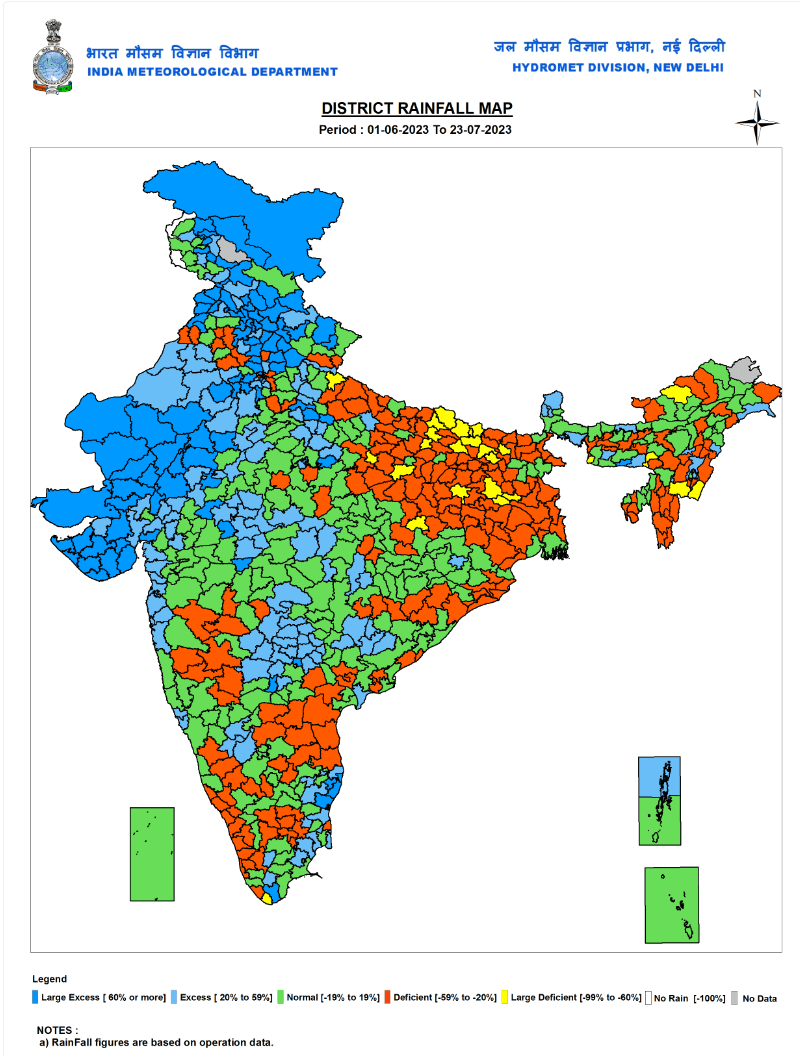
(Feature Image: – IMD’s District Wise Cumulative Rainfall Map for 01 June to 23 July 2023)

India received 389.2 mm rainfall till 0830 hrs on July 23, 2023 in SW monsoon. This being 5% above the normal rainfall till this date of 370.9 mm, India Meteorological Department and with it, the whole nation calls it Normal Monsoon. But anyone who is familiar with the rainfall pattern across India will not call it Normal.

We must urgently develop new parameters for describing the monsoon that also take into account spatial (across states, districts, Tehsils, blocks) and temporal variability. These parameters should take into account the departure from normal for each unit of space for each day and combine such departures to arrive at a figure that will better describe the monsoon for each unit of space. It can also take into consideration the high intensity rainfall events as also the longer dryer patches. This will help us understand not only the nature of monsoon rainfall, but also alert the farmers and everyone else but also help us understand how this pattern is changing over the years. This should not be so difficult for IMD to initiate and accomplish quickly. When aggregated at river basin level, this will also help us understand the actual rainfall pattern in each river basin but also how it is changing. Is this too much to ask?

Continue reading “DRP NB 240723: Urgently need parameters that will truly reflect rainfall pattern”
DRP News Bulletin

DRP NB 170723: Man-Made Reasons That Make Flood A Disaster

(Feature Image: At Bhuntar, the Beas in spate claimed more than 20 shops, several houses and a major chunk of the road. PTI/The Tribune)

Over the past 10 days, several Himalayan and North Indian states including national capital Delhi have been battling severe flood disaster which has already taken a heavy toll of human lives apart from displacing people in large numbers and causing massive scale and still unfolding destruction to public-private infrastructure which is still unfolding.

While at macro level the impact of climate change induced excessive and abnormal rainfall patterns is seen as a major culprit but the micro level analysis reveals the deep connection of human activities behind the devastation on ground.

For example, in Himachal and Uttarakhand it is increasingly becoming clear that the large-scale construction and widening of improperly designed and poorly executed highways projects have started proving a double whammy for the fragile hills and river systems.

Continue reading “DRP NB 170723: Man-Made Reasons That Make Flood A Disaster”
DRP News Bulletin

DRP NB 030723: Peak Hour Tariffs to be implemented from April 2024

(Feature Image: Vyasi HEP power station at Hathyari, Dehradun. SANDRP, June 2023)

This announcement by the government is indeed much belated but welcome step that India plans to increase peak hour power tariff compared to non-peak hour power tariff, beginning with commercial and industrial consumers from April 2024 a year later for others excluding agriculture consumers. The notification mentions it as daytime tariff (during solar hours) and night time power use, but this essentially also helps peak management.

This will not only put a premium on peak hour power consumption and hence generation, but also hopefully ensure that assessment of impacts of the peak hour power generation including at hydropower projects is done and done in a credible way, along with compensating those affected. It will also hopefully ensure that existing hydro capacity is used optimally for peak hour power generation before going for new hydro projects in the name of increasing peak our power generation.

One also hopes that it will lead to better peak hour power management and also considering all the options for such power generation rather than pushing hydro projects blindly in the name of peak hour power generation.

Continue reading “DRP NB 030723: Peak Hour Tariffs to be implemented from April 2024”
DRP News Bulletin

DRP NB 260623: National Framework for Sediment Management

A National Framework for Sediment Management is certainly a long standing requirement and any move in that direction would have been welcome. Not only because the sediment accumulation destroys storage capacity of India’s Dams, created at such massive costs. But also because sediment is an integral part of river flow and also very important for the rivers to stop or reduce erosion at deltas. There are other issues related to sediment including creation and disposal of toxic sediment and impact of sediment free water flowing downstream from the hydropower projects.

But we need much more serious and sincere efforts in this direction than what has been suggested in following government press release. The movement on such an important subject is so snail paced, half hearted, non-comprehensive, unscientific and non-sincere that it is not clear how this is going to help.

Continue reading “DRP NB 260623: National Framework for Sediment Management”
Yamuna River

Vyasi Hydro: Village Drowned; River Dried but little power generation

(Featured Image: Submerged Lohari village houses in Vyasi HEP ‘RoR’ dam reservoir. SANDRP, June 2023)

The 120 Mw Vyasi HEP built by Uttarakhand Jal Vidyut Nigam Ltd (UJVN Ltd.) in Vikas Nagar tehsil of Dehradun is on its way to become the textbook example of how thoughtlessly pushed hydro power projects are proving a nightmare for local people, a costly affair for the state and the nation and a disaster for free-flowing living river.

The project offers some bitter lessons for the policy-makers, experts and society who have been assuming that hydro power is a cheap, green source of energy and the Run of River (RoR) projects don’t dam and cause much harm to the environment, people or rivers.

Continue reading “Vyasi Hydro: Village Drowned; River Dried but little power generation”
DRP News Bulletin

DRP NB 190623: Ten years of Uttarakhand Flood disaster

(Feature Image: Thousands of people have been rescued but the inability of rescue teams to navigate disaster-struck areas has left over 60,000 people stranded in Uttarakhand. The Hindu, 19 June 2013)

This week marks ten years since the Uttarakhand flood disaster of June 2013, the worst recorded disaster in the state. The deaths and destruction in the disaster were unprecedented. Large parts of the deaths and destruction were due to man-made causes. Climate Change played its anthropogenic role too as the unprecedented rainfall happened even before the monsoon was set in. Even the Supreme Court took suo motu cognizance of the disaster and ordered halt to all hydropower projects and independent review of them. One of the major human causes that worsened the disaster was the lack of credible disaster prevention and management systems.

One expected that we and particularly our all powerful governments in the state and the Centre would learn lessons from such an unprecedented, such a massive destructive disaster. The first step to that would have been credible reporting of what exactly happened during the disaster, which agencies played what role and how the destruction could have been reduced. That such a report does not exist even today says a lot.

Continue reading “DRP NB 190623: Ten years of Uttarakhand Flood disaster”
DRP News Bulletin

DRP NB 120623: Tip of Karnataka irrigation scam?

(Feature Image: A decade old Amul caricature on Rs. 70, 000 crore irrigation scam in Maharashtra.)

It’s not very frequent that irrigation scams come to light. Somewhat inadvertently, the Karnataka irrigation scam seems to be getting exposed when the newly elected state government stopped two irrigation projects in the constituency of the irrigation minister of the previous state government, the Gatti Basavanna Dam and the Ammajeshwari Lift Irrigation Project. In both cases, the department officials are saying that they prepared the project reports based on instructions from above. In both cases, the costs proposed at one stage were 3 to 9 times higher than the revised estimated cost.

One only hopes that the government, media and the judiciary will go to the bottom of these revelations and bring to light the full dimensions of what seems like a tip of the Karnataka Irrigation Scam. It is public knowledge that Karnataka has been spending tens of thousands of crores each of the last few years in the name of big irrigation or dam projects, without commensurate benefits.

Continue reading “DRP NB 120623: Tip of Karnataka irrigation scam?”
Yamuna River

मनोज मिश्र: नदियों के संरक्षण को समर्पित एक वनाधिकारी

(फीचर इमेज: कौशाम्बी उत्तर प्रदेश में यमुना की ऑक्स बो लेक अलवारा में भ्रमण के दौरान मनोज मिश्र। फोटो: डॉ एस आर टैगोर, दिसंबर 2012)

“मेरे जीवन काल में तो यमुना की हालत में सुधार संभव नहीं है पर आने वाली पीढ़ी शायद एक जीवित नदी देख पाएं”, यह बात मनोज मिश्र जी ने वर्ष 2013 में उस समय कही थी जब वे यमुना में आई बाढ़ का मुआयना कर रहे थे। आज यमुना नदी संरक्षण को समर्पित प्रख्यात पर्यावरणविद मनोज मिश्र हमारे बीच नहीं हैं। विगत दो माह तक करोना से जूझने के बाद, 04 जून 2023 को मनोज जी का निधन हो गया।

देश की राजधानी दिल्ली में सालभर मृत अवस्था में रहने वाली यमुना, केवल बाढ़ के समय ही थोड़ी अवधि के लिए खुद को साफ़ करते हुए उद्गम से संगम तक एकरूप में बहती है। इसे मनोज जी नदी के लिए वरदान मानते थे और सरकारों से यमुना बाढ़ क्षेत्र (खादर) को बचाने और नदी में अविरल बहाव को लाने के लिए समग्र सोच के साथ गंभीर प्रयास की अपेक्षा रखते थे। वास्तव में नदी खादर का बचाव एवं नदी में प्राकृतिक बहाव की बहाली मनोज जी के यमुना शोध एवं संरक्षण कार्य का केंद्र बिंदु रहे।

Continue reading “मनोज मिश्र: नदियों के संरक्षण को समर्पित एक वनाधिकारी”
Ken River

The Natural Water Systems that Make Ken a Living River

(Feature Image: Water pools (Dabras) formed in Ken (left) & Patne (right) rivers confluence in Pawai block, Panna district, MP. (Image taken during Ken River Yatra by SANDRP & Veditum) 

This report is based on the experiences and understandings made during a thirty-three-day long walk along Ken River covered in three phases in June & October 2017 and in April 2018 by Bhim Singh Rawat, South Asia Network on Dams, Rivers and People (SANDRP), Delhi and Siddharth Agarwal, Veditam India Foundation, Calcutta.

The objective of the report is to share the observations with common public as we have done in past which can be seen here Part 1, Part, 2, & Part 3. In future also we would try to prepare similar reports to highlight the unexplored aspects and lesser-known stories of Ken river. The Hindi version of this report can also be seen here.

Continue reading “The Natural Water Systems that Make Ken a Living River”