Wetlands

Mumbai Civil Society Efforts to Protect Mangroves, Wetlands

Continue reading “Mumbai Civil Society Efforts to Protect Mangroves, Wetlands”
Wetlands

World Wetlands Day 2025: Ten Positive Stories from Urban India

Continue reading “World Wetlands Day 2025: Ten Positive Stories from Urban India”
Wetlands

World Wetlands Day 2025: Top Ten Positive Actions & Reports

Continue reading “World Wetlands Day 2025: Top Ten Positive Actions & Reports”
Beas · Culture · Fish Sanctuaries · Wetlands

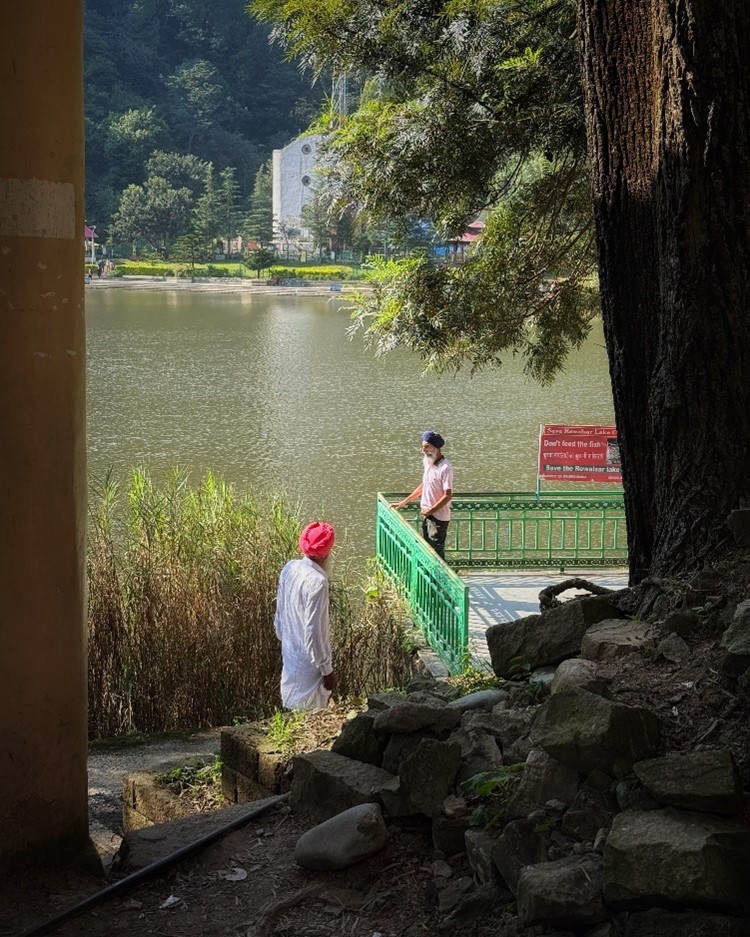
Rewalsar Lake: Where Faiths, Ecosystems and Communities Meet

Rivers and lakes of the Indus basin have been at the crossroads of civilizations, trade routes, and ecosystems for centuries. They are surrounded by stories and songs from many religions, languages and tribes. One such river is Beas, celebrated as Vipash[1] or the ‘breaker of chains’ in the Rigveda, circa 1500 BC. Beas originates at 4361 meters near Rohtang Pass[2] and flows through the Himalayan state of Himachal Pradesh before meeting River Sutlej in the plains of Punjab, literally “the land of five rivers’. Beas flows for about 470 kms to water some of the most fertile valleys in the world.

Continue reading “Rewalsar Lake: Where Faiths, Ecosystems and Communities Meet”
Wetlands

WWD 2023: Top Ten India Wetlands Stories about Govt Actions

(Feature Image: Kochi Corporation’s proposal to reclaim wetlands at Brahmapuram shot down. A view of the Brahmapuram solid waste treatment plant on the banks of the Kadambrayar. | Photo Credit: Thulasi Kakkat/ The Hindu)

In this second part of annual wetlands overview of 2022, SANDRP compiles the top ten actions by various governments in India regarding wetlands in 2022. The compilation also highlights some of the controversial steps planned and taken by the governments with an adverse impacts on wetlands conservation. The first part of wetlands review 2022 has focused on the how wetlands continue to suffer from misgovernance. 

Continue reading “WWD 2023: Top Ten India Wetlands Stories about Govt Actions”
Wetlands

WWD 2023: India’s Wetlands continue to face Rising Threats and Misgovernance

(Feature Image: Giri tal of Kashipur, Uttarakhand succumbing to govt’s apathy. Bhim Singh Rawat/SANDRP Nov. 2022.)

World Wetlands Day is celebrated every year on February 2. The theme for year 2023 is Wetlands Restoration. Marking the occasion, SANDRP has been presenting annual overviews on various governance aspects of wetlands in India including general scenario, governments’ plans, judicial interventions and positive efforts to save these crucial eco-systems. This first part of the 2023 series covers the overall situation of wetlands in the country in 2022. The reports show that the wetlands continue to face rising threats and misgovernance.

Continue reading “WWD 2023: India’s Wetlands continue to face Rising Threats and Misgovernance”
Wetlands

World Wetlands Day 2020: Positive Stories from India

On February 2, the World Wetlands Day is celebrated globally. The theme of 2020 is Wetlands and Biodiversity to emphasize the critical roles the wetlands plays for wildlife, aquatic life, and native vegetation. They also play crucial role in harvesting rainwater, recharging groundwater, providing livelihoods, acting as carbon sinks and providing cushion against flash floods thus they hold immense significance in changing climate.

This compilation puts together some of the positive developments related to wetlands that took place in 2019. It also includes few individual initiatives of lakes and water bodies cleaning from greater Noida, Chennai and Udaipur. There have been some fruitful efforts by citizen and community groups in Maharashtra, Goa and Kerala.

Continue reading “World Wetlands Day 2020: Positive Stories from India”

Wetlands

World Wetlands Day 2019: Save Wetlands to Face Climate Change

The theme of the World Wetlands Day[i] 2019 is very fittingly, “Wetlands and Climate Change”. With climate change already upon us and its impact likely to increase due to increasing emissions and global temperatures, its high time we understand the importance of wetlands to face inevitable impacts of climate change, even as we must continue to do everything possible to reduce emissions.

On the occasion, Martha Rojas Urrego, Secretary General, Ramsar Convention on Wetlands has said[ii]: “Peatlands[iii] for example cover just three per cent of our world. Yet they store nearly a third of all land-based carbon. This is twice as much as all the world’s forests.

Continue reading “World Wetlands Day 2019: Save Wetlands to Face Climate Change”

Dams · Wetlands

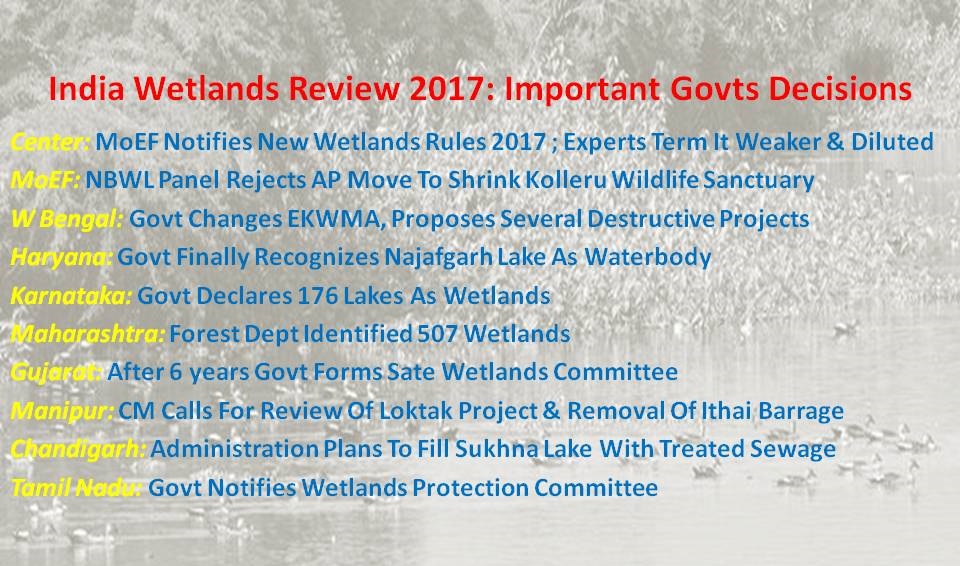
India Wetlands Review 2017: Important Governments Decisions

Central Government Decisions

Environment ministry notifies new wetland rules In a major decision, the union environment ministry notified the new Wetland (Conservation and Management) Rules 2017 on 26 Sept. 2017 replacing the 2010 version of the rules. The draft of the Wetland Rules was first presented by the Ministry of Environment, Forest and Climate Change (MoEF&CC) in March 2016. But they were severely criticized by conservationists who had alleged that the draft rules don’t mention anything about a national regulator and don’t list specific activities prohibited in these ecologically sensitive areas.

The new rules stipulate setting up of a State Wetlands Authority in each State and union territories that will be headed by the State’s environment minister and include a range of government officials. They will also include one expert each in the fields of wetland ecology, hydrology, fisheries, landscape planning and socioeconomics to be nominated by the state government.

The State authorities will also need to prepare a list of all wetlands of the State or union territory within three months, a list of wetlands to be notified within six months, a comprehensive digital inventory of all wetlands within one year which will be updated every ten years.

To oversee the work carried out by States, the rules stipulates for setting up of National Wetlands Committee, which will be headed by the MoEFCC Secretary, to monitor implementation of these rules. The Committee will also advise the Central Government on appropriate policies and action programmes for conservation and wise use of wetlands, recommend designation of wetlands of international importance under Ramsar Convention, advise on collaboration with international agencies on issues related to wetlands etc. http://www.livemint.com/Politics/y6Tr3tkrr3q28AmGKaBFII/Environment-ministry-notifies-new-wetland-rules.html  (Live Mint, 28 Sept. 2017)

Continue reading “India Wetlands Review 2017: Important Governments Decisions”

Dams · Wetlands

India Wetlands Review 2017: Important Court Orders

SUPREME COURT The Supreme Court of India is hearing a matter Writ Petition(s)(Civil) No(s). 230/2001 in which there have been several orders of consequence this year (e.g. 8 Feb 2017 & 16 Aug 2017) for protection of wetlands.  In spite of several directions for identification, preparation of brief documents, implementation of rules 4, notification of wetlands under the Wetlands Rules 2010, hardly any progress has happened.

Rule 4 of Wetlands Rules 2010 applicable to Wetlands of size ≥2.25 ha 

 “National Wetland Inventory & Assessment” was filed in SC. This Brochure indicates on page 11 that 2,01,503 wetlands have been mapped at 1:50,000 scale. All these wetlands have ‘an area of more than 2.25 hectares’. As a first step, the ‘Brief Documents’ with regard to these 2,01,503 wetlands should be obtained by the Union of India from the respective State Governments in terms of Rule 6 of the Wetlands (Conservation and management) Rules, 2010.

Continue reading “India Wetlands Review 2017: Important Court Orders”