Dams · DRP News Bulletin

DRP: 1 August 2016 (Increasing Water Conflicts in Times of Surplus Monsoon)

INTER-STATE WATER DISPUTES

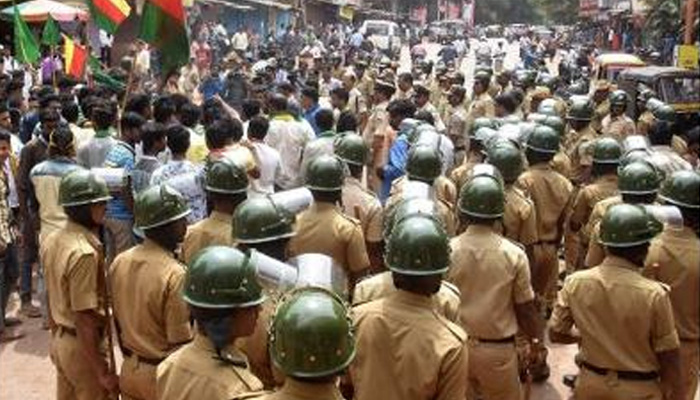
Center Meeting held to sort out Mahanadi issue Union Water Ministry on July 31 called a Meeting of representatives of Odisha & Chattisgarh Govts to consider the various water resources issues/projects in Mahanadi Basin. It was decided that the Central 514380-karnatakabandhWater Commission would invariably ensure that the DPRs for the projects in Mahanadi basin which are appraised by it, are duly shared with the other riparian State and that the riparian State is given a period of 45 days to convey their views/comments on the project. It was also decided that the DPRs would be delivered to the Resident Commissioners of respective States and thereafter the representatives of the State would be invited to share their observations. The meeting was called in pursuance of the assurance  given by Water Minister Uma Bharti in Parliament on July 26. Earlier, fearing that dams on river Mahanadi in Chhattisgarh would have adverse impact on Odisha, former union minister Jairam Ramesh has asked CM Naveen Patnaik to take up all party team to Delhi to raise the matter with the PM. He also said that Congress will send a delegation to Chhattisgarh in a week to study the sites where dam and barrages are proposed to be constructed. On the other hand, former CM Ajit Jogi having broken away from the Congress on July 25 attacked Congress over its opposition to Chhattisgarh’s plan to construct dams & barrages on Mahanadi river.

Continue reading “DRP: 1 August 2016 (Increasing Water Conflicts in Times of Surplus Monsoon)”
Dams · DRP News Bulletin

DRP: 18 July 2016 (Remove inefficient Farakka Barrage: Bihar CM)

Bihar CM  demands removal of Farakka barrage CM Nitish Kumar on July 16 demanded removal of Farakka barrage on river Ganga, saying “the disadvantages of the barrage appear to be higher than its benefits”. Raising the issue of Bihar’s share in Ganges waters at the 11th Inter State Council meeting in New Delhi, Nitish also sought the Centre’s intervention to ensure uninterrupted flow of water from the states of upper co-basin so that the entire length of Ganga has continuous supply of water even during lean season. The meeting was chaired by PM Narendra Modi and attended by CMs of different states and union ministers. The CM also told the meeting that responsibility to ensure the required water availability at Farakka barrage has been put solely on Bihar. Presenting Bihar’s views Nitish further added that about 16% of the catchment area of river Ganga is in Bihar, but in the lean season 3/4th of the total water flowing in Ganga comes from rivers of Bihar. Estimated 400 cusecs of water flow is received at the Uttar Pradesh border of Bihar in river Ganga. However, at Farakka barrage, 1500 cusecs of water flow is to be ensured, which is achieved mainly through the water contributed by the rivers of Bihar. Indeed, during lean season, not even 400 cusecs of water flow is available at the border of Bihar. In this regard, Centre’s intervention is required to ensure uninterrupted flow of water from the states of upper co-basin, so that the entire length of Ganga river in Bihar has continuous supply of water even during lean season. Nitish also demanded formulation of an effective National Silt Management Policy, saying such a body at the national level is essential for silt management as well as for ensuring uninterrupted flow of water not only in Ganga, but all the other rivers.

Continue reading “DRP: 18 July 2016 (Remove inefficient Farakka Barrage: Bihar CM)”
Dams · DRP News Bulletin

DRP: 11 July 2016 (Namami Gange proving mere an extension of Ganga Action Plan)

Ganga Manthan to Ganga Act: No progress made Chairing the 6th meeting of the National Ganga River Basin Authority on July 04  Water Minister Uma Bharti has said that a new act will be formulated for speedy implementation of Namami Gange programme. On July 06, giving a major boost to Namami Gange Programme Ms Uma Bharti has also announced that 231 projects will be inaugurated at various locations in Uttrakhand, UP, Bihar, Jharkhand, West Bengal, Haryana and Delhi on July 07. Incidentally, on July 07, 2014 NDA Govt. launched the Namami Gange programme to rejuvenate the river to be executed over five years. The project has a budget outlay of Rs 20K crore which is 10 times more than what was allocated in previous Ganga Action Plan (GAP) phase I and II. But more money and the PM minister’s zeal, notwithstanding, Namami Gange seems a carryover from its predecessor in one crucial respect.  The overwhelming emphasis on pollution abatement that had led to the GAP’s failure bedevils Namami Gange as well. In certain respects, Namami Gange is an improvement on the GAP. It seems that the govt has not learnt lessons from the GAP’s failure. The lag between sewage generation and treatment has remained between 55% & 60% even as new STPs were built under the GAP. This is because a lot of the waste is generated outside the sewerage network and is not conveyed to the STPs. A large section of the country’s urban population lives outside this network. Moreover, the STPs can only do so much. The official statistics show that the STPs are currently running at a deficiency of 55%. The problem of STPs is three-fold: underestimation, shortage and underutilization due to lack of a well-connected underground sewage system.

The problems associated with river Ganga, however, do not end or begin in its middle course dotted by factories. The upstream of the river, where Bhagirathi and Alaknanda join to form the Ganga, is part of a very fragile Himalayan ecosystem. Caution is needed in implementing the Namame Gange projects along this stretch. The Kedarnath flood of Uttarakhand is an example of what a combination of melting glaciers and mindless construction can do to a sensitive geological zone. With more than 40 dams, barrages and weirs  and many more planned aviral Ganga seems nothing more than an empty catchphrase. Ganga is the sum total of the contribution of some 12 major tributaries. Without a rejuvenation strategy for each of Ganga’s tributaries, there can be no Ganga rejuvenation.

Meanwhile, increased fishing activity and vessel traffic are proving to be the disturbing element downstream. Deploying more scientific methods for fishing and limiting it to levels enough for species’ sustenance might help without significantly affecting livelihoods. The direct consequences of climate change are also felt in the lower belts, around the Ganga Sagar region. Land is disappearing but no comprehensive plans have emerged as yet to provide for the rehabilitation of the region’s inhabitants.

Continue reading “DRP: 11 July 2016 (Namami Gange proving mere an extension of Ganga Action Plan)”
Dams · DRP News Bulletin

DRP: 4 July 2016 (In Proposed Hydro Policy, Govt Pushing Hydro Through Subsidies)

New Hydro Policy: Govt unjustifiably pushing hydro through subsidies A comprehensive policy to promote hydropower generation is set to be announced by September—with viability gap funding for projects, compulsory hydropower purchase obligations for distribution companies and a set of good practices that states have to follow. The idea is to address factors that currently drive hydropower costs up way above those of other sources of power and give policy support in its market development, according to a government official, who asked not to be named. The policy being prepared by the power ministry will have provisions for viability gap funding, which will help in meeting the shortfall in project costs and reducing hydroelectricity tariffs for consumers. Hydropower is expensive and in some cases more than double the cost of power from coal-based thermal plants, which is available at Rs.3-5 per unit.The ministry will also expand the scope of power distribution companies’ renewable power purchase obligations to include hydropower from projects with a capacity greater than 25 Mw. At the moment only power from those with less than 25MW is considered renewable power. According to officials, compulsory hydropower purchase from large projects will either be made part of the existing renewable power purchase obligation of distribution companies or a separate requirement, so that its inclusion does not affect the market for other renewable sources of energy like wind, solar or biomass. Govt unjustifiably pushing hydro through subsidies in proposed new hydro policy can be lead story. It is not going to help push hydro.  

Continue reading “DRP: 4 July 2016 (In Proposed Hydro Policy, Govt Pushing Hydro Through Subsidies)”
Wetlands

Threats to East Kolkata Wetlands are threats to Kolkata: Majhi jo nau dubaaye…

Guest Blog by: Chicu Lokgariwar (chicu.l@gmail.com), Usha Dewani (usha.dewani7@gmail.com)

‘Majhi jo nau dubaaye, to usey kaun bachaaye’ laments a popular song[i]. It literally translates as: ‘If an oarsman sinks his boat, who can save it?’

This is a question that concerned citizens of Kolkata are asking themselves today in connection with the famed East Kolkata Wetlands. A notified Ramsar site, this extensive wetland spread over 12,500 Ha has been protected for decades by the communities who live within it and by The East Kolkata Wetlands (Conservation and Management) Act, 2006. Today, it is the Environment Minister of West Bengal who has taken it upon himself to destroy the wetlands. Continue reading “Threats to East Kolkata Wetlands are threats to Kolkata: Majhi jo nau dubaaye…”

Dams · DRP News Bulletin

DRP: 20 June 2016 (MoWR invites suggestions on National Water Framework & Model Ground Water Bill)

Centre Suggestions invited on Draft National Water Framework Bill and Draft Model Bill for Conservation, Protection, Regulation and Management of Ground Water   Ministry of Water Resources, River Development and Ganga Rejuvenation has uploaded the draft national water framework bill and draft model bill for conservation, protection, regulation and management of ground water on its website (http://mowr.gov.in). The  Draft  National  Water  Framework  Bill  provides  an  overarching  national  legal framework based on principles for protection, conservation, regulation and management of water as a vital and stressed natural resource, under which legislation and executive action on water at all levels of governance can take place. The comments/suggestions/views from all Individuals/Experts /Organizations/Institutions on the above bill may be sent to jspp-mowr@nic.in or sjcpp-mowr@nic.in latest by June 25, 2016. The Draft Ground Water Model Bill is based on the principles of subsidarity, equitable distribution in an integrated approach. The State should act as a public trustee of ground water, which should be treated as a common pool resource to make sure that groundwater is protected, conserved, regulated and managed. The comments/suggestions/views from all Individuals/Experts/Organizations/Institutions on the above bill may be sent to dirgw-mowr@nic.in or pratul.saxena@nic.in latest by June 25, 2016.

Continue reading “DRP: 20 June 2016 (MoWR invites suggestions on National Water Framework & Model Ground Water Bill)”

Dams · DRP News Bulletin

DRP: 6 June 2016 (India to be power surplus for next 3 yrs: why govt continue to pursue hydro projects)

India will not have power deficit situation in FY17 India won’t need any new power plants for the next three years as it is flush with generation capacity, according to a government assessment. The country can manage for the next three years with existing plants that are currently under-utilised, and those that are under construction and upcoming renewable energy projects, assessment made by the power ministry for reviewing  the National Electricity Policy shows. Govt declares for the first time in history that India is POWER SURPLUS in 2016-17 with 3.1% power surplus in peak hours and 1.1% power surplus in off peak hours, both figures in 2015-16 were -3.2% during peak hours and -2.1% in peak hours. The western and Southern regions will be power surplus, but Northern, Eastern and Northeastern regions will have deficits. At the same time Power Minister Piyush Goyal says that Big hydro power units may come under renewable energy According to Minister the Centre has begun studies to decide whether to include big hydro power plants under the ambit of renewable energy. When India will be energy surplus for next three years why then Govt. of India is continue to pursue disastrous hydro projects on ground.  Where ASSOCHAM is asking Arunachal govt.  to do away with adverse tax policies on Hydro power to boost construction of hydro projects in the State. NHPC has also   raised relief amount for Kishanganga HEP around Rs 60 lakh and Rs 70 lakh to each family for the land acquired. And despite Delhi Govt. openly rejecting water from Renuka dam NGT panel has visited the area to look into the rehabilitation issue. 

Continue reading “DRP: 6 June 2016 (India to be power surplus for next 3 yrs: why govt continue to pursue hydro projects)”
Wetlands

An undiscovered wetland thriving under looming threats

In April 2016, the Central Government presented Wetland (Conservation and Management) Draft 2016 for comments which has been vigorously contested by leading experts as deliberate attempt to weaken key steps of Wetland (Conservation and Management) Rule 2010. Various organizations, community groups, NGOs including SANDRP has objected to the dilution of key norms and urged the government to discard Draft 2016 Rules and fully implement the 2010 Rules till new effective wetland protection rules are formed.  

Now, highlighting the neglected state of our wetlands, SANDRP again urges the responsible authorities to come forward and take steps to protect a thriving wetland which is facing threats from none other than Government itself.

Naya Bans Wetland The Holambi Kalan and Khera Khurd are among several villages dotting North West Delhi’s agriculturally dominated landscape. Between the Railway Station of these two villages lies a flourishing wetland spread on the either side of the railway track which has intercepted two local storm water drains passing though the area.

Whether the area was originally a wetland or the interception of rain water carried during laying down of railway lines has resulted in accumulation of waste water is unknown. Yayati Bhardwaj a resident of nearby Alipur village recalls his childhood days when he used to frequent the area to have a glimpse of Lotus like flowers blooming in the wetland which now has disappeared. The 32 years old youth raising voice for local environmental issues still remembers his father talking of the marshland on few occasions. So the marshy land may or may not be artificial but over the time it has evolved into a living wetland in concretized capital providing refuge to large numbers of flora and fauna.

Continue reading “An undiscovered wetland thriving under looming threats”

Dams · Ministry of Environment and Forests · Wetlands

REJECT Draft Wetland Rules 2016: Designed to destroy wetlands

While the Ministry of Environment, Forests and Climate Change never implemented Wetland (Conservation and Management) Rules 2010, it has now brought out a new and seriously watered down Draft Wetland Rules 2016. The New Rules can jeopardise wetland conservation in the country and need to be rejected in entirety. Following is a submission made by SANDRP to the Secretary, MoEF and CC about the same. Last date for sending comments is 6th June 2016. Emails are b.sikka@gov.in, ram.jindal@nic.in,  c.singh@nic.in.

We request you to kindly make similar submissions. Feel free to use our letter below. Our Wetlands need protection, not degradation! Continue reading “REJECT Draft Wetland Rules 2016: Designed to destroy wetlands”

Dams

Telangana Drought 2016

The severe drought in Telangana has caused acute shortage of drinking water and worsened the agriculture crisis in the state.

On Nov 24, 2015, the Telangana government declared drought in 7 out of 10 districts. It declared 231 out of 443 rural mandals (blocks) in the State as drought-affected and sought an immediate assistance of Rs. 1000 crore from the Centre. All the mandals in Mahabubnagar (64), Medak (46) and Nizamabad (36) districts were declared drought-hit.  Other mandals declared drought-hit included 33 out of 37 in Ranga Reddy, 19 of 57 in Karimnagar, 22 of 59 in Nalgonda, and 11 of 51 in Warangal. None of the mandals in Adilabad (52) and Khammam (41) districts were on the list.

Continue reading “Telangana Drought 2016”