Dams · Wetlands

West India Wetlands Review 2017: No Protection Here

GUJARAT WETLANDS DEVELOPMENTS 2017

Gosabara wetland declared IBA In March 2017 during a two days workshop, The Bombay Natural History Society (BNHS) declared 96 sq km coastal wetland area of Gosabara-Mokarsagar in Porbandar, as Important Bird Area (IBA) site. There are around 544 IBAs in India and 18 in Gujarat. As per experts though IBA does not have any legal status, it helps environmentalists to raise alarm if the site faces any threats and press for its conservation. In 2001, Salim Ali Centre for Ornithology (SACON) conducted a country-wide survey for important ‘Inland Wetlands of India’ and Gosabara-Mokarsagar wetland was one the 50 important wetlands of the country.  https://timesofindia.indiatimes.com/city/rajkot/gosabara-wetland-now-a-bnhs-iba-site/articleshow/57453811.cms  (The Times of India, 4 March 2017)

Continue reading “West India Wetlands Review 2017: No Protection Here”

Dams · Wetlands

Maharashtra Wetlands Review 2017: Destruction Despite Legal Intervention

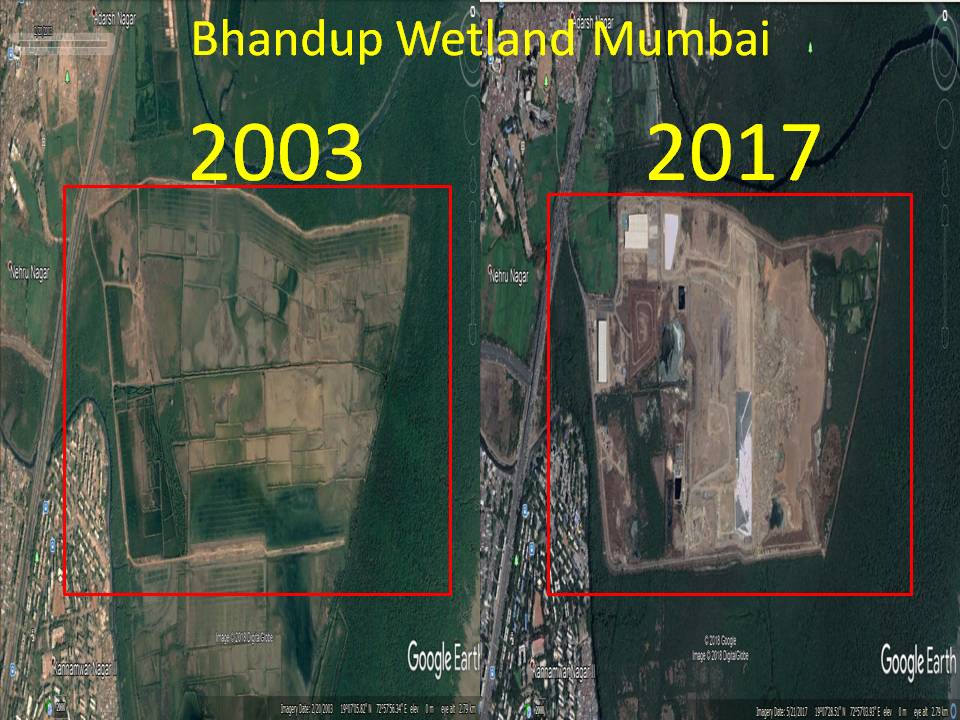
Throughout 2017, civil society groups have been working hard to protect the wetlands in mangrove and coastal area in Maharashtra. Bombay High Court has also passed several orders in this regard. State Government has taken some steps in the interest of wetlands. However despite all these, the wetlands in Maharashtra stand at the receiving end of encroachments, pollution and waste dumping.

Continue reading “Maharashtra Wetlands Review 2017: Destruction Despite Legal Intervention”

Dams · Wetlands

East India Wetlands Review 2017: West Bengal Bent On Destroying World’s Largest Natural Sewage Treatment Plant

The East Kolkata Wetlands (EKW) are unique yet complex system of natural and human-made wetlands in West Bengal. The wetlands cover 125 sq km comprising of salt marshes, salt meadows, sewage farms and settling ponds. They are used to treat Kolkata’s sewage, and the nutrients contained in the waste water sustain fish farms and agriculture.

Devised by local fishermen and farmers, these wetlands served, in effect, as the largest natural sewage treatment plant (STP) for the city. And using the purification capacity of wetlands, Kolkata by transforming nearly one-third of the city’s sewage into a rich harvest of fish and fresh vegetables daily, has pioneered an environment-friendly system of sewage disposal. Because of this, the EKW were designated a “wetland of international importance” under the Ramsar Convention on August 19, 2002. https://en.wikipedia.org/wiki/East_Kolkata_Wetlands

However for past many years, these wetlands are under threat due to exponential expansion of real-estate projects. Recently illegal landfills are on the rise and unprecedented land development and urbanization have been creating concerns about the impact on EKW environment. 2017 has seen the situation turning only worse for EKW. 

Continue reading “East India Wetlands Review 2017: West Bengal Bent On Destroying World’s Largest Natural Sewage Treatment Plant”

Dams · Wetlands

North East Wetlands Review 2017: “Remove Ithai Barrage on Loktak Lake”

MANIPUR

Loktak lake is the largest freshwater lake near Moirang in Manipur state. In local language Loktak means end of stream. The lake is referred as the “lifeline of Manipur” as it is highly productive and provides habitat to biota and livelihoods to people. The lake is an Important Bird Area (IBA) and is widely famous for the phumdis (heterogeneous mass of vegetation, soil and organic matter at various stages of decomposition) floating over it.

In 1990, the lake was included under Ramsar Convention as a ‘Wetland of International Importance’. But over the years, NHPC’s hydropower projects specially Ithai Barrage have led to severe impact on the lake eco-system and serious disturbance in local community.  Despite this, NHPC has been pushing more hydro projects on the lake streams. As a result, local people and concerned have univocally and repeatedly started protesting against proposed hydro projects and demanding removal of Ithai barrage. And the demand have only grown louder in 2017.  https://en.wikipedia.org/wiki/Loktak_Lake

Continue reading “North East Wetlands Review 2017: “Remove Ithai Barrage on Loktak Lake””

Dams · Wetlands

North India Wetlands Review 2017: Callous Governments

After separate reports on key developments surrounding wetlands in 2017 in North India including Jammu & Kashmir, Uttarakhand, Punjab, Chandigarh and Haryana – this final compilation in North India Wetlands Review 2017 series by SANDRP, highlights the plight of wetlands, lakes and water bodies in Uttar Pradesh, Delhi and National Capital Region.

Continue reading “North India Wetlands Review 2017: Callous Governments”

Dams · Wetlands

Punjab Wetlands 2017: Ramsar Sites Under Severe Threats

Introduction

National Wetlands Atlas has mapped 1381 big wetlands in Punjab State. It has also identified 5049 small wetlands of less than 2.25 hectare area. Total wetland area estimated in the state is 86283 hectare which is about 1.71 per cent of its total geographic area. Out of this, with 59864 hectare the river/stream is accounts for for 69.38 per cent of the wetlands. Reservoirs/Barrages ranks second with 13.74 per cent share spread over 11858 hectare of area.. http://www.moef.nic.in/downloads/public-information/NWIA_Punjab_Atlas.pdf

There are three Ramsar sites (wetlands of International importance) in the state- Harike, Kanjli and Ropar. These wetlands are important habitats for waterfowl, fish and diversity of other flora and fauna including endangered and vulnerable species. Two other wetlands- Ranjit Sagar and Nangal are National wetlands.

Ranjit Sagar is an interstate wetland spreading over in three states (Punjab, Himachal Pradesh and J&K). There are 5 small wetlands considered as state wetlands owing to their rich biodiversity and ecological characters. These are – Keshopur-Miani Jheel, Kahnuwan Chhamb, Jastarwal Jheel, Mand Bharthala and Dholbaha Reservoir. In all, Punjab has 12 important natural and 9 man-made wetlands.

Continue reading “Punjab Wetlands 2017: Ramsar Sites Under Severe Threats”

Dams · Wetlands

Siltation, Encroachment & Pollution Choke Jammu & Kashmir Wetlands in 2017

Captivating images of lakes and wetlands strike the imagination of general masses when the name of Jammu and Kashmir is mentioned. For years, the aquatic wonders have been the main attraction of tourists, at the same time supporting livelihood of local communities in multiple ways. These water bodies also provide safe habitats to the lakhs of migratory birds.

However, over the years, gradual siltation, steady encroachment and increasing pollution have put the wetlands eco-system and associated socio-economical benefits at receiving ends. And, in 2017 the situation only got worse.

Continue reading “Siltation, Encroachment & Pollution Choke Jammu & Kashmir Wetlands in 2017”

Dams · Wetlands

Wetlands Review 2016: Government Actions

India is one of the 169 signatories to the Ramsar Convention on Wetlands, signed in Ramsar, Iran, in 1971, an intergovernmental treaty that provides the framework for national action and international cooperation for the conservation and wise use of Wetlands and their resources. There are 2,241 Ramsar sites across the world, including 26 spread across India from Wular Lake in Jammu and Kashmir to Ashtamudi Wetland in Kerala, and from Deepor Beel in Assam to Nal Sarovar in Gujarat.

Despite their vital importance to humans, across India, Wetlands are seriously threatened by reclamation and degradation through processes of drainage, land filling, discharge of domestic and industrial effluents, disposal of solid waste, and over-exploitation of the natural resources that they offer.

Here is an account of major decisions and actions by Central as well as State Governments on wetlands related issues in 2016.

Continue reading “Wetlands Review 2016: Government Actions”

Dams · Wetlands

WORLD WETLANDS DAY 2017: Man made Disaster for Wetlands that protect us from Disasters

The World Wetlands Day, celebrated around the world on 2nd February each year, marks the adoption of Ramsar Convention on Wetlands in Iran in 1972. The Convention came into force in India since 1982. The theme for this year’s World Wetlands Day is “Wetlands for Disaster Risk Reduction.”[i]

During floods, wetlands can act as natural sponges and absorb intense runoff and discharge, holding more water than most soil types.[ii] This role of wetlands has been demonstrated most powerfully in India in the past few years. Chennai deluge in Nov-Dec 2015 highlighted what happens when wetlands in a city reduce by 2/3rds in just 20 years. Similarly, Kashmir valley lost 50% of its riverine wetlands in just over 30 years, which was one of the main reasons behind the extensive losses during the Sept 2014 Jhelum floods, as corroborated by Dr Asam Rahmani of Bombay Natural History Society (BNHS)[iii]. In 40 years, Bangalore has lost 79% of its wetlands, similar is the case with Mumbai, Hyderabad, Kolkata and New Delhi. Bhopal, a city of relatively sloping profile, faced floods twice in 2016, and wetlands, including the rivers in the city are facing existential risks in terms of encroachments[iv].

Continue reading “WORLD WETLANDS DAY 2017: Man made Disaster for Wetlands that protect us from Disasters”

Urban Water Sector · Wetlands

Urban Wetlands and Floods

In city after city wetlands are being built over, for houses, markets and offices to meet the demands of an increasing urban population. As agriculture is being rendered unviable because of soaring costs of inputs, declining prices of farm products, lack of water arising from water diversions and drought conditions and low support prices, there is increasing scale of urban migration. Availability of cheap, migrant labour alongwith the government’s policies to invite investment in the manufacturing sector, opening up of more sectors for foreign direct investment and weakening of labour laws have led to ‘development’ of many suburbs into industrial corridors, manufacturing hubs and economic zones. This suburban expansion has translated into a take over of wetlands which, until recently, were tilled by farmers or were the abode of birds or covered by mangroves. The development of the suburb is usually accompanied by a property boom in the new area which leads to complete destruction of the local ecology and construction of offices, residential complexes, shopping malls, educational institutions, parking spaces and other infrastructure for the urban elite and middle class.

Continue reading “Urban Wetlands and Floods”