Dams

East India Rivers Review 2017

The seventh report reviewing status of India’s rivers in 2017, focuses on Rivers in West Bengal, Odisha, Bihar, Jharkhand and Chhattisgarh. This review does not include main Ganga river as there is separate Review of state of Ganga River.

West Bengal Rivers

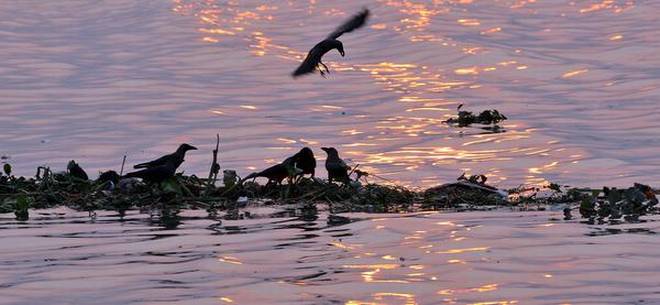
Rivers pollution worse than in 2014 According to the latest State of Environment Report, it has been found that in the 17 major rivers of the state, including the Ganga, the levels of coliform bacteria are much higher than the permissible limit. The report further revealed that several stretches of the Ganga had a total coliform count ranging from one to four lakhs, making the water totally unfit for even bathing. The report has also stated that compared to 2014, all the four main rivers of north Bengal recorded a significant increase in total coliform count. http://www.thehindu.com/todays-paper/tp-national/bengals-rivers-in-a-bad-shape/article22459562.ece (The Hindu, 18 Jan. 2018)
Continue reading “East India Rivers Review 2017”

Dams

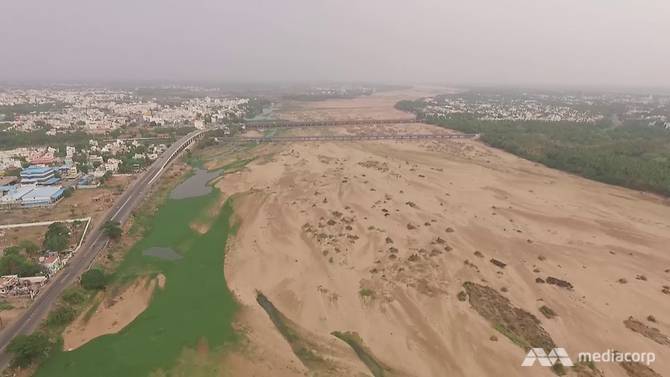
Tamil Nadu Rivers Review 2017: Despite Drought; Diversion of Rivers’ Waters To Private Companies

This sixth compilation under Rivers Review series, presents situation of rivers in Tamil Nadu in the year 2017. 

Tamirabarani River Opposition grows against Tamirabarani water to soft drink units In March 2017, various citizen groups submitted petitions to Collector M. Karuankaran, opposing the decision to supply huge quantity of water from the Tamirabarani to beverage manufacturing units in Gangaikondan Industrial area. They also asked the State Government to cancel the agreement with the soft drink manufacturing units on supplying the river water and make sincere efforts to revive the river. http://www.thehindu.com/news/national/tamil-nadu/tamirabarani-protest-intensifies-tirunelveli/article17457199.ece (The Hindu, 13 March 2017)

Continue reading “Tamil Nadu Rivers Review 2017: Despite Drought; Diversion of Rivers’ Waters To Private Companies”

Dams

Kerala Rivers Review 2017 : Government Efforts Fail To Protect Rivers

The fifth rivers’ review highlights status of Kerala rivers in the year 2017. 

Rivers Pollution and Government Actions

Govt mulls severe punishment for agents of water pollution The state government on Feb. 2017 signaled its intentions to zero in on agents of pollution in water resources. The Pollution Control Board and Revenue Department officers swooped down on a private resort in Chinnakkanal, Idukki, for allegedly diverting sewage into a potable water source. Water Resources Minister Mathew T Thomas stated that his department has proposed amendments to the Kerala Irrigation and Water Conservation Act, 2003, to make punishments more severe. He also said that the govt was planning to have harsher measures in place to discourage people from polluting rivers and water bodies.http://www.newindianexpress.com/states/kerala/2017/feb/14/kerala-government-mulls-severe-punishment-for-agents-of-water-pollution-1570357–1.html (The New Indian Express, 14 Feb. 2017)

The state also planned to enact strong legislation for the conservation of rivers. http://www.newindianexpress.com/cities/thiruvananthapuram/2017/sep/06/state-to-frame-strong-law-for-river-protection-1653026.html(The New Indian Express, 6 Sept. 2017)

Continue reading “Kerala Rivers Review 2017 : Government Efforts Fail To Protect Rivers”

Dams

Maharashtra Rivers Review 2017: Multi-colored Rivers!

About Rivers Pollution and Pollution Control Board

Highest number of polluted rivers Maharashtra state has 49 polluted river stretches, highest in the country, which including Mithi, Ulhas, Vaitarna, Godavari, Bhima, Krishna, Tapi, Kundalika, Panchganga, Mula-Mutha, Pelhar and Penganga. 3,000 MLD of untreated sewage and industrial effluents are discharged into the state’s water bodies daily. http://www.hindustantimes.com/mumbai-news/pollution-in-three-maharashtra-rivers-is-nine-times-permissible-limit/story-RCuTrl8zi8tmFoOvgKR2zI.html(Hindustan Times, 16 Nov. 2017) 

According to a report by Union Environment Ministry, Maharashtra generates about 8,143 Million Liter per Day (MLD) which is almost 13 per cent of the country’s sewage, butclaims to treats 5,160.36 MLD.In this way Maharashtra is releasing at least 3000 MLD untreated sewage in rivers, creeks and wetlands areas. http://www.hindustantimes.com/mumbai-news/834-factories-across-maharashtra-shut-down-in-2-years-for-causing-pollution-mpcb/story-MrmmXa9XH9Vdkzu2wKSdcL.html (Hindustan Times, 22 Dec 2017)

Continue reading “Maharashtra Rivers Review 2017: Multi-colored Rivers!”

Dams · DRP News Bulletin

DRP: 5 Mar 2018 (Will India Face An Unprecedented Water Crisis This Summer?)

Residents of Muruga Tholuvu Harijan Colony in Chennimalai Union have urged the district administration to take steps to provide them water on a regular basis. In a petition, they said that villagers have to go in search of water from other areas and transport it in bicycles regularly. They said that most of the people were labourers and their livelihood is lost when they go in search for water. They said that the situation is worse during summer season, as water is not available at nearby areas and they are unable to purchase water from the market too. http://www.thehindu.com/news/states/provide-drinking-water-villagers/article22935093.ece (The Hindu, 5 March 2018)

With the beginning of summer season, there are several news reports describing the growing water crisis in different parts of country. Here are details of various Indian states suffering from  water scarcity for industrial, irrigational and even for drinking purposes which given the due summer months could develop into grim scenario. These stories also show how the mismanagement of dam storages, exploitation of ground water resources and pollution of rivers have significant role in aggravating the situation.

Gujarat The state is staring at a water crisis this summer, with low water levels in the Narmada dam and almost all other major dams. On March 3, the CM Vijay Rupani has held a meeting with senior minister and bureaucrats to take stock of the water situation in the state and discussed ways to ensure drinking water availability. The government also has decided to allocate Rs 200 crore in special grants for augmentation of local water sources and instructed all collectors to form district committees, have weekly review meetings and start supply of water by tankers wherever required.

Continue reading “DRP: 5 Mar 2018 (Will India Face An Unprecedented Water Crisis This Summer?)”
Dams · DRP News Bulletin

DRP: 26 Feb 2018 (Banda People Also Protest Against Ken Betwa Link)

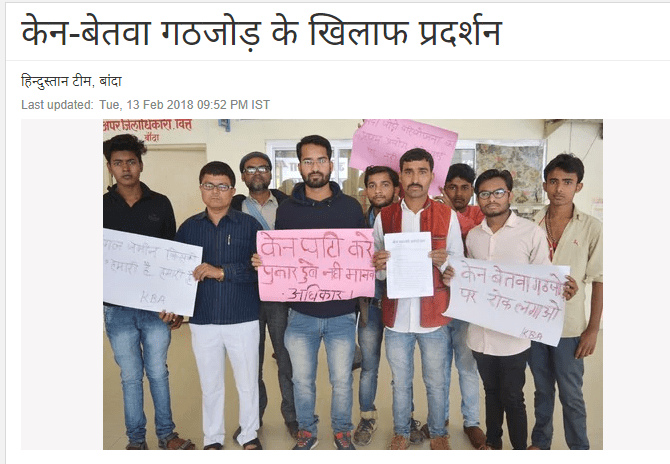
When Central Government is trying to push Ken Betwa link project terming it as beneficial for both Madhya Pradesh and Uttar Pradesh, local people of Banda are now also protesting against it, in addition to the people of Panna that are already opposing it. On Feb. 13, 2018, the Ken Bachao Samiti comprising of farmers, citizens and social workers in Banda sat on a Dharna before district magistrate office. The group have also sent a memorandum to the President of India, demanding immediate cancelling of the project. Raising serious concerns over environmental and social of the linking project, they asked demanded proper impact assessment and public consultation and said the project wont be allowed to go forward. Indeed, as they have said, there has been no downstream impact assessment and people of Banda are likely to loose their river.  https://www.livehindustan.com/uttar-pradesh/banda/story-demonstrate-against-ken-betwa-alliance-1800951.html (Hindustan Hindi,13 Feb. 2018) 

Continue reading “DRP: 26 Feb 2018 (Banda People Also Protest Against Ken Betwa Link)”
Dams · DRP News Bulletin

DRP: 19 Feb 2018 (How Are We Treating Our Urban Rivers?)

In this comprehensive article Mumbai-based author Vaishnavi Chandrashekhar throws the light on the plight of Uraban Rivers. “Rivers and streams have borne the brunt of the recent urban explosion in India, a nation whose population has nearly doubled in the last 40 years to 1.35 billion. Unplanned growth has led to the use of water bodies as dumping grounds for sewage and industrial effluent. According to CPCB, 63 % of the urban sewage flowing into rivers (some 62 billion liters a day) is untreated.

In addition, riverbanks, wetlands, and floodplains have been claimed over time by infrastructure, slums, offices, and housing developments – all of which has narrowed natural river channels and distorted flow, greatly reducing the ability of India’s rivers to buffer flooding. It also has taken a toll on biodiversity. http://e360.yale.edu/features/dying-waters-india-struggles-to-clean-up-its-polluted-urban-rivers (Yale Environment 360, 15 Feb. 2018) 

Continue reading “DRP: 19 Feb 2018 (How Are We Treating Our Urban Rivers?)”
Dams · DRP News Bulletin

DRP: 12 Feb 2018 (With Innovative Ideas Hyderabad, Chennai & Delhi Are Reviving Its Wetlands)

This week there are exemplary and encouraging wetlands revival stories from three metro cities of Chennai, Hyderabad and Delhi.  In the first example from Hyderabad, meticulously chosen plant species such as tulsi, aswagandha, citronella and hibiscus have been used to create an artificial island to clean Neknampur Lake. The treatment islands are composed of four layers of which the bamboo base keeps the entire structure afloat. Based on soil-less hydroponics, these floating treatment wetlands absorb excess nitrates, thereby reducing the chemical content of the lake water. Microorganisms present in the wetland break down organic matter while the root systems filter out pollutants and sediments. https://www.thenewsminute.com/article/3500-saplings-floating-islands-help-rejuvenate-hyd-neknampur-lake-75819 (The News Minute, 3 Feb. 2018)

Similarly, Chennai-based Care Earth Trust along with the public works department (PWD) and the civic body has managed to restore three urban lakes. While many of the smaller wetlands have vanished over time, many mid-sized wetlands seem to have shrunk by almost 65 percent. Thanks to their joint effort, invasive hyacinth was removed from the Narayanapuram Lake in Pallikaranai, while sewer lines, which emptied into the Perungalathur Lake, have now been plugged. A detailed restoration proposal has been forwarded to the PWD regarding the Korattur-Madhavaram-Ambattur lakes. https://timesofindia.indiatimes.com/city/chennai/hyacinth-out-sewer-line-plugged-three-water-bodies-restored/articleshow/62748110.cms (The Times of India, 2 Feb. 2018)

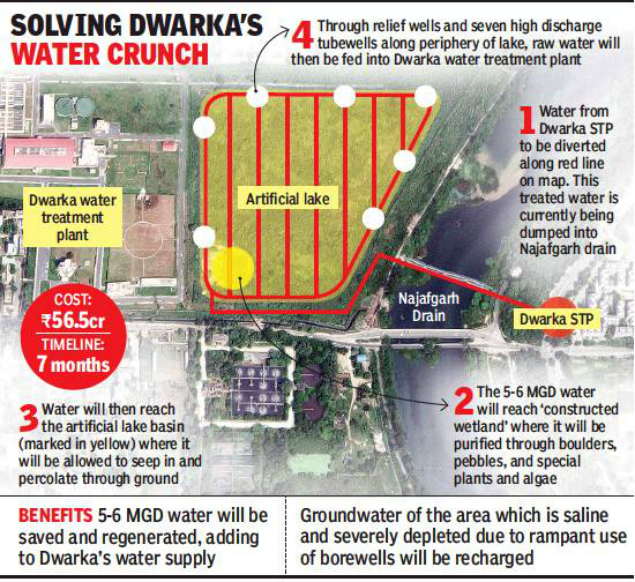
Meanwhile, Delhi Jal Board (DJB) has taken up interesting new project of creating an artificial lake in Dwarka. The project will supply water in sub-city and improve ground water level too. DJB has approved Rs. 56 crore for the project which will be completed in next seven months.  This would the first model project wherein a lake will be used to augment water supply. The special lake is being created next to the Dwarka water treatment plant (WTP) will have a sand bed to allow maximum percolation of water into the ground. It will have a capacity of 10 million gallons (MGD). The project is expected to add supply of 5-6 million gallons water to Dwarka every day.

Continue reading “DRP: 12 Feb 2018 (With Innovative Ideas Hyderabad, Chennai & Delhi Are Reviving Its Wetlands)”
Dams · DRP News Bulletin

DRP: 13 March 2017 (20 Big Hydro Projects Costing Over 30K Crore, Stalled & Stressed: Piyush Goyal)

20 hydro projects stalled or stressed  The Power Minister Piyush Goyal on March 09, 2017 in a written statement has informed the parliament that as many as 20 under construction HPPs totalling 6,329 MW are either stalled or stressed in the country and Rs 30,147.08 crore has already been spent on them. These projects include 2,000 MW Subansiri Lower of NHPC Ltd, 500 Mw Teesta VI of Lanco Teesta Hydro Power Ltd, 120 MW Rangit-IV of Jal Power Corp, 300 Mw Panan of Himagiri Hydro Energy Pvt Ltd, 850 MW Ratle of GVK Ratle HEP Pvt Ltd, 100 Mw Sorang of Himachal Sorang Power Ltd and 960 MW Polavaram of Polavaram Project Authority.

Continue reading “DRP: 13 March 2017 (20 Big Hydro Projects Costing Over 30K Crore, Stalled & Stressed: Piyush Goyal)”
Dams

Living Planet Report, 2016: Rivers, Wetlands, Fresh Water Species Face the Greatest Threat

According to just released Living Planet Report 2016, the loss of habitat is prime reason behind declining of wildlife species found in and around wetlands, rivers and lakes due to increasing fragmentation, pollution and destruction of these ecosystems. Data in report also underlines that the global water crisis is real and water requirements worldwide will go up by 40 per cent by 2030.

The report emphasizes habitats based on rivers, wetlands and lakes command high economic, cultural, aesthetic, recreational and educational value. At the same time, these habitats are challenging to conserve because they are strongly affected by the modification of their river basins as well as by direct impacts from dams, pollution, invasive aquatic species and unsustainable water extractions.

Further, fresh water based habitats often are beyond administrative and political boundaries; warranting the extra effort for collaborative forms of protection. The report refers to several studies which have found that species living in freshwater habitats are faring worse than terrestrial species.

The report notes that Brazil, Russia, India, China and the United States (a different BRICS) account for nearly half of the planet’s total bio-capacity. These few countries function as global bio-capacity hubs as they are among the primary exporters of resources to the other countries. This results in great pressure on ecosystems in these countries, contributing to habitat loss.

This account summarizes the key findings of the report in context of threats and impacts over fresh water sources and species. 

Continue reading “Living Planet Report, 2016: Rivers, Wetlands, Fresh Water Species Face the Greatest Threat”