DRP News Bulletin

DRP NB 03 Jan 2022: Are we any safer from Dam Disasters?

In the 2021 year-end review by the Ministry of Jal Shakti (Ministry of Water Resources), the passage of the Dam Safety Bill by the parliament figures in headlines. The question is are we any safer from dam disasters due to this? If we take a quick review of the numerous dam disasters just this year and also look at the dam disasters mentioned in this Bulletin that happened just in the last week of the passing year, the answer is clear no. Such disasters include ones in Himachal Pradesh, Nepal and Brazil.

There is also the news here of the Uttarakhand agency report about the Feb 2021 Chamoli disaster, about which the official govt agency has said failure of Early Warning System was a factor in the disaster. The bigger disaster is that the state govt has promptly issued show cause notice to the authors of the paper blaming the lack of EWS!

Continue reading “DRP NB 03 Jan 2022: Are we any safer from Dam Disasters?”
DRP News Bulletin

DRP 271221: PM pushes unviable, destructive Hydro projects in HP

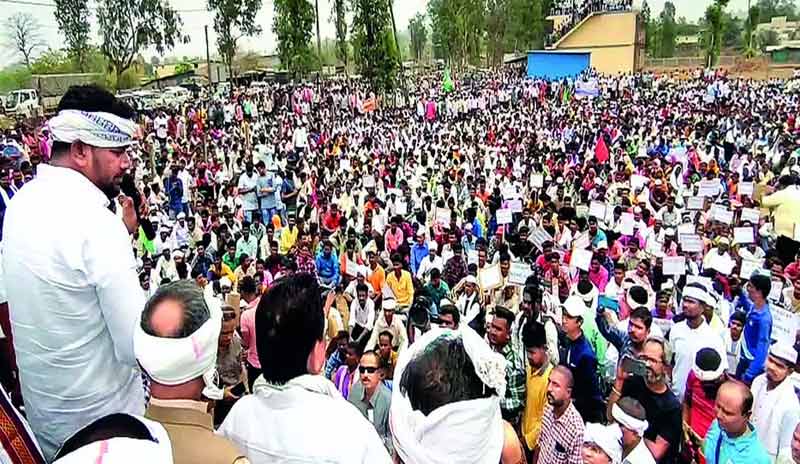
Feature Image: Renuka Dam Sangharsh Samiti members take out a protest march at Dadahu in Sirmaur district on Dec. 19, 2021. Tribune photo

What will be the realistic cost of power from hydropower projects being pushed by the Prime Minister during this visit today to Himachal Pradesh? One indication of that comes from the 111 MW Sawra Kuddu HEP that he inaugurates during his visit. The cost of this project is already over Rs 2080 Crores, likely to go up further. Which means per MW installed capacity, the cost is around Rs 20 Crores. At this cost, the cost of power from the project is likely to be over Rs 8 per unit even without factoring in the social, environmental and increased disaster vulnerability costs that such projects impose on the fragile Himalayan Mountains. As if to also remind the active seismic zone, on the eve of his visit, there were tremors, even if mild, in Mandi.

The Renuka dam that he lays the foundation for does not even have all the statutory clearances. Its EIA has been the most dishonest exercise, as came out in the NGT hearings. What signal is the government sending by laying foundation stone for such a project? Similar are the issues with Luhri I and Dhaulasidh HEPs. The government seems to be pushing such outdated, unviable, costly and destructive projects in fragile Himalayan regions, purely on political arithmetic assumptions, but possibly need to realise that these projects are not even popular and they are also most inappropriate in the climate change context. Or is it the lure of spending such huge sums of unaccountable public money that provide opportunities for getting election funds for the party that is driving such undemocratic decisions?

Continue reading “DRP 271221: PM pushes unviable, destructive Hydro projects in HP”
DRP News Bulletin

DRP 201221: Judiciary fails the environment AGAIN

By allowing the Char Dham Highway to go ahead, putting aside all the environment, safety, disaster vulnerability and even norms and affidavits of the Ministry of Highways and the Defence Ministry, as well as the report of the expert panel set up by the apex court, the Judiciary has again failed the Environment, among other things. This is contrary to the generally held belief that Judiciary stands up for the cause of the environment. That belief has no real basis, as can be seen again. This is also failure of the governance, experts and environmental groups, besides also the failure of the media too.

Continue reading “DRP 201221: Judiciary fails the environment AGAIN”
DRP News Bulletin

DRP 131221: Gargai Dam Scrapped; Wise Move by BMC to Go for Alternatives

In a wise move, the Brihanmumbai Municipal Corporation (BMC) has cancelled Gargai dam project. In its January 2014, submission to Expert Appraisal Committee (EAC), SANDRP had highlighted the adverse impacts of this project on tribal people and Tansa Sanctuary stressing on alternatives including recycling of sewage and rain water harvesting. Finally, now the BMC has scrapped the unjustified project which would have caused felling of 4.5 lakh trees which BMC chief Iqbal Chahal rightly finds pointless in the wake of increasing climate change threats.

It is worth to mention that in February 2020 BMC was learnt reconsidering its Pinjal dam project and exploring other options including waste water recycling. Indeed the BMC is taking right steps. Dams are costly, destructive projects impacting rivers, forests and local people in multiple ways. The demand side management, efficient use of existing water supplies, rain water harvesting and recycling of waste water are among far better alternatives to meet urban water demands.

Continue reading “DRP 131221: Gargai Dam Scrapped; Wise Move by BMC to Go for Alternatives”
DRP News Bulletin

DRP 061221: NGT demands accountability for Ganga Cleaning

The NGT demanding that there is need for greater transparency in the Ganga Cleaning efforts by NMCG and others, leading to accountability for the expected results is no doubt welcome if it were to become a reality. It has been required for long, since the Ganga Cleaning Efforts started in 1980s when Ganga Action Plan started, and it is even more required with the promises coming from the Prime Minister, no less today. Unfortunately, there is no real improvement in the state of the river, as the NGT has said. One only hopes that this latest initiative will lead to some real change, even through the track record of judiciary (including NGT) in this regard is far from inspiring.  

Continue reading “DRP 061221: NGT demands accountability for Ganga Cleaning”
DRP News Bulletin

DRP 291121: Pathetic State of Sabarmati River Front in Ahmedabad

This photo from the Gujarat Samachar newspaper of Ahmadabad on Nov 25, 2021 depicts the reality of Sabarmati River Front Development. It shows that the growth of weed water hyacinth spread all over the stagnant, polluted river channel that is no longer a river. It says the boat service (running into losses) and AC Cruise services have stopped. There is no place for sea planes to land due to the growth of the water hyacinth, but the government has asked for permission to run two sea planes! There is the big issue of pollutants from industries and Ahmedabad flowing into the river that the Gujarat High Court is dealing with (see below).

Similar photos also appeared on the same date in two more Ahmedabad based two newspaper: Dainik Bhaskar and Nav Gujarat Samay, reinforcing the pathetic state of Sabarmati River Front.

Is there any doubt that all River Front Development projects are likely to face similar or worse fate than this? The situation could worsen in near future as both Sardar Sarovar Dam on Narmada and Dharoi dam on Sabarmati in the upstream of Ahmedabad have insufficient storage. In a related development, Rajasthan is threatening to stop flow of 45 TMC water to Mahi Dam, it is pertinent to note that Sabarmati also flows from Rajasthan to Gujarat.

Continue reading “DRP 291121: Pathetic State of Sabarmati River Front in Ahmedabad”
DRP News Bulletin

DRP 151121: District Level Vulnerability Assessment in India

This is the kind of study that was long overdue. In fact such a study should have been done before formulating India’s National Action Plan on Climate Change (NAPCC) as SANDRP has been saying since 2009 (see SANDRP critique of NAPCC published under the title “THERE IS NO HOPE HERE) when NAPCC was made public by a dozen wise individuals sitting in a room without any participatory or transparent exercise. One hopes that India will restart the exercise of fresh formulation of NAPCC after doing such a study on an urgent basis, on the lines of the study described below. In any case one hopes the union and state governments will wake up and take up District level vulnerability assessment in India in an independent way on urgent basis.

“This study undertakes a first-of-its-kind district-level vulnerability assessment of India, which maps exposure, sensitivity, and adaptive capacity using spatio-temporal analysis. To do this, we developed a climate vulnerability index (CVI) of Indian states and Union Territories (UTs). Instead of looking at climate extremes in isolation, we map the combined risk of hydro-met disasters and their compounded impacts on vulnerability. By doing so, we aim to inform policy goals in the resource-constrained context of India.

Continue reading “DRP 151121: District Level Vulnerability Assessment in India”
DRP News Bulletin

DRP 081121: Is heavy rain ALONE to be blamed for flooding in Chennai?

In past couple of days heavy rains have caused significant flooding in several areas of Chennai. While weather bloggers claim the rains were unusual and combination of several atmospheric factors, however the same can not be blamed for flooding in several residential areas, roads and other public spaces. Like common problem afflicting several urban centers across the country, Chennai is no exception to gradual encroachments of water bodies, wetlands, drainage channels and common lands.

Apart from lack of synchronization of hydrological factors in infrastructural projects, the urban water governance system is still missing despite the devastating 2015 flood event. Moreover the systematic and ongoing destruction of Ennore Creek which includes floodplain and wetlands of Adyar and Koshthiyar rivers has made lakhs of river, wetlands dependent people victims of such avoidable disasters.

Continue reading “DRP 081121: Is heavy rain ALONE to be blamed for flooding in Chennai?”
DRP News Bulletin

DRP 011121: Why is Ganga not ENTHU about Ganga Utsav?

The Government of India, through the National Mission for Clean Ganga (NMCG) under the Union Ministry of Jal Shakti has announced the celebration of Ganga Utsav this year from Nov 1-3, 2021. The Ganga Utsav is supposed to mark the anniversary of announcement of River Ganga as the ‘National River’ i.e. 4th November, 2008. It is supposed to be celebrated not only in Ganga basin, but across the country as River Festival. There is little enthusiasm or even knowledge about this across the country or even in Ganga basin, though.

Ganga River itself continues to face the onslaughts all across the basin in the name of development, some noteworthy aspect of these include: pushing unviable hydropower project in the upstream; pushing disastrous projects like the Lakhwar Dam project and the Ken Betwa River Link project in the Ganga basin; construction of Char Dham and other highways without any assessment of impacts of the project on the river; construction of huge infrastructure along the river in the name of Ganga waterway, further impacting the river and its biodiversity, again without any impact assessment or participatory decision making; continuously increasing water extraction, diversion, use, pollution and dumping of solid wastes along the river; increasing and indiscriminate sand and boulder mining and quarrying from the river bed and floodplain, without any credible impact assessment; increasing encroachments into the river bed in the name of solid waste dumping, river front development, channelisation etc, in absence of any policy, rules or regulation about the space belonging to the river, to name a few. No wonder, the rivers in the Ganga basin has shown no enthusiasm for the Ganga Utsav!

Continue reading “DRP 011121: Why is Ganga not ENTHU about Ganga Utsav?”
DRP News Bulletin

DRP 111021: Are we being forced towards nature based solutions?

Four interesting developments in this week seems to suggest that mankind is being pushed closer to nature based solutions to society’s needs. In Brussels in Belgium (Europe), the local government has started to uncover the Senne river that now is hidden under the pavements with the declared objective to “return nature to the city” and the river becoming an ecological corridor in the city.

In USA, the Army Corps of Engineers, more known as Dam builders, have over the last five years, moved towards nature based flood control by creating wetlands. In the 2020 Water Resources Development Act, US Congress directed the Corps to consider nature-based systems on equal footing with more traditional infrastructure. Its possibly a baby step, but a very significant one for a traditional dam building organisation that has stopped building dams and have been working towards decommissioning dams.

Continue reading “DRP 111021: Are we being forced towards nature based solutions?”