Cumulative Impact Assessment · Environment Impact Assessment · Expert Appraisal Committee · Ministry of Environment and Forests

Proposed Maharashtra Telangana Inter-state Water sharing Agreement of Aug 23, 2016: In complete violation of people’s rights & environmental laws of India

Maharashtra & Telangana governments, it has been announced, will be signing a pact for three irrigation projects to be constructed on River Godavari. Under the agreement, the two states would take up Tummidihatti, Medigadda (Kaleswaram) and Chanaka–Korata projects. Chief Minister of Telangana K Chandrasekhar Rao has reportedly said that “this would herald a new era in the relations between the two states and would be a standing example of how the states can resolve inter-state disputes without the Centre’s intervention.”[i]

This pact which has been looked at as ‘historical victory’ for Telangana for convincing the neighbouring states is in fact one of the most blatant and outright violations of India’s environmental laws. Tummidihetti Project & Medigadda Project featured in the agreement have long history of gross irregularities and violations exposed by several apex agencies as well as media. SANDRP has visited these project sites multiple times, studied and written extensively about the projects and also repeatedly sent submissions to Chief Minister of Maharashtra pointing out the violations. The agreement is also being signed, keeping the affected people and also people in the Godavari river basin in two states completely in the dark. Some of the links for these articles are given at the end of this article. Continue reading “Proposed Maharashtra Telangana Inter-state Water sharing Agreement of Aug 23, 2016: In complete violation of people’s rights & environmental laws of India”

Dams · Drought · Hydropower

Letter to PM: Devise a policy for curbing hydropower water diversions during drought years

Above: Red arrows indicate diversion of water from Tata Dams into surplus basin. Source: Google earth images and SANDRP

Since past three years, SANDRP has been raising the issue of West-ward water transfer during drought years by hydropower dams. Maharashtra annually diverts 3324 Million Cubic Meters of water from its water deficit Bhima and Krishna basins into the water surplus Konkan basin for hydropower generation. This happens though 6 dams on Bhima Basin privately owned by Tata Power and the Koyana Hydropower Project. Although drinking water is the first priority for any society and this is enshrined in the National and State Water Policies, there is no system in place to allocate the waters of these dams to the downstream, when there is dire need. During this drought, which is possibly Independent India’s worst droughts, Tata Dams have released nearly no water to the Bhima Basin and Maharashtra Government on its part has taken no stand on this issue.

After raising this issue several times at many platforms, SANDRP has sent a letter to the Prime Minister as well as to the National Human Rights Commission on this issue. If you agree with the points raised in the letter below, please send similar letter to the authorities.  Continue reading “Letter to PM: Devise a policy for curbing hydropower water diversions during drought years”

Dams

Godavari Krishna River Linking: Are we celebrating an illegal, unnecessary & misconceived water transfer project?

The national media seems to be celebrating linking of Godavari and Krishna River in Andhra Pradesh on September 16, 2015 as the first major step towards Inter Linking of Rivers in India. An emotional Andhra Pradesh Chief Minister Shri N Chandrababu Naidu called it historic and Pavitra Sangam (Holy Confluence)[1].

What is the reality? Continue reading “Godavari Krishna River Linking: Are we celebrating an illegal, unnecessary & misconceived water transfer project?”

Dams

Open Letter to Chief Minister of Maharashtra: Stop Westwards diversion of water from Krishna basin

OPEN LETTER TO HON. CHIEF MINISTER OF MAHARASHTRA:

Water Diversion from Krishna basin by Koyna and Tata Dams:

Maharashtra is violating Human Rights, National & State Water Policy

August 18, 2015

Dear Shri Devendra Fadnavis,

As we all know, large parts of Maharashtra, including Marathawada and Western Maharashtra (part of IMD division called Madhya Maharashtra) are in the grip of biggest monsoon deficit in the country with deficits of 48% and 33% respectively at the end of August 17, 2015 as per IMD[1]. Even beyond the state border, North Interior Karnataka has monsoon deficit of 45%, Rayalseema 36% and Telangana 23%.

Farmers in all these regions are in distress, rainfed Kharif crop, the only crop for most of them, may have been jeopardised for almost all of them. Most of the reservoirs have paltry storages, the biggest in the Krishna basin, Ujani in Maharashtra and Nagarjunsagar in Telangana (also catering to parts of Andhra Pradesh) have zero % in live storage, Srisailam has paltry 9%[2]. Millions of farmers and people are facing the prospects of livelihood loss and severe water scarcity.

While the situation is this serious in Krishna River Basin and adjoining basins, in Maharashtra, huge amounts of water is being diverted from the Krishna basin to the water surplus Konkan region which has seen close to 1600 mm rainfall already. This westward diversion of water from the east flowing Krishna-Bhima basin ultimately takes the water to Arabian Sea, while the Krishna basin, which should have the first right over this water, remains plunged in massive water scarcity. Krishna basin is thus being deprived of its water. Continue reading “Open Letter to Chief Minister of Maharashtra: Stop Westwards diversion of water from Krishna basin”

Dams

As Krishna Bhima basin farmers in Maharashtra, Karnataka, AP & Telangana face drought, crop failure, Water scarcity, Maharashtra DIVERTED 350 MCM water from the basin & stored another 2535 MCM reserved to release, literally to sea!

(Photo above: Koyna Dam)

Large parts of Krishna basin spanning Maharashtra, Karnataka, Andhra Pradesh and Telangana are facing massive rainfall deficits, drought like conditions and crop failures. The tail-end reservoirs of Srisailam and Nagarjun Sagar are almost empty. Telangana and Andhra Pradesh are already thinking of conserving the available water for drinking water. They are not even thinking of releasing any water for saving the crops in delta farmers. In upstream Maharashtra itself, the Ujani dam has ZERO live storage and perennially dry Marathawada has the highest rainfall deficit. Shockingly, in this very period from July 1 to Aug 6, Maharashtra has diverted more than 350 Million Cubic Meters of water (at most conservative estimates) FROM this very Krishna and Bhima basins to the High Rainfall area of Konkan (it already has had 1467.1 mm rain till Aug 7, 2015) and down to the sea! If this diversion was stopped since July 1, when the signs of severe monsoon deficits in the three states were already there[1], this water would have been available to save crops in lakhs of acres in the river basin, and some of it would have also flowed to Andhra Pradesh and Telangana and water may have been available for saving some crops. Even now these Koyna and Tata dams have 2535 MCM water in live storage that is reserved for diversion to Konkan and to sea, but wont be release for the failing crops across the basin. How can we continue such wasteful use of water in a water deficit basin, at the cost of livelihoods of lakhs of farmers? Even now it is necessary to URGENTLY review this situation and consider stopping diversion of water FROM Krishna basin to sea. This may save crops and livelihoods of lakhs of farmers. Continue reading “As Krishna Bhima basin farmers in Maharashtra, Karnataka, AP & Telangana face drought, crop failure, Water scarcity, Maharashtra DIVERTED 350 MCM water from the basin & stored another 2535 MCM reserved to release, literally to sea!”

Maharashtra · Telangana

Pranahita Chevella Project: What it means for the affected people in Maharashtra

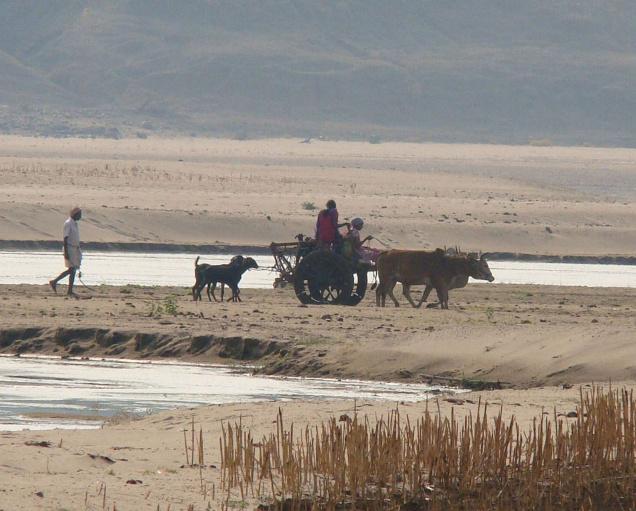
Above: A farmer family crosses the Pranahita river close to the Pranahita-Chevella project barrage site. Photo: Harpal Singh, The Hindu

Shivni is a small village of about 700-800 population in Gondpimpri Tehsil of Chandrapur District situated right at the confluence of Wardha and Weinganga rivers. These two rivers meet at juncture of three districts of two states (viz. Gadchiroli & Chandrapur of Maharashtra and Adilabad of Telangana) to form River Pranahita which is one of the biggest tributaries of Godavari. Pranahita travels a length of 113 km and meets Godavari at Sironcha tehsil of Gadachiroli Dist. Continue reading “Pranahita Chevella Project: What it means for the affected people in Maharashtra”