Dams · DRP News Bulletin

DRP: 3 April 2017 (India: Power Surplus & Exporter, Record Solar-Wind Growth, Need Not Push Destructive Hydro)

Power surplus, power exporter India, with record solar& wind wind generation trend, why push more destructive hydro projects According to power ministry statement on March 29, 2017, India for the first time became NET EXPORTER OF ELECTRICITY during 2016-17, it exported 4% more power during last 11 months (April-Feb), that what it imported from Bhutan. At the same time, power plants, on a national average, are opera ting at roughly 60%, down from nearly 65% in 2014-15.

Meanwhile, the Cabinet Committee on Economic Affairs has approved the amendments in the Mega Power Policy to push 31 GW stuck projects entailing an investment of Rs 1.5 lakh crore. The stuck projects in mega power policy include hydro projects of above 350 Mw in designated states (J&K and eight NE states) and above 500 Mw in other states.

Amid this, New and Renewable Energy Ministry has added over 5400 Mw wind energy capacity in 2016-17 against the target of 4000 Mw. This year’s achievement surpassed the previous higher capacity addition of 3.423 Mw achieved in the previous year. The leading States in the wind power capacity addition during 2016-17 are Andhra 2190 Mw, followed by Gujarat 1275 Mw and Karnataka 882 Mw.

In the last couple of years, India has not only seen record low tariffs for solar power but wind power too has seen a significant drop in tariffs. The onshore wind power potential alone is about 302 Gw. Preliminary estimates show the Gujarat coastline has the potential to generate around 106,000 Mw of offshore wind energy and Tamil Nadu about 60,000 Mw.

Continue reading “DRP: 3 April 2017 (India: Power Surplus & Exporter, Record Solar-Wind Growth, Need Not Push Destructive Hydro)”
Dams · DRP News Bulletin

DRP: 20 March 2017 (South India Reeling Under Severe Drought)

The drought has extended its grip in the South, with the South-West (S-W) monsoon falling significantly short and the North-East monsoon proving a total failure. Reeling under the impact of failed monsoons, Kerala, Karnataka, Tamil Nadu and Puducherry have declared themselves as drought affected. Kerala and Karnataka, which are the worst affected, are already contemplating actions such as cloud seeding to tide over the situation.

In Kerala, the S-W monsoon deficit stood at -34 per cent, and the North-East monsoon, -61 per cent. Similarly, in Tamil Nadu, the deficits were -19 per cent and -62 per cent (North-East monsoon). For Coastal Karnataka, the shortfall stood at -21 per cent and -63 per cent, respectively. Drought-like conditions are also prevailing in parts of Andhra Pradesh and Telangana.

Water levels in key reservoirs in the region are at their lowest. The water tables have declined further even as the civic administration in many cities, small towns and panchayats has been increasingly tapping groundwater to ensure supplies. The situation is so dire that the Kerala govt has directed PepsiCo to cut down drastically on the use of groundwater for its Palakkad plant. Traders in Tamil Nadu are also boycotting these fizzy after claims that foreign firms are exploiting the country’s water resources.

Continue reading “DRP: 20 March 2017 (South India Reeling Under Severe Drought)”
Dams · DRP News Bulletin

DRP: 6 March 2017 (Farm Ponds In Maharashtra Causing Groundwater Decline)

SANDRP Blog Farm ponds in Maharashtra Causing Groundwater Decline Farm ponds recognized as a drought proofing measure have received a great push from the central Govt recently. On the flip side however serious concerns are being raised over implementation of the farm ponds and more importantly –their use. Civil society organizations like Watershed Organization Trust and also SANDRP have been pointing out that the use of farm ponds has long drifted from its objective of storing rainwater for protective irrigation. Most of the farm ponds are instead being used as storage tanks for pumped out groundwater exposing this underground resource to losses through evaporation, etc. In the process they are accelerating the rate of groundwater exploitation multi fold.

Continue reading “DRP: 6 March 2017 (Farm Ponds In Maharashtra Causing Groundwater Decline)”
Dams

DRP: 27 Feb 2017 (Urgent Need To Review Impacts Of Farakka Dam: Experts)

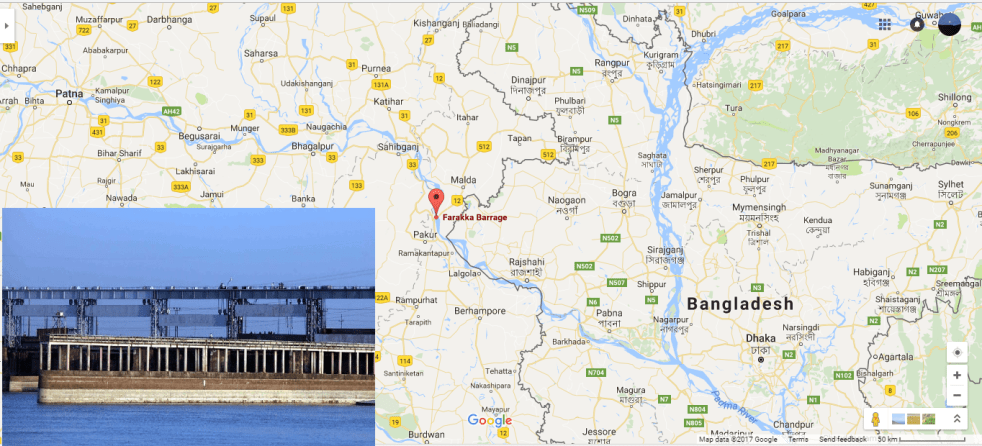
During a global seminar held on Feb. 25-26, 2017 in Patna experts from across the country have advocated an “urgent review” and comprehensive study of the Farakka dam to revive the Ganga river. The experts were discussing various concerns facing River Ganga and the possible solutions for them. The seminar titled as “Incessant Ganga” was organised by Bihar’s Water Resources Department, almost week after, Bihar CM Nitish Kumar has openly termed the barrage as genesis of floods in the State. Speaking in the program, the CM again expressed deep concerns behind receding water flow in the Ganga and increasing silt deposit due to Farakka dam.

Speaking during the seminar, environment expert Himanshu Thakkar the coordinator of SANDRP advocated urgent need for review of Farakka barrage claiming that it has failed to fulfill any of the purpose – irrigation, hydro electric power, water supply – of the barrage for which it was built. As per, Himanshu Thakkar the dam was built to maintain the navigability of Kolkata port. 

Thakkar also suggested that the gates of Farakka be opened during monsoon to mitigate the intensity of floods in Bihar. As per Thakkar there was an urgent need for a comprehensive study of the Farakka barrage to find out its achievements or whether the barrage fulfilled its objectives. The committee constituted for study must include the Centre, Bihar, West Bengal and all states having Ganga, he said adding that a study should be made on the social and livelihood impact of the barrage, how it affected people’s lives, whether its existence was justified and cost-benefit assessment among other issues.

Continue reading “DRP: 27 Feb 2017 (Urgent Need To Review Impacts Of Farakka Dam: Experts)”

Dams · DRP News Bulletin

DRP: 20 Feb. 2017 (Bihar Govt Demands Decommissioning of Farakka Dam)

Bihar wants Farakka barrage to be decommissioned The Nitish Kumar govt has held the Farakka barrage in West Bengal responsible for heavy floods in Bihar and asked the Centre to decommission it to de-silt the heavily loaded upstream of Ganga River. The state has made the recommendation, observing that the dam is the “genesis of severe” flood consequences and responsible for “alarming” silt increase in the river’s upstream. According to sources, Nitish Kumar dispensation has made the demand before an experts’ committee formed by the Centre to work out guidelines for de-silting Ganga following last year’s devastating floods. 

As per the statement, decommissioning the barrage will help automatically de-silt the heavily loaded upstream, allowing silt to move to deltas before the sea thus helping  in restoration of deltas and its eco-system which is also getting adversely affected due to this barrage. To buttress its point, the state government has referred to Kolkata Port Trust’s data, which suggests that silt dredging at the port has increased from 6.40 million cubic metres annually from pre-Farakka days to four times, i.e. at 21.88 MCM annually, during 2003. The state government has also recommended the panel to come up with ‘National Silt Policy’ to address the problem. Bihar faced one of its worst floods as Ganga swelled in August last year, claiming lives of over 20 persons and affecting 20 lakh people.

Bihar Government has rightly asked for decommissioning of Farakka barrage and held it as the genesis of severe, destructive and prolonged floods that Bihar and other regions upstream from Farakka face year after year. Good to see that Bihar government has officially demanded decommissioning of the Farakka barrage before an expert committee of Ministry of Water Resources. Hope this starts the ball rolling to remove this unnecessary and giant dam on Ganga, which will also help the cause of fisheries (including Hilsa), downstream Bengal and also the river in general. The road cum rail line on the  barrage can continue to exist.

Continue reading “DRP: 20 Feb. 2017 (Bihar Govt Demands Decommissioning of Farakka Dam)”
Dams · DRP News Bulletin

DRP: 13 Feb 2017 (Oroville Dam Disaster, USA: A Wake up Call for India’s aging big Dams)

Finally the Oroville Dam spillway damage has turned into a disaster. Report at this time (01:00pm, Feb. 13, 2017) finds dam level rising about 1 feet above the danger level. Water currents have started pouring out all over and around the emergency spillway which has never been put in use for last half a century. Meanwhile, more water is gushing in the dam reservoirs due to recent heavy rainfall in catchment areas upstream.

Continue reading “DRP: 13 Feb 2017 (Oroville Dam Disaster, USA: A Wake up Call for India’s aging big Dams)”
Dams

Yamuna River Developments in 2016-2- Other River Interventions

(During monsoon the polluted river cleanses itself allowing migrant fishermen to move in and seek out their livelihood through fishing ;  Photo by Burhaan Kinu)

The exploitation of Yamuna Rivers that starts in upper basin comprising Uttarakhand (UKH) and Himachal Pradesh (HP) gets worse as the river is dammed at Hathini Kund Barrage (HKB) while passing through Shivalik Hills located at the border of Haryana and Uttar Pradesh (UP), the barrage has severely compromised lean season (8-9 months) water flow in the river downstream.

As a result, the waterless riverbed resembles a desert till Delhi’s potable water is released back into the river at Palla village, the border of Delhi and Haryana. The absence of flow facilitates intensive illegal riverbed mining for sand and boulders for longer periods in a year which further destroys the river’s eco-system. More over industrial and domestic effluents in great volume from nearby towns reach the river via tributaries, storm water drains. Amid all this successive State Governments show no will to achieve even basic flow of freshwater in the river, even as they keep pushing more dams.

Here is an account of the projects planned and launched in 2016 related to the River Yamuna. 

Continue reading “Yamuna River Developments in 2016-2- Other River Interventions”

Dams · DRP News Bulletin

DRP: 23 Jan. 2017 (Unjustified Ken-Betwa Link Costs: Bundelkhand To Gain Nothing, Panna To Lose Its Tigers)

SANDRP Blog Little for Bundelkhand, lot for contractors in Ken Betwa river-link The official executive summary of the Detailed Project Report of KBLRP on NWDA website says: “The main objective of the Ken-Betwa link project is to make available water to water deficit areas of upper Betwa basin through substitution from the surplus waters of Ken basin.” Upper Betwa basin (Raisen and Vidisha districts of MP) is not in Bundelkhand. So KBLRP is essentially facilitating export of water from drought prone Bundelkhand to area outside Bundelkhand, which, in fact is well endowed with over 900 mm of average annual rainfall.

The DPR further says, a third o the surplus water will be utilized for “enroute irrigation of 0.60 lakh ha. in the districts of Tikamgarh and Chhatarpur of MP and Mahoba & Jhansi of U.P.” The claim in the minutes of Expert Appraisal Committee meeting of Dec 30, 2016 that “It is proposed to provide irrigation facility in 6,35,661 ha of area in Panna, Chhatarpur, Tikamgarh Districts of Madhya Pradesh and Banda, Mahoba and Jhansi Districts in Uttar Pradesh” needs to be put in context here. Firstly, this claim is far in excess of what the presumed surplus water can irrigate.

Continue reading “DRP: 23 Jan. 2017 (Unjustified Ken-Betwa Link Costs: Bundelkhand To Gain Nothing, Panna To Lose Its Tigers)”
Dams · DRP News Bulletin

DRP: 16 Jan. 2017 (MoEF’s Expert Committee Shows Biases)

EAC against entertaining ‘anti-development’ representations The expert appraisal committee (EAC) on river valley and hydel projects of the Union Environment Ministry has decided “not to take any cognizance of such representations” received by its members. In its Dec. 30, 2016 meeting, the committee concluded that once a project proposal reaches the EAC for appraisal, it has crossed the stage of public consultation and “the EAC should not go back in time, and should not reopen it, by entertaining unsubstantiated representations received from the people”. 

The EAC noted that in case of any clarification regarding action taken on such representations under the RTI Act, the EAC prescribed that a standard reply “action has been taken in accordance with the decisions taken in the 1st meeting of the EAC for River Valley and HEP on 30.12.2016” should suffice. “It was also felt that many of the objections raised are repetitive. Many such kind of representations have an anti-development attitude so that the projects are kept on hold or delayed. This has financial implications to the developers in particular and to the nation in general.

The committee emphasized that relevant ministries scrutinised every aspect of a project and proposed it for final appraisal only when all details were in place. If not satisfied that public consultation had been completed properly, the EAC said it could ask the project promoter to do the needful. The committee also made allowance for representations with “new points” and “grave consequences” on which comments from project proponents could be sought. The EAC considered 13 projects in its December 30 meeting and cleared eight of them.

Environmental activists, however, pointed out the impracticality of the contention that representations should be restricted to the 30-day public consultation window. Sripad Dharmadhikari also, in his blog has mentions various reasons to counter the EAC’s suspicious justifications. He also says that the fact that a body which is supposed to represent the environmental perspective displays such an attitude is the biggest critique of the EAC and the environmental clearance process that it is a part of. The newly constituted MOEF’s EAC on River Valley Projects has in their very first meeting shown anti people, anti democratic and anti environment attitude.

Continue reading “DRP: 16 Jan. 2017 (MoEF’s Expert Committee Shows Biases)”
Dams · DRP News Bulletin

DRP: 9 Jan 2017 (India Groundwater Continues to Decline: Govt Report)

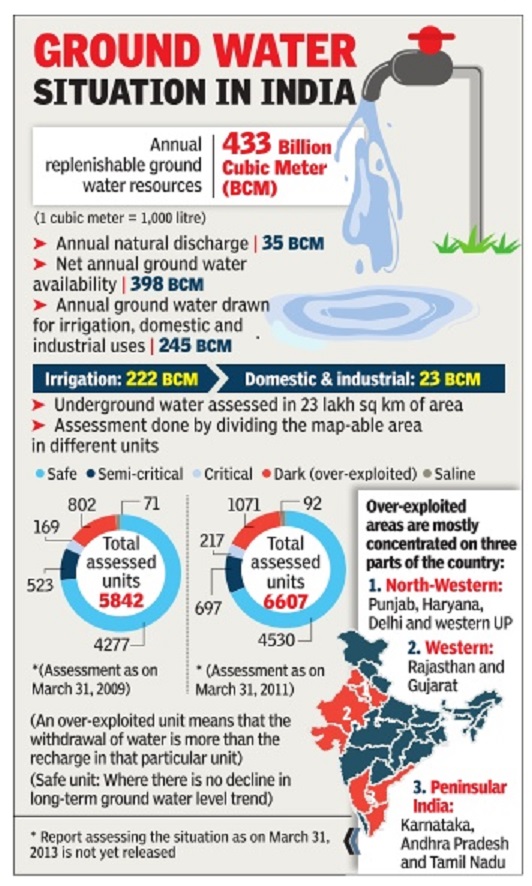
Ground water recharge plan is a non-starter Though the latest report, covering assessment of ground level situation as on March, 2013, is still being compiled, sources in the Central Ground Water Board (CGWB) hinted at further increase in the number of `dark’ (over-exploited) units. Decline in ground water level due to over exploitation of available resources had prompted the Centre in 2013 to come out with a master plan for artificial recharge of ground water, specifying how different states would go about it on priority. But majority of the states have, so far, not implemented the master plan. Only six states -MP, Gujarat, W-Bengal, UP, Chhattisgarh and Karnataka have taken follow-up actions despite the fact that the number of `dark’ units increased from 802 in March, 2009 to 1,071 in March, 2011. This not only says what the title mentions, but also shows how slow our official agencies are in even coming up with groundwater data, the latest data is for March 2011! 

Continue reading “DRP: 9 Jan 2017 (India Groundwater Continues to Decline: Govt Report)”