Dams · DRP News Bulletin

DRP: 18 Dec 2017 (Also Needed To Mention This About Turial HEP)

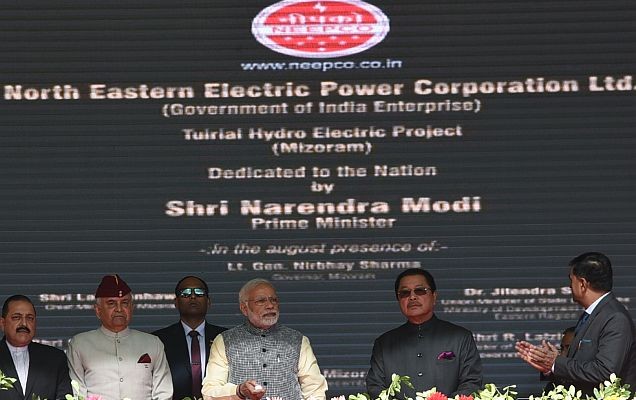
The Prime Minister, on Dec 16, 2017, while dedicating to nation the 60 MW Turial HEP, should have also mentioned:

– PUBLIC PROTESTS: The project faced strong protests from local people, so much so that work had to be stopped for over 7 years from 2004 to 2011. Even a day before PM dedicated the project, people took out a protest march.

– NO PUBLIC CONSULTATION:  One of the reasons people protested was that the project did not have any proper public consultation.

– NO PROPER IMPACT ASSESSMENT: Another reason for people’s anger was no proper environment or social impact assessment, or proper compensation and rehabilitation.

– HIGH COST: The project cost was Rs 368.72 Crores, but now already has gone above Rs 1441 crores officially, likely to go up further. That means per MW cost is already above Rs 24 crores, one of the highest in the country. WHO WILL PAY THE HIGH COST OF ELECTRICITY FROM THE PROJECT?

– HUGE COST ESCALATION from Rs 369 crores to over Rs 1440 crores

– HUGE TIME OVER RUN: The project was supposed to be completed many decades back but  has seen huge time over run, not only because of protests, but also because of inadequate mobilisation by the contractor, poor approach road, power house slope failure, among many other reasons.

This latest project once again shows that big hydro is no longer viable, one wishes, the Prime Minister would also highlight these realities in his speeches.

Continue reading “DRP: 18 Dec 2017 (Also Needed To Mention This About Turial HEP)”
Dams · DRP News Bulletin

DRP: 11 Dec 2017 (Shoddy EIA, People’s Opposition & Unviable Pancheshwar Project Highlighted In Documentary)

A brilliant coverage by NDTV INDIA at PRIME TIME (08 Dec 2017) on so many issues related to the proposed controversial Pancheshwar Dam, World’s tallest dam in the Himalayas that has neither credible impact assessment nor proper public hearings. Please watch and share.

Meanwhile, residents and various political organizations at Almora, Pithoragarh and Jhulaghat staged a protest against public hearings held for environmental clearance of Pancheshwar projec, saying that the sessions were unfair and flouted procedure. https://timesofindia.indiatimes.com/city/dehradun/pancheshwar-row-residents-protest-against-public-hearings/articleshow/61946615.cms

The wrong process of dam clearance for the Pancheshwar and Rupaligad Dams have been strongly condemned by Mahakali Lok Sangathan, Uttarakhand Parivartan Party, Uttarakhand Kranti Dal, the National Alliance of People’s Movements: Uttarakhand Akta Manch, Delhi Solidarity Group and others. https://www.facebook.com/sandrp.in/posts/1874936619200669

Continue reading “DRP: 11 Dec 2017 (Shoddy EIA, People’s Opposition & Unviable Pancheshwar Project Highlighted In Documentary)”
Dams · DRP News Bulletin

DRP: 4 Dec 2017 (Protests Against Pancheshwar Dam in Champawat, Pithoragarh, Almora, Delhi)

Protests and controversies around Pancheshwar Multipurpose Project (PMP) are only growing louder and wider. While Expert Appraisal Committee (EAC) Rivers Valley Project in unnecessary hurry considering the project tomorrow (05 Dec. 2017)  http://environmentclearance.nic.in/writereaddata/Form-1A/Agenda/2811201745T4GD5I10thAgendaEACHydro05122017.pdf

Villagers and local groups people also continue raising their concerns and objections against 5040 Mw dam project. Today, scores of villagers, environmental groups including regional political party have protested at Jhulaghat in Champawat, Pithoragarh, Almora and in Delhi demanding EAC to listen to the voices of local people and groups.

Continue reading “DRP: 4 Dec 2017 (Protests Against Pancheshwar Dam in Champawat, Pithoragarh, Almora, Delhi)”
Dams · DRP News Bulletin

DRP: 20 Nov 2017 (GLOBAL SLOW DOWN IN HYDRO POWER PROJECTS)

It is getting increasingly clear that days of large hydro power projects are coming to an end. While in India large numbers of big hydro power projects are stalled, this week there was news from Meghalaya, Arunachal Pradesh, Sikkim and rest of North East India of cancellation or stoppage of hydro power projects. http://www.sentinelassam.com/story/main-news/0/subansiri-project-not-to-see-light-for-4-years/2017-11-12/1/325720#.WgpysVuCzIV

Pancheshwar project on India Nepal border continues to face opposition. https://timesofindia.indiatimes.com/city/dehradun/traders-oppose-pancheshwar-dam/articleshow/61705308.cms  

Nepal this week cancelled the agreement for 1200 MW Budhi Gandaki hydropower project. In Bhutan, the Prime Minister declared that they are in no hurry to go ahead with new hydropower projects. http://kathmandupost.ekantipur.com/news/2017-11-13/govt-scraps-budhigandaki-project-with-chinese-company.html  

In Pakistan, the agreement for the massive 4500 MW Diamer Bhasha hydropower company with China has fallen through. https://economictimes.indiatimes.com/news/defence/chinas-strict-conditions-force-pakistan-not-to-include-diamer-bhasha-dam-in-cpec-officials/articleshow/61660935.cms

In Mynmar, too the agreement with China for massive hydropower project stands cancelled. http://www.reuters.com/article/us-china-myanmar-energy/china-says-will-keep-talking-to-myanmar-over-stalled-dam-scheme-idUSKBN1D80X4?il=0

This is further reinforced by study by Dr. Luke Gibson, Honorary Assistant Professor of the School of Biological Sciences at the University of Hong Kong, which concludes that among so called green energy sources, hydropower is most dangerous. https://phys.org/news/2017-10-green-energy-hydropower-dangerous.html#jCp

Continue reading “DRP: 20 Nov 2017 (GLOBAL SLOW DOWN IN HYDRO POWER PROJECTS)”
Dams · DRP News Bulletin

DRP: 13 Nov 2017 (EAC Defers To Clear Pancheshwar Dam But Ignores People’s Voices)

The minutes of expert appraisal committee (EAC) shows that Environmental Clearance  (EC) for the Pancheshwar Multipurpose Project has been deferred. The minutes were uploaded after 16 days of EAC meeting conducted on Oct 24, 2017. http://environmentclearance.nic.in/writereaddata/Form-1A/Minutes/09112017PCU6UH80Finalminutesof9thEACmeeting1.pdf

In the minutes, the EAC said that it would require to study the Environmental Impact Assessment (EIA) report for the Nepal portion of the project to get a holistic view. It also directed the project proponent to obtain wildlife clearance as the project was located 300 metres from the Ascot Wildlife Sanctuary. 

It is worth to mention that the Pancheshwar dam with a height of 315 meters is world’s second tallest dam proposed in ecologically sensitive region. Scores of media reports have underlined the unfair and politically influenced Environment Public Hearing (EPH) process, conducted during peak monsoon month in landslide ridden and disaster prone region. The venue of the EPH was also several kms away from villages going to be affected thus depriving the local people participation in essential decision making process. As a result the concerns and voices of villagers to have their voices heard. The EIA report of the project has also not mentioned several grave environmental issues of GOLFs events, cloud bursts, earthquakes etc in the catchment of the dam let alone the question of impact on endangered wildlife like Mahseer fish. 

Continue reading “DRP: 13 Nov 2017 (EAC Defers To Clear Pancheshwar Dam But Ignores People’s Voices)”
Dams · DRP News Bulletin

DRP: 6 Nov 2017 (NGT Asks For Fresh Appraisal Of Lower Subansiri Hydro Project)

In a remarkable development, the National Green Tribunal (NGT) on October 24 has suspended the clearances given to the 1750-megawatt (MW) Demwe Lower Hydroelectric Project  (HEP) planned on the Lohit river in Arunachal Pradesh.

In its detailed order, released on October 27, the NGT ruled that the Environment Minister as Chairperson of the National Board for Wildlife (NWBL), a statutory body constituted under the Wildlife Protection Act, 1972, could not “just brush aside” the views of the majority of NBWL standing committee members.

Suspending the clearances given by the Centre and the state govt, the NGT order added that “the decision taken by the Standing Committee is not in accordance with established principles of law and hence the Standing Committee shall reconsider the issue and pass appropriate orders within a period of six months from the date of the judgment”.

Environmental clearance for the project was given by the Union environment ministry’s Expert Appraisal Committee (EAC) for river valley and hydroelectric projects back in 2009. An in-principle forest clearance for the Lower project was given in February 2012 and agreed upon in 2013.

However, the in-principle clearance of the project was opposed by a majority of the Standing Committee of the NBWL but subsequently cleared by the then-environment minister of state (independent charge), Jayanthi Natarajan, who was also the chairperson of the Standing Committee.

Natarajan is currently under the CBI’s scanner for alleged anomalies in clearance given for diversion of land in Saranda forest in Singhbhum district, Jharkhand to mining company Electrosteel during the previous UPA regime.

The NGT said that it is “of the view that either the Chairperson (Natarajan) should have given a proper reason for rejecting the objection of the majority of the non-official members or the decision ought to have been arrived at based on the opinion of the majority of the members. Even though the Standing Committee is a recommendatory body, the same being a statutory committee, is bound by the laudable principles of justice and fair play”.

Continue reading “DRP: 6 Nov 2017 (NGT Asks For Fresh Appraisal Of Lower Subansiri Hydro Project)”
Dams · DRP News Bulletin

DRP: 2 October 2017 (New Rules Disastrous For India’s Wetlands)

The wetlands are the hotspots of biodiversity, act as carbon sinks, act as buffers against floods and are essential for groundwater recharge. With groundwater reservoirs in the country heavily exploited, this last function has assumed greater importance. http://www.hindustantimes.com/environment/centre-notifies-wetland-rules-environmentalists-unhappy/story-3MoGp9D8eSzHI90zfOXWSO.html

Wetlands can be defined as lands transitional between terrestrial and aquatic eco-systems where the water table is usually at or near the surface or the land is covered by shallow water.

But they are threatened by reclamation and degradation due to activities like drainage and landfill, pollution, hydrological alteration (water withdrawal and changes in inflow and outflow), over-exploitation resulting in loss of biodiversity and disruption in ecosystem services provided by them.

DRP 12

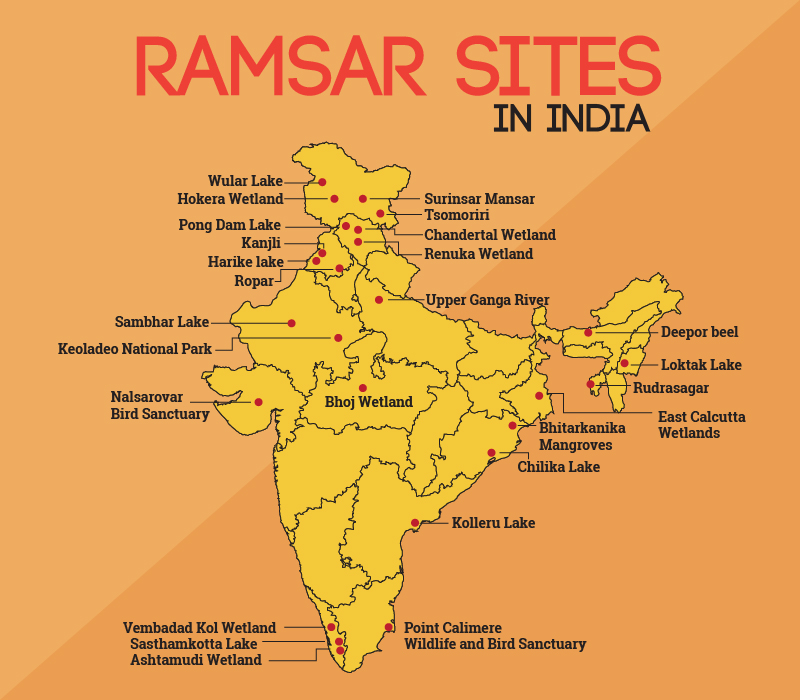
There are at least 115 wetlands that are officially identified by the central government and of those 26 are identified as wetlands of international importance under Ramsar Convention which is an international intergovernmental treaty for conservation of wetlands. India is a party to the treaty. http://www.livemint.com/Politics/y6Tr3tkrr3q28AmGKaBFII/Environment-ministry-notifies-new-wetland-rules.html

The Centre on September 26 notified a new set of rules under the head Wetlands (Conservation and Management) Rules, 2017 replacing the Wetlands (Conservation and Management) Rules, 2010. http://www.thehindu.com/news/national/kerala/new-wetland-conservation-rules-notified/article19779100.ece

It is worth to mention that under the 2010 rules, not a single water body was notified as a wetland over and above the ones already recognised as such by the Centre and the Ramsar Convention, defeating its purpose in a way. http://www.zeebiz.com/agencies/centre-notifies-new-rules-for-preservation-of-wetlands-26312

Similarly, despite country’s space agency ISRO had in 2011 mapped over two lakhs of wetlands across the country, the centre has, so far, notified only 115 wetlands and 63 lakes in 24 states and 2 UTs for conservation and management.

Continue reading “DRP: 2 October 2017 (New Rules Disastrous For India’s Wetlands)”
Dams

How much longer will Goa remain Otter Worthy?

Above: A fisherman on his traditional mango-wood canoe in Goa. (Photo: Atul Borker)

Guest Blog by Atul Borker, with Salil Chaturvedi

My deep engagement with Goan rivers began almost half a decade ago, when I started researching otters in the state. In this short span of time, an otter’s life has seen its ups and downs, and I don’t mean the daily rise and fall of tides that are critical to wildlife adapted to the mangroves!

Though Goa is the smallest state of India, it is blessed with as many as nine rivers. A unique aspect of Goan rivers is that they are tidal as well as rain-fed. During the monsoon months (June-September), water is drained out of the watershed through the rivers and into the sea. At the same time, the rivers experience a daily tidal influx upto 40 kilometers inland. The salinity of the rivers varies sharply between the monsoon and non-monsoon seasons, and so does the physico-chemical quality of the water. Needless to say, the people and the wildlife along the banks are highly attuned to these seasonal (and diurnal) changes, and the shy and elusive otter is one such animal. Continue reading “How much longer will Goa remain Otter Worthy?”

Rivers

Will this ‘Rally’ help the rivers?

PRESS RELEASE From India Rivers Week Organising Committee on Sept 13, 2017

We are concerned about the increasing superficial optics around saving rivers, with little or no effort to address fundamental issues which are causing their demise.

The high profile rally initiative to save India’s rivers taken up by well respected religious guru Sadguru and his followers is noteworthy, and the most recent case in point. It is striking that so many film stars, politicians, governments, and public personalities, are joining the call. Lakhs of children are expected to join in the program. While we welcome such an outpouring of good intentions and good will as a demonstration of the positive energy all around, unfortunately, we have seen no evidence either from the rally organisers, on their website[i] or their messaging, that they understand or plan to address the real threats faced by our rivers and their sorry state. Continue reading “Will this ‘Rally’ help the rivers?”

Dams · DRP News Bulletin

DRP: 11 September 2017 (Why This Rally Won’t Help The Rivers?)

The news media is filled with this new kid on the block, trying to wake the nation about the need to save our rivers… amazing to see so many film stars, politicians, governments, and public personalities, many of them rather innocently joining the band wagon… some friends were pleading that see, he is able to take the message of rivers to so many people, including lakhs of children… let us try and see if there is something positive here… may be, may be this is just the entry point, but the guy and his team have bigger vision? May be we need to give him longer rope, be more charitable and not jump to negativity?

We have kept all this in mind while writing this.

We see nothing from the people who are leading the rally, or their websites or messages that they understand the real threats faced by and reasons for the state of our rivers, are ready to even list such causes or protest any further move to destroy our rivers. The website claims it is “a nationwide awareness campaign to revive our rivers”. Can missed call save our rivers?

Continue reading “DRP: 11 September 2017 (Why This Rally Won’t Help The Rivers?)”