Tamil Nadu A people’s initiative to restore a river’s glory The Noyyal River Restoration Federation will launch ‘Noyyalai Nokki’ (Towards Noyyal), a people’s initiative to restore the Noyyal river system on 26 March. Social activist Anna Hazare will launch the project at Kooduthurai in Alandurai in Coimbatore district. The river originates in the Western Ghats and runs through the four districts to join the Cauvery at Noyyal village. Known as Jungle stream, in olden times as many as 34 streams used to feed water into it and the river would flow throughout the year with two or three annual flood spell. But now, just 4 or 5 streams feed the river. In many places, the river is encroached upon, sewage is let into it, or the river needs to be desilted. The river is all set to regain its glory with the ‘Noyyalai Nokki’ initiative. What is encouraging is the willingness of the public to be part of it. The project proposes to divide the river into segments of 500 metres for restoration and maintenance. Ownership groups will be formed for every 500 metres and it will consist of the local people, experts and patrons (divide-distribute-develop model).
Tag: River
DRP: 14 March 2016 (No Rain Dance, Only Dry Holy This Time: Pune District Administration)
Dam levels down, ‘rain dance’ for Holi dropped Pune district, where a water cut is in effect due to depleting water levels in the dams, will not have any kind of “rain dance” functions this Holi. As water reserved in the dams is to be used only for drinking purposes as per the district administration’s instructions, the collectorate has urged people to go for a “Dry Holi” this year and will ensure that there are no such functions during Holi. With dam levels coming down to as much as 23% of their capacity, the entertainment department of the collectorate will ensure that permissions are not given for events like the “rain dance” during the festival. Meanwhile, a BJP legislator in Mumbai has written to the Brihanmumbai Municipal Commissioner seeking a ban on “rain dance” functions in Mumbai in the metro during Holi. Ameet Satam, in a letter to the BMC, said that the civic body should ban rain dance and even asked the corporation to slap a fine of Rs 50,000 on those who indulge in waste of water.

Blow by Blow, how pollution kills the Yamuna river: A Field Trip Report
Yamuna River from Hathini Kund Barrage to Delhi (All maps from Google Earth, created by author)
A field trip along the Yamuna River this April 2015 showed how the river is killed blow by blow, by the pollution and diversion. The visit was planned with an objective to study and observe actual status of industrial and domestic pollution reaching River Yamuna via various Escapes and Drains in Haryana, upstream Delhi. A team of two members Sri Manoj Misra, Yamuna Jiye Abhiyan and Bhim Singh Rawat, SANDRP spent three days (03-05 April 2015) closely travelling along the river through four districts of Haryana (Sonipat, Panipat, Karnal and Yamuna Nagar) and tracking various drains, escapes (from origin) which pour massive amount of effluents in River Yamuna . Continue reading “Blow by Blow, how pollution kills the Yamuna river: A Field Trip Report”

Landslide dam threat in Zanskar Valley to continue for more weeks: Update 2
In the most significant event so far on the issue of landslide blockage of Phutkal River in Zanskar Valley in Kargil District in Kashmir, the National Crisis Management Committee[1] (NCMC) chaired by the Union Cabinet Secretary Shri Ajit Seth met[2] on Feb 20, 2015 and approved the Action Plan whose implementation will begin within next 15 days and is to be completed by end of March. This decision is based on assumption that the snowmelt will cause landslide dam threatening situation only in April.

Continue reading “Landslide dam threat in Zanskar Valley to continue for more weeks: Update 2”

NGT Orders MAILY SE NIRMAL YAMUNA – WILL THIS LEAD TO A REJUVENATED YAMUNA?
Guest Blog by Manoj Misra (yamunajiye@gmail.com), Yamuna Jiye Abhiyan, Delhi
The National Green Tribunal (NGT) in a landmark judgment pronounced on 13 January 2015[1], has set an ambitious road map for a rejuvenated river Yamuna by 2017. Naming it as “Maily se Nirmal Yamuna rejuvenation project, 2017” the green court in the judgment spread over almost 100 pages has detailed steps necessary to achieve what all previous efforts have miserably failed. Continue reading “NGT Orders MAILY SE NIRMAL YAMUNA – WILL THIS LEAD TO A REJUVENATED YAMUNA?”
Ganga and Varanasi’s Waste-water Management: Why has it remained such an Intractable Problem?
Guest blog by: Dr Kelly D. Alley (ALLEYKD@auburn.edu), Auburn University, USA
Varanasi is newsworthy these days, situated symbolically and politically in the new Prime Minister’s agenda. In his victory speech, the PM-elect Narendra Modi vowed to clean the sacred river Ganga. After assuming the office of Prime Minister, he reiterated the vow and pledged renewed efforts for Ganga cleanup.
Three months later, a skeptical Supreme Court reviewed the new government’s Ganga Plan and remarked that with this approach the river will not be cleaned in 200 years. The Supreme Court asked for the full details of the cleanup plan, and inserted its role as a monitor over central government plans. The government has reportedly submitted a new plan to the court, but no details are available yet in the public domain. However, from media reports, it seems the plan is not very different from what has been done in the name of the Ganga Action Plan so far.
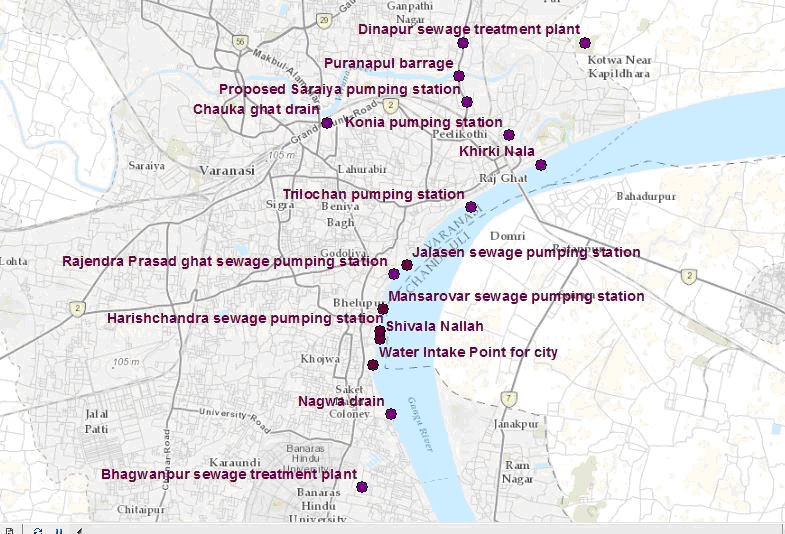
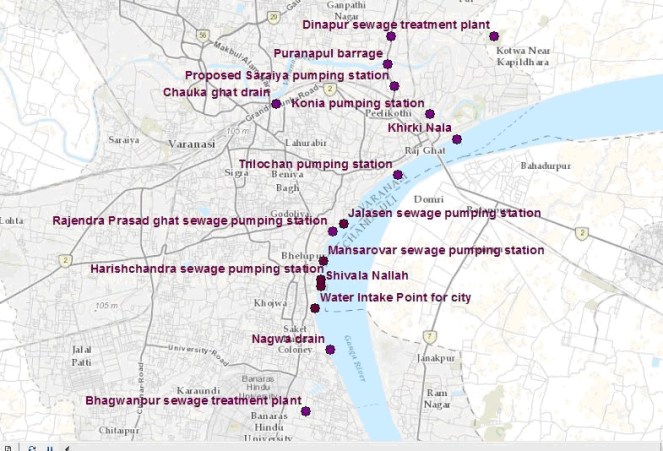
As residents and sympathetic outsiders know, the wastewater problem in this sacred, ancient city is seemingly intractable. In order to implement lasting solutions to the recurring river pollution scenario, we need to investigate the current situation. I just completed a field trip to this special city that many call Banaras. I visited all the existing and planned components of the wastewater collection, treatment, and disposal system. In this article I will try to create a visual map of the wastewater infrastructure and management problems and define the current lines of command and control within the vast and overlapping water, environment, and public health bureaucracies. This should help to identify systemic problems in each that need to be addressed when charting a new direction.
The seemingly intractable problems of Ganga clean up (rejuvenation will need so much more than just a clean up) in Banaras can be divided into three categories. First, there are governance problems that are related to how decisions on technologies, scale, operators and siting are made. These include problems with the solicitation, selection, and implementation of projects, especially the design and construction and operation and maintenance of sewers, sewage pumping stations and sewage treatment plants. Second, there are serious infrastructure problems that are part of the complexity of this ancient city.
Third, there is a real electrical power supply problem. Securing continuous electrical power for sewage pumping stations and wastewater treatment facilities is a low priority, and emergency standby generators are not used when the grid-provided power is unavailable. As a result, the intermittent operation of sewage pumping stations and sewage treatment plants is ineffective in protecting water quality in Ganga and in provisioning safe drinking water and sanitation in Varanasi.
When the sewerage infrastructure is operated intermittently, the treatment technology cannot treat the wastewater adequately, and the concentration of contaminants and water quality indicators such as total suspended sewage solids (TSS) and biological oxygen demand (BOD), heavy metals, toxic organic compounds, and the Most Probable Number (MPN/100ml) of fecal coliform bacteria–indicating the presence of enteric waterborne disease pathogens in the treated effluent–remain high. So in a way providing partial power to a sewage treatment plant does not do the work and is therefore a largely inoperable, non-functional, sunk cost.
Governance
The Government of India established the Ganga Action Plan in 1986 to lead the way in river pollution control programs. In 2009, the Government declared the Ganga a national river and established the National Ganga River Basin Authority. The National Mission Clean Ganga (NMCG)–the implementing agency under this Authority–is now housed in the Ministry of Water Resources, River Development and Ganga Rejuvenation under the Government of India. The Mission Director is the chief executive of the NMCG.
At the state level in Uttar Pradesh, there is a state Project Management Group (PMG) chaired by the Chief Minister. It includes members from the State Ministries of Environment and Irrigation, the Uttar Pradesh Pollution Control Board and the state water commissions. The State PMG decides whom to select for work, and in most cases uses the Uttar Pradesh Jal Nigam (the state level sewage engineers) to execute wastewater project work.
The State PMG can outsource consultancy work and allocate projects to NGOs as well; although in all cases, it has allocated the wastewater engineering work to the Uttar Pradesh Jal Nigam. These layers of committee membership create a vast water bureaucracy at the state level in addition to the committee memberships and officers at the Central level. They are not independent regulators, monitors and compliance officers (which are needed) but contributors and benefactors of political and profitable decisions in the ongoing issuing of contracts, clearances and other approvals.
This is a big problem because any contract for sewerage work must pass through all these departments and boards, with money wasted on bids and approvals for specific projects. In addition there is no other implementing agency in Varanasi so if the UP Jal Nigam’s work is shoddy or even fraudulent, then the Ganga River and the whole city suffers without an alternative. This situation is well known to Banaras residents who will complain daily that funds meant to improve the sewerage system are simply eaten up by various agencies while wastewater is diverted into the sacred river without treatment.
In addition, the foreign donor agency, the Japan International Cooperation Agency or JICA, has been present in Varanasi for many years to advise and assist with capacity building and technological cooperation for the Ganga Action Plan. Apart from controlling the flow of funds, however, it appears that JICA has worked within the current lines of command and control, thereby helping to perpetuate rather than reform the system.
Infrastructure
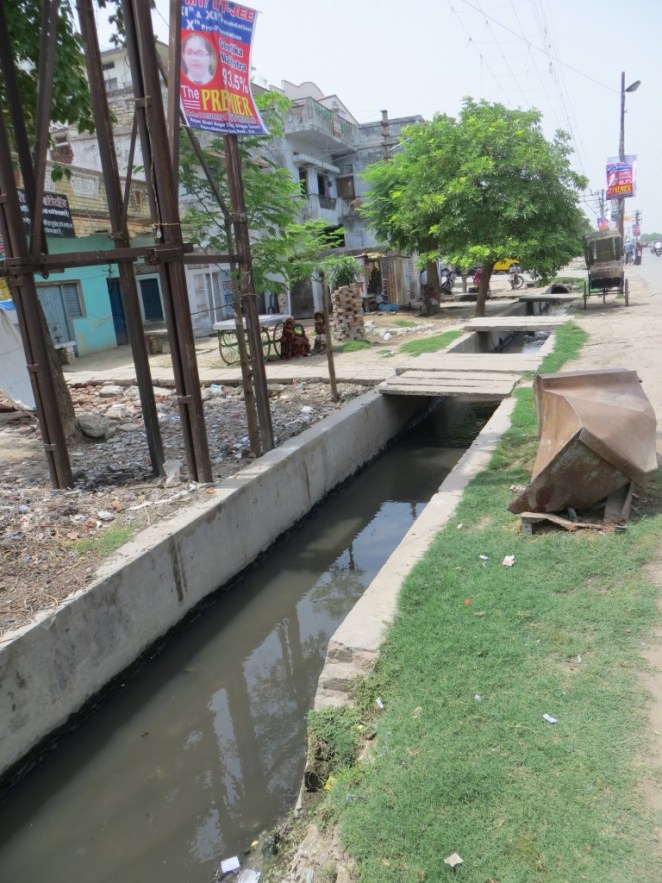
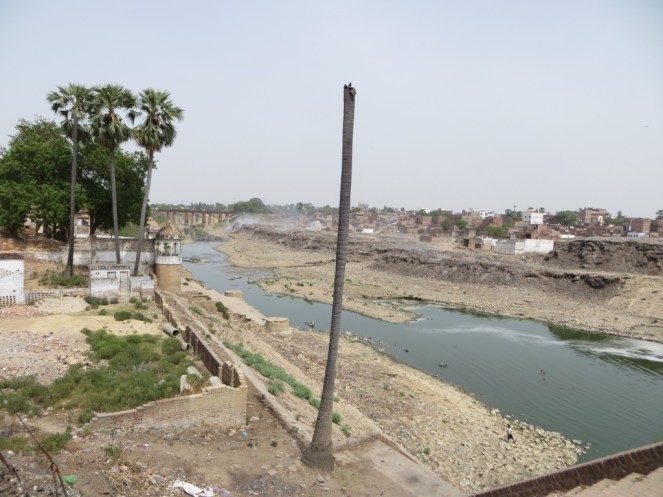
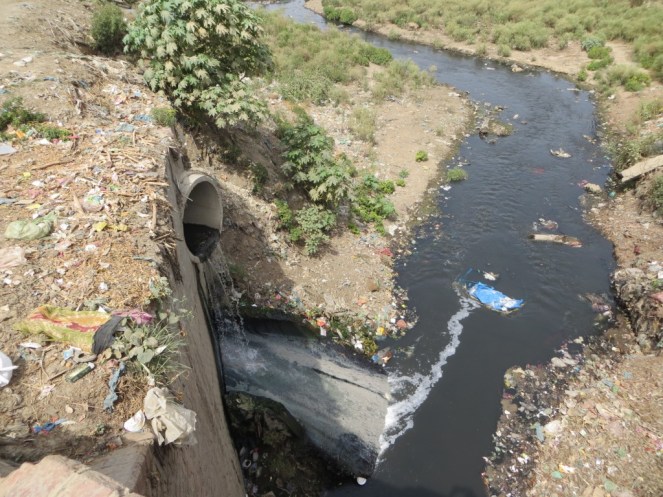
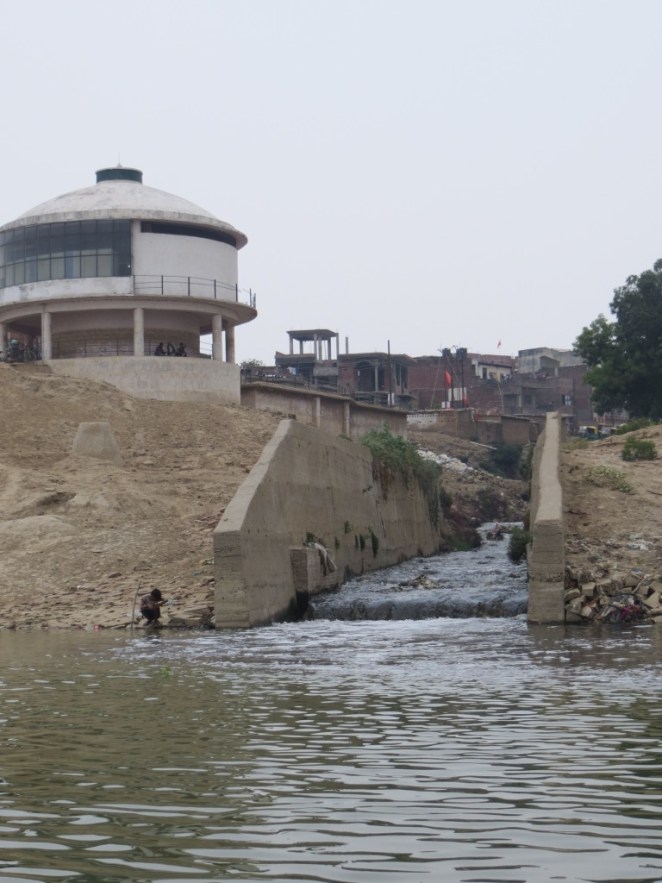
So what is the current situation with the main wastewater drains? The main drains for the city are the Nagwa drain, located in the south and upstream of the main city, and Khirki nallah, located in the north downstream of the main bathing ghats. The Ganga flows northward at Banaras (see map). The Varuna River enters from the west and circles the outer part of the older sacred city complex before draining into the Ganga at the downstream or northern end. In the last year the Varuna River has turned into a wastewater pond upstream of the barrage recently built under the Puranapul Bridge that crosses the Varuna River. The Varuna river banks downstream of that barrage have also become the dumping grounds for all forms of solid waste and the entire landscape is hellish. One wonders how the communities in the vicinity can survive.
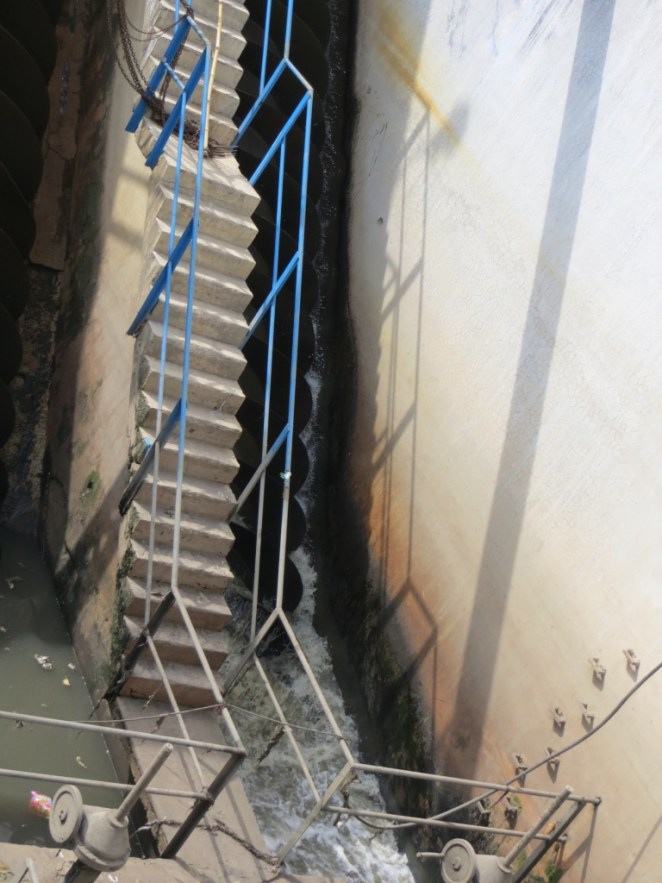
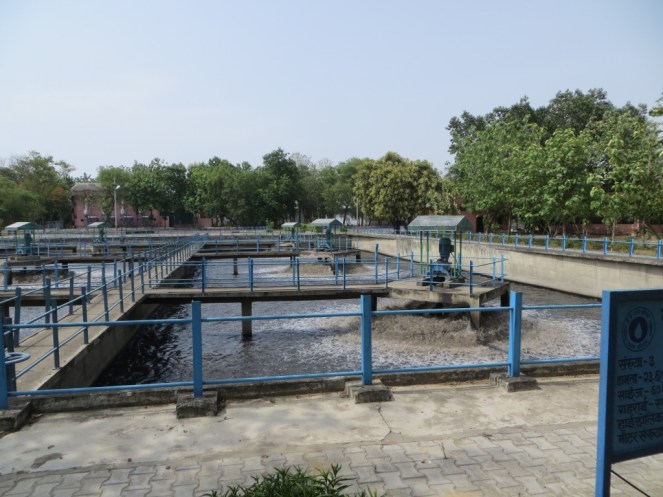
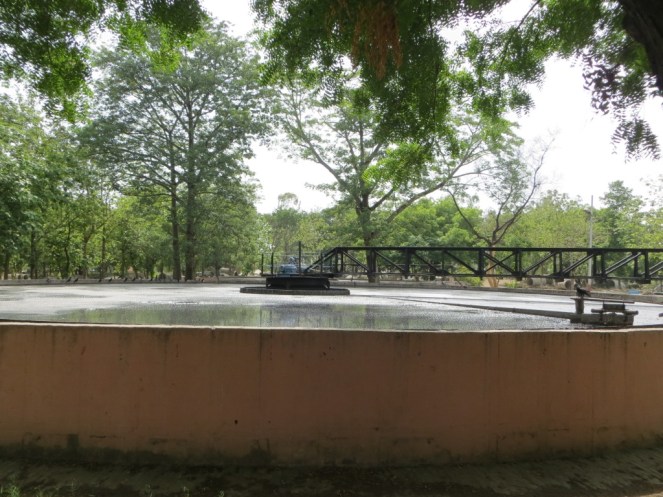
The existing wastewater management facilities include three sewage treatment plants, five sewage pumping stations along the ghats, and one main sewage pumping station at Konia. The Konia pumps are supposed to pump up to 80 million liters of sewage per day to the Dinapur treatment plant located in the trans-Varuna neighborhood of Dinapur village, if they work at full capacity. However they rarely do.
For instance, only one screw pump was working on the day of my visit, so that means it was running at 1/3 its capacity. This would also mean that the Dinapur treatment plant was receiving only 1/3 of the wastewater it is capable of treating, according to its nominal treatment capacity, and therefore it was running at 1/3 capacity. However to be exact one would have to know how many hours the one pump operates each day of the week and then the capacity factor can be calculated. For instance, if the pumping station runs at 1/3 capacity for only 6 of the 24 hours each day then the capacity factor would be 1/12 or about 8%.
If capacity factors of the pumping stations and treatment plants are taken into account in a Life Cycle Cost assessment then the cost per unit volume (ML) of treated sewage would sky rocket. The UP Jal Nigam does not keep a daily operational log with data like energy usage data, and thus there are no metrics, no measures, and no good management practices. This adds up to a lack of proper governance. Many monitoring committees have made visits to site facilities but have failed to correct the daily malfunctioning of the entire system. On my trip to videotape the Khirki wastewater drain in late June, I said to the boatman taking me, “So they release this water into Ganga ji at night and in early morning, right? Like chup ke?” He replied, “No Madam not chup ke. It is right there running wastewater all the time. Everyone can see it, and they are not even bothering to hide it!”
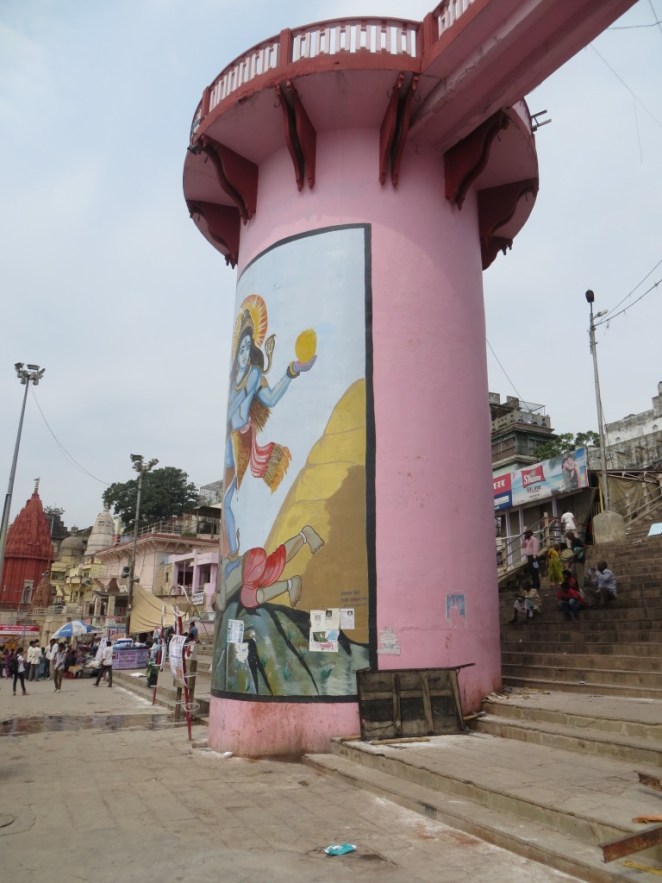
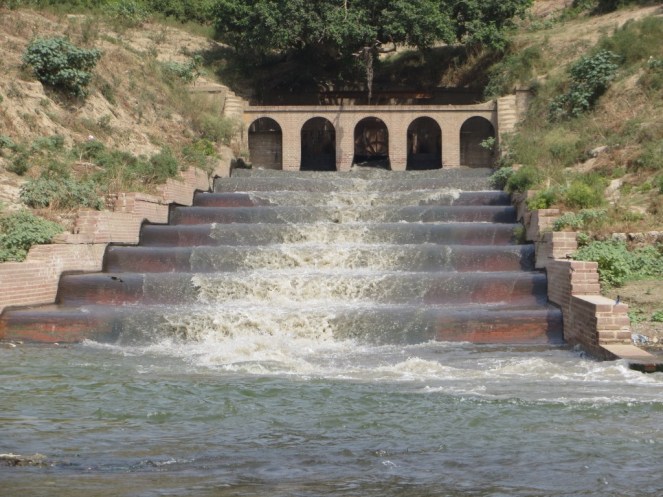
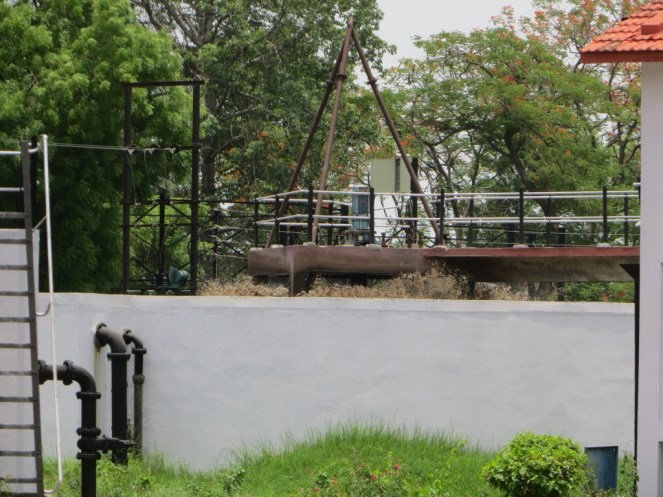
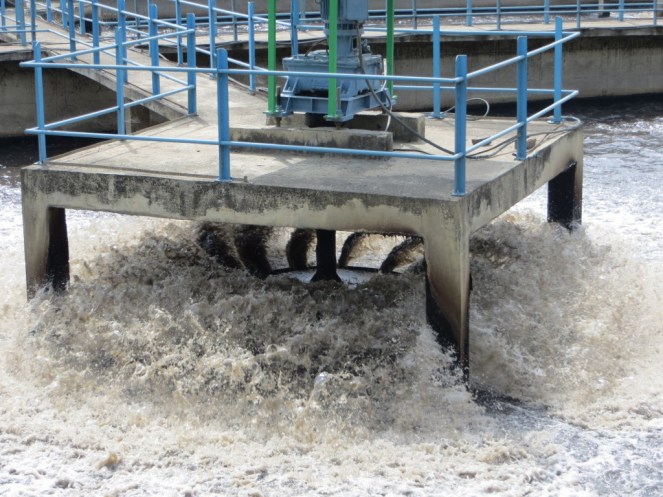
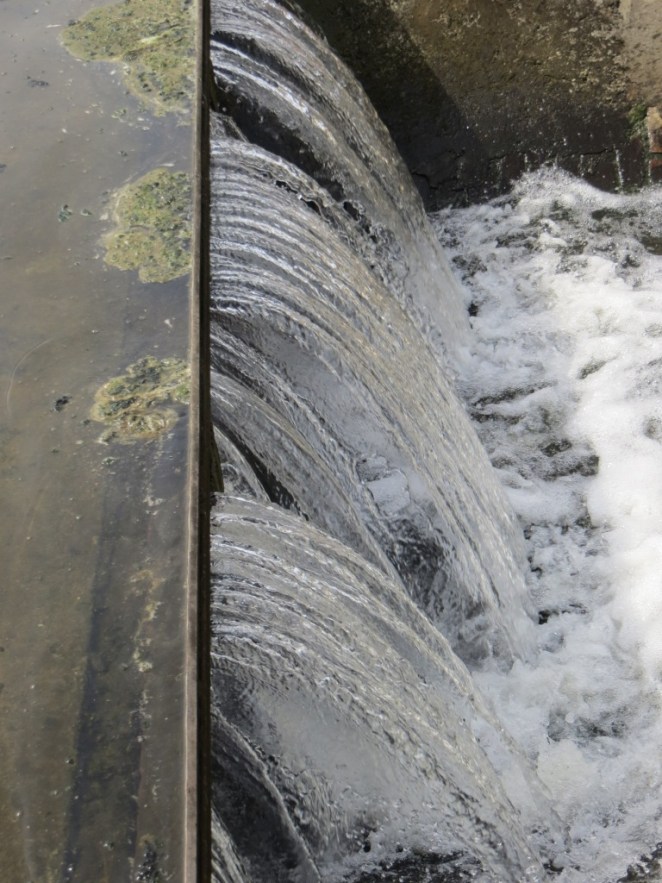
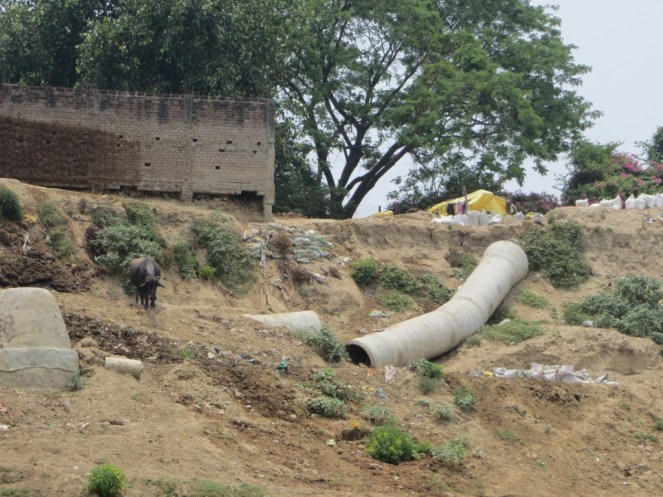
Below are current pictures of parts of the system that have been damaged, destroyed or poorly maintained. The map can be used to place these pictures in the city space.



Power
We have to think about wastewater problems in the context of public health, environmental health, electrical power supply and national and state priorities for power distribution. In the current scenario using existing technologies and scales (there are better options for technology and scale), a significant amount of energy is required to pump and treat wastewater using sewage pumping stations and the activated sludge treatment process. In India energy supplies are allocated to industrial and urban needs long before they are distributed to sewage treatment plants. Looking at the current energy scenario in India it is not hard to see that wastewater pumping and treatment require continuous power and are not sustainable in the context of the current power deficit. Biological secondary treatment using the Activated Sludge Process (ASP) uses a significant amount of electricity to operate aeration equipment and mixers. Another technology used in Kanpur, the Upflow Anaerobic Sludge Blanket (UASB), is also a capital and energy intensive process. With other demands high on the agenda, it is unlikely that precious power will be available to run all the existing and proposed sewage pumping stations and sewage treatment plants on a daily basis now and into the future if the existing technologies and scales continue to be used.
Take Away Points
If wastewater infrastructure is built, it is done with large government investments of public funds, sometimes with capital from international banks; there is little private equity to drive the process. Instead the costs of building (and also poorly building) these facilities are absorbed across a range of human services including public health, education, housing and infrastructure. The costs of operating and maintaining sewage pumping stations and treatment plants are also high and operation and maintenance of the facilities become a low priority after construction.
For instance, the sewage treatment plant laboratories are ill-equipped and this means that the UP Jal Nigam operators are unable to monitor, measure, and report operational and water quality data. Due to the absence of laboratory equipment, instruments and analytical capacity, they are not able to optimize the treatment process. Generally the functional components of the sewerage infrastructure – the sewage pumping stations and treatment plants – are overwhelmed by the dysfunctional components and by the enormous pollution load. In this way the functioning units in the system become important, not for effectively treating the waste but for projecting a façade of functional infrastructure, especially when site visits by monitoring agencies are underway. Yet the norm is that facilities are operated only periodically and usually below capacity, and the result is that untreated wastewater is passed through open drains to agricultural fields or rivers. During rains and the monsoon, wastewater combined with storm water flows directly into the Assi, Varuna, and Ganga Rivers.
This sacred city requires a competent participatory authority to master plan, design, select the right scales and technology, construct, operate and effectively maintain a comprehensive wastewater collection, treatment and reuse system. Its governance requires clearly defined norms of transparency, accountability and participation.
A competent authority should connect central, state and municipal levels and be accountable to the residents of the city not just through the municipal corporation and its elected officials, but also directly through norms of participatory governance. These governance reforms should include clearly defined norms of transparency, accountability and participation that pertain to the entire system and to each component part–the pumping stations, sewage and water treatment plants, sewers and associated facilities. A piecemeal approach with the Jal Nigam exclusively at the helm has not worked thus far and it has sunk crores of rupees into poorly operated and maintained infrastructure, even in the face of national and global attention and numerous judicial interventions to the cause of Ganga cleanup. A careful constitution of accountable engineering agencies, a welcoming approach in planning and implementation to citizen contributions, and a vigilant monitoring of operations and maintenance practices by concerned citizen groups can go a long way to reforming the system. There is no doubt that this cause runs deep in the hearts of every Banaras resident.
[For PDF file containing this blog, see: https://sandrp.in/otherissues/Varanasi_Ganga_Wastewater_Management.pdf.]
Additional Information:
1) Video of the run off coming through the Rajendra Prasad ghat pumping station after a heavy rain in June 2014: https://www.youtube.com/watch?v=ujBB2FLYkZM
2) Video of Khirki Nallah in June 2014: https://www.youtube.com/watch?v=S0KUXEw7DRg
3) Video of Nagwa Nallah in June 2014:
https://www.youtube.com/watch?v=7xraLNjdPg4&feature=youtu.be
4) POST SCRIPT For further reading: http://www.thethirdpole.net/2015/11/06/tibet-dams-hold-back-silt-not-water

LAKHWAR DAM PROJECT: Why the project should not go ahead
PRESS STATEMENT ON WORLD EARTH DAY: APRIL 22, 2013
We the signatories to this statement would like to bring some key issues to the attention of all concerned on the proposed Lakhwar Dam Project on the Yamuna River in Upper Yamuna River Basin in Dehradun district of Uttarakhand state.
The proposed dam involves a massive 204 m high dam with storage capacity of 580 Million Cubic meters, submergence area of 1385.2 ha, including 868.08 ha forest land, at least 50 villages to be affected by submergence of land in the upstream, many more in the downstream area. This site is just about 120 km downstream of the river’s origins from the holy shrine of Yamunotri. The composite project involves, in addition to the Lakhwar dam with 300 MW underground power house, another 86 m high Vyasi dam with 2.7 km long tunnel and 120 MW underground power house and a barrage at Katapathar.
As can be seen from the details below:
a) The project has not undergone basic, credible environment or social appraisal in any participatory manner.
b) It does not have legally valid environment or forest clearance.
c) There has not been any cumulative impact assessment of various existing, under construction and planned dams and hydro-projects in the Yamuna system.
d) There has not been any credible assessment about options for the project.
e) The project is to come up in an area that is seismically active, prone to flash floods and also prone to erosion and land slides.
f) The spillway capacity of the project has been awfully underestimated resulting in significant risks of dam damage / breakage with concomitant risks of unprecedented downstream flooding and destruction. It may be mentioned here that Delhi is a major city standing in the path of the river in the downstream area.
g) The religious and spiritual importance of the Yamuna River is at risk since whatever remains of the river will be completely destroyed both in the upstream and downstream of the project.
h) No agreement exists among the Upper Yamuna basin states about sharing of costs and benefits of the project, which should be a pre-condition for taking up any such project.
i) It is well known that Yamuna River is already one of the most threatened rivers in the country and the project shall further adversely affect the river system.
Recently as well as earlier last year thousands of people from Allahabad/ Vrindavan marched to Delhi, seeking a revival of their river Yamuna. The focus of the authorities should be on ways and means to restore the river Yamuna system rather than take such massive project without even basic appraisal.
We thus urge the official agencies at both the state and at the centre level to not go ahead with this project. We urge them to rather take steps to protect and preserve than destroy one of the biggest and culturally important river, without even basic appraisal at project or basin level or any options assessment carried out in a due participatory manner.
We hope that the government will not go ahead with this project until all the issues mentioned have been satisfactorily resolved.
Endorsed by:
Ramaswamy Iyer, Former Union Water Resources Secretary, Delhi, ramaswamy.iyer@gmail.com
E.A.S. Sarma, Former Union Power Secretary, Vishakhapattanam, eassarma@gmail.com
Medha Patkar, Narmada Bachao Andolan, Badwani, nba.medha@gmail.com
Ashish Kothari, Kalpavriksh, Pune, chikikothari@gmail.com
Rajendra Singh, Tarun Bharat Sangh, Rajasthan, watermantbs@yahoo.com
Prof. MK Prasad, Kerala Sastra Sahitya Parishad, Cochin, prasadmkprasad@gmail.com
Bittu Sahgal, Editor, Sanctuary Asia, Mumbai bittusahgal@gmail.com
Prashant Bhushan, Senior Supreme Court Lawyer, Delhi, prashantbhush@gmail.com
Vandana Shiva, Navdanya, Delhi, vandana.shiva@gmail.com
10. Amit Bhaduri, Prof. Emeritus, JNU, Delhi, amit.bhaduri@gmail.com
Ravi Agarwal, Toxics Link, New Delhi, ravig64@gmail.com
Madhu Bhaduri, Former Indian Ambassador & member Yamuna Jiye Abhiyaan, Delhi, madhubhaduri@rediffmail.com
Prof S. Janakarajan, Madras Institute of Development Studies, Chennai, janak@mids.ac.in
Dr Dinesh Mishra, Barh Mukti Abhiyan, Bihar, dkmishra108@gmail.com
Sharad Lele, Centre for Environment and Development, Bangalore, sharad.lele@gmail.com
S. Faizi CBD Alliance, Kerala, s.faizi111@gmail.com
Rohit Prajapati, Paryavaran Suraksha Samiti, Gujarat, rohit.prajapati@gmail.com
Bharat Jhunjhunwala, Former Professor-IIM Bengaluru, Uttarakhand, bharatjj@gmail.com
Vimalbhai, Matu Jansangthan, Uttarakhand, matujansangthan@gmail.com
20. E Theophilus, Malika Virdi, Himal Prakriti, Uttarakhand, etheophilus@gmail.com
Ramnarayan K, Save the Rivers Campaign Uttarakhand, ramnarayan.k@gmail.com
Kalyani Menon-Sen, Feminist Learning Partnerships, Gurgaon, kmenonsen@gmail.com
Dr RK Ranjan, Citizens Concern for Dams and Development, Manipur ranjanrk50@gmail.com
Jiten Yumnam, Committee on Natural Resources Protection in Manipur, jitnyumnam@yahoo.co.in
Renuka Huidrom, Centre for Research and Advocacy, Manipur, mangangmacha@gmail.com
Shweta Narayan, The Other Media, Chennai, nopvcever.new@gmail.com
Wilfred Dcosta, Indian Social Action Forum – INSAF, New Delhi insafdelhi@gmail.com
Nidhi Agarwal, Activist, Community rights on environment, Delhi, nidhi.sibia@gmail.com
Rahul Banerjee, Dhas Gramin Vikas Kendra, Indore, rahul.indauri@gmail.com
30. Subhadra Khaperde, Kansari Nu Vadavno, Khargone, subhadra.khaperde@gmail.com
Shankar Tadwal, Khedut Mazdoor Chetna Sangath, Alirajpur, shankarkmcs@rediffmail.com
Michael Mazgaonkar, Gujarat, mozdam@gmail.com
Ranjan Panda, Convenor, Water Initiatives Odisha, ranjanpanda@gmail.com
M Gopakumar, Bangalore, gopakumar.rootcause@gmail.com
Janak Daftari, Jal Biradari, Mithi Nadi Sansad, Mumbai, daffy@jalsangrah.org
Shripad Dharmadhikary, Manthan Ahdyayan Kendra, Pune, manthan.shripad@gmail.com
Prof Rohan D’Souza, Jawaharlal Nehru University, Delhi, rohanxdsouza@gmail.com
Dr Brij Gopal, Jaipur, brij44@gmail.com
Alok Agarwal, Narmada Bachao Andolan & Jan Sangharsh Morch, Madhya Pradesh, aloknba@gmail.com
40. Debi Goenka, Conservation Action Trust, Mumbai, debi1@cat.org.in
Shardul Bajikar, Editor – Natural History, Saveus Wildlife India, Mumbai shardulbajikar@gmail.com
Sankar Ray, Kolkata, sankar.ray@gmail.com
Samir Mehta, International Rivers, Mumbai, samir@internationalrivers.org
V Rukmini Rao, Gramya Resource Centre for Women, Secunderabad, vrukminirao@yahoo.com
Dr. Latha Anantha, River Research Centre, Kerala, latha.anantha9@gmail.com
Mrs Anjali Damania, Aam Admi Party, Mumbai, anjalidamania@rediffmail.com
Manshi Asher, Him Dhara, Himachal Pradesh, manshi.asher@gmail.com
Commodore (rtd) Lokesh Batra, Social and RTI activist, NOIDA, batra_lokesh@yahoo.com
Arun Tiwari, Water activist, Delhi, amethiarun@gmail.com
50. Ananda Banerjee, Writer and member, Yamuna Jiye Abhiyaan, Delhi,
Sudha Mohan, Yamuna Jiye Abhiyaan, Delhi, sudhamohan@peaceinst.org
Dr Sitaram Taigor, Yamuna Jiye Abhiyaan, Madhya Pradesh, srtchambal@gmail.com
Bhim S Rawat, Yamuna Jiye Abhiyaan, Delhi, we4earth@gmail.com
Prasad Chacko, Social activist, Ahmedabad, prasad.chacko@gmail.com
Swathi Seshadri, EQUATIONS, Bangalore, swathi.s@equitabletourism.org
Parineeta Dandekar, SANDRP, Pune, parineeta.dandekar@gmail.com,
Manoj Mishra, Yamuna Jiye Abhiyaan, Delhi (09910153601, yamunajiye@gmail.com)
58. Himanshu Thakkar, South Asia Network on Dams, Rivers & People, 86-D, AD block, Shalimar Bagh, Delhi (09968242798, ht.sandrp@gmail.com)
Annexure
DETAILED NOTES
1. No Options Assessment There has been no assessment to show that this project is the best option available for the services that it is supposed to provide, including water supply to Delhi, irrigation in Uttarakhand, hydropower generation and water storage. It was not done during the process preceding the now out-dated environmental clearance given in 1986, nor has it been done subsequently.
It is well known that Delhi has much cheaper, environment friendly and local options that has not been explored with any sense of seriousness. These include reduction in transmission & distribution losses (which stand at 35%), rainwater harvesting (as National Green Tribunal order in April 2013 exposed, even the Delhi Metro is not doing this) including groundwater recharge, demand side management, stopping non essential water use, protection of local water bodies, protection of flood plains, streams and the ridge, recycle and reuse of treated sewage, among others.
As far as irrigation in Uttarakhand is concerned, in this relatively high rainfall area, and considering the local agro-geo-climatic situation and suitable cropping patterns, better options exist. Similarly about other claimed services.
It may be added here that the EIA manual of Union Ministry of Environment & Forests, the National Water Policy and best practices around the world including the recommendations of the World Commission on Dams, require such an options assessment study, including no project scenario, before embarking on such costly and risky projects.
2. No Basin wide cumulative impact assessment or basin study: Yamuna River is already in very bad situation in many senses, including being very polluted for lack of surface water flow. The river basin also has large number of projects existing and under construction, See: http://www.sandrp.in/basin_maps/Major_Hydro_Projects_in_Yamuna_Basin.pdf, for details. Particularly, see the concentration of projects in narrow upper Yamuna Basin. However, there has been no basin wide cumulative impact assessment of projects and water use in the basin in the context of its carrying capacity on various aspects. Without such an assessment, adding more projects may not only be unsustainable, it may actually be worse than zero sum game, since the new projects will have large number of adverse impacts. That we may have already crossed the basin carrying capacity upstream of Delhi seems evident from the worsening state of Yamuna over the past decades in spite of investment of thousands of crores rupees. Adding this project with its massive impacts without such an assessment may actually be an invitation to disaster.
We learn that a Yamuna basin study has been assigned to the Indian Council for Forestry Research and Education (Dehradun). However, it should be noted that in the first place, ICFRE has had poor track record. Its EIA study for the Renuka dam in the same Yamuna basin was so poor that it was based on the poor quality of the study that the National Green Tribunal stayed the work on the project for over a year now.
3. No valid environment clearance, no valid EIA-EMP or Public consultation process
The Composite Lakhwar Vyasi project got environment clearance 27 years back in 1986 without any comprehensive environment impact assessment (EIA) or preparation of environment management plan (EMP) or any participatory process. Some preliminary work started, continued only till 1992 and stopped thereafter for lack of funds.
a) In Sept 2007, the 120 MW Vyasi HEP, part of the original composite project, sought and got environment clearance although the minutes of the Expert Appraisal Committee of MoEF notes a number of unresolved issues. In Nov 2010 EAC meeting, the EAC considered the Lakhwar Dam for Env clearance, and raised a number of questions, none of them were ever resolved. The EAC did not consider the project in any meeting after Nov 2010.
This sequence of events makes it clear that Lakhwar Dam does not have valid environment clearance. The MoEF and project proponent assumption that the Environment Clearance (EC) of 1986 is valid is not correct, since if that EC was not valid for the Vyasi HEP which has sought and received fresh EC in Sept 2007, then how could Lakhwar HEP Dam of which Vyasi HEP is a part, continue to possess a valid EC.
Thus to give investment clearance to Lakhwar dam without valid EC will be imprudent, and might invite long drawn legal challenge to the project, resulting in more delays and in turn unnecessary cost escalations.
b) The project also does not have valid EIA-EMP. What ever assessments were done before the 1986 EC cannot be considered adequate or valid today. The environment standards and also environment situation has hugely changed in the intervening 27 years.
The project did not have any public consultation process in 1986 or anytime there after. Fresh EC will require that and the project must go through that process.
4. Issues raised by EAC remain unresolved: When the 43rd meeting of EAC considered the project for EC on Nov 12-13, 2010, the minutes of the meeting raised a large number of questions, all of them remain unresolved. These issues are fundamental in nature. Without resolving these issues, the project should not go ahead.
Just to illustrate, EAC raised questions about the need and usefulness of various project components. It is clear from the EAC minutes that the project also involves construction of Katapathar barrage downstream from Vyasi Power House at Hatiari. However, just about 10 km downstream from this barrage there is an existing barrage at Dak Pathar. It is not clear why this Katapathar barrage is required, the EAC asked. None of these issues have been resolved.
5. Project does not have valid forest clearance: The composite Lakhwar Vyasi project requires a very large area of forest land, at 868.08 ha, the diversion was originally permitted for the UP irrigation Dept, which was then transferred to Uttaranchal Irrigation Dept upon creation of the separate Uttaranchal State. However, the project has now been transferred to Uttaranchal Jal Vidyut Nigam Limited. The Vyasi Project was earlier transferred to NHPC and now stands transferred to UJVNL.
In Aug 2012 FAC (Forest Advisory Committee is a statutory body under the Forest Conservation Act 1980) meeting, there was a proposal put forward to transfer the clearance for 99.93 ha (out of total forest land of Rs 868.08 ha for composite project) forest land required only for the Vyasi Project to UJVNL from Uttaranchal Irrigation Dept. While discussing this proposal, FAC noted that the Vyasi project was earlier transferred NHPC, without getting the forest clearance transferred in favour of NHPC. In fact FAC has recommended, “State Govt shall examine the reasons for not obtaining prior approval of the Central Govt under the Forest (Conservation) Act, 1980, for change of user agency from irrigation dept to NHPC and fix responsibility”. Secondly what is apparent from the minutes of the Aug 2012 FAC meeting is that even the Catchment Area Treatment Plan for the Vyasi project has not yet been prepared. This shocking state of lack of preparation of basic management plan is the consequence of allowing the project based on outdated clearances. The FAC has now asked the user agency to fulfil all such requirements, before which the project will not be given stage II forest clearance. So the Vyasi Project also so far does not have stage II forest clearance.
Most importantly, the transfer of forest clearance for the remaining 768.15 ha of forest land required for the Lakhwar project from Uttarakhnd irrigation dept to the current project agency UJVNL has not been even sought. So the Lakhwar project does not have valid forest clearance even for first stage, and surely no stage II forest clearance. Under the circumstances, the project does not have legal sanction.
6. Inadeaquate spillway capacity The project spillway capacity is proposed to be of 8000 cumecs, as per official website, see: http://india-wris.nrsc.gov.in/wrpinfo/index.php?title=Lakhwar_D00723. However, as per the latest estimates, the location is likely to experience probable Maximum Flood of 18000 cumecs. This is as per a paper titled “The probable maximum flood at the Ukai and Lakhwar dam sites in India” by P R Rakhecha and C Clark, presented in the year 2000 at an international Symposium. Dr Rakhecha later joined Govt of India’s Indian Institute of Tropical Meteorology in Pune. The paper concludes: “For the Lakhwar dam site there would be significant flow over the dam crest after 12 h from the start of the storm hydrograph and this would be maintained for over 18 h. The maximum depth of flow over the crest would be 4 m which is large enough to cause major if not catastrophic damage to the dam structure.”
Thus the spillway capacity of the project needs to be reviewed and it would not be prudent to go ahead without the same as the new PMF could cause major damage to the dam, the paper says. Any damage to this massive structure will have far reaching consequences all along the downstream area, right upto Delhi and downstream.
In fact even for the Vyasi HEP, while discussing the project in the EAC meeting of Aug 16, 2007, the minutes notes that the clarification sought by EAC on Dam Break Analysis for the project is incomplete, inadequate and far from satisfactory and the EAC desired further concurrence of Central Water Commission. In fact, EAC should not have recommended EC to the Vyasi Project with a flawed study. For the bigger Lakhwar project, there has not even been any such appraisal.
7. No agreement among Upper Yamuna basin states, Unresolved disputes The Lakhwar storage project is part of the Upper Yamuna basin. An interstate agreement was arrived at in 1994 for sharing of water in the Upper Yamuna basin among the basin states of Himachal Pradesh, Uttar Pradesh (now also Uttarakhand), Haryana, Delhi and Rajasthan. Each project under the agreement required separate agreements. However, there has been no agreement on sharing the costs and benefits of the individual projects under the agreement.
On Renuka project also in the same Upper Yamuna basin, there was an agreement that was arrived at in 1994, but the Ministry of Law has said that the agreement is no longer valid. For several years now the Upper Yamuna River Basin Board has been holding meetings, but has failed to arrive at any agreement for sharing the costs and benefits of Renuka dam. For Lakhwar dam there has been not been any serious attempt in that direction. The current project proposal envisages to provide 50% of water (about 165 MCM) to Delhi and 50% to Uttarakhand for irrigation (see: http://www.business-standard.com/article/companies/work-on-300-mw-lakhwar-project-to-begin-by-aug-112062200178_1.html dated June 22, 2012 includes statement from project proponent UJVNL (Uttarakhand Jal Vidyut Nigam Ltd) Chairman). However, this proposal completely ignores the claims of share from the project by Uttar Pradesh, Haryana, Rajasthan and Himachal Pradesh. To go ahead with the project without an inter state agreement on sharing costs and benefits would surely not be prudent.
8. Inadequate cost estimates As per estimate as on March 1996 the cost of the project is Rs 1446 crore out of which Rs 227 crore have been spent (see: official website http://uttarakhandirrigation.com/lakhwar_vyasi_project.html). Note that this cost was for the composite project, including Vyasi HEP. As per UJVNL official webstie http://www.uttarakhandjalvidyut.com/lakhwar.php, the cost of Lakhwar Project alone is Rs 4620.48 crore on Feb 2010. The same site gives the cost of Vyasi HEP at Rs 1010.89 crores, so the cost of combined project at Feb 2010 PL is Rs 5631.37 crores. The cost has thus seen 300% escalation in 14 years between 1996 and 2010. This is a very costly project and the cost is likely to be even higher at current prices. In any case, the estimate should be for current price level and the cost benefit calculations should also be for the latest date.
9. Seismically active area, erosion prone landscape: The project area is seismically active, flash flood, land slides, cloud bursts and erosion prone. In the context of changing climate, all these factors are likely to be further accentuated. When the project was first proposed in mid 1980s, none of these issues as also the issues of biodiversity conservation, need to conserve forests for local adaptation, forest rights compliance, environment flows etc were seen as relevant or important. However, all of these issues are important today. The project clearly needs to be reappraised keeping all these issues in mind.
~~
 SANDRP