DRP News Bulletin

DRP NB 030624: Ecological challenges before the new govts in Sikkim & Arunachal

Continue reading “DRP NB 030624: Ecological challenges before the new govts in Sikkim & Arunachal”
DRP News Bulletin

DRP NB 120224: Report of Parl Com on Yamuna wants 23 cumecs water in the river

Continue reading “DRP NB 120224: Report of Parl Com on Yamuna wants 23 cumecs water in the river”
DRP News Bulletin

DRP NB 260623: National Framework for Sediment Management

A National Framework for Sediment Management is certainly a long standing requirement and any move in that direction would have been welcome. Not only because the sediment accumulation destroys storage capacity of India’s Dams, created at such massive costs. But also because sediment is an integral part of river flow and also very important for the rivers to stop or reduce erosion at deltas. There are other issues related to sediment including creation and disposal of toxic sediment and impact of sediment free water flowing downstream from the hydropower projects.

But we need much more serious and sincere efforts in this direction than what has been suggested in following government press release. The movement on such an important subject is so snail paced, half hearted, non-comprehensive, unscientific and non-sincere that it is not clear how this is going to help.

Continue reading “DRP NB 260623: National Framework for Sediment Management”
DRP News Bulletin

DRP NB 060323: India’s regulators blind to increasing threats in Himalayas

This week the weekly DRP bulletin brings news of increasing threats from changing climate in inherently disaster prone Himalayas. The news come from Ladakh in the NW to Nagaland in the NE, and includes Uttarakhand among others. The news is about retreating glaciers, increasing threats of Glacial Lake Outburst floods and landslides. The news also notes that factors like indiscriminate infrastructure development and lack of drainage are worsening the disaster potential of the Himalayan states. Most importantly, implicitly more than explicitly, the news reports highlight complete inattention of the regulators to these increasing threats and risks in inherently vulnerable Himalayas while considering new infrastructure projects like Highways, Railways, Hydropower projects, Dams and urbanization and also in terms of disaster management laws and practices.

It underlines that the threats and risks in the Himalayan states is also increasing due to changing rainfall patterns due to changing climate. This trinity of inherent vulnerability, changing climate and inattention to the risks of indiscriminate infrastructure projects is clearly very very dangerous, but there is little hope for any immediate change. One clear indication is the handling of the Joshimath disaster, a clear case of how not to handle communication as Dave Petley has noted. The Prime Minister’s office is sitting on the report submitted by the investigating agencies several weeks ago. Why should this report be a secret or will we get a negotiated report?

Continue reading “DRP NB 060323: India’s regulators blind to increasing threats in Himalayas”
DRP News Bulletin

DRP NB 19 Apr 2021: Hydro lobby at work, but it won’t help forget the WCD guidelines

The Hydropower lobby continues to push unsustainable, unviable, destructive hydropower projects. They want everyone to forget about the World Commission on Dams report and guidelines and the lobby keeps bringing out its own guidelines which has zero credibility. They are looking for new voices to sing their song, and have appointed Ashok Khosla, as the Chair of the Hydropower Sustainability Assessment Council but Ashok Khosla already stands discredited. He or his organisation is not known to be doing any credible work in the area of hydropower projects. He or his organisation Development Alternatives has never taken a stand on any public spirited campaign against destructive hydropower projects in India. So that voice is neither independent nor credible. So this new move by the hydro lobby is not going to help the cause of the lobby either in India or beyond. The write up below, as expected does not mention the WCD report or guidelines. Mr Khosla possibly does not even know about the existence of the WCD report or guidelines because he had no credible role to play there or in any hydropower related work in the past. The write up has loads of misleading and wrong statements too. But all these attempts are not going to help forget people about WCD guidelines as the only globally credible and accepted guidelines on dams and hydropower projects.

Continue reading “DRP NB 19 Apr 2021: Hydro lobby at work, but it won’t help forget the WCD guidelines”
DRP News Bulletin

DRP News Bulletin 1 March 2021: Actions speak louder than words on PM’s appeal for water, river conservation

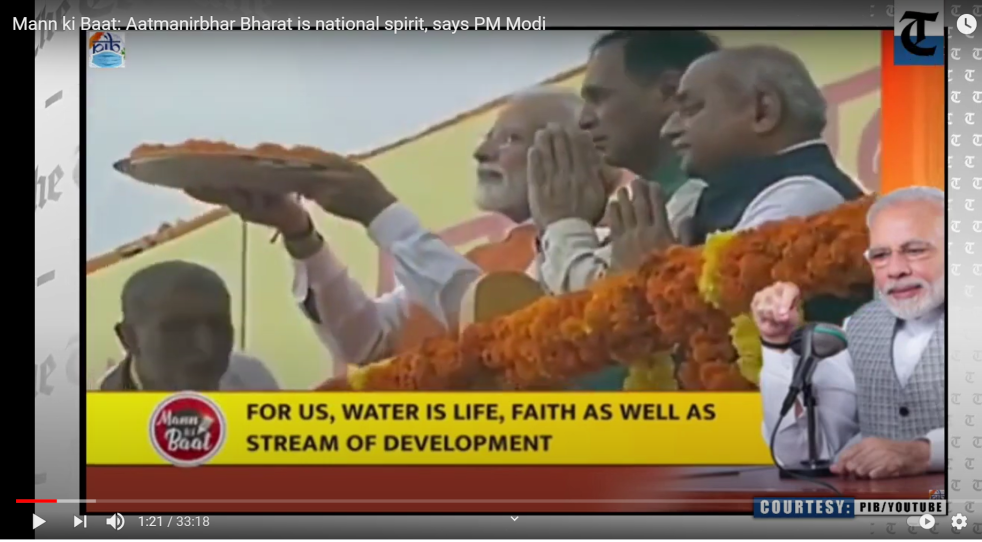
In his #MannKiBaat on Feb 28, 2021, India’s Prime Minister Shri Narendra Modi appealed to people to conserve our Rivers, Water, referring to Magh Purnima on Feb 27 2021 and Sant Ravi Das teachings. He also said that India’s traditions, festivals, scriptures, etc have so much place for rivers, also mentioning the Kumbh mela this year at Haridwar. He mentioned that a 100 day campaign will be launched soon by the Jal Shakti Ministry for rainwater harvesting. He gave several examples from across the country where individuals and groups have taken up such words.

All that sounds fine and welcome. But the trouble is that his all-powerful government is working consistently and with increasing intensity towards opposite direction. This very week his Power Minister expressed ignorance if hydropower projects have any environmental adverse impact, right in the face of destruction wrought by the hydropower projects in Chamoli disaster in Uttarakhand on Feb 7, 2021. Why is the Union Government still pushing hydropower projects which are no longer even economically viable, they never were environmentally sustainable or socially acceptable.

Continue reading “DRP News Bulletin 1 March 2021: Actions speak louder than words on PM’s appeal for water, river conservation”
Dams, Rivers & People

DRP NB 15 Feb. 2021: Why Mangshri Devi of Tapovan Should Head Uttarakhand’s Disaster Management Department?

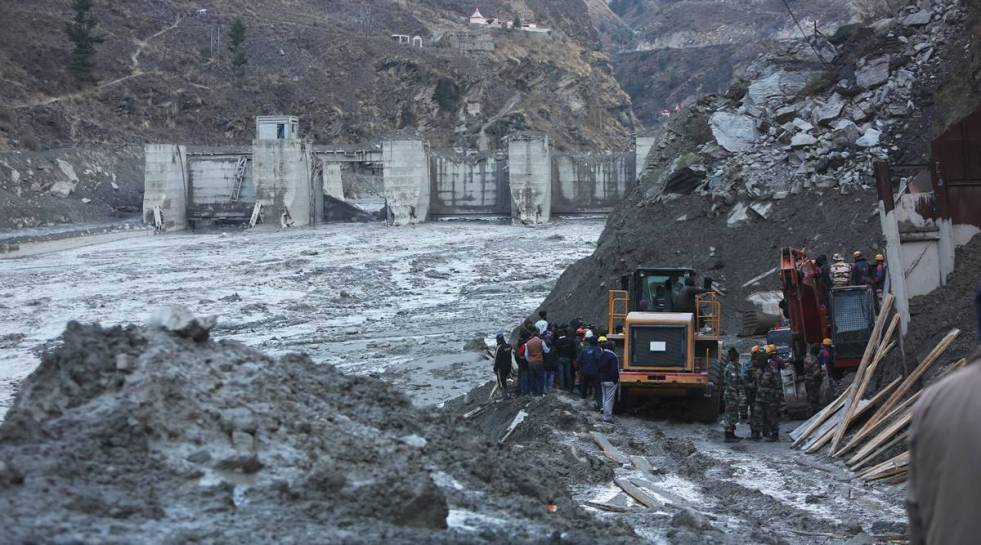
Feature image Tapovan-Vishnugad hydropower project in Chamoli district on Feb., 7 by Gajendra Yadav, Express Photo

In a fantastic story, Shivani Azad of The Times of India has reported possibly the most remarkable story of the Chamoli avalanche disaster that started on Sunday morning on Feb 7, 2021. She reported that Vipul Kairuni of Dhaak village in Tapovan, working at the time at the now destroyed Tapovan Vishnugad project, got saved thanks to frantic calls by his mother Mangshri Devi as she and his wife saw from their village home, situated at a height from the river, that a massive flood is approaching the dam site. It was thanks to frantic, repeated calls by Mangshri Devi that not only Vipul, but at least two dozen more people could run to safety of a ladder and saved their lives.

So effectively, Mangshri Devi has saved at least two dozen lives in Chamoli disaster. Who else can claim to have achieved anything like that in the disaster? The disaster management department seems completely absent from the scene either in terms of pre disaster monitoring or in taking steps to save lives during the disaster. In fact, there should have been an early warning system in place that could have saved many more lives. But it does not exist. Either in Rishiganga/ Dhauliganga basin or anywhere else in Uttarakhand. NTPC’s Tapovan Vishnugad Project has faced so many disasters already since 2008, but is only now talking about putting in place early warning system. Should not the NTPC and power ministry top brass as well as Uttarakhand disaster management department held accountable for that?

Continue reading “DRP NB 15 Feb. 2021: Why Mangshri Devi of Tapovan Should Head Uttarakhand’s Disaster Management Department?”
DRP News Bulletin

DRP NB 9 Nov 2020: Welcome water initiatives

Nature in Focus features India’s 12 water heroes. This is an interesting exercise. We also add some interesting stories from this week that should possibly feature in such efforts.

Nature in Focus 12 heroes redefining the landscape of water conservation This is the final story in a series of articles launched by Astral Pipes and Nature in Focus to create awareness about the ongoing water crisis and to encourage necessary action to address it. The names include Vishwanath Srikantaiah, Veena Srinivasan, Aabid Surti, Aabid Surti, Kalpana Ramesh, K.J.Joy, Rajendra Singh, Shishir Rao, Parineeta Dandekar, Ajya Mittal, Nachiket Kelkar, Aditi Mukherji. Links to interviews with each of them can be found here: https://www.natureinfocus.in/save-every-drop. Great to see that Parineeta Dandkear of SANDRP is also there! https://www.natureinfocus.in/save-every-drop/the-answer-to-india-s-water-crisis (4 Nov 2020) 

Continue reading “DRP NB 9 Nov 2020: Welcome water initiatives”
Dams · DRP News Bulletin

DRP NB 10 February 2020: Examples of Better Water Management Options

This week’s news bulletin has a number of examples of Better Water Management Options that India has, let us focus on the example from state. These examples come from Kerala (achieving a barren land free constituency & KERI study showing the need for desilting of Malampuzha reservoir), Tamil Nadu (lessons from implementation of System of Rice Intensification in large parts of cultivable land and also declaring the Cauvery Delta as protected agriculture zones that will help stop the problematic hydrocarbon exploration project as also, hopefully other destructive projects), Odisha (govt filing affidavit in the Supreme Court asking it to stop work on Polavaram Dam of Andhra Pradesh is hugely belated but right move), Telangana (rejecting the Godavari Cauvery River Linking proposal of NWDA for its shoddy water balance), Uttarakhand (Dehradun DM accepting in affidavit to High Court that 270 acres of river bed land is encroached in the district), Kashmir (drive to remove encroachments of Khushal Sar lake, even if selective, hopefully it will be a beginning), NGT (cancelling the township coming up in lake eco sensitive area in Bengaluru) among others. We have listed only the welcome initiatives from the govt. Even if these initiatives are taken to logical conclusion and also emulated by other states, it can go a long way in moving towards better water management.

Continue reading “DRP NB 10 February 2020: Examples of Better Water Management Options”

CWC - Central Water Commission

South India Overview of CWC Flood Forecasting Sites 2019

Flood Forecasting (FF) is one of the important activities of Central Water Commission (CWC), which is undergoing expansion and improvement, but there is still a huge scope for improvement. In order to better understand the CWC’s flood monitoring and forecasting work, in this article, we have given an overview of CWC’s flood forecasting and monitoring sites in South India, the last region to be covered for 2019 flood season. It includes state wise list of CWC’s Level Forecast, Inflow Forecast and level monitoring sites in South Indian states of Andhra Pradesh, Telangana, Karnataka, Tamil Nadu, Puducherry (no FF sites) and Kerala. Similar report has been published for North India[i] and North East India[ii], East India[iii] and West India[iv].    Continue reading “South India Overview of CWC Flood Forecasting Sites 2019”