Dams

Maharashtra Rivers Review 2017: Multi-colored Rivers!

About Rivers Pollution and Pollution Control Board

Highest number of polluted rivers Maharashtra state has 49 polluted river stretches, highest in the country, which including Mithi, Ulhas, Vaitarna, Godavari, Bhima, Krishna, Tapi, Kundalika, Panchganga, Mula-Mutha, Pelhar and Penganga. 3,000 MLD of untreated sewage and industrial effluents are discharged into the state’s water bodies daily. http://www.hindustantimes.com/mumbai-news/pollution-in-three-maharashtra-rivers-is-nine-times-permissible-limit/story-RCuTrl8zi8tmFoOvgKR2zI.html(Hindustan Times, 16 Nov. 2017) 

According to a report by Union Environment Ministry, Maharashtra generates about 8,143 Million Liter per Day (MLD) which is almost 13 per cent of the country’s sewage, butclaims to treats 5,160.36 MLD.In this way Maharashtra is releasing at least 3000 MLD untreated sewage in rivers, creeks and wetlands areas. http://www.hindustantimes.com/mumbai-news/834-factories-across-maharashtra-shut-down-in-2-years-for-causing-pollution-mpcb/story-MrmmXa9XH9Vdkzu2wKSdcL.html (Hindustan Times, 22 Dec 2017)

Continue reading “Maharashtra Rivers Review 2017: Multi-colored Rivers!”

Dams · DRP News Bulletin

DRP News Bulletin 5 March 2018 (Will India Face An Unprecedented Water Crisis This Summer?)

Residents of Muruga Tholuvu Harijan Colony in Chennimalai Union have urged the district administration to take steps to provide them water on a regular basis. In a petition, they said that villagers have to go in search of water from other areas and transport it in bicycles regularly. They said that most of the people were labourers and their livelihood is lost when they go in search for water. They said that the situation is worse during summer season, as water is not available at nearby areas and they are unable to purchase water from the market too. http://www.thehindu.com/news/states/provide-drinking-water-villagers/article22935093.ece (The Hindu, 5 March 2018)

With the beginning of summer season, there are several news reports describing the growing water crisis in different parts of country. Here are details of various Indian states suffering from  water scarcity for industrial, irrigational and even for drinking purposes which given the due summer months could develop into grim scenario. These stories also show how the mismanagement of dam storages, exploitation of ground water resources and pollution of rivers have significant role in aggravating the situation.

Gujarat The state is staring at a water crisis this summer, with low water levels in the Narmada dam and almost all other major dams. On March 3, the CM Vijay Rupani has held a meeting with senior minister and bureaucrats to take stock of the water situation in the state and discussed ways to ensure drinking water availability. The government also has decided to allocate Rs 200 crore in special grants for augmentation of local water sources and instructed all collectors to form district committees, have weekly review meetings and start supply of water by tankers wherever required.

Continue reading “DRP News Bulletin 5 March 2018 (Will India Face An Unprecedented Water Crisis This Summer?)”

Dams · DRP News Bulletin

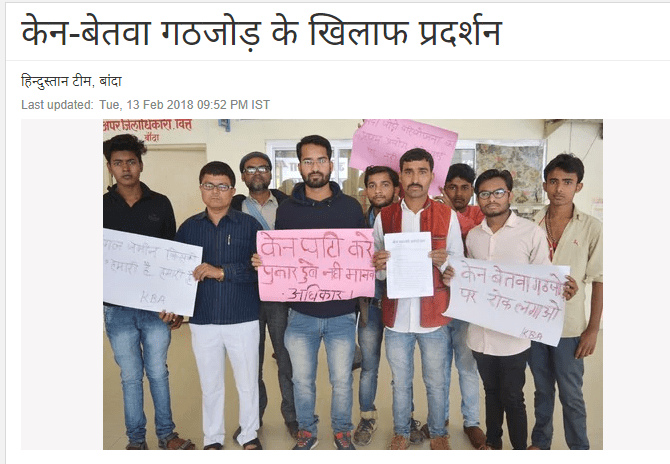
DRP News Bulletin 26 February 2018 (Banda People Also Protest Against Ken Betwa Link)

When Central Government is trying to push Ken Betwa link project terming it as beneficial for both Madhya Pradesh and Uttar Pradesh, local people of Banda are now also protesting against it, in addition to the people of Panna that are already opposing it. On Feb. 13, 2018, the Ken Bachao Samiti comprising of farmers, citizens and social workers in Banda sat on a Dharna before district magistrate office. The group have also sent a memorandum to the President of India, demanding immediate cancelling of the project. Raising serious concerns over environmental and social of the linking project, they asked demanded proper impact assessment and public consultation and said the project wont be allowed to go forward. Indeed, as they have said, there has been no downstream impact assessment and people of Banda are likely to loose their river.  https://www.livehindustan.com/uttar-pradesh/banda/story-demonstrate-against-ken-betwa-alliance-1800951.html (Hindustan Hindi,13 Feb. 2018) 

Continue reading “DRP News Bulletin 26 February 2018 (Banda People Also Protest Against Ken Betwa Link)”

Dams · DRP News Bulletin

DRP News Bulletin 19 February 2018 (How Are We Treating Our Urban Rivers?)

In this comprehensive article Mumbai-based author Vaishnavi Chandrashekhar throws the light on the plight of Uraban Rivers. “Rivers and streams have borne the brunt of the recent urban explosion in India, a nation whose population has nearly doubled in the last 40 years to 1.35 billion. Unplanned growth has led to the use of water bodies as dumping grounds for sewage and industrial effluent. According to CPCB, 63 % of the urban sewage flowing into rivers (some 62 billion liters a day) is untreated.

In addition, riverbanks, wetlands, and floodplains have been claimed over time by infrastructure, slums, offices, and housing developments – all of which has narrowed natural river channels and distorted flow, greatly reducing the ability of India’s rivers to buffer flooding. It also has taken a toll on biodiversity. http://e360.yale.edu/features/dying-waters-india-struggles-to-clean-up-its-polluted-urban-rivers (Yale Environment 360, 15 Feb. 2018) 

Continue reading “DRP News Bulletin 19 February 2018 (How Are We Treating Our Urban Rivers?)”

Dams · Landslide

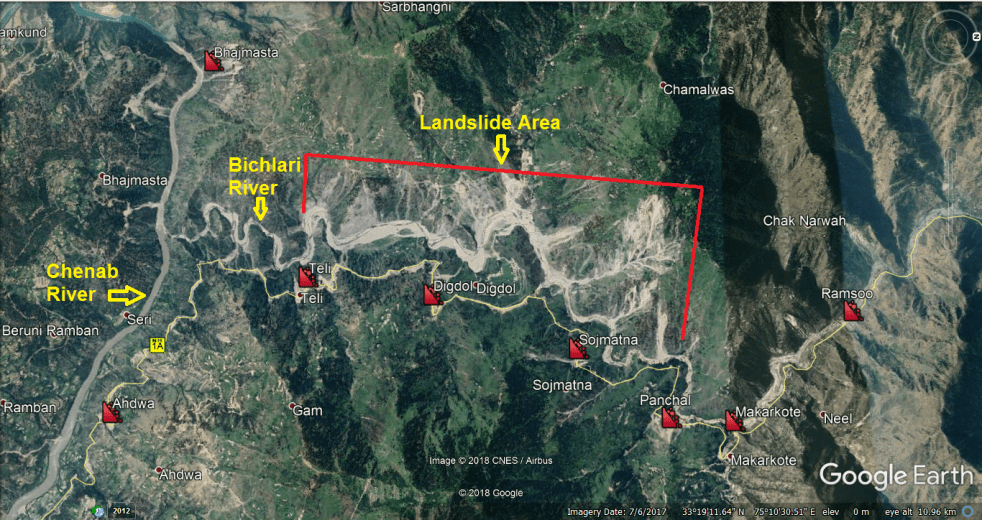
Why Jammu-Srinagar Highway Is So Landslide Prone?

Finally, after five days gridlock, the Jammu-Srinagar National Highway (NH-1A) has been opened to traffic, on Feb 17, 2018, but only for one side. The all weather road was closed since February 12, 2018 following landslides at multiple locations along Bichleri (Bichiari) stream (a tributary of Chenab River) between Banihal and Ramban area. The highway was briefly re-opened for traffic on February 14 only to be closed again on February 15, due to recurring landslides.

We have narrated below some details of the landslides along Jammu Srinagar Highway in Feb 2018 as well as earlier since 2011. 

Continue reading “Why Jammu-Srinagar Highway Is So Landslide Prone?”

Dams · DRP News Bulletin

DRP News Bulletin 12 February 2018 (With Innovative Ideas Hyderabad, Chennai & Delhi Are Reviving Its Wetlands)

This week there are exemplary and encouraging wetlands revival stories from three metro cities of Chennai, Hyderabad and Delhi.  In the first example from Hyderabad, meticulously chosen plant species such as tulsi, aswagandha, citronella and hibiscus have been used to create an artificial island to clean Neknampur Lake. The treatment islands are composed of four layers of which the bamboo base keeps the entire structure afloat. Based on soil-less hydroponics, these floating treatment wetlands absorb excess nitrates, thereby reducing the chemical content of the lake water. Microorganisms present in the wetland break down organic matter while the root systems filter out pollutants and sediments. https://www.thenewsminute.com/article/3500-saplings-floating-islands-help-rejuvenate-hyd-neknampur-lake-75819 (The News Minute, 3 Feb. 2018)

Image by: Madhulika Choudhary

Similarly, Chennai-based Care Earth Trust along with the public works department (PWD) and the civic body has managed to restore three urban lakes. While many of the smaller wetlands have vanished over time, many mid-sized wetlands seem to have shrunk by almost 65 percent. Thanks to their joint effort, invasive hyacinth was removed from the Narayanapuram Lake in Pallikaranai, while sewer lines, which emptied into the Perungalathur Lake, have now been plugged. A detailed restoration proposal has been forwarded to the PWD regarding the Korattur-Madhavaram-Ambattur lakes. https://timesofindia.indiatimes.com/city/chennai/hyacinth-out-sewer-line-plugged-three-water-bodies-restored/articleshow/62748110.cms (The Times of India, 2 Feb. 2018)

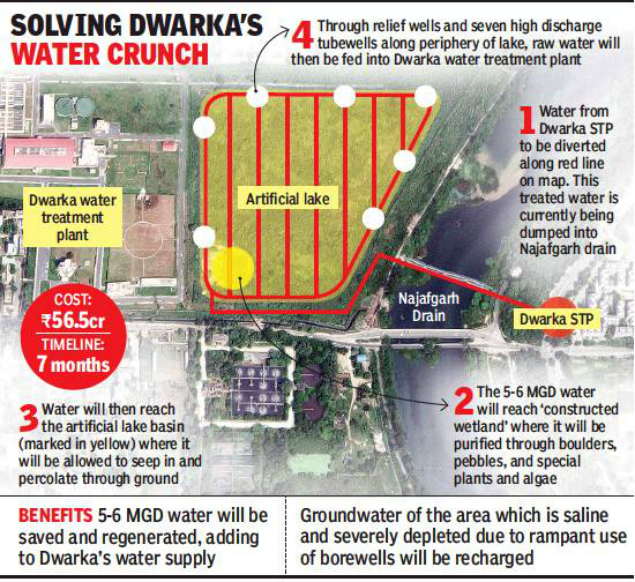
Meanwhile, Delhi Jal Board (DJB) has taken up interesting new project of creating an artificial lake in Dwarka. The project will supply water in sub-city and improve ground water level too. DJB has approved Rs. 56 crore for the project which will be completed in next seven months.  This would the first model project wherein a lake will be used to augment water supply. The special lake is being created next to the Dwarka water treatment plant (WTP) will have a sand bed to allow maximum percolation of water into the ground. It will have a capacity of 10 million gallons (MGD). The project is expected to add supply of 5-6 million gallons water to Dwarka every day.

Continue reading “DRP News Bulletin 12 February 2018 (With Innovative Ideas Hyderabad, Chennai & Delhi Are Reviving Its Wetlands)”

Dams · DRP News Bulletin

DRP News Bulletin 05 February 2018 (J&K Shows The Way To The Nation: To Assess The Viability Of Big Hydro Pojects)

In a remarkable development, Jammu & Kashmir Govt is reviewing its Hydro policy to assess whether the Hydro Electric Power Projects (HEPs) are still viable. As per sources, this is for the first time that the Govt is discussing the viability of generating hydro power.

An empowered committee led by the Chief Secretary has started this discussion by calling for an “approach paper” that will give an overall picture of the hydropower industry in India. Top sources in the State Power Development Corporation (SPDC), a government-owned company, told Kashmir Reader that the empowered committee wants to lay a roadmap for power generation in the state. “It will reflect the vision of the government. It will give the picture of hydropower generation in India, its rates, market, demand and supply. It will also lay down a roadmap for large power projects,”

The approach paper will be part of a new hydropower policy which will be submitted before the same committee, and then before the cabinet for approval. The SPDC had submitted a hydro policy draft in April last year, which was returned to it in December. Sources said the approach paper has to be submitted in two months’ time.

At present, India has a surplus generation of hydropower, which has plummeted its rate. This has led to losses for SPDC as it invested in projects whose generation costs were high. The blunt example is that of the 450-MW Baglihar II. SPDC has failed to lure any buyer for more than a year as its selling cost of per unit of energy, Rs 4.4, is nearly Rs 2 higher than the market rate. The SPDC has finally managed to sell the power at about Rs 4 per unit to the Uttar Pradesh government but for one year only. The SPDC may have to struggle again next year if the state of UP does not continue the contract.

Another example is that of Nimuno Bezgo, and Chutak hydropower projects, which sell energy at Rs 13 per unit. The SPDC also buys power from Dulhasti project at Rs 7, when the available rates for power in the market is around Rs 2 and Rs 4. https://kashmirreader.com/2018/02/02/cs-led-panel-to-lay-roadmap-for-power-generation-in-jk/ (Kashmir Reader. 2 Feb. 2018)

As per another report, facing a growing demand for electricity and unable to tap its vast potential for generating hydroelectric power, the state government is looking to boost solar power generation. Given the long gestation period of hydel projects, it is unlikely the generation of hydroelectric power will expand significantly in the near future, said. Hence,  the focus on solar power. Indeed, when solar power potential exists, with lower installation and operation costs and impacts, why States continue after destructive, expensive hydro projects? https://scroll.in/article/866058/kashmir-can-generate-a-lot-more-hydel-electricity-than-it-requires-why-is-it-eyeing-solar-power (Scroll.In, 30 Jan. 2018)

There is one more interesting hydro power development in which the state cabinet of Bihar has approved closing 3 and cancelling the development of 2 others in addition to handing over of 8 hydropower projects to neighboring Jharkhand.

Continue reading “DRP News Bulletin 05 February 2018 (J&K Shows The Way To The Nation: To Assess The Viability Of Big Hydro Pojects)”

Dams · DRP News Bulletin

DRP News Bulletin 29 January 2018 (Organic Farming Through Cluster Approach Can Help Farmers, Groundwater And Our Future)

There have been many positive developments on agriculture, groundwater and environment round the week. In the first positive development, data from the first impact study of Paramparagat Krishi Vikas Yojana (PKVY) shows that small and marginal farmers, who can’t afford costly agricultural inputs, are turning a new leaf by going organic because of lower costs and higher margins. The study conducted by the National Institute of Agriculture Extension Management, has also revealed that Net Returns of organic farmers were higher for all the three crops studied, namely wheat, paddy and soybean, by 15.8%, 36.7% and 50% respectively.

of

This was based on study of 690 organic clusters in 25 states, out of some 6211 clusters comprising of 2.25 lakh farmers in a PKVY (each ha getting Rs 50 000 as aid) scheme launched in 2015, comprising of 52.3% small farmers. The average cluster size was 69 acres, in each there were 54.6 farmers on average. Maharashtra had the highest number of clusters at 1043 and MP had the highest area under clusters. The funding however remained irregular. India’s domestic organic food market is expected to show Compound Annual Growth rate of 25%, says the study. https://www.hindustantimes.com/india-news/small-farmers-go-big-with-organic-farming/story-nlyQQVUnoewHgeJyvaAnJI.html (Hindustan Times, 29 January 2018)

Another positive news report, have disclosed that how a simple groundwater recharge technique is transforming farmlands in Gujarat. The simple pit and pipe system simply and expertly captures standing water during rains, thus freeing arable land from water logging while recharging groundwater to use for irrigation during the lean season. This is essentially a simple groundwater recharge scheme but appears to last long. As per report about 3000 such units have already been installed in Gujarat and several other states.  http://www.thehindu.com/society/this-simple-technology-has-transformed-gujarat-farmlands-into-an-oasis/article22529034.ece (The Hindu, 27 January 2018)

The third positive news have come from Central Government which has prepared a Rs 6000 crore plan to recharge ground water. The scheme is yet to be cleared by the Expenditure Finance Committee and the Cabinet.  

As per report, the new 5-yr long scheme will be funded 50: 50 by the World Bank and centre, to be implemented in Gujarat, Maharashtra, Madhya Pradesh, Uttar Pradesh, Karnataka, Haryana and Rajasthan, covering 78 districts, 193 blocks and 8300 gram panchayats.

Gram Panchayats that prepare water security plans and put infrastructure to augment water supply will get incentives. Interestingly, an earlier version of the scheme, called National Groundwater Management Improvement Scheme was rejected by AFC in May 2017.  https://www.hindustantimes.com/india-news/centre-readies-rs-6-000-crore-plan-to-recharge-groundwater/story-nziZ6rvp88ZJHFo0DM5kNO.html (Hindustan Times, 28 January 2018)  

Continue reading “DRP News Bulletin 29 January 2018 (Organic Farming Through Cluster Approach Can Help Farmers, Groundwater And Our Future)”

Dams · DRP News Bulletin

DRP News Bulletin 22 January 2018 (Dams Again Being Used To Achieve Political Objectives) 

As per Counter View report, a well-informed Gujarat government source has told it that a major reason why the Sardar Sarovar Narmada Nigam Ltd (SSNNL) recently declared there would be “no water” from the multi-purpose irrigation scheme, Sardar Sarovar dam, to Gujarat farmers starting March 15, 2018, is Madhya Pradesh elections, scheduled for this year-end.

The source, refusing to be identified, said, “Already, massive preparations are on in Madhya Pradesh to provide as much Narmada water to the state’s farmers by storing as much water as possible. The idea is to appease the farmers with Narmada waters in the same way as it was done last year before the elections took place in Gujarat.”

This shows how dams in Narmada Valley are being used for achieving political ends, once again. Earlier they were used for Gujarat elections, now they are being used for Madhya Pradesh elections. https://www.counterview.net/2018/01/narmada-waters-in-gujarat-stopped-to.html (Counter View, 20 January 2018)

In another report, anonymous official admits water shortage apparent in Nov 2017 before Gujarat polls was not announced, another indicator of how Narmada dams are used to achieve political ends. https://www.counterview.net/2018/01/narmada-water-for-irrigation-state.html (Counter View, 21 January 2018)

However, this is not happening for the first time. This also happened before the Nov 2017 Gujarat elections and also before 2014 General elections and 2012 Punjab elections, as illustrated below.

Before 2014 general elections too the level of water in Narmada reservoirs was depleted to generate additional power keeping in mind the elections. https://sandrp.wordpress.com/2014/04/13/narmada-dams-levels-depleted-to-generate-more-electricity-threatening-water-security-for-gujarat-and-madhya-pradesh/

In case of Bhakra, the way the reservoir level was allowed to deplete in summer of 2012 had consequences in subsequent monsoon.  https://sandrp.in/dams/PR_Why_precarious_water_situation_at_Bhakra_dams_was_avoidable_July_2012.pdf

Continue reading “DRP News Bulletin 22 January 2018 (Dams Again Being Used To Achieve Political Objectives) “

Dams · DRP News Bulletin

DRP News Bulletin 15 January 2018 (Do We Care About Rivers’ Aquatic Bio-diversity?)

Great to see this focus on aquatic biodiversity (unfortunately the article keeps using the word marine biodiversity, not using the word aquatic or freshwater biodiversity even once) along the 120 km long Sindhudurg Coast line, one of the 11 ecologically sensitive habitats identified along India’s coasts.

The FIRST study of local Otter Population by Ela Foundation identified upto 591 Smooth coated otters (strangely article does not mention about existence of small clawed Otters in Sindhudurg), 561 Indo Pacific humpbacked dolphins, among many others. The coast is particularly river rich with some twelve creeks/ rivers including Shanti, Piyali, Naringre, Achra, Gad, Talavade, Otawane and Pithdhaval Rivers.

The biodiversity here is facing multiple threats including rapid urbanisation, tourism onslaught with attendant plastic and sewage disposal, unregulated fishing trawlers, illegal sand mining, and global warming. It also underlines the need to do assessment of any interventions done in the area, of impacts on the aquatic biodiversity. http://www.hindustantimes.com/india-news/orphans-in-the-wild-what-the-otter-s-trying-to-tell-us-about-our-oceans/story-IfRFFi63Q8nV7UkUK4c16O.html (The Hindustan Times, 14 January 2018)

Continue reading “DRP News Bulletin 15 January 2018 (Do We Care About Rivers’ Aquatic Bio-diversity?)”