
Rajasthan Lessons from a reborn river The district of Alwar in Rajasthan is water-stressed, receiving less than 650 mm of rainfall in a year, most of which falls during the Southwest monsoon. But Alwar exists in a stable equilibrium, where even if there is a drought, the Johad’s and the forests make it possible for water to be stored underground. Because of strong communal interdependencies, all villagers stuck to sensible crops for the region, and maintaines the Johads. The community, the Forests, the Johads, the choice of crops, all worked together and reinforces one another. Equilibriums are maintained by such reinforcing activities that fortify status quo. FASCINATING account of how Arvari community rejuvenated their rivers and what are the lessons.
Continue reading “DRP: 29 May 2017 (Drought Options: Lessons from Rajasthan)”Tag: NGT

DRP: 15 May 2017 (MP talks about Narmada Seva after destroying the River with Dams, displacement of Lakhs)
On conclusion of five month long Narmada Sewa Yatra, Prime Minister Narendra Modi is today ( May 15, 2017) launching a road-map for steps to be taken for the conservation of the Narmada river. The MP state assembly has also recently declared river Narmada a living entity. Even otherwise quiet on rivers environment minister Anil Madhav Dave has expressed concerns for Narmada.
Contrary to all this, the Central Govt and 3 states of MP, Maharashtra and Gujarat have begun a process towards sanctioning completion of the Sardar Sarovar Dam, with closure of the 17 meters high gates. It is a countdown towards impounding waters in the 214 km land stretch where more than 40,000 families are residing till date. There are standing crops and massive plantations; thousands of pakka houses, schools, other public and private services erected; hundreds of temples, tens of mosques (as opposed to three temples claimed by the authorities), adivasi gods and worship places, all of which will be submerged. In protest thousands of people from Narmada valley, to be affected by Sardar Sarovar Project created a Human Chain on the borders of living village communities and on the banks of the river, protesting against any decision to close the dam gates.
Continue reading “DRP: 15 May 2017 (MP talks about Narmada Seva after destroying the River with Dams, displacement of Lakhs)”DRP: 17 April 2017 (Bihar needs to launch Farakka Satyagarha on centenary of Gandhiji’s Champaran Satyagraha)
As the President of India is in Patna today (April 17, 2017) to remember the centenary of Gandhiji’s Champaran Satyagraha, we need to remember that the Central message of Gandhi’s Satyagraha was to fight injustice, atrocities and abuse, irrespective of the source of the atrocities.
During the international workshop on INCESSANT GANGA in Patna on Feb 25-26, 2017, Bihar Chief Minister Nitish Kumar mentioned that this is the centenary year of Gandhiji’s famous Champaran Satyagraha in Bihar. He also mentioned how Bihar has suffered the increasing intensity, duration and destructive floods due to Farakka Dam.
Continue reading “DRP: 17 April 2017 (Bihar needs to launch Farakka Satyagarha on centenary of Gandhiji’s Champaran Satyagraha)”
Maharashtra Rivers Profile
Above: Major River Basins of Maharashtra Source: MWRRA
Major Issues faced by Rivers of Maharashtra include complete lack of governance geared towards protecting rivers as ecological systems, unjustifiable dam projects blocking most of the rivers of the state without even comparable benefits, increasing water conflicts, depleting groundwater levels which affect base flow of the rivers, catchment degradation, climate change induced changes in river hydrology, repeated droughts and increasing levels of pollution.

DRP: 13 March 2017 (20 Big Hydro Projects Costing Over 30K Crore, Stalled & Stressed: Piyush Goyal)
20 hydro projects stalled or stressed The Power Minister Piyush Goyal on March 09, 2017 in a written statement has informed the parliament that as many as 20 under construction HPPs totalling 6,329 MW are either stalled or stressed in the country and Rs 30,147.08 crore has already been spent on them. These projects include 2,000 MW Subansiri Lower of NHPC Ltd, 500 Mw Teesta VI of Lanco Teesta Hydro Power Ltd, 120 MW Rangit-IV of Jal Power Corp, 300 Mw Panan of Himagiri Hydro Energy Pvt Ltd, 850 MW Ratle of GVK Ratle HEP Pvt Ltd, 100 Mw Sorang of Himachal Sorang Power Ltd and 960 MW Polavaram of Polavaram Project Authority.
Continue reading “DRP: 13 March 2017 (20 Big Hydro Projects Costing Over 30K Crore, Stalled & Stressed: Piyush Goyal)”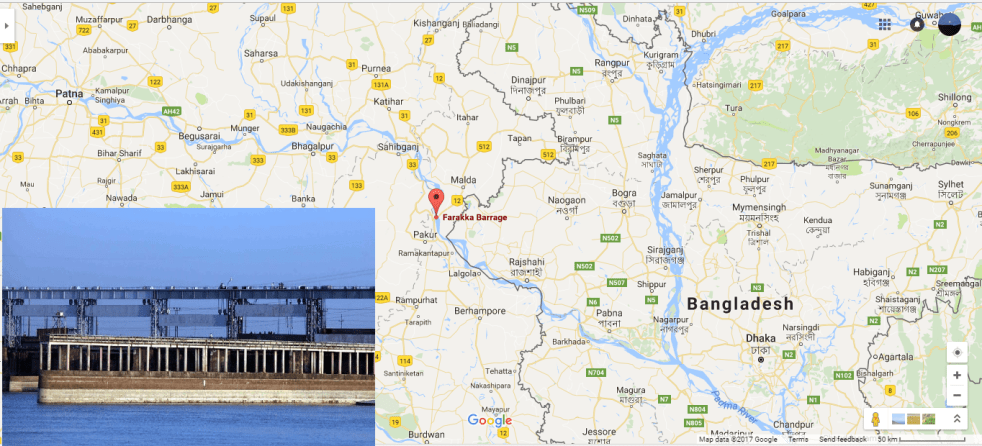
DRP: 27 Feb 2017 (Urgent Need To Review Impacts Of Farakka Dam: Experts)
During a global seminar held on Feb. 25-26, 2017 in Patna experts from across the country have advocated an “urgent review” and comprehensive study of the Farakka dam to revive the Ganga river. The experts were discussing various concerns facing River Ganga and the possible solutions for them. The seminar titled as “Incessant Ganga” was organised by Bihar’s Water Resources Department, almost week after, Bihar CM Nitish Kumar has openly termed the barrage as genesis of floods in the State. Speaking in the program, the CM again expressed deep concerns behind receding water flow in the Ganga and increasing silt deposit due to Farakka dam.
Speaking during the seminar, environment expert Himanshu Thakkar the coordinator of SANDRP advocated urgent need for review of Farakka barrage claiming that it has failed to fulfill any of the purpose – irrigation, hydro electric power, water supply – of the barrage for which it was built. As per, Himanshu Thakkar the dam was built to maintain the navigability of Kolkata port.
Thakkar also suggested that the gates of Farakka be opened during monsoon to mitigate the intensity of floods in Bihar. As per Thakkar there was an urgent need for a comprehensive study of the Farakka barrage to find out its achievements or whether the barrage fulfilled its objectives. The committee constituted for study must include the Centre, Bihar, West Bengal and all states having Ganga, he said adding that a study should be made on the social and livelihood impact of the barrage, how it affected people’s lives, whether its existence was justified and cost-benefit assessment among other issues.
Continue reading “DRP: 27 Feb 2017 (Urgent Need To Review Impacts Of Farakka Dam: Experts)”
DRP: 20 Feb. 2017 (Bihar Govt Demands Decommissioning of Farakka Dam)
Bihar wants Farakka barrage to be decommissioned The Nitish Kumar govt has held the Farakka barrage in West Bengal responsible for heavy floods in Bihar and asked the Centre to decommission it to de-silt the heavily loaded upstream of Ganga River. The state has made the recommendation, observing that the dam is the “genesis of severe” flood consequences and responsible for “alarming” silt increase in the river’s upstream. According to sources, Nitish Kumar dispensation has made the demand before an experts’ committee formed by the Centre to work out guidelines for de-silting Ganga following last year’s devastating floods.
As per the statement, decommissioning the barrage will help automatically de-silt the heavily loaded upstream, allowing silt to move to deltas before the sea thus helping in restoration of deltas and its eco-system which is also getting adversely affected due to this barrage. To buttress its point, the state government has referred to Kolkata Port Trust’s data, which suggests that silt dredging at the port has increased from 6.40 million cubic metres annually from pre-Farakka days to four times, i.e. at 21.88 MCM annually, during 2003. The state government has also recommended the panel to come up with ‘National Silt Policy’ to address the problem. Bihar faced one of its worst floods as Ganga swelled in August last year, claiming lives of over 20 persons and affecting 20 lakh people.
Bihar Government has rightly asked for decommissioning of Farakka barrage and held it as the genesis of severe, destructive and prolonged floods that Bihar and other regions upstream from Farakka face year after year. Good to see that Bihar government has officially demanded decommissioning of the Farakka barrage before an expert committee of Ministry of Water Resources. Hope this starts the ball rolling to remove this unnecessary and giant dam on Ganga, which will also help the cause of fisheries (including Hilsa), downstream Bengal and also the river in general. The road cum rail line on the barrage can continue to exist.
Continue reading “DRP: 20 Feb. 2017 (Bihar Govt Demands Decommissioning of Farakka Dam)”
DRP: 13 Feb 2017 (Oroville Dam Disaster, USA: A Wake up Call for India’s aging big Dams)
Finally the Oroville Dam spillway damage has turned into a disaster. Report at this time (01:00pm, Feb. 13, 2017) finds dam level rising about 1 feet above the danger level. Water currents have started pouring out all over and around the emergency spillway which has never been put in use for last half a century. Meanwhile, more water is gushing in the dam reservoirs due to recent heavy rainfall in catchment areas upstream.
Continue reading “DRP: 13 Feb 2017 (Oroville Dam Disaster, USA: A Wake up Call for India’s aging big Dams)”
Yamuna Jiye Abhiyan: A Decade in the Service of River Yamuna
At least since 1994, ever increasing pollution of River Yamuna had ballooned into a national concern, with Supreme Court of India taking up the case of Mailee Yamuna. The authorities lacked a holistic view of a river system. Essential issues like unhindered flow and intact floodplain were seldom discussed and debated. Thus, cleaning of pollution through infrastructure and technologies had become the central theme of saving Yamuna River. As a result, the cleaning efforts got no success and Yamuna River health kept worsening.
Amid this scenario, a group of Delhi citizens in 2006 woke up to impact of a 10 days shopping event to be organized on annual basis in the floodplain of Yamuna River at Delhi- Noida, Uttar Pradesh border. The event faced criticism and was resultantly called off.
But the incident just proved a tip of iceberg for the concerned group who after sometimes came across a list of permanent and commercial structures, being proposed within ecologically valuable and sensitive floodplains of River Yamuna in Delhi as a part of Common Wealth Games 2010.
The prevailing ignorance towards importance of floodplains of River Yamuna in Delhi and blatant encroachment of it, led to formalization of the group into Yamuna Jiye Abhiyan (YJA) on 07 February 2007.
Continue reading “Yamuna Jiye Abhiyan: A Decade in the Service of River Yamuna”

Wetlands Review 2016: Government Actions
India is one of the 169 signatories to the Ramsar Convention on Wetlands, signed in Ramsar, Iran, in 1971, an intergovernmental treaty that provides the framework for national action and international cooperation for the conservation and wise use of Wetlands and their resources. There are 2,241 Ramsar sites across the world, including 26 spread across India from Wular Lake in Jammu and Kashmir to Ashtamudi Wetland in Kerala, and from Deepor Beel in Assam to Nal Sarovar in Gujarat.
Despite their vital importance to humans, across India, Wetlands are seriously threatened by reclamation and degradation through processes of drainage, land filling, discharge of domestic and industrial effluents, disposal of solid waste, and over-exploitation of the natural resources that they offer.
Here is an account of major decisions and actions by Central as well as State Governments on wetlands related issues in 2016.
 SANDRP