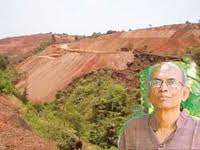
“At the ground level people are really interested and they want to get involved and our report if nothing else, seem to have served the purpose of triggering such kind of an interest” said Dr Madhav Gadgil while delivering a lecture on “Democracy and ecology in contemporary India” in Delhi in July 2013. He was referring to the 2010-11 report of the Western Ghats Ecology Expert Panel (WGEEP), which he chaired and which was one of the major contributions of Dr Gadgil to India’s environmental governance. One of us accompanied him during some of his travels which mainly consisted of back to back and often heated meetings in some of the remotest corners of the Western Ghats. The meetings were not only about plants, trees and rivers, but about what the villagers feel about development and how it should happen. No one had asked such questions before. It was democratisation of Environmental Governance at its messiest and the most beautiful. Something that was rarely attempted before. Or since.
Continue reading “MADHAV GADGIL’s unflinching faith in Community led Natural Resource Governance”Tag: Narmada Bachao Andolan
2024: Dam Affected Continue to Struggle across India
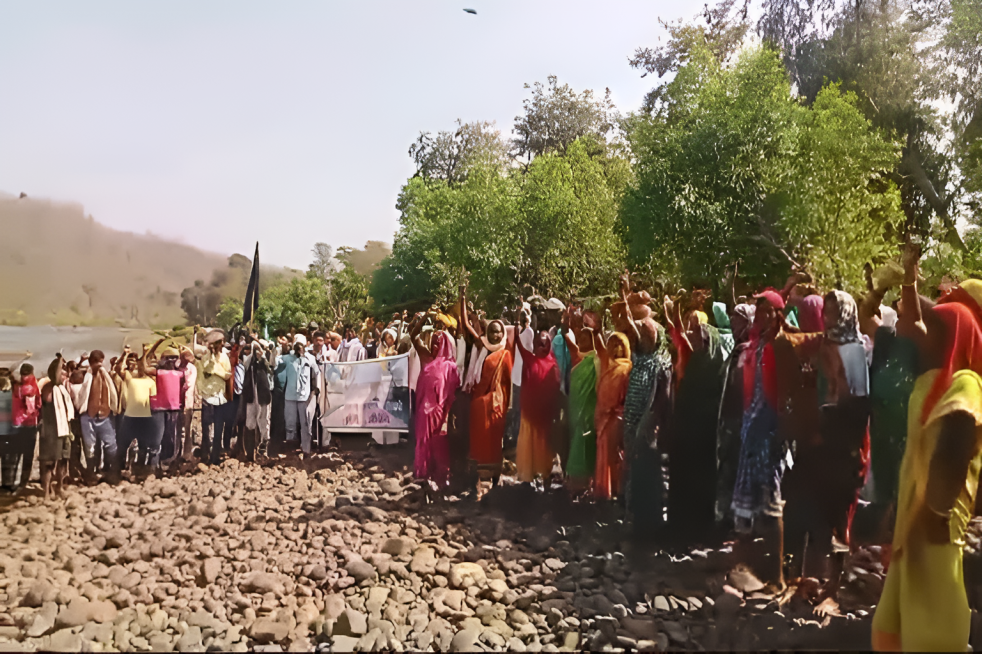
(Feature Image: Tribals in Mandla district of Madhya Pradesh protesting against Basania dam in March 2024. Image: ETV Bharat)
The part 3 of annual 2024 overview on the dams and hydro projects covers the ongoing movements of dam affected people in India. All through the year 2024, the Narmada Bachao Andolan continued peaceful protests seeking justice for Sardar Sarovar Project affected villagers. Tribals in upper Narmada Valley have also been fiercely opposing the Basania dam. The Hirakud dam displaced people have demanded formation of statutory national commission to hear their grievances.
The plight of Pong dam affected villagers have worsened as they again face displacement from rehabilitated lands due to new development projects while most of the land given to Renuka dam affected has been damaged by floods. It is indeed tragic that despite sacrificing their land and livelihoods for the ‘development’ of the country decades back, thousands of dams affected villagers are still forced to fight for promised rehabilitation.
Continue reading “2024: Dam Affected Continue to Struggle across India”
DRP 240624: India to help Bangladesh conserve Teesta River
The news this week that India and Bangladesh have agreed for India to help Bangladesh conserve the Teesta River that flows from India to Bangladesh. We hope this development is taken to its logical conclusion soon in terms of implementation of the project as soon as possible. This has the potential to not only two nations working together on conservation and rejuvenation of the Teesta River, but also possibly other 53 shared rivers. However, it would have been better if the W Bengal government would have been briefed, taken into confidence and involved in the discussions. History tells us that the cooperation efforts do not succeed without the involvement of all the stakeholders.
The formation of Joint Technical Committee to initiate discussions for the renewal of the Ganges Water Sharing treaty 1996 that will expire in 2026. One hopes that all these happen with a benevolent disposition from India as this has the potential of creating a much stronger bond between the two countries. A good example is the 1996 Ganga treaty that was also signed with a benevolent disposition. This move can also help strengthen the relations across South Asia as both Nepal and Bhutan are hoping to export hydro-electricity to Bangladesh via India.
Continue reading “DRP 240624: India to help Bangladesh conserve Teesta River”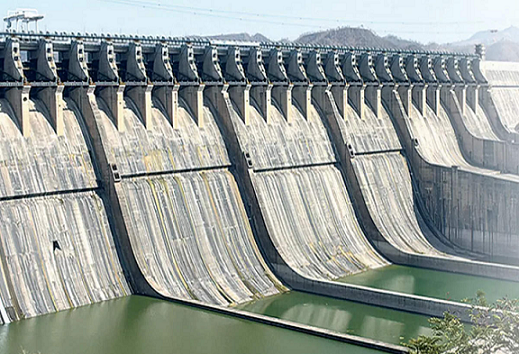
DRP 170624: Sardar Sarovar Power House to operate to reduce Dam Water level in anticipation of surplus rains: Welcome, but…
(Feature Image: Sardar Sarovar Dam. Image Source: The Economic Times, Sept. 2022)
The news this week that SSNNL has decided to operate the 1200 MW River Bed Power House and the 250 MW Canal Head Power house to reduce the water level in Dam from 122.28 meters on June 14 to around 115 m before the monsoon inflows start, in anticipation of the above average rainfall anticipated during SW Monsoon 2024 is welcome. One hopes this is sign of SSNNL, Gujarat Government and the Narmada Control Authority have learnt some lessons after the avoidable flood disasters brought by SSP in 2023 and earlier in 2019 and 2020, as revealed by SANDRP’s analysis in each of these years.
One hopes this is not just one-off ad-hoc decisions, but part of a systemic change. This will require an integrated basin level reservoir operation policy including all the major dams of the Narmada Valley and put it out in public domain along with clearly defined Standard Operating Procedure, and names of the responsible officials for each of such major dam in the basin. The Central Water Commission will also need to be held accountable for its flood forecasting including the 7-day advance forecasts.
Continue reading “DRP 170624: Sardar Sarovar Power House to operate to reduce Dam Water level in anticipation of surplus rains: Welcome, but…”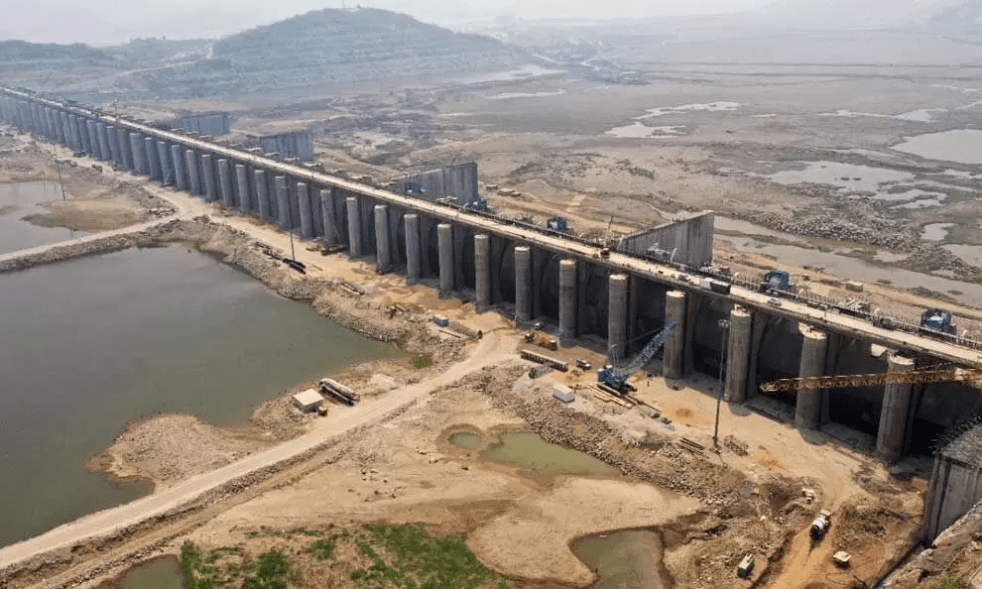
DRP 240423: The world is moving away from Big Dams: Are we?
(Feature Image: Construction works going on at Polavaram Dam site. Source: The Hans Media, May 2021)
This well substantiated report from Yale School of Environment this week shows that the end of the big dam era is approaching. The well argued report from Jacques Leslie uses the reports from UN University, International Renewable Energy Agency, Oxford University, Inclusive Development International, China, among others to show how the pace of construction of dams and hydropower projects and also pace of financing such projects have hugely reduced in recent years and decades.
Even the International Hydropower Association, sensing the change, is now advocating pump storage hydro rather than conventional hydro and that too off stream version, to complement the power from solar and wind. Emerging economics with rising cost of hydropower projects and rising cost of power from such projects compared to solar, wind (onshore and offshore) are a major reason for the massively slowing pace of new hydropower projects.
Continue reading “DRP 240423: The world is moving away from Big Dams: Are we?”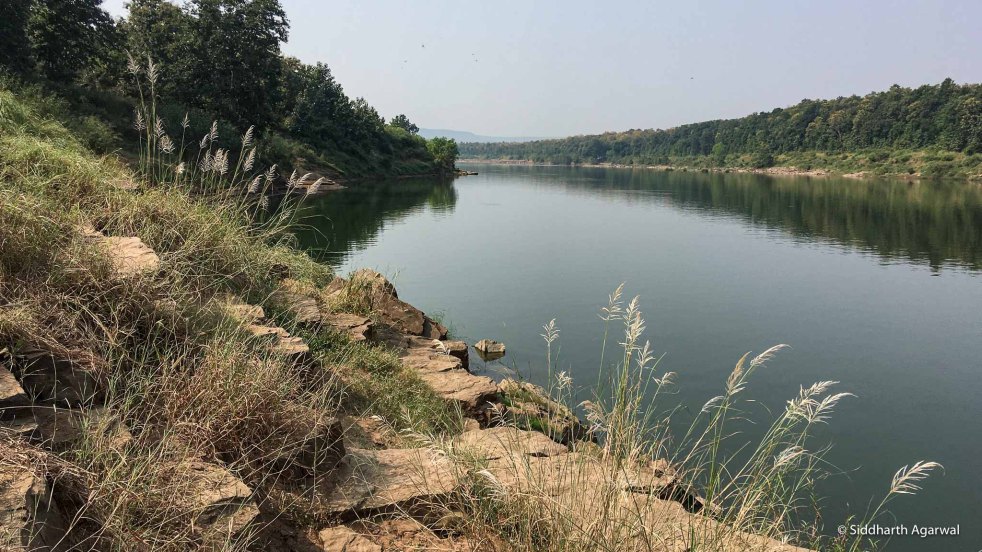
DRP 020123: Looking Back to Look forward to 2023
(Feature Image:-River Ken inside Panna National Park from River Stories, Walking Across India-I by Siddharth Agarwal)
This is the first DRP bulletin of 2023 and we would like to begin on a positive note. But to remain grounded in reality we also need to look back at the events in 2022. We see a number of positives in 2022 and we hope that trend continues. The number of new dams and hydropower projects being started has remained on a declining trend. People and civil society has continued its protests against destructive projects and for more decentralised projects and governance.
Continue reading “DRP 020123: Looking Back to Look forward to 2023”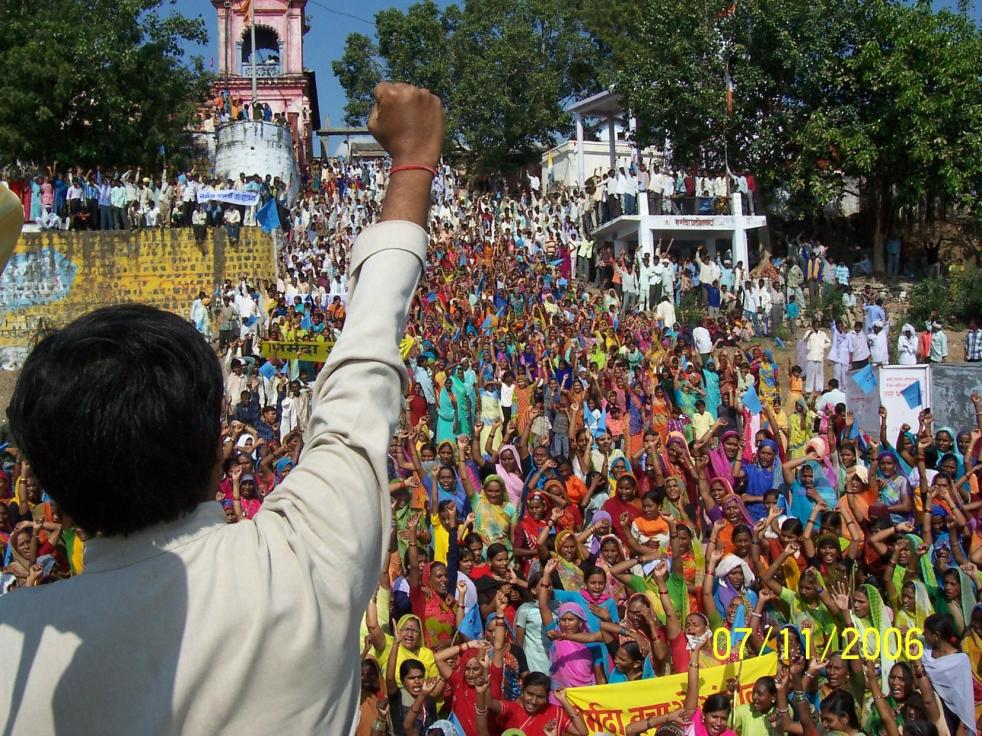
DRP 031022: Great Victory of People: MP govt scraps all contracts related to Maheshwar Dam
(Feature image: A protest by Narmada Bachao Andolan in Nov. 2006. Source: @Sripadmanthan)
On Sept 27, 2022, the Madhya Pradesh Government cancelled all contracts related to the Maheshwar Dam Project on Narmada. This massive dam on Narmada River in Madhya Pradesh upstream of Sardar Sarovar Project and downstream of the Omkareshwar Project was to be a multi-purpose project with a 400 MW hydropower component and water supply component among others. It was opposed by the people’s movement lead by Narmada Bachao Andolan for over two decades now. The project being implemented by the private textile company S Kumars showed no will or intention of taking care of the social or environment impacts of the project. Madhya Pradesh government so far was trying to push ahead with the project by hook or by crook, but finally had the sense to realise that this is going to be a massively costly affair at estimated Rs 42000 crores and the state and the people of state are only going to suffer costs and adverse impacts. The cancellation of all the contracts for the project signals a major victory of the people’s movement.
While congratulating the state government for cancelling the contracts, we would also suggest that the government needs to quickly decide about decommissioning of the dam, so that it does not pose safety risk to the people upstream and downstream and also perpetuates unnecessary adverse social and environment impacts. Earlier the dam is decommissioned, quicker will be the relief from these impacts. Moreover, the MP government should also not let the private company go scot free and all attempts should be made to recover the money spent and also penalise them for breach of the contracts. The private company should also be made to pay for the decommissioning costs.
Continue reading “DRP 031022: Great Victory of People: MP govt scraps all contracts related to Maheshwar Dam“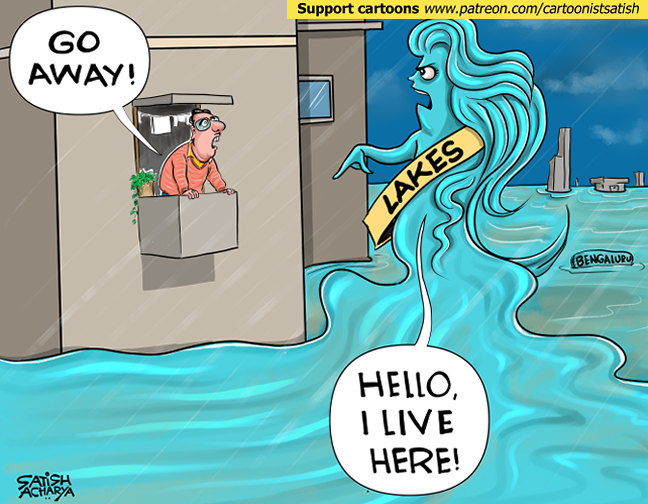
DRP 120922: Decisive judicial action dire necessity for wetlands
( Feature Image:- Satish Acharya’s illustration on Bengaluru floods: Whose land is it anyway? 07 Sept. 2022)
The wetlands reports tell us a lot, but the key point is that decisive judicial action is necessary if our wetlands are to have any future. The directions of the Tamil Nadu High Court to geo reference all wetlands of Tamil Nadu, including small (Less than 2.25 ha area) is good beginning, but the court will need to ensure continuous monitoring and ensure implementation. Because the past shows that the government and other stakeholders have collectively failed to take any decisive action to save our wetlands. The disastrous results are evident at so many places, this week it is most clear from the flooding of Bangalore, mainly due to encroachment of lakes, wetlands, water channels and their catchments.
Continue reading “DRP 120922: Decisive judicial action dire necessity for wetlands“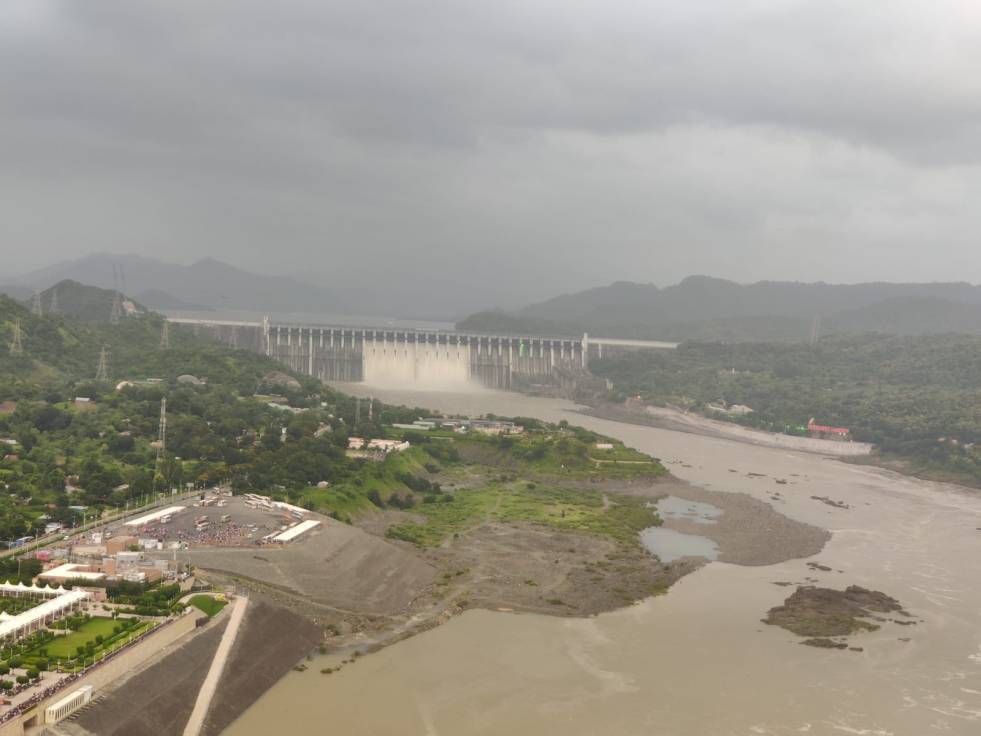
DRP 050922: Corruption in Large Dams & pro dam media Mughals
(Feature Image: Sardar Sarovar Dam on Narmada river. Source: Central Water Commission 30.08.2022)
As this article on corruption in large dams in India shows, it is open secret that large dams involve massive corruption, kickbacks and political funding. But the politicians from PM downwards across the party lines have understandably no interest in this issue.
But unfortunately, the large dams-corruption is not limited to politicians. The corruption in various forms plague even the media Mughals like Swaminathan Ankalesaria Aiyer and Shekhar Gupta, both known for their fundamentalist pro dam views. They too have no interest in corruption in large dams. In fact some of them have no qualms accepting sponsorships of dam contractors for their media awards! They are however, ever ready to criticize Narmada Bachao Andolan and Medha Patkar, though they have no clue about the issues they are talking about and keep using some flawed study whose reply (by Nandini Oza and Shripad Dharmadhikary) is already out in public domain. It is interesting that they have launched this fresh attack on dam critics just when Gujarat Chief Minister and country’s Home Minister have also launched attack on the NBA. Neither Gujarat CM, PM or HM is replying as to why Kutch, the main justification for Gujarat getting disproportionate share of Narmada waters, were the last to get their share of the water (even now not fully as the canal distribution system is still incomplete), almost two decades after the water rich Central Gujarat started getting Narmada waters. Nor are the pro dam media Mughals bothered about this.
Continue reading “DRP 050922: Corruption in Large Dams & pro dam media Mughals“
DRP 111021: Are we being forced towards nature based solutions?
Four interesting developments in this week seems to suggest that mankind is being pushed closer to nature based solutions to society’s needs. In Brussels in Belgium (Europe), the local government has started to uncover the Senne river that now is hidden under the pavements with the declared objective to “return nature to the city” and the river becoming an ecological corridor in the city.
In USA, the Army Corps of Engineers, more known as Dam builders, have over the last five years, moved towards nature based flood control by creating wetlands. In the 2020 Water Resources Development Act, US Congress directed the Corps to consider nature-based systems on equal footing with more traditional infrastructure. Its possibly a baby step, but a very significant one for a traditional dam building organisation that has stopped building dams and have been working towards decommissioning dams.
Continue reading “DRP 111021: Are we being forced towards nature based solutions?” SANDRP