Maharashtra · Marathwada · Monsoon

State says 59.9% rainfall, IMD says 73%: Highlights and discrepancies of Maharashtra’s Monsoon 2015

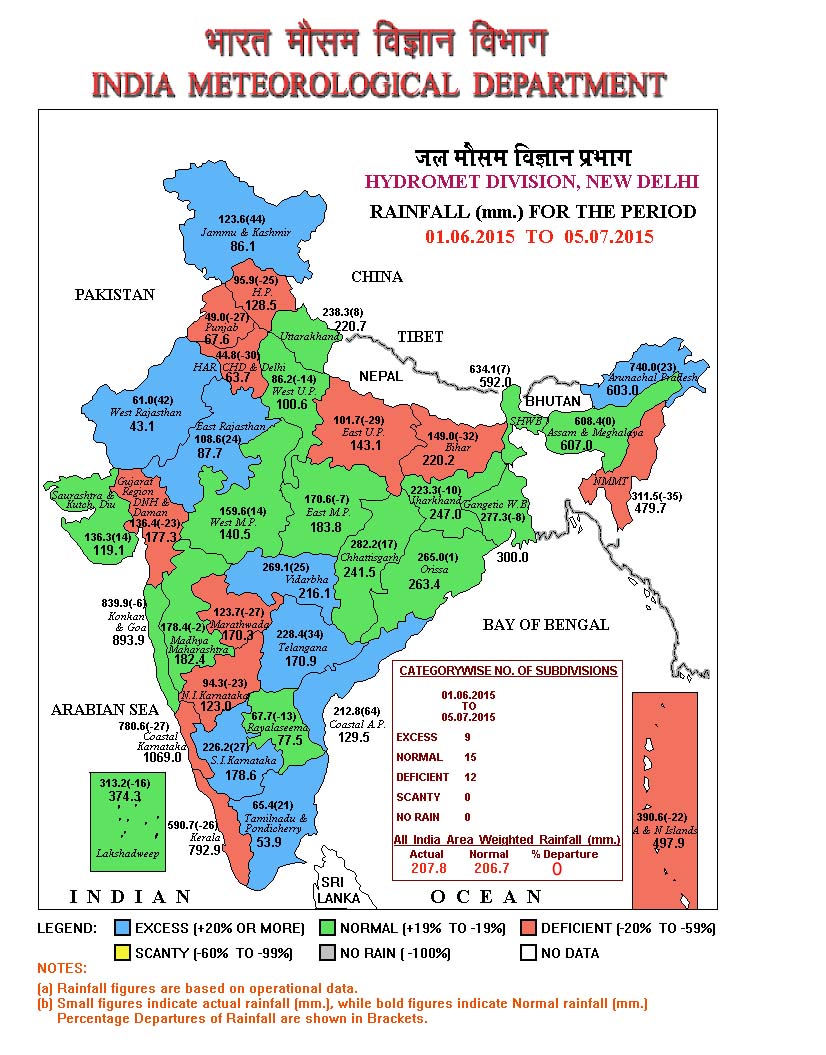
30th September marks the end of June-September South West summer monsoon in India and Maharashtra. The 2015 summer monsoon has proved to be the worst monsoon in the last six years for India. Rainfall deficits are seen in all major food-producing regions like UP (47% deficit), Bihar (28% deficit), Punjab and Haryana (32% deficit). This is India’s second successive year of high rainfall deficit, and only the fourth time this has happened since 1901.

1

Monsoon retreats from the country and the states on various dates. Some welcome showers are falling and are further expected in Maharashtra in the coming weeks, but the summer monsoon figures are now set. According to meteorologist Akshay Deoras. “Rain counters are refreshed on 1st October and new count of post monsoon season or winter monsoon season will start now.”

First week of October calls for an analysis of the summer monsoon, its performance in June, July, August and September and the implications this holds for various sectors.

People of Maharashtra have heard about, seen and experienced the dismal monsoon of 2015. Marathwada fared the worst, and was number one deficit state in the country at 52% deficit for a long time. However, at the end of monsoon, deficit of Marathwada is 40%. This is more worrisome as it comes piggybacking the 42% rainfall deficit in Marathwada in 2014, with rainfall of just 398.8 mm.

But, in order to understand the situation better, if one tries to analyse rainfall figures from various reputed official sources, one is taken aback by the disparities. We looked at official Indian Meteorological Department[i] figures, official Maharashtra Agriculture Department[ii] (Rainfall Recording and Analysis) figures and numbers from the 49th Cabinet Committee Note of the Government of Maharashtra dated 30th September 2015 accessed by SANDRP[iii].

All are concerned with Monsoon rainfall from 1-6-2015 to 30-9-2015. All of these contain different figures!

Indian Meteorological Department: IMD generates its rainfall data for Maharashtra based on its approximately 878 rain gauging stations spread across the state[iv]. According to IMD, regions of Maharashtra fall in rainfall deficit this year of varying proportions. Konkan region shows deficit of 31% with 2914 mm rainfall, Madhya Maharashtra shows deficit of 33% with 488.1 mm rainfall, Vidarbha shows deficit of 11% with 848.2 mm rainfall, but the highest deficit is Marathwada at 40% with 412.4 mm rainfall.

3According to IMD, between 1st June to 30th September, Maharashtra has received 732.5 mm rainfall of its 1007.3 mm average normal rainfall, which is 73% of average rainfall (27% deficit).

5 Districts that have received 50% or less of the average rainfall include

Kolhapur (803.4mm, -54%)

Solapur (231.8 mm, -51%)

Beed (287.4 mm, -50%)

Latur (372 mm, -51%) and

Parbhani (344.9 mm, -54%)

2
From http://hydro.imd.gov.in/hydrometweb/ . Thanks to Akshay Deoras for indicating this

The region-wise, month-wise rainfall in Maharashtra this monsoon, as per IMD figures was as per following table.

Rainfall, mm Konkan-Goa Vidarbha Madhya Maharashtra Marathawada
June Normal 663 161 140 138
Actual 781 254 177 119
July Normal 1147 318.9 247.8 192.5
Actual 581.5 137.8 111.7 26.8
Aug Normal 759.6 305.7 289.1 188.2
Actual 388.7 288.9 56 112.2
Sept Normal 344.7 169 152.4 164.2
Actual 253.8 167.5 143.4 154
Monsoon Normal 2914.3 954.6 729.3 682.9
Actual 2005.0 848.2 488.1 412.4

Where is Madhya Maharashtra? Incidentally, IMD classifies the country in various categories.  Maharashtra includes Konkan, Madhya Maharashtra, Marathwada and Vidarbha. Madhya Maharashtra includes Nashik and Pune Divisions of whopping 10 districts, from Nandurbar, Dhule, Jalgaon, Nashik, Pune, Ahmednagar, Satara, Solapur, Sangli and Kolhapur. This region is not uniform in any sense, neither rainfall-wise, nor geographically nor is it “Madhya (Central) Maharashtra”. Any assessment based on a Madhya Maharashtra is meaningless in a sense as it clubs Kolhapur, at the southern tip of Maharashtra whose normal rainfall is more than 1500 mm with Dhule at the northern end of the state whose normal rainfall is about 500 mm and includes areas of Tapi, Narmada, Krishna and Godavari basins. It is time IMD adds some rationale to its meteorological divisions in India.

Maharashtra Agriculture Department: Agriculture Department of GoM runs a very useful website:  maharain.gov.in which displays detailed data from its Rainfall Recording and Analysis Department. It states: “The department of Agriculture, Maharashtra State initiated the project for recording daily rainfall in the state in year 1998. Initially rainfall data was recorded at tehsil level and subsequently same functionality was extended to circle level from 2013 as GoM has installed rain gauge at every circle. Circle officer sends daily rain data using mobile through SMS. In addition to SMS rain data can be entered directly on the web portal.”

Prima facie it appears that Agriculture Department may have a better spread in the over 40,000 villages in Maharashtra than IMD’s 878 rain gauging stations.7According to Agriculture Department, of the 353 administrative blocks in the state (taluks):

  • 65 bocks have received rainfall less than 50% rainfall (18.4% blocks). Most of these are concentrated in Solapur and Marathwada region.
  • 174 blocks have received rainfall between 50-75% rainfall.
  • Just 23 blocks have received 100% or above of normal, and these are concentrated in Vidarbha and Nandurbar, Northern Maharashtra.6

Cabinet Note of Government of Maharashtra, 49th Meeting, 30th Sept 2015: It reports that state has received 678.5 mm rain of the avergae 1131 mm, that is 59.9% or 60% of the average. But as we saw above, IMD says its 732.5mm of average 1007.3 mm, 73% of the average. There is no explanation for such widely different figures in the cabinet note.

Agricultural experts like Nishinkant Bhalerao states that the 60% magic figure will make any drought aid difficult and that it masks the monthly disparities which very badly affected this season’s Kharif. For example, Marathwada received barely 14% of its July average rainfall, a mere 28 mm, but cumulatively mainly due to late Spetmeber rains, this anamoly is hidden.

According to the note:

  • 13 districts of Dhule, Nandurbar, Pune, Aurangabad, Buldana, Akola, Washim, Amravati, Wardha, Nagpur, Bhandara, Gondia, Gadchiroli received between 76-100% average rainfall,
  • 17 districts of Thane, Palghar, Raigad Ratnagiri, Sindhudurga, Jalgaon, Ahmednagar, Satara, Sangli, Jalna, Beed, Latur, Osmanabad, Nanded, Hingoli, Yavatmal, Chandrapur eceived between 51-75% average rainfall and
  • In 4 districts, rainfall has been less than 50%, these include Nashik, Solapur, Kolhapur and Parbhani.
  • Strangely, IMD states Nashik received 729 mm rainfall till 30th Sept and has just 20% rainfall deficit but for the same period, Agriculture Department shows Nashik has received just 484.8 mm rainfall, and shows a rainfall deficit of about 52%! The difference between the two values is whopping 244.2 mm, more than entire seasonal rainfall of Solapur!!
  • IMD note also includes Beed (just about here at -50%) and Latur (-51%) in less than 50% rain, these are not included in the cabinet note.
  • Agriculture Department statistics includes Osmanabad in less 50% rainfall bracket, but it is not included in Cabinet Note

Cabinet note talks about 355 blocks, while Agri Dept considers 353 blocks and Government of India[v] considers 351 blocks in Maharashtra!

Sr. No Cabinet Note, 30th September 2015 Agricultural Department Government of Maharashtra, 1st October 2015
Blocks with less than 25% rainfall 1 1
Blocks with 26-50% rainfall 49 64
Blocks with 51-75% rainfall 171 174
76-100% Rainfall 105 91
100% or more 29 23

While discrepancies in these sources is not the subject matter of this discussion, there is definitely a need to streamline and improve monsoon rainfall reporting. This is especially important at a time when policies, drought assistance, insurance payment to farmers and water allocation decisions are heavily dependent on rainfall figures. If we cannot get our rainfall figures right, it raises a lot of questions about our capacity to monitor and understand the most important weather event of the year, on which lives of over 50% of the population directly depend! There is a vast difference not only in observed rainfall, but also supposed normal rainfall figures, which skew up the percentages.

Below: Notable differences between IMD and State Govt Data

District IMD (mm) State Agriculture (mm) Difference in Actual Rainfall (mm)
  Normal Actual Rainfall % of Normal Normal Actual Rainfall % of Normal  
Dhule 523.5 533.5 101.9% 530.5 448.2 84.5% 85.0
Nashik 912.2 729.0 80% 1013 484.8 47.9% 244.2
Satara 723.8 455.7 63% 834.2 539.5 64.7% 83.3
Solapur 474.2 231.8 49% 488.8 193.9 39.7% 37.9
Kolhapur 1737.6 803.4 46% 1772.4 634.8 35.8% 168.6
Yavatmal 855 663.3 78% 911.4 479.1 52.6% 184.2
Nagpur 923.9 970 105% 988.5 938.2 94.9% 31.8
  • Solapur gets less than 1972 rainfall: According to Agriculture Dept, Solapur has received low rainfall of barely 193.9 mm from June-Sept. This is on top of 25% rainfall deficit in 2014 monsoon. In the epic drought of 1972 also, Solapur received more than this at 224.9 mm rainfall.[vi] This year, Solapur has received less than half of the rainfall Rajasthan received! This also seems to be the lowest monsoon rainfall Solapur received since 1901!
  • For two consecutive years, Parbhani has received less than 50% rainfall (326.9 mm this year). In fact it’s June –July August Rainfall this year is lowest in the century.
  • The district which has shown the highest deficit is Kolhapur. As per Agriculture Department data, it has received just 634.8 mm rainfall, 35.8% of its normal average monsoon rainfall. Strangely, IMD shows 803.4 mm rainfall this monsoon for Kolhapur, which is 46% of normal. The difference of 168.6 mm is too huge to be ignored and needs to be explained.

Reservoir Storages:

  • Reservoirs storages at Maharashtra state level are at 56% of live storage capacity right now. But this is again masking the regional disparities. Marathwada has just 15% storage and 9 months ahead before the next monsoon. Four of its reservoirs are at 0 Live Storage (Mazalgaon, Manjara, Nimn Terna, Nimn Dudhna). The biggest Dam Jayakwadi is at a mere 7% storage.
  • Nashik division upstream of Marathwada also has relatively low storage at 59%.
  • Pune is slightly better at 61%.
  • Nagpur, Amravati and Konkan divisions are above 70%.

Some Contingency Planning steps:

  • Even in this situation, westward diversion of water from drought-hit Bhima-Krishna basin to high rainfall Konkan region and down to sea by Koyna and Tata dams continues, with no attempt to stop this completely wasteful diversion in this dry season.
  • No information is available in public domain about district-wise planning of available water resources till the commencement of next monsoon
  • No strong decision has been taken by the government about restricting or regulating sugarcane crushing which will commence from 15th October and which will consume lakhs of liters of water in the most severely drought-affected parts of the state.
  • No strong decision on limiting new area under sugarcane in Solapur and Marathwada regions, which will be planted after this harvesting and crushing season.

While IMD states that Maharashtra has received more than 70% average rainfall and State Government pegs it at around 60%, the reality is that water situation in Maharashtra especially Western Maharashtra, Nashik region and Marathwada is dismal. Erratic rainfall with long dry spell in July and August has affected Kharip crops, groundwater levels and surface water storages. There is a need to immediately work on a participatory contingency planning of the available water resources for the coming year.

This planning cannot happen in a closed door manner by the cabinet or group of ministers, but should include and respond to water users and farmers and should be built on the principles of equity and sustainability. MWRRA also needs to get into its act. The people of the state are waiting for such an initiatives from the government and MWRRA.

– Parineeta Dandekar, with inputs from Himanshu Thakkar

END NOTES:

[i] http://www.imd.gov.in/section/nhac/dynamic/Monsoon_frame.htm

[ii] http://maharain.gov.in

[iii] Shared by Shri. Nishikant Bhalerao, Editor of Adhunik Kisan

[iv] http://www.imdpune.gov.in/research/ndc/rainfall/DRF_STN.htm

[v] http://indiawater.gov.in/IMISReports/NRDWPDistrictMain.aspx?IState=018&StName=MAHARASHTRA

[vi] http://www.indiawaterportal.org/met_data/

Maharashtra · Marathwada

Sugarcane in Marathwada: A Syrupy debate amidst Lowest June-Aug Rainfall in the Century

Above: Ashok Pawar’s motorbike cruises right inside his dry field, even after recent showers in Marathwada Photo: Ashok Pawar

After a heartbreaking gap, retreating monsoon is now blessing Marathwada with some showers. Small water harvesting structures and those built under the Jal Yukta Shivar Abhiyan, a flagship project of CM Devendra Fadnavis, are clocking an increase in water levels. 96.3% of average September rains in just the first 10 days of September (Dept of Agriculture, Govt of Maharashtra) is indeed a respite for a region that stands at the doorstep of an epic drought. What is lost in June-July-August in terms of crops failures, water scarcity, dismal dam storages etc., cannot be compensated by September rains, which are a fraction of total monsoon (June-July-Aug-Sept) rainfall.  But if the rains continue, they can help drinking water situation and possibly Rabi crops. It is heartening to see the farmers celebrating this downpour. Continue reading “Sugarcane in Marathwada: A Syrupy debate amidst Lowest June-Aug Rainfall in the Century”

Dams

Dams, Rivers & People: August 17, 2015

HYDROPOWER

UTTARAKHAND: National Institute of Disaster Management asks Govt. to make disaster study must for Uttarakhand hydel projects (17 Aug. 2015) This is good to see, it uses almost the exact language some of us having using since the disaster.

SIKKIM: Lanco in talks to sell Sikkim hydro power project (11 Aug. 2015) The Lanco group confirmed that it is in talks with strategic investors to sell its 500 megawatt (MW) hydro-electric power plant in Sikkim, as part of an effort to consolidate its businesses and reduce debt.

ARUNACHAL PRADESH: Neha Sinha (BNHS) in her article titled A bird, a dam and a belief explores the ethical and environmental aspects intertwined with construction of Nyamjang Chhu dam which will destroy the habitat of the Black-necked crane at Zemithang in Arunachal Pradesh. The Save Mon Region Federation (SMRF), a group spear-headed by local Buddhist Lamas, has challenged the environmental clearance in the NGT. LIFE are the lawyers for petitioners. Sanjay Upadhyay and Raj Panjwani are lawyers for Bhilwara group.

MANIPUR:  Why Manipur is flooded (12 Aug. 2015) Interesting to see Down to Earth sees role of dams in Manipur floods: On the other hand continuing their agitation Mapithel dam affected downstream people hold protest meet (16 Aug. 2015) Joint Action Committee (JAC) for Mapithel Dam Downstream Affected People organized a protest meeting at Tumukhong Village, Imphal East District. The meeting demanded immediate rehabilitation and resettlement of Mapithel Dam affected people in the downstream areas. Also get to see a special news report on 26 years long protest of Chandog village against Mapithal Dam.

Continue reading “Dams, Rivers & People: August 17, 2015”

Dams, Rivers & People

Dams, Rivers & People: August 10, 2015

HYDROPOWER

NORTH-EAST:ASSAM: Experts warned Centre Govt against rushing through big dam projects  (08 Aug. 2015) Even local BJP leaders are against Big dams in North EAST: “BJP leader and former bureaucrat Chandrakanta Das said that the power-starved Northeast should generate electricity through small and run-of-the-river dams instead of big dams. We need power for development, but that should not come at the cost of our pristine environment. We should explore power generation through small and run-of-the-river dams,” he said.

SIKKIM: Delay in completion of 500 MW Teesta Hydropower Project cost Lanco dearly as lenders prepare for Rs. 2400 crore debt-equity conversion (10 Aug. 2015) Lenders to Lanco Teesta Hydro Power will convert part of their Rs 2,400-crore outstanding loans to the company into 51% equity in the most significant such takeover since the Reserve Bank of India allowed lenders to do so when borrowers fall behind on repayments. A consortium of lenders, including some large private and public sector banks, agreed to convert part of their loans to Lanco Teesta into equity at a recent meeting. Senior executives at a large commercial bank said that close to Rs 780 crore will be converted into equity under the capital market regulator’s formula. This will be the second such instance of a bank exercising its right to acquire a majority stake in an ailing company.

Continue reading “Dams, Rivers & People: August 10, 2015”

Dams

Dams, Rivers & People: August 03, 2015

HYDROPOWER  

NORTH-EAST: ARUNACHAL PRADESH: Mapithel Dam; Social organization demand decommissioning of Mapithel dam (03 Aug. 2015) Asia Indigenous Peoples Pact (AIPP) and Naga People’s Movement for Human Rights (NPMHR) submitted memorandum to the Prime Minister of India Narendra Modi demanding a halt to the construction of Mapithel Dam and immediate decommissioning of the project. A joint statement issued by AIPP Secretary General Joan Carling and NPHRM Secretary General Neingulo Krome said the construction of Mapithel Dam under the supervision of the Government of Manipur directly affects and threatens the several scheduled tribes in the affected districts whose sources of income are land and agriculture. It may be mentioned that when it is commissioned the dam would affect over 8,000 people in 22 villages. http://e-pao.net/GP.asp?src=28..030815.aug15

UTTARAKHAND: Expert Body recommends modification of Uttarakhand hydro projects prevent 2013-like disaster (31 July 2015) An expert body appointed by the Centre to analyze the adverse ecological and environmental impact of hydroelectric power projects (HEPs) in Uttarakahand has told the Supreme Court that comprehensive modification of the projects is required to prevent a repeat of 2013 disaster in the state. In an affidavit filed in the Supreme Court, the Centre said the expert body (EB) had suggested promoters of the six projects– National Thermal Power Corporation (NTPC), National Hydroelectric Power Corporation (NHPC), Tehri Hydro Development Coporation (THDC), GMR and Super Hydro Pvt Ltd—to incorporate a number of safeguards in view of the 2013 disaster. The government said the projects would not be allowed to operate till the companies modify their projects. http://timesofindia.indiatimes.com/india/Uttarakhand-hydro-projects-need-to-be-modified-to-prevent-2013-like-disaster-SC-told/articleshow/48290097.cms

Chief Minister asks industry to invest in small hydroelectric projects (27 July 2015) Chief Minister Harish Rawat today sought help from the PHD Chamber of Commerce and Industry Uttarakhand for investment in small and micro hydel projects in the state. He sought support for 2 MW to 5 MW hydel projects under the policy formulated by the state government. The state is still not realizing how small hydro projects are equally disastrous for sensitive mountains.  In June 2015 SANDRP visit in Yamuna valley highlights how Gangani and Hanuman Ganga small hydro projects have caused irreversible losses to local environment and community people as well.http://www.tribuneindia.com/news/uttarakhand/cm-asks-industry-to-invest-in-small-hydroelectric-projects/110988.html

Continue reading “Dams, Rivers & People: August 03, 2015”

Dams

Dams, Rivers & People: July 27, 2015

HYDROPOWER

Thermal, Hydro Power projects on the blink despite clearances by government (23 July 2015) Power sector is now bereft of capital flow. While thermal power projects might see some respite, hydropower projects continue to fester even after getting all the clearances. This puts a question mark on the claims of the hydro lobby that environment ministry and environment clearances are responsible for delaying the projects. Of the 80 stalled power projects, around 25 are hydro-based. Due to delays, the cost of the project, in almost all cases, has increased manifold thereby inviting regulatory tiff over tariff. NHPC’s Subhansari Power Project remains stalled due to the agitation in Assam. NHPC officials need to be held accountable as to how did they start the work without addresing the downstream impacts issues. Due to their callousness, the cos has doubled and work is stlled for over 3.5 years. http://www.business-standard.com/article/economy-policy/power-projects-on-the-blink-despite-clearances-by-government-115072200024_1.html

JAMMU & KASHMIR:  Baglihar Hydro Electric Power project threatens Doda, Kishtwar (27 July 2015) Baglihar HEP is making life difficult with landslides, floods and additional submergence: “Before construction of dam, rocks were visible on both banks of the river. But when water level increased and became stagnant, rocks are nowhere in sight and water has entered loose soil. The root cause of frequent landslides and sinking of area in Doda districts on both side sides of the dam is stagnant water.”GM Bhat, Geological expert. http://www.tribuneindia.com/…/baglihar-power-pr…/111641.html

Continue reading “Dams, Rivers & People: July 27, 2015”

DRP News Bulletin

Dams, Rivers & People: 20 July, 2015

HYDROPOWER

NORTH-EAST ARUNACHAL PRADESH: Green clearance to Dibang Project challenged in NGT (17 July 2015) The 2880 MW Dibang Multipurpose Project will see construction of a mammoth 278-metre tall concrete gravity dam and it will submerge a vast forest area of 4,577.84 hectares or 45.77 sq km, of which major chunks are community forests. The forest land to be diverted is also a major habitat of endangered species such as tiger, leopard, snow leopard, Himalayan Black Bear, Slow Loris, Himalayan Black bear, Leopard cat and Fishing Cat. http://www.dnaindia.com/india/report-green-clearance-to-country-s-biggest-proposed-hydro-project-challenged-in-ngt-2105267 Continue reading “Dams, Rivers & People: 20 July, 2015”

Dams

Dams, Rivers & People: July 13, 2015

HYDRO POWER

UTTARAKHAND: Vishnugad-Peepalkoti Hydroelectric Project affected protested against World Bank (09 July 2015) The affected people of Vishnugad-Peepalkoti Hydroelectric Project (VPHP) have surrounded the officers of World Bank with the slogan of “World Bank Go Back, Let Ganga free”. In even the bad weather and rain, almost 70-80 people have surrounded the hotel in which the team of World Bank was staying. Their officers were present there from 03rd July without the knowledge of villagers. After the incident, Ms.Sona Thakur of World Bank has came out and asked them to sit and talk inside the hotel. https://www.facebook.com/sandrp.in/posts/1083146828379656

Why Vishnuprayag and other Uttarakhand Hydro Projects continue to affect two years after the June 2013 disaster https://sandrp.wordpress.com/2015/07/09/why-vishnuprayag-and-other-uttarakhand-hydro-projects-continue-affect-two-years-after-the-june-2013-disaster/

Small Hydro: Kharadi in Yamuna Basin: when Small Hydro unleashes big destruction https://sandrp.wordpress.com/2015/07/10/kharadi-small-hydro-unleashing-big-destruction/

Jammu & Kashmir: NHPC’s Chutak power house submerged in Kargil: NHPC clueless two weeks after the disaster https://sandrp.wordpress.com/2015/07/11/nhpcs-chutak-power-house-submerged-in-kargil-nhpc-clueless-two-weeks-after-the-disaster/

DAMS

MHA to Monitor Landslide Dams to Avoid Any Disaster (10 July 2015) The threat of severe earthquakes in the Himalayan region close on the heels of the devastating one in Nepal, as indicated by several scientific studies, has prompted India to put hundreds of landslide dams or LSDs under constant monitoring so that they do not break with catastrophic consequences. The Centre has roped in the National Remote Sensing Centre, Central Water Commission and the Indian Air Force as part of the new SOPs to ensure continuous monitoring of the quantity of water flow of all major rivers in the upper reaches by visual, instrumental, aerial and satellite surveillance, and ascertaining the cause of a reduced water flow at the earliest. http://epaperbeta.timesofindia.com/Article.aspx?eid=31818&articlexml=MHA-to-Monitor-Landslide-Dams-to-Avoid-Any-10072015003067

NAPM Press Release: Frustrated over long delay in rehabilitation, Sardar Sarovar Project Affected Commits Suicide (10 July 2015) Yesterday, on 9th July 2015, in the village Chimalkhedy, barely 10 to 12 kms away from the Sardar Sarovar Dam, TembhryaKutarya consumed poison and committed suicide. This news reveals the actual dire reality underlying the false tall claims of rehabilitation by Maharashtra Government. While this press note is being drafted the dead body of the old man Tembhrya Kutarya is decaying on the banks of the river Narmada in the village Chimalkhedy and the Govt. is “still thinking” how to take MBBS doctor there to do postmortem. Dr. Anil Patil appointed on the riverine dispensary on the medical barge that is very irregular, in spite of being in Kevadia colony (the colony near SSP) since yesterday morning was apparently neither aware of nor was concerned about this incident. https://www.facebook.com/sandrp.in/posts/1083835098310829

Continue reading “Dams, Rivers & People: July 13, 2015”

Dams · Dams, Rivers & People

Dams, Rivers & People: July 06, 2015

HYDROPOWER

NORTH-EAST: ARUNACHAL PRADESH: 4 hydroelectric projects including 2000 MW Subansiri denied environmental clearance (02 July 2015) ” The committee also noted that public hearings for the projects had not been conducted and asked the power developers to submit response to the various issues raised by the New Delhi-based NGO South Asia Network on Dams, Rivers and People.” http://www.telegraphindia.com/1150702/jsp/northeast/story_29019.jsp#.VZXfvqRdz5d Continue reading “Dams, Rivers & People: July 06, 2015”

Irrigation

Huge Potential of System of Rice Intensification: SRI needs government attention

It is officially the monsoon season but there are no dark clouds to be seen on the horizon as yet in majority parts of the country. This year, like some previous drought years, the monsoon has disappointed and the rice crop is in jeopardy. The fields are almost dry and the provision for enough water for irrigation seems to be the only hope the farmers have. Over the past Century, water use around the world has been increasing at a rate more than twice that of population growth1. With the changing climatic conditions, water from rainfall is becoming more unreliable. It is in such a situation that the agricultural sector will have to feed more people and have very little water to spare1 as there is also pressure from increasing water demand from other sectors. In order to then get more crop with less water, our techniques of rice production must be modified. It is in this context that one can look at the System of Rice Intensification (SRI), which, experts argue and studies demonstrate, can be used to preserve this indispensable resource. Studies show that SRI uses upto 52.4% less water per ha of rice farm1.

It has been estimated that irrigated rice uses 34-43% of the world’s total irrigation water.1 Almost all the rice crop grown in India is sustained through irrigation. About 1900-5000 litres of water is used to produce 1 kg of rice2. Thus the water use is immense in rice production. SRI then, is an agro-ecological method[1] for increasing the productivity of rice by changing the way that the plants, soil and water are managed. It is a technique developed in collaboration with the farmers in Madagascar in the 1980s. The purpose of SRI was to enable farmers with limited resources to increase their production and income without relying on external sources7. Most importantly, this practice can be adjusted to suit local climatic and soil conditions. This is because it is based on adjustments in the environment and not a change in the physiological aspect of the seed that is planted. The biggest advantage of SRI is the fact that it uses less seed and less water to give an increased yield as compared to conventionally transplanted (CT) rice. SRI does not require continuous flooding of fields like conventional rice, but requires water only when the crop needs it, i.e., when the field is relatively dry and ready for the next irrigation. Though by its name, SRI only stands for rice cultivation, it is also seen to be used in other crops.

sri 1

Climate change adaptation: SRI using less water has larger root system in Andhra Pradesh, India.

Source: http://www.thewaterchannel.tv/tutorial/en/section_1/3.html

Substantiating studies:

A number of countries have been practising the SRI technique. In India, this has started becoming popular with farmers. Farmers in states such as Tamil Nadu, Andhra Pradesh, Odisha, Bihar, Tripura have been practising SRI and gaining good results from it for many years now. According to a report in The Hindu, the area under SRI management in Tamil Nadu has now reached about half of the State’s rice area8. It says that in Tripura, almost 3,50,000 farmers are practising SRI in about 1,00,000 hectares, almost half of the State’s rice area8. A recent report on Odisha by the Cornell University in their SRI-Rice Global News Update states that among the families studied by them who actively practise SRI, there was a saving of 19% in the cost of production as the grain yield was higher even though the cost of cultivation was 3.2% higher. The farmers had a positive perception about SRI because it was economically better for them6.

Water saving potential of SRI

Various other studies have been conducted to measure the amount of water saved in the use of SRI in different countries. The results have been positive almost everywhere. Jagannath, Pullabhotla and Uphoff1 in their Meta study comparing SRI and non-SRI method for irrigated rice production using data from 251 trials published in various studies, out of which 139 were from India, observe that there is almost 22% reduction in water use if one uses the SRI technique as compared to the traditional ways of cultivating rice. As compared to the mean Total Water Use (TWU) being about 15.3 million litres per hectare for conventional methods, SRI only demanded 12 million litres per hectare. The saving is even higher for the mean Irrigation Water Use, where non-SRl methods used about 11.1 million litres per hectare; SRI used about 7.2 million litres per hectare1. The study demonstrates that on an average, there is a “37.6% increase in water use efficiency (irrigation + other) with SRI methods compared to non-SRI methods”1. A study by Adusumilli and Bhagya Laxmi in Andhra Pradesh, India, in 2011 shows that there was upto 52.4% total water savings in SRI per ha basis and the SRI crop produced 18.5% higher rice, so water productivity of every kg of SRI rice was over 70% higher than that of non-SRI rice.

Y. V. Singh in his field experiment earlier in 2010-11, observed that less quality of water was utilized in SRI for the production of each unit of grain. Water saving of 34.5-36 % was recorded in SRI as compared to CT rice3. In SRI, cycles of repeated wetting and drying have been found beneficial to rice plant growth as it leads to increased nutrient availability leading ultimately to higher grain yield. There are visible gains in terms of yield upturn and water saving with non-flooding conditions7.

Singh, in his report, also recorded that there was a saving of 7-9 irrigations in SRI rice over CT rice. Besides savings in number of irrigations, there was saving in water in each irrigation since only 3cm water depth was filled in SRI whereas in CT used 5cm of water depth3.

The above statistics show that SRI has definitely been more efficient as a growing technique in conserving the water that is used for irrigation of the fields. It has also been observed that this is true for varying soil textures, differences in seasons, soil pH and also the duration of the variety of rice. Therefore, it is adaptable across diverse agro-ecologies.

SRI 2

An Indian woman shows the difference in the SRI (left) and the non-SRI (right) crop.

Source: http://www.indiawaterportal.org/articles/experience-sharing-workshops-system-rice-intensification-sri-report

 SRI is even more relevant in times of water scarcity:

So if we look at the question of water today, it becomes extremely important to then look at the benefits that SRI gives us. This year’s troubled monsoon (while the rainfall deficit at national level is 35% as on July 17, 2014, there are regions where the the rainfall deficit is as high as 64% in Punjab-Haryana, 71% in Western Uttar Pradesh & 82% in Gujarat, in fact these deficits were even higher on July 15, 2014) has been a cause for concern for farmers all over India. It is also the season for the rice crop. Areas of Central India and North-Western India have been receiving very less rainfall leading to reduced water availability. It has been getting more and more difficult for the farmers to maintain their crop and hope for the yield to be good. Since most of the rice crop is grown through irrigation, it then becomes important to maintain the sources of irrigation, mainly groundwater, since most dams do not have water at this stage.

In the Ganga Basin, one of the main kharif (monsoon season) crop is paddy or rice, significant part irrigated with water from the river and groundwater. The Ganga river is in crisis today not only because of pollution, but also because the river has very little freshwater most of the times and most of the places. In such conditions, if river is to have more freshwater all round the year, cutting down on water use for agriculture through SRI like technique for all crops can be hugely useful. SRI thus provides a less water consuming alternative to the people. Despite this potential, the government is not making any efforts to provide policy and economic incentives for farmers to take up SRI. It’s tried and tested benefits are being overlooked. SRI thus can also help the cause of the rivers in the Ganga basin[2].

Importance of Irrigation management:

Though all these studies have demonstrated that there is definite reduction in water use under SRI as compared to conventional methods, Adusumalli and Sen have also observed that even though this decrease is there, there are chances that the potential of water saving may be only marginally utilized4. This large potential in water saving can be realized through various measures like the better control and management of timeliness of water availability. But implementation of such types of irrigation is often difficult by farmers mainly due to lack of reliable water source & little water control7.

sri 3

SRI practice in Uttarakhand Photo by Padmakshi Badoni

Application of such water saving technique to rice cultivation has the potential to reduce irrigation water requirements by upto 50% with yield advantage of upto 25%. This system requires low investment and is easy to operate. Proper water management is in fact key to higher yields and net income in SRI as this important input influences the effects of other inputs also.7

It is the Union Agriculture ministry, the state governments, agriculture universities and extension system which needs to wake up to this huge water saving potential of SRI, in addition to so many other advantages of SRI, including, most importantly, increasing the incomes of the farmers. This is particularly relevant in North West, West and Peninsular India. Even in climate change context, the SRI plants have shown greater adaptability to both droughts and floods. So why is it that this potential is not being harnessed? Why is it that on the one hand the government is making big budget plans for the apparent rejuvenation of rivers and on the other hand doing nothing about preserving their water? Why is it not pushing SRI in this drought year, particularly the western and North West India where there is maximum monsoon deficit?

To illustrate the neglect of SRI by government, see the PIB Press Release dated July 18, 2014 from Union Ministry of Agriculture with the title: “Measures to Address any Situation Arising due to Deficient Rainfall”. One would have expected that this would at least mention SRI, but there is no mention of SRI there!

Padmakshi Badoni, SANDRP (padmakshi.b@gmail.com)

References:

  1. Jagannath, P., Pullabhotla H. and Uphoff, N. 2013. Meta-Analysis Evaluating Water Use, Water Savings, and Water Productivity in Irrigated Production of Rice with SRI vs. Standard Management Methods. Taiwan Water Conservancy. Vol. 61. No. 4.
  2. Jagannath, Pratyaya. “More Crop per Drop- System of Rice Intensification”. Cornell International Institute for Food, Agriculture and Development. – published as a poster by the Cornell University.
  3. Singh, Y. V. 2012. Crop and Water Productivity as influenced by Rice Cultivation Methods under Organic and Inorganic sources of Nutrient supply. Paddy and Water Environment. DOI 10.1007/s10333-012-0346-y. Springer-Verlag.
  4. Adusumilli, R. and Schipper, R. Groundwater Irrigated Rice: A Techno-Economic exploration of the possibilities of producing ‘More Rice with Less Water’. Development Economics Group. Wageningen University and Research.
  5. Adusumilli, R and Sen, D. Irrigation System Reforms: New Policy Opportunities with SRI.
  6. http://www.scoop.it/t/system-of-rice-intensification-sri
  7. http://www.indianjournals.com/ijor.aspx?target=ijor:oryza&volume=50&issue=3&article=014
  8. Dass A and Dhar S. 2014. Irrigation Management for improving Productivity, Nutrient uptake and Water-use Efficiency in the system of rice intensification: a Review. Annual Agricultural Research. New Series. Vol. 35 (2): 107-122.

END NOTES:

[1]For some basic information on SRI, see https://sandrp.in/sri/

[2] https://sandrp.wordpress.com/2014/07/08/will-this-ganga-manthan-help-the-river/