Betwa River

Uttar Pradesh: Satellite Images Reveal Betwa River Ravaged by Mining

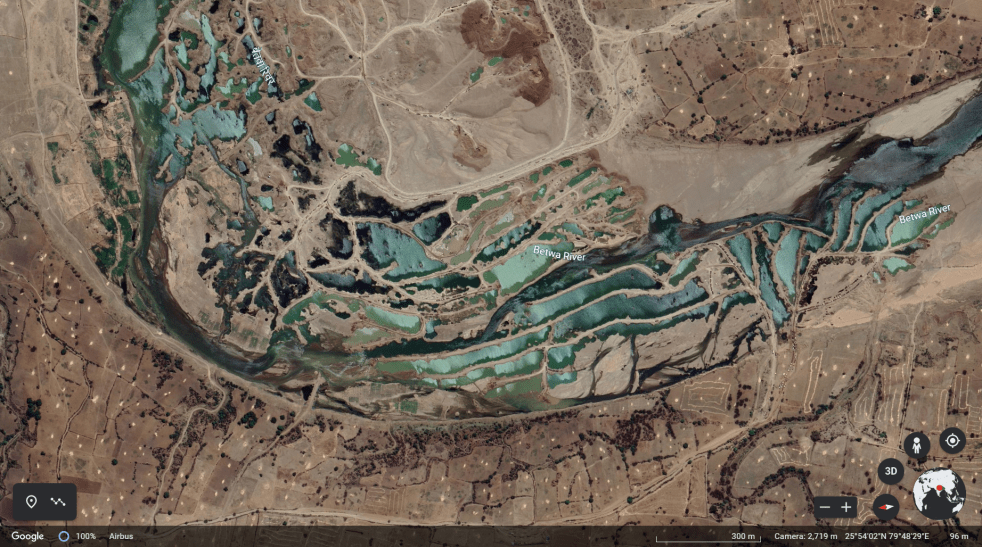
(Feature Image: Screen shot of undated google earth image showing multiple vertical, horizontal bunds created by deep, mechanized riverbed mining across Betwa near Bheri Dariya in Sarila tehsil of Hamirpur district.)

The comparison of Sentinel satellite images dated February 20, 2023 with images of September-October 2022 reveal large scale riverbed mining operations along Betwa river at multiple sites in Jhansi, Jaluan and Hamirpur districts. The details of some of the sites is given in table below followed by the satellite imageries and time lapse animation of few sites.

Continue reading “Uttar Pradesh: Satellite Images Reveal Betwa River Ravaged by Mining”
DRP News Bulletin

DRP NB 200223: US EPA starts reporting methane emissions from dams

(Feature Image:-Vyasi HEP dam reservoir on Yamuna river in Dehradun. Credit: Varsha Singh/Third Pole, Jan. 2022)

In a landmark move, United States Environment Protection Agency has started reporting methane emissions from dams and hydropower projects in its annual reporting to UN in 2022. It needs to go a step further and make it mandatory for all dams and hydropower projects to annually report such emissions on their websites. This will not only help clear the mistaken notion that hydropower projects are climate friendly, it will also help take right policy measures and project construction or decommissioning decisions. It will also lead to more scientific accounting of global warming causing emissions. It will also give the consumer right picture about GHG emissions from such projects when they look at options for electricity supply. There is a lot that India and rest of the world that needs to learn from this and implement on urgent basis as US EPA seems to be the first agency to do this.  

Continue reading “DRP NB 200223: US EPA starts reporting methane emissions from dams”
DRP News Bulletin

DRP NB 130223: El Nino set to endanger 2023 SW Monsoon rains

After four years (SW Monsoons of 2019 [110.4%], 2020 [108.74% compared to normal rainfall], 2021 [99.3% or almost normal rainfall], 2022 [106.5%]) of normal or surplus monsoon rainfall, SW Monsoon 2023 could face rainfall deficit and uncertainties as per US Govt weather agency NOAA and also India’s IMD. El Nino conditions are many times associated with poor monsoon rainfall in India. Since SW Monsoon provides more than 75% of total annual rainfall of India, this can be critical for India. The shift from particularly prolonged La Nina conditions to El Nino conditions should be a warning sign for India. IMD DG has said that the department will come out with an update on Feb 28, which should be sufficient advance notice to take necessary steps to tackle its possible impacts on upcoming Summer and SW Monsoon. We hope the government is ready to take the necessary steps to tackle any eventuality.

Continue reading “DRP NB 130223: El Nino set to endanger 2023 SW Monsoon rains”
Hydro Disaster · Uttarakhand

Systemic failures at the root of Joshimath disaster

The 520 MW Tapovan Vishnugad Hydropower project of NTPC (formerly National Thermal Power Corporation Limited) has remained controversial at least since 2009 as it is again now in January 2023. This time it is in the dock over the sinking of Joshimath town in Chamoli district of Uttarakhand.

Continue reading “Systemic failures at the root of Joshimath disaster”
DRP News Bulletin

DRP NB 060223: Wetlands in India face damages, threats and Govt Apathy

(Feature Image:-Nayapakkam a lake near Chennai and a bird hotspot. 190 species have been recorded here and is a refuge for migratory harriers. https://ebird.org/hotspot/L3396760 Excavators were filling one end of the lake yesterday. Allegedly the ACS group is building an International school over it. M Yuvan, 05 Feb. 2023)

On the occasion of World Wetlands Day 2023 on Feb 2, 2023, SANDRP brought out five overviews about state of India’s wetlands. These included overview related to: 1. India’s Ramsar Wetlands 2. General overview of India’s wetlands 3. Top Ten stories about govt actions about wetlands 4. Top ten stories about judiciary actions about wetlands and 5. Positive stories about India’s wetlands. The links to the five overviews are available below.

The first thing that strikes from these overviews is that state of wetlands in India is bad, getting worse, they continue to face systemic neglect, damages, threats and govt apathy including Ramsar wetlands, which are supposed to have better protection than other wetlands, which is unfortunately not true. The nameplate of Ramsar wetland has now been given to 75 wetlands, but that provides no additional protection to them. in the name of information of Ramsar sites, there is only a combined interactive map apart from two separate pdf file links with location map and state wise listing Ramsar wetlands on Wetlands of India portal by MoEF&CC. The govt has neither prepared any concrete plan to address the threats nor has it developed credible monitoring mechanism which clearly shows it has no intention to improve the governance of these sites.

Continue reading “DRP NB 060223: Wetlands in India face damages, threats and Govt Apathy”
Sand Mining

Riverbed Mining 2022: Judiciary tries but fails to bring effective change

(Feature Image: Screen shot of The Power Time Dec. 2022 video news report revealing large scale mechanized, illegal sand mining in Sone rivers in Sonbhadra district Uttar Pradesh)

Judiciary has been striving to remedy the lawless situation currently dominating riverbed mining in India. The year 2022 has been full of court cases and orders dealing with unsustainable and illegal riverbed mining operations. In this yearend overview, we have reported top ten judicial interventions to control exploitative minor mineral mining by various state governments and to make the regulators accountable against the illegalities & violations.

In 1st part of the annual Sand Mining overviews, we tracked the adverse impacts of riverbed mining activities on freshwater species and rivers’ eco-system. In 2nd part, we covered the riverine community’s agitations against destructive riverbed mining. The 3rd part highlighted the damages and threats to infrastructures by excessive, mechanized riverbed mining.

Continue reading “Riverbed Mining 2022: Judiciary tries but fails to bring effective change”
DRP News Bulletin

DRP NB 020123: Looking Back to Look forward to 2023

(Feature Image:-River Ken inside Panna National Park from River Stories, Walking Across India-I by Siddharth Agarwal)

This is the first DRP bulletin of 2023 and we would like to begin on a positive note. But to remain grounded in reality we also need to look back at the events in 2022. We see a number of positives in 2022 and we hope that trend continues. The number of new dams and hydropower projects being started has remained on a declining trend. People and civil society has continued its protests against destructive projects and for more decentralised projects and governance.

Continue reading “DRP NB 020123: Looking Back to Look forward to 2023”
DRP News Bulletin

DRP NB 261222: People on roads against hydro projects that govt is pushing

(Joshimath residents staging protest against land sinking and damages to their homes demanding rehabilitation & halt in NTPC’s Tapovan Vishnugad HEP tunnel work on Dec. 24, 2022. Image source: Atul Sati, Joshimath)

People of at least four states are opposing hydropower projects that the central and state governments are pushing, ignoring all the ground realities. In Uttarakhand, the Joshimath residents are on roads to wake up the government that seems deaf to their protests due to their houses cracking and land subsiding due to the tunnels being blasted for hydropower projects and Char Dham highway being built ignoring the voices of not only the affected people, but also the experts.

In Arunachal Pradesh, people have been writing to the central govt authorities against the Etalin and Dibang projects being pushed in Dibang valley of Brahmaputra basin.

In Himachal Pradesh, the people of Kinnaur and Lahaul Spiti districts have made it an election issue the destructive hydropower projects being pushed there both by the state and central governments.

In Andhra Pradesh too people have been protesting against the pump storage projects being given permission in schedule tribe areas without their prior informed consent and ignoring the statutory requirements.

2022 is thus ending with people’s active protests across the country against destructive, disaster prone and unviable projects being pushed against their wishes and in violation of any proper consultations or even any credible impact assessments. In the escalating impacts of climate change, these projects are even more problematic as they not only worsen the adaptive capacity of people and invite more frequent, intense and spread of the disasters, but they also destroy the mitigation tools like forests and flowing rivers. This when all these projects are not even economically viable, and when better, cheaper options are available. It would be best if sooner the government listens to the people and stop pursuing such projects.

Continue reading “DRP NB 261222: People on roads against hydro projects that govt is pushing”
DRP News Bulletin

DRP NB 121222: Green Hydrogen from Hydropower is false solution

(Feature Image: Reservoir of Vyasi hydro project dam on Yamuna river in Dehradun. Credit: Varsha Singh/The Third Pole.)

A section of the hydro lobby has been trying to push hydropower in the name of producing green hydrogen as an alternative energy source. However, it has been known for a long time that this is a false solution. There cannot be green hydrogen when sourced from hydropower as not only hydropower projects have huge social and environmental footprint, they also have huge carbon footprint as the following article shows. It would be best to out rightly reject any such claim of green hydrogen when sourced from hydropower project.  

Continue reading “DRP NB 121222: Green Hydrogen from Hydropower is false solution”
DRP News Bulletin

DRP NB 051222: World Soil Day 2022: Soil where food begins

(Feature Image:-Several practical principles for soil and water conservations are important to be understood and combined. Source Wiki Farmer)

United Nations is celebrating today, i.e. Dec 5, as the World Soil day, the theme this year is “Soils: Where food begins”. The World Soil Day is held on Dec 5 each year since 2014, following the recommendation the International Union of Soil Sciences (IUSS) in 2002. The FAO Conference unanimously endorsed World Soil Day in June 2013 and requested its official adoption at the 68th UN General Assembly. In December 2013, the UN General Assembly responded by designating 5 December 2014 as the first official World Soil Day as a global awareness raising platform.

In the context of climate change, the soil organic content assumes additional huge significance. While the organic content in soils is decreasing globally, it can be reversed. If we can increase the soil organic content, it will not only help in mitigation of climate change by helping reduce the carbon in the atmosphere, it can also help in adaptation as soil with higher organic context has much greater capacity to store soil moisture, which can then be helpful in both flood mitigation (as more of the rain water is stored in the soil), and drought mitigation (soils with most moisture storage will help crops survive longer dry spells).

Continue reading “DRP NB 051222: World Soil Day 2022: Soil where food begins”