Marathwada

Release water sitting idle in Bhama Askhed Dam: It can help ameliorate drought in Solapur and Marathwada to some extent

Writing about drought in Marathwada can give a feeling of deja vu. But, what makes drought this year different is that we are writing about drought not in December or March or April, but in August, bang in the monsoon. Last monsoon wasn’t very generous to Marathwada, but the picture was much better than what it is today with dam storages at dismal 8% this year as against 26% this time last year. Marathwada had 344.5 mm rainfall as on Sept 3, 2014 (deficit of 37%) compared to 250.9 mm on Aug 28, 2015, with much higher deficit of 50%.  (Our detailed analysis of Marathwada drought: https://sandrp.wordpress.com/2015/08/18/drought-and-marathwada-an-oft-repeated-tragedy/)

On the 28th of August 2015, reservoir storages in Marathwada stand at 8%, with the largest Jayakwadi Dam at 5%, 4 dams at 0% (Mazalgaon, Majara, Lower Terna and Seena Kolegaon) and 3 more at less than 5% storages (Purna Siddheshwar at 1%, Yeldari at 3% and Manar at 3%). Of the average June-August rainfall of 525.2 mm, Marathwada has received only 250.9 mm, 50% of the average so far. Kharif crop is lost for most and Rabi is under cloud.

By now, the issue is not only about irrigation, but drinking water for humans and cattle.  How can this situation improve? Where can the region get water from? It seems even retreating monsoon will help only to an extent now. Dams in Nashik and Nagar districts which are upstream of Marathwada, themselves have low storages, with Nashik region at 45% as against 69% storage last year. Still, Bhandardara Hydroelectric project in Ahmednagar District, which is about 74% full with about 224 MCM of water and can afford releasing some to the downstream Jayakwadi and areas beyond. (It is not clear if the Ghatghar pump storage project, upstream from Bhandardara HEP, is actually operating in pump storage mode or generation mode and releasing water to the west, in which case it needs to be stopped). It will be better to take the decision about such releases soon, without waiting for a major conflict to arise. MWRRA needs to proactively perform its main duty of equitable water distribution, without waiting for October end, till which time any releases will become hugely contentious.

Similarly, dam storages in Pune Division are generally low at 52% as against 89% last year. However, there are a few dams which are literally sitting idle with a lot of water.

One such Dam is Bhama Askhed, which has a whopping 86% storage now at 187 MCM.

In April 2013, based on an order from Hon. High Court of Mumbai, 84.9 MCM (3 TMC) water from this very same Bhama Askhed Dam for the parched Ujani in the downstream. Back then, MWRRA was dysfunctional. The Authority could not take any decision on water releases from upstream dams even on court orders as it was simply non-functional then, with almost all of its posts vacant! (Read our detailed piece on Bhama Askhed: https://sandrp.wordpress.com/2013/06/08/dams-as-pawns-bhama-askhed-pune/)
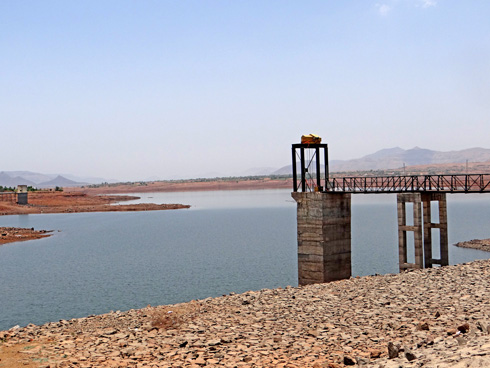
Bhama Askhed Reservoir Photo: Parineeta Dandekar

Why water release from Bhama Askhed makes sense now

Bhama Askhed Dam on Bhama River, tributary of Bhima River, epitomizes nearly all the problems of Maharashtra Water Resources Department. It has seen huge costs escalations, delays in its construction, it has not rehabilitated the 7000+ people that it has displaced. Most of the oustees are today without a reliable source of drinking water, irrigation or land based rehabilitation.

But the most damming fact is that it has absolutely no canal network.

The dam with live storage capacity of 217 MCM (7.5 TMC) was to have two canals: a right bank canal (RBC) of 105 kilometers and a left bank canal (LBC) of 14 kilometers. Construction on the dam started in 1995. When I visited the site in May 2013 to observe the impacts of High Court order, I saw that canal-work has not been undertaken even according to the claims of the WRD in the White Paper.

Right Bank Canal is barely 18 kilometers complete that too, in disjoint patches, making any use impossible. Left Bank Canal work is not even initiated. The 18 kms of Right Bank Canal is a dead investment as the canal is not even connected to the dam: that part is still not constructed.

In short, Bhama Asked dam does not irrigate a single hectare of its envisioned command till date. It has not used an inch of canals.

Bhama Askhed received administrative sanction in 1992 and was to irrigate 37 villages in Khed, 18 villages in Haveli and 9 villages in Daund talukas of Pune district with a total command area of 29,465 hectares, as per the White Paper on Irrigation Projects brought out by the WRD. All of its original command remain unirrigated, 20 years after undertaking the project.

I talked with the Deputy Engineer of Bhama Askhed on Aug 28, 2015 and he told me that the situation I saw in 2013 still prevails. No irrigation in command, no new work on canals initiated, no progress in canal work. The reason being that according to a Government Resolution (GR) of 2011, about 1.3 TMC water from Bhama Askhed has been allocated to Pune Municipal Corporations. Pimpri Chinchwad Municipal Corporation also wants roughly same quantity of water share from the dam. There are many issues with the GR and this allocation. But leaving that discussion aside for now, the fact remains that none of these Municipal Corporations are taking water from this dam at this moment and will not do so this year. Pune’s ambitious scheme of getting water from Bhama Askehd, funded by the erstwhile Jawaharlal Nehru National Urban Renewal Mission (JNNURM) remains unrealized and incomplete.

Deputy Engineer of Bhama Askhed Division told me that it will take at least 2-3 years more before these schemes materialize.  He says “What’s the point of making canals if the water is anyway to be allocated to cities? As it is the first priority is for Drinking Water.”  There is a huge irony in equating the unsatiated water demand of these metros with protective, livelihood irrigation needs of the downstream region. Pune or Pimpri Chinchwad Municipal Coporations waste and pollute water with impunity and have not taken  any credible steps for using available water effectively. But this is not the time to raise all this with the officer.

When I ask him why water is not being released from this idle dam to the downstream which is suffering right now? “In any case, City allocations will not happen this year as you say”. He brushed this off saying that it needs to be a policy decision.

While touring Marathwada, Chief Minister Devendra Fadnavis has publicly accepted that water needs to be released from the upstream dams for the region now. But theer are very few dams in the upstream which can do this. At the same time, a simple mention of sending water trains from Pandharpur (in Solapur district, on the boundaries of, but not in Marathwada) to the parched Latur District has sparked a political conflict in Solapur with one group saying they will not allow a drop of water to go from Solapur. It is understandable to an extent as the largest dam in Bhima Basin, the Ujani Dam in Solapur, is below dead storage already and the prospect of a whole year with severely rationed water availability is prompting aggressive reactions.

At such a critical time, any release from Bhama Askhed, if carefully monitored, can reach Ujani directly and help to a considerable extent. There needs to be very strict monitoring of this release, ensuring that it is not siphoned off enroute or once it reaches Ujani. Any groundwater recharge that may happen along the way need not be grudged. It will help someone, rather than that water sitting idle in Bhama Askhed reservoir, open to evaporation losses.

From Ujani Dam, water can reach fringes of Marathwada through Seena-Madha Link Tunnel, which reaches Paranda Taluk of Osmanabad. Water from Ujani will also reach parched cities of Osmanabad and Latur for drinking water through pipeline supply. If only the half-completed Shirala Lift Irrigation scheme was completed by now, this water could have helped a different part of Osmanabad. But Shirala is a part of the Dam Scam. If at all trains need to be deployed for sending water to Latur, or water needs to be reserved in Ujani for drinking water needs of Solapur like 2013, additional water in Ujani from Bhama Askhed will be invaluable.

But for this to be effective, we need the will and discipline from both the politicians and the communities along the river. We simply cannot afford this water being siphoned off for water hungry sugarcane cultivation, as is happening with Pune division dams, in collusion with some officials.

So the water sitting idle in the Bhama Askhed, if released, right now can ameliorate the problems of a deeply troubled region. If water is not released now, but is released closer to cane crushing season in Oct-Nov-December, we will know that the real beneficiaries are not thirsty people, but sugar factories.

We request the Government of Maharashtra and the Maharashtra Water Resource Regulatory Authority to order releases from Bhama Askhed urgently along with stoppage of westward diversion of Krishna basin water by Tata and Koyna dams and to devise a plan to monitor and utilize these releases most effectively for this drought hit region.

parineeta.dandekar@gmail.com, SANDRP
Dams · Maharashtra · Marathwada

Drought and Marathwada: An Oft repeated Tragedy

Marathwada, a region known more for its routine and severe droughts in the recent years, now showing the highest rainfall deficit in the country at 48%[1].

Marathwada (which coincides with Aurangabad Division of Maharashtra) consists of 8 districts in the heart of Maharashtra: Aurangabad, Beed, Latur, Osmanabad, Parbhani, Jalna, Nanded and Hingoli.

Index Map Marathwada Source: http://www.wikiwand.com/en/Marathwada

The region has a population of about 1.87 Crores and a geographical area of 64.5 Thousand sq. kms. Nearly the entire region, barring parts of Beed, Latur and Osmanabad, falls in Godavari basin. This has historically been a rain shadow region with average rainfall of about 700 mm, but in districts like Beed, it dips down to 600 mm. Apart from Godavari, no major rivers originate or flow through Marathwada except rivers like Purna, Shivna, Dudhna, Velganga, Sindhphana, Bindusara, etc. These are modest rivers, which carry little water as the harsh summer approaches. This is unlike Vidarbha (to the east of Marathwada) which has mighty rivers like Penganga, Wainganga, Wardha etc., or Khandesh and Western Maharashtra to its north and west, which have bigger rivers, denser watersheds and more rainfall.

Since the past 4 years, Marathwada has been facing exceptionally cruel weather. June-September Monsoon, which is the lifeline of most of this rainfed region, has been playing truant. Last year, the region experienced highest rainfall deficit in the past 10 years at -42%. In two districts it was much more than 40%, leading to a severe water crisis.[2] To give you an example, the JJAS (June, July, August, and September) rainfall in Parbhani in 2014 was just 346 mm, barely 4 mm more than rainfall during the horrifying 1971 drought! These two are the lowest rainfall figures for Parbhani since 1902, for more than 113 years!   Continue reading “Drought and Marathwada: An Oft repeated Tragedy”

Climate Change · Dams · Maharashtra

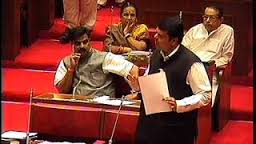
We pushed large dams, not irrigation, this has to change: CM Fadnavis’ Assembly Speech

“Maharashtra has the country’s 40% large dams, but 82% area of the state is rain fed. We have moved away from our vision of watershed and conservation…We did not think about hydrology, geology and topography of a region before pushing large dams everywhere. But this has to change”

These are not the words of an activist or water researcher. This was said by Maharashtra’s Chief Minister Devendra Fadnavis, during Monsoon Assembly Session of Maharashtra on 21st July 2015. Continue reading “We pushed large dams, not irrigation, this has to change: CM Fadnavis’ Assembly Speech”

Dams · Krishna River · Maharashtra · Marathwada · Ministry of Environment and Forests

Krishna Marathwada Scheme receives Environmental Clearance WITHOUT Water Availability!

Why is the Maharashtra Govt and the MoEF misleading people of Marathwada?

Press Release 29.06.15

On the 24th June 2015, the Union Ministry for Forests, Environment and Climate Change (MoEF for short) granted Environmental Clearance[1] to Krishna Marathwada Lift Irrigation Scheme for diverting 23.66 TMC (Thousand Million Cubic Feet) water from Krishna 1 Sub basin to Krishna 3 Sub basin of Krishna River Basin. The media has reported the development as a “Respite for Marathwada”.

However, as SANDRP had written to the MoEF several times[2], this Environment clearance is based on non-existent water availability and a misleading EIA[3] by Science and Technology Park, University of Pune. Continue reading “Krishna Marathwada Scheme receives Environmental Clearance WITHOUT Water Availability!”

Groundwater · Maharashtra

Maharashtra Groundwater Authority: Can it save the state from deep trouble?

(Photo from Outlook)

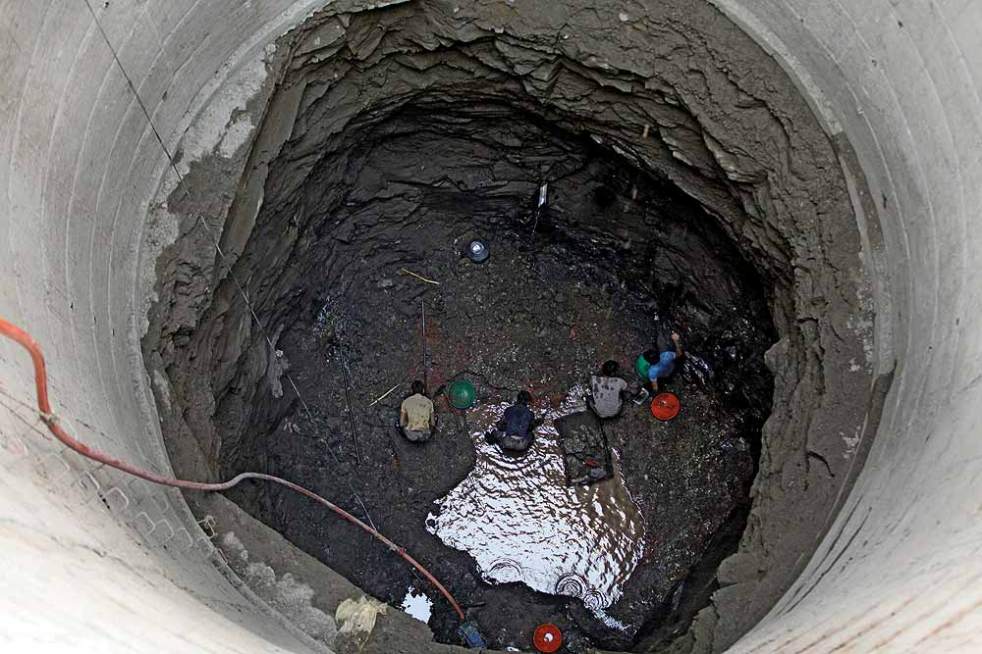
Harischandra Yerme from Latur (Maharashtra) sunk not one or two but 60 borewells in his field in Marathwada in the hope of finding water for his orchard. None of these 60 borewells yield water today. Mr. Yerme has taken on himself the task of educating farmers in his region that there is no sense in growing an orchard on bore wells: the supply may dry up at any moment, resulting in huge losses. He told me, “We don’t even consider 250 feet borewells now, all bores are at least 700-800 feet deep and even then they don’t work.” Marathwada is reportedly drilling as many as 10,000 borewells[1] per month in this drought: a boom that is sustained by the “boring mafia” from Andhra Pradesh and Tamilnadu using travelling rigs… In as many as 247 villages of Marathwada, the draft has exceeded recharge to such an extent that the aquifer has literally gone dry.. Water in villages is plummeting even by 7 meters of the 5 years average.[2] The density of borewells is so high that is villages near Tasagaon, a 40-50 square kilometer area has more than 210 deep bore wells. Officials from GSDA tell SANDRP of multiple instances where farmers only lose money in the hope of going deeper for groundwater, deeper than 800-900 feet. The landscape is likened to a “Chaalan”: a sieve in Marathi, but also several gunshot wounds.. Continue reading “Maharashtra Groundwater Authority: Can it save the state from deep trouble?”

Maharashtra

Krishna Marathwada Project: A costly pipe dream?

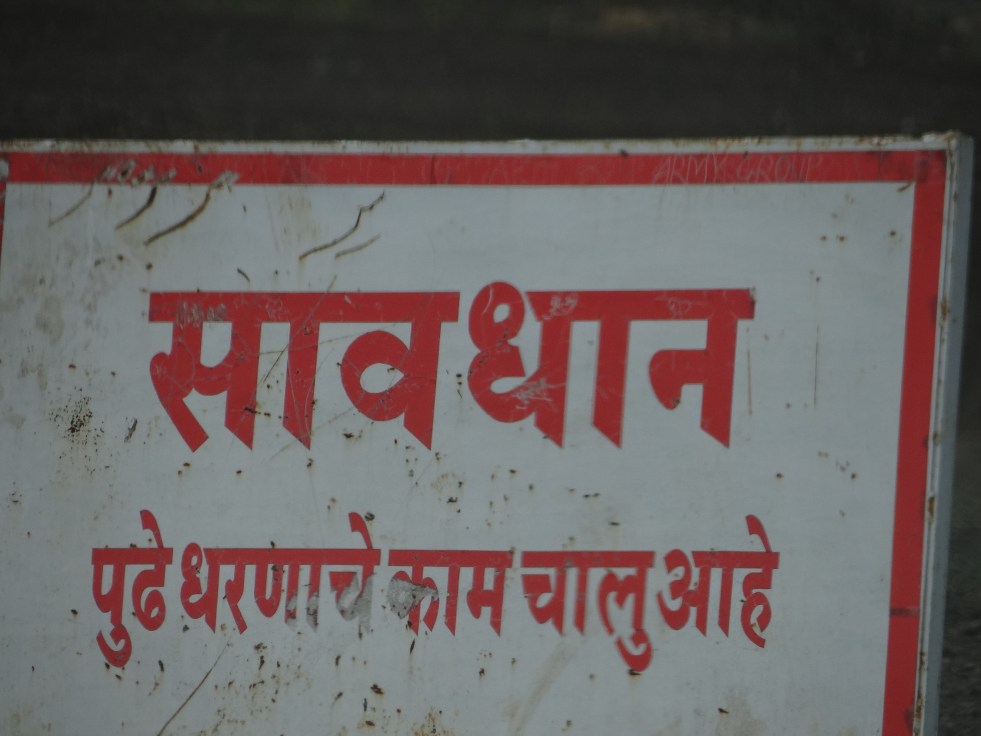
Above: A board at the dam site proclaims: “Beware, dam work ahead”. The warning pretty much sums up the situation of Krishna Marathwada Project Photo: Parineeta Dandekar

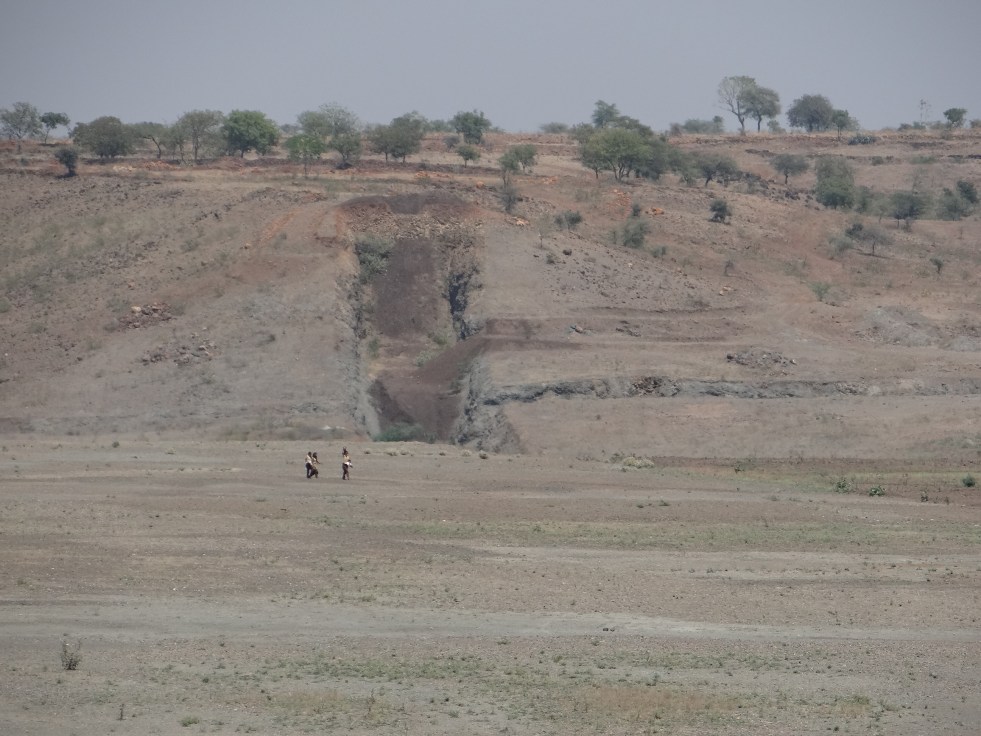
It was a blazing hot afternoon, made hotter by the subconscious association of Marathwada with all things dry, parched and drought-stricken. I was standing on the half completed dam wall of the Khuntephal Storage Tank in Beed, along with Macchindra Thorave and his colleagues. I’ve seen many dams and many dam walls, but it was impossible to believe this was a dam wall, supposed to impound 5.68 TMC of water (TMC=Thousand Million Cubic Feet. 1 TMC=28.317 billion liters). Primarily because there was no water in sight on either sides of the dam! There was no river in sight either! It actually looked like an under-construction road connecting two hills.

But as I realized later, being a part of the Krishna Marathwada Lift Irrigation Scheme and Krishna Bhima Stabilisation Project, issues like water were inconsequential.  This was Dam for Dam’s sake.

Half completed wall of the Khuntephal/Ashti Storage Tank, part of the Krishna Marathwada Project. Photo: Parineeta Dandekar

Continue reading “Krishna Marathwada Project: A costly pipe dream?”

Maharashtra

Thirsty sugarcane in dry Marathwada means a loss of 2 million farmer livelihoods

Above: Gangakhed sugar factory from Parbhani Marathwada which has crushed 7 Lakh Tonnes of cane till 21 Feb 2015. Parbhani has received a mere 346 mm rainfall this year, nearly equal to what it received during epic drought of 1972

~~~

Although Marathwada region in Maharashtra is no stranger to droughts, it’s facing a singularly acute crisis this year. Kharif crops had failed in all of the 8139 Kharif villages in the region with yields less than 50% of government standards (paisewari). Rabi is under cloud too with all 396 villages assessed for production showing less than 50% yield. And yet, area under and production of water guzzler crop like Sugarcane is going up. In 2013-14, Marathwada grew over 2 lakh hectares of sugarcane and is now crushing the cane in its 61 sugar factories using thousands of lakhs of litres water every day.

Does this make any social, economic or environmental sense? No

But do we have options? It seems so. Let us see how.  Continue reading “Thirsty sugarcane in dry Marathwada means a loss of 2 million farmer livelihoods”

Maharashtra · Marathwada

Can Marathwada afford to undertake Sugarcane Crushing in this terrible drought?

Since 2012, farmers in Maharashtra, especially in Marathwada and Vidarbha region of central and eastern Maharashtra are faced with unending mountains of crisis. What started as drought of 2012 went on in form of violent rains at places in 2013, hailstorms of February-March 2014, scanty monsoon in 2014 and unseasonal rains at places in November 2014, affecting lakhs of farmers. Agricultural production has suffered losses as impact of scanty rainfall has been compounded by absence of rains in critical time windows when soybean was filling and cotton bolls were forming. More than 8000 villages in Marathwada region which comprises of Aurangabad, Nanded, Parbhani, Latur, Beed, Hingoli, Jalna and Osmanabad have recorded crop losses of more than 50%.

Marathwada region in Maharashtra Map from: Marathi Wikipedia

The entire Winter Assembly of the newly formed Government seems to be clouded by discussions of drought package and increasing farmer suicides in Marathwada and Vidarbha. Since January 2014, more than 400 farmers have committed suicide in Marathwada region, and the pace is picking up worryingly since the past month. Hydrological, meteorological and agricultural droughts are becoming more pronounced in Marathwada.

But can this be attributed to vagaries of nature alone?

A brief analysis of the underlying reasons for the crisis in Marathwada and its future implications:

Truant Monsoon of 2014

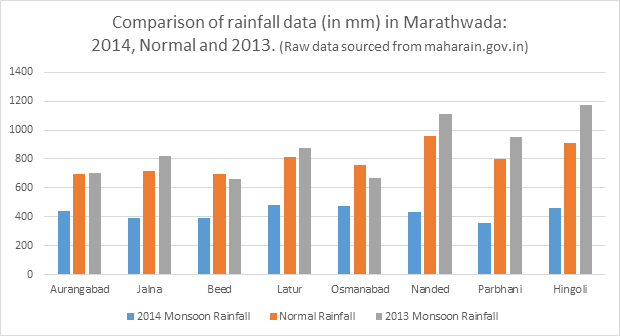
As per SANDRP’s analysis of district-wise rainfall figures of Marathwada in monsoon 2014, the picture which arises is dismal:

GRaph

For 2014, departure from normal rainfall for 6 out of 8 districts in Marathwada was more than 40% and rest two districts it was more than 50%, indicating a huge reduction in rainfall. However, contrary to what is being stated in the media, the region received satisfactory rainfall in 2013 monsoon. In fact, 6 districts of the 8 received more than 100% of normal rains and remaining two districts received 88% and 95% of normal rains last year. This is one of the reasons that the reservoir storage in 2014 did not fall as sharply as they did in 2012-13 drought. On 15th October 2014, Jayakwadi dam in Aurangabad had 42% Live storage, which was more than October 2013 storage of 33% and 2012, when it had reached dead storage already (http://www.mahawrd.org/). The entire Marathwada region too showed large reservoir storage of 47%, which is not extremely alarming.

Significantly, 2012-13 drought also unfolded in a similar manner, with highly satisfactory monsoons of 2011.

At the same time, the region is facing one of the worst droughts in recent history today.

This seemingly contradictory situation underlines a number of things, most important being: large dams do not automatically equate with water in farmers’ fields. Work on many projects (most projects in Marathwada) is incomplete ( for example: canals of projects like Lower Dudhana, Jayakwadi Phase II, etc), while contractors and politicians have made a pretty packet from the contracts, many projects are ‘evaporation machines’ than a water supply systems, without canals and distributaries or systems to govern water management. The available impounded water is a valuable political tool, and is used as such. Water allocation and management is far from being sustainable, transparent and accountable.

Projects under the jurisdiction of Godavari Marathwada Irrigation Development Corporation

According to news reports, in the past 11 months, 454 farmers only in Marathwada[1] have committed suicide due to number of reasons, most linked to crop failure and debt. Strikingly, after late November 2014, 52 farmers committed suicides mainly from Beed, Nanded and Osmanabad regions.

District Number of farmer suicides since January 2014
 1. Beed 122
 2. Nanded 104
 3. Osmanabad 54
 4. Parbhani 49
 5. Aurangabad 40
 6. Jalna 22
 7. Hingoli 29
 8. Latur 34

The issue has been raised in the Winter Assembly by the enthusiastic opposition and the CM is yet to announce a drought relief package. It is expected to be close to 8000-9000 Crores or more.

At the same time, there is a huge tussle going on between Nashik and Nagar on one hand and Marathwada on the other, for waters Godavari which originates in Western Ghats flows through Northern Maharahstra and then becomes the lifeline of Marathwada region. Nashik and Ahmednagar have constructed slew of large dams on Godavari and have always been reluctant to release water for Jayakwadi dam in Aurangabad in the downstream. We saw this episode flaring up last year and we are seeing an action replay this year as the HC has ordered immediate release of water from upstream dams for Jayakwadi. (See:http://indiatogether.org/share-environment). (Notably, this is the first time I have witnessed that the Dam Storages data of www.mahawrd.org, the official website of the Water Resources Department is not updated with weekly Dam Storage Levels. This had not happened even at the peak of 2013-12 Drought. Our queries to WRD on this front have been unanswered till date.)

WRD officials and administration have taken cautious stand and water in reservoirs is now reserved mainly for drinking water purposes, any release in downstream for irrigation is being delayed and is being made only after strong negotiations, badly hitting rabi cultivation, which is already less than last year.

Even as conflicts flare up, protests rage and assembly is disrupted, sugarcane crushing goes on unhindered in Marathwada, in whopping 61 Sugar factories!

On the unfortunate and expected lines, the government has not said a word about restricting cane crushing in Marathwada this year, which itself guzzles massive amounts of water, apart from cane cultivation. On the other hand, the party president, Amit Shah himself attended first crushing day of some factories (one of which was reportedly captured by relatives of a BJP MLA by fraud![2])

A look at sugarcane cultivation and crushing season so far in Marathwada:

(All data obtained by SANDRP from Sugar Commissionarate, Maharashtra Government, December 2014)

Area under sugarcane in Marathwada in 2013-14 and Sugar factories

District Area under sugarcane (in hectares) Number of Sugar factories
1. Aurangabad 15,373 9
2. Jalna 11,083 5
3. Beed 27,299 10
4. Parbhani 25,567 6
5. Hingoli 18,037 3
6. Nanded 28,057 9
7. Osmanbad 43,635 16
8. Latur 61,479 12
TOTAL 2,30,530 Hectares 61 Factories
TOTAL SUGARCANE CULTIVATED IN MARATHWADA FOR CRUSHING 154.28 Lakh Tonnes  

So around 61 sugar factories will crush 154.28 Lakh Tonnes Cane in a period when drought is so bad that water will not be released from reservoirs for irrigation!

In doing so, the factories will use a minimum of 1500 litres of water to crush one tonne of cane. To crush 154.28 lakh tonnes, minimum amount of water used will be: 23,142,000,000 Litres or 23.1 Million Cubic Meters. This is the lowest estimate.

This amount would be sufficient to irrigate nearly 8,000 acres of high yielding groundnut, more of Jowar or can be sufficient for drinking water needs of nearly 15 lakh 85 thousand people[3] till the onset of 2015 monsoon!

This water will be used till the end of crushing season when the drought will be extremely severe if we look at current indices.

Is there a justification of doing so? Will a 10,000 Crore drought package come close to ameliorating the impact of water loss at the peak of drought?

In addition, the pollution control mechanism of most sugar factories is pathetic. Pollution Control Board has raised this number of times. Uncontrolled water and soil pollution by sugar factories will additionally pollute groundwater and water bodies, further affecting water security of the region.

This water may be sourced from dams and groundwater. SANDRP has witnessed in 2012-13drought, sugar factories in Marathwada, mainly Osmanabad region lifted water from dams even when water levels had dipped below dead storage. What will be the impact of this siphoning on local drinking water security?

We should not forget that one of the costliest political lesson for NCP came when Ajit Pawar uttered extremely insulting remarks on dry reservoirs, mocking people’s plight. This was in context of a protest by a lone farmer from Mohol, urging water for drinking, even as sugar factories on Mohol used lakhs of litres of water when the farmer, Prabhakar Deshmukh, was fasting in Mumbai! Needless to say, the ruling party’s defeat was sealed through such acts. (More about Sugarcane in Solapur here: https://sandrp.wordpress.com/2013/04/22/why-solapur-sugarcane-and-sustainability-do-not-rhyme/)

Even in terms of groundwater, Marathwada region has literally touched rock bottom. In a report by GSDA (Groundwater Survey and Development Agency) submitted to Government of Maharashtra,[4] it has been reported that in 249 villages of Marathwada, abstraction has been 100% and there is no more water to draw. Not surprisingly, the regions suffering largest groundwater problems are surrounded by sugarcane and sugarcane factories.

In the past too, SANDRP has underlined how sugarcane in drought affected areas contributed to worsening drought of 2012-13. Then Solapur was in crisis.  This year, the district which has 28 sugar factories two years back has 34 sugar factories!

All government announcements about bringing sugarcane under drip have remained on paper and sugarcane continues to rule the drought politics of the region, regardless of the political party. In fact, the Cooperation Minister BJP Government Chadrakant Patil has announced that the only clause which has been limiting further sugar factory rush (of having a minimum aerial distance of 15-25 kms between two factories[5]),  can be diluted “ to promote healthy competition”. 200 factories are lined up for licenses with the Sugar Commissionarate!  There is no thought about the impact of this decision on water profile of Maharashtra.

This defies logic. The work of Winter Assembly was disrupted several times yesterday (10th December 2014) by aggressive opposition asking for an immediate drought package for Marathwada and Vidarbha. How can a 4,000 or 10,000 Crore Drought Package address these systemic issues? How can this package address siphoning off water from a drought hit region in peak drought? The opponents are happy discussing help to sugar factories for drought relief, not raising any points about impending impacts of crushing cane in drought.

In the long term, there is a need to reduce area under sugarcane and provide proper incentives, fair support price, forward and backward market linkages and support for initiatives like horticulture under drip (and there are several success stories from Marathwada on this), dairying, oil seed and pulses cultivation and processing, dryland farming and importantly, equitable and transparent water management involving all farmers in the region, not restricted to a few.

It is high time that long term decisions are taken in order to make Marathwada truly drought proof and free from clutches of ‘drought packages’ and opportunistic politics, year after year. A start can be made by restricting cane crushing in the region immediately.

-Parineeta Dandekar, SANDRP, parineeta.dandekar@gmail.com

End Notes:

Marathwada Farmers need Water: http://72.78.249.126/Agrowon/20141013/5520233630699177815.htm

SANDRP Analysis on water issues in Maharashtra:

Open Letter to Devendra Fadnavis: https://sandrp.wordpress.com/2014/11/14/open-letter-to-devendra-fadnavis/

Why Solapur, Sugar and Sustainability do not rhyme: https://sandrp.wordpress.com/2013/04/22/why-solapur-sugarcane-and-sustainability-do-not-rhyme

[1] http://www.esakal.com/NewsDetails.aspx?NewsId=5611377824684291267

[2] http://www.loksatta.com/mumbai-news/bjp-leaders-closed-try-to-take-over-controle-on-sugar-factory-in-paithan-1049861/

[3] @ 80 litres per capita per day

[4] http://www.loksatta.com/maharashtra-news/no-rain-in-marathwada-1047256/

[5] http://www.business-standard.com/article/economy-policy/maharashtra-likely-to-abolish-25-km-limit-between-two-sugar-units-114112300348_1.html

Further work on SANDRP on Drought, Maharashtra and Sugarcane can be found in Category: Maharashtra