DRP News Bulletin

DRP 231023: Need to be a little serious about Dam Safety, Flood Forecasting, Use of Early Warnings

Continue reading “DRP 231023: Need to be a little serious about Dam Safety, Flood Forecasting, Use of Early Warnings”
DRP News Bulletin

DRP 180923: Floodplain loss, the biggest in Asia, disaster in the making

Continue reading “DRP 180923: Floodplain loss, the biggest in Asia, disaster in the making”
CWC - Central Water Commission · Dams

Rivers Breaching Highest Flood Levels in July 2023

Continue reading “Rivers Breaching Highest Flood Levels in July 2023”
DRP News Bulletin

DRP 030723: Peak Hour Tariffs to be implemented from April 2024

(Feature Image: Vyasi HEP power station at Hathyari, Dehradun. SANDRP, June 2023)

This announcement by the government is indeed much belated but welcome step that India plans to increase peak hour power tariff compared to non-peak hour power tariff, beginning with commercial and industrial consumers from April 2024 a year later for others excluding agriculture consumers. The notification mentions it as daytime tariff (during solar hours) and night time power use, but this essentially also helps peak management.

This will not only put a premium on peak hour power consumption and hence generation, but also hopefully ensure that assessment of impacts of the peak hour power generation including at hydropower projects is done and done in a credible way, along with compensating those affected. It will also hopefully ensure that existing hydro capacity is used optimally for peak hour power generation before going for new hydro projects in the name of increasing peak our power generation.

One also hopes that it will lead to better peak hour power management and also considering all the options for such power generation rather than pushing hydro projects blindly in the name of peak hour power generation.

Continue reading “DRP 030723: Peak Hour Tariffs to be implemented from April 2024”
DRP News Bulletin

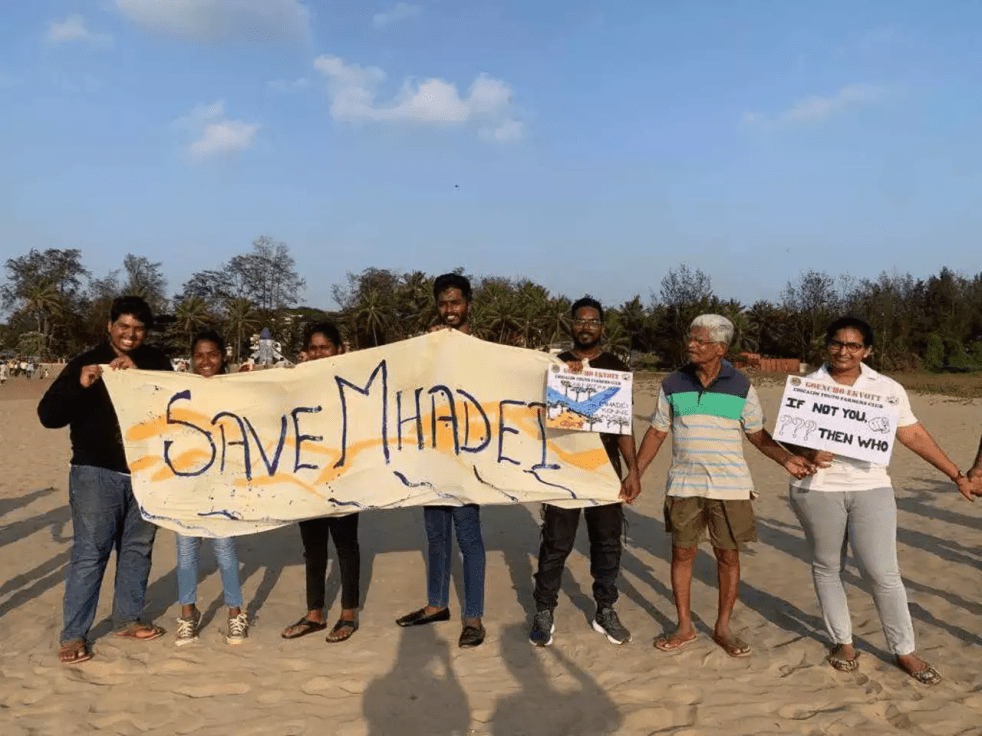
DRP 290523: Goa Fights to save Mahadayi River

(Feature Image: Thousands form human chain along Mhadei river to celebrate #MahadaiAmchiMai festival. Source: ToI)

On May 20, 2023 when thousands of people of Goa, Rakhondars (protectors) came out to form a 7 km long human chain to save Mhadei or Mahadayi river, they were not only celebrating Goa’s unique Mahadayi River festival, but were also coming together to declare their resolve save and rejuvenate the River that is lifeline of Goa.

A large number of organizations came together, including Earthivist Collective, Goa Heritage Action Group, Save Mhadei Save Goa front, among many others. It was a unique attempt to reconnect with the river, its history, its soul. The people from all kinds of art forms and all walks of life came together in a state where the connection with the river has always been strong for the people.

One hopes their tribe multiplies and they succeed in saving the river from dam building plans and other river affecting activities. That success will provide an example and impetus for river conservation activities elsewhere too.

Continue reading “DRP 290523: Goa Fights to save Mahadayi River”
DRP News Bulletin

DRP 220523: Water Options as we await South West Monsoon 2023

(Feature Image: Waster Chest nut cultivators removing weeds from Giri Taal of Kashipur. April 2023)

As we await the onset of South West Monsoon 2023, we would like to highlight the water options stories in lead story here, that includes examples from Ladakh, Madhya Pradesh, Rajasthan, Gujarat, Chennai, among others. It is important to remember these as we need to be ready to welcome and nourish the coming annual bounty that monsoon brings.

It also reminds us the fascination our poets have for this season, particularly the wonderment that Gulzar keeps expressing. In this one of his non filmy poetry “Baarish” he warns:

“Mujhko ye fikr, ke is baar bhi sailab ka paani…

Kud ke utrega kohsahr se jab..

tod ke le jayega ye kachhe kinaare..”

Continue reading “DRP 220523: Water Options as we await South West Monsoon 2023”
DRP News Bulletin

DRP 170423:Forecast of Indian SW Monsoon & definition of normal monsoon

The India Meteorological Department (IMD) has on April 11, 2023 forecast that rainfall at national level in four months of June-Sept 2023 Southwest Monsoon will be 96% of Long Period Average (LPA). IMD considers Indian Monsoon rainfall as normal based on just one parameter of total rainfall in these four months at national level is between 96% and 104% of LPA, with model error of +/- 5%. This raises large number of questions as media has rightly raised post the IMD announcement.

Firstly, in a strange turn of events, on April 12, an update jointly by US weather agencies under the National Oceanic & Atmospheric Administration (NOAA), contradicted a number of assumptions of IMD the previous day, including the period when El Nino will become active and probability of it being a strong event, both of which have a strong bearing on the Indian Monsoon in an adverse way. So the first question that arises is, did the IMD not have the benefit of the observations on April 11 based on which NOAA made the forecast very next day? Or was it an attempt at providing an unjustified feel good monsoon forecast? This question arises as in the past too questions have been raised about such attempts by IMD. This question also becomes important as only a day or two before IMD’s forecast, private forecaster had predicted that monsoon rainfall is likely to be deficient and not normal.

Continue reading “DRP 170423:Forecast of Indian SW Monsoon & definition of normal monsoon”
DRP News Bulletin

DRP 030423: IRENA confirms bleak future of Large Hydro globally

(Feature Image: Graph showing annual growth in hydro power capacity in MW. Source: Rivers Without Boundaries, April 01, 2023)

The annual Renewable Statistics 2023 report from IRENA (International Renewable Energy Agency) says that globally, only 1.6% was added to the hydropower capacity in 2022, that too two thirds in non-democratic China. The capacity added in rest of the world outside China in 2022 was 7.3 GW, lowest figure in last 15 years. Similarly 99% of additional capacity added in pump storage projects in 2022 was in China. The report from IRENA also says that 97% of hydropower finance comes from public or government sources and private sector seems to have little enthusiasm for this sector. The projections for future painted in the report is no better. This is broadly in line with our lead story in DRP News Bulletin last week (dated March 27 2023) painting bleak future of large hydropower projects.

Continue reading “DRP 030423: IRENA confirms bleak future of Large Hydro globally”
DRP News Bulletin

DRP 270223: How much Pump Storage Hydro capacity is required in India?

(Feature Image: State steps up pumped hydro storage projects amid coal crisis. Source: EQ Mag Pro/ May 2022)

On Feb 15, 2023, Union Ministry of Power issued draft guidelines for Pump Storage Projects, inviting comments from stakeholders in 15 days to the email id – hydro2-mop@gov.in. The guidelines say that more Pump Storage Projects (PSPs) are required in view of increasing solar and wind power capacity connected to the grid, to stabilize the grid, store the power to make it available during non-solar and non-wind power hours and for peaking power, reactive power, etc. It describes the PSP as “clean, green, safe, and non-explosive” and “environment friendly” option. No studies or basis are provided for this sweeping conclusion.

Continue reading “DRP 270223: How much Pump Storage Hydro capacity is required in India?”
DRP News Bulletin

DRP 200223: US EPA starts reporting methane emissions from dams

(Feature Image:-Vyasi HEP dam reservoir on Yamuna river in Dehradun. Credit: Varsha Singh/Third Pole, Jan. 2022)

In a landmark move, United States Environment Protection Agency has started reporting methane emissions from dams and hydropower projects in its annual reporting to UN in 2022. It needs to go a step further and make it mandatory for all dams and hydropower projects to annually report such emissions on their websites. This will not only help clear the mistaken notion that hydropower projects are climate friendly, it will also help take right policy measures and project construction or decommissioning decisions. It will also lead to more scientific accounting of global warming causing emissions. It will also give the consumer right picture about GHG emissions from such projects when they look at options for electricity supply. There is a lot that India and rest of the world that needs to learn from this and implement on urgent basis as US EPA seems to be the first agency to do this.  

Continue reading “DRP 200223: US EPA starts reporting methane emissions from dams”