
At a well-attended meeting at India International Centre in Delhi on Feb 20 2025, organised by VIDHI Centre for Legal Policy, a panel of speakers including Shri Shashi Shekhar (former secretary, Union Ministry of Water Resources) and Shri Jasbir Singh Chauhan (former Principle Chief Conservator of Forests, Madhya Pradesh) and Himanshu Thakkar of SANDRP, a number of fundamental questions were raised about the controversial Ken Betwa River Link Project. Unfortunately, no clear answers are forth coming from the authorities.
Continue reading “DRP 240225: Unanswered questions on Ken Betwa Project”Tag: Krishna
DRP 200125: Whither Env Clearance Rejection rate from Expert Appraisal Committee or MoEF?
A detailed review of functioning of Union Ministry of Environment and Forests’ (MoEF) Expert Appraisal Committee (EAC) on River Valley Projects (RVP) for 2024 by SANDRP shows that the committee or for that matter MoEF has almost non-existent rejection rate. Even when a project is not cleared, when it applies again, it gets clearance, whether the application if for stage I (Terms of Reference) or Stage II (Environment Clearance- EC) clearance. Even in some cases like Pump Storage Projects (PSP) in Western Ghats or the Hydropower projects in disaster prone Himalayas, including the disaster-stricken projects like the 1200 MW Teesta III projects in Sikkim, the scrutiny including field visits by the EAC Sub committees is minimal, not worthy calling even scrutiny.
Continue reading “DRP 200125: Whither Env Clearance Rejection rate from Expert Appraisal Committee or MoEF?”
EAC & FAC Decisions on Dams, Hydro, Irrigation Projects in 2024
This annual overview tracks the minutes of meetings held by Expert Appraisal Committee (EAC) for River Valley and Hydropower Projects between 20 December 2023 and 31 December 2024 for consideration of Dams, Hydroelectric Power (HEP), Pumped Storage Hydro Projects (PSP) and Irrigation related proposals seeking Terms of Reference (TOR) and Environment Clearance (EC) approvals. The analysis also covers various water projects related proposals considered by the Forest Appraisal Committee (FAC) between 15 December 2023 and 26 December 2024 for Forest Clearances (FC).
Continue reading “EAC & FAC Decisions on Dams, Hydro, Irrigation Projects in 2024”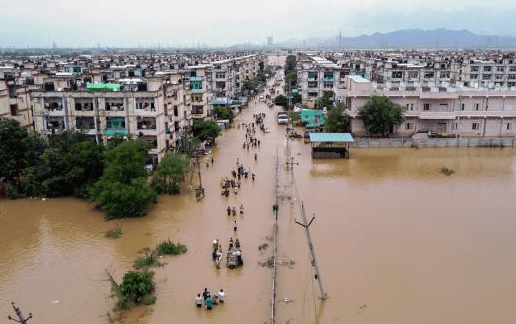
2024: Dam Induced Floods in Urban India
(Feature Image: A drone visual of the flood-affected areas of Vijayawada city on Sept. 6, 2024. Credit: ANI Photo/Source: Rediff.com)
Having covered dam induced flood incidents and embankment breach flooding events in part 1 and part 2, this third part on annual overview compiles media reports on manmade Urban flood disasters in India during the year 2024. While the cities of Pune, Nasik, Nagpur, Vadodara and Bharuch were affected by dam induced floods, the high discharges from Prakasam barrage and multiple breaches in Budameru river deluged the Vijayawada city. Interestingly, these urban flood episodes coincided with heavy rainfall events giving a reality check to dam and city managers.
In addition to failure in dam management, the deluge in Pune, Vadodara and Vijayawada city were particularly worsened by river front development projects and encroachment on river floodplains putting question marks on the urban planning and development works in these cities. Similarly, the breach in embankment of Munak canal in Delhi flooded several homes Bawana area during the monsoon season.
Continue reading “2024: Dam Induced Floods in Urban India”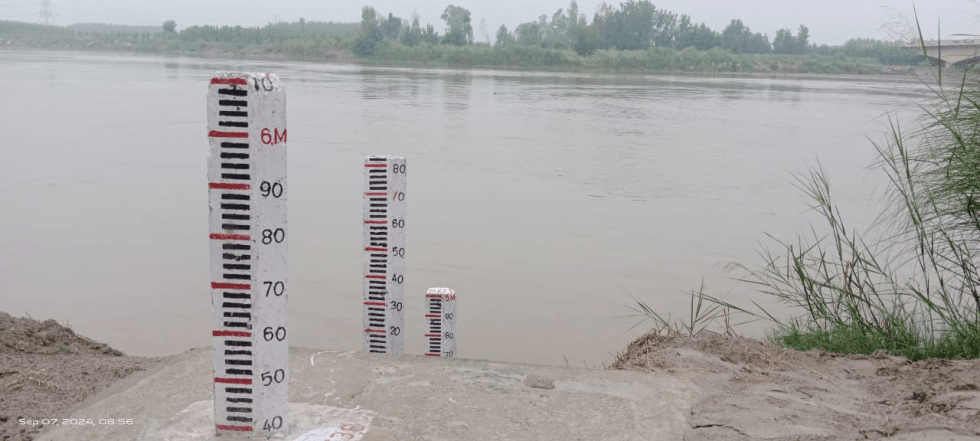
SW Monsoon 2024: Rivers Crossing Highest Flood Levels
During southwest monsoon season 2024, SANDRP has tracked at least 64 flood forecast and flood monitoring sites where the respective rivers have crossed the highest flood levels (HFL). Here we present detailed analysis of these sites along with some key observations and other relevant information. SANDRP’s previous reports on the subject can be seen here: HFL breach incidents in 2018, 2019, 2020, May-Sept 2021, Oct.-Nov 2021, May-June 2022, July-October 2022, June-October 2023.
Continue reading “SW Monsoon 2024: Rivers Crossing Highest Flood Levels”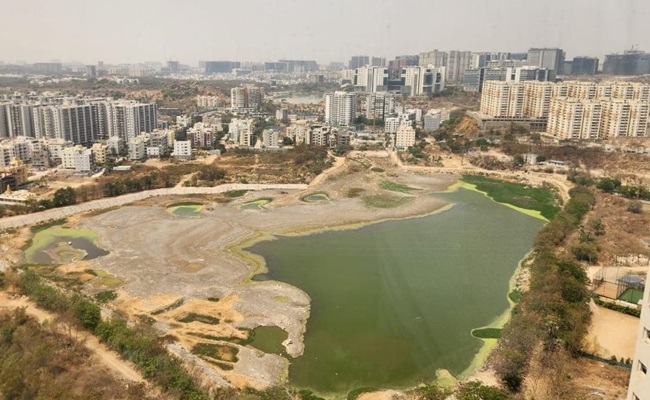
DRP 020924: HYDRA to protect water bodies in Hyderabad – a landmark move?
(Feature Image: An analysis of satellite imaging of 54 lakes taken in 1979 and 2023, secured by the HYDRAA from the NRSA shows that 40 lakes or nearly 75 per cent of lakes have shrunk by half. (Image: Twitter/DC)
The Hyderabad Disaster Response and Asset Monitoring and Protection Agency, or Hydra was established under GO 99, dated July 19 2024. A task the agency has taken up in all seriousness is protection of water bodies in the Hyderabad Capital Region (it includes 4 districts). To begin with it has started demolition of buildings illegally built inside the Full Tank Area (FTL) and Buffer area of the water bodies.
In July, Telangana Chief Minister Revanth Reddy replaced the Enforcement, Vigilance and Disaster Management (EVDM) wing of the government with Hydra, a body mandated to tackle illegal encroachment on water bodies in the Greater Hyderabad Municipal Corporation (GHMC) limits and surrounding areas. Its strength was upgraded from around 800 to 2,200 and its officials came directly under the principal secretary, municipal administration and urban development or the CM himself. “Hydra will also ensure the protection of water bodies in and around Hyderabad,” former EVDM commissioner and Hydra chief A V Ranganath said during its inception.
Continue reading “DRP 020924: HYDRA to protect water bodies in Hyderabad – a landmark move?”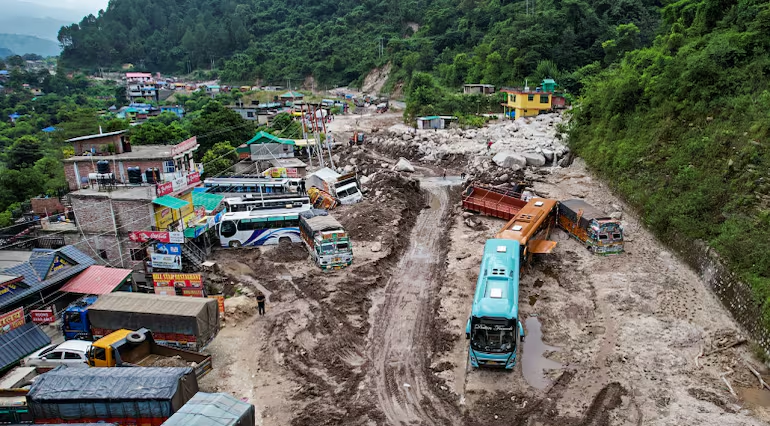
DRP 290424: Why is Climate Change not major election issue?
(Feature Image: Vehicles stuck in debris following a recent cloudburst at Saat Meel in Mandi, on August 20, 2023. (PTI Photo/Money Control)
World’s largest democratic exercise is now ongoing in India to elect the members of India’s Lok Sabha. Over 97 crores are eligible to vote in these elections. One of the biggest factors that is adversely affecting people across India currently is Climate Change. It is affecting almost every aspect of life and the adverse impacts are only increasing with every passing year. This is man-made disaster basically happening due to anthropogenic reasons, affecting air, water, climate, food, health, livelihoods, disasters and so on, affecting everyone. Currently, India is also a major contributor to the climate change causing green-house gas emissions, even though historically, the developed countries have contributed much more.
More importantly, the development options that the elected government choose will decide how the people will be impacted by climate change. The government has large number of options for pathways to development. Considering all this, one expected that climate change responses will be a major issue in these elections. But that is clearly not the case. BJP and Congress, two of the biggest parties fighting the elections, have mentioned climate change in their manifestos, but neither has dealt with this important issue with the detail and seriousness required. Nor are any of them making climate change a major election issue. One expects the ruling party to at least respond in greater detail and seriousness to this issue, but that is not the case.
Continue reading “DRP 290424: Why is Climate Change not major election issue?” DRP 220424: International Energy Agency accepts high-cost high risk hydro is no longer High Priority
DRP 220424: International Energy Agency accepts high-cost high risk hydro is no longer High Priority
The International Energy Agency (IEA) has accepted in its latest World Energy Investment Special Report titled “Reducing the Cost of Capital: Strategies to unlock clean energy investment in emerging and developing economies” has candidly accepted that hydropower (excluding pump storage) is no longer the high-priority sector.
Among the challenges hydropower faces, according to IEA, include long permitting time necessary considering the high and complex impacts of hydropower projects amd delays during construction. IEA figures show that the capacity of Chinese developed hydropower projects that had high proportion of installed hydropower capacity globally in any year for decades, was the lowest in 2023 since 2014. The report accepts that high cost of capital with high interest rates can have a major impact on Cost of electricity, affecting competitiveness of the hydropower projects.
Continue reading “DRP 220424: International Energy Agency accepts high-cost high risk hydro is no longer High Priority”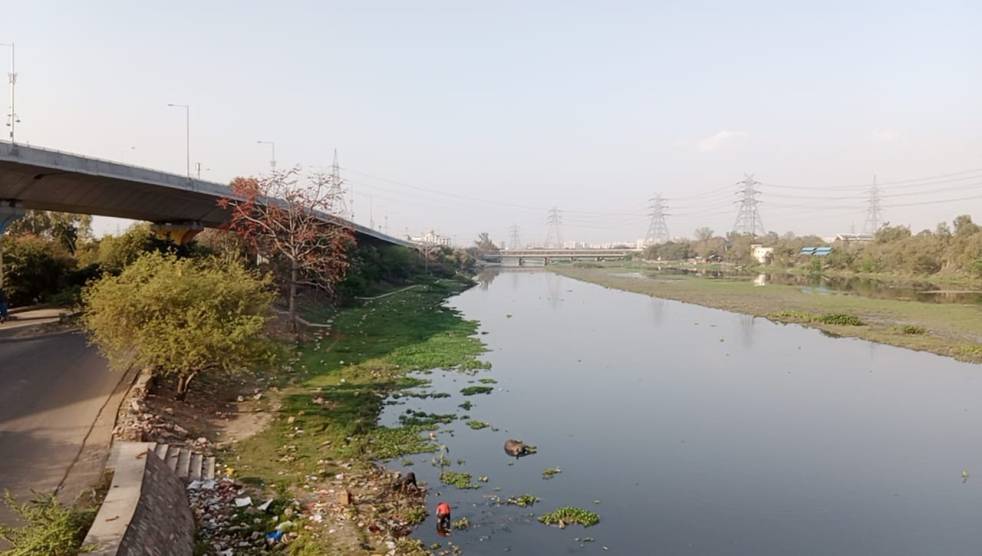
DRP 150424: Supreme Court’s order on right to be free from climate change impact is welcome, BUT…
(Feature Image: Polluted Hindon river flowing through Ghaziabad in March 2024. Bhim Singh Rawat/SANDRP)
On March 21, 2024, a case related to the Grean Indian Bustard, a critically endangered bird – numbering less than 150 individuals – has led the Supreme Court of India to expand citizens’ constitutional right to life and equality to include the right to be free from the adverse impact of climate change. The PIL filed by M.K. Ranjitsinh asked to protect the GIB from extinction. In 2021, in this PIL, the Supreme Court had passed directions restricting and regulating power lines and renewable energy projects in an area of 99,000 sq km in Rajasthan and Gujarat.
The Supreme Court’s latest order modified directions passed in the earlier judgment. Chief Justice D.Y. Chandrachud – writing for the 3-judge bench including Justices J.B. Pardiwala and Manoj Mishra – has expanded the contours of environmental jurisprudence: from the oft-repeated polluter pay principle–precautionary principle–public trust doctrine to the larger arena of climate justice, environmental inequity and gender justice. However, in the process, the protection the SC gave through earlier order has been withdrawn.
Continue reading “DRP 150424: Supreme Court’s order on right to be free from climate change impact is welcome, BUT…”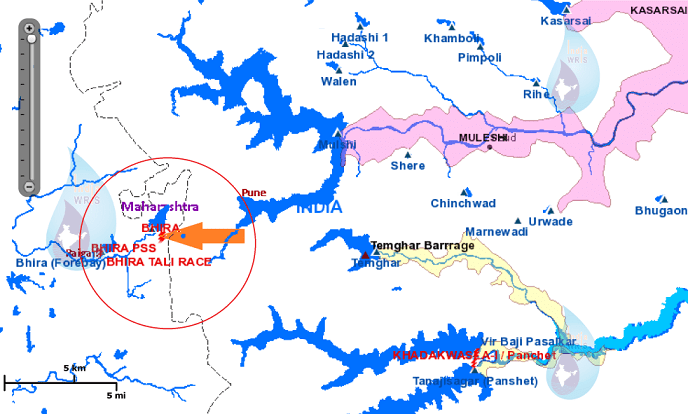
DRP 010424: As Krishna basin faces drought and scarcity, water diverted from the basin to Konkan
(Feature image: Map of Bhivpuri Hydropower Project, one of the Tata Dams)
Large parts of South India, including Maharashtra are facing depleted reservoir levels with the beginning of summer and water scarcity. However, the Krishna Bheema basin, the second largest basin of peninsular India, is diverting water to outside the basin to Konkan. The Krishna Bheema basin has the largest live storages of Maharashtra in Koyna dam (1347.5 MCM) and Tata dams (617.67 MCM), but the water in those storages won’t be available to the drought hit residents of Krishna basin in water scarce Maharashtra, Karnataka, Telangana and Andhra Pradesh.
This is because Koyna and Tata dams divert the water from Krishna Bheema basins to Konkan for power generation. Even in March, according to Maharashtra Load Dispatch Centre, Koyna had generated 128.87 Million Units (MU) of power and Tata Dams had generated 130.47 MU, both by March 30. This implies diversion of millions of Cubic meters of water from Koyna and Tata Dams during March 2024, which mostly gone down from Konkan to Arabian sea.
Continue reading “DRP 010424: As Krishna basin faces drought and scarcity, water diverted from the basin to Konkan” SANDRP