
Rajasthan Lessons from a reborn river The district of Alwar in Rajasthan is water-stressed, receiving less than 650 mm of rainfall in a year, most of which falls during the Southwest monsoon. But Alwar exists in a stable equilibrium, where even if there is a drought, the Johad’s and the forests make it possible for water to be stored underground. Because of strong communal interdependencies, all villagers stuck to sensible crops for the region, and maintaines the Johads. The community, the Forests, the Johads, the choice of crops, all worked together and reinforces one another. Equilibriums are maintained by such reinforcing activities that fortify status quo. FASCINATING account of how Arvari community rejuvenated their rivers and what are the lessons.
Continue reading “DRP: 29 May 2017 (Drought Options: Lessons from Rajasthan)”Tag: Irrigation

DRP: 22 May 2017 (SOLVE SILTATION OF GANGA OR REMOVE FARAKKA DAM TO REVIVE GANGA: BIHAR CM)
Bihar Chief Minister Nitish Kumar again has urged the central govt to remove the Farakka barrage in West Bengal and make a countrywide policy on silt management for letting river Ganga to flow freely.
“Siltation is destroying Ganga’s ecology and health. It’s due to heavy deposits of silt on the riverbed that stream of the river is being badly affected,” Kumar said at a two-day national seminar on ‘Obstacles in the Incessant Flow of the Ganga’.
Speaking on the occasion, Swami Avimukteshwara Anand criticised Union Water Resources Minister Uma Bharati for doing absolutely nothing for the cause of the river Ganga and said she seems more interested in her chair rather than the river. He also criticised Prime Minister Modi for claiming that he is son of Ganga, but doing nothing positive for the river. Swami ji said Nitin Gadkari seems bent on further destroying the river in the name of National Waterway.
Addressing the seminar Nitish Kukar said that Bihar’s demand for the framing of national policy on desiltation of the Ganga and clearance of silt in the state is not a political issue, as the matter is related to larger environmental and biodiversity issues facing the people.
He added, “Concrete steps have to be taken to ensure incessant flow of the Ganga. Otherwise, cleanliness of the river is not possible.” Referring to the need to protect biodiversity, he said conservation of the Ganga dolphins is dependent on the cleanliness of its water. He added the Farakka barrage constructed across the river in West Bengal has led to slow flow of water between Buxar to Bhagalpur, and consequent annual flood and waterlogging during the monsoon.
Nitish recalled the devastating flood that the state had witnessed in the Ganga basin last year and said Bihar had spent Rs 1,058 crore over the last five years to prevent soil erosion. He appealed to the Centre to frame a sound policy on silt management, stressing that it should be prepared by making on the spot survey and assessment of the prevailing situation. Nitish said even the report of the committee headed by Madhav Chitale had accepted the problem of siltation facing the Ganga.
Continue reading “DRP: 22 May 2017 (SOLVE SILTATION OF GANGA OR REMOVE FARAKKA DAM TO REVIVE GANGA: BIHAR CM)”
DRP: 24 April 2017 ( NHPC says Dams have no adverse impacts anywhere in the world! Admits, Hydro is no longer viable for private sector)
Centre Getting forest clearance is not a problem now: NHPC Chairman In an interview, taking a dig at its private peers, NHPC chairman KM Singh said that NHPC is the only company in the county that has the capability to execute hydro projects. He also said that in the NDA regime green clearances come easy, while local agitation by NGOs is the biggest threat. He further stated that there has been no negative impact of building a dam, not just in India, but anywhere in the world.
Continue reading “DRP: 24 April 2017 ( NHPC says Dams have no adverse impacts anywhere in the world! Admits, Hydro is no longer viable for private sector)”DRP: 17 April 2017 (Bihar needs to launch Farakka Satyagarha on centenary of Gandhiji’s Champaran Satyagraha)
As the President of India is in Patna today (April 17, 2017) to remember the centenary of Gandhiji’s Champaran Satyagraha, we need to remember that the Central message of Gandhi’s Satyagraha was to fight injustice, atrocities and abuse, irrespective of the source of the atrocities.
During the international workshop on INCESSANT GANGA in Patna on Feb 25-26, 2017, Bihar Chief Minister Nitish Kumar mentioned that this is the centenary year of Gandhiji’s famous Champaran Satyagraha in Bihar. He also mentioned how Bihar has suffered the increasing intensity, duration and destructive floods due to Farakka Dam.
Continue reading “DRP: 17 April 2017 (Bihar needs to launch Farakka Satyagarha on centenary of Gandhiji’s Champaran Satyagraha)”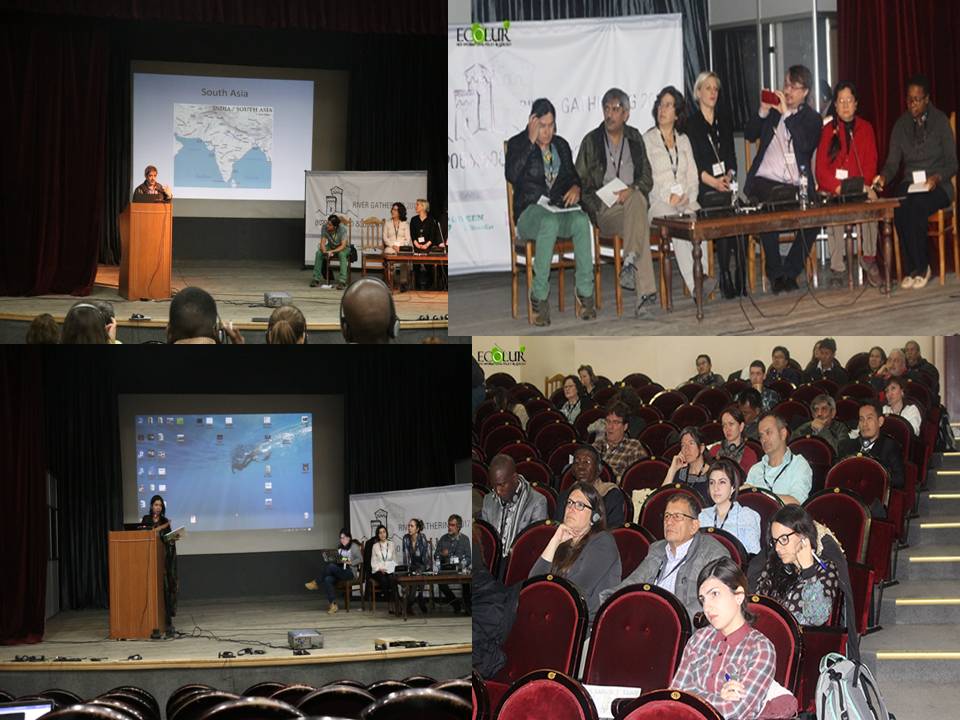
DRP: 10 April 2017 (Activists from 40 countries & all continents meet for RIVER GATHERING in Georgia)
In a most significant event, some 85 river and dam activists from 40 countries and all continents gathered in Tbilisi, Georgia (on border between Asia and Europe, between Black and Caspian Sea) during March 27-31, 2017 to share experiences about their efforts to protect the world’s rivers and join their struggles against destructive hydropower projects. The meeting was organized by CEE BankWatch Network (active in 12 countries in Eastern and Central Europe) and International Rivers.

Eight persons from South Asia, including those from India, Pakistan, Nepal and Bangladesh joined the meeting to share experiences from the region. Indian participant included SANDRP coordinator (who was also in steering committee of the meeting) and Associate Coordinator Parineeta Dandekar. A number of participants from neighboring and nearby countries like China, Myanmar, Thailand, Cambodia, Mongolia and Russia also participated. Issues related to trans-boundary rivers, small hydropower projects and multiple projects on the same rivers, decommissioning of the dams, how to achieve free flowing rivers and importance of rivers in changing climate were some of the key issues discussed at the meeting.
Continue reading “DRP: 10 April 2017 (Activists from 40 countries & all continents meet for RIVER GATHERING in Georgia)”
Himachal Pradesh Rivers Profile
About Himachal Pradesh
5 river basins; Total Area: 55,000 square kms.; Total Population: 68.65 lakhs; Total Catchment Area of 5 rivers; Total Catchment Area: 53311 sq.kms
Himachal is a relatively small state and in 2011 its population stood at 68.65 lakhs. It is only 9% urbanised and most of Himachal lives in its villages. Of the total land geographical area only 10% is under agriculture while close to 70% in under the category of ‘Forest land’. And yet agriculture is the main source of livelihood in Himachal with over 93% of the population dependent on it. As in most mountain areas agriculture and forest dependence is interwoven.
Agriculture is made possible due to the irrigation from river channels or natural springs. The health of the forests directly determines the health of the surface and ground water systems which in turn determines the viability of agriculture and horticulture. Horticulture and cash based agriculture was pushed by the government in the late 70s and 80s. Today the state has massive apple cultivation, apart from commercial vegetable cultivation, which is an important source of income for the farmers.
DRP: 27 Feb 2017 (Urgent Need To Review Impacts Of Farakka Dam: Experts)
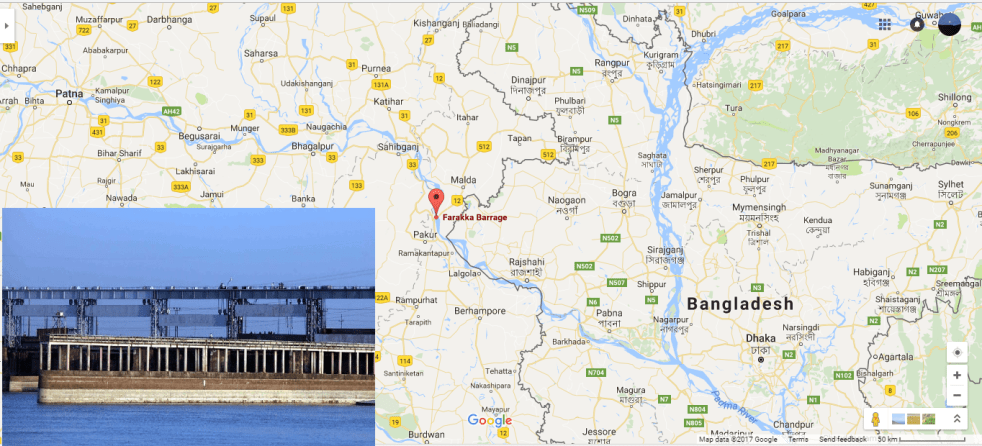
During a global seminar held on Feb. 25-26, 2017 in Patna experts from across the country have advocated an “urgent review” and comprehensive study of the Farakka dam to revive the Ganga river. The experts were discussing various concerns facing River Ganga and the possible solutions for them. The seminar titled as “Incessant Ganga” was organised by Bihar’s Water Resources Department, almost week after, Bihar CM Nitish Kumar has openly termed the barrage as genesis of floods in the State. Speaking in the program, the CM again expressed deep concerns behind receding water flow in the Ganga and increasing silt deposit due to Farakka dam.
Speaking during the seminar, environment expert Himanshu Thakkar the coordinator of SANDRP advocated urgent need for review of Farakka barrage claiming that it has failed to fulfill any of the purpose – irrigation, hydro electric power, water supply – of the barrage for which it was built. As per, Himanshu Thakkar the dam was built to maintain the navigability of Kolkata port.
Thakkar also suggested that the gates of Farakka be opened during monsoon to mitigate the intensity of floods in Bihar. As per Thakkar there was an urgent need for a comprehensive study of the Farakka barrage to find out its achievements or whether the barrage fulfilled its objectives. The committee constituted for study must include the Centre, Bihar, West Bengal and all states having Ganga, he said adding that a study should be made on the social and livelihood impact of the barrage, how it affected people’s lives, whether its existence was justified and cost-benefit assessment among other issues.
Continue reading “DRP: 27 Feb 2017 (Urgent Need To Review Impacts Of Farakka Dam: Experts)”

DRP: 13 Feb 2017 (Oroville Dam Disaster, USA: A Wake up Call for India’s aging big Dams)
Finally the Oroville Dam spillway damage has turned into a disaster. Report at this time (01:00pm, Feb. 13, 2017) finds dam level rising about 1 feet above the danger level. Water currents have started pouring out all over and around the emergency spillway which has never been put in use for last half a century. Meanwhile, more water is gushing in the dam reservoirs due to recent heavy rainfall in catchment areas upstream.
Continue reading “DRP: 13 Feb 2017 (Oroville Dam Disaster, USA: A Wake up Call for India’s aging big Dams)”
DRP: 23 Jan. 2017 (Unjustified Ken-Betwa Link Costs: Bundelkhand To Gain Nothing, Panna To Lose Its Tigers)
SANDRP Blog Little for Bundelkhand, lot for contractors in Ken Betwa river-link The official executive summary of the Detailed Project Report of KBLRP on NWDA website says: “The main objective of the Ken-Betwa link project is to make available water to water deficit areas of upper Betwa basin through substitution from the surplus waters of Ken basin.” Upper Betwa basin (Raisen and Vidisha districts of MP) is not in Bundelkhand. So KBLRP is essentially facilitating export of water from drought prone Bundelkhand to area outside Bundelkhand, which, in fact is well endowed with over 900 mm of average annual rainfall.
The DPR further says, a third o the surplus water will be utilized for “enroute irrigation of 0.60 lakh ha. in the districts of Tikamgarh and Chhatarpur of MP and Mahoba & Jhansi of U.P.” The claim in the minutes of Expert Appraisal Committee meeting of Dec 30, 2016 that “It is proposed to provide irrigation facility in 6,35,661 ha of area in Panna, Chhatarpur, Tikamgarh Districts of Madhya Pradesh and Banda, Mahoba and Jhansi Districts in Uttar Pradesh” needs to be put in context here. Firstly, this claim is far in excess of what the presumed surplus water can irrigate.
Continue reading “DRP: 23 Jan. 2017 (Unjustified Ken-Betwa Link Costs: Bundelkhand To Gain Nothing, Panna To Lose Its Tigers)”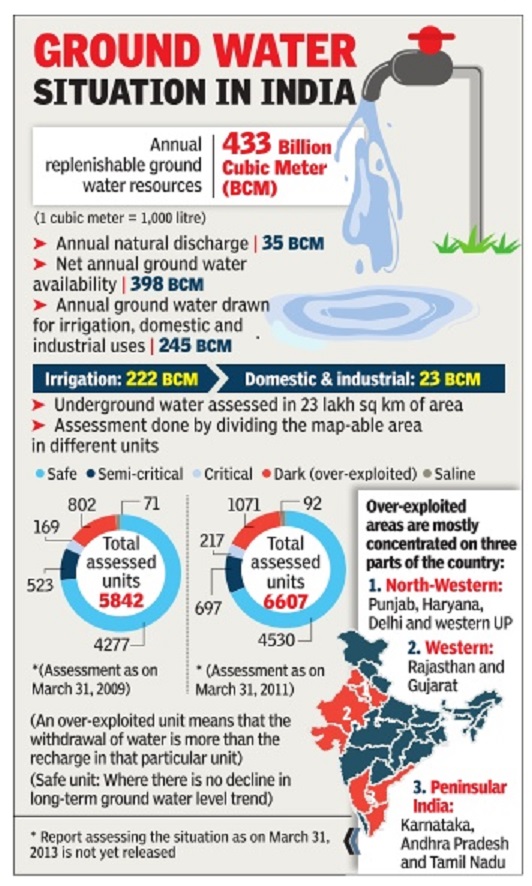
DRP: 9 Jan 2017 (India Groundwater Continues to Decline: Govt Report)
Ground water recharge plan is a non-starter Though the latest report, covering assessment of ground level situation as on March, 2013, is still being compiled, sources in the Central Ground Water Board (CGWB) hinted at further increase in the number of `dark’ (over-exploited) units. Decline in ground water level due to over exploitation of available resources had prompted the Centre in 2013 to come out with a master plan for artificial recharge of ground water, specifying how different states would go about it on priority. But majority of the states have, so far, not implemented the master plan. Only six states -MP, Gujarat, W-Bengal, UP, Chhattisgarh and Karnataka have taken follow-up actions despite the fact that the number of `dark’ units increased from 802 in March, 2009 to 1,071 in March, 2011. This not only says what the title mentions, but also shows how slow our official agencies are in even coming up with groundwater data, the latest data is for March 2011!
Continue reading “DRP: 9 Jan 2017 (India Groundwater Continues to Decline: Govt Report)” SANDRP