Sikkim · Teesta

Retracing Her Path -3: A Journey along the Teesta River in Sikkim

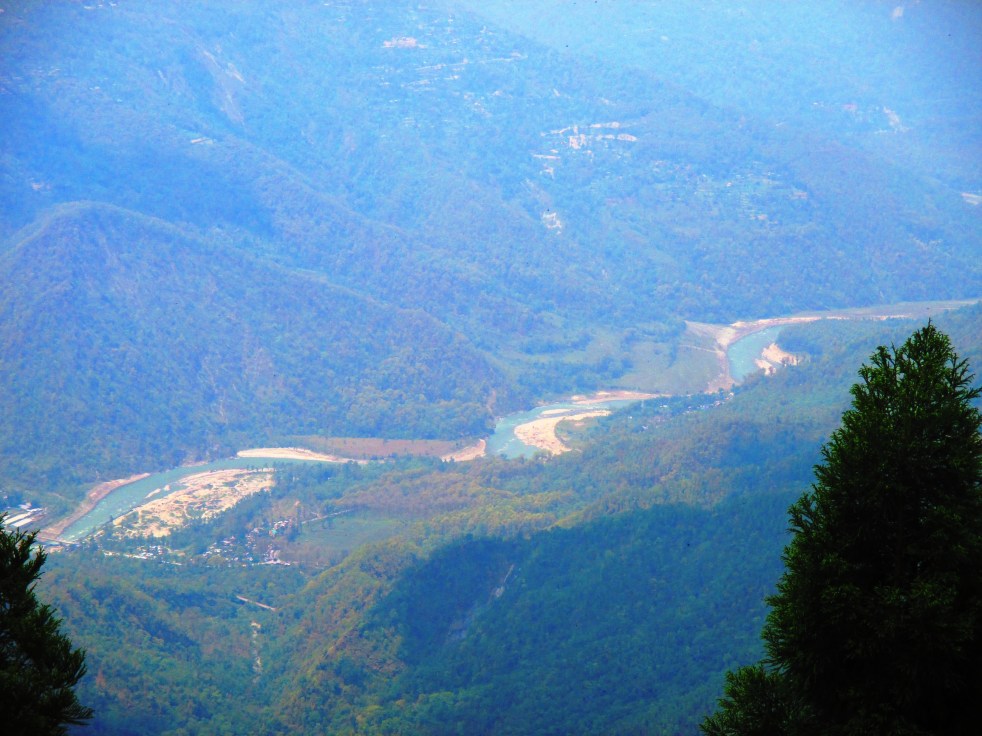
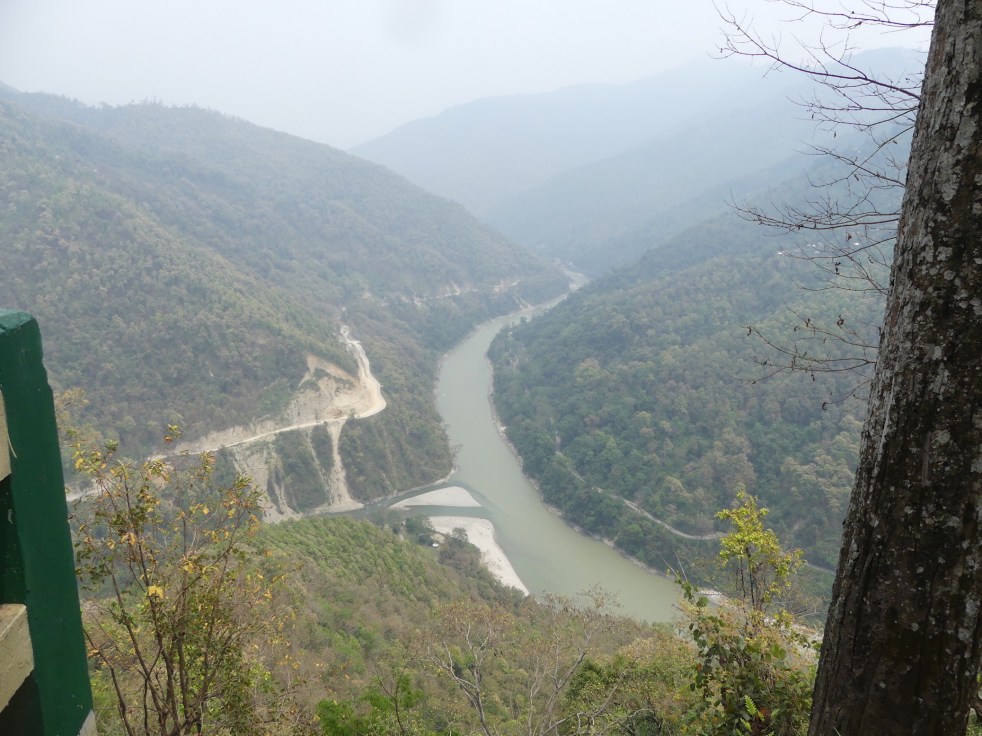
Above: The Teesta valley (photo: Gauri Noolkar-Oak)

Guest Blog by Gauri Noolkar-Oak

A day later, I set out on the last leg of my journey – through Sikkim, to the source. The journey from Kalimpong to Singtam and further to Mangan was breathtaking. The mountains grew taller as I climbed higher, the Teesta keeping me company all the while. It rained breezily and the clouds came down, clinging to the thick cloak of green that draped the mountains. Beauty was all around me and at one point, I just had to put my camera away and take in the splendour of nature.

Continue reading “Retracing Her Path -3: A Journey along the Teesta River in Sikkim”

Teesta · West Bengal

Retracing Her Path 2: A Journey along the Teesta River in W Bengal

Above: Fabulous view of Rangeet Teesta Confluence (Photo: AJT Johnsingh)

Guest Blog by Gauri Noolkar-Oak

The minute I crossed over the Indo-Bangladesh border into India at Chengrabandha, the atmosphere changed instantly; more briskness, more people and more English and Hindi surrounded me. I also spotted posters of Baahubali 2, and a few flags of Bhartiya Janata Party fluttered at the local bus station of Chengrabandha. I set out for Mainaguri, and through the pitter-patter of a weak drizzle, as the first tea plantations came into view.

My journey in the Teesta basin in North Bengal

Continue reading “Retracing Her Path 2: A Journey along the Teesta River in W Bengal”

Dams

India’s hydro generation drops to below 10% for the first time

For the first time in independent India’s history, hydropower generation from large hydropower projects in India in 2016-17 year fell below 10% of total electricity generation and is likely to go further down in years to come. It is well known that hydropower generation as proportion of total power generation has been going down. However, this proportion is generally seen in terms of installed capacity (measured in Mega Watts), and not actual generation (measured as Million or Billion Units[i]). Continue reading “India’s hydro generation drops to below 10% for the first time”

DRP News Bulletin

DRP: 26 June 2017 (Pancheshwar Project in Nepal)

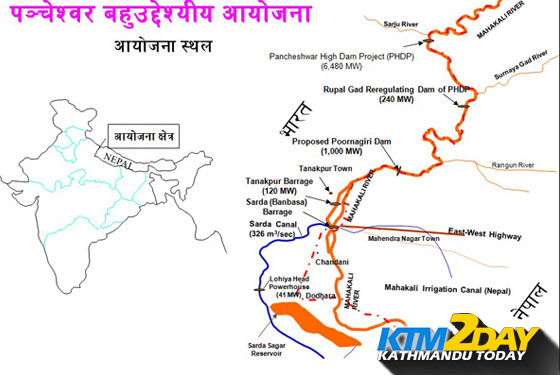
India should not push Pancheshwar Project in Nepal DIPAK GYAWALI asks a lot of pertinent questions here, including this one about PANCHESHWAR DAM: “Did it (India) not ram the Mahakali Treaty down Nepali throats in 1996 against all sane voices of caution and then has been unable to move an inch forward in all these two decades since then? As per the agreement, Nepal was to have received additional irrigation benefits from Tanakpur from an outlet with a sill level built maliciously high: Nepal has already spent billions building canals and distribution structures on its side but not only is there no movement on the Indian side, rather the latest Mughlani communication has been that you Nepalis can build all the canals you want on your side but we will do nothing until after the 6480 MW Pancheshwar high dam is built (when, in the next century?).”

Continue reading “DRP: 26 June 2017 (Pancheshwar Project in Nepal)”
Dams

Himachal Pradesh Rivers Profile


About Himachal Pradesh  

5 river basins; Total Area: 55,000 square kms.; Total Population: 68.65 lakhs; Total Catchment Area of 5 rivers; Total Catchment Area: 53311 sq.kms

Himachal is a relatively small state and in 2011 its population stood at 68.65 lakhs. It is only 9% urbanised and most of Himachal lives in its villages. Of the total land geographical area only 10% is under agriculture while close to 70% in under the category of ‘Forest land’. And yet agriculture is the main source of livelihood in Himachal with over 93% of the population dependent on it. As in most mountain areas agriculture and forest dependence is interwoven.

Agriculture is made possible due to the irrigation from river channels or natural springs. The health of the forests directly determines the health of the surface and ground water systems which in turn determines the viability of agriculture and horticulture. Horticulture and cash based agriculture was pushed by the government in the late 70s and 80s. Today the state has massive apple cultivation, apart from commercial vegetable cultivation, which is an important source of income for the farmers.

Continue reading “Himachal Pradesh Rivers Profile”

Dams · DRP News Bulletin

DRP: 13 March 2017 (20 Big Hydro Projects Costing Over 30K Crore, Stalled & Stressed: Piyush Goyal)

20 hydro projects stalled or stressed  The Power Minister Piyush Goyal on March 09, 2017 in a written statement has informed the parliament that as many as 20 under construction HPPs totalling 6,329 MW are either stalled or stressed in the country and Rs 30,147.08 crore has already been spent on them. These projects include 2,000 MW Subansiri Lower of NHPC Ltd, 500 Mw Teesta VI of Lanco Teesta Hydro Power Ltd, 120 MW Rangit-IV of Jal Power Corp, 300 Mw Panan of Himagiri Hydro Energy Pvt Ltd, 850 MW Ratle of GVK Ratle HEP Pvt Ltd, 100 Mw Sorang of Himachal Sorang Power Ltd and 960 MW Polavaram of Polavaram Project Authority.

Continue reading “DRP: 13 March 2017 (20 Big Hydro Projects Costing Over 30K Crore, Stalled & Stressed: Piyush Goyal)”
Hydropower Performance

Diminishing Returns from Large Hydropower projects: Opportunity for a pause

As per the latest power generation figures released by the Central Electricity Authority,[1] the hydropower generation during the current Financial Year 2016-17 is likely to be lower than the previous year’s generation even though the installed capacity has gone up. Average generation per MW of hydro capacity in India in 2016-17 is likely to be about 30% less power than what our average generation was in 1994-95. More worryingly, the hydropower generated per MW installed capacity continues its downward slide, the downward slide has been going on for now over two decades. Continue reading “Diminishing Returns from Large Hydropower projects: Opportunity for a pause”

Dams · DRP News Bulletin

DRP: 16 Jan. 2017 (MoEF’s Expert Committee Shows Biases)

EAC against entertaining ‘anti-development’ representations The expert appraisal committee (EAC) on river valley and hydel projects of the Union Environment Ministry has decided “not to take any cognizance of such representations” received by its members. In its Dec. 30, 2016 meeting, the committee concluded that once a project proposal reaches the EAC for appraisal, it has crossed the stage of public consultation and “the EAC should not go back in time, and should not reopen it, by entertaining unsubstantiated representations received from the people”. 

The EAC noted that in case of any clarification regarding action taken on such representations under the RTI Act, the EAC prescribed that a standard reply “action has been taken in accordance with the decisions taken in the 1st meeting of the EAC for River Valley and HEP on 30.12.2016” should suffice. “It was also felt that many of the objections raised are repetitive. Many such kind of representations have an anti-development attitude so that the projects are kept on hold or delayed. This has financial implications to the developers in particular and to the nation in general.

The committee emphasized that relevant ministries scrutinised every aspect of a project and proposed it for final appraisal only when all details were in place. If not satisfied that public consultation had been completed properly, the EAC said it could ask the project promoter to do the needful. The committee also made allowance for representations with “new points” and “grave consequences” on which comments from project proponents could be sought. The EAC considered 13 projects in its December 30 meeting and cleared eight of them.

Environmental activists, however, pointed out the impracticality of the contention that representations should be restricted to the 30-day public consultation window. Sripad Dharmadhikari also, in his blog has mentions various reasons to counter the EAC’s suspicious justifications. He also says that the fact that a body which is supposed to represent the environmental perspective displays such an attitude is the biggest critique of the EAC and the environmental clearance process that it is a part of. The newly constituted MOEF’s EAC on River Valley Projects has in their very first meeting shown anti people, anti democratic and anti environment attitude.

Continue reading “DRP: 16 Jan. 2017 (MoEF’s Expert Committee Shows Biases)”
India Rivers Week · Manipur

“Citizens’ Concern for Dams and Development”: the voice of vulnerable honored with Bhagirath Prayas Samman at India Rivers Week 2016

Manipur in the North East is characterized by lush terrain, flowing rivers, and diverse flora and fauna.[1] This region forms an important part of the Indo-Myanmar biodiversity hotspot, one of the 25 global biodiversity hotspots recognized recently.[2] This picturesque setting has however become a fertile ground for large-scale hydro power projects and dams by the government, involving violations of human rights and unbridled exploitation of natural resources.[3] Continue reading ““Citizens’ Concern for Dams and Development”: the voice of vulnerable honored with Bhagirath Prayas Samman at India Rivers Week 2016″

Dams

Living Planet Report, 2016: Rivers, Wetlands, Fresh Water Species Face the Greatest Threat

According to just released Living Planet Report 2016, the loss of habitat is prime reason behind declining of wildlife species found in and around wetlands, rivers and lakes due to increasing fragmentation, pollution and destruction of these ecosystems. Data in report also underlines that the global water crisis is real and water requirements worldwide will go up by 40 per cent by 2030.

The report emphasizes habitats based on rivers, wetlands and lakes command high economic, cultural, aesthetic, recreational and educational value. At the same time, these habitats are challenging to conserve because they are strongly affected by the modification of their river basins as well as by direct impacts from dams, pollution, invasive aquatic species and unsustainable water extractions.

Further, fresh water based habitats often are beyond administrative and political boundaries; warranting the extra effort for collaborative forms of protection. The report refers to several studies which have found that species living in freshwater habitats are faring worse than terrestrial species.

The report notes that Brazil, Russia, India, China and the United States (a different BRICS) account for nearly half of the planet’s total bio-capacity. These few countries function as global bio-capacity hubs as they are among the primary exporters of resources to the other countries. This results in great pressure on ecosystems in these countries, contributing to habitat loss.

This account summarizes the key findings of the report in context of threats and impacts over fresh water sources and species. 

Continue reading “Living Planet Report, 2016: Rivers, Wetlands, Fresh Water Species Face the Greatest Threat”