Ministry of Environment and Forests

Eflows in India: Groping in Darkness

Eflows in India: Groping in Darkness

– Dr. Latha Anantha

It is becoming increasingly evident that ‘rivers’ do not figure anywhere in the entire e flows discourse and assessments going on at Government level in India. We have so many different types of e-flows assessments being tried out.

Multiple agencies, but where are the flows? At least 69 hydro power projects are in various stages of development in Alaknanda – Bhagirathi sub basins of the Ganga (as per IMG records). Four different e-flow regimes based on different approaches have been put forward by the four different agencies. While AHEC (Alternate Hydro Electricity Centre) has used Mean Annual Flows (MAF), WII (Wildlife Institute of India) has resorted to Mean Seasonal Runoff (MSR) for different seasons based on the needs of the fishes. CWC (Central Water Commission) has resorted to ad-hoc e flows of 20 % of daily flows. IMG (Inter-Ministerial Group) has come out with its own recommendation of percentage of daily inflows for different seasons  going upto 50 % for winter season from December – March where winter flows are very low.

The beautiful Nyamjangchu River, Tawang, Arunachal Pradesh, now threatened by the 780 MW Nyamjangchu Hydel Project and very  low eflows recommendation Photo courtesy: Tenzing Rab Monpa
The beautiful Nyamjangchu River, Tawang, Arunachal Pradesh, now threatened by the 780 MW Nyamjangchu Hydel Project and very low eflows recommendation Photo courtesy: Tenzing Rab Monpa

While admitting that Building Block Methodology (BBM) is the most comprehensive holistic methodology, IMG report claims (without basis) that since it is time consuming and since it has not been tried out in any large river basin, interim e-flows recommendations be done so that hydro power development is not held up for want of environmental decisions. Mind you, this is the case with all the rivers where hydro power projects are being planned.  While many of the project developers and EIA agencies claim that they follow BBM methodology, it is evident that none of these fulfill the requirements of a comprehensive BBM methodology. So who cares about the rivers here?

NIH workshop on Oct 2-3, 2013 without MoEF! The National Workshop on Environmental flows organized by the National Institute of Hydrology (NIH), Roorkee along with UK based Centre for Ecology and Hydrology (CEH) during 2-3 Oct 2013 only reinforced my conviction that what is going on in the name of e flows assessment is indeed not for any goodwill for the rivers. The workshop was conspicuous by the absence of MoEF officials whose main mandate is protecting river ecosystems and life in rivers. Were they not invited or did they decide not to participate? It was mostly dominated by technical persons and organisations who believe that rivers are for the exploitation by humans alone mostly through mega projects. The workshop agenda was set on the oft repeated dictum that e flows should be integrated into water resources development, without any will for such integration.

Ganga, completely dry downstream Bhimgouda Barrage, Haridwar Photo: Parineeta, SANDRP

E-flows are for rivers In India e flows is just a formality to fulfill the requirements of the environmental clearance process. Ironically, resource persons from countries outside India with ample experience on e flows assessment pointed out that the intention was to find ways to ‘limit’ or mitigate the impacts of development. If the agenda had been set with the intention that e flows should be part of river conservation and not just to fulfill the development agenda then we would have some hope for rivers.

Developers don’t want any e-flows Project developers are clearly unhappy with even the meager allocation in the name of e flows. The dam builders like the NHPC, Uttaranchal Jal Vidyut Nigam Ltd. and Tehri Hydro Power Corporation claimed that they are actually releasing more water than they are ‘asked to’! This is indeed ridiculous. Even what they are ‘asked to’ release does not amount to e-flows and is not based on any comprehensive assessment or community validation! And there is clear evidence that they are not releasing even that (e.g. NHPC’s Teesta V or Tehri). Then where does the question of reducing e-flows allocation below dams arise? They even went to the extent of recommending that in those rivers where tributaries join the dry stretch below the dam, can’t e flows allocation be reduced and can’t the tributary contribution added as e flows? Can’t e flow releases be used for power generation by installing dam toe power houses? For them e flows is mere ‘cumecs’ (Cubic meters per second) of water to be released and nor do they understand that each tributary and the main stem of the river have their own ecological niches & functions; and social and cultural dependencies which are linked to the flows in each of these.
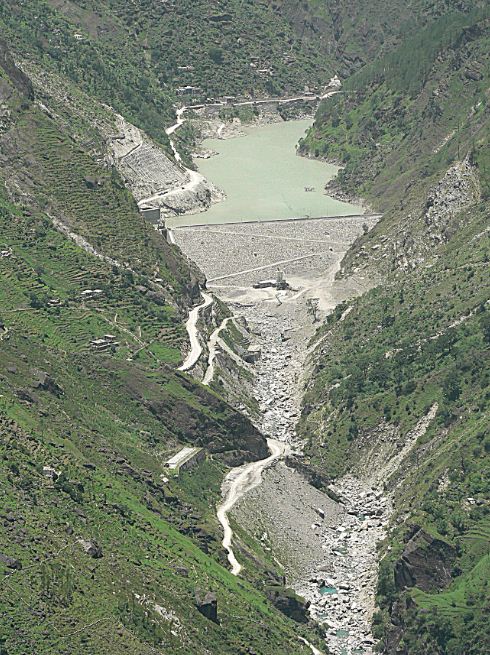
Dhauliganga before the disaster, with zero water flow downstream from the dam, killing a perennial river. Source: Author
Dhauliganga before the June 2013 disaster, with zero water flow downstream from the dam, killing a perennial river. Source: Emmanuel Theophilus

The presentations made by NIH Roorkee, CIFRI (Central Inland Fisheries Research Institute), GBPIHED (GP Pant Institute of Himalayan Environment and Development) and AHEC for proposed hydro power projects in the Himalayas and the North East India revealed that none of the studies had carried out consultations with river dependent communities and did not follow the BBM principles either.

CIFRI-NIH’s flawed assessment of Teesta IV HEP e-flows Teesta IV HEP proposed in Sikkim is presently under the scanner since many groups have raised the genuine concern with the MoEF (Ministry of Environment and Forests), EAC (Expert Appraisal Committee), FAC (Forest Advisory Committee) and the NBWL (National Board of Wild Life) that if implemented it would mean the death of the last free flowing stretch of the main Teesta river. The ToR (Terms of Reference) of the study commissioned by MoEF says, “An estimation to be made for environmental flows downstream for sustenance of aquatic environment and for downstream uses, considering details of streams joining the river below the proposed dam site with their approximate distance from the dam site, their nature (whether perennial or seasonal) etc. A detailed environmental flows study shall be carried out through the premier institutions such as Central Inland Fisheries Research Institute (CIFRI), Barrackpore and National Institute of Hydrology (NIH), Roorkee for biological and hydrological components”.


The consultants took just 7.5 km length of the river from dam axis to the existing downstream project Teesta V which is immediately downstream. The study carried out in 2009- 2010 period has prescribed a minimum discharge of 10 cumecs (Cubic Meters per second) from the dam during the lean period and 40 cumecs for wet season for aquatic life is also prescribed. The ToR has two objectives namely e flows for the sustenance of aquatic environment and for downstream uses, but the sampling parameters in the presentation does not reflect the fulfillment of these objectives.
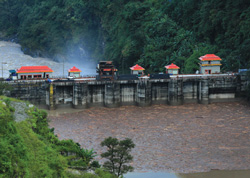
Teesta V HEP Photo: Tehelka

Since the Teesta V is already commissioned, the impact below the dammed and flow regulated stretch of Teesta V on the aquatic environment and downstream uses would have given useful comparisons. The study seems to have ignored the e flows for downstream uses of communities even in the 7.5 km stretch. The study though claimed to have used the BBM methodology, it is doubtful if all the relevant building blocks have been considered. The study carried out in 2009-10 does not seem to be uploaded in public domain to date.

E-flows for all projects do not make sense? Most shockingly, the chief consultant for the Ganga River Basin Management Plan now being formulated by a consortium of IITs (Indian Institutes of Technology) Dr Vinod Tare was of the opinion that all projects to release e flows does not make sense. He said it is important to seek balance and generate power as well. Now this is problematic. Let us face it that in Indian conditions we are working on e-flows under data and information deficient conditions. We are still far away from understanding a river system in its complexity along with its basin characters, eco- hydrological interactions and land use changes.

Lack of Eco-hydrological understanding Even NIH engineers and other experts agreed during discussions that we lack reliable hydrological data and have absolutely very little ecological data base on our rivers to arrive at proper recommendations for e-flows. MoEF and NGRBA (National Ganga River Basin Authority) has meanwhile accepted BBM methodology (as in the NGRBA Report; Code – 022_GBP_IIT_EFL_SOA_01_Ver 1_Dec 2011) as the most robust assessment approach to e-flows and they also say it needs to be worked upon.

The report says, ‘The BBM methodology is found to be robust with high confidence level. However, specific flow recommendations are difficult to justify at this stage, and will have to be worked out afresh. The major uncertainties centered on the hydrological and hydraulic models due to lack of availability of reliable data’. In BBM all blocks are equally important as they interact with each other. Against such a scenario, Dr Tare needs to think twice before making such statements! They can be used by dam developers to lobby for reduced or even no flows.

What about e-flows from existing dams? Another missing element from e-flows at the NIH workshop that is bothersome was the lack of interest by the experts and the various authorized institutions in allocating e flows below already dammed rivers. They say it will be a tough job and would not be possible politically. However, ultimately e-flows is a social and political choice with trade offs and negotiations inbuilt into it. Does that imply that we can leave heavily dam ravaged rivers like the Mahanadi, Krishna, Cauvery, Narmada, Tapi, Sabarmati, Godavari, Teesta, Sutlej, Ravi, Beas, Chenab, Periyar and the like to die without allowing them at least their long overdue minimum flows leave alone e flows ? It is high time the Government took interest and started engagement and studies in arriving at and allocating e flows below dammed rivers.

The same Baspa, bone dry, about 5 kms downstream Baspa Dam. Photo: SANDRP Partners

Future challenges After two days of debate and disagreements, I came out of the workshop with the following thoughts at the top of my mind.

Several institutions in this country with expertise in ecology and hydrology and with necessary infrastructure who could have made efforts to put in place comprehensive e-flows assessment process are working for dam developers and serving as experts in EIA studies giving green signals to ill conceived hydro electric projects and dams based on inadequate e-flows recommendations. The level of dilution of science and ethics this can lead to is mind-boggling and with disastrous consequences for our rivers. For example e-flows and minimum environmental flows are being used as synonyms by many institutions including CWC. An interesting and dangerous recommendation from CWC at the workshop is; ‘If feasible, a separate storage of water in the upper reaches of a river basin maybe created for environmental needs which will help in augmenting flows during lean season and satisfy the e-flows demands particularly for Himalayan rivers’. So in future all river basins with dam cascades could be recommended with e-flows reservoirs!

What about compliance, MoEF? While e-flows have become mandatory for hydro power projects in this country, it is surprising and shocking that MoEF is yet to ensure compliance and to take up comprehensive and fundamental assessment of e-flows in sample river basins on its own which is its primary mandate. It is high time MoEF develops a ToR for e-flows from its conception to implementation to monitoring. E-flows assessment presently being carried out lacks proper objectives and mostly excludes communities from its purview or assessment. There is vagueness about what constitutes downstream in e-flows assessment. Even for the e flows assessment carried out in River Ganga for the NGRBA has there been any effort to implement the same? Has the MoEF ever tried to seek inputs on e flows from outside the government organisations or from the several groups working tirelessly for conservation of rivers?

Will NIH exercise have credibility? NIH in collaboration with many institutions proposes to take up sample river basins in India and put in place eco hydrological models for e flows. The absence of MoEF and members of the Expert Appraisal Committee on River Valley Projects at this workshop organized by a MoWR institution speaks for itself how e-flows will be realized if the mandatory ministry does not take a pro active role.

Some of the gaps and challenges in e flows assessment in Indian context include: lack of reliable data, lack of understanding of eco- hydrological linkages, river aquifer interactions, pollution related aspects (how to quantify and relate to flow releases), e-flow releases for flood plains, lack of resource allocation, lack of valuation of ecosystem services and societal – cultural value of rivers, multiple institutions working against each other’s interests (MoWR vs MoEF), Peaking induced flashiness, scientific and acceptable ways to compute e-flows and lastly but most importantly, effective implementation and monitoring.

Experts from other countries pointed out that rather than numbers it is better to have distribution ranges for e flows under Indian conditions with complex dependencies. They also made an important comment that uncertainty and risk factors never get integrated into our e-flows estimations. In India land use changes are also not accounted in e flows calculations.

We have a very long way to go.

Dr. Latha Anantha (latha.anantha9@gmail.com)

SANDRPs post on NIH Eflows workshop:

 https://sandrp.wordpress.com/2013/09/30/nih-roorkees-workshop-on-eflows-where-is-the-credibility/
Dams

NIH Roorkee’s Workshop on Eflows: Where is the credibility?

National Institute of Hydrology (NIH), Roorkee, an organisation under Union Ministry of Water Resources (MoWR) is organising a workshop on Assessment of Environmental flows (E-flows) in Rivers in Roorkee on the 2-3 October 2013.

Any serious engagement with e-flows, from any quarter is a welcome sign. However, NIH’s engagement with eflows is a bit ironic, looking at its past work and support for hydroelectric and large infrastructure projects, without any consideration for environmental flows.

Not surprisingly, NIH has refrained from inviting almost any voices that have been critical about MoWR’s Large Dam agenda. On the other hand, main ‘stakeholders’ invited are representatives from Hydroelectric dam projects! Expectedly, the workshop is looking at environmental flows in a role adversarial to “development”, without understanding the role the rivers play in a society. In fact there is no session on value of rivers, which forms the basis of the concept like eflows.

Let us have a quick look at NIH’s track record and its response to the concept of eflows so far.

Following the Uttarakhand Disaster, Supreme Court on the 13th of August, 2013 said in no uncertain terms that the Cumulative Impact Assessment Study done by AHEC, Roorkee on Upper Ganga Projects “has not made any in-depth study on the cumulative impact of all project components”, practically rejecting AHEC Study. Even the members of the MoEF’s (Ministry of Environment and Forests) EAC (Expert Appraisal Committee) on River Valley Projects have said that e-flows estimated in the AHEC report are unclear. Inter-ministerial Group Report (The BK Chaturvedi Committee) on Upper Ganga Projects has rejected most of the AHEC recommendations for eflows.

National Institute of Hydrology, Roorkee (NIH Roorkee) was a part of the study team of the AHEC Report on Upper Ganga[I] and hence, what this SC order and other agencies have said about AHEC report applies to NIH too.

NIH is supposed to be India’s premier institute on hydrology, but a closer look at the research and projects its done so far makes it clear that NIH is a also an integral part of the lobby that pushes large dams as the only solution to all of India’s water-related problems. The lobby includes the Ministry of Water Resources and the Central Water Commission. These organisations form an integral part of NIH’s organisational structure. Chairman of the governing body of NIH[II] is Secretary, MoWR. Its members include MoWR Joint Secretary and planning commission members. Its Standing Committee is comprised exclusively of MoWR representatives.

NIH introduces Environmental Hydrology as its area of specialisation. One of its tasks is[III] “Estimation of surplus and deficit water availability considering water demand and available water supply”. This concept of surplus and deficit has been used to support Interlinking of Rivers, which is ecologically one of the most destructive water projects in India. This too is explicitly supported by NIH. Note that while doing the studies related to ILR, NIH has assumed NO water for the environment!

It has estimated[IV], “In India, the estimates put a requirement of 10 BCM (billion cubic meters) for the year 2025 and 20 BCM for the year 2050 for EFR purpose.” This estimate, coming from an institute which is supposedly India’s Premier institute on hydrology lacks any ecological, social and scientific justification.

NIH’s thrust on ‘Water Resource Projects’ is so strong that its ‘water resources section’[V] pushes projects like the 2000 MW Lower Subansiri HEP, in Brahmaputra basin, without even mentioning that work on the project has stalled since Dec 2011 and  it is facing the biggest anti dam protest in India, mainly due to downstream impacts and non-transparent decision making processes.

As hydropower projects are being built in cascades in vulnerable regions, NIH has been conspicuously absent from the discourse. It has not taken a stand about e-flows, distance of free flowing rivers between projects and other environmental measures when hydropower projects are being built from Kashmir to Arunachal Pradesh with high disaster potential. On the other hand, through its studies like GLOF Analysis for Jelam Tamak Hydropower project [2] in Alaknanda basin in Uttarakhand, NIH has been largely supporting these projects, underplaying their impacts.

In fact, NIH did a eflows study for Loharinagpala HEP in Bhagirathi, where it assumed that Bhagirathi is a highly degraded river and recommended that 10% MAR will suffice as e-flows[VI], using the Tennant Method. Bhagirathi, which is hailed as the original stream of Ganga is not a ‘highly degraded’ river by stretch of imagination upstream of Maneri Bhali projects, but it will be ‘highly degraded’ if projects pushed by institutes like NIH are implemented. Significantly, Loharinagpala HEP was scrapped because of issues related to e-flows and aviral dhara of Ganga.

Strangely, NIH workshop on Assessing E-flows program starts not by addressing the importance of e-flows, but by stressing the importance of dams! The first session will be on Water Resources Development in India – need for power, irrigation, water supply and dams, to be conducted by NIH itself. It seems that this workshop is an attempt to get more eflows consultancies from private and government hydel projects.

Groups like WAPCOS (also a MoWR institute) and CIFRI have been churning out studies after studies with shoddy analysis and wrong biodiversity assessments, helping the project proponents and destroying the river further. However, communities, groups, and even judiciary are now putting its foot down about these shoddy studies.

NIH should realise that eflows are not one more of their studies which can be carried out excluding wide range of stakeholders: from communities to ecosystems. NIH has poor track record on eflows and it will have to do much more than organising workshops on eflows, if it is looking to establish its credibility on the issue.  

END NOTES:


[1] Environmental flows or E-Flows are defined as: ‘Environmental Flows describe the quantity, quality and timing of water flows required to sustain freshwater and estuarine ecosystems and the human livelihoods and well-being that depend on these ecosystems.” (Brisbane Declaration 2007)

[2] which has been rejected by Wildlife Institute of India and even BK Chaturvedi committee has suggested that the project should be taken up only after Ganga Basin Management Plan from IIT Consortium


[VI] “The E-Flow value computed by the Tenants method, considering it as 10% of the MAR, is 3848 Cumec Days for a calendar year” (NIH: Concluding Remarks No 10): Source: Dr. Bharat Jhunjhunwala’s Letter to IITR xa.yimg.com/kq/groups/8723444/2093659328/name/iitr

Expert Appraisal Committee · Hydropower · Ministry of Environment and Forests

EAC’s norms for Eflows need to Change: Submission from civil society

The following submission has been sent to the Expert Appraisal Committee, River Valley and Hydro Power Projects, Ministry of Environment and Forests, India. The current norms recommended by EAC while clearing hydropower and irrigation projects are hardly leaving any water for the rivers (eflows), thereby destroying rivers as well as livelihoods.

  Norms on e-flows followed by EAC need to change

 Respected Chairperson and members,

As you know, the Inter ministerial Group on Ganga Basin was constituted by the Union Ministry of Environment and Forests through an order issued on June 15, 2012. It has subsequently submitted its report to the MoEF in April 2013.

While there are several issues about IMG’s report and recommendations, some of the recommendations are the minimum, urgent stop gap measures that need to be implemented by the EAC. IMG’s recommendations are relevant for nearly all rivers across the country. All of the rivers have rich social and religious values and a large proportion of population depends on them for livelihood. Hence, the recommendations of IMG logically apply to all the rivers. In line with the IMG Report recommendations, we urge the EAC to modify its recommendations about eflows and environmental impacts as suggested below:

1.           Eflows

a.           Eflows to be based on daily uninterrupted flows, not seasonal flows

The IMG report states that: “An important component of the e-flows regime has to be mimicking of the river flows so as to keep it very close to the natural flows. Cumulative norms even on seasonal basis do not meet this objective. Daily inflow norms may, however, enable a sustained river flow as well as have large flows in the high season and hence are more suitable.” (emphasis added)

IMG has thus recommended that all dams and hydro projects should release water based on daily inflows, following the % releases recommended in each season, but the releases must change as per daily inflows.

 b.           Eflows as 30-50% of daily lean season flows

The IMG report recommends that releases should be 50% of lean season flows where average lean season flow is less than 10% of the average high season flow. Where average lean season flow is 10-15% of the average high season flows, the releases should be 40% of inflows and where 30% for the rest of the rivers.

In keeping with IMG recommendations, we urge that the EAC should be recommending 50% average daily flows in lean season as eflows.

c.           Independent, community-based monitoring of Eflows releases

Monitoring of eflows releases from operating projects is crucial, given the fact that it is currently entirely in the hands of the proponent without any monitoring of compliance by the MoEF. In such a situation, proponents are not releasing any eflows as pointed out by the one person Avay Shukla Committee Report, recent CAG report of Himachal Pradesh.

IMG recommends: The IMG has considered the need for an effective implementation of the e-flows as cardinal to its recommendations. It is recommended that the power developer must be responsible for developing a monitoring system which is IT-based and gives on a real time basis the flow of water in the river, both at the inflow and in the outflow after the river gates in the river stream. This should be

(a) monitored by an independent group

(b) reviewed yearly by the Ministry of Environment and Forests in the first five years and

(c) put in public domain the e-flows. This real time public monitoring of e-flows will be the key.

We urge that that EAC recommends similar monitoring norms for all projects. Effective monitoring cannot be done if local affected population is not a part of this process, hence, in addition to above points, EAC should recommend that eflows should be monitored by an independent group which has at least 50% participation of downstream communities facing the impacts of these projects.

d.           Assessing eflows only through participatory and true Building block Methodology (BBM)

The IMG states: “Considering environment, societal,  religious needs of the community and also taking  into taken in to account the status of river Ganga as national river, the IMG recommends adoption of Building Block Methodology (BBM) for assessing the e-flow requirements on a long-term basis. This recognizes the fact that the riverine species are reliant on basic elements (Building Block) of the flow regime, including low flows, and floods that maintain the sediment dynamics and geo-morphological structure. It also includes an understanding of the functional links between hydrology and ecology of the river systems.”

However, the EAC is accepting any eflows assessment as BBM, simply looking at the label provided by EIA consultants, without applying its mind. We have pointed out that BBM purportedly used by consultants like WAPCOS in Lohit Basin Study is not BBM in any sense.

We urge the EAC to:

·                     Recommend methodology of BBM assessment clearly at the time of granting TORs (This is available from WWF or here: King, J.M., Tharme, R.E., and de Villers, MS. (eds.) (2000). Environmental flow assessments for rivers: manual for the Building Block Methodology. Water Resources Commission Report TT 131/100, Pretoria, South Africa. ),

·                     Recommend sectors which should be included in BBM study of a specific river (downstream users, fishermen, geomorphology experts, ecologists, etc.) clearly at the time of granting TOR. Downstream users should form a part of the BBM Group in all circumstances.

·                     Check whether these sectors are duly represented in flows studies

And only then accept the study as being based on BBM methodology. The current practice of EAC of accepting any shoddy assessment as BBM is serving neither the rivers, nor the communities, nor is it expanding India’s experience with BBM.

e. Release of Eflows

It is not just how much the releases are, but how the releases are made that decides if the releases are useful for the rivers, biodiveristy and the society. Unfortunately, EAC has given no attention to this issue.

In this context, one of the guideline of the IMG says, “Fish passes may be made an integral part of hydropower projects. Regular monitoring for their effectiveness be done by project developers.”

EAC should follow this and make well designed eflow release mechanism mandatory part of the EIA study and post-construction monitoring.

2. Free flowing river stretch between projects

Currently, the EAC has a very lax norm of recommending 1 km distance of the river between two projects. In many cases, the EAC is not following even this minimalist distance criterion. Nor is it following recommendations of civil society, or expert committees of having minimum 5 kms of free flowing river before it meets the downstream project/submergence.

In this regard, the IMG notes “There is a clear need to ensure that adequate river length is available to meet the societal needs and River gets adequate time during its flow to regenerate itself.” 

The EAC should include, as part of EIA and TOR a detailed study of:

·                     “Time” required by the river between two projects to rejuvenate itself and how much distance the river need to have such time to rejuvenate itself.

·                     Ecology (including livelihood fisheries) downstream of a project and how it will be affected by modified flows while granting TORs to hydro projects.

·                     Social and cultural use of the river downstream the project: presence of religious sites, river sanctuaries, etc. while granting TORs to hydro projects.

Based on this, the EAC should recommend distance of free flowing river that needs to be maintained downstream a specific project. This should be applicable even if this was not stated at the time of deciding TOR.

3.           Recommend Free flowing and Pristine rivers in all basins

World over, there exist norms and laws to protect free flowing rivers as “Pristine, Wild or Heritage Rivers”. EAC has been recommending damming most of the rivers in the country in the recent years. The EAC should recommend that some rivers should be maintained in their pristine, undammed (or with the current stage of development, no further) condition.

In fact, the IMG has specifically recommended: “ The River Ganga has over a period of years suffered environmental degradation due to various factors. It will be important to maintain pristine river in some river segments of Alaknanda and Bhagirathi. It accordingly recommends that six rivers, including Nayar, Bal Ganga, Rishi Ganga, AssiGanga, Dhauli Ganga (upper reaches), Birahi Ganga and Bhyunder Ganga, should be kept in pristine form and developments along with measures for environment up gradation should be taken up.”

Unfortunately, currently the EAC is actually clearing projects when Cumulative Impact Studies or Basin Studies on such rivers are not completed or are on-going (Example: Chenab Basin Projects, Satluj Basin Projects, Lohit Basin Projects). We have pointed this out to the EAC on number of occasions, without any response.

We urge the EAC to recommend a few ecologically and socially important rivers in each basin as pristine rivers, to be protected from any projects at the time of clearing basin studies or cumulative impact assessment studies. At the same time, the EAC should analyse the present development stage of a basin while clearing specific projects and should recommend some rivers in pristine state. In places like North East India and western Ghats, certain river basins may need to be left in pristine state.

 4.           Recommendations to the MoEF about eflows from existing projects

The IMG has made a clear recommendation in this regard: “The suggested e-flows should be applicable to the existing power projects in operation in these States.” IMG has given maximum of three years for the projects to achieve e-flows.

We urge the EAC to make a recommendation to the MoEF to look at existing projects and recommend eflows norms on the same lines as those for new projects in time bound manner.

As the World Environment Day is drawing close, we are sure that the EAC will look at its role of protecting the Riverine environment and communities and will take proactive steps in this regard.

Looking forward to your point-wise response to the issues raised above.

Thanking you,

Yours Sincerely,


Himanshu Thakkar and Parineeta Dandekar, 

South Asia Network on Dams, Rivers and People (ht.sandrp@gmail.comparineeta.dandekar@gmail.com)

Samir Mehta, 

International Rivers (samir@internationalrivers.org)

Dr. Latha Anantha, 

River Research Centre, Kerala (rrckerala@gmail.com)