Maharashtra

Lawlessness in Maharashtra’s Water Sector

Above: Increasing height of a dam which holds no water Photo: Parineeta Dandekar

Guest post by Pradeep Purandare, pradeeppurandare@gmail.com

Irrigation Laws in Maharashtra: Politics of Non-Implementation

Laws are generally enacted to implement the policy by the ruling class & its government to promote & safeguard its own class & caste interests. However, while drafting the policy & laws, politically correct concepts & terminology in fashion is used for public consumption. New things are accepted because those come as conditions for getting the loan from donor agencies. Creating a desirable image or impression at national / international level can also be the motivation. Adopting a new policy or enacting a new law does not necessarily mean that the establishment of the day sincerely believes in that policy & law. Once the purpose of getting the loan and or creating an impression is served, government conveniently forgets implementing the policy & the law. Or, implementation is done in selective & superficial manner. Clauses / sections which were included for public consumption & which can really make the difference, if implemented in letter & spirit, are generally either put in cold storage or subsequently amended to make them more “practical & workable”. This does not happen as a result of inefficiency, callousness or indifference. This happens with purpose & by well defined strategy. This is politics of non-implementation! It is done to implement the hidden agenda. Of course, it’s not something new. It has been happening since long & in most of the walks of life. This paper makes an attempt to simply describe how politics of non-implementation is being done in water sector in general & in the field of irrigation in particular in Maharashtra – a supposedly progressive, highly industrialized & a modern State of India.

Enacting a law is not sufficient. The operative part which includes rules, notifications, agreements, government resolutions, orders & circulars as per the new Act is also equally important. If operative part is not in place, then the Act remains on paper for all practical purposes.

PLEASE SEE ANNEXURE 1 for Detailed table.

Gist of missing operative parts & its implications are given below:

In absence of rules (yes, MIA 76 does not have rules for last 37 years!) & non-issuance of basic notifications (rivers, command areas & appointment of Canal Officers), MIA 76 which is supposed to be the parent Act has remained mostly on paper. Locus standi of implementing authority i.e. Water Resources Department (WRD), therefore, can itself be questioned. The obvious result is there is no water governance. Free for all situation exists. Water theft, vandalism & tampering with canal system are rampant. Offences go un-punished. Irrigators, particularly the tail enders neither get water nor compensation. Politically influential irrigators grab all the benefits. Diversion of water from irrigation to non-irrigation, flow irrigation to lift irrigation & food crops to cash crops becomes easy. Since nothing is legally committed, nothing can legally be challenged. The overall situation is best suited for privatization. An un-notified river or command area, relatively speaking, can easily be handed over to private company. That’s seems to be the ulterior motive of missing operative part!

MMISF Act was brought in to legally provide for Participatory Irrigation Management (PIM). World Bank insisted for the enactment & made it a compulsory condition for getting the loan under Maharashtra Water Sector Improvement Program (MWSIP). WRD, therefore, had to succumb. It however did not comply in letter & spirit. Ambiguity in rules for WUAs at higher level, non formation of sub committees, delayed or non execution of agreements with WUAs, insincerity in the processes such as “joint inspection” to “handing over”, not providing measuring devices, confusion over powers of WUAs, keeping lift irrigation out of purview of the Act, inordinate delays in returning part of tariff to WUAs for carrying out maintenance & repairs and last but not the least, non involvement of WUAs either in water budgeting or in conflict resolution speak volumes about the actual implementation of MMSIF Act. Intentions of WRD are clear & obvious. It considers WUAs as just a stop gap arrangement before going for corporatization & contract farming. One can imagine WRD’s line of argument in near future. It could be as follows “We tried our level best but WUAs could not succeed. Government cannot now take the responsibility of water management. Privatization appears to be the only way out”. Incomplete legal processes thus help establishment & make tail enders vulnerable.

Maharashtra established an Independent Regulatory Authority (IRA) in water sector by enacting MWRRA Act. It’s no doubt a pioneering effort. But the actual implementation of this Act is frustrating. There was reluctance to prepare the rules. Rules were prepared after 7 years from the enactment of the Act & that too only after an order to that effect by the High Court. Prepared rules, it is alleged, are contradictory to the provisions of the Act. They have been challenged & the matter is sub-judice.[yesterday Maharashtra’s legislative council had to discuss the issue in the house & Minister for WRD had to stay the implementation of rules] State Water Board & State Water Council has been legally constituted way back in 2005 to respectively prepare & approve the Integrated State Water Plan (ISWP). Both the board & council have not yet started their functioning. Obviously ISWP which was to be prepared within one year from the enactment of the Act is still not in place even after 8 years. MWRRA as per its own Act is supposed to take decisions with reference to ISWP. But it is going ahead even without ISWP. Similarly, River Basin Agencies (RBA) have not been operationalized & issuing water entitlements by RBAs has not so far materialized. MWRRA Act has been amended in 2011 to retrospectively protect non transparent decisions of High Power Committee regarding transfer of water from irrigation to non-irrigation. Powers of MWRRA in respect of sectoral water allocation have already been withdrawn by the said amendment. Effective area under water entitlement thus has been drastically reduced. MWRRA recently decided the criteria for water tariff. But it opted for the safest path. It reduced the water tariff to avoid criticism. But in the process whether it could follow the mandate given by the Act is a moot point. Act says that water tariff should fully recover the O & M Cost & canal system should be properly maintained. Ever deteriorating condition of canals in Maharashtra, however, tell a different story. Regulation of all types of water (surface & ground water) & its uses for different purposes (drinking, domestic, industrial & irrigation) is supposed to be done by MWRRA. Nothing significant has been done so far. In fact, in case of dispute over sharing Godawari Waters between upper & lower Godawari basins, MWRRA has been a silent spectator. As a quasi- judicial IRA it could have done many things. But it preferred playing politics of non-implementation..

Very structure & framework of water governance are thus missing in Maharashtra & hence, there is no Rule of Law. Water conflicts of all types are on increase at all possible levels. Misappropriation & mismanagement is the end result.

It is necessary to develop pro-people intervention strategies & peoples participation in water sector. Implementation of existing water laws could be a necessary (but of course not sufficient) beginning. There are many provisions in the existing water laws that could help initiate pro people intervention.

Politics of ‘non-implementation by ruling class’ needs to be effectively & immediately challenged by `politics of implementation by pro people forces’. That would help promote people-centered interventions which are so urgently required to fight diversion of water from irrigation to non-irrigation & privatization of water.

Annexure 1:

Implementation of Water Laws in Maharashtra: A Critical Review

                Sections Present status Impact

MIA,76

Sec 114: Rules Rules not prepared in 37 years Act remains on paper
Sec11: River  notification Incomplete in many projects People not informed/ opportunity of being heard denied. Locus standi of WRD doubtful
Sec 3: Command  notification Incomplete in many projects —- do ——–
Sec 8: Appointment of Canal Officers Done but not operative No one takes initiative. Nobody is held responsible. Free for all situation. Water theft, vandalism & tampering with canal system are rampant. Offences go un punished. No FIR. No action.
Sec 75 to 87: Award of

Compensation

Not used at all. Irrigators don’t get compensation even if the agreed volume of water is not delivered at right time & place. No accountability for the Canal Officers.

MMISF Act, 2005

Sec 76: Rules Prepared. Excessive use of “mutatis mutandis

Ambiguity in rules for WUAs at higher level

Sec 20: Sub committees

Not formed in last 8 years Purpose of participation with decentralization & expanding the circle of knowledge & skill defeated.
Sec 21,29: Agreement Not executed in time & at all levels of WUAs

Serious complaints about not having  joint inspection in true sense, non- completion of agreed repairs & rehabilitation & reluctance by officers  to hand over the system

Purpose of delegation of powers & imbibing sense of responsibility defeated. Encroachment on powers of WUAs

Nexus between local Politicians & officers continues unabated. WRD loses its credibility. Poor quality of repairs & rehabilitation. In absence of real handing over of management to WUAs, power of water distribution remains with WRD officials. Only lip service to participation.

Sec 22: Joint inspection,

…..handing over … and

Sec 23: Measuring devices

(MD)

Not executed in time & at all levels of WUAs

Serious complaints about not having  joint inspection in true sense, non- completion of agreed repairs & rehabilitation & reluctance by officers  to hand over the system

Providing MD is not yet complete. Credibility of  measurement records is doubtful

Volumetric supply of water to WUAs mostly remains on paper.
Sec 28: Supply of water as per entitlement In absence of proper water budgeting at project level, irrigation scheduling of main system & MD, supply of water as per entitlement is an exception rather than a rule. Bulk supply of water based on entitlement given volumetrically is still a distant dream. WRD is not yet fully equipped for the purpose with compatible physical system.

Sec 30: Powers to WUAs

Not spelt out WRD officials wield the real power.
Sec 38: Competent Authority Not operative WUAs don’t get any technical advise

Sec 39 to 51: Lift Irrigation WUAs

Provisions not brought in force No control over – & regulation of – lift irrigation. Act simply not made applicable to lift irrigation..

Sec 52: Powers & functions of WUAs

Only responsibilities(& not powers) have been spelt out WUAs remain ineffective.
Sec 53: Powers & functions of Canal Officer Emphasis on powers & not on responsibilities In absence of accountability of any kind, WRD officials remain indifferent & callous
Sec 54: Sources of Funds of WUAs Water tariff collected from the members of WUA is the only source of income. WRD has promised to return substantial part of tariff to WUA. However, the promise is not being kept. Most of the WUAs are not economically self reliant. They face problems in routine maintenance & repairs of the canal system and can’t afford to maintain office & staff.

Sec 60 to 62: Offences & penalties

Not operative.

No water governance worth the name.

Sec 63 & 64: Conflict Resolutions Not operative. MWRRA indirectly attempts to bypass the powers of upper level WUAs through regulators WUAs not involved in conflict resolution. Purpose defeated.

Sec 68: Water budgeting at Project Level

Not operative. WUAs not involved in water budgeting. Purpose defeated.
Sec 70:  Water supply for  non-irrigation purposes Water entitlement issued only to select WUAs in selected projects. Unit for issuing entitlement is not project as a whole. Therefore, ineffective provision. Water supply to non-irrigation gets priority even during periods of shortage of water. Second priority given to irrigation by amending State Water Policy is not being honoured.

Sec 71: Recovery of water charges

Coercive measures not operative. Recovery of water tariff is very poor.
Sec 72: Act to apply to

Existing WUAs

Difference of opinion between WRD & Cooperative Department regarding how to operationalize the provision

Act not being applied to existing WUAs

MWRRA Act, 2005

Act amended in 2011 to retrospectively protect non transparent decisions of High Power Committee regarding transfer of water from irrigation to non-irrigation

Sec 3: Establishment of Authority

Retired bureaucrats are in control.

Powers of MWRRA regarding sectoral allocation withdrawn.

Effective area under water entitlement drastically reduced. There is hardly any regulation as per the Act. Issue of releasing water to Jayakwadi project from up – stream projects is the glaring example.

Sec 5: Selection Committee Serving bureaucrats are in control. Members of selection committee select themselves as Member / Secretary of MWRRA & join the authority soon after retirement from Government.
Sec11: Powers, functions duties of authority Selective & limited implementation. Sec 11 (f) not implemented. Project clearance even without Integrated State Water Plan [ISWP] Adhocism, confusion & regional imbalance in water resources development may further increase
Sec 12: General policies of Authority

Not implemented even when water users have moved the court of law. Several petitions pending in Mumbai High Court

Principles of Tail to head irrigation & equitable distribution of water at river basin level not implemented leading to political agitations & increased animosity within regions of the State.
Sec 13: Dispute Resolution Officers

Appointed. Not active.

In absence of information & awareness about provisions in the Act, water users don’t insist for suitable action. Hence, it is assumed that absence of complaint means absence of dispute itself.

Sec 14: Permission of River basin Agency

River Basin Agencies though exist as per law, they have not started functioning like RBAs

Since RBAs have not issued any water entitlement & not officially permitted any water use whatsoever, every water use since enactment of the Act could be, legally speaking, unauthorised & hence, illegal.
Sec 15: State Water Board

Legally constituted but not at all functioning.

SWB (Chairperson- Chief Secretary) is supposed to prepare ISWP.  Nothing happened in last 8 years.

Sec 16: State Water Council

Legally constituted but not at all functioning.

SWC (Chairperson- Chief Minister) is supposed to approve ISWP.  And then MWRRA should function as per ISWP. Nothing happened in last 8 years. MWRRA is taking decisions violating Sec 11 (f) of its own Act.

Sec 21: Special

Responsibility of

Authority

Not implemented Gravity & seriousness of issues regarding backlog in irrigation has not reduced. In fact, it has increased a lot.

Sec 22: Disputes & Appeals

Not in use by the water users. Lack of awareness.

Grievance redressal mechanism provided in the Act, if used, could reduce number of cases going directly to court of law.
Sec 23 : Directives of

Government

Not given so far Government could have used this route instead of amending the Act in haste & panic. It could have also given directions to MWRRA in case of Jayakwadi dispute.
Sec 26: Punishment for

non-compliance

Not used so far.

No effective governance

Sec 30: Rules

Prepared late only after High Court’s order. Rules to certain extent are contradictory to the provisions in the Act Discontent about Rules in Marathwada. Rules challenged in court of law. MLAs requested to challenge the rules in legislative assembly & council

References:

  1. Maharashtra’s State Water Policy, July 2003
  1. Maharashtra Irrigation Act, 1976 (MIA76),
  1. Maharashtra Management of Irrigation by Farmers Act, 2005 (MMISF Act)
  1. Maharashtra Water Resources Regulatory Act, 2005(MWRRA Act)
  1. Purandare Pradeep, “Wanted – Rule of Law”, http://www.downtoearth.com

***

– Pradeep Purandare

Retd. Associate Professor, Water & Land Management Institute, Aurangabad, Maharashtra

(The above piece is based on a paper presented at the  International Conference, Dec 19-21, 2013,Organized by College of Social Work, Nirmala Niketan, Mumbai, India)

pradeeppurandare@gmail.comhttp://jaagalyaa-thewhistleblower.blogspot.in/,  http://www.irrigationmainsystem.com

Maharashtra

Thirsty sugarcane in dry Marathwada means a loss of 2 million farmer livelihoods

Above: Gangakhed sugar factory from Parbhani Marathwada which has crushed 7 Lakh Tonnes of cane till 21 Feb 2015. Parbhani has received a mere 346 mm rainfall this year, nearly equal to what it received during epic drought of 1972

~~~

Although Marathwada region in Maharashtra is no stranger to droughts, it’s facing a singularly acute crisis this year. Kharif crops had failed in all of the 8139 Kharif villages in the region with yields less than 50% of government standards (paisewari). Rabi is under cloud too with all 396 villages assessed for production showing less than 50% yield. And yet, area under and production of water guzzler crop like Sugarcane is going up. In 2013-14, Marathwada grew over 2 lakh hectares of sugarcane and is now crushing the cane in its 61 sugar factories using thousands of lakhs of litres water every day.

Does this make any social, economic or environmental sense? No

But do we have options? It seems so. Let us see how.  Continue reading “Thirsty sugarcane in dry Marathwada means a loss of 2 million farmer livelihoods”

Maharashtra · Marathwada

Can Marathwada afford to undertake Sugarcane Crushing in this terrible drought?

Since 2012, farmers in Maharashtra, especially in Marathwada and Vidarbha region of central and eastern Maharashtra are faced with unending mountains of crisis. What started as drought of 2012 went on in form of violent rains at places in 2013, hailstorms of February-March 2014, scanty monsoon in 2014 and unseasonal rains at places in November 2014, affecting lakhs of farmers. Agricultural production has suffered losses as impact of scanty rainfall has been compounded by absence of rains in critical time windows when soybean was filling and cotton bolls were forming. More than 8000 villages in Marathwada region which comprises of Aurangabad, Nanded, Parbhani, Latur, Beed, Hingoli, Jalna and Osmanabad have recorded crop losses of more than 50%.

Marathwada region in Maharashtra Map from: Marathi Wikipedia

The entire Winter Assembly of the newly formed Government seems to be clouded by discussions of drought package and increasing farmer suicides in Marathwada and Vidarbha. Since January 2014, more than 400 farmers have committed suicide in Marathwada region, and the pace is picking up worryingly since the past month. Hydrological, meteorological and agricultural droughts are becoming more pronounced in Marathwada.

But can this be attributed to vagaries of nature alone?

A brief analysis of the underlying reasons for the crisis in Marathwada and its future implications:

Truant Monsoon of 2014

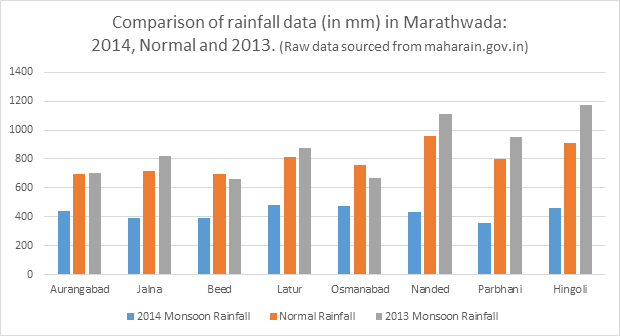
As per SANDRP’s analysis of district-wise rainfall figures of Marathwada in monsoon 2014, the picture which arises is dismal:

GRaph

For 2014, departure from normal rainfall for 6 out of 8 districts in Marathwada was more than 40% and rest two districts it was more than 50%, indicating a huge reduction in rainfall. However, contrary to what is being stated in the media, the region received satisfactory rainfall in 2013 monsoon. In fact, 6 districts of the 8 received more than 100% of normal rains and remaining two districts received 88% and 95% of normal rains last year. This is one of the reasons that the reservoir storage in 2014 did not fall as sharply as they did in 2012-13 drought. On 15th October 2014, Jayakwadi dam in Aurangabad had 42% Live storage, which was more than October 2013 storage of 33% and 2012, when it had reached dead storage already (http://www.mahawrd.org/). The entire Marathwada region too showed large reservoir storage of 47%, which is not extremely alarming.

Significantly, 2012-13 drought also unfolded in a similar manner, with highly satisfactory monsoons of 2011.

At the same time, the region is facing one of the worst droughts in recent history today.

This seemingly contradictory situation underlines a number of things, most important being: large dams do not automatically equate with water in farmers’ fields. Work on many projects (most projects in Marathwada) is incomplete ( for example: canals of projects like Lower Dudhana, Jayakwadi Phase II, etc), while contractors and politicians have made a pretty packet from the contracts, many projects are ‘evaporation machines’ than a water supply systems, without canals and distributaries or systems to govern water management. The available impounded water is a valuable political tool, and is used as such. Water allocation and management is far from being sustainable, transparent and accountable.

Projects under the jurisdiction of Godavari Marathwada Irrigation Development Corporation

According to news reports, in the past 11 months, 454 farmers only in Marathwada[1] have committed suicide due to number of reasons, most linked to crop failure and debt. Strikingly, after late November 2014, 52 farmers committed suicides mainly from Beed, Nanded and Osmanabad regions.

District Number of farmer suicides since January 2014
 1. Beed 122
 2. Nanded 104
 3. Osmanabad 54
 4. Parbhani 49
 5. Aurangabad 40
 6. Jalna 22
 7. Hingoli 29
 8. Latur 34

The issue has been raised in the Winter Assembly by the enthusiastic opposition and the CM is yet to announce a drought relief package. It is expected to be close to 8000-9000 Crores or more.

At the same time, there is a huge tussle going on between Nashik and Nagar on one hand and Marathwada on the other, for waters Godavari which originates in Western Ghats flows through Northern Maharahstra and then becomes the lifeline of Marathwada region. Nashik and Ahmednagar have constructed slew of large dams on Godavari and have always been reluctant to release water for Jayakwadi dam in Aurangabad in the downstream. We saw this episode flaring up last year and we are seeing an action replay this year as the HC has ordered immediate release of water from upstream dams for Jayakwadi. (See:http://indiatogether.org/share-environment). (Notably, this is the first time I have witnessed that the Dam Storages data of www.mahawrd.org, the official website of the Water Resources Department is not updated with weekly Dam Storage Levels. This had not happened even at the peak of 2013-12 Drought. Our queries to WRD on this front have been unanswered till date.)

WRD officials and administration have taken cautious stand and water in reservoirs is now reserved mainly for drinking water purposes, any release in downstream for irrigation is being delayed and is being made only after strong negotiations, badly hitting rabi cultivation, which is already less than last year.

Even as conflicts flare up, protests rage and assembly is disrupted, sugarcane crushing goes on unhindered in Marathwada, in whopping 61 Sugar factories!

On the unfortunate and expected lines, the government has not said a word about restricting cane crushing in Marathwada this year, which itself guzzles massive amounts of water, apart from cane cultivation. On the other hand, the party president, Amit Shah himself attended first crushing day of some factories (one of which was reportedly captured by relatives of a BJP MLA by fraud![2])

A look at sugarcane cultivation and crushing season so far in Marathwada:

(All data obtained by SANDRP from Sugar Commissionarate, Maharashtra Government, December 2014)

Area under sugarcane in Marathwada in 2013-14 and Sugar factories

District Area under sugarcane (in hectares) Number of Sugar factories
1. Aurangabad 15,373 9
2. Jalna 11,083 5
3. Beed 27,299 10
4. Parbhani 25,567 6
5. Hingoli 18,037 3
6. Nanded 28,057 9
7. Osmanbad 43,635 16
8. Latur 61,479 12
TOTAL 2,30,530 Hectares 61 Factories
TOTAL SUGARCANE CULTIVATED IN MARATHWADA FOR CRUSHING 154.28 Lakh Tonnes  

So around 61 sugar factories will crush 154.28 Lakh Tonnes Cane in a period when drought is so bad that water will not be released from reservoirs for irrigation!

In doing so, the factories will use a minimum of 1500 litres of water to crush one tonne of cane. To crush 154.28 lakh tonnes, minimum amount of water used will be: 23,142,000,000 Litres or 23.1 Million Cubic Meters. This is the lowest estimate.

This amount would be sufficient to irrigate nearly 8,000 acres of high yielding groundnut, more of Jowar or can be sufficient for drinking water needs of nearly 15 lakh 85 thousand people[3] till the onset of 2015 monsoon!

This water will be used till the end of crushing season when the drought will be extremely severe if we look at current indices.

Is there a justification of doing so? Will a 10,000 Crore drought package come close to ameliorating the impact of water loss at the peak of drought?

In addition, the pollution control mechanism of most sugar factories is pathetic. Pollution Control Board has raised this number of times. Uncontrolled water and soil pollution by sugar factories will additionally pollute groundwater and water bodies, further affecting water security of the region.

This water may be sourced from dams and groundwater. SANDRP has witnessed in 2012-13drought, sugar factories in Marathwada, mainly Osmanabad region lifted water from dams even when water levels had dipped below dead storage. What will be the impact of this siphoning on local drinking water security?

We should not forget that one of the costliest political lesson for NCP came when Ajit Pawar uttered extremely insulting remarks on dry reservoirs, mocking people’s plight. This was in context of a protest by a lone farmer from Mohol, urging water for drinking, even as sugar factories on Mohol used lakhs of litres of water when the farmer, Prabhakar Deshmukh, was fasting in Mumbai! Needless to say, the ruling party’s defeat was sealed through such acts. (More about Sugarcane in Solapur here: https://sandrp.wordpress.com/2013/04/22/why-solapur-sugarcane-and-sustainability-do-not-rhyme/)

Even in terms of groundwater, Marathwada region has literally touched rock bottom. In a report by GSDA (Groundwater Survey and Development Agency) submitted to Government of Maharashtra,[4] it has been reported that in 249 villages of Marathwada, abstraction has been 100% and there is no more water to draw. Not surprisingly, the regions suffering largest groundwater problems are surrounded by sugarcane and sugarcane factories.

In the past too, SANDRP has underlined how sugarcane in drought affected areas contributed to worsening drought of 2012-13. Then Solapur was in crisis.  This year, the district which has 28 sugar factories two years back has 34 sugar factories!

All government announcements about bringing sugarcane under drip have remained on paper and sugarcane continues to rule the drought politics of the region, regardless of the political party. In fact, the Cooperation Minister BJP Government Chadrakant Patil has announced that the only clause which has been limiting further sugar factory rush (of having a minimum aerial distance of 15-25 kms between two factories[5]),  can be diluted “ to promote healthy competition”. 200 factories are lined up for licenses with the Sugar Commissionarate!  There is no thought about the impact of this decision on water profile of Maharashtra.

This defies logic. The work of Winter Assembly was disrupted several times yesterday (10th December 2014) by aggressive opposition asking for an immediate drought package for Marathwada and Vidarbha. How can a 4,000 or 10,000 Crore Drought Package address these systemic issues? How can this package address siphoning off water from a drought hit region in peak drought? The opponents are happy discussing help to sugar factories for drought relief, not raising any points about impending impacts of crushing cane in drought.

In the long term, there is a need to reduce area under sugarcane and provide proper incentives, fair support price, forward and backward market linkages and support for initiatives like horticulture under drip (and there are several success stories from Marathwada on this), dairying, oil seed and pulses cultivation and processing, dryland farming and importantly, equitable and transparent water management involving all farmers in the region, not restricted to a few.

It is high time that long term decisions are taken in order to make Marathwada truly drought proof and free from clutches of ‘drought packages’ and opportunistic politics, year after year. A start can be made by restricting cane crushing in the region immediately.

-Parineeta Dandekar, SANDRP, parineeta.dandekar@gmail.com

End Notes:

Marathwada Farmers need Water: http://72.78.249.126/Agrowon/20141013/5520233630699177815.htm

SANDRP Analysis on water issues in Maharashtra:

Open Letter to Devendra Fadnavis: https://sandrp.wordpress.com/2014/11/14/open-letter-to-devendra-fadnavis/

Why Solapur, Sugar and Sustainability do not rhyme: https://sandrp.wordpress.com/2013/04/22/why-solapur-sugarcane-and-sustainability-do-not-rhyme

[1] http://www.esakal.com/NewsDetails.aspx?NewsId=5611377824684291267

[2] http://www.loksatta.com/mumbai-news/bjp-leaders-closed-try-to-take-over-controle-on-sugar-factory-in-paithan-1049861/

[3] @ 80 litres per capita per day

[4] http://www.loksatta.com/maharashtra-news/no-rain-in-marathwada-1047256/

[5] http://www.business-standard.com/article/economy-policy/maharashtra-likely-to-abolish-25-km-limit-between-two-sugar-units-114112300348_1.html

Further work on SANDRP on Drought, Maharashtra and Sugarcane can be found in Category: Maharashtra

Maharashtra

Local Initiatives for drought-proofing Maharashtra

Although infamous for the failure of its large dam approach and the recent dam scam, Maharashtra has also been one of the most progressive states in the country when it comes to watershed development, participatory water management and a pioneering discourse surrounding equitable sharing of available water sources. The state has had a number of remarkable stories like Ralegan Siddhi, Hiware Bazaar, Soppecom’s work on water users associations in Waghad and Palkhed, work of Paani Panchayat, Afarm, etc., in addition to a number of centrally funded and state funded watershed programs like Drought Prone Area Program (DPAP), Integrated Wasteland Development Program (IWDP), Adarsh Gaon Yojana, etc. The state has had its share of stalwarts like Late Dr. Vilasrao Salunkhe, Anna Hazare, Popatrao Pawar, Late Dr. Mukundrao Ghare, Smt. Kalpanatai Salunkhe to name just a few. They talked about not only increasing water availability, but also allocating and managing the available water resources equitably and sustainably and many other facets of participatory watershed management which were strongly rooted in equity, gender sensitivity, social realities and ecological sustainability.

Sarpanch of Hiware Bazar Popatrao Pawar Photo: Business Standard

This overall context had a role to play even as Maharashtra faced one of its worst droughts in 2012-13. The devastating drought pushed some unique watershed initiatives across the state, some of which were directly supported by the state, many without any support.

We looked at a few successful stories of increasing water availability locally, through watershed or other simple measures. The common thread running through these examples is ‘local initiative’. It was experienced again that having local communities at the driving seat, with encouraging guidance from the experts and help from government agencies can lead to positive results.

At the same time, we came across some quick-fix watershed measures which are currently supported by the government and discuss if these can replace the holistic and long-term effort of participatory watershed management and equitable water distribution. The examples below are taken from an agricultural daily “Agrowon” and they are indicative in nature[i]. We have talked with the key people behind the initiatives to understand how the work evolved.

Naigaon village in chronically drought prone Ahmednagar desilts its village tank

Naigaon is a small village of around 5000 people in Jamkhed taluka of Ahmednagar District of Maharashtra. Although Khairi Irrigation Project on Khairi River in Jamkhed is just 3 kms from the village, it does not save Naigaon from water scarcity. Since the past few years, Naigaon has been increasingly facing acute water scarcity in post-February months and its dependence on tankers has increased.

Dry landscape of Jamkhed Photo: jamkhed.wordpress.com

The village has a tank: The Naigaon Tank, constructed by the Water Resources Department after the great drought of 1972. It extends over 42 hectares of land. However due to lack of maintenance, the tank was silted and its water storage had decreased substantially.  The 2012-13 drought was the last straw for Naigaon. The tank, silted up and hardly holding any water was an eyesore for the villagers.  In the summer of 2013, more than 1500 people of Naigaon came together to desilt the Naigaon tank by hand and by machines. The collective effort resulted in removing over 3 lakh cubic meters of silt from the tank!

Being farmers, they realized the value of this silt and it was spread over more than 250 hectares of agricultural land. The Tahsildar of Jamkhed Taluk, seeing the enthusiasm and initiative of the farmers, waived royalty on the silt. But apart from this, the initiative did not take any help from the government. Why did they do that? We asked Watershed Committee Chair Suresh Ugale. “We decided to get together and do something in late 2012-early 2013. We were afraid that if government schemes like MNREGA take time in sanctioning, then we will lose the monsoon of 2013. We did not want to lose a single monsoon and did all the work entirely on voluntary basis.”

In addition to desilting, the villagers, along with agriculture department carried out watershed works in the surrounding region which included Continuous Contour Trenching, nallah bunding and gulley plugging.

The results are evident. Due to desilting of the village tank, water levels for 30 to 40 surrounding wells have increased. Farmers have been lifting water directly from the tank too. Watershed works have also resulted in increase in water levels of other wells and an increase in soil moisture. This in turn has lead to more crop diversity. In kharif of 2013, 35 ha of additional land was cultivated with multiple crops like cotton, soybean, mung, urad, sugarcane and 18 ha of land was under horticulture. The villagers proudly proclaim that the lands where silt was spread are more productive. In the words of Yogesh Shinde, “My light soil did not allow me much crop choice. But the silt from the tank allowed me to grow jowar and udid ( black gram, a lentil) and fodder crops. We’ve indeed been fortunate this year.”

At the same time, it is worrying that area under sugarcane is also increasing. When asked about this, the watershed Committee chair says, “Yes, we’ve been trying to irrigate all new sugarcane by drip. But that is difficult. The subsidies don’t reach the poorer farmers who need it the most.” But it is clear that without active efforts, more water can mean more water guzzling sugarcane in Naigaon.

No tankers for Pingori village this year

Pingori village in Purandar taluka of Pune district is surrounded by hillocks from three sides. 80% of the land is hills and only 20% is cultivable. Although Pune region has a very high density of large dams, no canal water reaches Pingori. Veer dam lies about 15 to 20 km downstream of the village and plays no role in water supply to the village.

In 2013 the village faced acute drought. People who held lands on the hilly tracts were left with no option but to sell offs their lands. In the words of Babasaheb Shinde, a veteran from the village, ““There was hardly any income source in village without water. People were migrating to cities. We had to do something.”As the situation turned alarming, some villagers came together. It was accepted by all that the key to their challenge lay in water availability.  Pingori had a village tank which was badly in need of maintenance and desilting. Despite several follow ups with Water Conservation Department, no desilting was undertaken by the department, siting non-availability of funds as the reason.

Left with no choice, the villagers of Pingori came together. Hundreds of villagers raised funds for desilting the tanks by working on NREGS schemes. Though they raised a considerably sum, it was still not sufficient for the entire desilting operation. Here, they were helped by Dagdusheth Ganapati Temple Trust.

With some help like this, Pingori undertook desilting work for nearly 45 days in summer 2013 by manual labour and machines. Villagers told SANDRP that more than 200,000 cubic meter silt was removed from the single tank and spread on agricultural fields. Desilting not only increased water holding capacity of the tank, but also its recharge. Following the monsoon of 2013, the village tank held more water and water table in the surrounding areas also increased.

Desilted "Ganesh Sagar" of Pingori village Photo:www.dagdushetganapati.oeg
Desilted “Ganesh Sagar” of Pingori village Photo:www.dagdushetganapati.org

Several years ago when Pingori tank held more water, it had fish in it and fishery was existing, if not thriving. Silt and droughts killed this initiative. But with desilting, local youth introduced over 2 lakh fish seed in the tank and even formed a Fisheries Society. In addition to desilting, the villagers have also undertaken watershed works in nearby hills, especially continuous contour trenches (CCTs) which has helped significantly in raising water table and augmenting stream flows. Cumulative gain of desilting has been increased cultivation on over 300 acres of land and also increased fodder availability.

Pingori has a remarkable lady Sarpanch Ms. Pallavi Bhosale. Ms. Bhosale tells us “I know what it is not even to have drinking water in your home. As a Sarpanch in 2012-13 I was deeply saddened as I had to call for tankers every other day. I could see women from my village walk for miles for water. So many horticultural plantations had to be hacked. It was very disturbing. The entire village stood together and hence this could happen.”

Today Pingori has not called for a single tanker as yet, although the Purandar block has received less than 25% rainfall in this monsoon till date.

How does Pingori avoid water guzzling crops, now that Pingori tank has water? “As a gramsabha we don’t allow water guzzling crops like sugarcane in Pingori. Our water is very precious and we cannot give more water to a few.”

Medsinga village in Taluka & District of Osmanabad is a village of 2700 population. Drought and water scarcity is a regular feature in Osmanadabad in Marathwada and Medsinga is no exception. As SANDRP indicated during the rought of 2012-13, water from major dams in Osmanbad-Latur regions is almost exclusively diverted to sugarcane and sugar factories, leaving smaller villages high and dry.

The village has a tank built by the villagers themselves, 25-30 years ago. Villagers decided to desilt this tank and increase its water holding capacity.

Here, they built recharge shaft inside the tank bed to increase groundwater recharge. This was a 13m x 7m x 2m pit with 2ft x 2ft pit below that followed by a bore well 70 ft deep. Twine was wound around the borewell casing pipe before inserted into the shaft. The shaft was then filled with pebbles to facilitate water percolation.

The villagers also repaired about 16 cement bunds constructed about 10 years back. These bunds were leaking as parts of cement had washed away. The expenses of about Rs 7 lakhs was covered by Holistic Watershed Development and Mahatma Phule Water Conservation Programme.

The cumulative impact of desilting, recharge and repaired bunds was increased water availability in 27 wells and 32 borewells.  There are 2 percolation tanks in the village constructed by Water Conservation Department. They have however lost their capacity due to siltation. Next phase of work plan includes desilting of these tanks.

Is increased water availability an end in itself?

The leaders in Pingori, Naigaon, Sinnar, etc., accept that watershed development is a long and complex process and not simply synonymous with increasing water availability. While it is very positive that water availability is indeed impacted by even short term measures, it seems to be essential that there is long term vision and a watershed approach behind these initiatives. In the absence of a long term vision, water guzzling crops and mismanagement of available resources can lead to a zero sum game. As reviewed by Soppecom in their review on watershed development in Maharashtra,[ii] in itself, watershed development can accentuate inequity by favoring the landed and the lower reaches as well as those who have the capacity to use pumps, siphons, etc.

Unfortunately the May 2013 Government of Maharashtra resolution of supporting nallah widening and deepening known as Shirpur Pattern and raising cement nallah bunds indiscriminately cannot really count as participatory, bottoms up process. Unscientific deepening and widening of streams is not only wasteful, but can also expose the groundwater aquifer, rather than helping recharge. It also raises additional questions of water availability in the downstream, exclusive work by mechanical equipment and not human effort that provides employment to the local needy, Shramadan, etc. While watershed development entails a ridge to valley approach where measures are taken right from the mountain top and logically culminate in the valley in form of bunds or weirs, indiscriminate erection of cement nallah bunds cannot qualify as watershed development. As Seema Kulkarni, Soppecom says, “Watershed program is a culmination of a watershed plan for a village or micro watershed. In the absence of such a plan, it is doubtful whether ad hoc measures can help”.

It is no wonder then that in the contractor-savvy Maharashtra, mega-scale projects like building thousands of cement bunds is looked at as a business venture than a critical intervention. According to reports, Government of Maharashtra through Agriculture and Water Conservation Department built over 3000 bunds spending more than 700 crores just in the last two years. As it is recently reported, many of the cement nallah bunds built hastily in 2013-14 after the Government GR are not holding water, some are built at hydrologically wrong locations, some are already damaged, some are built without sufficient desilting affecting water storage, etc.  A Government inquiry has been constituted on the same in many districts.

From the experience of recent examples like Pingori, Naigaon, Devnadi or the older successes like Ralegaon Siddhi or Hiware Bazaar, it seems that Watershed Development is so much more than erecting some structures at the right places with the help of machines. As much as a technical process, it is also a social and ecological process. And it is indeed more effective that way.

– Parineeta Dandekar, Amruta Pradhan, SANDRP

POST SCRIPT:

1. This election time (Oct 10, 2014) report highlights the success story of similar local efforts in Jalna-Aurangabad area: http://indianexpress.com/article/india/india-others/bring-water-gain-goodwill/.

2. Since the implementation of Phad irrigation, a low cost and eco-friendly system that works without electricity, agricultural production has increased improving the situation of farmers in Yavatmal. (Sept 7, 2014) http://www.indiawaterportal.org/articles/oasis-hope-land-suicides

END NOTES

[i] http://www.agrowon.com/Agrowon/index.htm

[ii] A. Samuel, K.J. Joy, Seema Kulkarni et al, Watershed Development in Maharashtra: Present Scenario and Issues for Restructuring the Programme

Irrigation

Huge Potential of System of Rice Intensification: SRI needs government attention

It is officially the monsoon season but there are no dark clouds to be seen on the horizon as yet in majority parts of the country. This year, like some previous drought years, the monsoon has disappointed and the rice crop is in jeopardy. The fields are almost dry and the provision for enough water for irrigation seems to be the only hope the farmers have. Over the past Century, water use around the world has been increasing at a rate more than twice that of population growth1. With the changing climatic conditions, water from rainfall is becoming more unreliable. It is in such a situation that the agricultural sector will have to feed more people and have very little water to spare1 as there is also pressure from increasing water demand from other sectors. In order to then get more crop with less water, our techniques of rice production must be modified. It is in this context that one can look at the System of Rice Intensification (SRI), which, experts argue and studies demonstrate, can be used to preserve this indispensable resource. Studies show that SRI uses upto 52.4% less water per ha of rice farm1.

It has been estimated that irrigated rice uses 34-43% of the world’s total irrigation water.1 Almost all the rice crop grown in India is sustained through irrigation. About 1900-5000 litres of water is used to produce 1 kg of rice2. Thus the water use is immense in rice production. SRI then, is an agro-ecological method[1] for increasing the productivity of rice by changing the way that the plants, soil and water are managed. It is a technique developed in collaboration with the farmers in Madagascar in the 1980s. The purpose of SRI was to enable farmers with limited resources to increase their production and income without relying on external sources7. Most importantly, this practice can be adjusted to suit local climatic and soil conditions. This is because it is based on adjustments in the environment and not a change in the physiological aspect of the seed that is planted. The biggest advantage of SRI is the fact that it uses less seed and less water to give an increased yield as compared to conventionally transplanted (CT) rice. SRI does not require continuous flooding of fields like conventional rice, but requires water only when the crop needs it, i.e., when the field is relatively dry and ready for the next irrigation. Though by its name, SRI only stands for rice cultivation, it is also seen to be used in other crops.

sri 1

Climate change adaptation: SRI using less water has larger root system in Andhra Pradesh, India.

Source: http://www.thewaterchannel.tv/tutorial/en/section_1/3.html

Substantiating studies:

A number of countries have been practising the SRI technique. In India, this has started becoming popular with farmers. Farmers in states such as Tamil Nadu, Andhra Pradesh, Odisha, Bihar, Tripura have been practising SRI and gaining good results from it for many years now. According to a report in The Hindu, the area under SRI management in Tamil Nadu has now reached about half of the State’s rice area8. It says that in Tripura, almost 3,50,000 farmers are practising SRI in about 1,00,000 hectares, almost half of the State’s rice area8. A recent report on Odisha by the Cornell University in their SRI-Rice Global News Update states that among the families studied by them who actively practise SRI, there was a saving of 19% in the cost of production as the grain yield was higher even though the cost of cultivation was 3.2% higher. The farmers had a positive perception about SRI because it was economically better for them6.

Water saving potential of SRI

Various other studies have been conducted to measure the amount of water saved in the use of SRI in different countries. The results have been positive almost everywhere. Jagannath, Pullabhotla and Uphoff1 in their Meta study comparing SRI and non-SRI method for irrigated rice production using data from 251 trials published in various studies, out of which 139 were from India, observe that there is almost 22% reduction in water use if one uses the SRI technique as compared to the traditional ways of cultivating rice. As compared to the mean Total Water Use (TWU) being about 15.3 million litres per hectare for conventional methods, SRI only demanded 12 million litres per hectare. The saving is even higher for the mean Irrigation Water Use, where non-SRl methods used about 11.1 million litres per hectare; SRI used about 7.2 million litres per hectare1. The study demonstrates that on an average, there is a “37.6% increase in water use efficiency (irrigation + other) with SRI methods compared to non-SRI methods”1. A study by Adusumilli and Bhagya Laxmi in Andhra Pradesh, India, in 2011 shows that there was upto 52.4% total water savings in SRI per ha basis and the SRI crop produced 18.5% higher rice, so water productivity of every kg of SRI rice was over 70% higher than that of non-SRI rice.

Y. V. Singh in his field experiment earlier in 2010-11, observed that less quality of water was utilized in SRI for the production of each unit of grain. Water saving of 34.5-36 % was recorded in SRI as compared to CT rice3. In SRI, cycles of repeated wetting and drying have been found beneficial to rice plant growth as it leads to increased nutrient availability leading ultimately to higher grain yield. There are visible gains in terms of yield upturn and water saving with non-flooding conditions7.

Singh, in his report, also recorded that there was a saving of 7-9 irrigations in SRI rice over CT rice. Besides savings in number of irrigations, there was saving in water in each irrigation since only 3cm water depth was filled in SRI whereas in CT used 5cm of water depth3.

The above statistics show that SRI has definitely been more efficient as a growing technique in conserving the water that is used for irrigation of the fields. It has also been observed that this is true for varying soil textures, differences in seasons, soil pH and also the duration of the variety of rice. Therefore, it is adaptable across diverse agro-ecologies.

SRI 2

An Indian woman shows the difference in the SRI (left) and the non-SRI (right) crop.

Source: http://www.indiawaterportal.org/articles/experience-sharing-workshops-system-rice-intensification-sri-report

 SRI is even more relevant in times of water scarcity:

So if we look at the question of water today, it becomes extremely important to then look at the benefits that SRI gives us. This year’s troubled monsoon (while the rainfall deficit at national level is 35% as on July 17, 2014, there are regions where the the rainfall deficit is as high as 64% in Punjab-Haryana, 71% in Western Uttar Pradesh & 82% in Gujarat, in fact these deficits were even higher on July 15, 2014) has been a cause for concern for farmers all over India. It is also the season for the rice crop. Areas of Central India and North-Western India have been receiving very less rainfall leading to reduced water availability. It has been getting more and more difficult for the farmers to maintain their crop and hope for the yield to be good. Since most of the rice crop is grown through irrigation, it then becomes important to maintain the sources of irrigation, mainly groundwater, since most dams do not have water at this stage.

In the Ganga Basin, one of the main kharif (monsoon season) crop is paddy or rice, significant part irrigated with water from the river and groundwater. The Ganga river is in crisis today not only because of pollution, but also because the river has very little freshwater most of the times and most of the places. In such conditions, if river is to have more freshwater all round the year, cutting down on water use for agriculture through SRI like technique for all crops can be hugely useful. SRI thus provides a less water consuming alternative to the people. Despite this potential, the government is not making any efforts to provide policy and economic incentives for farmers to take up SRI. It’s tried and tested benefits are being overlooked. SRI thus can also help the cause of the rivers in the Ganga basin[2].

Importance of Irrigation management:

Though all these studies have demonstrated that there is definite reduction in water use under SRI as compared to conventional methods, Adusumalli and Sen have also observed that even though this decrease is there, there are chances that the potential of water saving may be only marginally utilized4. This large potential in water saving can be realized through various measures like the better control and management of timeliness of water availability. But implementation of such types of irrigation is often difficult by farmers mainly due to lack of reliable water source & little water control7.

sri 3

SRI practice in Uttarakhand Photo by Padmakshi Badoni

Application of such water saving technique to rice cultivation has the potential to reduce irrigation water requirements by upto 50% with yield advantage of upto 25%. This system requires low investment and is easy to operate. Proper water management is in fact key to higher yields and net income in SRI as this important input influences the effects of other inputs also.7

It is the Union Agriculture ministry, the state governments, agriculture universities and extension system which needs to wake up to this huge water saving potential of SRI, in addition to so many other advantages of SRI, including, most importantly, increasing the incomes of the farmers. This is particularly relevant in North West, West and Peninsular India. Even in climate change context, the SRI plants have shown greater adaptability to both droughts and floods. So why is it that this potential is not being harnessed? Why is it that on the one hand the government is making big budget plans for the apparent rejuvenation of rivers and on the other hand doing nothing about preserving their water? Why is it not pushing SRI in this drought year, particularly the western and North West India where there is maximum monsoon deficit?

To illustrate the neglect of SRI by government, see the PIB Press Release dated July 18, 2014 from Union Ministry of Agriculture with the title: “Measures to Address any Situation Arising due to Deficient Rainfall”. One would have expected that this would at least mention SRI, but there is no mention of SRI there!

Padmakshi Badoni, SANDRP (padmakshi.b@gmail.com)

References:

  1. Jagannath, P., Pullabhotla H. and Uphoff, N. 2013. Meta-Analysis Evaluating Water Use, Water Savings, and Water Productivity in Irrigated Production of Rice with SRI vs. Standard Management Methods. Taiwan Water Conservancy. Vol. 61. No. 4.
  2. Jagannath, Pratyaya. “More Crop per Drop- System of Rice Intensification”. Cornell International Institute for Food, Agriculture and Development. – published as a poster by the Cornell University.
  3. Singh, Y. V. 2012. Crop and Water Productivity as influenced by Rice Cultivation Methods under Organic and Inorganic sources of Nutrient supply. Paddy and Water Environment. DOI 10.1007/s10333-012-0346-y. Springer-Verlag.
  4. Adusumilli, R. and Schipper, R. Groundwater Irrigated Rice: A Techno-Economic exploration of the possibilities of producing ‘More Rice with Less Water’. Development Economics Group. Wageningen University and Research.
  5. Adusumilli, R and Sen, D. Irrigation System Reforms: New Policy Opportunities with SRI.
  6. http://www.scoop.it/t/system-of-rice-intensification-sri
  7. http://www.indianjournals.com/ijor.aspx?target=ijor:oryza&volume=50&issue=3&article=014
  8. Dass A and Dhar S. 2014. Irrigation Management for improving Productivity, Nutrient uptake and Water-use Efficiency in the system of rice intensification: a Review. Annual Agricultural Research. New Series. Vol. 35 (2): 107-122.

END NOTES:

[1]For some basic information on SRI, see https://sandrp.in/sri/

[2] https://sandrp.wordpress.com/2014/07/08/will-this-ganga-manthan-help-the-river/

Dams

Maharashta Drought: Breaking the Sugar Shackles


The fact that the state’s most drought-prone regions have continued to devote precious resources for highly water-intensive sugarcane cultivation and sugar production indicates that there is more to the region’s water crisis than climatic conditions alone. Parineeta Dandekar analyses.

This year seems to be a year of basalt-hard lessons for Maharashtra. The year saw the irrigation scam, sugarcane farmers protesting for a fair price (leading to the death of two farmers) and now a ‘drought worse than 1972’ with 11,801 villages declared to be drought affected in March 2013.

If we analyse these three events in perspective, their link becomes inextricably clear. This year’s drought, though devastating, was not an unannounced calamity. It had been building up since August 2012, when more than 400 villages were declared drought-affected. The protest by sugarcane farmers was not a sudden outburst either; their discontent over fair price for sugarcane had been simmering and occasionally boiling over for the past few years. Last but not the least, the irrigation scam, though unprecedented in scale, was not a sudden revelation. Many NGOs, whistle blowers and government committees had been warning about the tip of the iceberg for several years.

Many experts, organisations and reports like World Bank have highlighted the unjustifiably high share of sugarcane in Maharashtra’s irrigation

That all these factors came together in one year is not just an unfortunate coincidence. It shows that the reasons behind the Maharashtra drought are starker than simply less rainfall. Unless these root causes are addressed, no amount of state and central assistance can banish droughts. Farmers and rural and urban poor have been suffering for too long due to the opportunistic and myopic response of the political and administrative leadership in Maharashtra to successive droughts. To understand and change this, we need to first take a long, deep look at some of the reasons sparking the water shortage:

Worst drought-affected districts have the most sugar factories

Sugarcane is one of the most water-intensive crops grown in Maharashtra, requiring ten times more water than Jowar or nut. Ironically, the regions where it is grown the most are chronically drought hit regions, which have been receiving central aid for drought proofing though the Drought Proof Area Program and other such schemes. Sugarcane area under drip irrigation in these regions is dismally low.

According to the Water Resources Department, Maharashtra, in 2009-10, of the approximate 25 lakh hectares (Ha) of irrigated area in Maharashtra, 3,97,000 Ha was under sugarcane. However, according to the Union Agricultural Ministry (which would get its data from the State Agricultural Department), area under sugarcane was 9,70,000 hectares in 2010-11 and again 10,02, 000 hectares in 2011-12.

When it was grown on 16% Irrigated area, sugarcane used 76% of all water for Irrigation. With area under sugarcane increasing, its hegemony has increased exponentially.  Not only does it capture maximum water, it results in water logging, salinity and severe water pollution by sugar factories. Incidentally, Maharashtra has 209 sugar factories, the highest in any state in India.

A strong example of links between drought and sugarcane may be found in the Solapur District in the Bhima Basin, which is facing the worst of droughts today. Live storage of Ujani Dam is zero and drinking water is being taken from dead storage, even as Solapur and 400 villages depend on Ujani for drinking water. Drinking water supply has become a severe problem. Hundreds of villages and blocks have been declared drought affected. Nearly 1000 tankers have been plying, and there is a near exodus of stricken communities to urban areas.Image

When it was grown on 16% Irrigated area, sugarcane used 76% of all water for Irrigation. With area under sugarcane increasing, its hegemony has increased exponentially. Not only does it capture maximum water, it results in water logging, salinity and severe water pollution by sugar factories. Incidentally, Maharashtra has 209 sugar factories, the highest in any state in India.

Solapur also includes the Union Agriculture Minister’s parliamentary constituency Madha. This chronically drought-prone district, with average annual rainfall of 550 mm, is the largest sugarcane producer in Maharashtra with the densest concentration of sugar factories and area under sugarcane . That such water intensive cropping pattern in an arid region should flourish in Union Minister of Agriculture Sharad Pawar’s constituency speaks volumes about the political backing for sugarcane and the attitude of the Ministry.Image

During a meeting at the Ministry of Environment and Forests (MoEF), officials from the Water Resource Department (WRD) claimed that of the 87 TMC (Thousand million cubic feet) live storage of Ujani, 50-60 TMC is flow irrigation to sugarcane in command, accounting for more than 60% of its live storage. The authorised use, however, is only 32 TMC! In addition, there are several sugar factories in the upstream of the Ujani dam, taking water through unauthorised lifts from the backwaters. So, actual water going to sugarcane from Ujani is estimated to be close to 80% or more. This is causing severe water scarcity in the downstream regions, creating severe drinking water crisis.

All of this diversion apparently happens with political support. Of the 30 cabinet ministers in Maharashtra, 13 ministers either own sugar factories, or a substantial share in these. The White Paper on Irrigation Projects proudly boasts that the Ujani Project irrigates 92000 hectares of Sugarcane.

Apart from Ujani, Pune region (Districts Satara, Solapur and Pune), Ahmednagar Region, Aurangabad region and Nanded region, – all of them drought-prone areas – also have a dense concentration of sugar factories, aided by irrigated sugarcane fields in the vicinity.

Sugarcane is increasing in area in drought affected Krishna and Godavari Basins too, commanding maximum share of the irrigation water. This is borne out by the table below, all figures taken from the Maharashtra Irrigation Status report 2009-10 (the latest one available).

Area under main crops in thousand hectares
(canals, groundwater and rivers) ISR 2009-10
Region Jowar Wheat Ground nut Harbhara Rice Oilseed Sugar-cane Cotton Fruits
Pune 221.43 191.85 38.68 52.85 96.96 61.58 315.97 5.77 13.80
Aurangabad 29.38 33.33 5.07 12.68 0.08 2.30 43.30 27.83 5.48

Sugarcane: Lifeline of the political economy of Maharashtra

A Memorandum for Drought Relief sent to the centre from Maharashtra in 2003-04 said that Sugarcane is the “Lifeline of the agro economy of Maharashtra”. However, more than a lifeline of the agro-economy, it appears to be so for the political economy of Maharashtra. Hugely entrenched in sugar politics, the political economy is unable to take any brave and sustainable decisions when it comes to cultivating sugarcane. As experts have pointed out in the past, entire water management of Maharashtra revolves around sugarcane.

The Ujani Dam, sanctioned in 1964 for 40 Crores is still not complete, while the expenses have been pegged at nearly 2000 Crores. Even as the main canal work is incomplete, more and more lift irrigation schemes, link canals, underground tunnels are being planned on this dam, for sugarcane. Incomplete projects, with bad distribution network, which has been the hallmark of the irrigation scam, has aided sugarcane cultivation the most and has resulted in concentration of water in small ‘pockets of prosperity’ amidst drought affected zones and thirsty tail-enders.

Osmanabad collector K.M. Nagzode had written to the state sugar commissioner on 29 November 2012 that Osmanabad “had received only 50% of average rainfall, and water levels in dams are extremely low while ground water hasn’t been replenished and that since a sugar factory typically uses at least one lakh litres of water a day, it would be advisable to suspend crushing and divert the harvest to neighbouring districts”. However, no such orders were given and cane crushing went on. Osmanabad district contributes significantly to sugar production of Maharashtra, with over 25100 hectares of sugarcane, which is the only crop that gets irrigation in this district.

District Collectors have the right to reserve water for drinking in any major, medium and minor projects, when they see the need. However, even when Ujani was reaching zero live storage, such decision was not taken by the Solapur Collector.

Everybody loves a good drought

A Memorandum for drought relief sent by the Maharashtra government to the Centre does not seem to be in the public domain, but the state is reportedly seeking Rs 2500 crore for drought relief. The Memorandum for drought relief, 2003-04 shows that during every drought, we indulge in the same fire- fighting measures of resorting to the Employment Guarantee Scheme, tanker water supply, cattle camps and well-control. Once the drought passes, sugarcane is pushed again.

Currently 3 million farmers and significant number of labourers are involved in sugarcane farming, it is claimed. In reality, even if a million hectares were to be under sugarcane, how can 3 million farmers be involved in sugarcane farming when the average farm size in Maharashtra is 1.45 hectares?

We have neither been able to solve the minimum price for sugarcane lock till now. Farmers have been demanding Rs 4500 per tonne of sugarcane from sugar industries, which have agreed to only Rs 2300/ tonne. In Vidarbha, the situation is even worse with prices at Rs 1500/ tonne. The government has made it clear that it will not interfere in the issue. Many sugar industries did not even pay last year’s dues to farmers. Globally and in Indian markets, sugar prices are going down. Last November, during farmers’ protests for minimum price for sugarcane, two farmers lost their lives. This protest was the strongest in the drought hit region around Ujani Dam.

Instead of hiding behind claims of three million sugarcane farmers, politicians need to ensure that these farmers do not have to suffer the same fate time and again. With climate change, droughts have become a more frequent reality. The only way to tackle and manage droughts is to improve the resilience of the agro-economic system and water management systems in coping with droughts. Encouraging and pushing for sugarcane in chronically drought-affected areas is a poor adaptation measure and only pushes farmers deeper into the vicious cycle of uncertainty, crop failures, and hardships.

Drip Irrigation: A Band-aid solution?

The Maharashtra state government is planning to make it mandatory for sugarcane growers to use drip irrigation systems over the next three years, a move prompted by the drought. “Hence a regulation will make a big difference in the water utilization pattern in the agro-sector,” chief minister, Prithviraj Chavan said in an interview.

Measures like drip Irrigation, sprinkler irrigation, etc, though critical, are incapable of arresting the proliferation of sugarcane, a fundamentally inappropriate crop in drought prone areas. Moreover, despite the relative abundance of sugarcane and heavy subsidies for drip, sugarcane belts have stuck to flood irrigation and have not adopted drip the way Nashik region has for grapes. Of the one million hectares under sugarcane, barely 10% is under drip. Even the Union Agriculture Minister’s constituency has not shown any notable success on this front.

Image

As sugarcane is claiming almost all of irrigation and also domestic water from dams in the drought-affected zones, villagers in Marathwada and Western Maharashtra do not have drinking water; students are missing their exams to attend to cattle at cattle shelters and hospitals have to postpone surgeries for want of water. If at all Maharashtra wants to liberate itself from the shackle of regular droughts, one of the things it must first do is break free from sugarcane, and politicians who push the mirage of sugarcane in the absence of any sustainable efforts towards improving farm livelihoods.

This drought would not have been so severe if Maharashtra had broken the shackles of sugar earlier.

Parineeta Dandekar 
14 March 2013

Parineeta Dandekar is with the South Asia Network on Dams, Rivers and People.

References and Links

  1. Bharat Patankar, Asserting the Rights of the Toiling Peasantry for Water Use, IWRM in India
  2. Irrigation Status Report 2009-10, Maharashtra Water Resources Department
  3. 64th Meeting of the Expert Appraisal committee on River Valley and Hydropower projects: TOR for Shirapur Lift Irrigation Scheme
  4. Revised Memorandum to the Government of India on Drought Relief and Mitigation in Maharashtra (2003-04)
  5. Agriculture Statistics at a Glance 2012, Ministry of Agriculturehttp://eands.dacnet.nic.in/Publication12-12-2012/Agriculture_at_a_Glance 2012/Pages85-136.pdf
  6. http://www.jains.com/Company/bhj/2agriculture in maharashtra.htm
  7. http://www.vsisugar.com/india/statistics/maharashtra-sugar-industry.htm
  8. http://www.hindustantimes.com/India-news/Mumbai/Maharashtra-set-to-face-worst-drought-ever/Article1-1021808.aspx
  9. http://www.livemint.com/Politics/tBAf2SQJDHNzcmRGmlifsM/Suspend-cane-crushing-in-11-factories–Osmanabad-DM.html
  10. http://agricoop.nic.in/Agriculture Contingency Plan/Maharastra/Maharashtra 30-Osmanabad- 31-12-2011.pdf
  11. http://www.thehindu.com/news/states/other-states/in-western-maharashtra-cane-farmers-protest-turns-violent-2-die/article4091037.ece
  12. http://www.livemint.com/Politics/xZBeoQVgOMFZiFwmJWtHBL/Maharashtra-govt-to-tackle-water-shortage-with-drip-irrigati.html