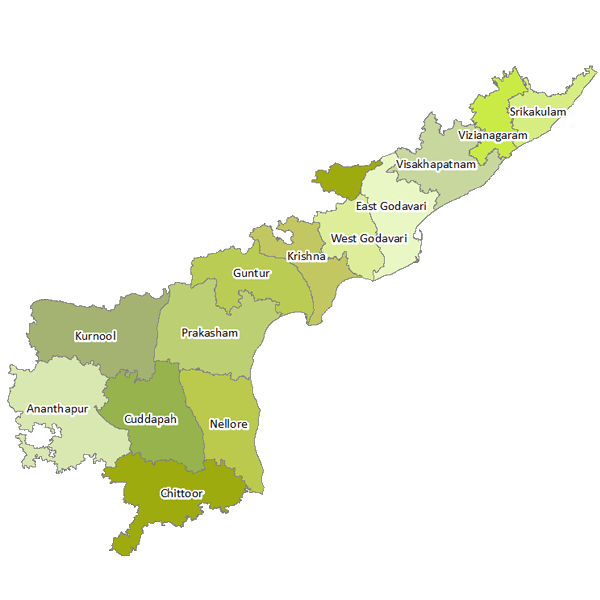
On October 28, 2015, the government of Andhra Pradesh declared drought[1] in 196 mandals in seven of the thirteen districts of the state. Having seen the serious discrepancies (between IMD and state government) in the rainfall figures of districts in Maharashtra[2] and Madhya Pradesh[3] where the respective state governments declared drought earlier, we decided to check the same for these seven districts of AP too. The IMD figures[4] for the monsoon (June 1 to Sept 30) rainfall for these seven districts are given in terms of Normal Rainfall, Actual Rainfall and how much actual rainfall departure was there from Normal Rainfall. During 2015 monsoon, IMD figures say that Coastal Andhra Pradesh (nine districts, three of which are declared drought affected now) received 642 mm rainfall, compared to normal rainfall of 581.1 mm, so a surplus of 10%. Rayalseema (comprising of four districts, all drought hit now) received 358.3 mm rainfall, 10% below the normal figure of 398.3 mm. In the previous year, both regions had 23% deficient rainfall, with actual rainfall of 448.7 mm in Coastal AP and 308.6 mm in Rayalseema. Continue reading “Discrepancies in rainfall figures for Andhra Pradesh’s drought hit districts”
Tag: Drought
IMD & MP govt provide shockingly different district rainfall figures: Will they explain, please?
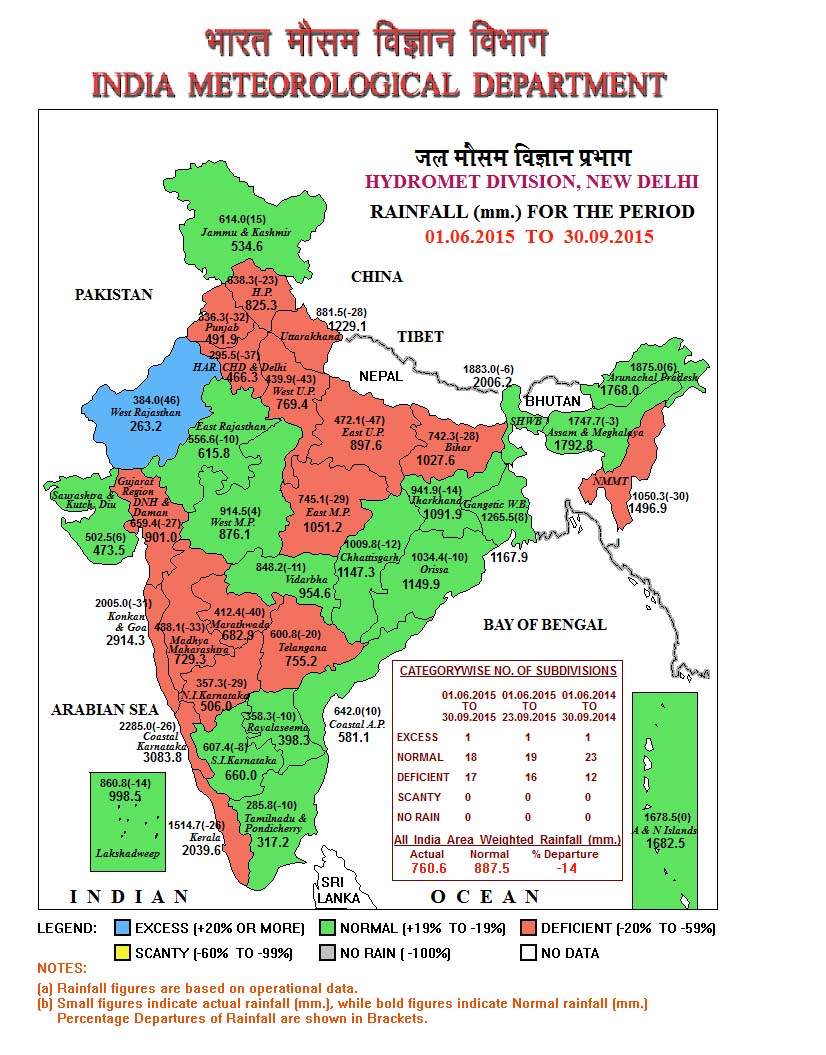
On Oct 26, 2015, Madhya Pradesh declared drought[1] in 33283 villages in 228 tehsils in 35 districts (of total of 50 districts), affecting 4.4 m ha area and 4.8 m farmers. It sounded a bit strange since Western MP, comprising of 30 districts, had above average rainfall as per IMD (India Meteorology Department[2]) figures for the 2015 monsoon (rainfall during June 1 to Sept 30).
So we decided to cross check district wise rainfall figures. We found that as per IMD, in 29 of the 50 districts in the state, rainfall was Normal or Excess. In case of 21 districts, the rainfall was deficient, that is more than 20% below normal. Continue reading “IMD & MP govt provide shockingly different district rainfall figures: Will they explain, please?”

Open Letter to Chief Minister of Maharashtra: Stop Westwards diversion of water from Krishna basin
OPEN LETTER TO HON. CHIEF MINISTER OF MAHARASHTRA:
Water Diversion from Krishna basin by Koyna and Tata Dams:
Maharashtra is violating Human Rights, National & State Water Policy
August 18, 2015
Dear Shri Devendra Fadnavis,
As we all know, large parts of Maharashtra, including Marathawada and Western Maharashtra (part of IMD division called Madhya Maharashtra) are in the grip of biggest monsoon deficit in the country with deficits of 48% and 33% respectively at the end of August 17, 2015 as per IMD[1]. Even beyond the state border, North Interior Karnataka has monsoon deficit of 45%, Rayalseema 36% and Telangana 23%.
Farmers in all these regions are in distress, rainfed Kharif crop, the only crop for most of them, may have been jeopardised for almost all of them. Most of the reservoirs have paltry storages, the biggest in the Krishna basin, Ujani in Maharashtra and Nagarjunsagar in Telangana (also catering to parts of Andhra Pradesh) have zero % in live storage, Srisailam has paltry 9%[2]. Millions of farmers and people are facing the prospects of livelihood loss and severe water scarcity.
While the situation is this serious in Krishna River Basin and adjoining basins, in Maharashtra, huge amounts of water is being diverted from the Krishna basin to the water surplus Konkan region which has seen close to 1600 mm rainfall already. This westward diversion of water from the east flowing Krishna-Bhima basin ultimately takes the water to Arabian Sea, while the Krishna basin, which should have the first right over this water, remains plunged in massive water scarcity. Krishna basin is thus being deprived of its water. Continue reading “Open Letter to Chief Minister of Maharashtra: Stop Westwards diversion of water from Krishna basin”

Tata Power responds on the issue of Tata dams diverting water from Drought hit Bhima Krishna basin to Konkan, but it is a vacuous, insensitive response
On the 7th August 2015, SANDRP published a Press Release titled “As Krishna Bhima basin farmers in Maharashtra, Karnataka, AP & Telangana face drought, crop failure, Water scarcity, Maharashtra DIVERTED 350 MCM water from the basin & stored another 2535 MCM reserved to release, literally to sea!”[1]. On August 9, 2015[2], DNA, a leading newspaper in Mumbai published a report based on this story as their front page top story titled “Drought? Last month alone Maha govt drained 350 MCM water into sea!” Continue reading “Tata Power responds on the issue of Tata dams diverting water from Drought hit Bhima Krishna basin to Konkan, but it is a vacuous, insensitive response”
Dams, Rivers & People: August 10, 2015
HYDROPOWER
NORTH-EAST:ASSAM: Experts warned Centre Govt against rushing through big dam projects (08 Aug. 2015) Even local BJP leaders are against Big dams in North EAST: “BJP leader and former bureaucrat Chandrakanta Das said that the power-starved Northeast should generate electricity through small and run-of-the-river dams instead of big dams. We need power for development, but that should not come at the cost of our pristine environment. We should explore power generation through small and run-of-the-river dams,” he said.
SIKKIM: Delay in completion of 500 MW Teesta Hydropower Project cost Lanco dearly as lenders prepare for Rs. 2400 crore debt-equity conversion (10 Aug. 2015) Lenders to Lanco Teesta Hydro Power will convert part of their Rs 2,400-crore outstanding loans to the company into 51% equity in the most significant such takeover since the Reserve Bank of India allowed lenders to do so when borrowers fall behind on repayments. A consortium of lenders, including some large private and public sector banks, agreed to convert part of their loans to Lanco Teesta into equity at a recent meeting. Senior executives at a large commercial bank said that close to Rs 780 crore will be converted into equity under the capital market regulator’s formula. This will be the second such instance of a bank exercising its right to acquire a majority stake in an ailing company.

As Krishna Bhima basin farmers in Maharashtra, Karnataka, AP & Telangana face drought, crop failure, Water scarcity, Maharashtra DIVERTED 350 MCM water from the basin & stored another 2535 MCM reserved to release, literally to sea!
(Photo above: Koyna Dam)
Large parts of Krishna basin spanning Maharashtra, Karnataka, Andhra Pradesh and Telangana are facing massive rainfall deficits, drought like conditions and crop failures. The tail-end reservoirs of Srisailam and Nagarjun Sagar are almost empty. Telangana and Andhra Pradesh are already thinking of conserving the available water for drinking water. They are not even thinking of releasing any water for saving the crops in delta farmers. In upstream Maharashtra itself, the Ujani dam has ZERO live storage and perennially dry Marathawada has the highest rainfall deficit. Shockingly, in this very period from July 1 to Aug 6, Maharashtra has diverted more than 350 Million Cubic Meters of water (at most conservative estimates) FROM this very Krishna and Bhima basins to the High Rainfall area of Konkan (it already has had 1467.1 mm rain till Aug 7, 2015) and down to the sea! If this diversion was stopped since July 1, when the signs of severe monsoon deficits in the three states were already there[1], this water would have been available to save crops in lakhs of acres in the river basin, and some of it would have also flowed to Andhra Pradesh and Telangana and water may have been available for saving some crops. Even now these Koyna and Tata dams have 2535 MCM water in live storage that is reserved for diversion to Konkan and to sea, but wont be release for the failing crops across the basin. How can we continue such wasteful use of water in a water deficit basin, at the cost of livelihoods of lakhs of farmers? Even now it is necessary to URGENTLY review this situation and consider stopping diversion of water FROM Krishna basin to sea. This may save crops and livelihoods of lakhs of farmers. Continue reading “As Krishna Bhima basin farmers in Maharashtra, Karnataka, AP & Telangana face drought, crop failure, Water scarcity, Maharashtra DIVERTED 350 MCM water from the basin & stored another 2535 MCM reserved to release, literally to sea!”

Dams, Rivers & People: August 03, 2015
HYDROPOWER
NORTH-EAST: ARUNACHAL PRADESH: Mapithel Dam; Social organization demand decommissioning of Mapithel dam (03 Aug. 2015) Asia Indigenous Peoples Pact (AIPP) and Naga People’s Movement for Human Rights (NPMHR) submitted memorandum to the Prime Minister of India Narendra Modi demanding a halt to the construction of Mapithel Dam and immediate decommissioning of the project. A joint statement issued by AIPP Secretary General Joan Carling and NPHRM Secretary General Neingulo Krome said the construction of Mapithel Dam under the supervision of the Government of Manipur directly affects and threatens the several scheduled tribes in the affected districts whose sources of income are land and agriculture. It may be mentioned that when it is commissioned the dam would affect over 8,000 people in 22 villages. http://e-pao.net/GP.asp?src=28..030815.aug15
UTTARAKHAND: Expert Body recommends modification of Uttarakhand hydro projects prevent 2013-like disaster (31 July 2015) An expert body appointed by the Centre to analyze the adverse ecological and environmental impact of hydroelectric power projects (HEPs) in Uttarakahand has told the Supreme Court that comprehensive modification of the projects is required to prevent a repeat of 2013 disaster in the state. In an affidavit filed in the Supreme Court, the Centre said the expert body (EB) had suggested promoters of the six projects– National Thermal Power Corporation (NTPC), National Hydroelectric Power Corporation (NHPC), Tehri Hydro Development Coporation (THDC), GMR and Super Hydro Pvt Ltd—to incorporate a number of safeguards in view of the 2013 disaster. The government said the projects would not be allowed to operate till the companies modify their projects. http://timesofindia.indiatimes.com/india/Uttarakhand-hydro-projects-need-to-be-modified-to-prevent-2013-like-disaster-SC-told/articleshow/48290097.cms
Chief Minister asks industry to invest in small hydroelectric projects (27 July 2015) Chief Minister Harish Rawat today sought help from the PHD Chamber of Commerce and Industry Uttarakhand for investment in small and micro hydel projects in the state. He sought support for 2 MW to 5 MW hydel projects under the policy formulated by the state government. The state is still not realizing how small hydro projects are equally disastrous for sensitive mountains. In June 2015 SANDRP visit in Yamuna valley highlights how Gangani and Hanuman Ganga small hydro projects have caused irreversible losses to local environment and community people as well.http://www.tribuneindia.com/news/uttarakhand/cm-asks-industry-to-invest-in-small-hydroelectric-projects/110988.html

Dams, Rivers & People: July 27, 2015
HYDROPOWER
Thermal, Hydro Power projects on the blink despite clearances by government (23 July 2015) Power sector is now bereft of capital flow. While thermal power projects might see some respite, hydropower projects continue to fester even after getting all the clearances. This puts a question mark on the claims of the hydro lobby that environment ministry and environment clearances are responsible for delaying the projects. Of the 80 stalled power projects, around 25 are hydro-based. Due to delays, the cost of the project, in almost all cases, has increased manifold thereby inviting regulatory tiff over tariff. NHPC’s Subhansari Power Project remains stalled due to the agitation in Assam. NHPC officials need to be held accountable as to how did they start the work without addresing the downstream impacts issues. Due to their callousness, the cos has doubled and work is stlled for over 3.5 years. http://www.business-standard.com/article/economy-policy/power-projects-on-the-blink-despite-clearances-by-government-115072200024_1.html
JAMMU & KASHMIR: Baglihar Hydro Electric Power project threatens Doda, Kishtwar (27 July 2015) Baglihar HEP is making life difficult with landslides, floods and additional submergence: “Before construction of dam, rocks were visible on both banks of the river. But when water level increased and became stagnant, rocks are nowhere in sight and water has entered loose soil. The root cause of frequent landslides and sinking of area in Doda districts on both side sides of the dam is stagnant water.”GM Bhat, Geological expert. http://www.tribuneindia.com/…/baglihar-power-pr…/111641.html
Dams, Rivers & People: 20 July, 2015
HYDROPOWER
NORTH-EAST ARUNACHAL PRADESH: Green clearance to Dibang Project challenged in NGT (17 July 2015) The 2880 MW Dibang Multipurpose Project will see construction of a mammoth 278-metre tall concrete gravity dam and it will submerge a vast forest area of 4,577.84 hectares or 45.77 sq km, of which major chunks are community forests. The forest land to be diverted is also a major habitat of endangered species such as tiger, leopard, snow leopard, Himalayan Black Bear, Slow Loris, Himalayan Black bear, Leopard cat and Fishing Cat. http://www.dnaindia.com/india/report-green-clearance-to-country-s-biggest-proposed-hydro-project-challenged-in-ngt-2105267 Continue reading “Dams, Rivers & People: 20 July, 2015”

Six regions of India facing prospects of crop failure and drought?

At least six of the 34 Meteorological divisions of India seems to be facing the prospects of crop failure and drought, if we look at the rainfall in these divisions in last 18 prime monsoon days from June 25, 2015 (monsoon had set in almost all over India by that date) to July 13, 2015, the latest date for which division wise rainfall are available. In these six sub-divisions, the rainfall during these 18 prime monsoon days has been between 0.1 mm to 12.8 mm. Continue reading “Six regions of India facing prospects of crop failure and drought?”
 SANDRP