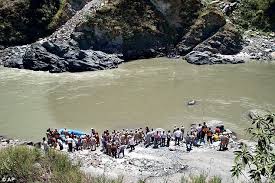
In an unprecedented development[i], the Himachal Pradesh Chief Minister Sukhvinder Singh Sukhu has sent a Rs 658-crore damage report to the Union Road Transport and Highways Minister Nitin Gadkari seeking from National Highways Authority of India (NHAI) compensation for the devastation caused at the 126-MW Larji hydel project allegedly due to the construction of a double-decker four-lane road.
Continue reading “Himachal demands Rs 658 Cr from NHAI for damage to Larji Hydro Project”Tag: Disaster
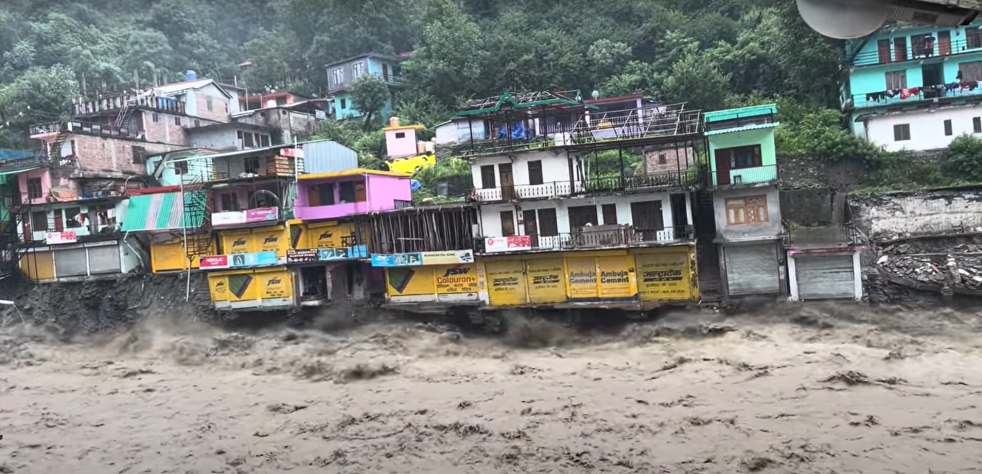
Himachalis blame NHPC dams for flood disaster in Sainj Valley in July 2023
(Feature Image:- Deluge in Pin Parbati river engufling riverbank habitations in Sainj market on July 09, 2023. Source: Anil Khatri Vlogs)
The official report of what has transpired in Sainj Valley under Banjar subdivision of Kullu district during July 8-10, 2023 is still not in public domain, however the multiple media reports suggest it to be one of the worst flood disasters for the valley and have once again raised serious questions on the role the hydroelectric power (HEP) projects. Local people have specifically underlined the gross negligence by National Hydro Power Corporation (NHPC) company for turning floods into a disaster. Moreover, old media reports from the area have also highlighted that it was a disaster in the making for which the state government machinery as well hydro projects and NHPC have contributed hugely.
Continue reading “Himachalis blame NHPC dams for flood disaster in Sainj Valley in July 2023”
DRP 030723: Peak Hour Tariffs to be implemented from April 2024
(Feature Image: Vyasi HEP power station at Hathyari, Dehradun. SANDRP, June 2023)
This announcement by the government is indeed much belated but welcome step that India plans to increase peak hour power tariff compared to non-peak hour power tariff, beginning with commercial and industrial consumers from April 2024 a year later for others excluding agriculture consumers. The notification mentions it as daytime tariff (during solar hours) and night time power use, but this essentially also helps peak management.
This will not only put a premium on peak hour power consumption and hence generation, but also hopefully ensure that assessment of impacts of the peak hour power generation including at hydropower projects is done and done in a credible way, along with compensating those affected. It will also hopefully ensure that existing hydro capacity is used optimally for peak hour power generation before going for new hydro projects in the name of increasing peak our power generation.
One also hopes that it will lead to better peak hour power management and also considering all the options for such power generation rather than pushing hydro projects blindly in the name of peak hour power generation.
Continue reading “DRP 030723: Peak Hour Tariffs to be implemented from April 2024”
Himachal Pradesh 25 June 2023: Cloud Bursts Damage 2 Hydro Projects
(Feature Image: Under construction 66 Mw Dhaulasiddh hydro project site in Hamirpur. Image Source: ETV Bharat)
With the onset of south west monsoon 2023, Himachal Pradesh has witnessed multiple incidents of ‘cloud bursts’ leading to destruction in Solan, Shimla, Hamirpur and Kullu between June 24-25. The extreme rainfall and resultant flash flood spells have caused widespread destruction to farms, cowsheds, local roads, bridges, vehicles and other public infrastructural in these districts.
Continue reading “Himachal Pradesh 25 June 2023: Cloud Bursts Damage 2 Hydro Projects”
DRP 260623: National Framework for Sediment Management
A National Framework for Sediment Management is certainly a long standing requirement and any move in that direction would have been welcome. Not only because the sediment accumulation destroys storage capacity of India’s Dams, created at such massive costs. But also because sediment is an integral part of river flow and also very important for the rivers to stop or reduce erosion at deltas. There are other issues related to sediment including creation and disposal of toxic sediment and impact of sediment free water flowing downstream from the hydropower projects.
But we need much more serious and sincere efforts in this direction than what has been suggested in following government press release. The movement on such an important subject is so snail paced, half hearted, non-comprehensive, unscientific and non-sincere that it is not clear how this is going to help.
Continue reading “DRP 260623: National Framework for Sediment Management”
Vyasi Hydro: Village Drowned; River Dried but little power generation
(Featured Image: Submerged Lohari village houses in Vyasi HEP ‘RoR’ dam reservoir. SANDRP, June 2023)
The 120 Mw Vyasi HEP built by Uttarakhand Jal Vidyut Nigam Ltd (UJVN Ltd.) in Vikas Nagar tehsil of Dehradun is on its way to become the textbook example of how thoughtlessly pushed hydro power projects are proving a nightmare for local people, a costly affair for the state and the nation and a disaster for free-flowing living river.
The project offers some bitter lessons for the policy-makers, experts and society who have been assuming that hydro power is a cheap, green source of energy and the Run of River (RoR) projects don’t dam and cause much harm to the environment, people or rivers.
Continue reading “Vyasi Hydro: Village Drowned; River Dried but little power generation”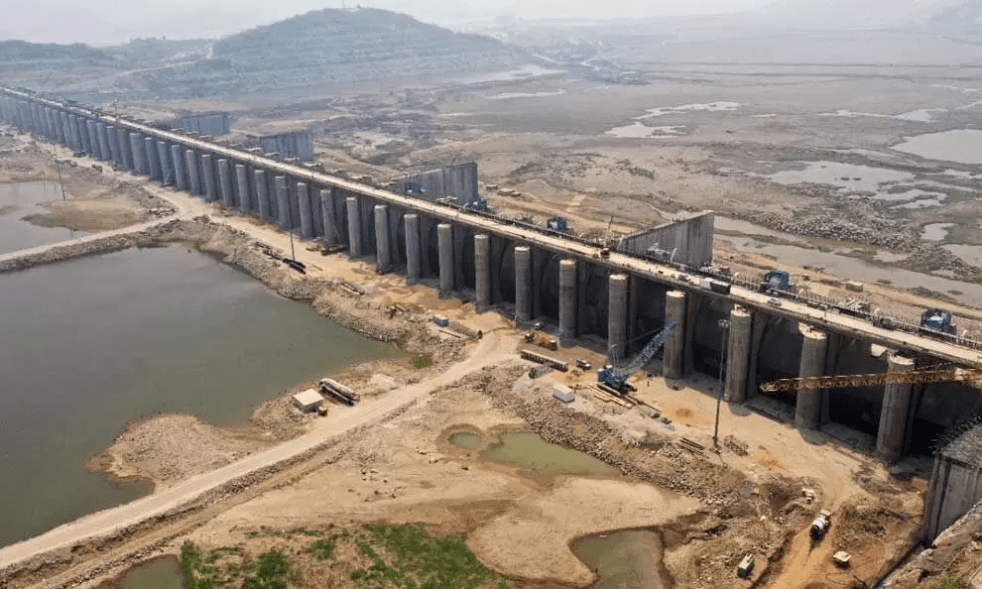
DRP 240423: The world is moving away from Big Dams: Are we?
(Feature Image: Construction works going on at Polavaram Dam site. Source: The Hans Media, May 2021)
This well substantiated report from Yale School of Environment this week shows that the end of the big dam era is approaching. The well argued report from Jacques Leslie uses the reports from UN University, International Renewable Energy Agency, Oxford University, Inclusive Development International, China, among others to show how the pace of construction of dams and hydropower projects and also pace of financing such projects have hugely reduced in recent years and decades.
Even the International Hydropower Association, sensing the change, is now advocating pump storage hydro rather than conventional hydro and that too off stream version, to complement the power from solar and wind. Emerging economics with rising cost of hydropower projects and rising cost of power from such projects compared to solar, wind (onshore and offshore) are a major reason for the massively slowing pace of new hydropower projects.
Continue reading “DRP 240423: The world is moving away from Big Dams: Are we?”
DRP 170423:Forecast of Indian SW Monsoon & definition of normal monsoon
The India Meteorological Department (IMD) has on April 11, 2023 forecast that rainfall at national level in four months of June-Sept 2023 Southwest Monsoon will be 96% of Long Period Average (LPA). IMD considers Indian Monsoon rainfall as normal based on just one parameter of total rainfall in these four months at national level is between 96% and 104% of LPA, with model error of +/- 5%. This raises large number of questions as media has rightly raised post the IMD announcement.
Firstly, in a strange turn of events, on April 12, an update jointly by US weather agencies under the National Oceanic & Atmospheric Administration (NOAA), contradicted a number of assumptions of IMD the previous day, including the period when El Nino will become active and probability of it being a strong event, both of which have a strong bearing on the Indian Monsoon in an adverse way. So the first question that arises is, did the IMD not have the benefit of the observations on April 11 based on which NOAA made the forecast very next day? Or was it an attempt at providing an unjustified feel good monsoon forecast? This question arises as in the past too questions have been raised about such attempts by IMD. This question also becomes important as only a day or two before IMD’s forecast, private forecaster had predicted that monsoon rainfall is likely to be deficient and not normal.
Continue reading “DRP 170423:Forecast of Indian SW Monsoon & definition of normal monsoon”
DRP 100423: Abysmal track record of water pollution control in India
(Feature Image: Stagnant waste water pools amid residential plots in Kashipur, Uttarakhand, Bhim Singh Rawat 10 April 2023)
That India’s track record in water pollution control is abysmal is self-evident. This is particularly important to note as India prepares to mark 50 years of Water Pollution Control Act enacted in 1974, next year. It was after that act that the huge institutional architecture of central and state pollution control boards and laboratories were created with huge bureaucracy. That whole institutional architecture is more known for inefficiency and corruption than for achieving any clean rivers or cleaning other water bodies. During the existence of this act the bureaucracy that came with it, the state of our rivers and water bodies have only gone worse with every passing year.
Continue reading “DRP 100423: Abysmal track record of water pollution control in India”
April 2023: Another Landslide at Lower Subansiri HEP
(Screengrab of India Today North East video report on landslide at Lower Subansiri HEP site on April 03, 2023)
The site of Lower Subansiri Hydroelectric Power (HEP) has witnessed another massive landslide on April 3, 2023. The 2000 MW project is being developed by NHPC Ltd at Gerukamukh bordering Assam and Arunachal Pradesh.
As per North East India 24 report, the landslide triggered by rainfall has caused damage in the main part of the dam and the workers had to be evacuated to a safe place. No human casualty has been reported from the incident.
Continue reading “April 2023: Another Landslide at Lower Subansiri HEP” SANDRP