Narmada

Why is Gujarat neglecting Safety of Sardar Sarovar Dam?

Sardar Sarovar Dam Stilling basin damaged: No repairs for 3 years:

No meeting of Dam Safety Panel for 30 months:

WHY IS GUJARAT NEGLECTING SAFETY OF ITS LIFELINE?
 Image

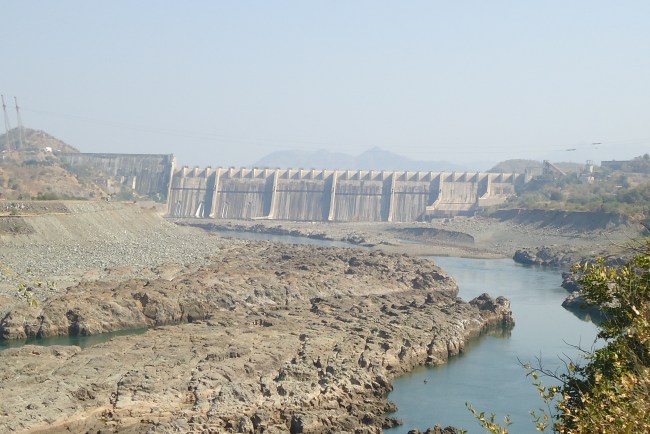
Sardar Sarovar Dam: (Photo by SANDRP)

Gujarat government, Gujarat politicians and their supporters never tire of telling the world that the Sardar Sarovar Dam (SSD) on Narmada River is their lifeline. Shockingly, perusal of recent official documents obtained under RTI indicate that Government of Gujarat (GOG) and its Sardar Sarovar Narmada Nigam Limited (SSNNL) are least bothered about the issues of the very safety of the SSD.

The only technical body that is supposed to be in charge of safety of the dam, namely Dam Safety Panel (DSP), has remained non existent for years together while the official reports show that the structures like stilling basin that are a part of the dam have suffered such serious damage that the Sardar Sarovar Construction Advisory Committee (SSCAC) and its Permanent Standing Committee (PSC) have repeatedly asked for attention.  First they asked for urgent attention then immediate attention, then attention before monsoon to the repair, but still, there has been no response for a long time from GOG or SSNNL.

Shockingly, India’s premier technical body on water resources, Central Water Commission (CWC), was not taking interest in this issue ostensibly since they were not represented on DSP!

Who can say Sardar Sarovar Project is really Gujarat’s lifeline and that Gujarat government is bothered about the lifeline?

CHRONOLOGY OF EVENTS RELATED TO DAMAGE AT SSP DAM: In what follows, we have given the blow by blow chronology of events related to the damage to SSP Dam, all information taken from official documents obtained under RTI.

May 2011 The minutes of 101st meeting of PSC notes, “He (Representative of GOG) further informed that a team of nine officials from National Institute of Oceanography, Goa carried out inspection under water of stilling basin of SSP dam during 3rd May to 15th May 2011 and it was found that there is no damage except some erosion of size 3-5 cm at some places, which is not a serious problem.” Please note the description of what NIO found, as reported by GOG here and let us see how this description and implications change from “there is no damage except…” and “not a serious problem”.

It is this report of NIO that had discovered the damage to the SSP dam stilling basins and other underground parts, the damage must have happened during 2010 monsoon or earlier, and till March 2014 and as we  write this, there is no confirmation of the repairs.
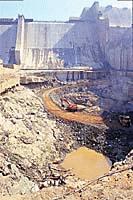
SSP Stilling Basin damaged in 1995 Photo: Frontline

June 8, 2011: 101st meeting of PSC notes: “The committee noted the progress of works and directed GOG to include the reports of National Institute of Oceanography, Goa in their quarterly progress report and also to take up remedial measures for the shortfalls indicated therein.” So PSC first asks for just necessary reports and remedial measures.

Feb 10, 2012: The minutes of the 102nd meeting of PSC notes: “Chairman suggested tat the observation of NIO may be taken seriously”. It calls for urgent steps for remedial actions on the recommendations of the NIO report and meeting of Dam Safety Panel at an early date in view of NIO report. If what NIO found was “no damage” and “not a serious problem”, as GOG reported to the 101st PSC meeting, why did PSC ask for URGENT meeting of DSP?

Moreover, the minutes of the meeting note: “The committee directed GOG to initiate urgent steps for remedial actions on the recommendations of NIO report.” The NIO report found, among other damages, “two big cavities noticed along with many minor ones” in Bay 5 and “RT[1] wall cavity at the bottom, where a small area which found disturbed, needs attention.” Damages were also reported from Bay 1, 2, 3 & 4 and divide wall and basin floor had cavities in all the bays, more in Bay 4 & 5.

March 16, 2012: The minutes of 79th meeting of SSCAC note: “… the NIO found minor cavities, loose pieces of concrete and broken iron rod pieces on the floor.” This description shows much more serious damage than what GOG reported to 101st meeting of PSC in June 2011. The Minutes of the 79th meeting of SSCAC go on to say: “SSCAC took on record the above fact and endorsed the decision of PSC for convening the meeting of Dam Safety Panel as early as possible and address the issue.”

So NIO finds damage in May 2011, but there is no meeting of DSP till March 2012. Then PSC (Feb 2012) and SSCAC (March 2012) recommend URGENT meeting of DSP. Note that PSC and SSCAC took nine and ten months respectively to recommend URGENT meeting of DSP. And yet, there is still no meeting of DSP for another 20 months!

Aug 23, 2012: The minutes of the 104th meeting of the PSC says: “it was decided that DSP meeting may be called up immediately and underwater inspection should be carried out after monsoon whenever high magnitude flood occurs.” Note the word “immediately”, since GOG had not responded to earlier URGENT recommendation. GOG still shows no urgency.

The GOG response, on reading of minutes of the 104th meeting of PSC appears most casual: “For conducting above mentioned DSP meeting, Shri Y K Murthy, Chairman DSP panel is being contacted to get the date convenient to him. However, meeting is getting delayed as Shri Y K Murthy is not keeping good health.” Shri Murthy, it may be noted, is close to 92 years old by now… and the meeting of DSP, immediately required since over two years, is not possible since this  90+ year old person is unable to give dates! In the meantime, as the minutes of the 104th meeting notes, two flood seasons (2011 & 2012) have passed and 2012 monsoon saw water level reach record level (till than) of 129.2 m on Sept 7, 2012 and dam overflowed for more  than 50 days.

Oct and Dec 2012: Considering the seriousness of the situation at SSP, SSCAC wrote letters to SSNNL on Oct 25, 2012 (Ltr no SSC/PB/PSC-104/2012/3112) and Dec 7, 2012 (Ltr no SSC/PB/PSC-105/2012/3553) asking for the status of the action by GOG on recommendation of the 104th meeting of PSC that DSP meeting be called immediately. The GOG does not bother to respond to the letters. Could SSCAC, a statutory body chaired by Union Water Resources Secretary & set up under NWDT award have done better than just writing letters, when safety of country’s costliest dam?

Feb 20, 2013: On the agenda of urgent repair of SSP dam stilling basin and meeting of DSP, the minutes of 105th meeting of PSC record: “Representative of Gujarat informed the Committee about the sad demise of Dr Y K Murthy, Chairman of DSP and so DSP has become defunct. To get expert advise it is proposed that BOC constituted for Canal work can also act as DSP for Dam. Accordingly, they referred the matter to BOC[2].” PSC asked GOG to send a proposal about BOC for Canals being given the task of DSP and reminded: “The remedial action needs to be completed before the monsoon of 2013.” The remedial action did not happen before the monsoon of 2013 or before the end of year 2013 either. Nor did the meeting of DSP happened till Nov 2013, after the end of Monsoon 2013.

March 25, 2013: The minutes of the 80th meeting of SSCAC notes that there is still no progress. On the GOG proposal of entrusting the DSP work to BOC for canals, SSCAC reminds GOG that “as per CWC guidelines for the safety of the project, the constitution of DSP is must.” Nothing happens till the monsoon is well underway, even the constitution of the DSP does not happen till July 2013. This means that for over 30 months after NIO discovers damaged dam, there is not even a meeting of the DSP, leave aside any remedial action.

July 6, 2013: SSNNL reconstitutes DSP under chairmanship of Shri R Jayaseelan (he is also the chairman of Board of Consultants of SSNNL), a former CWC chairman. DSP was originally constituted through GOG resolution of 20.2.1986. The DSP constituted on July 1, 2010 was supposed to be functioning till June 30, 2013 with extended term and was chaired by Dr Y K Murthy. Born in Oct 1920, Dr Murthy was already 90 when the DSP chaired by him got this extended term. Dr Murthy too was chairman of CWC during 1977-78[3].

Aug 18, 2013: The GOG remains most casual on the subject of DSP meeting, as reported in the minutes of the 106th meeting of PSC: “GOG representative informed that meeting of DSP will be convened within this month as per the availability/ convenience of the Chairman, DSP”. The dam safety has to wait, of course, till the chairman finds time for the meeting.

Aug 29, 2013: A letter from SSNNL to Gujarat Engineering Research Institute explains possible reason for damage to stilling basin: “Due to uncontrolled flow passing over the spillway, hydraulic conditions which have not been considered in the design of spillway basin have developed. This has caused damage/ erosion in the stilling basin area… in the floor of stilling basin, junction of stilling basin floor and divide wall/ right training wall.” SSNNL must know these conditions are existing since 2006 when dam reached present level of 121.92 m and should have taken necessary measures, but not only they do not take any, but even after NIO report shows the damage in May 2011, they don’t take any action on it for over 30 months before calling DSP meeting and even longer to start repair work.

Nov 25-26, 2013: The 48th meeting of Dam Safety Panel (at last) happens. Its first agenda is: “Repairing of Concrete Panels of different bays of stilling basin of Sardar Sarovar Dam.” In the meantime, letter dated Nov 20, 2013 from Chief Engr (Dam and Vadodara), SSNNL to secretary SSCAC says: “Regarding safety measures for Stilling Basin, memorandum is prepared for repairing of Stilling Basin and submitted to the DSP for heir guidance by the Superintending Engr, N P Designs (Dams & Power House) circle, Vadodara.. DSP meeting will be called as per the convenience of the DSP members.” So 30 months after NIO discovered damaged dam stilling basin, SSNNL has prepared memorandum for repair and six days before scheduled DSP meeting, they feign ignorance about the date of the meeting!

Dec 18, 2013: The minutes of the 107th meeting of PSC says: “The Committee directed GOG to give top priority for repair of stilling basin before coming monsoon and keep ready the embedded parts required for at least one working season.”

The minutes also note what GOG reported about the DSP meeting on Nov 25-26, 2013: “It has been suggested that dewatering of bay No 4 & 5 shall be carried out at first instance & then inspection of damaged portion will be done by the DSP members. After inspection by DSP members, remedial measures will be suggested… Representatives of GOG informed the Committee that the procedure for carrying out above works will be started after receiving the final report of 48th Dam Safety Panel Report.” Dam repairs are still waiting for the DSP report, dewatering and inspection by DSP members!

March 28, 2014: Agenda note of the 81st meeting of the SSCAC throw light on lack of interest by CWC in this whole affair: “… it was observed that there was no participation from CWC in DSP and on enquiry it was learnt that they did not give this priority as they are neither invitee nor member in the DSP.” The key words are that CWC “did not give” dam safety of SSP priority!

Conclusion It is clear from the above sequence of events that serious damage was found in the stilling basin[4] of Sardar Sarovar Dam by NIO in May 2011. Till March 2014 (34 months after damage was discovered) and till as we write this, there is still no news that the damage has been repaired, even as the monsoon of 2014 is about six weeks away. In fact it took Gujarat government 30 months just to organize the dam safety meeting. That too after pushing and prodding from several meetings of Permanent Standing Committee of SSCAC and also meetings and letters from statutory SSCAC itself. This for the costliest dam of India. A dam about which the Gujarat government and Gujarat politicians never tire of telling the world that it is Gujarat’s lifeline.

Image

Sardar Sarovar Dam with milestone showing 2 km distance (Photo: SANDRP)

Why did the central government (Please note that SSCAC is a body under Union Water Resources Ministry and is chaired by Secretary, Union Ministry of Water Resources) not do anything beyond writing letters and changing words from necessary to urgent to immediate and yet not doing anything when none of these words were heeded to?

Why did the premier water resources agency of India, CWC, not bother to do anything about this situation and did not take interest in Dam Safety Panel? Can CWC even be entrusted with the task of dam safety?

Why did SSNNL employ a person as old as 90 years to head an important body like Dam Safety Panel? Why did it take no action even as the chairperson reported sick then passed away dead ? Why did it wait for the chairperson’s term to be over before appointing a new Panel, again headed by a former CWC chief?

Is the Dam Safety Panel of Sardar Sarovar Dam a retirement perk for CWC chiefs? If Gujarat government cannot take necessary steps for the safety of Sardar Sarovar Dam, its claimed lifeline, then is this Government capable of taking any serious responsibility? Will the officers responsible for this state of affairs both in Gujarat and the Centre be identified and held accountable?

There are too many questions like these for which there seem to be no easy answers.

Himanshu Thakkar (ht.sandrp@gmail.com)

END NOTES:

[1] RT wall: Right Training wall

[2] Board of consultants (for canals)

[3] http://ienblc.org/personality/murthy.HTM

[4] A depression just downstream of the dam, deep enough and so structured as to reduce the velocity or turbulence of the flow and also channelise the downstream flow. The stilling basin is in fact integral part of the dam and without a safe stilling basin, a safe would not exist since an eroded and damaged still basin can expose the foundation of the dam to damage.

5. https://sandrp.wordpress.com/2014/04/18/why-is-this-dam-being-constructed/

6. Carried at: http://www.counterview.net/2014/04/despite-serious-issues-with-narmada-dam.html

7. Carried in full at: http://counterview.org/2014/04/30/sardar-sarovar-narmada-dam-why-is-gujarat-government-neglecting-the-safety-of-its-lifeline/
Dam Induced Flood Disaster

Is THDC preparing to repeat the disaster Tehri created in Sept 2010?

Why is Tehri filled up with half the monsoon still to come?

The Tehri dam reservoir on Bhagirathi river in Uttarkashi district in Uttarakhand is filled upto 818.4 m as on August 5, 2013, as per the latest available information on Northern Region Load dispatch Centre (http://nrldc.org/). With permitted full reservoir level of 820 m[1], the FRL is just 1.6 m above current level. At current rate, the water level in the Tehri dam may reach FRL in less than a week. The question is why is Tehri dam being filled up when almost half the monsoon is still to come? And when going by the trend so far, the monsoon is likely to continue to bring surplus rains? Now the Tehri dam is posing a huge, grave and real risk for the downstream areas in Uttarakhand and UP as the monsoon rains continue in all its fury.

In last 35 days since July 1 (level 780.05 m), the water level in the dam has gone up by 38.35 m. In last four days since Aug 1, the level has gone up by 7.85 m. On every single day since July 1, Tehri has been releasing less water than it has been receiving, which means the dam is hoarding water (a detailed list of reservoir level, inflow and usage at Tehri dam from July 1 to August 6 is given in the annexure below). On at least 22 days since July 1, the dam has used less than the optimum quantity of water it can use, that is 572 cubic meters/ sec. The Tehri dam generated 657.65 million units of power during July 2013, which is below the optimum it can generate (744 MU) and also less than what it generated for example in Aug 2011 and Sept 2010. As a direct consequence, while less power was generated, more water was accumulated behind the dam and now the dam is posing a risk to the downstream areas.

Safety issues at Koteshwar Dam: Vigilance enquiry on It may be recalled that in September 2010 similar mismanagement at the Tehri dam led to huge and avoidable floods (for details see page 20 of Aug Sept 2010 issue of Dams, Rivers & People: https://sandrp.in/drp/DRP_Aug_Sept_2010.pdf) in the downstream Uttarakhand and UP. Thus the highest ever flood level of 296.3 m at Haridwar was reached on Sept 19, 2010 (see http://www.india-water.com/ffs/static_info.asp?Id=24). In fact in Sept 2010, the downstream Koteshwar dam of THDC also suffered severe damages due to this mismanagement and now it is unable to take larger flows from upstream Tehri dam. The weak civil works of Koteshwar dam is also now facing vigilance enquiry as per the Aug 4, 2013 report from http://www.energylineindia.com/. The report said, “Vigilance department had expressed its concerns regarding the civil works and works relating to diversion plug, which are extremely susceptible to rains and are vulnerable to lead to major impact on the dam safety… The stalemate at THDC’s 400 MW Koteshwar Dam and Power House (KDPH) has seen work come to a halt in the event of non completion of emergency works for the project.”

97.5 m high Koteshwar Dam 20 km downstream of Tehri dam (photo: hydroworld.com)
97.5 m high Koteshwar Dam is located 20 km downstream of Tehri dam
(photo: hydroworld.com)


AIPEF misleading Power Ministry? It is reported[2] that All India Power Engineers Federation has written to the Union Power Ministry, expressing concern that spillage from Tehri dam will pose risk of flooding of the downstream Koteshwar project. This concern also seems to suggest that Koteshwar dam is not strong enough to take the higher water releases from Tehri that may be required. The Matu Jansangthan[3] has also raised concern about safety of the Koteshwar dam and its impacts. The request in the letter that THDC be allowed to increase the water storage to 830 m is anyway misleading since it is not in the hands of Power Ministry.

Uttarakhand waiting for new disaster? It seems from this situation that unless urgent steps are taken, Uttarakhand may be in for a new disaster pretty soon. It is strange that while this situation was developing over the last month a number of agencies that should have taken advance notice and action have been sitting quietly.

Þ    Central Water CommissionIndia’s highest technical body on water resources is supposed to provide rule curve for safe operation of all dams. It seems CWC has not issued any such safe rule curve for Tehri or the rule curve issued by it is unsafe like it is in many other dams.

Þ    Uttarakhand and Uttar Pradesh government In case of the flood disaster that will happen in the downstream area because of the wrong operation of the Tehri dam, it is the people, lands, property and environment of the Uttarakhand and Uttar Pradesh governments that will be affected. But Uttarakhand or the Uttar Pradesh seems to have taken no action. Uttar Pradesh government is also partner with THDC in the project.

Þ    National Disaster Management Authority NDMA should be concerned about this impending manmade disaster and should have taken action, but seems to have done nothing.

Þ    Union Ministry of Water Resources The Ministry is supposed to be concerned about the safety of all dams in India, but has clearly failed to do anything about Tehri or Koteshwar.

THDC, Uttarakhand Chief Minister, Central Water Commission among others have been making a lot of false claims about Tehri dam having saved Uttarakhand during the Uttarakhand flood disaster during June 15-17, 2013. Our analysis[4] showed that this is clearly false claim and also warned that Tehri could turn out to be a source of disaster in the remaining part of current monsoon. That situation now has clearly developed and requires urgent intervention. We hope all concerned authorities will urgently intervene and ensure that no such disaster happens.

Himanshu Thakkar (ht.sandrp@gmail.com)

South Asia Network on Dams, Rivers & People (https://sandrp.in/)


[1] In ongoing Supreme Court case, THDC does not have permission to take water level behind the dam above 820 m due to lack of progress in rehabilitation. On Aug 27, 2010, THDC was given a one time temporary permission to take water level to 830 m only as an “emergency measure”. Now THDC is seeking SC permission to take the water level to 835 m from the current permissible 820 m, but that is unlikely to be agreed by the Uttarakhand government considering the state of rehabilitation. The case is likely to come up before the Supreme Court in Sept 2013, as per Matu Jansangthan, which is fighting the case.

[4] https://sandrp.wordpress.com/2013/06/28/uttarakhand-floods-truth-about-thdc-and-central-water-commissions-claims-about-tehri/


Reservoir level, inflow and usage (outflow) at Tehri dam during July 1, 2013 to Aug 6, 2013 

Date Reservoir Level (meter) Inflow (cumecs) Usage (cumecs)
01-07-2013 780.05 603.78 462
02-07-2013 780.05 603.78 462
03-07-2013 781.1 554.73 540
04-07-2013 781.1 599.4 538
05-07-2013 781.6 545.81 536
06-07-2013 781.9 680.47 537
07-07-2013 781.9 680.47 537
08-07-2013 781.9 680.47 537
09-07-2013 781.9 680.47 537
10-07-2013 786.6 760.77 540
11-07-2013 787.1 785.2 645
12-07-2013 787.45 633.13 546
13-07-2013 788.45 804.66 546
14-07-2013 NA 749 549
15-07-2013 790.1 798.15 551
16-07-2013 790.1 798.15 551
17-07-2013 790.1 798.15 551
18-07-2013 793.8 910.51 546
19-07-2013 793.8 910.51 546
20-07-2013 796.35 855 475
21-07-2013 799.3 855 236
22-07-2013 800 810.53 459
23-07-2013 802.3 917 541
24-07-2013 802.3 917 541
25-07-2013 804.15 946.5 574
26-07-2013 808.5 1471.92 572
27-07-2013 809.7 972.44 564
28-07-2013 810.50 792.25 569
29-07-2013 810.50 792.25 569
30-07-2013 810.50 792.25 569
31-07-2013 810.50 792.25 569
01-08-2013 810.50 792.25 569
02-08-2013 810.55 730.41 572
03-08-2013 814.70 629.43 573
04-08-2013 816.15 617.8 572
05-08-2013 817.15 NA NA
06-08-2013 818.4 NA 566

Effective Full Reservoir Level of THDC – 820 meter, NA – Not Available. The dates mentioned here are reporting dates, the levels and flow figures are for the previous day.  Source: http://nrldc.org/

Ministry of Water Resources

MoWR’s Draft National Policy Guidelines for Water Sharing – Agenda to push Big projects and Inter Linking of Rivers?

Draft National Policy Guidelines for Water Sharing[1]: Comments[2]

 Copied below are the Comments sent by SANDRP to the Union Ministry of Water Resources in response to MWR’s invitation to send comments by July 31, 2013.

1. What is the value added by these Draft National Policy Guidelines on Water Sharing? What is the immediate reason for bring out these guidelines? The guidelines do not make this clear. This becomes particularly important as under constitution, water is a state subject and among states there is increasing suspicion that centre is trying to take over the rights of deciding about the water resources. If that is the case, as it seems (see comments below), than the guidelines also seem to violate the constitutional provisions.

2. The guidelines use the word “National Interest” at least four times, without explaining who will decide this and how. This is likely to raise suspicions among the states. This is particularly true with provisions like that in section 4.6 (c) saying, “The quantum of water exported from the surplus basin in overall national interest will not be counted as water available for sharing in that basin.” This seems to give unfettered rights to the centre to decide about inter basin transfer of water citing “national interest”.

3. If the Union Ministry of water resources is going to decide what is in National Interest than it is likely to invite risk of ridiculous and risky propositions. For example, the ministry some years ago came out with a scheme of National Projects, but most of the projects under this scheme did not have statutory clearances, or were unviable or were controversial and involved unresolved interstate issues. Thus use of such terms without clear definition and clear checks and balances is not likely to be acceptable.

4. It is pertinent to note that conflicts over river waters, whether inter-country or intra-country, invariably seem to arise only in the context of large projects. So long as the river is flowing freely without any such big projects, there is no cause for any conflict between the upper and lower riparians. As soon as any riparian State plans an intervention (dam or barrage or other diversion structure), anxiety in other riparians is triggered, and a potential for conflict arises. It would appear that large projects tend to become the foci of conflicts. This is essentially because (a) they tend to drastically alter geography and hydrological regimes, and (b) they involve issues of control, power and political relations, social justice and equity. The best course to avoid conflicts is to refrain from such interventions as far as possible, keep them minimal, give advance notice of an intended intervention to all the other riparians, provide full information, take the concerns and consent of the lower riparian into account, and refrain from causing ‘substantial harm’ or ‘significant injury’ to the lower riparian. This point has not been covered in the guidelines.

5. On similar lines, the guidelines basically take a macro view and do not seem to have a place for micro, local, bottom up process or democratic perspective.

6. The sharing should be only of what is available for sharing after the ecological functions of the river (in all its manifestation and catchments) are ensured. These would include the sustaining of wildlife, aquatic life and vegetation; the maintenance of the river regime and the capacity of the river to cope with pollution and regenerate itself; the maintenance of the micro climate; the support of the lives and livelihoods of people dependent on the river on both sides of the political or administrative border; the recharging of aquifers; the preservation of wetlands; the protection of the health of the estuary; and so on. This does not find mention in the guidelines.

7. Its very important to note here that groundwater is increasingly the main source of water for all sources and more and more areas. This is likely to remain the situation whether we like it or not. Under the circumstances, sustenance of rivers flowing all round the year with freshwater as one of the most important groundwater recharge mechanism is also important, both at intrastate as well as interstate level. This aspect should have found a key place in these guidelines.

8. An inter-State river is not a sequence of Statewise segments, it is one continuous flow, one integral whole as a hydrological/ecological system. Allocating so much of its waters to State A, so much to State B, etc, involves a segmentation – a chopping up – of the river. The ideal course would be a joint, agreed, integrated, holistic, harmonious use of its waters by all the basin States coming together. Any statement of sharing principles should begin with this recognition.

9. If a sharing becomes necessary, equitable sharing for beneficial uses must of course be the governing principle, and the Ministry’s draft says this in section 4.3.

The word ‘apportionment’ is best avoided because it suggests an imposition by a judicial or other agency. As mutual agreement is also possible, the word ‘sharing’ seems better. As contending States often argue on the basis of other principles such as ‘territorial sovereignty’ (the Harmon doctrine) or ‘prior use’ or ‘prescriptive rights’, the National Statement of Principles should not merely lay down the principle of equitable sharing but specifically rule out other principles such as those referred to above. Three, it is not enough to say ‘equitable sharing’; the words ‘for beneficial and justifiable uses’ must be added, because the sharing is not for non-use or waste.

The term ‘equitable sharing’ immediately leads to the question of what constitutes ‘equity’, and the draft has something to say about this. The Helsinki Rules enumerate a large number of criteria and leave the actual applicable criteria and the relative weights to be attached to each criterion to be determined in accordance with the circumstances of each case. These are missing here.

Thus, it is not clear how this equitable sharing will be applied and how it will get change with other principles like prior use, high economic value use, etc come in the picture. This principle has always been there, and in spite of such principles, in Maharashtra, a state with largest number of big dams, 70% of irrigation water gets used up by 2% land under sugarcane. Similarly while parts of Krishna basin is highly drought prone, over 3 billion cubic meters of water get transferred from that basin to the high rainfall area of Konkan while the downstream areas in the Krishna basin is severely drought prone. This is also applicable at interstate level as is clear from the reservoir filling methods applicable in all basins, where the upstream dams will release water only when they are full and till than downstream areas wont get any water, irrespective of if  the downstream areas are in the same state or another one. So in absence of clearly defined publicly accountable mechanism to implement this principle, it is of little value.

10. Incidentally, one of the criteria, namely the ‘contribution’ of each BasinState, is a bit dicey. Can that fact give unfettered rights over that water to that state?  If not what will limit those rights? This is because, the State that receives the precipitation also needs downstream state to provide drainage; it follows that by virtue of providing that crucial drainage the lower State also acquires a certain right over those waters. This factor is not mentioned here.

11. The upper riparian tends to assume a primacy of rights, and in any case has control over the waters, putting the lower riparian at a disadvantage. The upper riparian often talks in terms of ‘giving’ water to the lower riparian or ‘sparing’ water for the lower riparian. It is necessary for the Statement of Principles to make it clear that there is no hierarchy of rights; that all co-riparians have equal use-rights over the waters of the inter-State river; that the lower riparian has a right to the waters. If there is a hierarchy, than the hierarchy should be made clear and also how that hierarchy is going to be ensured in real situation.

12. One of the key issues that a statement of principles must deal with is the problem of sharing in a low-flow year. This is clearly recognised in the India-Bangladesh Ganges Water-Sharing Treaty 1996. However, the draft guidelines do not make this clear.

13. The upper riparian, in using the waters, must not cause ‘substantial harm’ (Helsinki language) or ‘significant injury’ (UN convention language) to the lower riparian. (The India-Bangladesh Ganges Treaty contains a ‘no harm to either party’ clause.) The draft guidelines must include this.

14. Under the law as it stands at present, the parties to an adjudication under the ISWD Act are the State Governments. A more inclusive approach seems desirable so as to allow water-users (agriculture, industry, citizens, etc), as well as those likely to be affected by the projects in dispute, to be heard in the adjudication process.

15. Data of all kinds needed for the purposes these guidelines (e.g. section 6.1.1) shall be freely shared by the States concerned and put in the public domain for the information of all without any restrictions on the grounds of confidentiality or secrecy.

16. Section 4.3 mentions that storage of rainwater shall not qualify as direct use of rainwater. However, there are many techniques that require local storage of rainwater and such local storage should not disqualify from being considered as direct user of rainwater. This may be modified to say that storage of water beyond a certain quantity at one place (say 1 million cubic meter) may not qualify as direct use of rainwater.

17. The guidelines are only pertaining to interstate water sharing. However, any such (non binding) guidelines should also include provisions for intra-state, inter-sectoral water sharing.

18.  Section 4.8 is problematic as it does not define what “existing use” is. Is the use of water by fish, plants and nature “existing use”?  Does it count? It seems the existing use is entirely anthropocentric, but in case of an ecologically embedded entity like water this may be seriously problematic. Secondly, it seems to recognise use only when done through projects approved through due process. But there is a lot of informal use of water (e.g. by tribals) that is beyond the project-generated use. Does it count? Thirdly it makes a strange distinction of preplanned use. Do we have well documented and well recognised pre plan uses of water? Fourthly, the use of phrase “Every effort shall be made to protect the existing utilization” creates serious doubts as it gives an escape route that nothing is sacrosanct.

19. Section 4.9.1 also raises serious suspicions since it says even where an existing interstate agreement has approval of all the basin states, it may still not be good enough before “national interests”. This is bound to raise suspicion of all the states.

20. Section 4.10.2 is also likely to raise suspicions as it reads: “In the process of water sharing/distribution, in consultation with the co-basin States, the Centre would take care of the water sharing/distributions required in the national interest… Any State affected adversely due to such sharing/distribution would be adequately compensated by alternative means.” This seems to give rights to centre that so far belongs to the state. As far as the interests of the ecology and environmental flows are concerned, centre has the powers under Environment Protection Act, 1986 and do not have to resort to such seemingly extra constitutional guidelines.

21. The presence of section 4.12 on interlinking further raises the suspicion that this whole effort is geared towards pushing such projects. This should have had no place in these guidelines.

22. In section 5.1b there should have been explicit mention of groundwater use and climate change implications on water use and availability.

23. In section 5.4b(i) it is not clear what is the basis for review after 40 years.

24. The whole guidelines have no place for people, and also has no value for transparency, accountability or participatory processes.

25. Conclusion This exercise may be redone with more open ended terms of reference and holistic way of considering water in nature and with greater faith in the people and democratic processes.

The Ministry should not rush through this. It should give more time for feedback, take up extensive consultation and make the draft available in regional languages.

Himanshu Thakkar[3] (ht.sandrp@gmail.com)


[2] I have used some of the comments on this document by Shri Ramaswamy Iyer.

[3] South Asia Network on Dams, Rivers & People, https://sandrp.in/

Ministry of Water Resources

India Water Week 2013: Another evidence of MoWR working like a big dam lobby?

India Water Week 2013

Another evidence of MoWR working like a big dam lobby?

It is well known that India’s water resources ministry in India and its offices like the CWC and NWDA work more like a big dam lobbies, now increasingly working for the private sector business organisations, rather than the communities that they are supposed to serve. If an additional proof was needed, it has become available in the form, content, inclusion and exclusion of the concerned groups in its India Water Week being organised at Vigyan Bhawan in Delhi during April 8-12, 2013.

Ministry of Water Resources, Govt of India, along with organisations likes Central Water Commission, Central Ground Water Board, National Water Development Agency, some related ministries of Govt of India are collectively organising India Water Week during April 8-12. Sponsors of the week long show include some state dam and irrigation organisations to private sector business organisations like L&T and Jain Irrigation and also hydro power company from neighbouring country like the Punatsanchu Hydropower Authority of Bhutan. The theme of this year’s event is: “Efficient Water Management: Challenges and Opportunities”.

The official website (http://www.indiawaterweek.in/) says about the event, “Ministry of Water Resources, Government of India have established a key annual policy and technology showcase event… The event is targeted at International and National audience comprising of policy planners and technologists involved with water resources management in all key sectors of economy”.

Further elaborate statement (http://www.indiawaterweek.in/html/aboutus.html) says something different, “the Ministry of Water Resources, Government of India have made a comprehensive plan for creating a unique platform for deliberating the issues involving all stakeholders including decision makers, politicians, researchers and entrepreneurs of water resources not only from Indian arena but also from International avenues”. So all stakeholders involved in India water sector are supposed to be participating in this. However, we see no sign of any scope for the most important stakeholders: farmers, women, tribals, fisherfolk or even critical voices from civil society. The organiser claims to have made efforts “for effective civil society involvement too in the consultative processes of India Water Week 2013”. We have not noticed any, but that must be our fault.

The registration fee: Who can afford? The fee is nominal: only Rs 8000/- per participant. Needless to add, the stakeholders have to make their own travelling and staying arrangements, not included in this registration fees. 99% of Indians cannot afford such fees, but we guess its not for them. The trouble, however, is that this is happening at public expense by the government of India agencies, in the name of people of India, most of whom cannot even participate it it.

The programme page of the official site (http://www.indiawaterweek.in/html/programme.html) opens with a telling statement: “Keeping in view the priorities of the Government of India towards making optimal usage of all the available water resources”. So, very interestingly, whatever the organisers are doing, is not only on behalf of water resources ministry and its subordinate offices, but the entire Government of India.

Commodification of Water That the event organisers equate water resources with water is apparent when they say: “the water resources are a single entity, which are shared by all the above sectors out of a common pool of utilizable water”. They simple do not seem to understand that water is an ecological good, embedded in the ecological entities and when water is taken out, it has consequences.

Enlightening definition of wide consultations What the Ministry understands by wide consultations is abundantly clarified by them. The Programme page says: “The theme for the event has been decided after wide consultations amongst the national and international level stakeholders and workers in the field. You can view the deliberations here.” When you click to view the deliberations, it takes you to: http://www.indiawaterweek.in/pdf/programme1.pdf. This page contains minutes of the meeting held on April 30, 2012, chaired by the Central Water Commission Chairman. It actually includes the list of 15 participants, and no prize of guessing that all, each one of them happen to be government officers! It is thus quite enlightening to know what is the meaning of wide consultations. Obviously those mortals who are not government officials have no place in the consultations.

National Water Policy It is learnt from the statements of the Union Water Resources Minister Harish Rawat that he will launch the new National Water Policy from the inaugural function on April 8, 2013. Here it should be noted that people of India have yet to see the final version of the new NWP, but those who pay the registration fees, will be first to see it! More importantly, it may be recalled that majority of the states that participated in the National Water Resources Council meeting held on Dec 29, 2012 opposed the policy. If one were to go by the latest draft available on MWR website (see: http://mowr.gov.in/writereaddata/linkimages/DraftNWP2012_English9353289094.pdf), the new policy is likely to advocate treated water as an “economic good”, encourage private sector to be service provider in public private participation mode and largely support business as usual practices rather than learn any lessons from past experiences. For more detailed comments on the new NWP draft, see: https://sandrp.in/wtrsect/Letter_to_NWRC_on_New_National_Water_Policy_Dec2012.pdf.

Buyer Seller meet for Dam Rehabilitation and Improvement Project There is an interesting session in the event with above sub title. DRIP is a World Bank funded programme managed by CWC for rehabilitation of some 243 dams that are more than 50 years old. The official programme website says, the objective of the event is to facilitate state dam agencies to get “exposure to state of the art technologies and solutions”. Its bit of a mystery what is going to be bought and sold, since even contours of the DRP programme are not in public domain. We hope, it is not about buying and selling of the old dams, as seems to be the case from the title of the session.

Hydropower A quick look at the detailed programme (see: http://www.indiawaterweek.in/html/event_plan.html) shows that the event will have four sessions on hydropower: 1. Water Availability and issues in development of hydro / thermal power 2. Hydro Power Green Power 3. Hydro Power Generation – Impact on Environment 4. Accelerated Development of Hydropower. The formulation, description and available names of moderators of these sessions clearly show how the MWR is acting like a big dam lobby.

For example, the page on first session (see: http://www.indiawaterweek.in/pdf/IWW-2013-IB2_30.pdf) does not talk about water availability issues at all, but about the huge untapped hydropower potential, like any lobbyist would do. The moderator is Mr A B Pandya, who is known to be proponent of big dams.

For the second session on Hydro Power Green Power (see: http://www.indiawaterweek.in/pdf/IWW-2013-IB2_49.pdf) the very title says that it is going to play the usual pro hydro jingle. Not surprisingly, the moderator is Mr Dasho Chhewang Rinzin from Bhutan’s Druk Green Power Corporation Limited. The session description includes, “Environmental Impacts of Hydro Projects need to assessed in proper keeping in view all aspects”. While former environment minister Jairam Ramesh, Assam Power Minister and many others are on record to have said that almost all EIAs in India are mostly dis-honest, cut and past jobs, to expect Managing Director of Bhutan corporation to moderate such a session is clearly inappropriate decision. It is open secret that Bhutan, in spite of its slogan of Gross Happiness Index, gives scant regard for social or environment issues of hydropower projects. Only where you can do that, can you get away with calling Hydro Power as Green Power.

For the Third Session on Accelerated Development of Hydro Power, (see: http://www.indiawaterweek.in/pdf/IWW-2013-IB2_42.pdf), the session is, to be moderated by the Chairman of Central Electricity Authority, which has been sanctioning every hydropower project that comes its way, without even fulfilling its  duty under Section 8(2) of India Electricity Act 2003, which asks CEA to evaluate the impact of the projects on basin wide context.

For the fourth session on Impact of Hydro Power on Environment (see: http://www.indiawaterweek.in/pdf/IWW-2013-IB2_15.pdf), the description actually talks only about positive impacts of hydropower on environment! Even about negative impacts, it says, “These impacts, however, may not necessarily be characterised as negative impacts”. The description actually shows how ostrich like the organisers are: “there is no universally accepted methodology for monitoring the downstream, reservoir or upstream ecological responses of the river systems”. They would not even like to acknowledge the existence of the report of the World Commission on Dams.

Session on Environment Flows It is indeed welcome to see the session titled: “Case for setting aside gains for environment flow”, though the title should be talking about gains from and not for environment flows. More worryingly, the organisers could not find anyone more credible than former Power Sector Shri Anil Razdan to moderate this session. Mr Razdan clearly has no environmental credentials and is rather known for his advocacy for more hydropower projects. This shows how insincere the organisers are on such vital issues.

There is only one more session on “Water Management and Sustainable Ecosystem” where there is likely to be some discussion on Ecosystem (see: http://www.indiawaterweek.in/pdf/IWW-2013-IB2_28.pdf). The session is to be moderated by Ms Sui Coates, Chief, WSH UNICEF. Good to see some representative of fairer gender at last. We hope UNICEF will in future speak up when dams destroy rivers, forests, biodiversity and livelihoods in future, which they have not done in the past, even though they are active in India.

In Conclusion: No-Water-weeks in India’s Drought Prone areas Even as the mandarins of water resource establishment host this multi crore  water week, very large parts of India, including parts of Maharashtra, Gujarat, Karnataka, Tamil Nadu and Kerala are facing drought and crores are people are suffering no-water-week, week after week. The organisers of India Water Week have clearly scant regard for these crores of unfortunate people. They may in fact join in chorus with Maharashtra Deputy Chief Minister Ajit Pawar (see: http://www.ndtv.com/article/india/ajit-pawar-apologises-for-shocking-remark-if-no-water-in-dam-do-we-urinate-in-it-351163) in mocking at these people. It would however be useful to remind them that Maharashtra is the state of India that has the highest number of big dams, more than a third of India’s big dams are in that state, and yet that state is claimed to be suffering drought worse than the 1972 drought, when the rainfall is much higher than the 1972 drought in most drought affected districts (for details see: https://sandrp.wordpress.com/2013/03/30/how-is-2012-13-maharashtra-drought-worse-than-the-one-in-1972/) and when the states has built close to thousand big dams in these 40 years. Big dams are not going to be solutions of India’s Water Future, they are actually going to create more problems and we need to find real solutions, beginning with some honest review of past experiences, which is what such event should start from. But the organisers of India Water Week seem in no mood for any such exercise.

Himanshu Thakkar (ht.sandrp@gmail.com)

South Asia Network on Dams, Rivers & People (www.sandrp.in)

Manoj Mishra (yamunajiye@gmail.com)

Yamuna Jiye Abhiyaan, Delhi (http://www.peaceinst.org/)


Dr Latha Anantha (rrckerala@gmail.com)

River Research Centre, Thrissur, Kerala


Parineeta Dandekar (parineeta.dandekar@gmail.com)

SANDRP, Pune


Shripad Dharmadhikary (manthan.shripad@gmail.com)

Manthan Adhyayan Kendra, Pune

Hydropower · Ministry of Environment and Forests

Central Water Commission’s Dam Register: How much do we know about our dams and rivers?


Image

Central Water Commission is India’s technical organisation under the Union Ministry of Water Resources. It publishes National Register of Large Dams (NRLD), the latest version can be seen at: http://www.cwc.nic.in/main/downloads/New%20NRLD.pdf. This is a key document that provides information about large dams in India.

The latest NRLD seems to have been uploaded only this month, since for a number of states, it claims to have been updated till January 2013. The NRLD is certainly a useful document, the only list of large dams in India and it also gives a number of salient features of the large dams in India. SANDRP has been using this document and also been doing some analysis of the information available in the NRLD.

As per the latest edition, India has 5187 large dams (height above 15 m in most cases, height of 10-15 m case of some with additional criteria). 371 of these dams are under construction and rest have been completed. In case of 194 large dams in NRLD, we do not know the year of construction, which means most of such dams must have been built before independence.

NRLD is not an exhaustive list

NRLD follows the definition of large dams given by the International Commission on Large Dams for inclusion of dams in the NRLD. However, the NRLD is far from exhaustive list of large dams in India. Very significant number of large dams built for hydropower projects in Himachal Pradesh, Uttarakhand, North East India, among other states, do not figure in the list, even though all of these would come under the definition of large dams as given in the NRLD. To illustrate from Himachal Pradesh, following dams are all under construction as per Central Electricity Authority, many of them in advance stages, but they do not figure in NRLD: Allain Duhangan, Kashang, Sainj, Swara Kuddu, Shongtong Karcham, Sorang, Tangnu Romai, Tidong. It’s a dangerous situation for safety issues, since many of them are under construction by private companies. For example, in December 2012 heavy leakage was detected in the surge shaft of the 1000 MW Karcham Wangtoo Project on Sutlej River in Kinnaur district in Himachal Pradesh. The project had to be shut down and the repairs are still going on. Had there been a serious mishap at the project the impact would be also felt by the cascade of projects downstream, including the 1500 MW Nathpa Jakhri HEP (India’s largest operating hydropower project), 412 MW Rampur HEP, 800 MW Kol Dam HEP and the Bhakra complex further downstream.

The case of missing dams

Earlier in 2010 and 2011 we filed a number of applications with the CWC under the Right to Information Act to ask them how a very large number of dams that were listed in earlier NRLD of 1990, 2002 (both printed versions) did not figure in the NRLD 2009 and many of the large dams listed in 1990 also did not figure in NRLD 2002. The CWC response in most cases was to transfer our RTI application to the relevant states, stating that CWC is not responsible for the information in the NRLD, it only compiles the information given by the respective states.

This was far from satisfactory response from India’s premier technical water resources organisation. Was CWC acting only as a post box on even such a serious issue of listing of large dams? It was not applying its mind to the information supplied by the states, not raising any questions, nor clarifying the contradictions and gaps with respect to the earlier editions of NRLD? Needless to add, this reflects very poorly on the CWC. Here it should be added that CWC is also responsible for the monitoring policies and practices related to the safety of dams in India as also a number of other aspects. What kind of diligence can we expect from CWC under these circumstances? Our analysis then also showed that many dams that should have figured in the earlier versions (considering the date of completion stated in the subsequent editions of NRLD) were not there. Again our RTI applications in such cases were transferred to respective states. We did get some response from Central Water Commission and Maharashtra, which was far from satisfactory. In case of over a hundred dams, the CWC Director, Design and Research Coordination Directorate accepted the errors in NRLD and promised that “Data entry errors/ omissions as indicated above will be rectified”.

Where are our dams located?

A quick review of the latest NRLD raises some fresh questions of the NRLD. In this exercise we just wanted to check how many dams are there in different river basins/ sub basins. This is an important question from a number of perspectives including cumulative impacts, optimisation of dam operations, hydrological carrying capacity and cumulative dam safety issues, to name a few. We through this would be simple enough exercise. But when we started looking at the 5187 large dams of India listed in NRLD, we found that in most cases, there is no name for the river on which the dam is constructed. When counted, we were shocked that in case of 2687 or 51.8% of large dams of India, the NRLD does not mention the name of the river. In most cases they just write “local river” or “local Nallah” or the box under river is left blank. Under the circumstances, it is not possible to get a clear picture of any river basin, nor about the cumulative impacts or safety aspects or possibility of optimisation of the dams in any one river basin. The absence of such basic information reflects very poorly on the quality of NRLD, and on the CWC and respective states.

Worst states

India’s largest dam builder state, namely Maharashtra, has the largest number of dams for which it does not know the name or location of the rivers or tributaries. Out of 1845 large dams in Maharashtra, in case of 1243 dams, Maharashtra does not know the name of the rivers! That means in case of 67.37% of its dams, Maharashtra does not even know the names of the rivers. It is not just for the old dams, but even for 81 of the dams completed after 2000, Maharashtra does not know the names of the rivers. Even for relatively larger 61.19 m high Berdewadi dam (completed in 2001) and 48 m high Tarandale dam (completed in 2007), the names of the rivers are now known.

Madhya Pradesh is worse than Maharashtra, it does not know the names of the rivers for 90.17% of its dams (817 dams out of total of 906). In percentage terms, Chhattisgarh is worst as it does not know names of the rivers for 227 of its 259 large dams. These three states of Maharashtra, Madhya Pradesh and Chhattisgarh collectively do not know the names of the rivers for 2287 of dams in NRLD. Some of the other states that should also share the “honours” here are Gujarat (138 dams out of 666 for which names of rivers are not known), Andhra Pradesh (124 out of total of 337) and Rajasthan (71 out of 211 large dams).

It is a disturbing situation that the agencies that are responsible for our large dams do not even know the names of the rivers (every river in India has a name, so if someone were to argue that the rivers do not have names, it won’t be acceptable excuse) on which they are located. Without the names of the rivers and locations of the various dams on specific rivers, we cannot even start looking at the crucial issues like dam safety, cumulative social and environmental impacts, hydrological carrying capacity and optimum utilisation of the storages created behind the dams. We clearly have far to go to even start knowing our dams and rivers.

Himanshu Thakkar (ht.sandrp@gmail.com)

South Asia Network on Dams, Rivers & People (www.sandrp.in, an edited version of this published at: http://indiatogether.org/2013/mar/env-dams.htm

Dams

Comments on MWR’s DRAFT HYDRO-METEOROLOGICAL DATA DISSEMINATION POLICY (2013)

 The Union Ministry of Water Resources has invited comments by March 31, 2013 (comments to be sent to: nwp2012-mowr@nic.in) on its Draft Hydro-Meteorological Data Dissemination Policy 2013 based on the document available at: http://mowr.gov.in/DraftHydrometlDataDisseminationPolicy_2013.pdf. This is indeed a welcome move. Since there has been no publicity of this notice, we assume that the policy has just been put up on the MWR website on March 7, 2013.

PREAMBLE The preamble to the policy should also mention that the National Water Mission of 2008 and the Draft National Water Policy 2012 (final version still not available on MWR website, typical of the MWR functioning) also require transparent data sharing policy.

LANGUAGE OF DRAFT POLICY AND PERIOD OF COMMENTS The three week period provided for comments is too brief and the policy is also not available in languages that majority of people of this country speak and understand. This is an issue that is of interest to majority of people of the country. Hence the draft policy should be translated into local languages and disseminated widely before setting a reasonable deadline for inviting comments.

UNCLASSIFIED RIVER BASIN INFORMATION The policy should mandate the MWR, CWC, CGWB, India Meteorological Department and all other organisations that are involved in such data collection to put all unclassified hydro-meteorological information promptly in public domain. This is also the requirement implied by the section 4(2) of the RTI act, which the draft policy quotes. United States Geological Society, the agency of USA that is in charge of gathering such data in the US is making this available to the mobile phone users through a publicly available application, see: http://www.enn.com/ecosystems/article/45658. The qualification now put in section 6.1 of the draft policy that the information even in unclassified basins only after “after validation and to the extent published in Water Year Book, Water Quality Year Book, Water Sediment Year Book, Ground Water Year Book” is clearly unacceptable. CWC takes years to publish its year books and the information cannot be held secret till CWC and CGWB find time to make their year books public. About the validation issue, the information promptly put up can say that this is unvalidated information and validated information an be put up after validation. This is even now standard practice adopted by number of agencies like Central Electricity Authority who put up the “tentative” monthly generation reports first and actual reports later on (see: http://www.cea.nic.in/monthly_gen.html).

CLASSIFIED BASINS INFORMATION It is good to see that there is no blanket ban on making public hydro-met information for the classified river basins and there is some application of mind to make some of it public. However, this is still far from sufficient. In the classified basins section, you can say that following categories of data should be made public:

(1) Data pertaining to any “public interest” project in the basin, public interest being defined as per say the Land Acquisition Act, any project where land is compulsorily acquired;
(2) Data related to any project that is defined as a public project under the RTI Act;

(3) Data related to any project being defined as Category A or B1 projects for EIA under the 2006 EIA Notification;

(4) Data related to any project that requires forest land;

(5) Data related to any irrigation, drinking water, flood control project and data related to any hydropower project as all of them are supposed to be public purpose projects. All information that is necessary for assessing and understanding cost benefit, social and environment impact assessment of hydropower projects, dams, diversions, information necessary for assessing and understanding disaster management plans including dam break analysis and such kind of information should be in public domain.;

(6) Data related to any project or intervention that can cause significant impact on the local populations or ecology, and

(7) Any data or information that is made available to any private developer or commercial interests.

(8) All information about the water flow at smaller sub basins of the classified basin should be in public domain, as this is very useful for all water related planning, decision making and analysis.

(9) All information shared with the neighbouring countries should be in public domain.

(10) Information about functioning of all transboundary cooperation projects, plans and committees should be in public domain.

INFORMATION SHARED BY NEIGHBORING COUNTRIES The policy should also make it clear that information shared by the neighbours with India, particularly relevant for people in terms of information related to floods, water flow and water quality etc should also be promptly available in public domain. What is the use of flood forecasting information if it is not available to those who are in the areas that are vulnerable to flood risks that this information is pertaining to?

ORGANISATIONS OTHER THAN CWC AND CGWB There are a large number of organisations besides CWC and CGWB that are also involved in collecting hydro-met information, including IMD, state government, BBMB, NHPC, NEEPCO, SJVN, THDC and private sector hydropower developers. The policy should be pertaining to all such organisations. All information gathered by IMD should be in public domain, in all basins.

METHODS OF DATA COLLECTION In addition to actual data, the methods of data collection should also be available in public domain, so that the information users can also understand the implications of such methods for the accuracy or otherwise of such data. The methods deployed related reports by CWC, CGWB, MWR and others in ensuring the accuracy of the data, including third party evaluation should also be in public domain.

GOOD OPPORTUNITY This is a good opportunity to make the functioning of the ministry of water resources also transparent, it would hugely help improve the image of the ministry. The National Water Mission and new Draft National Water Policy also talk about making available all relevant policy and document in public domain promptly. However, this is yet to happen. We hope you will give due consideration to these comments and accordingly change the policy.

Himanshu Thakkar, South Asia Network on Dams, Rivers & People (www.sandrp.in), ht.sandrp@gmail.com