
Lower Penganga, an interstate Maharashtra-Telangana project, proposes to build a dam across River Penganga (a tributary of Godavari river) near Tadsaoli Village in Ghatanji Tehsil of Yavatmal District, Maharashtra to irrigate a massive 2,18,129 ha. It has failed to take off even after two decades of its inception. It is a Vidarbha Irrigation Development Corporation (VIDC) which has been in limelight for corruption and controversies due to over seven fold increase in project cost in just 10 years. In this project contractors with political backing were favored so much so that even the Environmental Impact Assessment of the project was carried out by one of the contractors! The project floated tenders for securing Forest Clearance! The construction was started illegally violating the environmental laws. It is set to submerge around 1000 ha of forest land and affect some 11,000 tribals dependent on it. There has been a decade long struggle of the affected people to protect their rights. Anti Corruption Bureau (ACB) was asked to probe into massive corruption in the project. Continue reading “Lower Penganga Project: Two decades after inception, the struggle continues…”
Category: Maharashtra
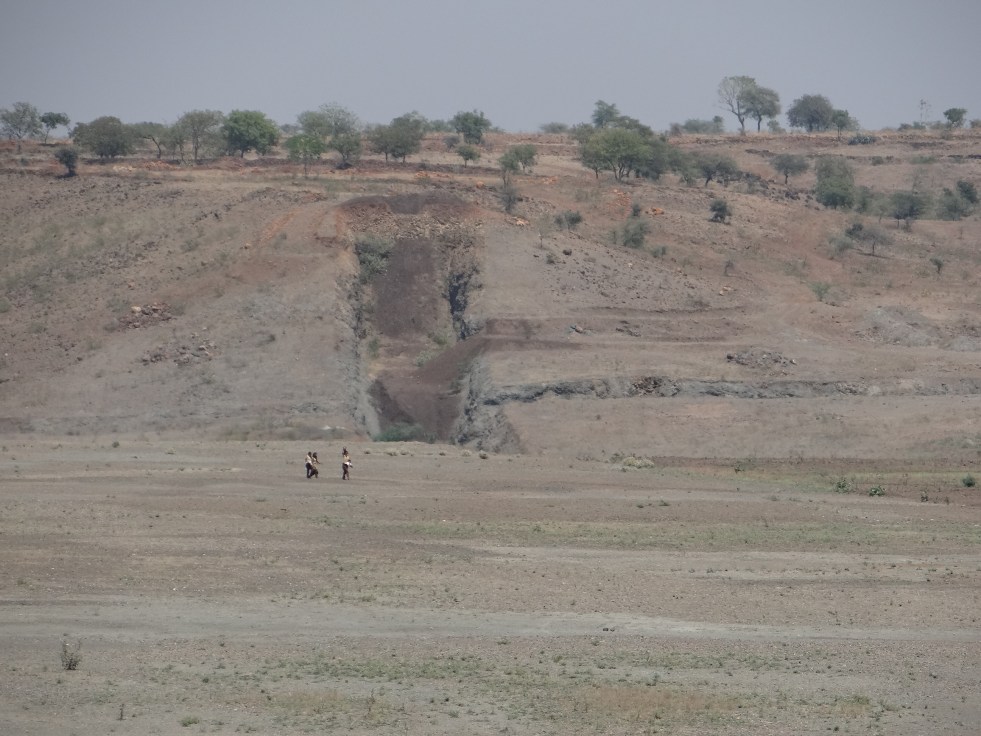
Krishna Marathwada Scheme receives Environmental Clearance WITHOUT Water Availability!
Why is the Maharashtra Govt and the MoEF misleading people of Marathwada?
Press Release 29.06.15
On the 24th June 2015, the Union Ministry for Forests, Environment and Climate Change (MoEF for short) granted Environmental Clearance[1] to Krishna Marathwada Lift Irrigation Scheme for diverting 23.66 TMC (Thousand Million Cubic Feet) water from Krishna 1 Sub basin to Krishna 3 Sub basin of Krishna River Basin. The media has reported the development as a “Respite for Marathwada”.
However, as SANDRP had written to the MoEF several times[2], this Environment clearance is based on non-existent water availability and a misleading EIA[3] by Science and Technology Park, University of Pune. Continue reading “Krishna Marathwada Scheme receives Environmental Clearance WITHOUT Water Availability!”

Digging deeper into water scarcity after watershed development
Above: Watershed measures in Maharashtra Photo: WOTR
~ Guest Post by Zareen Pervez Bharucha
Farmer after farmer had the same story: fields were parched, wells were empty, it was painful to see the land crack up and peel away like the soles of ones’ feet. ‘What can we do? This is what Nature has become,’ they said, in interview after interview.
I was speaking with farmers in Parner taluka in Maharashtra’s Ahmednagar district. My conversations were part of a research project on the long-term impacts of watershed development. In the same taluka, the village of Ralegaon Siddhi had turned dry fields into green farms using soil and water conservation and a strict set of rules governing land management. Their example and those of other seminal cases have shown the amazing potential of decentralized soil and water conservation. These successes have helped launch watershed development as India’s foremost strategy for dealing with the nexus of dryland degradation, rural poverty and hunger. I was curious about the lived experiences of people in ‘normal’ – rather than well-known – watershed projects. Continue reading “Digging deeper into water scarcity after watershed development”
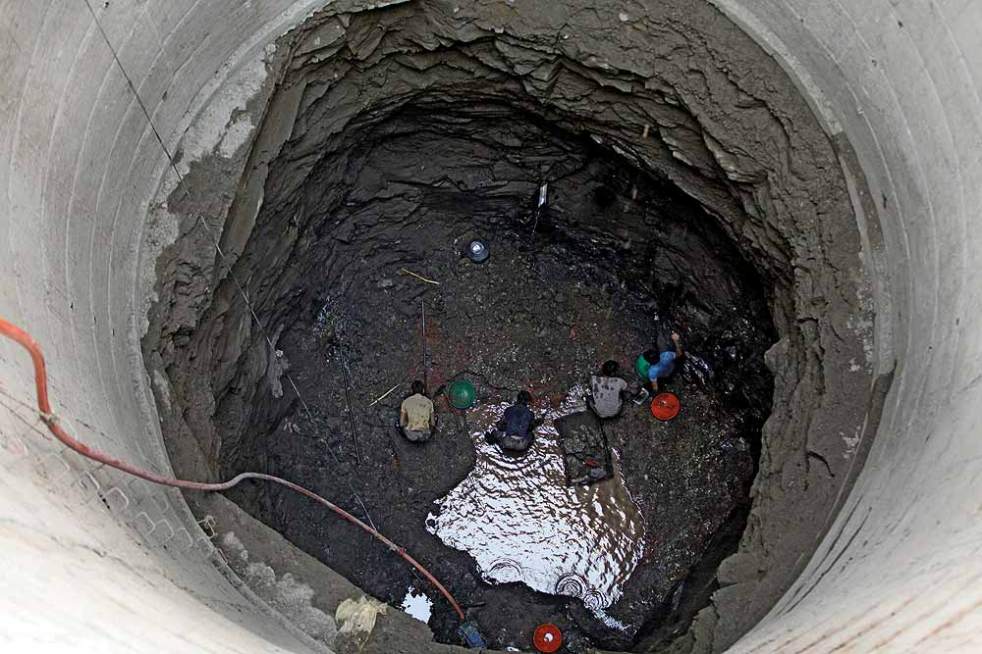
Maharashtra Groundwater Authority: Can it save the state from deep trouble?
(Photo from Outlook)
Harischandra Yerme from Latur (Maharashtra) sunk not one or two but 60 borewells in his field in Marathwada in the hope of finding water for his orchard. None of these 60 borewells yield water today. Mr. Yerme has taken on himself the task of educating farmers in his region that there is no sense in growing an orchard on bore wells: the supply may dry up at any moment, resulting in huge losses. He told me, “We don’t even consider 250 feet borewells now, all bores are at least 700-800 feet deep and even then they don’t work.” Marathwada is reportedly drilling as many as 10,000 borewells[1] per month in this drought: a boom that is sustained by the “boring mafia” from Andhra Pradesh and Tamilnadu using travelling rigs… In as many as 247 villages of Marathwada, the draft has exceeded recharge to such an extent that the aquifer has literally gone dry.. Water in villages is plummeting even by 7 meters of the 5 years average.[2] The density of borewells is so high that is villages near Tasagaon, a 40-50 square kilometer area has more than 210 deep bore wells. Officials from GSDA tell SANDRP of multiple instances where farmers only lose money in the hope of going deeper for groundwater, deeper than 800-900 feet. The landscape is likened to a “Chaalan”: a sieve in Marathi, but also several gunshot wounds.. Continue reading “Maharashtra Groundwater Authority: Can it save the state from deep trouble?”

Par-Tapi-Narmada Link: Divided States, United Tribals
Above: Just a few hundred meters upstream the proposed Jhari Dam, a tribal woman struggles to find water in the dry Par river bed Photo: Parineeta Dandekar
Village of Jhari at the northern most corner of Western Ghats has some of the loveliest houses I have seen. Appreciation for the evolved vernacular architecture goes beyond the obvious urban romanticisng of anything tribal. Homes in this region of tribes like Kokani, Warli, Thakurs, etc, are unique in their architecture, building materials, craftsmanship and the seamless mix of beauty and functionality. The tiled roof of our host Haribhau had intricate wooden trimmings, the mudfloor was cool and the door frame was carved in exquisite motifs. Vines arched and spread in disarray over courtyards. We were assembled under a passion fruit or ‘Rasna’ vine, bursting with white flowers. Inside, cane baskets creaked under the weight of Ragi, Udid and Rice filled to the brim: This year’s harvest has been good, though that’s not always the case. The hosts, both men and women, were busy with lunch preparations. Continue reading “Par-Tapi-Narmada Link: Divided States, United Tribals”
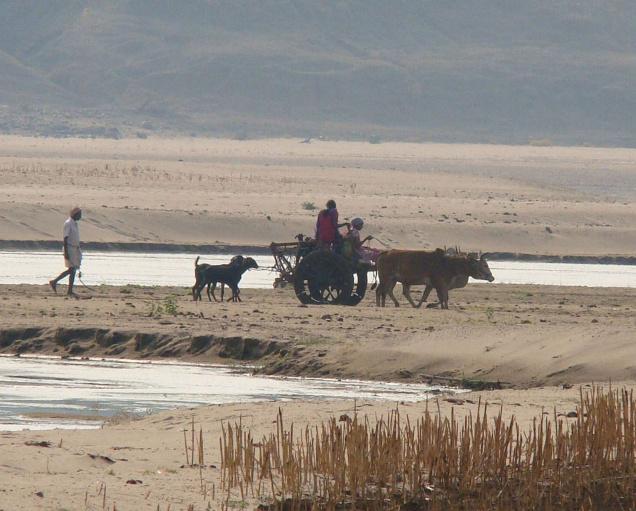
Pranahita Chevella Project: What it means for the affected people in Maharashtra
Above: A farmer family crosses the Pranahita river close to the Pranahita-Chevella project barrage site. Photo: Harpal Singh, The Hindu
Shivni is a small village of about 700-800 population in Gondpimpri Tehsil of Chandrapur District situated right at the confluence of Wardha and Weinganga rivers. These two rivers meet at juncture of three districts of two states (viz. Gadchiroli & Chandrapur of Maharashtra and Adilabad of Telangana) to form River Pranahita which is one of the biggest tributaries of Godavari. Pranahita travels a length of 113 km and meets Godavari at Sironcha tehsil of Gadachiroli Dist. Continue reading “Pranahita Chevella Project: What it means for the affected people in Maharashtra”
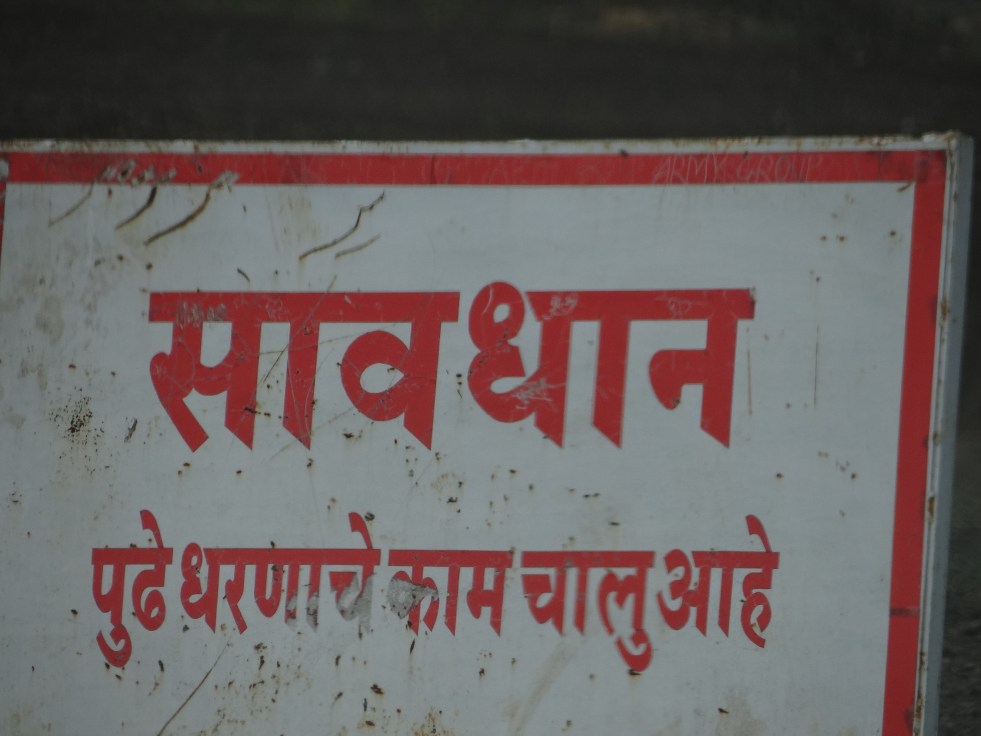
Krishna Marathwada Project: A costly pipe dream?
Above: A board at the dam site proclaims: “Beware, dam work ahead”. The warning pretty much sums up the situation of Krishna Marathwada Project Photo: Parineeta Dandekar
It was a blazing hot afternoon, made hotter by the subconscious association of Marathwada with all things dry, parched and drought-stricken. I was standing on the half completed dam wall of the Khuntephal Storage Tank in Beed, along with Macchindra Thorave and his colleagues. I’ve seen many dams and many dam walls, but it was impossible to believe this was a dam wall, supposed to impound 5.68 TMC of water (TMC=Thousand Million Cubic Feet. 1 TMC=28.317 billion liters). Primarily because there was no water in sight on either sides of the dam! There was no river in sight either! It actually looked like an under-construction road connecting two hills.
But as I realized later, being a part of the Krishna Marathwada Lift Irrigation Scheme and Krishna Bhima Stabilisation Project, issues like water were inconsequential. This was Dam for Dam’s sake.

Continue reading “Krishna Marathwada Project: A costly pipe dream?”

Lawlessness in Maharashtra’s Water Sector
Above: Increasing height of a dam which holds no water Photo: Parineeta Dandekar
Guest post by Pradeep Purandare, pradeeppurandare@gmail.com
Irrigation Laws in Maharashtra: Politics of Non-Implementation
Laws are generally enacted to implement the policy by the ruling class & its government to promote & safeguard its own class & caste interests. However, while drafting the policy & laws, politically correct concepts & terminology in fashion is used for public consumption. New things are accepted because those come as conditions for getting the loan from donor agencies. Creating a desirable image or impression at national / international level can also be the motivation. Adopting a new policy or enacting a new law does not necessarily mean that the establishment of the day sincerely believes in that policy & law. Once the purpose of getting the loan and or creating an impression is served, government conveniently forgets implementing the policy & the law. Or, implementation is done in selective & superficial manner. Clauses / sections which were included for public consumption & which can really make the difference, if implemented in letter & spirit, are generally either put in cold storage or subsequently amended to make them more “practical & workable”. This does not happen as a result of inefficiency, callousness or indifference. This happens with purpose & by well defined strategy. This is politics of non-implementation! It is done to implement the hidden agenda. Of course, it’s not something new. It has been happening since long & in most of the walks of life. This paper makes an attempt to simply describe how politics of non-implementation is being done in water sector in general & in the field of irrigation in particular in Maharashtra – a supposedly progressive, highly industrialized & a modern State of India.
Enacting a law is not sufficient. The operative part which includes rules, notifications, agreements, government resolutions, orders & circulars as per the new Act is also equally important. If operative part is not in place, then the Act remains on paper for all practical purposes.
PLEASE SEE ANNEXURE 1 for Detailed table.
Gist of missing operative parts & its implications are given below:
In absence of rules (yes, MIA 76 does not have rules for last 37 years!) & non-issuance of basic notifications (rivers, command areas & appointment of Canal Officers), MIA 76 which is supposed to be the parent Act has remained mostly on paper. Locus standi of implementing authority i.e. Water Resources Department (WRD), therefore, can itself be questioned. The obvious result is there is no water governance. Free for all situation exists. Water theft, vandalism & tampering with canal system are rampant. Offences go un-punished. Irrigators, particularly the tail enders neither get water nor compensation. Politically influential irrigators grab all the benefits. Diversion of water from irrigation to non-irrigation, flow irrigation to lift irrigation & food crops to cash crops becomes easy. Since nothing is legally committed, nothing can legally be challenged. The overall situation is best suited for privatization. An un-notified river or command area, relatively speaking, can easily be handed over to private company. That’s seems to be the ulterior motive of missing operative part!
MMISF Act was brought in to legally provide for Participatory Irrigation Management (PIM). World Bank insisted for the enactment & made it a compulsory condition for getting the loan under Maharashtra Water Sector Improvement Program (MWSIP). WRD, therefore, had to succumb. It however did not comply in letter & spirit. Ambiguity in rules for WUAs at higher level, non formation of sub committees, delayed or non execution of agreements with WUAs, insincerity in the processes such as “joint inspection” to “handing over”, not providing measuring devices, confusion over powers of WUAs, keeping lift irrigation out of purview of the Act, inordinate delays in returning part of tariff to WUAs for carrying out maintenance & repairs and last but not the least, non involvement of WUAs either in water budgeting or in conflict resolution speak volumes about the actual implementation of MMSIF Act. Intentions of WRD are clear & obvious. It considers WUAs as just a stop gap arrangement before going for corporatization & contract farming. One can imagine WRD’s line of argument in near future. It could be as follows “We tried our level best but WUAs could not succeed. Government cannot now take the responsibility of water management. Privatization appears to be the only way out”. Incomplete legal processes thus help establishment & make tail enders vulnerable.
Maharashtra established an Independent Regulatory Authority (IRA) in water sector by enacting MWRRA Act. It’s no doubt a pioneering effort. But the actual implementation of this Act is frustrating. There was reluctance to prepare the rules. Rules were prepared after 7 years from the enactment of the Act & that too only after an order to that effect by the High Court. Prepared rules, it is alleged, are contradictory to the provisions of the Act. They have been challenged & the matter is sub-judice.[yesterday Maharashtra’s legislative council had to discuss the issue in the house & Minister for WRD had to stay the implementation of rules] State Water Board & State Water Council has been legally constituted way back in 2005 to respectively prepare & approve the Integrated State Water Plan (ISWP). Both the board & council have not yet started their functioning. Obviously ISWP which was to be prepared within one year from the enactment of the Act is still not in place even after 8 years. MWRRA as per its own Act is supposed to take decisions with reference to ISWP. But it is going ahead even without ISWP. Similarly, River Basin Agencies (RBA) have not been operationalized & issuing water entitlements by RBAs has not so far materialized. MWRRA Act has been amended in 2011 to retrospectively protect non transparent decisions of High Power Committee regarding transfer of water from irrigation to non-irrigation. Powers of MWRRA in respect of sectoral water allocation have already been withdrawn by the said amendment. Effective area under water entitlement thus has been drastically reduced. MWRRA recently decided the criteria for water tariff. But it opted for the safest path. It reduced the water tariff to avoid criticism. But in the process whether it could follow the mandate given by the Act is a moot point. Act says that water tariff should fully recover the O & M Cost & canal system should be properly maintained. Ever deteriorating condition of canals in Maharashtra, however, tell a different story. Regulation of all types of water (surface & ground water) & its uses for different purposes (drinking, domestic, industrial & irrigation) is supposed to be done by MWRRA. Nothing significant has been done so far. In fact, in case of dispute over sharing Godawari Waters between upper & lower Godawari basins, MWRRA has been a silent spectator. As a quasi- judicial IRA it could have done many things. But it preferred playing politics of non-implementation..
Very structure & framework of water governance are thus missing in Maharashtra & hence, there is no Rule of Law. Water conflicts of all types are on increase at all possible levels. Misappropriation & mismanagement is the end result.
It is necessary to develop pro-people intervention strategies & peoples participation in water sector. Implementation of existing water laws could be a necessary (but of course not sufficient) beginning. There are many provisions in the existing water laws that could help initiate pro people intervention.
Politics of ‘non-implementation by ruling class’ needs to be effectively & immediately challenged by `politics of implementation by pro people forces’. That would help promote people-centered interventions which are so urgently required to fight diversion of water from irrigation to non-irrigation & privatization of water.
Annexure 1:
Implementation of Water Laws in Maharashtra: A Critical Review
| Sections | Present status | Impact |
|
MIA,76 |
||
| Sec 114: Rules | Rules not prepared in 37 years | Act remains on paper |
| Sec11: River notification | Incomplete in many projects | People not informed/ opportunity of being heard denied. Locus standi of WRD doubtful |
| Sec 3: Command notification | Incomplete in many projects | —- do ——– |
| Sec 8: Appointment of Canal Officers | Done but not operative | No one takes initiative. Nobody is held responsible. Free for all situation. Water theft, vandalism & tampering with canal system are rampant. Offences go un punished. No FIR. No action. |
| Sec 75 to 87: Award of
Compensation |
Not used at all. | Irrigators don’t get compensation even if the agreed volume of water is not delivered at right time & place. No accountability for the Canal Officers. |
|
MMISF Act, 2005 |
||
| Sec 76: Rules | Prepared. Excessive use of “mutatis mutandis” |
Ambiguity in rules for WUAs at higher level |
|
Sec 20: Sub committees |
Not formed in last 8 years | Purpose of participation with decentralization & expanding the circle of knowledge & skill defeated. |
| Sec 21,29: Agreement | Not executed in time & at all levels of WUAs
Serious complaints about not having joint inspection in true sense, non- completion of agreed repairs & rehabilitation & reluctance by officers to hand over the system |
Purpose of delegation of powers & imbibing sense of responsibility defeated. Encroachment on powers of WUAs
Nexus between local Politicians & officers continues unabated. WRD loses its credibility. Poor quality of repairs & rehabilitation. In absence of real handing over of management to WUAs, power of water distribution remains with WRD officials. Only lip service to participation. |
| Sec 22: Joint inspection,
…..handing over … and Sec 23: Measuring devices (MD) |
Not executed in time & at all levels of WUAs
Serious complaints about not having joint inspection in true sense, non- completion of agreed repairs & rehabilitation & reluctance by officers to hand over the system Providing MD is not yet complete. Credibility of measurement records is doubtful |
Volumetric supply of water to WUAs mostly remains on paper. |
| Sec 28: Supply of water as per entitlement | In absence of proper water budgeting at project level, irrigation scheduling of main system & MD, supply of water as per entitlement is an exception rather than a rule. | Bulk supply of water based on entitlement given volumetrically is still a distant dream. WRD is not yet fully equipped for the purpose with compatible physical system. |
|
Sec 30: Powers to WUAs |
Not spelt out | WRD officials wield the real power. |
| Sec 38: Competent Authority | Not operative | WUAs don’t get any technical advise |
|
Sec 39 to 51: Lift Irrigation WUAs |
Provisions not brought in force | No control over – & regulation of – lift irrigation. Act simply not made applicable to lift irrigation.. |
|
Sec 52: Powers & functions of WUAs |
Only responsibilities(& not powers) have been spelt out | WUAs remain ineffective. |
| Sec 53: Powers & functions of Canal Officer | Emphasis on powers & not on responsibilities | In absence of accountability of any kind, WRD officials remain indifferent & callous |
| Sec 54: Sources of Funds of WUAs | Water tariff collected from the members of WUA is the only source of income. WRD has promised to return substantial part of tariff to WUA. However, the promise is not being kept. | Most of the WUAs are not economically self reliant. They face problems in routine maintenance & repairs of the canal system and can’t afford to maintain office & staff. |
|
Sec 60 to 62: Offences & penalties |
Not operative. |
No water governance worth the name. |
| Sec 63 & 64: Conflict Resolutions | Not operative. MWRRA indirectly attempts to bypass the powers of upper level WUAs through regulators | WUAs not involved in conflict resolution. Purpose defeated. |
|
Sec 68: Water budgeting at Project Level |
Not operative. | WUAs not involved in water budgeting. Purpose defeated. |
| Sec 70: Water supply for non-irrigation purposes | Water entitlement issued only to select WUAs in selected projects. Unit for issuing entitlement is not project as a whole. Therefore, ineffective provision. | Water supply to non-irrigation gets priority even during periods of shortage of water. Second priority given to irrigation by amending State Water Policy is not being honoured. |
|
Sec 71: Recovery of water charges |
Coercive measures not operative. | Recovery of water tariff is very poor. |
| Sec 72: Act to apply to
Existing WUAs |
Difference of opinion between WRD & Cooperative Department regarding how to operationalize the provision |
Act not being applied to existing WUAs |
|
MWRRA Act, 2005 Act amended in 2011 to retrospectively protect non transparent decisions of High Power Committee regarding transfer of water from irrigation to non-irrigation |
||
| Sec 3: Establishment of Authority |
Retired bureaucrats are in control. |
Powers of MWRRA regarding sectoral allocation withdrawn.
Effective area under water entitlement drastically reduced. There is hardly any regulation as per the Act. Issue of releasing water to Jayakwadi project from up – stream projects is the glaring example. |
| Sec 5: Selection Committee | Serving bureaucrats are in control. | Members of selection committee select themselves as Member / Secretary of MWRRA & join the authority soon after retirement from Government. |
| Sec11: Powers, functions duties of authority | Selective & limited implementation. Sec 11 (f) not implemented. Project clearance even without Integrated State Water Plan [ISWP] | Adhocism, confusion & regional imbalance in water resources development may further increase |
| Sec 12: General policies of Authority |
Not implemented even when water users have moved the court of law. Several petitions pending in Mumbai High Court |
Principles of Tail to head irrigation & equitable distribution of water at river basin level not implemented leading to political agitations & increased animosity within regions of the State. |
| Sec 13: Dispute Resolution Officers |
Appointed. Not active. |
In absence of information & awareness about provisions in the Act, water users don’t insist for suitable action. Hence, it is assumed that absence of complaint means absence of dispute itself. |
| Sec 14: Permission of River basin Agency |
River Basin Agencies though exist as per law, they have not started functioning like RBAs |
Since RBAs have not issued any water entitlement & not officially permitted any water use whatsoever, every water use since enactment of the Act could be, legally speaking, unauthorised & hence, illegal. |
| Sec 15: State Water Board |
Legally constituted but not at all functioning. |
SWB (Chairperson- Chief Secretary) is supposed to prepare ISWP. Nothing happened in last 8 years. |
|
Sec 16: State Water Council |
Legally constituted but not at all functioning. |
SWC (Chairperson- Chief Minister) is supposed to approve ISWP. And then MWRRA should function as per ISWP. Nothing happened in last 8 years. MWRRA is taking decisions violating Sec 11 (f) of its own Act. |
|
Sec 21: Special Responsibility of Authority |
Not implemented | Gravity & seriousness of issues regarding backlog in irrigation has not reduced. In fact, it has increased a lot. |
|
Sec 22: Disputes & Appeals |
Not in use by the water users. Lack of awareness. |
Grievance redressal mechanism provided in the Act, if used, could reduce number of cases going directly to court of law. |
| Sec 23 : Directives of
Government |
Not given so far | Government could have used this route instead of amending the Act in haste & panic. It could have also given directions to MWRRA in case of Jayakwadi dispute. |
| Sec 26: Punishment for
non-compliance |
Not used so far. |
No effective governance |
|
Sec 30: Rules |
Prepared late only after High Court’s order. Rules to certain extent are contradictory to the provisions in the Act | Discontent about Rules in Marathwada. Rules challenged in court of law. MLAs requested to challenge the rules in legislative assembly & council |
References:
- Maharashtra’s State Water Policy, July 2003
- Maharashtra Irrigation Act, 1976 (MIA76),
- Maharashtra Management of Irrigation by Farmers Act, 2005 (MMISF Act)
- Maharashtra Water Resources Regulatory Act, 2005(MWRRA Act)
- Purandare Pradeep, “Wanted – Rule of Law”, http://www.downtoearth.com
***
– Pradeep Purandare
Retd. Associate Professor, Water & Land Management Institute, Aurangabad, Maharashtra
(The above piece is based on a paper presented at the International Conference, Dec 19-21, 2013,Organized by College of Social Work, Nirmala Niketan, Mumbai, India)
pradeeppurandare@gmail.com, http://jaagalyaa-thewhistleblower.blogspot.in/, http://www.irrigationmainsystem.com

Battered Maharashtra and Melting Tibet: The Climate Change Connection
Above: Nagpur or Anantnag? Hailstorms of March 2015 in Nagpur Photo by: Atul Patne
~~
It seems like a bad deja vu.
On the 11th March last year, we wrote about hailstorms in Maharashtra. Back then, the hail, unprecedented rains, strong winds and changes in temperature had affected more than 10 lakh hectares, mainly in Marathwada and Vidarbha. After near-exact one year, we write about the issue again.
Late February and March rains have battered farmers in Vidarbha, Konkan, Marathwada and Uttar Maharashtra (Nashik, Jalgaon and Dhule Districts). Preliminary estimates state that over 8.5 lakh hectares of crops have been impacted in just 17 days and thousands of farmers and landless laborers have been affected. Continue reading “Battered Maharashtra and Melting Tibet: The Climate Change Connection”

Thirsty sugarcane in dry Marathwada means a loss of 2 million farmer livelihoods
Above: Gangakhed sugar factory from Parbhani Marathwada which has crushed 7 Lakh Tonnes of cane till 21 Feb 2015. Parbhani has received a mere 346 mm rainfall this year, nearly equal to what it received during epic drought of 1972
~~~
Although Marathwada region in Maharashtra is no stranger to droughts, it’s facing a singularly acute crisis this year. Kharif crops had failed in all of the 8139 Kharif villages in the region with yields less than 50% of government standards (paisewari). Rabi is under cloud too with all 396 villages assessed for production showing less than 50% yield. And yet, area under and production of water guzzler crop like Sugarcane is going up. In 2013-14, Marathwada grew over 2 lakh hectares of sugarcane and is now crushing the cane in its 61 sugar factories using thousands of lakhs of litres water every day.
Does this make any social, economic or environmental sense? No
But do we have options? It seems so. Let us see how. Continue reading “Thirsty sugarcane in dry Marathwada means a loss of 2 million farmer livelihoods”
 SANDRP