Dams

India Rivers Studies 2017: Rivers Succumbing To Dams, Pollution & Climate Change

After reviewing status of India rivers, SANDRP presents an account of research, studies and important reports on erratic monsoon, climate change, floods which all are severely affecting the rivers, their aquatic life and livelihood of dependent communities.

Rivers and Monsoon

Number of rainy days falling across river basins in India The study has found that number of rainy days is falling across river basins in India and rainfall intensities are seen to be increasing. The analysis determined changes in heavy precipitation and peak flood for seven river basins in India—Krishna, Godavari, Mahanadi, Narmada, Cauvery, Sabarmati and Brahamani and Baitarani. For the study, data pertaining to daily flows for about 30 odd years and precipitation for 61 years (from 1951 to 2012) were analysed.

The analysis also said the rivers which flow from west to east direction (in India) have more rainy days compared to those which flow towards the west. The study also held that anthropogenic activities (construction of storage reservoirs, diversions, urbanization, land-use change, and soil and water conservation measures, among others) have probably affected the generation of peak floods in the rivers of India. http://www.livemint.com/Politics/c7v8oXmsMDHIldjDv9k6lK/Number-of-rainy-days-falling-across-river-basins-in-India-s.html (Live Mint, 27 April 2017)

Continue reading “India Rivers Studies 2017: Rivers Succumbing To Dams, Pollution & Climate Change”
Dams

Positive Rivers Stories 2017: Citizens Reconnecting with Rivers

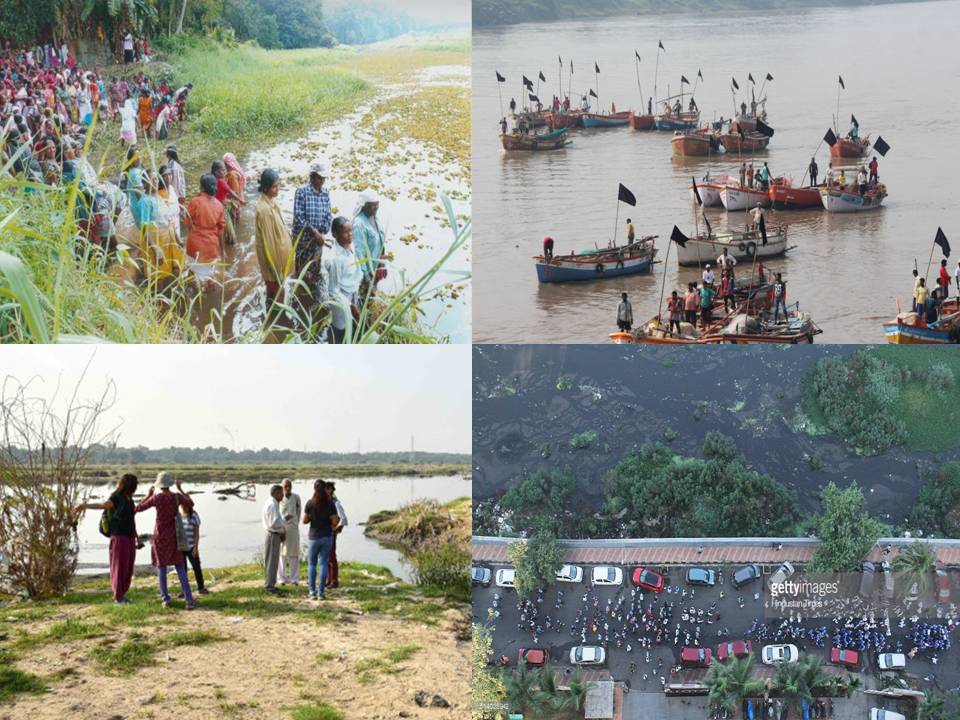
On occasion of International Day of Action for Rivers 14 March 2018, SANDRP presents a compilation of positive rivers stories that took place in the year 2017. The report highlights the exemplary rivers restoration work done by communities, village Panchayats.  It also attempts to acknowledge remarkable on going protests and struggle by fisherfolks, villagers and river communities in rural areas to protect the lifelines from unsustainable development projects. The report also presents the interesting “River Marches” where citizens have come forward to take actions against the threats on rivers in Urban areas and encouraging “River Walks” helping citizens rediscover their bond with RIVERS.  Continue reading “Positive Rivers Stories 2017: Citizens Reconnecting with Rivers”

Dams

North East India Rivers Review 2017: Agenda behind Brahmaputra & Barak Fesitvals won’t Help the Rivers

This eighth Rivers Review 2017 report presents account of key rivers related developments in North Eastern states comprising Assam, Arunachal Pradesh, Manipur and Meghalaya. 

Rivers As National Waterways Rivers of North-East to be tamed for transportation Pursuing its agenda of inland waterway transportation, the Inland Waterways Authority has reportedly organized a road show and a seminar in Guwahati to resolve major issues linked with developing the rivers as viable and sustainable means for cargo and passenger transportation.

Continue reading “North East India Rivers Review 2017: Agenda behind Brahmaputra & Barak Fesitvals won’t Help the Rivers”

Dams · DRP News Bulletin

DRP: 12 Mar 2018 (Swami Gyan Swaroop Sanand To Go On Fast For Ganga)

Swami Gyan Swarup Sanand (Prof G D Agarwal formerly) writes to Prime Minister on Feb 24 with three demands on Ganga and says if these are not satisfied by Ganga Dashera (June 22, 2018), he will go on fast unto death. The three demands are: 1. stop work on Vishnugad Pipalkoti, Singoli Bhawari and Phata Byung HEPs 2. Pass in Parliament the Draft Ganga protection act drafted by Just (retired) Girdhar Malviya headed committee and 3. Create a National Ganga follower committee whose permission will be necessary before taking any decision about Ganga. See the detailed blog by Arun Tiwari ji and link to the letter to PM. http://hindi.indiawaterportal.org/Swami-Sananda-open-letter-pm-modi-clean-ganga

Continue reading “DRP: 12 Mar 2018 (Swami Gyan Swaroop Sanand To Go On Fast For Ganga)”
Dams

East India Rivers Review 2017

The seventh report reviewing status of India’s rivers in 2017, focuses on Rivers in West Bengal, Odisha, Bihar, Jharkhand and Chhattisgarh. This review does not include main Ganga river as there is separate Review of state of Ganga River.

West Bengal Rivers

Rivers pollution worse than in 2014 According to the latest State of Environment Report, it has been found that in the 17 major rivers of the state, including the Ganga, the levels of coliform bacteria are much higher than the permissible limit. The report further revealed that several stretches of the Ganga had a total coliform count ranging from one to four lakhs, making the water totally unfit for even bathing. The report has also stated that compared to 2014, all the four main rivers of north Bengal recorded a significant increase in total coliform count. http://www.thehindu.com/todays-paper/tp-national/bengals-rivers-in-a-bad-shape/article22459562.ece (The Hindu, 18 Jan. 2018)

Continue reading “East India Rivers Review 2017”

Dams

Tamil Nadu Rivers Review 2017: Despite Drought; Diversion of Rivers’ Waters To Private Companies

This sixth compilation under Rivers Review series, presents situation of rivers in Tamil Nadu in the year 2017. 

Tamirabarani River Opposition grows against Tamirabarani water to soft drink units In March 2017, various citizen groups submitted petitions to Collector M. Karuankaran, opposing the decision to supply huge quantity of water from the Tamirabarani to beverage manufacturing units in Gangaikondan Industrial area. They also asked the State Government to cancel the agreement with the soft drink manufacturing units on supplying the river water and make sincere efforts to revive the river. http://www.thehindu.com/news/national/tamil-nadu/tamirabarani-protest-intensifies-tirunelveli/article17457199.ece (The Hindu, 13 March 2017)

Continue reading “Tamil Nadu Rivers Review 2017: Despite Drought; Diversion of Rivers’ Waters To Private Companies”

Dams

Kerala Rivers Review 2017 : Government Efforts Fail To Protect Rivers

The fifth rivers’ review highlights status of Kerala rivers in the year 2017. 

Rivers Pollution and Government Actions

Govt mulls severe punishment for agents of water pollution The state government on Feb. 2017 signaled its intentions to zero in on agents of pollution in water resources. The Pollution Control Board and Revenue Department officers swooped down on a private resort in Chinnakkanal, Idukki, for allegedly diverting sewage into a potable water source. Water Resources Minister Mathew T Thomas stated that his department has proposed amendments to the Kerala Irrigation and Water Conservation Act, 2003, to make punishments more severe. He also said that the govt was planning to have harsher measures in place to discourage people from polluting rivers and water bodies.http://www.newindianexpress.com/states/kerala/2017/feb/14/kerala-government-mulls-severe-punishment-for-agents-of-water-pollution-1570357–1.html (The New Indian Express, 14 Feb. 2017)

The state also planned to enact strong legislation for the conservation of rivers. http://www.newindianexpress.com/cities/thiruvananthapuram/2017/sep/06/state-to-frame-strong-law-for-river-protection-1653026.html(The New Indian Express, 6 Sept. 2017)

Continue reading “Kerala Rivers Review 2017 : Government Efforts Fail To Protect Rivers”

Dams

South India Rivers Review 2017: More Water for Cities from Drying Rivers

This fourth rivers review presents developments related to rivers in States of South India including Telangana, Andhra Pradesh, Karnataka. 

Telangana Rivers 2017

Manair River Garbage polluting Manair river The shores are being polluted by the Municipal Corp of Karimnagar (MCK), which is dumping garbage generated from the town. Other private agencies such as chicken centres, hotels, private hospitals, mechanical shops and others too are also dumping garbage generated at their places into the river Manair. The State Govt had decided to develop the Manair front on the lines of Sabarmati river front development, which would spell further disaster for the river.  http://www.thehindu.com/news/national/telangana/Garbage-polluting-Manair-river/article17113713.ece (The Hindu, 30 Jan. 2017)

Continue reading “South India Rivers Review 2017: More Water for Cities from Drying Rivers”

Dams

West India Rivers Review 2017: Governments, Industries Destroy Rivers

After review of North India and Maharashtra Rivers, SANDRP presents the development surrounding rivers in rest of West Zone: Gujarat, Goa, Madhya Pradesh and Rajasthan states in 2017.

Gujarat Rivers

Dams, industrial pollution killing State Rivers In MoEF report, Gujarat ranks 4th among top 5 states with highly polluted rivers. Sabarmati is among Gujarat’s 20 most polluted rivers including Narmada and Mahi. Over Rs 200 cr has been spent to curb pollution in Sabarmati & Mindola rivers. This fund is the highest amount ever spent outside the Ganga river conservation project on which Uttar Pradesh has spent Rs 917.24 crore, West Bengal Rs 411.26 crore and Bihar Rs 216.46 crore. As per activist, Rohit Prajapati, industrial effluents are being released in big rivers like Sabarmati, Mahi and Narmada without being treated and big dams have been built on big rivers due to which the rivers are drying up and vanishing as a result, the condition of rivers in Gujarat is going from bad to worse. https://timesofindia.indiatimes.com/city/ahmedabad/polluted-rivers-guj-ranks-4th/articleshow/62685910.cms (The Times of India, 29 Jan. 2017)

Continue reading “West India Rivers Review 2017: Governments, Industries Destroy Rivers”

Dams

Maharashtra Rivers Review 2017: Multi-colored Rivers!

About Rivers Pollution and Pollution Control Board

Highest number of polluted rivers Maharashtra state has 49 polluted river stretches, highest in the country, which including Mithi, Ulhas, Vaitarna, Godavari, Bhima, Krishna, Tapi, Kundalika, Panchganga, Mula-Mutha, Pelhar and Penganga. 3,000 MLD of untreated sewage and industrial effluents are discharged into the state’s water bodies daily. http://www.hindustantimes.com/mumbai-news/pollution-in-three-maharashtra-rivers-is-nine-times-permissible-limit/story-RCuTrl8zi8tmFoOvgKR2zI.html(Hindustan Times, 16 Nov. 2017) 

According to a report by Union Environment Ministry, Maharashtra generates about 8,143 Million Liter per Day (MLD) which is almost 13 per cent of the country’s sewage, butclaims to treats 5,160.36 MLD.In this way Maharashtra is releasing at least 3000 MLD untreated sewage in rivers, creeks and wetlands areas. http://www.hindustantimes.com/mumbai-news/834-factories-across-maharashtra-shut-down-in-2-years-for-causing-pollution-mpcb/story-MrmmXa9XH9Vdkzu2wKSdcL.html (Hindustan Times, 22 Dec 2017)

Continue reading “Maharashtra Rivers Review 2017: Multi-colored Rivers!”