Climate Change · Dams · Ganga · Irrigation · Monsoon · Sand Mining · Uttarakhand

Dams, Rivers & People News Bulletin Oct 12, 2015

Arunachal:-  Siang People’s Forum writes to MoEF to not allow mega dam on Siang River, State Govt. supports the cause

Assam:- Locals, CM show stiff resistance to Lower Subansiri power project

Himachal:-Jispa Dam project faces opposition

Uttarakhand:- From 60 to 7000 patients in 3 years, Uttarakhand floods play havoc with mental health

Maharashtra:- Drought-Hit Maharashtra to generate 400 mw hydropower

Himalaya:- Dams, Hydro projects & other development works may wipe out many unknown species being discovered in Eastern Himalaya

Climate Change :- The Hydropower Methane Bomb No One Wants to Talk About

Continue reading “Dams, Rivers & People News Bulletin Oct 12, 2015”

Climate Change · Dams · Drought · Environment · Ganga · Hydropower · Irrigation · Monsoon · Rivers · Sand Mining

Dams, Rivers & People News Bulletin, Oct 05, 2015 (On Climate Agenda Govt. scale down targets but on ground still pushing hard many hydro projects)

HYDROPOWER

Hydro fast loosing sheen in renewable energy basket  and the share of hydro is likely to decline further as through the past three years, the installed capacity of hydropower projects has remained around 40,000 Mw. While the report superficially may appear as a sigh of relief nevertheless on ground Indian Govt. is still in a hurry to push many big hydro power projects particularly in North-Eastern States. Last month only Piyush Goyal Power Minister cleared the Teesta-III and spoke of clearing Subansiri too. In Siang basin Pauk, Heo, Tato-I are recently approved by MoEF Panel. Protest against 780 Nyamjang Chhu HEP is going on. Similarly several projects in Ganga, Barhamputra and Satluj basin are being cleared and constructed in plain violation of stipulated green norms. Public and private developers are repeatedly ignoring environmental concerns and not addressing the issues raised by local people.

Continue reading “Dams, Rivers & People News Bulletin, Oct 05, 2015 (On Climate Agenda Govt. scale down targets but on ground still pushing hard many hydro projects)”

Climate Change · Dams · Drought · Environment · Ganga · Irrigation · Monsoon · Rivers

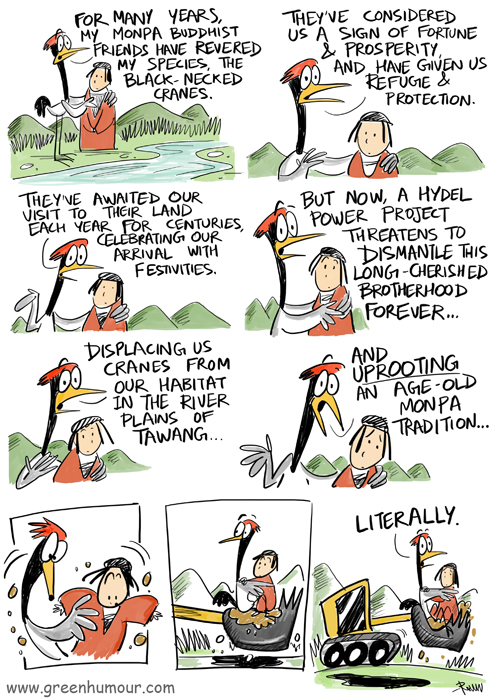
DRP News Bulletin, Sep 21, 2015: Buddhist Monpas, Black-necked Cranes & Nyamjang Chhu Project

Rohan Chakraborty’s cartoon on the threat from 780 MW Nyamjang Chhu hydel project to Black- necked Cranes revered by the Buddhist Monpas of Tawang.

HYDROPOWER

UTTARAKHAND: Hydro Power companies, BRO, PWD still dumping debris in Uttarakhand rivers, forest department under pressure as administration and judiciary stand in defence of culprits  MOST SHOCKING STATE OF AFFAIRS IN UTTARAKHAND HYDRO AND RIVERS: “SS Rasailey, director of the Nanda Devi Biosphere Reserve said, “BRO and PWD have been throwing all the road construction-related garbage into the rivers on a regular basis. Similarly, companies behind the THDC run Pipalkoti-Vishnuprayag and NTPC-run Tapovan-Vishnugad hydel projects have been doing this as well, despite the fact that all of them have to dispose waste on a separate piece of land as per the guidelines. While they show that they are following the rules on paper, in reality they don’t.” Rasailey added that while forest officials have taken up this issue, filing cases and even getting the people arrested for alleged waste disposal in Chamoli district, they have not received cooperation from the administration or the judiciary in prosecuting the big companies which are among the violators.

This story sheds light on the plight of people displaced by Tehri Dam as thousands of them are still waiting for proper compensation and rehabilitation. The woes of the displaced people never end. Himangshu Thakkar of SANDRP, who has been working on issues associated with large dams, warned of playing with rivers, “With dams, our politicians are inviting disaster and playing with the lives of people, the Himalayas, the Ganges and future generations. They didn’t learn anything from the June 2013 disaster”.

ARUNACHAL PRADESH MoEFCC massive clearance spree of Arunachal hydro power projects bound to have repercussions as there have been no public consultations in Arunachal Pradesh or Assam. Surprisingly, Subansiri river basin study was not even listed among the 14 subjects that were placed for discussion. However, this did not stop the Committee from taking a decision to go ahead with 26 projects. On 3097 MW Etalin by Jindal group on Dibang, the EAC has recommended  primary surveys only in monsoon, not in winter and pre-monsoon, which experts  say is an attempt to enable faster clearances while compromising ecological and social security as lot of use of areas by people and wildlife is in winter and pre-monsoon, not just monsoon.

Continue reading “DRP News Bulletin, Sep 21, 2015: Buddhist Monpas, Black-necked Cranes & Nyamjang Chhu Project”

Climate Change · Dams · Drought · Environment · Ganga · Hydropower · Interlinking of RIvers · Irrigation · Rivers

DRP News Bulletin 31 Aug. 2015: Drought hit Latur residents are not guarding gold or money but water

Water has become a closely guarded resource in Latur city which receives municipal supply only once every 15 days. The Dhanegaon dam which supplies water here has been at “dead storage level” for the last four years because of the meagre rains. But this year the water crisis is much worse: the arid Marathwada belt where Latur is located has reported the highest rain deficit in the entire country.

HYDROPOWER

JAMMU & KASHMIR: Eco concerns over Baglihar hydel project worry experts, locals The 900-MW Baglihar hydroelectric project continues to increase the worries of experts and inhabitants in the erstwhile Doda district comprising Kishtwar, Doda and Ramban districts as the region faces a major threat of severe climate change, courtesy successive regimes which have ignored all environmental concerns attached to the project. Torrential rain, cloudbursts and massive landslides are said to be new dangers confronting the people of the erstwhile Doda district which are mostly due to creation of the reservoir of between 30 km and 35 km in length. The region falls in Seismic Zone IV. In another interesting development referring to the All India Power Survey findings, the J&K government’s report—State Action Plan on Climate Change—states that climate change would have drastic impact on hydropower generation capacity in J&K in three possible ways. Firstly, the available discharge of a river may change since hydrology is usually related to local weather conditions, such as temperature and precipitation in the catchment area. Secondly, an unexpected increase in climate variability may trigger extreme climate events, i.e. floods and droughts, and thirdly, changing hydrology and possible extreme events may increase sediment risks. It further reveals that more sediment, along with other factors such as changed composition of water, raises the probability that a hydropower project suffers greater exposure to turbine erosion. Moreover, an unexpected amount of sediment will also lower turbine and generator efficiency, resulting in a decline in energy generated. Since the majority of power is generated from hydropower sources, there are high chances that Jammu and Kashmir may face power crisis if the projected impact of climate change happens. Higher demand of energy due to climatic variability and lower generation due to projected impact of climate change would widen the power supply-demand deficit in Jammu  and Kashmir.

Continue reading “DRP News Bulletin 31 Aug. 2015: Drought hit Latur residents are not guarding gold or money but water”

Climate Change · Dams · Maharashtra

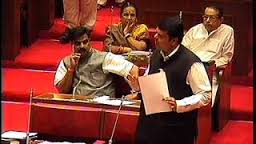
We pushed large dams, not irrigation, this has to change: CM Fadnavis’ Assembly Speech

“Maharashtra has the country’s 40% large dams, but 82% area of the state is rain fed. We have moved away from our vision of watershed and conservation…We did not think about hydrology, geology and topography of a region before pushing large dams everywhere. But this has to change”

These are not the words of an activist or water researcher. This was said by Maharashtra’s Chief Minister Devendra Fadnavis, during Monsoon Assembly Session of Maharashtra on 21st July 2015. Continue reading “We pushed large dams, not irrigation, this has to change: CM Fadnavis’ Assembly Speech”

Climate Change · Dams · Environment · Ganga · Narmada · Rivers · Sand Mining

Dams, Rivers & People News Bulletin June 15, 2015

HYDROPOWER

Nothing covert about it: We think of northeast India only as a frontier (12 June 2015) BRILLIANT and yet VERY THOUGHT PROVOKING piece from Nitin Sethi: “Take the case of dams in Himalayas. The religious value of Ganga for us in the mainland forces governments to at least pretend to save the river and the people around it from the contract and concrete driven madness. But the same governments do not think twice about displacing entire cultures that flourish in the Brahmaputra basin building the same bumper to bumper dams on the Brahmaputra basin, bending rules regulations and policies for ‘strategic interests’. The irony is lost on us when we cordon leftover lands of these cultures in ‘compensation’ for the loss of ‘India’s’ wildlife and forests to the inundation that follows… We govern their homelands like a frontier – sending out-of-favour governors and officials on punishment postings.” http://www.business-standard.com/article/opinion/nothing-covert-about-it-we-think-of-northeast-india-only-as-a-frontier-115061200799_1.html

Hydropower: Down to a trickle (10 June 2013) Uttarakhand flashflood put a fresh spanner in the works amid concerns over climate change and its impact on rainfall and on river flow and its patterns, which in turn may have an impact on plans for hydropower generation. Most of India’s hydropower potential falls in seismic zone 5, a region classified as highly vulnerable to high-intensity quakes. Even among green projects, hydro takes top billing. In March, during the first half of the Budget session, power, coal and renewables minister Piyush Goyal admitted in the Lok Sabha that uncertainties in the hydropower sector were keeping investors away. http://indianexpress.com/article/india/india-others/hydropower-down-to-a-trickle/#sthash.72LEpqvn.dpuf

NORTH-EAST:  Activists in  Arunachal Pradesh  oppose Centre’s plans  to build dams on Siang river  (12 June 2015) Very apt: “”on the one hand you are diligently busy in Clean Ganga and Save Ganga and on the other hand you are planning a disaster on Siang sitting at Delhi.  ” The forum’s general secretary     Oyar Gao also raised the issue of the river’s sanctity saying that the Siang is referred to as Aane (mother) in the same manner as Ganga Maiya.” http://economictimes.indiatimes.com/articleshow/47642482.cms?utm_source=contentofinterest&utm_medium=text&utm_campaign=cppst

Continue reading “Dams, Rivers & People News Bulletin June 15, 2015”

Climate Change · Dams · Maharashtra · Marathwada

Battered Maharashtra and Melting Tibet: The Climate Change Connection

Above: Nagpur or Anantnag? Hailstorms of March 2015 in Nagpur  Photo by: Atul Patne

~~

It seems like a bad deja vu.

On the 11th March last year, we wrote about hailstorms in Maharashtra. Back then, the hail, unprecedented rains, strong winds and changes in temperature had affected more than 10 lakh hectares, mainly in Marathwada and Vidarbha. After near-exact one year, we write about the issue again.

Late February and March rains have battered farmers in Vidarbha, Konkan, Marathwada and Uttar Maharashtra (Nashik, Jalgaon and Dhule Districts). Preliminary estimates state that over 8.5 lakh hectares of crops have been impacted in just 17 days and thousands of farmers and landless laborers have been affected. Continue reading “Battered Maharashtra and Melting Tibet: The Climate Change Connection”

Climate Change · Disasters · Hindi Blogs

जलवायु परिवर्तन की मार झेल रहे भारतीय किसान ; बेमौसमी बरसात का प्लेजियों को सबसे ज्यादा नुकसान

जलवायु परिवर्तन की मार से किस प्रकार भारतीय खेती और किसान प्रभावित हो रहे है, इसकी एक झलक हमको फरवरी अंत और मार्च 2015 के आंरभ में हुई। अप्रत्याशित हिमपात, बरसात एवं परिणामस्वरूप आई बाढ़ के रूप में देखने को मिली। 28 फरवरी से 03 मार्च 2015 चार दिन तक हुई इस बेमौसमी बरसात से लाखों भारतीय किसानों के प्रभावित होने की आशंका है। साथ-साथ जलवायु परिवर्तन जनित इन घटनाओं से भूमिहीन किसानों की बहुत अधिक दुर्दशा होती है और ऊपर उनकी सुध लेने वाला कोई नहीं है। Continue reading “जलवायु परिवर्तन की मार झेल रहे भारतीय किसान ; बेमौसमी बरसात का प्लेजियों को सबसे ज्यादा नुकसान”

Climate Change · Disasters

Early Spring Rains bring Climate Disaster for farmers in India

It was bit of a shock to get up to a VERY wet Sunday on March 1, 2015, having slept past midnight the previous night with a ‘dry’ weather. When I checked my inbox, the message from Manoj Misra of Yamuna Jiye Abhiyaan was waiting to provide a link to Accuweather.com site[1] and also satellite image from India Meteorology Department (IMD) site[2]. It looked ominous: “A potent storm will drop unusually far south as March begins, blasting India and Pakistan with heavy thunderstorms, flooding rain and burying mountain snow.” Northwestern India and Northern Pakistan were to face the maximum impact, but the impacts were to reach far down south right upto Karnataka. As the site said it was a rare event: “It is rare for widespread substantial rain such as this elsewhere across northern and central India”. Continue reading “Early Spring Rains bring Climate Disaster for farmers in India”

Climate Change · Environment Impact Assessment · Environmental Laws

HLC – TSR Subramanian report: Climate blind or a climate disaster?

The Report of the High Level Committee to review various Acts administered by MoEF & CC (the report hereafter) has been submitted[1] on Nov 18, 2014[2], though it has been made public only in early Dec 2014. The High Level Committee (HLC) headed by former cabinet secretary T. S. R. Subramanian faced a lot of well deserved criticism from its inception[3]. While a comprehensive critique of the 106 page HLC report will take time, some critiques have already been published[4].

At the outset it should be mentioned that the HLC report is replete with recommendations for expediting environmental clearance, fast tracking projects and they show anti environment bias, as reflected in its use of “Single Window clearance”, “Fast track clearances”, “making business easier”, “utmost good faith” to name only a few phrases frequently used by HLC. However, this article is limited to commenting on the direct and indirect implications of the HLC report on climate change concerns.

While the mandate of the HLC report was “to review various Acts administered by MoEF & CC”, as the title page of the report says, the report rightly acknowledges that such a review would entail analysis of functioning of the environmental governance in India. And any review of environmental governance would be considered grossly inadequate in 21st century, when climate change is the biggest over arching environmental concern of our times that is also dictating the developmental priorities and options. As the world moves from deeply disappointing negotiations at Lima (Peru), symbolizing the continued let down of recent COPs (Conference of Parties) under United Nations Framework Convention on Climate Change, to the next (21st) COP at Paris in 2015, it would be useful to see the HLC report through the climate change lenses.

HLC is climate blind Scanning through the report for the phrase “climate change”, one finds that it appears just once in the report outside the name of the commissioning ministry (Ministry of Environment, Forests & Climate Change), in para 1.3 in preamble chapter, where it says: “We need to take heed of the very recent Intergovernmental Panel on Climate Change (IPCC) call from Copenhagen that the earth is flirting with danger – the alarm flag has been hoisted.” That reference, one would have thought would lead HLC to give more importance to Climate Change, but that hope is belied when we read through the report. Even the word climate appears just one other time in the report (para 7.10.4 (e)) but that has nothing to do with climate change.

The other phrase generally used synonymously with climate change is global warming. This phrase appears in the report just once in preamble chapter, in para 1.7, which generates some hope: “Global warming, environmental degradation, loss of biodiversity and potential for conflict growing out of competition over dwindling natural resources are the current focus of humanity and should occupy the centre stage in policy formulation.” Indeed, Climate Change is “current focus of humanity and should occupy the centre stage in policy formulation”. But the HLC has nothing to do with that concern as the report does even care to mention that in any of its analysis or recommendations!

That shows that as far as direct reference to climate change is concerned, HLC has shown not referred to it in its analysis or recommendations. It would seem from this that may be HLC report is blind to climate change concerns.

But how can it be blamed for inviting a climate disaster? Let us see how.

Indian government is proud of its National Action Plan on Climate Change which is supposed to drive our developmental plans and priorities during the ongoing 12th Five year plan and beyond. There are several national missions, including National Mission for a Green India, National Mission for Sustaining the Himalayan Ecosystem, National Solar Mission, National Water Mission, National Sustainable Agriculture, National Mission for Enhanced Energy Efficiency and National Mission for Sustainable Habitat, all of which have far reaching implications for environment governance and climate change.  The prime minister himself chairs the PM Council on Climate Change, which is a policy making and national monitoring body.

The 12th Five Year Plan specifically gives importance to climate change when it says (para 1.42): “It is known that India will be one of the countries most severely affected if global warming proceeds unchecked and as such appropriate domestic action is necessary. A National Action Plan for climate change has been evolved with eight component Missions. Implementation of these missions must be an integral part of the Twelfth Plan.”

But HLC takes no cognizance of any of these. Nor does it see the ecology, forests, rivers, biodiversity from climate change perspective and how vulnerable groups from climate change point of view would be affected by projects that would adversely impact the ecology, forests, rivers, biodiversity & other natural resources. In fact HLC completely ignores the fact that millions of Indians directly depend on these natural resources. HLC seems to have no clue about this.

Here it will be illuminating to quote what the HLC chairman said recently[5]: “Villages in Gujarat could have got the water five years earlier had there been no andolan. Though some people lost their land in Madhya Pradesh (MP), the result is that half of MP and three-quarters of Gujarat today has access to water. So, there is some cost attached to everything. Some larger force will have to look at it. Ultimately, it is all about striking a balance. We are suggesting that the government should not go after development blindly but also not let people of one village blackmail it by shouting “my right, my right”. Mr Subramanian here is clearly referring to Narmada Bachao Andolan agitation against the Sardar Sarovar Dam on Narmada River. This is not only grossly ill informed opinion, it shows his shocking anti people and anti people’s movement bias.

The HLC was expected to consider populations that are vulnerable due to climate change and also affected by destruction of environment. In fact the entire HLC report has nothing to do with people or populations, leave aside identifying the vulnerable populations and giving affected people any effective say in environmental decision making process. Absence of such role for people is one of the key reasons for current environmental problems in India, as is apparent in any of the environmental and natural resources conflict. But HLC analysis not only ignores this lacuna, HLC recommendations are for further reducing say for the people by suggesting that public consultations can be done away with in most projects.

Let us see some further direct implications of HLC recommendations with respect to climate change. HLC is essentially dealing with forests (chapter 5), wildlife (chapter 6), biodiversity (chapters 5, 6 & 7), environmental governance (chapter 7). It makes a large number of recommendations on these issues and all of these have implications for climate change and how the populations vulnerable to climate change would become further vulnerable when these resources are taken away from them. But here again HLC sees no need to mention climate change. For example, forests are a major storehouse of carbon and HLC recommendations are going to lead to massive deforestations, thus increasing the release of stored carbon and reducing the carbon absorption, besides taking away the adaptation capacity of the forest dependent communities, but HLC finds no merit or reason to mention that. Even in section 7.9.2 where HLC mentions the kind of expertise NEMA (National Environmental Management Authority), there is no mention of climate change.

It is in this context that we need to view the HLC recommendations for faster and single window clearances with advocacy for utmost faith in the project developers, for relaxing the environmental governance on several counts, for fast track clearances for mining, power, line projects and large number of other projects, for recommending relaxation of public consultation process in most of the projects, for insulating the officials and the ministers (the executive) from environmental governance, for delaying the legal challenge process to clearances and also for debarring the legal challenge on merit.  These HLC recommendations are all going to help relax the environmental governance and hence invite greater environmental disaster and by implication, climate disaster for India.

The claim of HLC chairman that HLC had tried “to optimize the efforts to balance developmental imperatives causing least possible damage to environment” is clearly unfounded. The remarks of the Union Environment Minister Prakash Javdekar, while accepting the report from HLC, that “the Report was a historic achievement that would strengthen processes to balance developmental commitments and environment protection. The recommendations of the Report would enhance Ministry’s efforts to avoid undue delays and ensure transparency in clearances and implementation of projects” is deeply disappointing and seems to begin an era where environmental conflicts will only increase and deepen.

It is thus clear that HLC report will invite greater climate disaster for India, particularly for those who are poor and already vulnerable to climate change implications. The HLC report should be rejected for this reason alone, besides its other acts of omissions and commissions.

Himanshu Thakkar (ht.sandrp@gmail.com), SANDRP

SANDRP report on Water Options in India in changing climate

END NOTES:

[1] See full report: http://envfor.nic.in/node/4610

[2] See: http://pib.nic.in/newsite/PrintRelease.aspx?relid=111520

[3] For example, see: https://sandrp.wordpress.com/2014/09/26/review-of-environment-laws-is-necessary-but-the-tsr-subramanian-hlc-lacks-credibility/;

https://sandrp.wordpress.com/2014/10/10/strengthen-and-not-dilute-environment-laws-submission-to-the-mefs-hlc-to-review-environment-laws/,

http://www.assamtribune.com/scripts/detailsnew.asp?id=nov2614/state050

[4] For example, see: http://shripadmanthan.blogspot.in/2014/12/full-report-of-moefs-committee-to.html and Executive’s Environmental Dilemmas: Unpacking a Committee’s Report by Manju Menon and Kanchi Kohli in Economic & Political Weekly, Dec 13, 2014, among others

[5] For full interview, see: http://www.downtoearth.org.in/content/my-report-not-industry-report-t-s-r-subramanian