Climate Change · Uttarakhand

Uttarakhand Rainfall: Since 1901 and in light of the 2013 disaster

During the tragic Uttarakhand disaster, one of the most discussed but the most elusive topics has been rainfall. Uttarakhand, though having experienced frequent extreme weather events, has a poor distribution of rain gauge stations and weather monitoring. The worst hit districts like Rudraprayag, Chamoli and Pithoragarh have especially dismal distribution of monitoring stations, making it impossible for us to understand the intensity of rainfall in places like Kedarnath when the disaster struck. (https://sandrp.wordpress.com/2013/06/21/uttarakhand-deluge-how-human-actions-and-neglect-converted-a-natural-phenomenon-into-a-massive-disaster/)

According to the Indian Meteorological Department (IMD) June 2013 rainfall was over thrice the normal amount between June 1 and 21. The highest figure quoted by IMD was 370 mm a day at Dehradun, which was said to be ‘a record not seen for five decades’. IMD has also said that in the week of 13th to 19th June, the entire state of Uttarakhand received 847% excess rainfall, and that this has no precedent.[1] However, according to experts, this generalisation of a very diverse state does not depict the true picture.

Nonetheless, it is worthwhile to string together whatever data we have on Uttarakhand’s rainfall in order to get a clearer picture of rainfall trends, and also underline the fact that Uttarakhand and all the other Himalayan States need a much denser network on weather monitoring stations, representation all altitudes, river basins & sub-basins and climatic zones. Only then will the data be a useful tool in planning and forecasting.

In this piece, we have tried to analyse rainfall datasets of the hundred years (1901-2000) for some of the worst affected and vulnerable districts of Uttarakhand. This data has been obtained from Indian Meteorological Department. Districts analysed include Uttarkashi, Rudraprayag, Haridwar, Chamoli, Tehri Garhwal, and Pithoragarh.

While we have rainfall data from 1901-2000 (with some gaps), there is a gap in the data during 2000-2008. Then again we have data from 2008-2012 and 2013 till 25th September 2013. (All figures from IMD – India Meteorological Department – http://imd.gov.in/).

What we have attempted here is:

1.     Identification of Top 5 Maximum and Minimum rainfall events in the selected 7 districts in the past 100 years. Comparison of these values with 2013 Maximum monthly rainfall

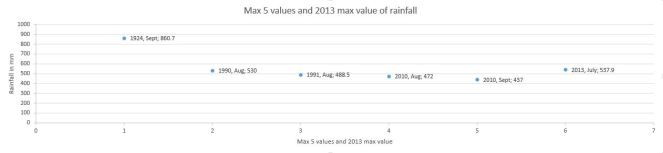
Interesting to note that the only time when 2013 monthly (approximate, as we have weekly figures from IMD, not monthly ones) features in top 5 monthly rainfall is for Chamoli, in July 2013! 537.9 mm rainfall it received in July 2013 was the second highest recorded rainfall in the district since 1901-2000 and 2008-2013.

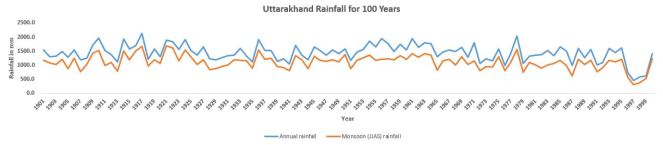
2.   100 year monthly monsoonal and annual rainfall for selected 7 districts, 2008-2012 monsoonal and annual rainfall for selected 7 districts.

3. 2013 weekly rainfall collated in respective months for June, July and August for the seven districts.

Results:

1.             Dehradun: 

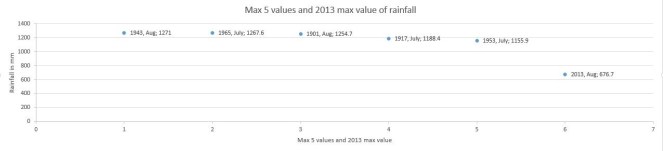
  • Maximum monthly rainfall in last 100 years during monsoon months (Same for all districts below): 1271 mm in August 1943
  • Minimum rainfall in last 100 years during monsoon months: 20.4 mm in June 1965
  • Maximum rainfall of 2013 compared with the 5 previous maximums: In August 2013 it received 676.7 mm rainfall which was maximum for the district in 2013 monsoon.

However, this did not figure amongst the top 5 values for monsoon rainfall in the period considered.

  • Rainfall during the week 13-06-13 to 19-06-13: 565.4 mm
  • Departure from normal for the same week – 1436%

Dehradun_Reshaped

Deharadun_100_Years

2. Uttarkashi:

  • Maximum rainfall in last 100 years: 800.8 mm in August 1963
  • Minimum rainfall in last 100 years: 36.8 mm in June 1987 
  • Maximum rainfall of 2013 compared with the 5 previous maximums: In 2013, 529.9 mm received in June was the highest for the 2013 monsoon season.

However, this does not feature among the top 5 values for monsoon rainfall in the period considered.

  • Rainfall during the week 13-06-13 to 19-06-13: 375.6 mm
  • Departure from normal for the same week: 1356%

Uttarkashi_ReshapedUttarkashi_100_Years

3. Tehri Garhwal-

  • Maximum rainfall in last 100 years 1097 mm in September 1995
  • Minimum rainfall in last 100 years- 0 mm in September 1997
  • Comparison of 2013 max rainfall with the previous 5 maximum: In 2013, 453.4 mm rainfall received in June was the highest for the 2013 monsoon season.

However, this does not feature among the top 5 values for monsoon rainfall in the period considered.

  • Rainfall during the week 13-06-13 to 19-06-13: 327.7 mm
  • Departure from normal for the same week – 390%Tehri Garhwal_ReshapedTehri Garhwal_100_Years

4. Haridwar-

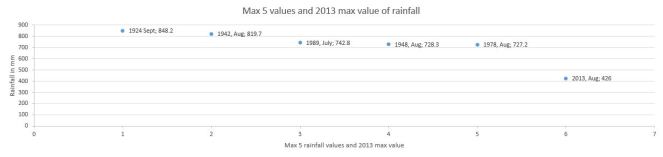
  • Maximum rainfall in last 100 years: 848.2 mm in September 1924
  • Minimum rainfall in last 100 years: 0 mm in September 1971
  • Maximum rainfall of 2013 compared with the 5 previous maximums: In 2013, 426 mm rainfall received in August was the highest for the 2013 monsoon season.

However, this does not feature among the top 5 values for monsoon rainfall in the period considered.

  • Rainfall during the week 13-06-13 to 19-06-13: 298.8 mm
  • Departure from normal for the same week – 1283%

Hardwar_Reshaped

Hardwar_100_Years

5. Rudraprayag

  • Maximum rainfall in last 100 years 914.6 mm in August 1925
  • Minimum rainfall in last 100 years 0 mm, in September 1971
  • Maximum rainfall of 2013 compared with the 5 previous maximums: In 2013, 664 mm rainfall received in June was the highest for the 2013 monsoon season.

However, this does not feature among the top 5 values for monsoon rainfall in the period considered.

  • Rainfall during the week 13-06-13 to 19-06-13:366.3 mm
  • Departure from normal for the same week – 580%

Rudraprayag_ReshapedRudraprayag_100_Years

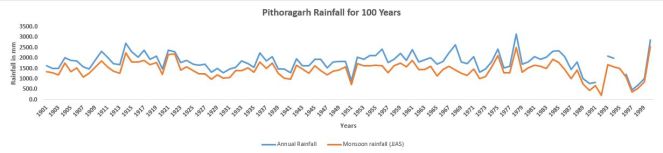
6. Pithoragarh-

  • Maximum rainfall in last 100 years 1057 mm in August 2000
  • Minimum rainfall in last 100 years 22 mm in June 1901
  • Maximum rainfall of 2013 compared with the 5 previous maximums: In 2013, 471.9 mm rainfall received in July was the highest for the 2013 monsoon season.

However, this does not feature among the top 5 values for monsoon rainfall in the period considered.

  • Rainfall during the week 13-06-13 to 19-06-13: 246.9 mm
  • Departure from normal for the same week – 238%

 Pithoragarh_ReshapedPithoragarh_100_Years

7. Chamoli

  • Maximum rainfall in last 100 years860.7 mm in September 1924
  • Minimum rainfall in last 100 years– 0 mm in 1998
  • Maximum rainfall of 2013 compared with the 5 previous maximums: In 2013, 537.9 mm rainfall received in July was the highest for the 2013 monsoon season.

It was a second maximum recorded rainfall since 1901-2000 and 2008-2013.

  • Rainfall during the week 13-06-13 to 19-06-13: 316.9 mm
  • Departure from normal for the same week – 1302%

Chamoli_Reshaped

Chamoli_100_Years

8. For Uttarakhand state-

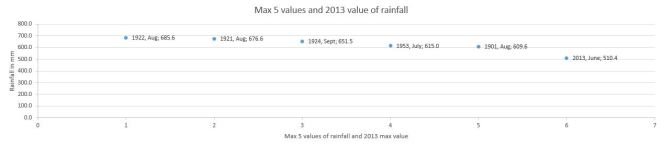
  • Maximum rainfall in last 100 years685.6 mm in August 1922
  • Minimum rainfall in last 100 years 28.1 mm in September 1907
  • Maximum rainfall of 2013 compared with the 5 previous maximums: In 2013, 510.4 mm rainfall received in June (June 1 to July 3) was the highest for the 2013 monsoon season.

However, this does not feature among the top 5 values for monsoon rainfall in the period considered.


Uttarakhand_ReshapedUttarakhand_100_years

In conclusion While presenting data for entire districts, we realise that there have been major variations in rainfall experienced within a district, for example, parts of Pithoragarh received extremely high rainfall during 15th-19th June, but the average rainfall for Pithoragarh District in June 2013 (Period between 06.06.13-03.07.13) is only 418.4 mm. The week between 13 June 2013-19th June 2013 shows only 238% departure from normal rainfall, when the higher reaches of Pithoragarh received some of the heaviest rainfall in Uttarakhand in June 2013.

As per researcher Emmanuel Theophilus, from Himal Prakriti at Munsiyari, Pithoragarh, the rainfall data with IMD for the entire Pithoragarh Districts  is  only from 2 stations in  the mid altitude areas, where it hardly rained much. Hence, the discrepancy, of Pithoragarh having only a 238% departure from normal, whereas the NASA maps show one of the darkest blue spots in Pithoragarh as well. In addition, he says: “IMD has only a very few stations scattered sparsely over the state, and what they have, are located in central district and sub-division office locations. Sure this makes for easy gathering of data, but is of little use for understanding any particularities, even at the sub-basin scale. In just the Gori sub-basin (Pithoragarh) for example, rainfall can vary from 15 cm annually, (spread over ~28 rainy days a year, and not counting snow) in the higher alpine Trans-Himalaya reaches, to as much as 4 meters, yes meters, of rain annually (spread over ~152 rainy days a year, and again not counting snow) just 50 km downstream, in the Greater Himalaya. Therefore, statements such as ‘the entire state of Uttarakhand received 847% excess rainfall’, can be misleading.”

After the Uttarakhand Disaster of unprecedented proportions, let us hope that now IMD, Uttarakhand Government, heavily funded programs like National Climate Mission, Universities, research institutes[2], etc can come together to create reliable and representative weather monitoring stations in the vulnerable state. Only through such data will a robust forecasting system be supported.

Damodar Pujari and Parineeta Dandekar

END NOTES:


[1] From Emmanuel Theophilus: A River Pulse. A discussion paper on the flood-events in June 2013, Mahakali basin, Uttrakahand. Himal Prakriti, Sept 2013

[2] Here it may be noted that some institutes have their own automatic and other rain-gauge stations, but data from such stations is not in public domain. For example, Wadia Institute of Himalayan Geology (http://www.wihg.res.in/) is supposed to have at least two automatic weather stations at Chorabari lake upstream of the worst impacted Kedarnath, but the data from these stations was not put up in public domain promptly or even now. Such data can be of great use for disaster forecasting, management and other purposes, but cannot be put to use without the data being in public domain.

brahmaputra · Climate Change · Indus

IWMI report on Glaciers and Snow cover in Himalayas in Changing Climate: Significant Impact on Seasonal flow of the Rivers in India

International Water Management Institute (IWMI) has recently published a study named  Glacier Systems and Seasonal Snow Cover in Six Major Asian River Basins: Hydrological Role under Changing Climate, authored by Oxana S. Savoskul and Vladimir Smakhtin which claims that the hydrological role of the melt-water resources in six major rivers e.g. Indus, Ganges, Brahmaputra, Syr Darya, Amu Darya and Mekong of the Hindukush-Himalayan region (HKH) has been comprehensively assessed for the first time on a basin scale. Reviewing already published studies, this report draws some interesting conclusions regarding the role of glacier and snow meting for six river basins which includes three major rivers basins of India.

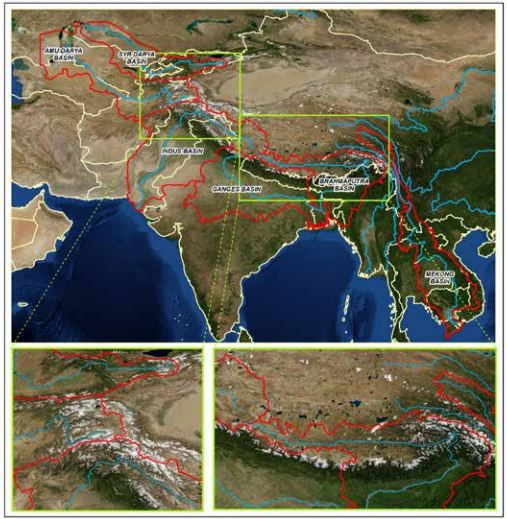
The map below shows area of the river basins included in this study. In this report, the term ‘melt-water resources’ has been used to cover glacier systems and seasonal snow cover. This report uses 1961-1990 status of melt-water resources as the baseline and compares with the 2001-2010 using the following characteristics: specific glacier runoff (average depth of annual discharge from glacier-covered area), basin total glacier runoff, shares of renewable and nonrenewable components in glacier runoff, total seasonal surface snowmelt from non-glaciated areas, portion of seasonal snowmelt lost for the recharge of groundwater aquifers, the contribution of glacier runoff and seasonal snowmelt to mean annual flow (MAF).

Map from the report showing the boundaries of the study basins (red line), state borders (light yellow line) and snow-covered high-altitude belts where glaciers are located (white spots
Map from the report showing the boundaries of the study basins (red line), state borders (light yellow line) and snow-covered high-altitude belts where glaciers are located (white spots)

The authors have used Glacier mass budget-based methods and hydrograph separation techniques which they stated as suitable for basin-scale assessments instead of the temperature-index methods. They say that application of these two methods in semi-distributed models can give the highest currently possible accuracy of +30%. The authors opine that many of the studies done previously had confused between the ‘snowmelt’ and ‘glacier-melt’ because these studies have not dealt with terminologies and methodologies in detail. The report states that there is a scarcity of glacier runoff estimates in peer-reviewed papers, “An analysis of publications on modeling runoff from large- and medium-scale glaciated catchments….. indicates that not many of these dealt with modeling glacier runoff per se. Even fewer report their evaluations of glacier runoff separately from snowmelt, if at all.”

For the three of the six river basins studies and which flow through India, i.e. Indus, Ganges and Brahmaputra the total annual glacier runoff for the period of 1961-1990 was 41 km3,16 km3 and 17 km3 respectively. But in the recent periods of 2001-2010, total glacier runoff was reduced to 36 km3, 15 km3 and 16 km3 respectively for the three basins, see Table 1 for details.

It is clear from the table that while Indus and Brahmaputra basins have similar percentage of  area under glaciers and snowmelt, the reduction in the glacier and snow cover area are more pronounced in Indus basin. Besides, in all the three basins the reduction in glacier area is more pronounced that the snow cover area. However, the contribution of glacier melt and also snow melt to run-off is much higher in Indus basin compared to Brahmaputra basin, showing the greater role of precipitation in Brahmaputra basin. Within the Indus basin even though seasonal snow covers 28% of the total area, much than the 2.6% occupied by glaciers during 1961-90, the contribution of two sources to Mean Annual Flow is almost same. But a question arises, has the contribution of glacier melt to the runoff increased in any of the basins in the recent decade? The answer is surprisingly, no.

Table 1: Recent changes in the glaciers and seasonal snow and their contributions to MAF

Basin Part of basin area(%) covered by Contribution to MAF (%)
Glaciers Seasonal Snow Glacier runoff Seasonal Snowmelt

1961-1990

INDUS

2.6

28 18

19

GANGES

1.2

6 4

2

BRAHMAPUTRA

2.7 27 2

2

2001 -2010

INDUS

1.8 25 15 16
GANGES

0.9

6 3

1

BRAHMAPUTRA

2.2 26 2

2

For the Ganges basin, the report says that heavy summer precipitation almost solely determines MAF volume for the basin. Maximum seasonal snow area in the Ganges basin makes just 6% of the entire basin area. Similar situation were reported for the Brahmaputra basin, where the lower parts of the basin i.e.  Southeastern Tibet and Eastern Himalayas where nearly 75% of the basin’s glaciers are located, witness heavy summer monsoon rains. Regarding Indus basin the report says, “Precipitation in the IndusBasin is more evenly distributed between the seasons, but is highly variable spatially – similar to Brahmaputra and Amu Darya, where annual precipitation in some catchments is tenfold (3,000 mm) of that in the other glacier-covered parts of the basin (300 mm).”

Reviewing already published documents the report states “it appears that the research in High Asia is concerned much more with CC impacts than with objects of the impact. Yet, understanding of the expected basin-scale changes in glacier runoff in response to climate change remains largely unclear.”

The report does an analysis of assessments done on impact of climate change on water availability in Himalayas and concludes that many assessments rely on poorly verified sources. The report refers to the statement made by Cruz et al. (2007) “The current trends of glacier-melts suggest that the Ganga, Indus, Brahmaputra and other rivers that criss-cross the northern Indian plain could likely become seasonal rivers in the near future as a consequence of climate change…,” This statement was admitted as a typing error after publication but even then this has been reiterated as an apocalyptic vision in NGO reports.

Using the Table 2 given below, the report states that glacier contribution is a minor item in the annual river water budgets in the Ganges and Brahmaputra basins. The report says “The impact of climate change was found to be more prominent on seasonal rather than annual water availability.” It is clear from the table that, in the recent decades non-renewable component in all three basins have gone up while renewable and total volume of water from glacier melt have come down. It is also noteworthy that, even though Brahmaputra basin has more area under glacier cover than the Ganges basin (see Table 1), the volume of water from non renewable glacier flow was more in both periods in the Ganges basin. Besides, the percentage of increase in nonrenewable glacier runoff components during 2001-10 is highest among all three basins, signifying that glaciers are melting fastest in Ganga basin.

Table 2: Contribution of renewable and non-renewable components to glacial runoff

Basin Glacier runoff components Total Glacier runoff (km3) Total Glacier runoff contribution to MAF (%)
Renewable (km3) Nonrenewable (km3)

1961-1990

INDUS

33.0

8.14 41.2

18

GANGES

11.0

4.74 15.7

4

BRAHMAPUTRA

12.7

4.29 17.0

2

2001 -2010

INDUS

24.5

11.62 36.1

15

GANGES

8.1

6.95 15.0

3

BRAHMAPUTRA

10.6

5.05 15.7

2

The reports also states, “Glaciers and seasonal snow in CC-impact assessments should be perceived as natural water reservoirs with gradually diminishing storage and flow regulation capacity, both on intra-annual and inter-annual scale. Potential changes of precipitation regime coupled with effects of temperature rise on evapo-transpiration will impact future hydrological regimes of the major rivers much more significantly, affecting both MAF and flow seasonality.”

The authors of this report clear some fog around climate change and Himalayan glacier system and snow-melt. One lacuna of the report is that even though the report discusses glacier run-off it makes no mentions of glacier lakes and glacier lakes induced floods. There are several incidents of glacier lake induced floods happening in the basins discussed. There is evidence to show that in the recent flood devastation in Uttarakhand in India glacial lakes played significant role.

Parag Jyoti Saikia

with inputs from Himanshu Thakkar

South Asia Network on Dams, Rivers and People (www.sandrp.in)

Climate Change · Western Ghats

Climate Change in Western Ghats: 4X4 Report and Beyond

Background

“No country in the world is as vulnerable, on so many dimensions to climate change as India. We need to build our own independent and credible research capacity on these issues.”

-Jairam Ramesh, erstwhile Union Environment Minister in Preface to CLIMATE CHANGE AND INDIA: A 4X4 ASSESSMENT: A SECTORAL AND REGIONAL ANALYSIS FOR 2030s

As India is struggling to cope with the extent and scope of the Uttarakhand Disaster[1], it is high time that we take the very real and urgent challenges of Climate Change seriously. India has several regions and communities significantly vulnerable to climate change. Himalayan glaciers are receding faster than global averages, precipitation across India is becoming more intense and unpredictable, biodiversity is under stress, sea levels are rising affecting thousands of coastal communities. And despite all this, destructive development in fragile regions is happening with utter disregard to this reality.

Maximum impacts of climate change are being faced by local poor communities and ecosystems.

With this in mind, we take a look at 4X4 Climate Assessment report (4X4 Report for short), brought out in 2010 by Ministry of Environment and forests (MoEF) which assessed Climate Change impacts by 2030 on four ecologically sensitive sectors: the Himalayan region, Western Ghats (WG), Coastal areas and North-east regions of the country and four issues: Agriculture, Forests, Human health and Water together. We also look at other reports on climate change in Western Ghats and compare these with actual challenges faced by WG. Till date this report remains the only official and definitive report about assessment of impact of climate change in India, to the best of our information (Readers, please let us know if there are other relevant reports in this regard).

The report is prepared by Indian network on Climate Change Assessment (INCCA)[2], which consists of 120 Indian Institutes and research laboratories, geared towards data analysis and impact predictions of the climate change scenarios. The network was launched by MoEF on 14th October 2009. 4X4 Report was published in November 2010 when Mr. Jairam Ramesh was the Union Minister for Environment and Forests.

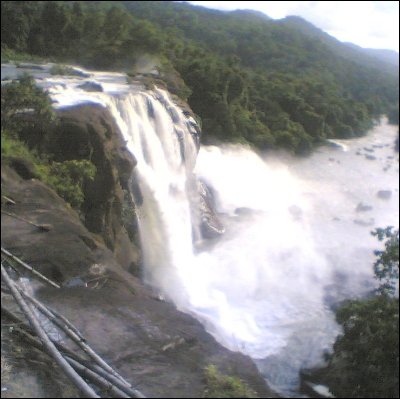
Athirappilly Falls 1

A1 B Scenario Predictions

The climate change impact predictions need the to assume of socio-economic context for which predictions are made. IPCC has classified socio-economic scenarios under A & B categories with further sub-divisions under each of them. 4X4 Report uses the A1B prediction scenario for India. This scenario assumes significant innovations in energy technologies, which improve energy efficiency and reducethe cost of energy supply with a balance across all sources. A1B assumes drastic reductions in power generation costs through the use of solar, wind, and other modern renewable energies and end use products.[3],[4].

Ironically, this assumption of A1B scenario for 2030 seems baseless when we look at the current dependence on non-sustainable energy sources like coal based thermal and large hydro.

PRECIS (Providing Regional Climates for Impact Studies)[5] tool used in this report considers data from large time scale of 5-7 decades in order to predict impact for coming 3-4 decades.

We look at Water in Western Ghats and what the Report predicts for this most populated biodiversity hotspot in the World.

1.       Western Ghats: The Water Tower of Peninsular India

Western Ghats (WG) are one of the oldest mountain ranges– older than the Himalayas- occupying around 6 % of Indian landmass. According to High Level Working Group Report on Western Ghats (HLWG/Kasturirangan Committee Report), geographical area of WG is over 1,64,280 sq. km. WG harbor high degree of endemism with more than 78% of amphibian and about 41% fish species[6] and similar high RET (Rare, endemic and Threatened) floral and faunal groups. They also support numerous tribal and forest dwelling communities. In 2012 UNESCO has declared 38 sites from Western Ghats as World-heritage sites. Most of the Peninsular east flowing or west flowing rivers originate from Western Ghats making it the water tower of peninsular India. Millions depend on these rivers like Krishna, Godavari, Cauvery, Malaprabha, Ghataprabha, Bhima, Tungabhadra for water and ecosystem goods and services. West flowing rivers are shorter and swifter. Examples include Vaitarna, Ulhas, Kali, Sharavati, Chalakudy, Pamba, Bharatpuzha, Nethravathy, Hemavathy, Bhawani etc. There are many complex community- water relationships which could be found in the region.

Rivers from Western Ghats drain almost 40% of Indian drainage. Therefore, it is essential to understand the impacts of the climate change on water resources in Western Ghats.

Pristine Forests set for submergence under the 24 MW Kukke Mini hydel Plant in Dakshin Kannada, Karnataka. Photo: SANDRP
  1. 2.       Predictions from 4X4 Report for Water and Western Ghats for 2030s

2.1   Precipitation and temperature:

In the Western Ghats, annual temperatures are likely to increase to 26.8 °C–27.5 °C in the 2030s. The rise in temperature with respect to the 1970s will be between 1.7° C and 1.8° C. The mean annual rainfall is likely to vary from 935± 185.33mm to 1794±247mm, which is an increase of 6%–8% with respect to the 1970s. The minimum temperatures may rise by 2.0 °C to 4.5° C, with minimum increase in those parts of Karnataka that lie in the Western Ghats. Within the region bordering the state of Kerala, the maximum temperature is likely to rise by 1° C–3° C.

The number of rainy days are likely decrease along the entire Western coast, including in the Western Ghats.

The intensity of rainfall is likely to increase by 1-2 mm/day.

2.2   Water yield, sedimentation the predictions for Western Coastal region, including the Western Ghats:

The west coast region exhibits a wide variability in the change in precipitation under the 2030s scenario. The northern portion of the west coast, consisting of areas of Gujarat and Maharashtra, shows an increase in precipitation for the 2030s scenario, and the increase varies from 4% to over 25%. However, areas of Karnataka and Kerala show a marginal decrease upto 4%.

The west coast region shows a general reduction in Evapotranspiration (ET), which varies from a very nominal value to about 5% for the 2030s scenario. Areas of Gujarat and Maharashtra, which had shown an increase in precipitation, still show a reduction in ET perhaps because of high intensity of the rainfall.  

The reduction in water yield for Karnataka and Kerala is up to about 10%. Gujarat and Maharashtra areas see an increase in water yield[7], and the magnitude is up to about 50%.

The west coast region also shows a considerable increase in the sediment yield for majority of the areas. Even those areas that are expected to receive less precipitation show an increase in sediment yield of up to 25%. The increase in sediment yield in these areas can possibly be explained due to an increase in the intensity of precipitation. This will have major impacts on water resource projects.

It is also seen that there is an increase in the moderate drought development for Krishna, Pennar, and Cauvery basins, which have either predicted decrease in precipitation or have enhanced level of evapo-transpiration. The maximum water withdrawal takes place from Godavari and Krishna river basins in Western Ghats in all the years[8]

2.3   Flood Analysis According to 4×4 Report, all the regions show an increase in the flooding varying between 10 to over 30% of the existing magnitudes. This has a very severe implication for the existing infrastructure such as dams for the areas and shall require appropriate adaptation and dam safety and operation measures to be taken up.

2.4   Impacts on crops:

a.       Coconut: Coconut yields are projected to increase by up to 30% in majority of the region. Increase in coconut yield may be mainly attributed to projected increase in rainfall (~10%) and relatively less increase in temperatures. However, some areas like south-west Karnataka, parts of Tamil Nadu and parts of Maharashtra, may lose yield up to 24%.

b.      Rice: Productivity of irrigated rice in Western Ghats region is likely to change +5 to –11% depending upon the location. Majority of the region is projected to lose the yield by about 4%. However, irrigated rice in parts of southern Karnataka and northern-most districts of Kerala is likely to gain. In the case of rain-fed rice, the projected change in yield is in the range of –35 to +35% with a large portion of the region likely to lose rice yields up to 10%.

c. Maize and sorghum: Climate change is likely to reduce yields of maize and sorghum by up to a whopping 50% depending upon the region.

Surprisingly, the report has no insights to offer to spice, coffee and tea plantation across Western Ghats. ( For impact of Climate Change on spices and plantations in Western Ghats: Dr. Latha Anantha and Unnikrishnan: https://sandrp.in/wtrsect/Water_Sector_Options_India_in_Changing_Climate_0312.pdf)

Plantations in Western Ghats Credit: Thinkstock


2.5   Impacts on forests:

The entire Western Ghats region is covered by 54 grids, out of which 10 (18%) are projected to undergo change. 18% forested grids in the region are projected to be vulnerable to climate change. The projection of the NPP (Net Primary Productivity) for the Western Ghats region is projected to have approximately 20% increase in NPP on an average.

2.6   Temperature Humidity Index (THI) and its possible impact on biodiversity:  While the report uses this index for studying analyzing impacts on livestock, its conclusions can also be used for biodiversity and fisheries. The report predicts “A severe thermal discomfort and stress is expected in most parts of Western Ghats and the Coastal region in the month of May.” This will not only affect the biodiversity, but also fisheries. However, the report makes no such correlation.

Seetha Nadi, free flowing river in Karnataka Western Ghats. Photo: SANDRP

3.       Limitations and Way Forward:

The report accepts its limitation in terms of data sources, details which have been gathered, lack of integration of existing data, etc. The authors seem aware that the report in this form is of little use to policy makers or communities.

4.       Conclusions:

While the report has its severe gray areas, and there are variations within Western Ghats, it is clear that for Western Ghats:

  • Precipitation will be more intense with less rainy days
  • Temperatures will see a gradual increase
  • Crops will be affected
  • Forests (and dependent biodiversity) will be made more vulnerable
  • Sedimentation will increase sharply
  • Incidence of floods and droughts will rise sharply

 5.       Problems with 4 X 4 Assessment:

Apart from the limitations admitted by INCAA, the report suffers several other limitations.

  • It does not offer any recommendations for policy makers.
  • Neither does it hold any recommendations for communities. In fact in its way forward, when it mentions that cooperation has to be sought from several departments and organizations, it does not even mention local communities who will face major impacts!
  • No mention of adaptation and mitigation measures that communities can adapt, except some very limited mentions. This is a huge gap. (More on Water Sector Options for India including a paper on plantations in Western Ghats can be found here:https://sandrp.in/wtrsect/Ex_Summary_WATER_SECTOR_OPTIONS_FOR_INDIA_IN_CHANGING_CLIMATE_MARCH_2012.pdf)
  • In the task of assessing impacts and devising solutions to mitigate and adapt to impacts of climate change, local communities have proved to be extremely adept. At the same time, the impacts of climate change affect these communities the most and hence they have to be made a part of ongoing research. 4 X 4 Report does not even attempt this.
  • Some big questions:

The report says that “The northern portion of the west coast, consisting of areas of Gujarat and Maharashtra, shows an increase in precipitation for the 2030s scenario, and the increase varies from 4% to over 25%. Gujarat and Maharashtra areas see an increase in water yield, and the magnitude is up to about 50%. As per the maps, this region also includes the Western Ghats.

Now Northern Western Ghats is exactly the same region where Indian Institute of Tropical Meteorology (IITM, also a part of INCA) has said that there have been drastic, ongoing reductions in rainfall!

In fact, Centre for Climate change, IITM has said that in the last 110 years (1901-2011) rainfall in Mahabaleshwar, origin of five rivers in northern Western Ghats has decreased by 800 mm! In northern Westenr Ghats of Maharashtra, rainfall has decreased at the rate of 2% per decade while the rate of decrease is lower in Southen Western Ghats for Kerala at 1%.[9]

This aspects needs some more clarity.

  • No reference to the ongoing destructive development in Western Ghats: Western Ghats are facing severe threat from Mining, Hydropower projects, Irrigation Projects, mini hydel projects, which affect water cycle, sedimentation, forests and biodiversity of the region and displacement and impoverishment of very large number of people. However, the report does not dwell on any of these practical problems and their impact in compounding climate change challenges.

    Mining in Goa Photo: Damodar Pujari
    Mining in Goa Photo: Damodar Pujari


  • No reference to biodiversity, freshwater fisheries: The report has no predictions or recommendations to offer for biodiversity in Western Ghats. While there is a section on coastal fisheries, there is no mention of rich freshwater fisheries in Western Ghats!


  • A1B Scenario: There is no evidence that India is adopting the A1B scenario which considers growth through a mix of energy sources like solar and wind, etc. We still depend heavily on non-sustainable energy sources like Thermal and large hydro. Hence, this assumption itself is flawed and predictions based on this assumption cannot be considered seriously. In fact, the actual predictions, looking at India’s and Western Ghat’s track record, (with over 10 coal based thermal power plants, several other nuclear power projects, ports and large dams coming up in Maharashtra, concentrated and non-sustainable mines in Goa) could be much more severe.

 6.       Impacts of climate Change on Western Ghats from Western Ghats Expert Ecology Panel report and High Level Working Group on Western Ghats Report:

  • Western Ghat Expert Ecology Panel Report: WGEEP does not refer to 4 X 4 Report. It considers A2 and B2 scenarios, and concludes that northern region of Ghats is more sensitive to climate change than southern region. Though the report does not deal with climate change in detail, the recommendations of WGEEP are extremely climate friendly.
  • High Level Working Group Report:  HLWG report has considered 4×4 Report in its analysis and includes a Chapter on Climate Change. This chapter is more effective in dealing with ground challenges than the 4×4 report. However there are some major problems in this.

The HLWG Report states:

a.       “Biodiversity: In the Western Ghats, climate change is expected to increase species losses.  Changes in phenology are expected to occur for many species. Ecosystems dominated by long-lived species (like forests in WG) will be slow to show evidence of change and slow to recover from the climate related stress

b.      Water, Irrigation and Hydro Power: Impacts of climate change and climate variability on the water resources are likely to affect irrigated agriculture, installed power capacity, environmental flows in the dry season, and higher flows during the wet season, thereby causing severe droughts and flood problems. “It is seen that there is an increase in the moderate drought development   for Krishna, Pennar, and Cauvery  basins, which have either predicted decrease in precipitation or have enhanced level of evapo-transpiration. The maximum water withdrawal takes place from  Godavari and Krishna river basins in Western Ghats in all the years.”

c.       Hydro capacity “is expected to increase, but its share decreases from the total installed capacity by 2100. The slow growth in capacity is due to barriers of high investment requirements and long gestation periods. A number of socio-environmental issues are related to dam construction, flooding of areas, damages to the ecology, and resettlement and rehabilitation of the population.”

Though HLWG dedicates an entire chapter to Climate Change Impacts on Western Ghats, it still does not comment on destructive hydropower projects and such other plans which decrease resilience and adaptation capacities of ecosystems and communities and in fact contributes to climate change by deforestation and methane emissions! In fact, by not opposing projects like 163 MW Athirappilly and 200 MW Gundia, the HLWG report supports projects which have huge potential on increasing climate change impacts[10],[11],[12]

Shockingly, the HLWG report certifies all hydro as green and renewable source of energy, something that even developed countries or UNFCCC does not do.

According to the Second National Communication on Climate Change (NATCOM, 2012), the Western Ghats is expected to experience increase in temperature regimes, rainfall and extreme events due to climate change. There is also a high probability of significant decrease in the duration of the precipitation (NATCOM, 2012). The projected changes in the precipitation may induce changes in the hydrological regimes especially increase in evapo-transpiration and increased runoff .

7.       Way Forward of Water, communities and ecosystems in Western Ghats

India has been witnessing several climate related disasters in the recent years. Instead of going into a ‘climate change or no climate change’ debate, it is time to adopt no-regrets strategies and build climate resilience of communities and ecosystems. Unfortunately, we do not see evidence of decreasing emissions or adopting climate friendly strategies from India, or even other developed countries which support and fun destructive projects in India.  The Clean Development Mechanism introduced by UNFCCC has in fact been supporting and pushing destructive projects in developing countries, while legitimizing pollution in developed countries.

 Some possible measures:

  • Natural ecosystems are resilient in coping with climate change challenges: natural ecosystems like rivers, streams, forests need to be protected for their resilience to climate change impact as well as the goods and services they provide to local communities, who are most vulnerable and least able to cope with the climate change implications.
  • Free flowing rivers are more resilient than their dammed counterparts: Free flowing rivers in western Ghats need to be protected on priority
  • Fragmented Forests are more vulnerable to climate change impacts: Deforestation and fragmentation of forests in Western Ghats should be avoided at all costs. Large Hydro power, irrigation projects, mini hydel, mines, hills station projects affecting forests should be dropped urgently. Local projects should be considered only with free, prior and informed consent of the communities. All projects related t the mega Inter Linking of Rivers in the western Ghats should be dropped, including Par Tapi Narmada, Damanganga Pinjal, Nethrawati, Hemawati, Pamba, Achankovil, among others.
  • Old and unsafe large dam projects like the Mullaperiyar and others should be considered for decommissioning as recommended by WGEEP.
  • The diversion of east flowing rivers to the west in Maharashtra should be reversed in a time bound manner and no more such projects should be considered.
  • All projects in Western Ghats: large or small should be brought under the ambit of environmental clearance which should look specifically at climate change impacts on these projects and should also require FPIC.
  • Community water harvesting systems, traditional water harvesting systems, watershed measures need to be encouraged. Western Ghats is rich in these examples
  • Efficient and water saving measures like System of Rice Intensification should be adopted for the entire Ghat region.
  • Recommendations of WGEEP need to be implemented urgently
  • Most importantly, communities need to be made an integral part of decision making surrounding natural resources. Currently, mega projects like Athirappilly, Gundia, Talamba and Tillari dams in Maharashtra, drinking water dams near Mumbai, etc. completely neglect community concerns. Communities will not only face direct impacts of displacement and losing rights, the long term impacts on adaptation and mitigation capacities of communities will also be jeopardized due to destructive projects.


Damodar Pujari

with inputs from Parineeta Dandekar

South Asia Network on Dams, Rivers and People


[2] INCAA- Indian Network for Climate Change Analysis.

[4] High Level Working Group Report, Part I, Page 20

[6] Western Ghats Ecology Expert Panel Group: WGEEP

[7] Water yield (water crop or runout). The runoff from the drainage basin, including ground-water outflow that appears in the stream plus ground-water outflow that bypasses the gaging station and leaves the basin underground. Water yield is the precipitation minus the evpotranspiration. (http://water.usgs.gov/wsc/glossary.html)

[8] HLWG Report, Part 1, Page 24

Climate Change · Disasters · Floods · Hydropower · Uttarakhand

Uttarakhand and Climate Change: How long can we ignore this in the Himalayas?

The current disaster in Uttarakhand has exposed our unpreparedness in many spheres: be it disaster management, weather forecasting, early warning system, tourism management or transparent and participatory environmental governance of a fragile region.

However, we cannot ignore Climate Change and its associated challenges when dealing with these issues.

Himalayas are experiencing Climate Change at an unprecedented rate, this is increasing the incidents of flash floods, GLOFs, landslides and related disasters. India has a huge National Action Plan for Climate Change in place since 2009, under it is a special National Mission for ‘Sustaining Himalayan Ecology’, National Mission on Water, among six others. But what has happened down these years? Are we even considering climate change and its impacts while clearing hundreds of projects on hydel power, river bed mining , urban development, roads and related infrastructure in this region? We are not even assessing the impact of such projects on disaster potential in already vulnerable areas. 

In our earlier blog, we have said that there are a number of reasons behind the sudden deluge in Kedarnath and surrounding areas including Glacial Lake Outburst Flood (GLOF) (https://sandrp.wordpress.com/2013/06/21/uttarakhand-deluge-how-human-actions-and-neglect-converted-a-natural-phenomenon-into-a-massive-disaster/). In the absence of precise weather monitoring or documentation, detailed analysis on this difficult.

Uttarakhand disaster linked to Climate Change However, a number of officials have accepted the climate change link with the current disaster. Secretary of Government of India Ministry of Earth Sciences Shailesh Nayak has now said that  the cloudburst that triggered flash floods in Uttarakhand read like a weather phenomenon brought about by warming. He also narrated how the high intensity rainfall is increasing while low and medium intensity events are decreasing. (See: http://timesofindia.indiatimes.com/india/Earth-sciences-secretary-blames-Uttarakhand-rains-on-climate-change/articleshow/20709643.cms)

Shri M Shashidhar Reddy, Vice Chairman of National Disaster Management Authority, (http://timesofindia.indiatimes.com/home/environment/flora-fauna/Need-to-assess-climate-change-Shashidhar-Reddy-says/articleshow/20749744.cms) speaking at the inauguration of South Asia Regional Consultation on Climate Change Adaptation, said: “Nothing more serious could have been witnessed. It is an example of extreme weather events we all are concerned about.” He also acknowledged the role of ecological imbalance: “There is no doubt that ecological imbalance has been created in the Himalayas… it made the impact higher.” Reddy also said precious lives could have been saved in Uttarakhand had the weather office made precise forecasts: “They [India Meteorological Department] need to develop a more precise observational and forecasting capability”. (http://www.thehindu.com/news/national/only-precise-forecast-of-rain-would-have-helped-says-ndma-chief/article4847316.ece?homepage=true)

However, it is an undisputed fact that climate change is impacting the Himalayas at much faster pace than what the global averages tells us. We take a look at our responses to adapt to and mitigate CC Challenges.

1. Unprecedented Climate Change in Himalayas

(This section is largely based on ICIMODs report: The changing Himalayas – Impact ofclimate change on water resources and livelihoods in the Greater Himalayas)

Warming in Himalayas is happening at an unprecedented rate, higher than the global average of 0.74 ˚C over the last 100 years (IPCC, 2007a; Du et al., 2004), at least 2-3 times higher than global averages.  Progressively higher warming with higher altitude is a phenomenon prevalent over the whole greater Himalayan region (New et al., 2002).

1.1          Impact on Precipitation: In many areas, a greater proportion of total precipitation appears to be falling as rain than before. As a result, snowmelt begins earlier and winter is shorter; this affects river regimes, natural hazards, water supplies, and people’s livelihoods and infrastructure. The extent and health of high altitude wetlands, green water flows from terrestrial ecosystems, reservoirs, and water flow and sediment transport along rivers and in lakes are also affected.

Throughout the himalayas, there is increasing perception and documentation that precipitation is changing, becoming more erratic and intense. “Flooding may arise as a major development issue. It is projected that more variable, and increasingly direct, rainfall runoff will also lead to more downstream flooding.”(http://lib.icimod.org/record/27016/files/c_attachment_782_6044.pdf, Changing With The Seasons: How Himalayan communities cope with climate change, Chicu Lokgariwar, People’s Science Institute)

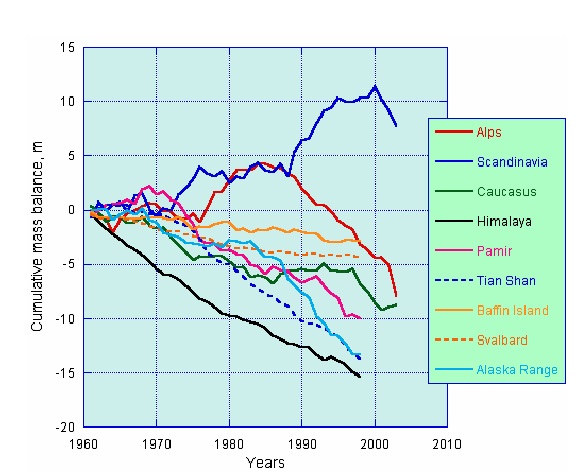
 1.2       Retreating glaciers: As compared to global averages, Himalyan glaciers are receding at a rapid rate. Retreat in glaciers can destabilize surrounding slopes and may give rise to catastrophic landslides (Ballantyne and Benn, 1994; Dadson and Church, 2005), which can dam streams and sometimes lead to outbreak floods.

Excessive melt waters, often in combination with liquid precipitation, may trigger flash floods or debris flows. Available studies suggest changes in climatic patterns and an increase in extreme events. An increase in the frequency of high intensity rainfall often leading to flash floods and land slides has been reported (Chalise and Khanal, 2001; ICIMOD, 2007a).

CC1
Rapid retreat of Himalayan Glaciers as compared to global averages Courtesy: ICIMOD

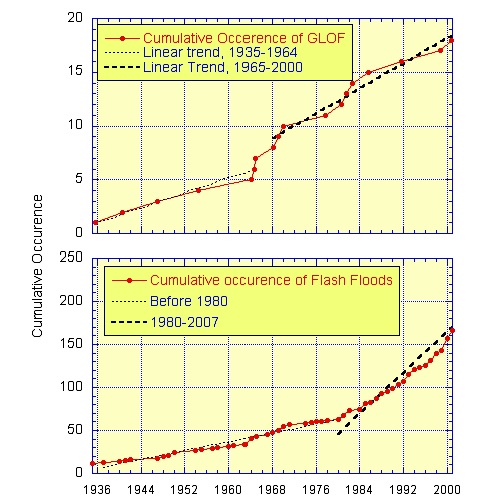
1.3       Higher frequency of flash floods and GLOF events: In the eastern and central Himalayas, glacial melt associated with climate change, has led to the formation of glacial lakes behind terminal moraines. Many of these high-altitude lakes are potentially dangerous. The moraine dams are comparatively weak and can breach suddenly, leading to the discharge of huge volumes of water and debris. The resulting glacial lake outburst floods (GLOFs) can cause catastrophic flooding downstream.

There is an indication that the frequency of GLOF events has increased in recent decades. In the Hindukush Himalayan (HKH) region two hundred and four glacial lakes have been identified as potentially dangerous lakes, which can burst at any time (ICIMOD, 2007b)

CC2
Cumulative Frequency of Flash FLoods and GLOFs in Hindukush Himalayan region Courtesy: ICIMOD

(From: The changing Himalayas – Impact of climate change on water resources and livelihoods in the Greater Himalayas Perspectives on water and climate change adaptation. ICIMOD http://www.worldwatercouncil.org/fileadmin/world_water_council/documents_old/Library/Publications_and_reports/Climate_Change/PersPap_01._The_Changing_Himalayas.pdf)

2.            Our Response so far

2.1       National Mission for Sustaining the Himalayan Ecosystem under the NAPCC:

The ambitious National Action Plan for Climate Change  has a separate National Mission for Sustaining the Himalayan Eco System (NMSHE) under the Ministry of Science of Technology, Government of India.

(There are several issues with this Action Plan itself. For a detailed Critique: http://www.sandrp.in/CRTITUQE_ON_INDIAs_CLIMATE_PLAN-There_is_Little_Hope_Here_Feb_2009.pdf, the link is not working, pl contact us for the file)

The NMSHE Mission document prepared in 2010 states:

“The mission would attempt to evolve management measures for sustaining and safeguarding the Himalayan glaciers and mountain ecosystem by:

• Enhancing monitoring of Himalayan ecosystem with a focus on recession of Himalayan glaciers and its impact on river system and other downstream socio-ecological processes.

• Establishing observational and monitoring network to assess ecosystem health including freshwater systems.

• Deploying technologies – for hazard mitigation & disaster management, development of ideal human habitats, and agriculture and forest sector innovations

2.1.1    Some Proposed Actions to address Objectives and Goals of the Mission:

  • Continuous Monitoring of the Eco-system and Data Generation
  • Enhanced implementation of guidelines for Priority Action in the National Mission on Sustaining the Himalayan Ecosystem
  • Sustainable Urbanization in Mountain Habitats:This includes:
  • Town Planning and Adoption and Enforcement of Architectural Norms:

Given the ecological fragility of mountainous areas, it was agreed that rather than permit the unplanned growth of new settlements, there should be consolidation of existing urban settlements, which are governed through land-use planning incorporated in a municipal master plan.

Further action points may include:

(a) Municipal bye-laws will be amended, wherever required, to prohibit construction activity in areas falling in hazard zones or across alignments of natural springs, water sources and watersheds near urban settlements. There will be strict enforcement of these bye-laws, including through imposition of heavy penalties and compulsory demolition of illegal structures.

(e) Construction activity will be prohibited in source-catchment areas of cities, including along mountain lakes and other water bodies. Their feeder channels will also be kept free of building activity.

In order to enable these decisions to be implemented urgently, it is necessary to draw up, as soon as possible, a comprehensive State-wide inventory of such water resources and their channels, which could then be declared fully protected zones.

Promotion of Sustainable Pilgrimage:

Measures for promoting the healthy and sustainable development of religious pilgrimage to the many sacred and holy sites scattered all over the Himalayas, are also necessary. Some of these actions are:

(a) A comprehensive inventory of key pilgrimage sites in each State would be drawn up, which would include analyses of the ecological capacity of each site, based on its location and fragility.

(b) In advance of the results of the above exercise, develop a plan to harmonise the inflow of pilgrims with the capacity of the local environment to cater to the needs of pilgrims. These include the source of several Himalayan rivers, sacred lakes and forest groves.

(c) The construction of roads should be prohibited beyond at least10 kilometres from protected pilgrim sites, thereby creating a much-needed ecological and spiritual buffer zone around these sites. These areas, like national parks and sanctuaries, will be maintained as special areas, where there would be minimal human interference, respecting the pristine nature of thesesites.

(d) Each designated pilgrimage site should have a declared buffer zone where development activity will be carefully regulated.

“Green Road Construction”The construction of roads must fully take into account the environmental fragility of the region. To this end, the concerned State Governments will consider promulgating, as soon as possible, the following guidelines for road construction in hill areas.

(a) Environmental Impact Assessment to be made mandatory for the construction of all state & national roads and expressways of more than 5 km length, including in the extension and widening of existing roads. This will not apply to inter-village roads.

(b) Road construction will provide for the treatment of hill slope instabilities resulting from road-cutting, cross drainage works and culverts, using bio-engineering and other appropriate technologies. Cost estimates for road construction in these areas will henceforth include estimates on this account.

(c) Plans for road construction must provide for disposal of debris from construction sites at suitable and identified locations, so as to avoid ecological damage and scarring of the landscape. Proposals for road construction must henceforth include cost estimates in this regard.

(e) All hill roads must provide adequate roadside drains and, wherever possible, be connected to the natural drainage system of the area.

(f) Alignment of proposed roads should avoid fault zones and historically landslide prone zones.Where this may not be possible, adequate measures will be taken to minimize associated risks, in consultation with experts.

Water security:

The importance of the Himalayas as a natural storehouse and source of water must be acknowledged fully. The region is already under water-stress, with the drying up or blockage of many water sources and natural springs. The following immediate actions, appear to be necessary:

The Himalayan eco system is vulnerable and susceptible to the impacts and consequences of a) changes on account of natural causes, b) climate change resulting from anthropogenic emissions and c) developmental paradigms of the modern society.

Recognizing the importance of scientific and technological inputs required for sustaining the fragile Himalayan Ecosystem, the Ministry of Science and Technology has been charged with the nodal responsibility of coordinating this mission.”

Unfortunately, we saw that NONE of the above is currently happening in the Uttarkhand Himalayas, or for that matter any of the Himalayan States. There are no clear action plans, timelines and budget breakups of this program available and at best, this seems like a vague wish list, rather than an urgent program.

2.2          Uttarakhand State Action Plan for Climate Change:

Uttarakhand has submitted a State Action Plan for Climate change in June 2012, with the help of UNDP. (http://www.uttarakhandforest.org/Data/SC_Revised_UAPCC_27june12.pdf)

Relevant sections of this Plan:

“Extreme precipitation events have geomorphological significance in the Himalayas where they may cause widespread landslides.  Increase in rainfall is likely to causes fresh floods land slides and damages to the landmass. Winter precipitation has become extremely erratic and unpredictable. Increase in the flooding varying between 10 to over 30 percent of the existing magnitudes is expected in all the regions. This has a very severe  implication for the existing infrastructure such as dams, bridges, roads, etc., for the areas  and shall require appropriate adaptation measures to be taken up.

Strategies:

“The UAPCC recognises that scientific knowledge and evidence base on impacts of climate change to the water sector is limited. As such, a comprehensive water data base in public domain and assessment of the impact of climate change on water resource through the various agencies responsible for different aspects of water resources management in the State will be developed, and updated and analysed on an on-going basis.

Strategies towards this will include:

  • Review of network of hydrological observation stations
  • Review of the network of automatic weather stations and automated rain gauge stations
  • Collection of necessary additional hydro-meteorological and hydrological data for proper assessment of impact of climate change in Himalayan region including other improvements required in hydrometric networks to appropriately address the issues related to the climate change.

Such data will include:

o Hydrological and hydro-meteorological data in low rainfall areas

o Hydrological and hydro-meteorological data above permanent snowline, glaciated areas, seasonal snow areas in Himalayan region

  • · Improved network for collection of evaporation and rain gauge data using automated sensors
  • · Establishment/strengthening of ground water monitoring and geohydrologynetworks
  • · Collection of data about river morphology for monitoring erosion and carrying capacity, and
  • · Surface and ground water quality data collection, etc.

Other initiatives will include adoption/development of modern technology for measurement of flow in hilly areas, development of water resources information system, and reassessment of basin wise water situation, apart from projection of water resources availability as a result of impact of climate change which would inter-alia include the likely changes in the characteristics of water availability in time and space.

Other necessary studies to improve understanding of climate impacts to the sector will also be carried out from time to time, and robust data mechanisms will be established. Currently, Uttarakhand does not have a State Water Policy. As such, it will be a priority agenda for the State to develop an appropriate policy framework, with explicit cognisance of climate concerns.”

Unfortunately, here too we did not find evidence that ANY of the strategies were put in practice. As we have said earlier, we still do not have a picture of how much rainfall occurred where and when. Rudraprayag district seems to have a single raingauge station, and high density tourist spots like Kedarnath, which are already vulnerable do not even have a raingauge. There exists no early warning system and as clarified by CAG report on Disaster Management, 2013, the State Disaster Management Authority has not met even once since its constituion in 2007.

3.    Hydropower and Climate Change: Time to bust the myths

 Hydropower projects are being aggressively pushed for their supposedly benign role in global warming and climate change. However, world over, there is increasing consensus that Hydropower dams are not only extremely vulnerable to climate change but (http://ieeexplore.ieee.org/xpl/login.jsp?tp=&arnumber=1007423&url=http%3A%2F%2Fieeexplore.ieee.org%2Fiel5%2F2195%2F21734%2F01007423), but actually contribute to global warming and climate change, depending on their size and nature. They are being increasingly recognized as being ‘False Solutions to Climate change.’

 (Ref:

http://www.academia.edu/1207242/Why_hydropower_is_not_clean_energy

http://www.academia.edu/2525879/Climate_change_and_the_Amazon_Tropical_dams_emit_greenhouse_gases

http://www.internationalrivers.org/campaigns/wrong-climate-for-damming-rivers

Dirty Hydro: http://www.internationalrivers.org/resources/dirty-hydro-dams-and-greenhouse-gas-emissions-2648

Many hydropower projects being planned, under construction or commissioned in Uttarakhand ( and across Indian Himalayas) are storage dams with reservoirs. Even the so called ‘run of the river’ projects involve reservoirs and big dams. These reservoirs emit methane (21 times more potent than carbon dioxide) and carbon dioxide.  It is now proved that methane is not only emitted from reservoirs, but that it is  boosted at each dam turbines and draw-down (Ref: http://news.wsu.edu/pages/publications.asp?Action=Detail&PublicationID=32301)

 4.            Environmental Clearances to Hydropower Dams do not consider Climate Change impacts or mitigation methods:

Despite the burgeoning literature, debates around the world, several submissions from civil society including SANDRP, there is not even as assessment of the impacts of hydel projects on climate change, leave alone mitigation measures. The Expert Appraisal Committee on River valley and Hydropower Projects constituted by the MoEF which recommends Terms and Reference and further Environmental Clearances to these projects has not included the impacts of climate change or the mitigation measures against impacts while recommending TORs or granting Environmental Clearances. It also does not include assessment of impact of the projects on disaster potential of the region or adaptation capacity of the people. The EAC in fact has zero rejection rate even when we know we do not have credible EIA, SIA or CIA for any projects or basins.

5. Carbon Credits: Incentivising destruction, pollution, discounting impacts

Many of the Hydropower projects in the Himalayas, including Uttarakhand have applied for carbon credits under the UNFCCC’s Clean Development Mechanism. Under this, clean energy projects in developing countries get millions of rupees as incentives from developed world, which in turn get carbon offset credits, which are a license to pollute further. The entire system, put in place after the Kyoto Protocol is inherently flawed due to absence of due attention impact of projects on adaptation of local people, to local voices and due to market based approach. Many destructive hydropower projects in Uttarakhand are being certified as clean projects, making a mockery of climate change adaptation and sustainable development. Notable among-st these include the 99 MW Singoli Bhatwari HEP , 76 MW Phata Byung HEP, both on Mandakini river (epicenter of current disaster), 300 MW Alaknanda (GMR) hydropower project, 330 MW Alaknanda Srinagar Hydropower project, 414 MW Rampur project in Himachal Pradesh, where the World Bank played an active role in getting it registered for Carbon credits.

Carbon credits to large hydropower projects in fact accelerate climate change and its impact on ecosystems and communities and is unacceptable.

6.            Dubious role of World Bank and Asian Development Bank

 World Bank is being reported to have come up with a report which says that “An extremely wet monsoon that at present has a chance of occurring only once in 100 years is projected to occur every 10 years by the end of this century,” It also projected a rise in severe floods within the next 25 years.

The same organisation is pushing some of the biggest and most destructive hydropower projects in the Himalayan region like the 775 MW Luhri HEP, in addition to 2 large Hydel projects upstream on Luhri in the Sutlej Basin in Himachal Pradesh. Luhri HEP will have one of the longest tunnels in Asia and there is no impacts assessment of the impact of this blasting and tunnelling on the villages above, or geological stability.

World Bank is also pushing and financing the 440 MW Vishnugad Pipalkoti Hydropower in Uttarakhand. Incidentally, Pipalkoti region experienced some severe impacts of the current deluge and also suffered damages as per MATU report. The World Bank is supporting these projects even when there are no credible project specific ESIA or cumulative impact assessment studies or carrying capacity studies or studies on the impacts of these cascade projects on disaster risks or climate change.

Asian Development Bank is also supporting a number of hydropower projects n Uttarakhand (they are reported to have suffered damages) and in Himachal Pradesh on similar lines.

Cascade projects along the rivers, with no distance between two projects effectively means that the entire landscape surrounding the rivers is blasted, submerged and tunneled.

There is a huge gap between what World Bank’s says and what it does as far as hydropower and climate change is concerned.

In Conclusion:

Current Uttarakhand disaster has seen government officials to the World Bank suggesting that impacts of climate change are severe, but ironically, when asked specifically if they would link current disaster with climate change, they say that cannot be established and hide behind ‘scientific uncertainity’.

As has been seen world over, the poor and most vulnerable sections of the society and the ecology are worst impacted by climate change. It is high time that we adopt no regret strategies to cope with impacts of climate change, through mitigation and adaptation.

(Uttarakhand Floods: Lessons for Himalayan States: https://sandrp.wordpress.com/2013/06/23/uttarakhand-floods-disaster-lessons-for-himalayan-states/)

National Action Plan of Climate Change needs to be audited for its efficacy and work from organisations like CAG. MoEF urgently needs to include impacts of climate change while it is busy sanctioning all the projects that come to it. Organizations like World Bank need to walk their talk on climate change and stop financing destructive hydro projects in this fragile region, in absence of any studies on their impact on Climate Change and lives and livelihoods of millions dependent on natural systems.

Climate change is knocking at some of our doors, while it has already arrived through other doors. We can choose to close our eyes and ears and say “this is normal and expected in this region”. But if we do not respond to challenges posed by Climate Change urgently, it wont be just politely knocking, but causing extreme damage, as it is being witnessed.

 Parineeta Dandekar