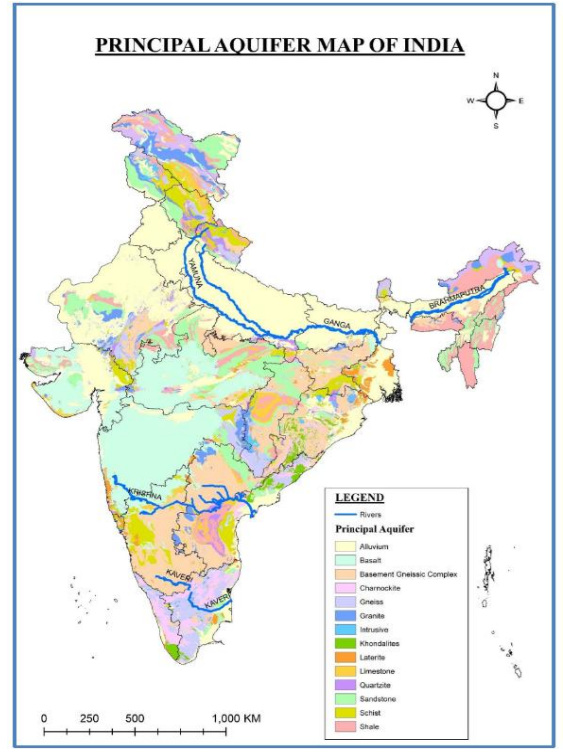
(Feature Image: Principal Aquifer Map of India. Credit: CGWB’s Annual Ground Water Quality Report 2025, Figure 02, Page 09)
This overview highlights the top ten measures undertaken by various governments to protect groundwater in India in 2025. At the central level, the Ministry of Jal Shakti (MoJS) has a master plan for artificial recharge, targeting the construction of 1.42 crore structures. As per MoJS, 21 states and UTs have adopted Model Groundwater Management Bill 2020. The MoJS is also piloting pressurized irrigation systems and water accounting technologies to improve efficiency, especially in agriculture, which consumes 87% of extracted groundwater.
The central govt has earmarked ₹32,000 cr under the Viksit Bharat–Guarantee for Rozgar & Ajeevika Mission (Gramin), with a focus on reviving dark zones & water-stressed regions. The implementation period of the Atal Bhujal Yojana is to end on Sept 30 2026. This scheme, launched in Dec 2019 with 50% funding from the World Bank, aimed to improve groundwater management.
State governments have also rolled out customized interventions for groundwater recharge and regulation. The Punjab government has initiated a 14-point action plan to replenish groundwater levels and has reported significant improvements in canal networks and micro-irrigation resulting in reduced dependence on groundwater.
In Haryana, the government has announced an Integrated Water Resources Action Plan, aiming to save around 6 Million Cubic Meters of water by 2027. The plan, with a special focus on agriculture and irrigation sectors, mandates 42 interventions to improve groundwater recharge, farming practices, water harvesting, and wastewater management.
The government has also launched the World Bank-supported ₹5,700 crore ‘Jal Sanrakshit Haryana Project’. The funds will be used to restore canal networks, address waterlogging issues and build structures for groundwater recharge.
Meanwhile, governments in Rajasthan, Karnataka, Himachal Pradesh and Uttarakhand have taken various steps to manage groundwater use in agriculture and industry. The Rajasthan government has mandated permits and metering for groundwater extraction. The government in Karnataka has introduced usage charges and digital monitoring. The industries in Himachal Pradesh now have to register and assess groundwater impact. In Uttarakhand, authorities have banned water-intensive summer paddy cultivation in some areas.
Tamil Nadu and Kerala are focusing on recharge structures and borewell rejuvenation, while Andhra Pradesh’s “magic drains” aim to combine sanitation with groundwater recharge. In Ladakh, the administration has imposed a strict ban on groundwater use for construction.
Weak enforcement, illegal borewells and rising water demand continue to put pressure on groundwater. The MoJS minister has said that the reason behind water scarcity in India is not lack of water resources but management which results in water scarcity.
1 Master plan for artificial recharge of groundwater Master Plan for Artificial Recharge to Groundwater- 2020 has been prepared by Central Ground Water Board (CGWB) in consultation with States/UTs which is a macro level plan indicating various GW recharge structures for the different terrain conditions of the country. The plan aims to construct approximately 1.42 crore such structures across India, potentially harnessing about 185 Billion Cubic Meters (BCM) of rainwater.
The plan has been shared with all state govts for taking up appropriate field interventions in convergence with schemes like MGNREGS, PMKSY and other state schemes. No specific fund has been allotted for this purpose.
Check dams, Percolation Tanks, Recharge shafts etc. have been constructed in the Aspirational Districts of Warangal, YSR Kadappa and Osmanabad at a total expenditure of Rs.54.38 cr. Recharge cum storage structures like Bridge-cum- Bhandaras have been built in Maharashtra with an expenditure of Rs.30 cr. Around 130 anicuts, check dams etc. have been constructed in the water stressed parts of Rajasthan at an expenditure of Rs. 120 cr. Punjab has constructed 236 injection wells, 425 check dams, 2556 soak pits, 123 new ponds and 5 Khambati wells, spread across all the districts of Punjab.
Moreover, under the umbrella campaign of Jal Shakti Abhiyan (JSA) being implemented by MoJS, during the period 2021-2025 construction/renovation of 1.14 cr artificial recharge, rain water harvesting and other water conservation structures at an estimated cost of Rs. 1.18 lakh cr have been coordinated across the country in convergence with MGNREGS. This information was provided by the minister of state for Jal Shakti in Lok Sabha July 24, 2025.
Review of Groundwater action plan The MoJS had drafted a Model ‘Groundwater (Regulation and Control of Development and Management) Bill’ providing a regulatory framework to curb indiscriminate extraction of ground water while also making provisions for rain water harvesting and artificial recharge. The Model Bill has been circulated to all States/UTs and so far, 21 States/UTs have adopted it.
The Central Ground Water Authority (CGWA) is supposed to be regulating the ground water use for industrial & commercial purposes in 19 states and UTs, in accordance with the provisions of its Guidelines dated 24.09.2020, which have pan India applicability. The Guidelines include provisions for imposition of heavy Environmental Compensation (EC) charges, penalties and even sealing of bore wells.
This Ministry has been following up with the state governments for regulation and management of ground water resources through correspondence, seminars, state water ministers’ and chief secretaries’ level conferences and by taking up the issues through the National Interdepartmental Steering Committee (NISC) on ground water, headed by Secretary, D/o Water Resources. CGWA is corresponding and holding discussions with the states for setting up their own regulatory mechanisms and to make them effective.
This information was provided by the minister of state for Jal Shakti in a written reply to a question in Lok Sabha on July 31, 2025.
Govt plans for water management To reduce the wastage and misuse of groundwater, the Union Government has identified pilot projects for water management. “We are in the process of finalising the pilot projects,” said CR Patil, Union Minister for Jal Shakti. “These projects will provide adequate water at a central location with enough pressure so that farmers can utilise it according to their needs.”
The scheme aims for modernisation of the irrigation water supply network from existing canals or other sources in a designated cluster. It will make backend infrastructure for micro-irrigation by farmers from established source to the Farm gate up to 1 Ha with underground pressurised piped irrigation. The technology will be used for water accounting and water management. This is expected to increase the Water Use Efficiency (WUE) at the farm level.
According to the Annual Groundwater Extraction report, the agriculture accounts for 87% of the total 239.16 BCM of water extracted. Indiscriminate extraction led to severe depletion of ground water in different states. For this scheme, the Central govt has allocated ₹1,100 cr, with an additional ₹500 cr provided from other projects.
2 Rs 32,000 cr allocated for revival of dark zones The Centre has allocated Rs 32,000 cr under VB-GRAMG in 2025-26 for water conservation and revival of dark zones across the country, Union Jal Shakti Minister C R Patil told the Rajya Sabha on March 09,2026. He said it is compulsory to allocate a minimum share of project costs in each category, under VB-GRAMG, to water conservation, water harvesting, and other water related works, with at least 65% funds allocated to dark zones and critical rural blocks, 40% in semi-critical blocks, and 30% remaining blocks. Union minister said Atal Bhujal Yojana has been discontinued now.
3 NITI Ayog report on water budgeting in Aspirational Blocks to enhance local water security The NITI Aayog on Nov 19, 2025 released a report “Water Budgeting in Aspirational Blocks”. It uses a web-based platform Varuni to enhance the block-level water security planning. It provides for estimating water demand across sectors: human, livestock, agriculture, and industry, while accounting for supplies from multiple sources such as runoff, surface water, groundwater, and water transfers. The report highlights customized strategies across 18 Aspirational Blocks with different endowments of water availability. These blocks, spread across 8 agro-climatic zones of the country in 11 States. NITI Aayog collaborated with GIZ India to prepare the report.
4 Punjab 14-point action plan to tackle groundwater crisis Punjab Govt on June 20, 2025 approved a 14-point action plan under its Integrated State Water Plan on groundwater, as the state faces an annual average water table decline of 0.7 metre. The plan aims to bring around 15,79,379 ha under drip and sprinkler irrigation.
To promote the use of surface water, CM Bhagwant Mann said that excess water from canals will be directed into adjacent ponds. Water from these ponds will then be delivered to fields using a lift irrigation system, thus expanding the area under surface irrigation. The plan also involves constructing check dams and ponds.
The CM stressed the need for comprehensive groundwater studies. He pointed out that sw Punjab faces waterlogging issues, while the Kandi area has extremely deep groundwater. The state will be divided into specific basins or catchment areas to regulate water flow, prevent soil erosion, and retain nutrients.
Mann said research will be conducted on flood modelling and mapping, flood plain zoning, and public participation. Other proposed interventions include bamboo plantations, vetiver grass, source control. The plan proposes storing floodwater from the Ghaggar River.
However, the statement did not mention the date for its rollout. The plan also proposes encouraging the private sector to set up treatment plants under corporate social responsibility. The treated water will then be taken to farms, for which an underground pipeline system would be built.
Canal irrigation surged from 26.5% in 2022 to 78%: CM The CM on March 17, 2026 said groundwater table has improved in the state following increased supply of canal water for irrigation. He claimed that the AAP government ensured water supply to fields equivalent to the Bhakra canal by unlocking 10,000 cusecs from seasonal rivers and reviving a collapsing canal network. The canal irrigation coverage had surged from 26.50 per cent in 2022 to 78 per cent today, with long-defunct systems like the 22-km Sarhali canal brought back to life, round-the-clock water supply ensured through the Ferozepur-Sirhind feeder and canal water reaching 1,446 villages for the first time since Independence, he said.
Mann said Rs 6,700 crore had been spent on canal lining, modernisation and strengthening of infrastructure from April 2022 till now. “Punjab has a total canal irrigation potential of around 75.90 lakh acres, but until March 2022, only 20.89 lakh acres were actually receiving canal water. We have increased this coverage to nearly 58 lakh acres,” said the CM.
He said, “We have spent around Rs 2,000 crore to construct and restore nearly 13,000 km of canals. Around 7,000 water channels have been restored.” He further added, “A total of 15,539 canals have been cleaned and 18,349 watercourses have been revived.” 101 abandoned canals spanning 545 km have been revived. Many of these canals had been closed for 30 to 40 years and even filled up with soil. He said, we restored them without acquiring even a single inch of land. He added that revival of rainwater channels alone has helped bring an additional 2.75 lakh acres under irrigation.
5 Haryana WB’s ₹5,700 cr for ‘Jal Sanrakshit Haryana’ The World Bank in Jan. 2026 has approved technical and financial loan of ₹5,700 crore under the ‘Jal Sanrakshit Haryana Project’, with the objective of making the state self-reliant in the water sector.
The CM said that this amount will be disbursed in a phased manner over six years, from 2026 to 2032. The funds will be utilised for large-scale works in the canal sector. He said that out of a total of 1,570 canals in the state, 892 canals have been restored over the past 20 years, and the restoration of the remaining 678 canals is proposed to be completed in the next five years. This includes restoration of 115 canals at a cost of ₹2,325 crore with World Bank financial assistance, 284 canals at a cost of ₹2,230 crore from the state budget, and 279 canals at a cost of ₹2,880 crore through NABARD.
The CM said that the Agriculture Department will develop tube-well-based drainage and surface drainage systems to resolve the problem of waterlogging in the remaining waterlogged areas of the state, covering approximately 2,00,000 acres of land. Further, sustainable and water-conservation-based agriculture will be promoted through crop diversification, direct seeding of rice, and other measures. For this, the World Bank will provide loan of ₹886 cr.
The CM said that about 80 water bodies will be constructed in south Haryana. In addition, treated water from four major sewage treatment plants located in Jind, Kaithal, and Gurugram will be reused to ensure irrigation for approximately 28,000 acres of agricultural land, for which the World Bank has provided loan of about ₹600 crore.
Govt plans to cut groundwater deficit by 50% Govt on May 20, 2025 announced its latest Integrated Water Resources Action Plan, under which it aims to save around 6 MCM water, just over half of the state’s projected deficit of 12 MCM by 2027. The plan sets targets for 16 govt departments, which will be responsible for saving water over two fiscal years – 2025-26 and 2026-2027. Key interventions will include rainwater harvesting, reuse of treated water by industries and crackdown on borewells illegally extracting groundwater.
“The plan mandates 42 interventions that are focused on improving groundwater recharge, farming practices, water harvesting, and wastewater management.,” said Dr Manish Kumar, research scientist leading the adaptation & risk analysis group at Center for Study of Science, Technology and Policy (CSTEP). Haryana currently lacks a robust, real-time water monitoring infrastructure. Implementing & maintaining such systems across state is resource-intensive.
Enforcement of regulations remains weak in many areas. Experts pointed out that even if the integrated water management plan achieves its target, the state would still not be able to meet its water needs in the future. A projection by HWRA estimates that domestic water needs are likely to increase from 1,396.6 MCM currently to 1,467.9 MCM by 2027, a hike of 10.5%.).
6 Rajasthan Meters mandatory on tubewells for industrial & commercial use As per this Sept. 2025 report, the provision has been made in the recently passed Groundwater (Conservation and Management) Authority Bill. Under the said bill, permission of the government has been made mandatory before digging a tubewell or borewell, with a fee for extracting water and meters in tubewells for industrial and commercial use. 83 percent of Rajasthan’s groundwater is being used in agriculture, but agriculture tubewells have been exempted from installing meters.
The minister for groundwater, Kanhaiya Lal Choudhary, said that this authority will handle the entire process, from tubewell drilling licenses to boring rig registration. The groundwater exploitation will be strictly controlled in areas declared as dark zones. A fine of up to 50 thousand rupees can be imposed for digging a tubewell or extracting groundwater without permission for the first time. Repeat offenders can be punished with up to 6 months in jail and a fine of up to 1 lakh rupees, or both.
The Groundwater Authority will not only give permission but will also keep a constant watch on the groundwater level and the condition of the ‘dark zone.’ It will prepare a report of its activities every year and present it in the assembly. Groundwater conservation and management committees will also be formed at the district level. These committees will make plans at the local level and get them implemented.
7 Karnataka Govt to levy groundwater extraction charges The govt in July 2025 decided to impose charges ranging from Re 1 to Rs 35 per cubic metre on individuals, housing societies, commercial establishments, industries, and mining operators drawing groundwater.
In addition, the govt has made it mandatory for all residential and commercial property owners to obtain a no-objection certificate (NOC) before digging borewells or extracting groundwater. While the 2011 and 2012 Karnataka Groundwater Regulations provided for NOCs for water extraction, they did not include charges or cover tanker suppliers.
All apartment complexes and group housing societies drawing 25-200 cubic metres per day will now have to pay Re 1 per cubic metre, and those using above 200 cubic metres will pay Rs 2 per cubic metre. There are no charges for the usage of up to 25 cubic meters.
Industries, infrastructure, and mining projects will be charged based on the groundwater categorisation of the taluk — safe, semi-critical, critical, or over-exploited. However, concessions of 50% on fees will be extended to existing projects that have fulfilled NOC conditions, including the construction of groundwater recharge structures. The govt has also extended the NOC regime and levies to bulk water suppliers and tankers. While the Centre restricts tanker usage to domestic and drinking purposes, Karnataka has allowed broader usage, citing geological constraints such as granite and schist formations that hamper groundwater recharge.
Borewell drilling now requires mandatory clearance The Directorate of Groundwater and Karnataka Groundwater Authority (GDKGA) in May 2025 reissued an advisory to all departments across the state—mandating prior permission for drilling borewells and using groundwater, especially for construction and commercial activities. Officials have stressed that any application for a NOC or Occupancy Certificate must now include clearance from the GDKGA. Despite this stipulation, many buildings and industries continue to bypass the rule, leading to overexploitation.
According to GDKGA records, since its inception in 2019, only 205 NOCs have been granted in Bengaluru, covering a mix of industrial, residential, and commercial setups. However, more than 400 notices have been issued to violators who failed to seek the authority’s nod for groundwater usage. In 2024-25, the department has approved 942 borewells. Deputy Director of GDKGA-Bengaluru City, said that a large chunk of applicants remains unaware of the rules.
Another senior official pointed out a major loophole. “Even 20% of the ongoing projects in Bengaluru have not sought our permission. BWSSB is granting online approvals independently without involving GDKGA”. To address the issue, a sub-committee has been formed comprising representatives from BBMP, BWSSB, and GDKGA, which will scrutinize all large-scale construction proposals—excluding individual houses and domestic use.
8 Himachal Pradesh Govt tells industries, builders to register for gw use HP GW Authority has mandated all commercial and industrial users to register by June 30, 2025 failing which they will face punitive action. All non-registered commercial and industrial users must apply via the Jal Shakti Dept portal or at http://www.emerginghimachal.hp.gov.in. After this date, the portal will be disabled, and no further applications will be entertained. “This is the last opportunity for non-registered users to comply,” Sumit Sood, Executive Engineer, HP GW Authority reiterated. He disclosed that around 100 commercial entities remain unregistered, and two firms were recently fined Rs 11.30 lakh for violating the HP GW Act.
The directive comes amid concerns over indiscriminate groundwater extraction by industries in areas like Nalagarh, Paonta Sahib and Una, where multiple borewells have been dug in close proximity. These establishments draw substantial volumes of water daily, risking over-exploitation. To prevent excessive water withdrawal, industries and infrastructure projects are required to submit an Impact Assessment Report prepared by accredited consultants and in consultation with a senior hydrogeologist. This regulation applies particularly to regions where groundwater is rated as critical or vulnerable. However, enforcement remains lax.
9 Uttarakhand Govt to ban Summer Paddy in US Nagar A total ban on summer paddy cultivation is set to be imposed in Uttarakhand’s ‘food bowl’ Udham Singh Nagar from Feb 1 to April 30 – the first such explicit groundwater-linked restriction in the region. The move may directly affect close to 15,000 farmers and put nearly Rs 150 crore worth of produce at stake.
The ban covers paddy sowing, nursery preparation & transplantation, DM Nitin Singh Bhadauria said, adding restrictions are likely to be extended across Terai region, including parts of Nainital & Haridwar, and “no relaxation would be granted this year”. In 2024, a similar ban was briefly imposed but later relaxed after talks with farmers. “This decision has been taken after consultations with agricultural scientists and farmer groups. Our priority is long-term water security, and we urge farmers to cooperate,” the DM said. Summer paddy is usually cultivated on around 22,000 ha in the dist, with most farmers operating holdings of 1-2 ha.
Over the past decade, groundwater levels in the district have reportedly fallen by nearly 70 feet. Jaspur and Kashipur blocks have already been classified as “critical”. Rice farming is widely seen as the single largest contributor to indiscriminate groundwater extraction.
10 CGWB to digitize groundwater monitoring system In a stakeholders’ meeting on dissemination of groundwater data and groundwater management plan held in the Chennai on Nov. 21, 2025 officials of CGWB discussed details on open access to groundwater data being generated and how the database can be used to prepare groundwater regulatory and recharge plans.
According to CGWB, Tamil Nadu’s stage of groundwater extraction stands at 73.50%. M. Sivakumar, Regional Director, CGWB, south eastern coastal region, said sensors to record water level and quality have been installed in 1,000 monitoring wells so far. “We get six-hrly GW data from these wells. We plan to add sensors in 1,500 more monitoring wells” he said.
Some Relevant Reports
India lacks water management, not water resources: MoJS minister Union Minister of Jal Shakti, CR Paatil has stated that India does not face a water scarcity issue but a water management problem, noting that the country receives around 4000 billion cubic metres (BCM) of rainfall annually, which is more than sufficient to meet the nation’s needs. However, he stated that due to poor management of water resources, the country struggles with water scarcity, especially after December. Patil pointed out that India’s requirement for water is approximately 1120 BCM, and it will need around 1180 BCM by 2050, noting that the current water storage capacity stands at 750 BCM.
‘Catch the rain’ campaign Punjab and Haryana lead the table in water-stressed districts in the country where the Union MoJS has a special focus. The campaign Catch the Rain’ (JSA: CTR), launched in 2021 was later scaled up to cover all districts, blocks, and municipalities across the country, but the focus remained on 150 districts, with both Punjab and Haryana at the forefront. Despite this, over 78% of blocks in Punjab are over-exploited, stated Union minister of state for Jal Shakti in the Rajya Sabha on Aug 18, 2025.
Telangana Govt constructed highest water conservation structures Union Jal Shakti Minister C R Patil announced the first-ever Jal Sanchay Jan Bhagidari (JSJB) Awards On Nov 11, 2025 with Telangana emerging as the top performer among states and UTs in construction of 5.2 lakh water conservation structures, followed by Chhattisgarh (4.05 lakh) and Rajasthan (3.64 lakh). The JSJB initiative was launched in Surat on Sept 6 2024.
“Under this initiative, states are divided into five zones, and the districts are encouraged to construct a minimum of 10,000 artificial recharge and storage structures. This number is 3,000 for the districts in northeastern and hilly states, and 10,000 for municipal corporations. The structures include those for rooftop rainwater harvesting and the rejuvenation of lakes, ponds and stepwells,” the Jal Shakti Ministry said.
Bundelkhand Groundwater is safe: CGWB Groundwater resources in the Bundelkhand region are mostly “safe,” according to the CGWB’s 2024 Dynamic Groundwater Assessment data. Union Minister of Jal Shakti told the Parliament on July 24, 2025 that groundwater levels in ten districts of Bundelkhand region were found to be safe, while three were found to be critical, and one to be semi-critical. The Ken Betwa project will not only submerge 10% of the Panna Tiger Reserve in Madhya Pradesh, but could interfere with rainfall patterns over the long-term and worsen climatic stressors.
Gujarat 88.11% of wells show rise in groundwater levels: Centre The water level data collected by CGWB during Nov 2024 has been compared with the decadal mean water levels of Nov (2014-2023) for Gujarat including the District of Banaskantha. Perusal of such long-term data on ground water levels in Gujarat indicates that 88.11% of wells have registered rise in ground water levels in Gujarat and in Banaskantha, 93.3% wells have registered rise. A total of 3,078 nos. Digital Water Level Recorders have been installed in Gujarat under various central schemes like Atal Bhujal Yojana and National Hydrology Project (NHP).
Punjab 57% wells show rise over 10 years: CGWB The CGWB data has revealed that approximately 57 per cent of the wells monitored in Punjab have registered a rise in groundwater levels while 43 per cent wells have shown decline over the past decade. The rise is mostly in the range of 0-2 metres, according to information shared by the MoJS with the Parliament on March 9, 2026.
Punjab not included in ABY: Union minister The Union minister of jal shakti, CR Patil, on July 30, 2025 stated in Parliament that Punjab has not been included in providing funds under the Atal Bhujal Yojana for groundwater management. MP Sahney had demanded that on the pattern of states like Haryana, UP, Madhya Pradesh, Maharashtra, Rajasthan and Gujarat, where a sum of ₹3,800 crore has been allocated, Punjab should also be included in the scheme, especially when it is among the most groundwater-stressed states in India.
Zone-wise paddy cultivation from June 1 CM Bhagwant Singh Mann on April 12, 2025 announced beginning of zone-wise paddy cultivation from June 1. The govt has divided the state into three zones for sowing paddy on June 1, 5 and 9 and assured adequate supply of electricity as well as the canal water. Despite opposition from agricultural scientists, the govt issued a notification advancing the paddy transplantation schedule. Direct seeding of rice (DSR) is permitted across the state from May 15 to May 31. The state Agriculture Dept issued instructions to strictly implement the prohibition on the sale of Pusa-44, also known as Peele Pusa, a long-duration water-guzzler paddy variety, during the upcoming kharif season. There is speculation that advancing the date of paddy sowing to June 1 may encourage sowing of long-duration paddy varieties.
Farmers urged to adopt DSR Amritsar Chief Agriculture Officer Baljinder Singh Bhullar highlighted that in 2024-25, around 17,000 acres in the district were cultivated using the DSR method. This year, the target has been set to expand the area to 30,000 acres. To achieve this, awareness campaigns are being organised at the village level, including farmer education camps, and the distribution of technical information via WhatsApp groups.
Karnataka Govt seeks statewide expansion of ABY As per April 2025 report, the state govt has formally sought expansion of Atal Bhujal Yojana to all districts, citing improved groundwater levels in 200+ gram panchayats amongst the current 1,199 participating panchayats across 14 districts. However, the Centre has said no decision has been taken yet on an expansion. The Rs 1,201 crore scheme in Karnataka has completed 1,707 conservation works, including boulder checks, check dams, and percolation tanks, with 771 projects still in progress until 2026. In Arkavathy River basin, a Rs 9.5 crore project at Doddatumakuru village near Doddaballapur aims to implement rainwater harvesting systems, though implementation faces delays despite approved project reports.
Govt exploring Shirapur model RWH project The govt is considering implementing the Shirapur Model of water conservation in Kalyana Karnataka districts to enhance groundwater levels and improve water availability, Minister for Minor Irrigation, Science and Technology N S Boseraju announced. The Shirapur Model relies on rainwater harvesting and groundwater recharge through scientific development of streams and construction of check dams. The project curbs runoff, boosts groundwater levels, and ensures long-term water sustainability.
Athani to get 1,000 injection borewell As per Jan. 2026 report, MLA Laxman Savadi has proposed setting up 1,000 injection borewells across 18 villages in the Athani segment to boost groundwater recharge, in association with the Minor Irrigation Department. The project aims to inject about 1 TMC ft of water into underground aquifers by capturing and filtering canal water, rainwater and surface run-off, and channeling it deep underground. Injection borewells help rejuvenate dried borewells, curb soil erosion and improve water quality.
Tamil Nadu CGWB Rs 3.5K-cr plan to recharge GW The plan will be implemented in a phased manner in the semi-critical, critical and overexploited blocks, said M Sivakumar, regional director (South Eastern Coastal Region) of the central board.
Sivakumar said only 30% of the area in the state is categorised as safe for GW extraction. Automated Digital Water Level Recorders with Telemetry has been installed at 1,000 vulnerable points across Tamil Nadu to transmit alerts in the event of the water turning saline.
Aquifer mapping study in 3 districts awaits fund The WRD has been awaiting state government’s approval for nearly seven months to sanction Rs 6.3 crore for a pilot study on village-level aquifer mapping in the districts of Ranipet, Tiruvannamalai, and Krishnagiri—areas classified as “over-exploited” in terms of groundwater availability. A Detailed Project Report (DPR) was submitted in Dec 2025. Once sanctioned, private consultants will be appointed to conduct technical surveys, collecting data on groundwater levels, recharge potential, and source availability at every village. Based on pilot results, the scheme may be expanded to other districts.
The WRD currently conducts groundwater mapping at the firka level across all districts except Chennai. Of the roughly 1,200 firkas in Tamil Nadu, nearly 400 have been categorised as over-exploited, with many others in critical or semi-critical condition. In the three targeted districts, around 50% of the firkas fall under the over-exploited category.
WRD plans to install artificial recharge shafts As per Aug 2025 report, the WRD will launch a project to install artificial recharge shafts on a large scale to boost percolation and help stabilise the water table in over-exploited and critical blocks. The govt has recently approved a proposal to install nearly 576 artificial recharge shafts in 23 districts at a cost of ₹6.74 crore.
Kerala ‘Neer Nira’ project for recharging of borewells The Kerala WRD in Oct. 2025 announced a new project ‘Neer Nira’ for recharging of borewells with government subsidies. Officials said the department was implementing a groundwater recharging project for the first time in State. According to the groundwater resources assessment report for 2014, there are three critical blocks and 29 semi-critical blocks in the State with excess groundwater use.
Andhra Pradesh Govt launches magic drains to improve recharge As per July 2025 report, the panchayat raj department launched a pilot initiative titled ‘magic drains’ aimed at improving rural sanitation and aiding groundwater recharge. The project is currently being implemented in 9 locations, including Somavaram village in Nandigama mandal of NTR dist.
The magic drains concept is designed to manage sewage and stormwater more efficiently, allowing wastewater to percolate into the ground through a layered system of rocks, pebbles, and sand. Officials say this method reduces the risk of water stagnation, foul smell, and groundwater pollution, which are common issues in conventional drainage systems.
Unlike traditional cement drains that cost around ₹4 lakh per 100 metres, a magic drain can be built for approximately ₹1 lakh. In Somavaram alone, 15 such drains are being constructed with an expected saving of ₹45 lakh. These drains are being developed using workers from the employment guarantee scheme, minimising the financial burden.
Chhattisgarh The 5% model in Korea district As per March 2026 report, the Ministry of Jal Shakti has introduced a 5% water model into the Indian context. This places community participation at its core. It has been introduced in the Korea district of Chhattisgarh. The model is simple: allocate five per cent of village land to water conservation structures, ensuring that rainwater is captured, stored, and allowed to recharge the ground. (No details of what is actually done on ground and its impacts are available in this piece.)
Ladakh No groundwater to be used for construction work Adviser to the Ladakh L-G, Pawan Kotwal on Feb. 07, 2025 while chairing a meeting on groundwater management issued strict directives that no groundwater shall be used for construction purposes, emphasising the importance of conserving groundwater resources for drinking and essential needs.
SANDRP

 SANDRP