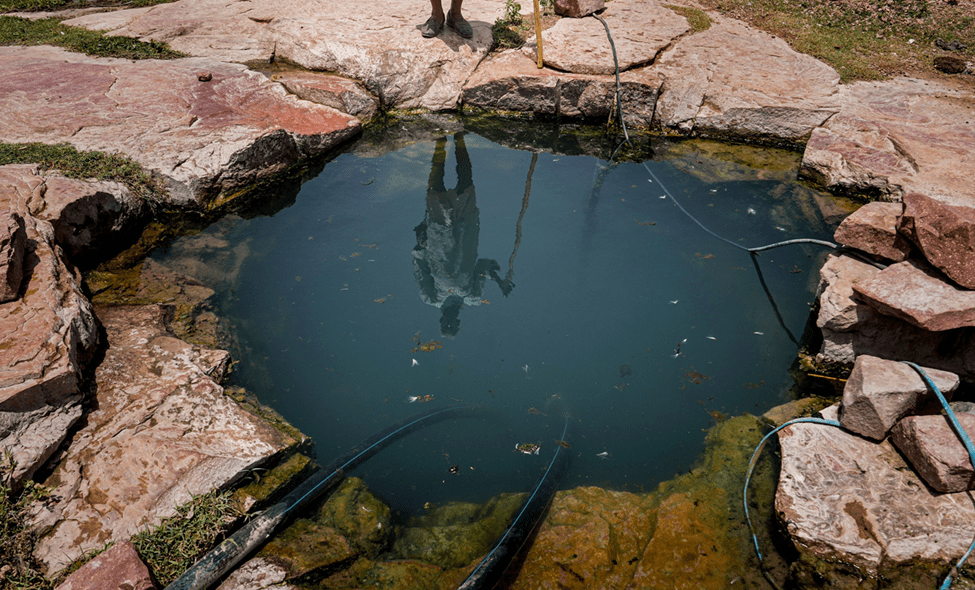
(Feature Image: In Rajasthan’s Chambal, wives of ex-dacoits lead revival of water sources and hope. Source: The Tribune)
On the occasion of World Water Day (WWD) 2026, themed around water and gender, this overview highlights ten stories of collective efforts by communities, experts, and government agencies to conserve groundwater from across India. These examples show how decentralized actions such as reviving wells, recharging aquifers, harvesting rainwater and managing surface water bodies offer simple yet effective alternatives to large-scale infrastructure projects to address the water scarcity. The compilation demonstrates that sustainable groundwater management depends on collective action, local knowledge and active participation of local people.
1 Celebrating the legacy & reflecting on the future of India’s groundwater India is the world’s largest user of groundwater, with over 21.9 million wells and tubewells extracting an estimated 247 billion cubic metres annually. This invisible resource supports most of the country’s drinking water needs and sustains the livelihoods of millions of small and marginal farmers. Yet despite its centrality to India’s water security, groundwater has long been poorly understood and weakly governed. There is no acknowledgement in national policy or otherwise by the government that GW is India’s water lifeline, has been so for over 4.5 decades. Over the past few decades, civil society organisations, scientists, and community institutions have worked to challenge this paradigm. Organisations such as the Advanced Centre for Water Resources Development and Management (ACWADAM), networks like the Revitalising Rainfed Agriculture Network (RRA), and numerous grassroots groups have advanced Participatory Groundwater Management (PGWM), an approach rooted in aquifer literacy, collective decision-making, and equitable use.
It was against this backdrop that a diverse group of researchers, practitioners, and policy thinkers gathered in Pune to reflect on the state of groundwater governance in India. The occasion also marked the conferring of the University of Oklahoma International Water Prize on Dr Himanshu Kulkarni, founder of ACWADAM and a leading hydrogeologist.
2 Maharashtra How hidden underground drainage pipes are reviving India’s black soil New research (by Raj Mukhopadhyay et al. titled, Sub-surface drainage: A win-win technology for achieving carbon neutrality and land amelioration in salt-affected Vertisols of India) shows subsurface drainage not only restores saline black soils and crop yields but also rebuilds soil carbon stocks, a positive outcome from climate change perspective. The study focuses on two villages in Kolhapur district of Maharashtra, Kavathesar and Shedshal, where subsurface drainage systems were installed in waterlogged saline Vertisols and operated for three and five years, respectively.
Across large stretches of western and southern India in parts of Maharashtra and Gujarat, black soils that once supported thriving sugarcane fields are slowly failing. Farmers added more water to secure crops, but over time the water had nowhere to go. Groundwater rose, salts collected near plant roots, and fields turned patchy and unproductive. In some areas, yields that once touched 200 tonnes per hectare fell sharply, pushing farmers into loss.
Yet beneath these degraded fields, an unlikely solution is at work. Buried quietly below the soil surface, networks of perforated pipes, known as subsurface drainage systems, are doing what surface interventions could not. By steadily removing excess saline water from below the root zone, they are transforming the physical, chemical, and biological health of soils.
Western Ghat villages trap runoff to tackle water scarcity In the rainiest pocket of Pune district in Maharashtra, some villages near the mountains have historically faced a dry reality by February as water simply slides off the steep hills. Through communal labour, residents in the Velhe taluk (officially known as Rajgad) of Pune, are using stone structures and farm ponds to trap runoff, allowing them to look beyond rain-fed rice for a year-round income from fruits and vegetables. While reliance on water tankers has decreased, the region’s agricultural water security is still available only to those who can afford to take risks.
Marathwada villagers came together to end water crisis At its core, Bansawargaon’s transformation is a story of human spirit — of villagers who refused to accept despair, leaders who looked beyond politics, and a community that dug deep, literally and figuratively, to reclaim its future. Standing by a canal that now glistens with water, farmer Prabhakar Swami reflects, “We once thought our village was cursed. Today, we know it was only thirst — and we learned how to quench that thirst together.” From scarcity to sustainability, Bansawargaon’s journey stands as a testament to what collective resolve can achieve when a community decides that water — and its future — belongs to everyone.
3 Rajasthan A water conservation project This is the case of a water conservation project taken up very recently in Jogipura village of Sapotra block (Karauli district of Rajasthan). The people here are quite convinced that once the rabi or winter crop is harvested, this water potential development and water conservation project would have more than recovered its entire cost in just one year. In addition, this project adds greatly to sustainability by increasing the water level in this village and in fact a part of this benefit spills over to two neighbouring villages as well. It was decided to take up reconstruction and renovation of an old water harvesting site that was no longer functional. As a result of this water conservation work, a significant part of farmland which could not be cultivated earlier could be cultivated now while the productivity on other farmland also increased. (By Bharat Dogra)
Women turn water warriors to battle drought Until about 15 years ago, Sampatti Devi and many women like her in Karauli district lived in constant fear, dreading the day their husbands might not return home. Repeated droughts, driven in part by declining rainfall linked to climate change, had turned their lands barren. Water sources dried up, crippling agriculture and animal husbandry, the lifeblood of their livelihood. With no other way to survive, many men were forced into dacoity, hiding in jungles and risking their lives every day to evade police.
Karauli’s average annual rainfall dropped from 722.1mm (1951-2000) to 563.94mm (2001-2011), according to govt data. But in the 2010s, something remarkable happened. The women, weary of fear and despair, resolved to reclaim their lives. They convinced their husbands to come out of the jungles and give up arms. Together, they began reviving old, dried-up ponds and constructing new pokhars (water bodies) with the help of Tarun Bharat Sangh.
New water harvesting model A transformative rural water conservation model is set to benefit farmers in the upcoming monsoon. Those behind the initiative, which relies on 50 scientifically designed and climate-resilient farm ponds at Kukas village in Jaipur, claim it has a 10-crore-litre seasonal monsoon run-off conservation potential. The village panchayat in Jaipur district’s Amber block is the second place in the State selected for the rainwater harvesting enterprise, following the successful installation of farm ponds in the rainfed land of Dausa district. As many as 250 ponds dug in the agricultural land of Dausa have enabled the farmers to get perennial crops.
4 Uttar Pradesh Water conservation as a source of climate resilience for Jhansi villages Villagers in Jhansi, facing erratic rainfall and drought, have made water conservation the heart of their climate resilience strategy. Community-led efforts such as check dams, injection wells, and desilting old tanks have secured water supply, revived agriculture, and restored groundwater, benefiting both people and livestock. Special attention has ensured the poor and marginalized now have better water access, reducing inequalities and empowering women. These interventions have stabilized livelihoods and enabled crop diversification, serving as models for enduring climate adaptation amid rising uncertainty.
Rise in groundwater table in Jalaun A district that once struggled for every drop is now witnessing revival, with groundwater levels improving by over 2 m several blocks. This transformation happened over the last couple of years, thousands of water conservation structures-from check dams and restored ponds to farm ponds have come up in Jalaun. Public participation has been a major driving force. Programs like Jal Panchayats and Pani Pathshalas have created a sense of local ownership, making the conservation of water a movement of the community. Jalaun was awarded the National Water Award 2024 as the Best District (North Zone).
5 Gujarat Community’s greywater revolution puts Vendancha village on national map The Community-led greywater reuse has put Vedancha village in Banaskantha district as an example. The 200 KL per day capacity Rs 5.55 lakh water reuse plant set up in 2019 is producing water for use for washing, irrigation, groundwater recharge and drinking water for the cattle. The plant treats domestic wastewater.
6 Punjab A farmer going beyond wheat, paddy Amrit Singh Chahal, 36, a progressive farmer from the Wahegurupura village in Barnala district has redefined modern agriculture by adopting zero-budget natural farming on 8 acres of his 15-acre farm. But his efforts don’t stop there — he is also on a mission to preserve and promote rare traditional seed varieties, once staples of rural farming but now at risk of extinction, by breeding them on his fields. Chahal has built a seed bank with over 150 types of seed varieties, including rare ones like Veena Kaddu (pumpkin), Damru and Tumbi Kaddu, seeds of five coloured carrots, and much more.
7 Jammu & Kashmir Pastoralists turn to RWH Water scarcity from declining snowfall and drying springs puts pastoralists at risk of abandoning their traditional migration practices. Community-led efforts to harvest rainwater through small artificial ponds in high-altitude pastures is proving to be a potential solution. The Alpine Pond Project, that supports over 230 pastoral households, is emerging as a model for climate adaptation, combining both local knowledge and scientific insight.
8 Tamil Nadu PWRM revives 15 defunct wells The initiative, an off-shoot of the Tamil Nadu-based Cuckoo Movement for Children has revived 15 defunct wells across the state over the past four years with crowd-funding. The Public Well Revival Movement identifies defunct wells, reminding people in the village or town of its existence. After necessary permissions from local authorities, citizen’s collectives, and the Forest Department are sought, it sets out to revive them with help from the locals.
9 Ladakh Ursi a model for water conservation Ursi, a village located 130 km off Leh, has been developing an artificial glacier for the past seven years to address its water crisis. It is among many villages in the region that struggle with water scarcity and are solely dependent on spring water. With just 18 households, the village has set an inspiring example of how youth initiatives and community involvement can effectively address water shortages.
10 Trust raising groundwater Aakar Charitable Trust helps rural communities improve access to water through practical, long-term solutions. Founded in 2003 by Amla Ruia, Aakar has constructed 1,380 rainwater harvesting structures, including 825 check dams and 555 ponds, across 11 Indian states. These projects have directly benefited 1,284 villages and helped 18 lakh people. These efforts have helped irrigate over 6.7 lakh acres and collected 38 billion litres of water annually.
6th National Water Awards
Winners for 6th National Water Awards Hon’ble Union minister of Jal Shakti Shri CR Paatil announced the list of winners of 6th National Water Awards, on Nov. 11, 2025, at Shram Shakti Bhawan New Delhi. The Department of Water Resources, River Development, and Ganga Rejuvenation (DoWR, RD &GR), under the Ministry of Jal Shakti announced the 46 winners, including joint winners, for the 6th National Water Awards for the year 2024 in 10 categories viz Best State, Best District, Best Village Panchayat, Best Urban Local Body, Best School or College, Best Industry, Best Water User Association, Best Institution (other than school or college), Best Civil Society and Best individual for excellence in water sector.
Jal Sanchay Jan Bhagidari (JSJB) Awards The Jal Sanchay Jan Bhagidari Awards, launched in 2024 under Jal Shakti Abhiyan: Catch the Rain (JSA: CTR) campaign, honor outstanding community-driven water conservation efforts. Recognizing 100 contributors across sectors, the initiative promotes scalable models for groundwater recharge and long-term water security. Under JSJB, 35 lakh GW recharge structures have been constructed.
Andhra Pradesh: Groundwater rises by 3.4 metres in a month in Annamayya For several years, farmers in Annamayya district struggled with failing borewells and rapidly declining aquifers. Recognising the severity of the crisis, Collector Nishant Kumar and his predecessor Sridhar Chamakuri pushed for an integrated, scientific approach to watershed conservation, leading to intensive interventions across eight mandals. In the Dubbaganipalli watershed of Madanapalle mandal, extensive works such as contour trenches, mini percolation tanks, farm ponds, dugout ponds, Amrit Sarovars, and other structures were undertaken. A total of 51 works worth ₹74 lakh created a storage capacity of 70,555 cubic metres.
Under the WDC–PMKSY 2.0 program, the district initiated 4,288 Natural Resource Management (NRM) works at an estimated cost of ₹81 crore. In Peddamandem village, borewells began discharging water automatically. Even with two consecutive years of below-normal rainfall, the district managed to conserve 14 TMC of surface water & 14.5 TMC of GW.
Official data show that while the average groundwater rise across Rayalaseema between May and December 2025 had been 3.6 metres, Annamayya recorded an 8.7-metre increase. Groundwater that lay at a depth of 12.97 metres in November 2024 and 14.45 metres in August 2025 is now available at about 3–8 metres in nearly 90 per cent areas of the district, reviving more than 20,000 defunct borewells and reducing dependence on deep pumping. District Collector said the initiative did not involve the construction of new irrigation projects but relied on reviving defunct infrastructure and linking surplus and deficit sub-basins. 90% of the district has benefited, with several tanks receiving water after a gap of over 4 decades.
Telangana State ranks first in RWH Telangana has secured the top position in the JSJB 1.0 rankings announced by the Union Ministry of Jal Shakti. Chhattisgarh and Rajasthan secured the second and third positions. During 2024-25, Telangana undertook 5,20,362 rainwater harvesting works, the highest in the country. The works included construction of check dams, soak pits, rooftop rainwater harvesting structures, borewell recharge, sub-surface dykes, farm ponds and percolation tanks.
Jangaon’s low cost RWH pits To conserve water, govt employees in Jangaon have joined a voluntary effort & constructed 7175 rainwater harvesting pits, each pit of 1 cubic meter.
Karnataka Bidar bags national award for water conservation efforts Bidar district has been honoured with the JSJB Award.
Maharashtra First prize as best state Maharashtra bagged first prize for the Best State in 6th National Water Awards. Gujarat got second position, and Haryana the third.
Relevant Reports
The role of communities in conserving water A common theme across these suggestions (mentioned in the article) is that local and indigenous communities and their practices can support effective water management. The communities’ practices may come with their own limitations which should be addressed through sensitisation and capacity building. (Kanika Jamwal)
Climate Resilient Socio-Economic Growth Through Water Conservation Dr. Indira Khurana’s book shows how community-led water conservation in Chambal turned water scarcity into a model for climate resilience, rural prosperity, and sustainable development through science and storytelling.
Rainwater: The most underused climate solution One of the most scalable solutions is also one of the oldest: rainwater harvesting. Simple structures like check dams, aquashafts, and recharge ponds can improve groundwater levels by 10–15% within two monsoons. Paired with techniques like drip irrigation and agroforestry, the impact multiplies — in soil health, yield stability, and climate resilience. (KS Mehta)
Need to talk about water We need more interdisciplinary conversations around water, conversations that connect education, activism, science and sustainable choices.
SANDRP

 SANDRP