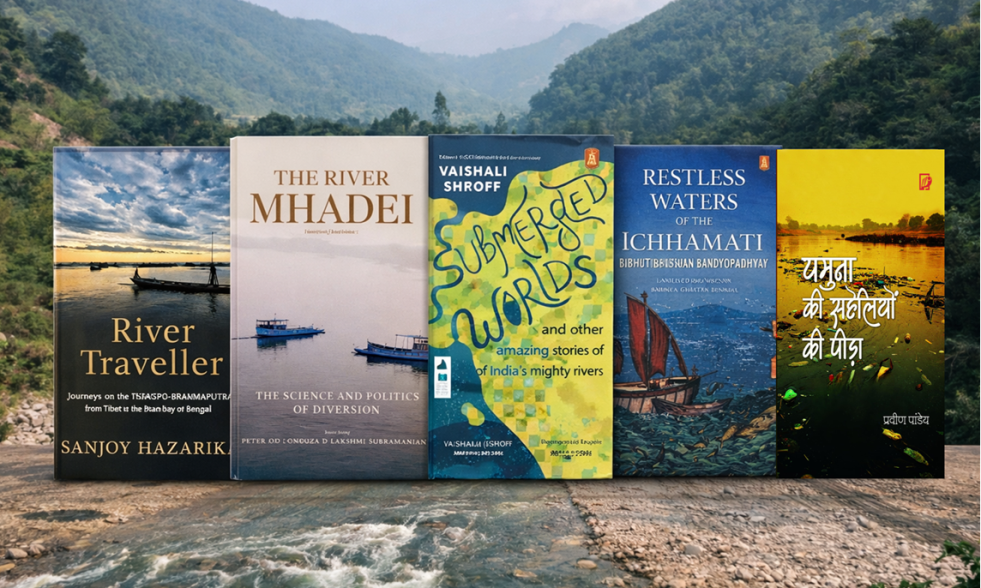
(Feature Image: Cover page of five books on Indian rivers mentioned in this overview)
This overview puts together brief information on top five books, films, discussions, reports, and cultural stories published during previous year to present a comprehensive view on the state of rivers in India. The compilation emphasizes how rivers are deeply intertwined with ecology, society, politics and culture while highlighting the growing crises they face due to pollution, dams, urbanization and climate change. Through research, storytelling and lived experiences, the collection questions current policies and development models, stressing on the need for sustainable management, stronger accountability and recognition of rivers as living systems essential to human and ecological well-being.
Five Books by Indian Authors on Indian Rivers
1 River Traveller: A Majestic Journey Along the Brahmaputra Speaking Tiger Books brings forth a remarkable new work by acclaimed journalist and author Sanjoy Hazarika — River Traveller, an epic narrative that traces the life, history, and mysteries of one of the world’s great rivers: the Brahmaputra. The numerous travels of the author along the river from Tibet to Arunachal Pradesh to Assam and Bangladesh is not only a good narration but also a warning that the river will retaliate to the various dams being built and planned on it by China and India.
2 The plot twists about a river’s politics The book, The River Mhadei: The Science and Politics of Diversion, published by Goa 1556, is a compilation of research essays on the river which traverses through three states — Karnataka, Goa, and Maharashtra. Written by experts — scientists, ecologists, legal scholars, historians, planners, journalists, activists, and community practitioners — explore the environmental dispute over the damming and diversion of Mhadei’s waters.
3 A fascinating book on India’s rivers Submerged Worlds and Other Amazing Stories of India’s Mighty Rivers by Vaishali Shroff brings together well-researched stories of the ecology, mythology, politics, history and culture of India’s rivers. The book revisits the struggles of the dammed rivers and drowned communities, highlighting the injustices they have endured for decades. It prompts us to question why we continue to overlook more viable alternatives, especially when most dams have entirely failed to achieve their intended goals.
4 Ecological fiction masterpieces “Restless Waters of the Ichhamati” by Bibhutibhusan Bandyopadhyay celebrates the flora and fauna of Bengal. Through the gaze of a slow-moving river-farer, the novel considers the vibrant plant life and traces of human habitation along the Ichhamati river’s banks. Bandyopadhyay’s poetic prose evokes the flow of time and the interconnectedness of generations with the river and its surroundings. The novel’s form, devoid of chapter breaks, mirrors the fluidity of the river’s course, inviting readers to immerse themselves in the ebb and flow of nature’s rhythms.
5 The Plight of Yamuna’s tributaries This Hindi book not only analyzes the current state of the Yamuna’s major tributaries—the Chambal, Betwa, Ken, Hindon, Kali, Sahibi, and others—but also reveals how unchecked industrialization, illegal sand mining, and the indiscriminate exploitation of water resources have pushed these rivers to the brink of collapse.
Five Books on Global Rivers Issues by Foreign Authors
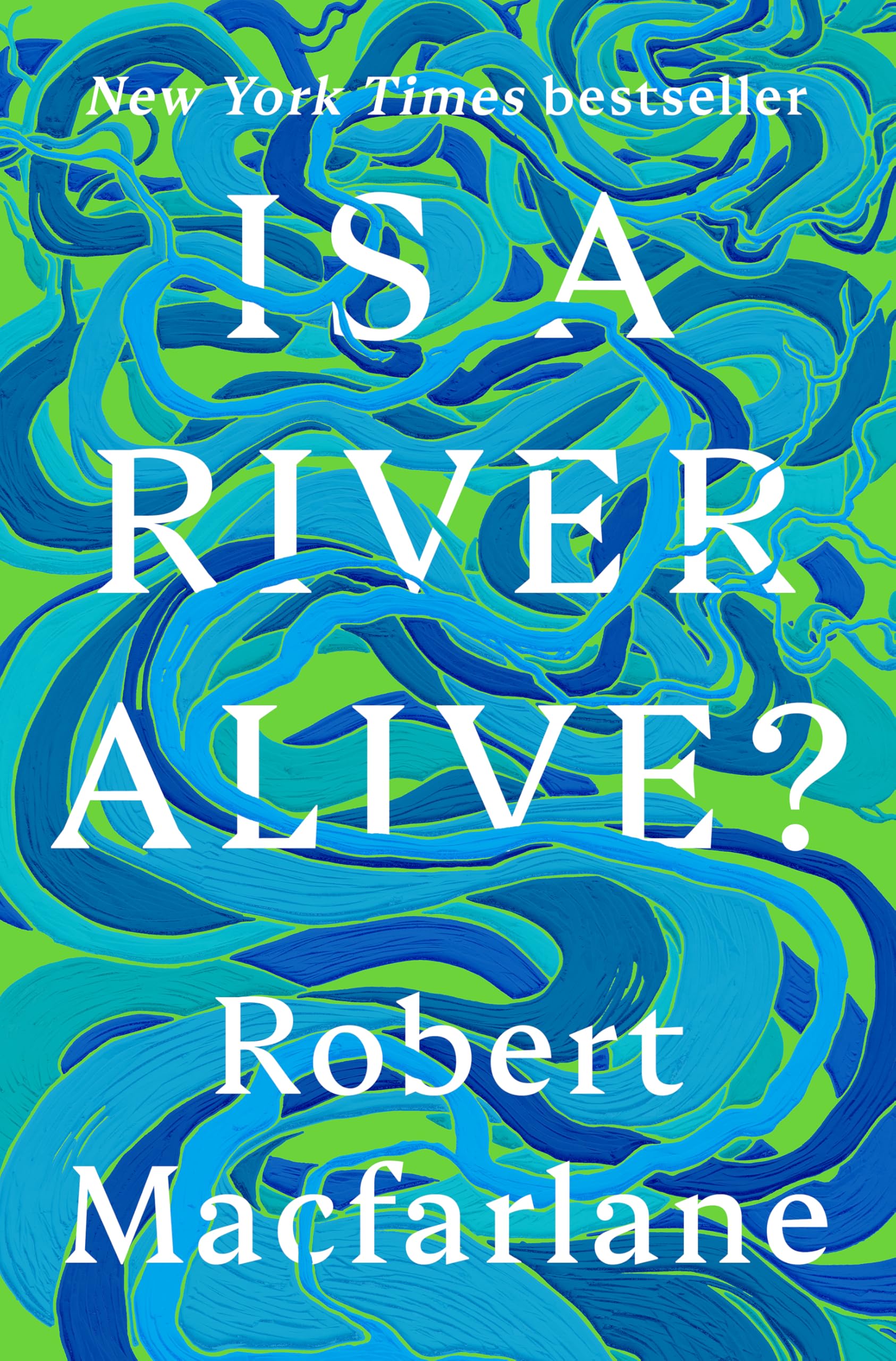
1 Is a river alive? At the heart of IS A RIVER ALIVE? is a single, transformative idea: that rivers are not mere matter for human use, but living beings – who should be recognized as such in both imagination and law. Macfarlane takes the reader on a mind-expanding global journey into the history, futures, people and places of this ancient, urgent concept.
2 Liquid Empire: Water and Power in the Colonial World A bold new account of European imperialism told through the history of water. Revealing how the legacies of empire have persisted long after colonialism ebbed away, Liquid Empire provides needed historical perspective on the crises engulfing the world’s waters, particularly in the Global South, where billions of people are faced with mounting water shortages, rising flood risks, and the relentless depletion of sea life.
3 Muddying divide between land & water The book introduces “amphibious anthropologies” as a framework to challenge the dichotomy of water and land and interrogate spaces marked by rapid and profound environmental change. It brings to light the everyday creativity and uncertainty in wet environments like California’s Salton Sea and India’s North Bihar floodplain. Engaging with disciplines like anthropology, geography, and STS, this work offers a timely discourse on environmental change and resilience.
4 A In Praise of Floods: The Untamed River & the Life It Brings Award-winning author James C. Scott opens our understanding of rivers to encompass their entirety—tributaries, wetlands, floodplains, backwaters, eddies, periodic marshlands, and the assemblage of life forms dependent on rivers for their existence and well-being. The book paints a strong picture of the challenges that biodiversity in the Ayeyarwady river faces and highlights the inherent contradictions in man-made conservation efforts, given what is best for mankind is so often at odds with what’s best for nature.
B The Surge: The Race Against the Most Destructive Force in Nature In this timely, panoramic and gripping book, climate editor Jeevan Vasagar traces humanity’s responses to flooding over the centuries, from the deadly North Sea floods of 1953 to the catastrophic events of today. He explores the costly and complicated choices governments face: fight the water with ever- expanding defences, or adapt and move? Drawing on groundbreaking engineering solutions, Vasagar argues for a radical rethink — combining resistance and accommodation as we reimagine our cities.
5 Rivers, Cities and People: Social Challenges of Urban Waterfront Development in Asia This book uses an interdisciplinary perspective to assert that insufficient consideration of social issues in the planning and management of urban riverscapes leads to social exclusion. Utilising diverse entry points and theoretical orientations, every chapter of the volume contributes to the exploration of the way urban river restoration is entwined with questions around urban citizenship, violation of international housing rights, poverty and vulnerability, livelihoods and the use of common property resources.
Five Films, Documentaries, Video Reports on Indian Rivers
1 Parikrama: a thought-provoking yet flawed look at India’s Narmada River Parikrama is the latest addition to the vast filmography of Goutam Ghose. The movie tells the story of a migrant teenage boy and an Italian man who was making a documentary film on Narmada river pilgrimage. ‘Parikrama’ dwells on issues like threats to ecology, environmental damage, battle for survival. Mother Narmada is central to the film, which follows fictional Italian film director Alessandro (Marco Leonardi) as he sets out to make a documentary on the Narmada pilgrims.
However, the river also spells destruction for many local villages. Due to the huge Sardar Sarovar Dam built by the government, upstream villages that have stood for hundreds of years are becoming submerged. The dam has been subject to controversy ever since its construction began in 1987 and continues to spell disaster for many local villages.
2 Jeremy Wade’s Mighty Ganges Revered as a living goddess by a billion Hindus, the Ganges is among the planet’s most iconic rivers. But recent reports paint a troubling picture of a waterway hit by industrial pollution, waterborne diseases, and plummeting fish stocks. Jeremy Wade travels to India to uncover the truth.
3 Jojari: India’s Deadliest River The Jojari River, once a modest lifeline to Jodhpur’s villages and fields, has been transformed into a toxic vein – carrying the waste of negligence, corruption, and indifference. Its waters no longer nurture; they corrode. Its flow no longer sustains; it suffocates. Here, farmers sow seeds that never ripen, children grow up with poison in their veins, and generations inherit not prosperity, but disease. The soil turns barren, the cattle fall sick, and the villages live under an invisible siege. Here is one more video report on Jojari pollution.
4 Plight of Betwa river This Hindi documentary by Environment Story reveals that Betwa river has dried up at its origin place due to some construction and encroachment works. Few springs fed by Kollar dam seepage are feeding the river course there. The river is further polluted by industrial waste from Mandideep area and sewage pollution from Bhopal city making its water unfit for drinking and bathing purposes
5 How Gangua become Bhubaneswar’s sewer liine? Gangua—also known as Gangabati—was once a significant and ancient river. Today, however, its condition has deteriorated drastically. Gangua serves as a vital urban water source, originating in the Chandaka forest region. Flowing southeastward from Bhubaneswar, it traverses a distance of approximately 45 kilometers before merging with the Daya River.
Five Informative Video Discussions on Rivers
1 Ken Betwa Link Questions on decision-making process The Wednesdays.for.Water session provides an understanding of the geopolitical-social-ecological aspects that shape and impact and will do so to the future of the linking rivers and the served population in India.
2 Eco-Hydrology In this episode, host Veena Srinivasan speaks with Jagdish Krishnaswamy to explore the science that connects hydrology, ecology, and the people who depend on India’s rivers and landscapes. From the Western Ghats to the Himalayas, from springs to large reservoirs, this episode dives into decades of pioneering field research, where data collection meets cutting-edge science.
3 Rivers are Alive Engaging session organized on the World Rivers Day (28th Sep) dwelt on reflective river-hood conversations on living rivers, rights of rives & earthy governance between Shrishtee Bajpai, Parineeta Dandekar (SANDRP) and Alyen Foning, followed by active interventions by many participants.
4 Kota Declaration on Riverfront Activists and concerned citizens from across India gathered in Kota, Rajasthan for a National Consultation on Riverfronts Development in India titled, “Rivers at Risk: Riverfront Development and Socio-Ecological Crisis”. Here is the Kota Declaration on Riverfronts that the discussants released. Also see the video recordings of discussion 1, 2 and 3.
5 Vadodara Can Vishwamitri be revived? The discussion questions government river-cleaning and development projects, suggesting they may not solve the real problems of river pollution and urban flooding. It also highlights issues like flooding and ecological imbalance, which affect people living nearby.
River Rights & responsibilities The Wednesdays for Water session focus is on the nuances of the legal, regulatory, social, political, cultural, and spiritual, framework of the rights and responsibilities of the society over Rivers in India.
Five Relevant Reports, Articles, Opinion on Rivers
1 India’s non-functional STPs A detailed report shows how India’s Sewage Treatment Plants (STPs), Govt’s main weapon against pollution of rivers in Urban areas, have been a failure for decades. It is pertinent to note that this is the golden jubilee year of Water Pollution Control Act of 1974, that led to the formation of Central, state Pollution Control Boards, and the whole water pollution control bureaucracy, institutions and legal architecture. There should be little doubt that whole architecture has abysmally failed in achieving basic objective for which it was created, including ensuring proper treatment of urban sewage.
2 Sanctuaries inside Indian rivers Venkatesh Dutta There are several stretches of rivers that have been declared protected areas under the Wildlife Protection Act, 1972. These river stretches are special in many ways — they are known to protect and shelter many iconic species such as dolphins, gharials, otters and turtles.
3 Legal personhood ruling gave symbolism, not solutions – Legal personhood for rivers may one day be a meaningful concept in Indian law. But only if it rests on a foundation more robust than religion, more inclusive than symbolism, and more practical than sentiment. Until then, the judgment remains a poetic gesture—beautiful, perhaps, but legally fragile. – (By Amrita Pankaj Satija)
4 Role of sediments in river hydrology Sediments play a crucial role in the river’s health and ecosystem. The process of sediment formation, transport, deposition, & natural erosion not only affects the river’s flow but also moulds islands & sandbanks – with this constant interplay of deposition & erosion shaping the riverine system itself. Human activities on rivers such as the construction of dams and barrages, sand mining, hampers the flow of sediments, which affects the rivers’ energy and flow, and consequently its floodplain.
5 The River Parliament A fictional “parliament” of rivers by Ashish Kothari discusses the damage caused by humans like pollution, dams, and overuse and debates how to respond. The story highlights the need to treat rivers with respect and protect them for the future.
Five Stories on River Culture
1 World’s largest river island in India Spread across 475-880 square kilometres depending on seasonal floods, Majuli is India’s only island district and a geographical wonder. Formed centuries ago, by the shifting course of the Brahmaputra, it is often described as a living museum of Assamese traditions. Majuli’s beauty hides a grim reality. Once spread over 1,200 sq km, the island has shrunk drastically due to riverbank erosion and annual monsoon floods. Experts warn that if erosion continues unchecked, much of Majuli could disappear within our lifetime. The erosion not only threatens land but also endangers centuries-old art forms and livelihoods.
2 Where men migrate & river meanders In the 1960s, the Ganga changed the course of thousands of people’s lives after it was channelled into the Farakka Barrage Project, setting them up for displacement and uncertainty. Shiv Sahay Singh meets those most affected by the project to understand the link between the erosion of the riverbank and men leaving the State to seek employment elsewhere.
River refugees of the Ganga People living in villages along the Ganga River in Malda and Murshidabad regions have faced displacement for decades. The erosion by the Ganga River is attributed to natural dynamics, exacerbated by the construction of structures like the Farakka Barrage. Located in Murshidabad district, the intervention in the Ganga at Farakka has impacted the equilibrium of the river.

3 Ice porters on frozen Chadar river A collaborative photo essay, “The Feel of Climate Change,” published in Current Anthropology explores this world of ice porters on the Chadar, and how this ancient way of life is rapidly changing. Climate change is destabilizing the river’s freezing patterns, and development is bringing tourism and resources to this long-isolated region.
4 Milk, moonwalks and icebergs: the metaphors of Luni The article reflects on a walking journey along the Luni River and uses metaphors to understand its changing nature. It shows that the river is neither fully alive nor completely dead – it shifts between water, sand, and human use. Through local voices and lived experiences, the piece highlights issues like water scarcity, sand mining, poverty, and ecological decline, while also revealing how communities continue to depend on and adapt to the river.
5 India’s ‘Unmarried’ river A popular legend speaks of Narmada’s love for the handsome river Son. Just before their wedding, Narmada discovers Son’s affection for another river, Johila. Heartbroken, she changes her course, flowing westward—away from Son—and vows to remain unmarried. Interestingly, all three rivers—Narmada, Son, and Johila—originate from the same Maikal ranges in Madhya Pradesh. Geologists attribute this unusual flow to the presence of a rift valley — a geological formation where land between two faults sinks, creating a natural westward slope.
Kaleshwaram Treasures – Temples, Tussar, Three Rivers Located at the confluence of the Pranahita and Godavari rivers, Kaleshwaram finds mention in ancient texts and treatises such as the Skanda Purana. A third, invisible underground river is believed to join the above two rivers at Kaleshwaram. Lord Shiva presides over this confluence, where the mystical Saraswati is said to remain subterranean. This holy place is revered much like the Sangam at Prayag in north India.
Godavari: About Nagoba Jatara The Mesrams embarked on a padayatra for fetching holy water from the Godavari river, at Keslapur village in Indervelli mandal on Jan. 10, 2025 as part of Nagoba Jatara, a five-day annual religious and cultural affair of the clan slated for Jan. 28, 2025. Nagoba Jatara is the largest congregation of ethnic tribes belonging to several parts of not only Telangana but also Maharashtra, Madhya Pradesh, and Chhattisgarh.
SANDRP

 SANDRP