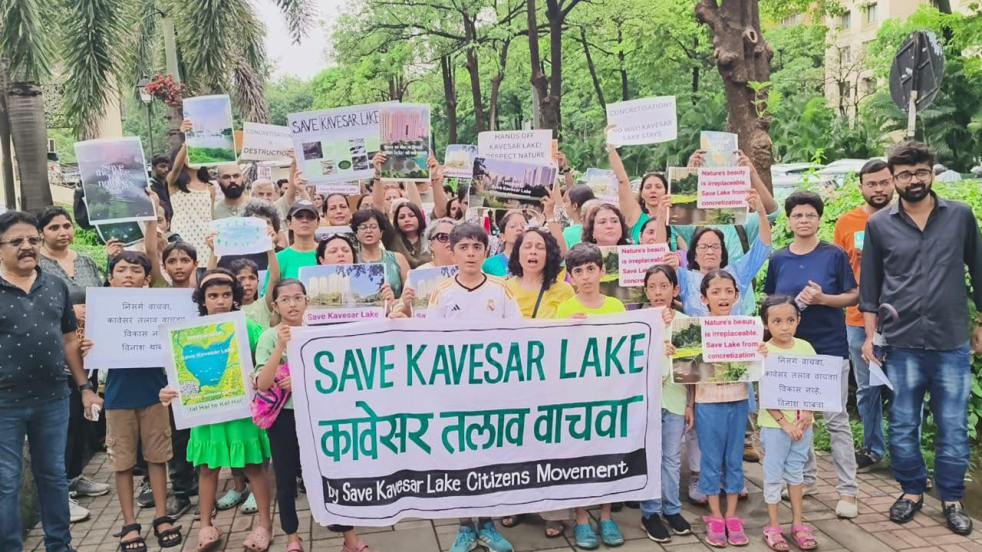
(Feature Image: Citizens under Save Kavesar Lake campaign carrying out a march in Thane in June 2025. Source: Manohar Dumbre FB Post)
This final 2025 India Wetlands overview documents wetland-related developments during 2025 & highlights remarkable actions by individuals, community and citizen groups to protect lakes and water bodies across India during past one year. It also covers some encouraging and collective efforts undertaken to reclaim and revive degraded wetlands. Together, these inspiring stories reflect on growing awareness among people that wetlands are vital for water security, flood protection and climate resilience.
1 Karnataka Breathing life into the lakes For thousands of farmers in the dozens of drought-prone villages in Gauribidanur taluk, Chikkaballapur district, local lakes are not relics of the past anymore. Over the past five years, de-weeding and desilting have infused life into 12 community water sources that had been reduced to beds of weeds. The community initiative to revive lakes firmed up in 2020, after the region experienced eight years of drought in one decade, starting from 2009. The initiative followed after a group of like-minded people, who worked in different sectors, got together and decided to put their collective sense of purpose to make lakes functional again.
It was during the Covid-19 pandemic when Varaprasad Reddy, an Administrative Service Officer brainstormed with friends and acquaintances to give shape to the thoughts and formed Gouribidanur Seva Prathishtana Trust. “Hailing from a farmers’ family, I have seen the plight of farmers during drought. While initially I thought big water projects were the only solution for drought-prone areas, eventually I realised that the watershed approach could be more sustainable,” he says.
The trust working informally, was registered in 2025, after there was a consistent demand for rejuvenation projects. The team identifies lakes depending on the gravity of the crisis, reaches out to the community leadership, holds consultations with the villagers and approaches potential donors for resource mobilisation. Most of the donors from the first lake project have continued their support in successive projects.
As representatives from other villages have started to approach him to execute similar projects, he has connected them with NGOs. The trust takes up two projects every year, on average. Villagers have noticed that the expenses of desilting come down drastically in this model compared to the standard rates prescribed by the government. “This is because it is a community-driven initiative and involves a lot of resource mobilisation, collaboration and voluntary work,” Varaprasad Reddy says.
2 W Bengal Villagers’ decade long fight to protect a waterbody In the first week of Jan 2025, a group of residents from Bhabadighi village attended a convention in Chinsurah, the district headquarters of Hooghly, to advocate for the protection of a 17.48-acre natural waterbody in their village, named after it. For a decade, they have been protesting against the construction of a railway line that would cut through the Bhabadighi.
This railway line is part of the Tarakeswar-Bishnupur Rail Project. Local residents have raised concerns about the construction of the railway line over the waterbody, which is integral to the livelihood of approximately 150 families. The dighi (a Bengali term for a large pond) is a vital source of sustenance for the village and a core component of the local ecosystem. Locally, it is believed that Sri Chaitanya Deb and Sri Ramkrishna Paramhansa once drank water from this waterbody.
Initially, the villagers were pleased with the railway project’s progress. However, upon learning that the final stretch of the railway line would pass over their dighi, they launched their protest. While the administration and mainstream media portray the village residents as anti-development, they are not opposed to the construction of the railway line. Rather, they believe that the route could have been planned to bypass the waterbody. However, they perceive the sudden change in the route as indicative of corruption and favouritism.
The villagers have issued leaflets explaining their opposition to the railway project. These leaflets read: “As this dighi is an integral part of our existence, for us to exist, this dighi must exist with us. Please do not dismiss this as a conspiratorial movement – it is a movement for our right to live.” They further state: “Yes, we are opposing the railway track for our own selfish gains, but if you claim that the railway track is in the ‘larger interest’, we ask – what can be larger than life itself? Bhabadighi is our life.”
3 Kerala A farmer’s fight to preserve wetlands stalls billionaire’s mall plan UAE-based business magnate M A Yusuff Ali’s efforts to bring his global chain of Lulu shopping malls to his hometown of Thrissur have hit a hurdle – a 61-year-old paddy farmer fighting for the preservation of dwindling patches of wetlands in the state. T N Mukundan’s legal battle came to light after Yusuff Ali said at an event on Agu. 31 that his plan to build a shopping mall in Thrissur was yet to materialise after “one party” moved a case against it in the High Court.
When the Revenue Divisional Officer (RDO) passed an order excluding Lulu’s land from the paddy land databank, which would have allowed its use for non-agricultural purposes, Mukundan moved the Kerala High Court in 2023 against the move. In last week of Aug. 2025, the High Court cancelled the RDO’s order, and directed authorities to reconsider the status of the land, effectively stalling plans for the mall.
According to Mukundan, he has been waging a legal battle regarding the status of the land since 2016, when it had a different owner. Mukundan says his fight for paddy fields began after the state government enacted the Kerala Conservation of Paddy Land and Wetland Act in 2008. He maintains that his fight is not against the Lulu Group, and that he has 15 different petitions against the conversion of paddy fields that are pending before the authorities.
His legal fight has forced the state government to maintain the Agriculture Promotion Fund to protect and restore paddy fields. From 2008 to 2024, the state has collected Rs 1,510 crore as fees for converting paddy/wetlands. “The state had not deposited the amount with the Agriculture Promotion Fund, and instead, diverted the same into the Treasury for other purposes. Only Rs 6 lakh has been used for the restoration of paddy fields,” he said. In Nov. 2024, the Division Bench of the High Court ordered the government to transfer the Rs 1,510 crore to the Agriculture Promotion Fund in four instalments.
4 Thane Citizens oppose cosmetic beautification of Kavesar lake Spread on 6 acres of land, the Kavesar Lake is now the only unpaved wetland in Thane, a city once known for its 70-odd lakes. Over time, most of these lakes have been lost to urban development or subjected to “beautification” projects involving man-made structures. Today, the ecologically sensitive Kavesar Lake also faces the threat of destruction from a revamp project sanctioned at a budget of ₹6-7 crore by the municipal authorities.
The Thane Municipal Corporation (TMC) has already issued a work order after procuring funding from the State government, which approved the project without public consultations or approval of local communities, environmental groups or even the local MLA. This project exemplifies the construction-centric mindset, which is at the root of all climate change conversations today. It shows how government spending is driven by private interests and greed, rather than the larger public interest and preservation of biodiversity.
The ‘Save Kavesar Lake Citizens Movement’ emerged in response to these valid questions. On World Environment Day (June 5, 2025), more than 100 people came together to stage a silent protest, donning black attire and holding placards to voice their opposition. Around 200 residents of all age groups braved heavy rains to participate in an awareness march. An online petition opposing the project has already garnered over 8,000 signatures. Representatives from the citizen movement have met the TMC Commissioner and the local MLA and submitted their petitions against the beautification project.
Many citizens and environmentalists have criticised the TMC and filed written complaints against the unscientific and ill-advised practice of removing the rare white lotus from 80–90% of the Kavesar Lake waters, under the pretext of cleaning the water body of weeds. Birders, zoologists, horticulturists and wildlife enthusiasts have also registered several complaints with the corporation, urging it not to disturb the lotus habitat during the breeding season.
Save kavesar Lake Citizens Movement On the occasion of World Environment Day 2025, over 100 residents of Thane participated in a protest lake, saying construction activities were destroying the pristine environment and the trees being planted as part of the beautification drive were not suited for wetlands. The TMC took note of the protest and halted the scheduled plantation event.
Situated amidst the urban sprawl of Thane, Kavesar wetland provides a calming space for people in search of peace in the fast-paced city. “Kavesar lake isn’t just a patch of water. It’s one of the last wild, breathing spaces left in our city. There are no paved paths here, no artificial lights – just birdsongs, native trees, and the quiet balance of an untouched ecosystem. It helps cool the air, absorbs rainwater, recharges groundwater, and gives both wildlife and people a place to slow down and breathe,” said Nishant Bangera, a local environmental activist.
The beautification drive involves converting the existing unpaved trail into a paved walkway and adding structures such as an amphitheatre, gazebo, skywatch tower, and seating arrangements. Protestors said that though the project was termed as “beautification”, the manmade additions would cause irreversible harm to the sensitive ecosystem.
5 Chennai Locals stop housing project near Madambakkam lake A real estate firm dumped earth into the water body to raise the land for a layout project, alleged Raju of ‘Save Madambakkam Lake Committee,’ warning that the project would cause inundation in the northern side of the Madambakkam lake and pose a serious flood threat to Madambakkam residents. He also pointed out that “no mitigation measures have been considered by the concerned depts like the WRD (Water Resources Dept) and the CMDA (Chennai Metropolitan Development Authority).”
The residents pointed out that the Tamil Nadu Combined Development and Building Rules, 2019, bar construction within a 15-metre radius of a water body. Moreover, environmental clearance is required for projects exceeding 20,000 sqm while the said real estate project is estimated at around 58,000 sqm. Also, no planning permission was obtained from the CMDA.
Irked by these violations, about 1,610 residents of Madambakkam area, which falls under Wards 69 and 70 of the Tambaram Corporation, submitted petitions to CMDA, WRD, Tambaram Corporation, Forest Department, Wetland Authority, Pollution Control Board, District Collector and Revenue Department officials. In their letters, they have sought for extension of the streets up to the lake, to ensure smooth flow of the surface runoff from the northern side of the lake. They have also requested to ensure that no construction activity is undertaken within the specified buffer zone.
In response to the petitions, revenue department officials inspected the lake area and stopped the work, following which, Tambaram Corporation Commissioner S Balachander and other officials visited the lake and informed the public that the civic body had issued a stop-work notice to the real estate firm. Meanwhile, the southern bench of the NGT, which is hearing a case pertaining to pollution in the Madambakkam lake, has taken up the matter after the residents petitioned the Tribunal.
6 Raipur NRANVP’s projects near Jhanjh wetland faced objections The Naya Raipur Atal Nagar Vikas Pradhikaran (NRANVP) has proposed two development projects in Sector 24 near Jhanjh Wetland (Audhumi) in Naya Raipur. The tendering process is currently underway for these projects, which include a plotted development and floating recreation facility on 2.66 acres (NIT No. 10361) and a branded residential area on 18.64 acres (NIT No. 10360). However, objections have been raised regarding these tenders. Dr. Rakesh Gupta from Raipur has formally written to the Chief Secretary-cum-Vice Chairman of the Chhattisgarh State Wetland Authority, the Chairman and CEO of NRANVP, expressing concerns over the legality of these projects.
Jhanjh Wetland is a notified wetland under the Supreme Court’s ruling in the M.K. Balakrishnan vs. Union of India case, where Rule 4 of the Wetlands (Protection and Management) Rules, 2010, is applicable. Dr. Gupta has alleged that despite a complaint filed in 2023 regarding encroachment on Jhanjh Wetland by dumping soil and constructing a pathway, no investigation report has been submitted yet. He claims that court orders have been openly violated, and the encroached structures have not been removed. He questioned the urgency of inviting tenders for construction near the wetland when its demarcation report, as ordered by the Supreme Court, has not been finalized.
Dr. Gupta has demanded an immediate halt to the tendering and proposed construction near Jhanjh Wetland. He has suggested that the Revenue Dept be involved in verifying the wetland’s ground status and demarcation, emphasizing that permanent construction is prohibited within 50 meters of the highest recorded flood level since 2000. He argued that both proposed project sites fall within the average high flood level of the past 25 years, making them unsuitable for development. He has also criticized the Chhattisgarh State Wetland Authority, accusing it of playing a role in the destruction of wetlands rather than their protection.
7 Coimbatore Women Wetland Watch documenting waterbodies As dusk falls on Valankulam, a sprightly group of birders prepares for its 25th bird watching expedition. There are teachers, a dentist, an HR professional: all of them women with a love for the outdoors. They are part of Women Wetland Watch, an initiative by city-based Siddharth Foundation, a non-profit organiation that focuses on biodiversity conservation. Armed with field glasses and mobile phones with the eBird app at the ready, they set out to count grebes, spot swamphens, and document spot-billed ducks at the wetland in the heart of the city.
The team meets for birding one Sunday every month at one of the city’s wetlands. Siddharth Foundation, says P Pramod, a scientist with SACON who is also one of its trustees, was started to connect people with Nature. “Women are a section of the population we want to focus on,” he says. “I feel that when we motivate women to do something, they motivate others too.” He explains that their focus is not on the technicalities of birding such as species identification. “It is more on mentally connecting people to Nature. Once that is done, the rest is taken care of,” says Pramod.
Around 10 to 30 women from all walks of life gather for their Sunday sessions, many of whom bring their children along. The programme has covered 11 wetlands in and around the city, with over 450 women participating since its inception in 2023 to document 146 bird species, apart from insects, butterflies, reptiles, amphibians, and wetland flora. Spending time by the city’s wetlands has also left them with first-hand observations of the decline of our waterbodies. “We’ve had passers-by tell us how a lake is being polluted by sewage water, asking us to do something about it,” says Auxilia. “We feel a sense of responsibility to go beyond just birding.”
8 Karela Activists demand removal of soil dumped in Kottooli wetlands Demanding the immediate removal of soil dumped in the Kottooli wetlands, activists of the Sarovaram Environment Protection Committee staged a protest at the site on Dec 18, 2025 condemning the alleged failure of the authorities to enforce orders to protect the urban biodiversity hotspot during the Vijil murder investigation. The organisation alleged that around 46 loads of soil were deposited in the wetlands on August 29, 2025 by the police as part of the evidence collection process. The case dates back to 2019.
Earlier in Dec. 2025, the Kerala High Court also observed that complaints regarding threats to the Kottooli wetlands could not be ignored, warning that delays in protecting the area could cause permanent environmental damage. The court noted that the wetland is being considered for Ramsar site status and posted the matter for further hearing in Jan. 2026. Previously, the Kozhikode city police chief had reportedly assured the committee that the soil would be removed once the evidence collection process was complete. However, the committee members pointed out, no action has been taken so far.
Samithi, RAs stop landfilling of wetland in Vazhathuruthi Tension is brewing in the Vazhathurthi area near the Sarovaram Biopark in Kozhikode once again after the workers of the Sarovaram Prakrithi Samrakshana Samithi and the Vazhathuruthi Residents’ Association successfully stopped an attempt to continue the landfilling of Kottooli wetlands adjacent to a school compound. The workers noticed on May 17, 2025 afternoon that the concrete that covers the courtyard of the school was being removed using an earthmover and being dumped into the wetland. This is the same area where they had spotted ongoing landfilling in Nov. 2024 and obtained an order from the Kerala high court to maintain status quo.
A team of officials led by Village Officer-in charge P. Dhanya of the Vengeri Village reached the spot and noted that the landfilling was indeed a violation of the Kerala Conservation of Paddy Land and Wetland Act, 2008. Meanwhile, the Samithi is planning to approach the District Collector with a petition under the RTI Act in connection with the disappearance of another earthmover, which was confiscated by the Revenue Department and stored in one of the compounds in the locality.
9 Chennai Proactive community revived Madipakkam Lake A walk around Madipakkam Lake today offers a lush, green escape: a scenic pathway encircling brimming waters, shaded by native trees and plants that purify the air. Small islands in the lake attract a variety of birds, making it a haven for urban biodiversity. Along the paved paths, vendors selling healthy snacks and fresh vegetables have set up shop, a reflection of how environmental restoration can also support local livelihoods, particularly for low-income groups. But this transformation did not happen overnight. It is the result of more than two decades of persistent, grassroots effort by the local community, supported by organisations such as Exnora.
V Subramani, trustee of Exnora and a long-term resident of Madipakkam, who has been instrumental in the restoration of Madipakkam Lake reflects on the journey and shares several lessons drawn from over twenty years of lake conservation work. He emphasises that the depth of a lake is more critical than its surface area. He also cautions against focusing too much on cosmetic interventions in lake restoration projects. Subramani further stresses the need for patience and social understanding in water activism. “We cannot label everyone living near or on lake land as encroachers without understanding their socio-economic circumstances. Many are there out of necessity. Any solution must take this into account.”
The revival of Madipakkam Lake is not just the story of a waterbody, but a reflection of what sustained community effort, supported by legal action and responsive governance, can achieve. Over the course of two decades, local residents transformed a neglected, encroached-upon lake into a thriving public space that supports biodiversity, provides livelihoods, and strengthens community ties.
10 Chennai First Indian to win Ramsar award Jayshree Vencatesan, co-founder of Chennai-based Care Earth Trust, has become the first Indian to be honored with the Ramsar award for ‘Wetland Wise Use’, a globally recognised accolade celebrating contributions to the sustainable management of wetlands. Jayashree is known for her decades-long dedication to preserving India’s wetlands, particularly the Pallikaranai Marsh in Chennai. Her journey in conservation began with a modest $350 and a resolve to protect India’s marshlands, often dismissed as “wastelands”. Her work documenting the biodiversity and ecological significance of Pallikaranai Marsh brought wide attention to its role in flood mitigation and as a haven for over 337 species of flora and fauna. Leading an all-women research team, she has not only safeguarded wetlands but also mentored a new generation of female conservationists.
Jayshree Vencatesan has helped restore 44 wetlands in Tamil Nadu. It’s hard work, she says, but perhaps the hardest part was being a rare woman in the field. She highlighted efforts like wetland “health cards” in Punjab and Jammu & Kashmir, but argued that stronger integrated management plans, stricter enforcement, and even civil penalties for violations are necessary. “There is a need for a clearer, though not uniform, definition of wetlands and enhanced inter-sectoral coordination,” she added, pointing out that wetlands are too often viewed only as environmental concerns rather than water resources. Dr. Vencatesan’s concluding remark struck both as a warning and a promise: “Delay is no longer an option, or ecosystems won’t forgive us.”
Some More Wetlands Positive Reports
Jammu & Kashmir Man reviving dying water bodies Mission Ehsaas, launched in Feb 2021 under the Nigeen Lake Conservation Organisation (NLCO), works to revive water bodies, restore springs, rejuvenate wetlands, raise awareness, and collaborate with local authorities. It contributes to policy-level decisions, ensuring ecological concerns are heard.
Lakes like Nigeen, Khushalsar, and Gilsar have seen visible improvements through this initiative. But Mission Ehsaas is more than a cleanup effort; it’s about building shared responsibility for Kashmir’s natural heritage. At its core is Manzoor Wangnoo, founder of NLCO and the Mission Ehsaas initiative’s driving force. In this interview with India Water Portal, Manzoor Wangnoo reflects on what inspired Mission Ehsaas, why environmental action matters in conflict-hit Kashmir, and how community-led efforts can drive lasting change.
Mumbai Citizens continue decade-long fight to conserve an urban lake The struggle to save DPS Flamingo Lake in 2010-11 when residents raised alarms over debris dumping threatening to reclaim the wetland. The lake’s ecological issues began gaining attention when the Navi Mumbai Environment Preservation Society (NMEPS) and Vinod Kumar Punshi filed a PIL in the Bombay High Court in 2013. The PIL raised the issue related to the destruction of wetlands and mangroves in Navi Mumbai, including concerns related to DPS Flamingo Lake. In Nov 2018, the high court restrained CIDCO from “..destructing the DPS lake in any manner by carrying on any development activity” in the area covered by the lake. CIDCO was also directed to remove the debris and ensure free creek water flow into the lake.
Book Intertidal A coast and a marsh diary Shortlisted for prestigious Wainwright prize, Chennai-based Yuvan Aves’ book is a masterclass in nature writing. Personal, political and beautifully observed, he writes about the ocean teeming with life, the marsh with an eco-system, or frogs that make home in construction sites, of the campaign to save wetlands, working with children and his deep devotion to all things wild. It is also a comment on the invisible in the city – those who make place for development, whether it is fishermen, fish, crabs or birds. He chronicles marshes slowly turned into concrete, of flood plains being gobbled up and of habitats being lost. Climate change may be measured in carbon, but its mother tongue is water, writes Yuvan. This is a powerful lesson for Chennai & others.
Book that brought ponds back to life Translated into eight languages and available in Braille, Anupam Mishra’s ‘Aaj Bhi Khare Hain Talab (The Ponds Are Still Relevant)’ wasn’t launched in a farmhouse or nominated for major literary awards. But the book has become a movement. Spread over a frugal 119 pages, it reveals how ponds and lakes were fundamental to life and livelihoods across the country, and how their construction, preservation, and regeneration was embedded in community fabric — guided both by science and deeper philosophical values. First published by the Gandhi Peace Foundation in Hindi in 1993, the book continues to find fresh readers in new languages and forms. This year, it has been made accessible online in a disabled-friendly e-text, says Kailash Pande of Delhi Blind School.
West Bengal Course on wetlands ecology & conservation St Xavier’s College will introduce a multi-disciplinary course for undergraduate students in wetlands ecology and conservation. Principal Father Dominic Savio said the one-semester course – aimed at protecting the wetlands to the east of Calcutta, the Sunderbans and the lower Gangetic floodplains – will be introduced soon. The course has been designed by ecologist and conservation expert Tiasa Adhya, who is a member of the freshwater committee of the International Union for Conservation of Nature (IUCN).
Wetlands as a national public good There is a need to shift the focus from ‘projects’ to programs and ‘beautification’ to ecological functionality, and ensure watershed-scale governance (Dr. Soumya Swaminathan, Rupesh K. Bhomia)
Regenerating waterbodies to build resilient cities This paper argues for a shift from fragmented and cosmetic approaches to embedding urban water bodies as central to climate-resilient urban planning, thereby envisioning water-secure future cities and a flourishing urban ecology. (Soma Sarkar)
CSR Sponsored Wetlands Revival Efforts The CSR (Corporate Social Responsibility) sponsored efforts need independent review before they are accepted on face value.
Mumbai-Maharashtra Revival of Vasai’s traditional ponds Even as the recent deluge turned most of MMR into a wetland, a community-led campaign in Vasai (once home to actual wetlands) has been steadily working to revive a centuries-old system of water bodies in a bid to improve the region’s ecological health, restore its biodiversity and, most crucially, mitigate floods. These freshwater ponds, or bavkhals, numbered 511 in Dec 2024; locals suggest there are more to be mapped.
In Nadan Wadi, Glinita Coutinho and a group of women from the village successfully stopped a bavkhal from being levelled to make way for a private road. In Kalbhatwadi, one of the community ponds has been repurposed into a community pool, its sides slapped with RCC and the floor left as it was—sans the silt, but with the mud. The project cost Rs 4 lakh, with the village footing the entire bill. The bavkhal-pool became the locus of community life and improved groundwater levels at the same time.
Since October 2024, AKAH and Wipro Foundation have been assisting local communities with their conservation efforts, advising them on desilting, edge restoration, slope maintenance, and plant propagation. They’ve also collected hydrogeological data, mapped ponds, set up six pilot projects as demonstration sites, and awarded ten community-led conservation efforts a cash prize of Rs 50,000 each, to inspire others.
Karnataka Yagavoddu tank restoration revives life in village Yagavoddu tank, once the lifeline for the small village of Ammacheruvapalli under Mudimadugu gram panchayat in Srinivaspur taluk of Kolar, has dried up over the years. As silt accumulated and monsoon failures became more frequent, the tank’s storage capacity drastically diminished, along with the hopes of the many families who depended on it. However, the tank has been revitalised by Bengaluru-based Aahwahan Foundation in partnership with Netcracker Technology. “Spanning 15 acres, the lake has been restored at a cost of around Rs 80 lakh,” said Viswanatha Sastry, a priest from the neighbouring Royalpad village.
Hindignala’s century-old Kalyani restored The ancient temple well, Kalyani, at Hindiganala near Hoskote in Bengaluru Rural, lay abandoned for over a century – unsafe, silted, and forgotten. Today, it stands fully restored and reopened to the public, thanks to a rejuvenation effort under Jala Samrudhi programme. Ashraya Hastha Trust (AHT), with support from Infosys co-founder K Dinesh and implemented by Myrada in collaboration with local community volunteers, the project has transformed a neglected heritage site. It is supported by muzrai department.
Gujarat Devalali pond restoration In a project in rural water conservation, CLEAR Premium Water, in collaboration with YFLO and the Dreams Foundation, has completed the restoration of Devalali pond in Sabarkantha’s Ramad village. Work on the project was concluded in the first week of June and is expected to yield benefits in the monsoon season. The project involved deepening the pond by an additional 3 to 4 feet, raising its total storage capacity to over 2.64 crore litres. The enhanced capacity will reduce the pressure on groundwater sources while directly benefiting nearly 70 farming families for irrigation and domestic water use.
Report Converting weeds into organic fertilizer Maninder Singh is the founder of Clean ‘Effen’ Tech (CET), a local-govt partner company that harvests thousands of tons of those lake weeds every year, dries and enriches them, then grinds them into fertilizer to sell to local farmers. Maninder was first inspired to find a solution for clearing the Dal lake weed when visiting Kashmir for his first wedding anniversary. Having already launched an IT startup in his native Uttar Pradesh, Singh would eventually change his focus to creating a social enterprise.
“Our project is designed to process up to 70,000 tons of lake weed each year, which yields between 20,000 to 22,000 tons of organic manure. This large-scale effort is expected to lead to an annual reduction of around 50,000 tons of CO2 emissions,” Singh says. “We have made an impact by enriching over 4,400 acres of land, improving soil health, and supporting sustainable agriculture.” Singh aims to replicate this success in other Indian lakes—starting in Odisha and Rajasthan.
Odisha Chilika’s women craft an innovation Around 14 women members of Swayamshri Producers Group from Hatabaradi panchayat in Chilika block are now crafting decorative, ornamental, stationery and daily use items from the weeds. From earrings, money purses and vanity bags to pen stands, gift boxes and file covers, the women from the fishermen community are making a number of products from the waste. They include, baskets, home decor items and weaves.
Women turn water hyacinth into livelihood What was once seen as a nuisance choking water bodies has now become a source of dignity, income, and empowerment for women in Chinnapuram village of Machilipatnam.
SANDRP

 SANDRP