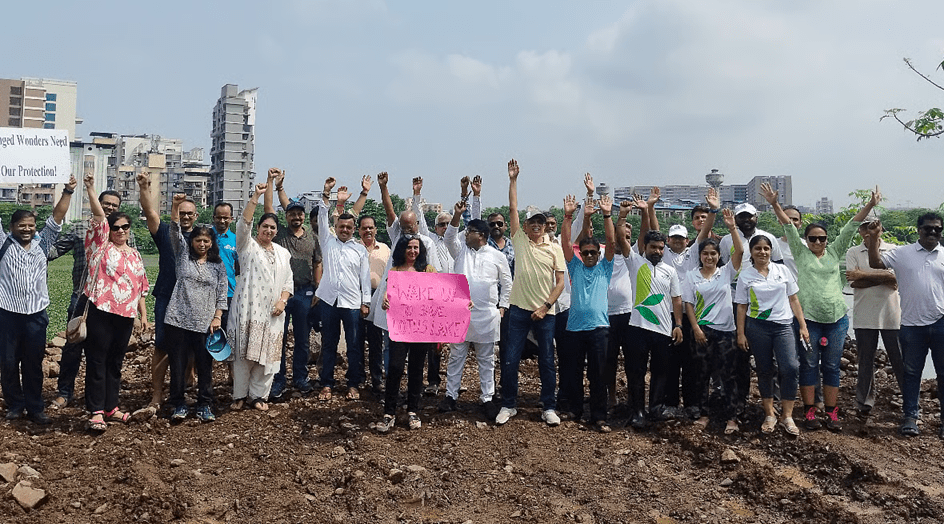
(Feature Image: Residents & activists gather at Lotus Lake pledging to protect the wetland from illegal dumping. Source)
Like previous years, the structural failures in the governance of Mumbai’s wetlands, lakes, and mangroves were laid bare in 2025 also. While citizens demonstrated extraordinary vigilance and courts delivered occasional relief, the action and inaction of state developmental agencies continued enabling their degradation.
The declaration of DPS Flamingo Lake in Nerul as a Conservation Reserve in April 2025 was indeed a hard-won victory. Yet, this achievement was swiftly undermined when CIDCO passed a resolution to pursue de-reservation of the very same wetland.
The DPS Flamingo Lake decision also brought attention to the TS Chanakya Wetland and NRI Lake, which are hydrologically and ecologically linked to DPS Lake. In a significant contradiction of CIDCO’s repeated claims, the Mangrove Cell officially confirmed that both TS Chanakya wetland and NRI lake are water bodies. The return of flamingos following partial restoration of tidal flow at DPS Lake proved that its hydrological integrity is central to recovery.
At the same time, Lotus Lake in Nerul faced repeated land reclamation attempts through debris dumping and encroachments highlighting how even officially recognized wetlands remain vulnerable to developmental threats. Again, CIDCO’s refusal to recognize the wetland’s legal status resulted in sustained campaign by the concerned citizens.
Similarly, Powai Lake continued to be choked by untreated sewage even as authorities pushed ill-conceived “beautification” projects that ignored ecological consequences. Though NGT panel has recommended fine on BMC, its restoration remains uncertain.
The year also witnessed widespread assaults on mangroves and wetlands in Borivli, Bhayander, Goregaon, Vasai Creek, and near Vihar Lake. Illegal dumping, unregulated construction and their approvals in ecologically sensitive zones revealed a corrupt governance system.
As the city enters 2026, the question remains, will wetland and mangroves protection evolve from reactive to citizen campaigns and court interventions to proactive, accountable governance or they will continue to be damaged one after another?
DPS Lake: Feb. 2025 Minister backs conservation tag Maharashtra Forest Minister Ganesh Naik promised to pursue a govt committee recommendation to declare the 30-acre wetland a conservation reserve. The committee, formed in response to a series of flamingo deaths near DPS Lake and tasked with safeguarding migratory bird habitats, has urged the government to grant the wetland conservation status. Environment watchdog NatConnect Foundation’s director B N Kumar met Naik on Feb. 14, 2025, urging him to push for the lake’s protection. Kumar also presented Naik with a written appeal and a copy of the government committee’s findings, which NatConnect obtained through the RTI Act. In response, Naik immediately forwarded the request to Additional Chief Secretary–Forest, Milind Mhaiskar, and assured follow-up action.
Despite this, CIDCO was yet to act on the committee’s directive to clear blocked water channels and restore intertidal water flow, leaving the lake polluted with muck and moss, forcing flamingos to avoid the area, according to Navi Mumbai Environment Preservation Society (NMEPS) activist Sandeep Sareen.
March 2025 Over 300 trees illegally cut in ESZ The location, Sector 52A, is adjacent to crucial habitats like mangroves and DPS Lake, vital for flamingos and migratory birds, protected under the CRZ. Recently, CIDCO sold this land to Today Royal Developers for approximately ₹200 crore, leading to public discontent. In response, Maharashtra Forest Minister Ganesh Naik is advocating for the transfer of the land to the forest department to avert further ecological harm. Reports suggest that over 300 trees were removed using JCB machines by a contractor.
Residents alerted the Navi Mumbai Municipal Corp (NMMC) and the forest dept, prompting the machinery’s confiscation. The village revenue officer, Nilesh Kamble, conducted a joint inspection and confirmed widespread illegal deforestation, revealing that at least 100 trees were cut without the required approvals.
Protests against mangrove felling Residents & greens irked after private contractors started destroying trees at mangrove buffer zone near DPS lake, plot number 3,6 & 7 of sector 52 A.
Citizens continue a decade-long fight The struggle to save DPS Flamingo Lake dates back to 2010-11 when residents raised alarms over debris dumping threatening to reclaim the wetland. The lake’s ecological issues began gaining attention when the NMEPS and Vinod Kumar Punshi filed a PIL in the Bombay High Court in 2013. The PIL raised the issue related to the destruction of wetlands and mangroves in Navi Mumbai, including concerns related to DPS Flamingo Lake. In Nov 2018, the high court restrained CIDCO from “..destructing the DPS lake in any manner by carrying on any development activity” in the area covered by the lake. CIDCO was directed to remove the debris & ensure free creek water flow into the lake.
Water flow partially restored after 3 yrs In April 2025, flamingos began returning to the 30-acre DPS lake in Nerul, after three years following partial restoration of intertidal water flow to the wetland. Range forest officer Sudhir Manjare said the water flow has cleared 60-70% of accumulated algae. The lake’s tidal water inlets had earlier been blocked. This led to an overgrowth of algae, which forced the migratory birds to skip the site. A govt-appointed panel and the state mangrove cell then asked Cidco to clear the blockage. The lake, part of the Ramsar site Thane creek flamingo sanctuary’s satellite wetland system, used to serve as a resting and feeding ground for flamingos during high tide.
DPS Flamingo Lake declared a conservation reserve The State Wildlife Board on April 17, 2025 officially approved the declaration of DPS Flamingo Lake as a conservation reserve, making it the first wetland connected to the Thane Creek Flamingo Sanctuary (TCFS) to receive such protection. Forest Minister Ganesh Naik said, “This lake is an important stopover for flamingos and needs to be preserved as a sensitive biodiversity zone.” Naik a vice-chairman of the State Wildlife Board, explained to members that protecting this habitat was not just about conservation, but also public interest and environmental responsibility.
Oct. 2025: Flamingo haven to be ‘developed’? Greens expressed worry and concern as CIDCO has installed a new notice board at the DPS Lake site stating that this plot is owned by CIDCO and trespassers will be prosecuted under the MRTP Act. They wrote to the CM urging not to meddle with this bird-rich biodiversity of DPS Lake. They felt that a fake narrative was being set that since the Navi Mumbai Airport will now be operational, the planes will suffer from bird hits. However, an earlier study by BNHS clearly stated that the DPS Lake must be conserved as a flamingo visiting site and that there is no question of interfering with the aircraft at the Navi Mumbai Airport.
The greens pointed out that the builder lobby is marketing a “Rs 4000 crore Real Estate Potential” at DPS Lake. However, the existing biodiversity here is worth much more; it is priceless. Environmental groups have urged CM not to entertain Cidco’s proposal to revoke the Conservation Reserve status of the DPS Flamingo Lake. CIDCO, at its Board of Directors meeting on April 30, 2025, passed a resolution authorising its Managing Director to take up the issue with the govt and has since expedited its efforts to get the lake “de-reserved.”
TS Chanakya; NRI Lakes: April 2025 Residents demand protection While welcoming the govt’s recent move to declare DPS Lake as a Conservation Reserve, residents in April 2025 demanded that NRI Wetland & TS Chanakya Lake also receives the same protected status.
Conservation tag is likely for 2nd wetland The WII proposed including the NRI wetland, alongside DPS Flamingo Lake, as a conservation reserve for aquatic birds. The state forest department invited the WII to evaluate the DPS Flamingo Lake area for potential conservation reserve status for the flamingo habitat. In its assessment report on DPS Lake’s significance for flamingos in Navi Mumbai, the Institute indicated that specific water bodies in the Arabian Sea inlet outside TCFS require management for aquatic birds, particularly emphasising DPS Lake and NRI Lake for flamingos.
May 2025: Wetlands are waterbodies: Mangrove cell The divisional forest office of the mangroves cell in May 2025 submitted a report to the government confirming that the TS Chanakya, NRI area wetlands and DPS lake are water bodies. CIDCO has long contested this claim, stating that these are not natural lakes, water had accumulated here over the years.
Lotus Lake: March 2025 Gasping for breath Despite repeated complaints, CIDCO fails to clear the Lotus Lake, a vital ecological landmark in Sector 27, Nerul. It is again under threat due to illegal water chestnut cultivation, despite a Bombay HC order directing NMMC to protect the lake. Fresh plantation of water chestnuts, which had previously wiped out lotus vines in the lake two years ago, have been spotted again, DK Jain, core member of the Save Lotus Lake (SLL) group, said. There is also issue of illegal debris dumping & encroachment, he said.
The lake also plays a critical role in preventing floods in the area. During monsoons, heavy rainwater from Parsik Hill flows into the lake, preventing flooding in the entire node. The lake is also home to several birds and other fauna.
April 2025 NMMC removes encroachment In the wake of the Bombay HC order, NMMC has removed the encroachment around the Lotus Lake. An illegal cowshed that was operating was removed and fence was installed along the southern portion of the lake to stop debris dumping. However, clearing the chestnuts from the lake is pending, DK Jain said. The chestnut removal will be done jointly by NMMC and CIDCO, Dr Amol Palve, assistant commissioner, Belapur Ward, NMMC, said.
On April 15, 2025 the Bombay HC had directed the NMMC to ensure the protection of the lake and submit a report before April 29, 2025. Advocate Pradeep Patole, a resident of sector 27, had filed a PIL against encroachment on the lake. Residents alleged that the chestnut farming had affected the quality of lake water and consequently prevented the growth of lotus.
Encroachments, debris cleared: NMMC to HC The NMMC on April 29, 2025 informed the Bombay HC that it has cleared all encroachments and debris from Lotus Lake in Nerul and also installed fencing to prevent future encroachments or dumping.
June 2025 Former MLA demands action against CIDCO officials Accusing CIDCO of repeatedly trying to harm Navi Mumbai’s environment, former MLA Sandeep Naik demanded an inquiry against officials who allowed debris dumping in the Lotus Lake.
Opposing CIDCO’s move to reclaim the ecologically-sensitive waterbody in sector 27, Naik wrote to CM, DCMs, forest minister Ganesh Naik, CIDCO managing director, NMMC commissioner, and the district collector. Over the past few days, dumping activity has reportedly started in the lake. CIDCO has granted permission to dump debris from the Navi Mumbai International Airport construction site into the lake.
Debris dumping stopped After repeated attempts to reclaim the Lotus Lake, the last of the earthmover and other paraphernalia used for the illegal activity has left the wetland. The activists, however, remained sceptical and suspect the illegal reclamation of land may resume soon. Demanding complete protection of the lake, the activists plan to organise a ‘Chalo Lotus Lake’ march on June 8, 2025.
Meanwhile, reacting to the repeated failure of CIDCO to protect the wetland, Stalin said, “CIDCO cannot be allowed to continuously violate the court order. Eminent ISRO scientists, experts on biodiversity and ecosystems, all have documented the presence of thriving wetlands in the possession of CIDCO. Misleading the courts, concealment of facts, refusal to acknowledge mistakes, all these characteristics are being persistently displayed by CIDCO. The way it has violated environmental laws, court orders, make it a fit case for initiating contempt proceedings against the highest officials of CIDCO”.
United to protect lotus lake Residents and activists from multiple sectors in Seawoods and Nerul came together on June 08, 2025 morning at sector 27, Lotus Lake in a strong show of solidarity, pledging continued legal and civic action to protect the wetland. “The peaceful gathering, attended by around 100 citizens from all walks of life, began with a vote of thanks to the Wetlands Grievances Redressal Committee for promptly intervening and halting illegal activities at the site. The action came in response to complaints raised by environmentalist Stalin Dayanand and other concerned citizens,” Activist Sunil Agarwal, founder of SLL said.
At the event, participants resolved to take a series of legal and administrative steps to ensure lasting protection of the wetland. “What CIDCO has been doing is violation and contempt of the court’s order in Civil Writ Petition 230/2001, which mandates the safeguarding of wetlands listed in the National Wetlands Atlas. This lake is notified as wetland in National Wetland Atlas. Our fight is not against the ownership of this lake, but against the violation being done by Cidco,” Agarwal added
Residents to protest again The activists and residents of sector 27 at Nerul decided to gather once again on June 15, 2025 at the Lotus lake to demonstrate their disappointment with the CIDCO who have till date not removed the debris they dumped to the lake.
Citizens slam CIDCO Despite four consecutive Sunday protests and over 120 emails sent by concerned citizens, CIDCO continues to ignore calls for the removal of illegally dumped debris in Lotus Lake, sparking widespread outrage among environmentalists and residents. Protestors also resolved to engage nearby educational institutions, aiming to sensitize youth about the environmental and cultural significance of the Lotus Lake ecosystem.
July 2025 CIDCO ignores deadline Despite the Forest Minister Ganesh Naik issuing clear instructions and a seven-day deadline for the removal of debris illegally dumped into Lotus Lake, CIDCO has yet to act.
Protest continues against illegal dumping On the fifth consecutive Sunday, (Jul 6, 2025) over 70 to 80 environmentally conscious citizens gathered at Lotus Lake, continuing their peaceful campaign to protect the vital wetland from further degradation. A large number of college students from nearby institutions also joined the protest. Citizens marched around the lake, holding placards & posters and urging fellow residents to join the movement.
Govt seeks reports As per an RTI response, the govt had sought comprehensive reports from the Thane district collector & CIDCO regarding dumping activities at Lotus Lake. This followed the Central govt’s instructions to the State Environment Dept to investigate Nat-Connect Foundation’s complaints about CIDCO’s debris disposal activities into the wetland.
NatConnect Director B N Kumar submitted a grievance through the PMO public grievance portal to the MOEFCC regarding CIDCO’s plans to fill the lake. The matter was acknowledged by Pankaj Verma, Scientist-F in the MOEFCC’s Wetland Division, who directed state environment director Abhay Madhukar Pimparkar to handle the complaint.
Through an RTI inquiry with the state Environment Department, Kumar requested details about actions following the MOEFCC directive. The department disclosed that the state requested separate reports from both authorities. Notwithstanding these measures, CIDCO engaged a private agency, owned by an influential politician, to deposit debris from the Navi Mumbai International Airport construction onto the wetland. CIDCO asserted ownership of the Lotus Lake whilst rejecting its wetland status, leading to debris dumping.
Nov. 2025 Concern over ‘plan to bury’ Lotus Lake for real estate development Environmentalists alleged that the three-hectare Lotus Lake at Nerul is under threat after CIDCO’s plan to bury the wetland for real estate development. CIDCO claims that Lotus Lake is not a wetland. The situation remains the same even after State Forest Minister Ganesh Naik’s public reprimand to CIDCO officials. NatConnect Foundation director B N Kumar expressed frustration that the minister’s directive has been ignored.
CIDCO, which has long denied the existence of wetlands in Navi Mumbai, allegedly engaged an infrastructure firm with political backing to dispose of construction waste from the Navi Mumbai International Airport project at Plot No 2, Sector 27, Nerul—the site known as Lotus Lake. Meanwhile, the State environment department has confirmed that the ground-truthing exercise of Lotus Lake, listed in the National Wetland Inventory and Assessment of the Wetland Atlas, has been completed by the National Centre for Sustainable Coastal Management. This process is a precursor to officially notifying over 23,000 wetlands across Maharashtra.
Powai Lake: May 2025 Musical fountain sparks concern BMC’s plan to install musical fountain at Powai Lake is criticised by activists who say it will badly impact lake’s reptile population. Stalin says, the lake is home to crocodiles and other fauna. Wildlife expert and Honorary Wildlife Warden of Thane, Pawan Sharma, emphasised that Powai Lake is not just a water body but a thriving habitat. “Thousands of species of mammals, birds, reptiles, amphibians, and aquatic creatures depend on this ecosystem. Any development, including beautification, will impact the lake’s food chain and ecological balance.”
Lights and musical fountains will disturb everything, from top predators like crocodiles to prey like fish and birds. Even slight disturbances affect nesting and breeding in reptiles, birds, amphibians, and fish. Vegetation like trees, shrubs, and grasses is also impacted by heavy lighting & sound. An Environmental Impact Assessment will answer many of these concerns.”
BMC to set up STP to rid water hyacinth While about 25,000 tonne was cleared in the past six months, its growth rate has far outpaced clean-up efforts. Currently, two machines are engaged in the task, but five more will be deployed immediately, along with additional manpower in two shifts. After the monsoon, six machines will be permanently stationed at the site. The weed will be transported to landfill sites for disposal, said BMC.
To address the issue, BMC initiated two tenders: one for laying a new sewer line and another for setting up an 8 MLD STP. Together, these are expected to help treat the 18 MLD of sewage currently entering the lake. While 8 MLD will be treated at the proposed plant at the now defunct Powai pumping station and released back into the lake, another 8 MLD will be diverted through an existing sewer line to the Bhandup treatment facility. The remaining 2 MLD will be routed via the Peru Baug pumping station to Mithi river’s 9 MLD plant. The project is expected to take 18 months from issuance of the work order, which officials said is likely next week.
July 2025: NGT forms joint committee to look into pollution The NGT constituted a joint committee to investigate residents’ grievances with the Powai lake. The committee, comprising officers from the Central Pollution Control Board (CPCB), Maharashtra Pollution Control Board (MPCB) and the Maharashtra State Wetland Authority (SWA) was directed to submit the report to the Pune bench within a month.
The NGT passed the order on July 10, 2025 after the NGT in New Delhi took cognisance of a letter by Rakesh Bakshi, a resident of Hiranandani Powai, highlighting the deteriorating conditions of the Powai lake. The tribunal forwarded the application to the Western Zone bench in Pune. It directed the committee “to meet within two weeks, undertake visits to the site, look into the grievances of the applicant, verify the factual position, and submit a report suggesting appropriate remedial action.”
Powai Lake, one of the oldest artificial lakes in Mumbai suburbs, receives over 18 MLD of sewage waste from the area. Additionally, water hyacinth, aquatic decay, and plastic waste cover the lake’s surface. “Earlier, we could see the clean water and the rich biodiversity surroundings from our windows, but now the species of birds and fish have gone down significantly,” added Bakshi.
Aug 2025 Campaign to clean Powai lake The campaign asks BrihanMumbai Municipal Corporation (BMC) to include ‘Clean Powai Lake’ mission as part of its Swachh Bharat campaign. Heaps of garbage such as plastic wrappers, liquor bottles, and even debris are being dumped on the lake, said activist Pamela Cheema, who is also the chairperson of BMC-mandated Advanced Locality Management (ALM) committee.
Dec. 2025 NGT panel impose ₹5 lakh fine The NGT mandated joint committee recommended that the BMC pay a penalty of Rs 5 lakh per month per inlet if it violates its new action plan to prevent untreated sewage from entering Powai lake. The recommendation formed part of the joint committee report submitted to the NGT, which is hearing a case on the continued discharge of untreated sewage into the lake. Following an NGT ruling in a petition by Vanashakti in 2021, the MPCB issued several directions to the BMC to stop sewage inflow, which were not complied with.
The fresh case began when Powai resident Dr Rakesh Bakshi sent a letter-petition to the tribunal in March 26, 2025 highlighting the lake’s condition. The NGT bench noted that the BMC had not filed its response to the tribunal’s notice dated Sept 19, 2025. The civic body was given two more weeks to submit its reply. The next hearing is scheduled for Feb 12, 2026.
Environmentalists have launched a focused campaign seeking freedom from sewer for Mumbai’s 600-hectare Powai Lake which has turned into a reservoir of filth with the draining of 18 MLD untreated sewer. With the title, “I Am Powai Lake, I need freedom from your sewer”, the NatConnect Foundation’s campaign pointed out that the lake was once a jewel of Mumbai.
Mangroves; April 2025 60k mangrove trees face axe The BMC’s ambitious northward extension of the Mumbai Coastal Road, running from Versova to Bhayander, is expected to impact around 60,000 mangrove trees. Of these, approximately 9,000 mangroves spread across 10 ha will be cut for the proposed road. Officials said that while the BMC has sought forest clearance for diverting around 102 ha, the actual area with mangrove vegetation that will be cut is significantly smaller.
“Destroying nature to this mega extent to build a road will be catastrophic,” said activist Zoru Bhathena. The alignment cuts across diverse urban landscapes—mangroves, creeks, salt pans, marshy land, and dense city areas. A cable-stayed bridge is proposed at the waterway crossings, designed with a longer span to minimise disruption to the aquatic biodiversity.
Dec. 2025 HC approves cutting of 45675 mangoves If the Supreme Court’s acceptance of the ‘uniform definition’ of the Aravalli hills (later held in abeyance) was absurd, then the earmarking of 45,675 of the 60,000 mangroves in Mumbai’s northern stretch to be destroyed for a 26 km road at a cost of Rs 20 000 Cr with the permission of the Bombay High Court is no less so. This is the extension of the coastal road from Versova to Bhayander in the suburbs; the coastal road is being built in sections in the Arabian Sea to reduce travel time mainly for private cars or semi-private transport like taxis. It’s a case of public money, private gain. But its ecological cost has hardly been counted.
Road that does not make public interest sense The absurdity multiplies when we note that the compensatory afforestation for the mangrove destruction will happen in faraway Chandrapur district. It’s disturbing how the high court agreed to such a proposal that clearly has no backing of science, public interest or understanding of climate science or even climate change. One hopes citizens and groups in Mumbai will rise up and write to the apex court to review this decision urgently. That would be an appropriate start for a Happy New Year.
Jan. 2026 Replacing mangroves with a road The decision has drawn sharp criticism from citizens, fisherfolk, and environmental activists, who have raised concerns about the significant impact on the environment, livelihoods, and people. The loss of mangroves could worsen tidal flooding, air pollution, and other climate extremes.
Borivli Mangrove; Feb. 2025 Land to be used for wedding: Locals Nearly 30 acres of a coastal buffer zone of mangroves in Borivli  was illegally reclaimed by dumping truckloads of debris over the mangroves in the past 20 days, and a part of this encroached land is to be used for a private wedding function which is to take place on Feb. 23, 2025, residents said.
While the local activists and members of the New Link Road Residents Forum have complained to the state mangrove cell, the tehsildar, and also the BMC, no immediate action was taken by the authorities to remove the illegally dumped debris at the site. Forum member Harish Pandey said, “It is shocking how brazenly an eco-sensitive CRZ area of mangroves was destroyed and the site reclaimed for wedding functions. Range forest officer Shankar Kavate confirmed that he had received the complaint from the New Link Road Residents Forum regarding mangrove destruction and that the site visit has been planned.
Goregaon Wetland; April 2025 HC questions BMC nod for construction The Bombay HC on Apr 24, 2025 issued notices to the BMC, the Mah Coastal Zone Management Authority (MCZMA) and the Konkan Wetland Committee over alleged illegal permission for development on a recognised wetland in Goregaon West. The HC was hearing a PIL filed by environmental activist Zoru Bhathena. The PIL challenged the BMC’s 2023 approval granted to private developers for landfilling and construction on a 191.39-hectare plot in the Pahadi area, which, according to the petitioner, has been identified as a wetland since 1991 by the MCZMA.
Bhathena said the site falls under CRZ-1 (Coastal Regulation Zone), as per the Wetland Atlas prepared by the MCZMA. He alleged that developers – Beeline Impex Pvt. Ltd and Pearl CosChem Pvt. Ltd – applied in 2022 to build a compound wall and carry out landfilling work. This request was approved by the BMC the following year. The petition further claims that 39,601 square metres of landfilling was already carried out around the edge of the plot, which borders mangroves. Satellite imagery used to demarcate the high tide line confirms the area is low-lying and influenced by tidal water, Bhathena said.
2 ha forest land cleared near Vihar Lake 2 ha forest land near Vihar lake has been cleared for construction of a 25-storeyed building with three basements. The city environmentalists learnt about this destruction recently and are up in arms against Forest Conservator and BMC.
BMC Commissioner Bhushan Gagrani said that all the permission are within the rule books. “The said land is not under Coastal Regulation Zone or Non Developmental Zone. It’s true it’s near the lake, but tree cutting permissions is given following the rules,” Gagrani said.
Environmentalist Stalin D did not agree with the commissioner’s response and said the plot is definitely within the forested land. “Despite court orders BMC has not yet notified forested land in Mumbai and surrounding areas. Any naked eye can tell said plot near Vihar Lake is within dense trees surrounded from all sides. It’s only the delay in enlisting forested land, the developers are getting entry into the protected land for construction.”
Vasai Creek; June 2025 Illegal RMC plants built on wetlands The MPCB confirmed that several Ready Mix Concrete (RMC) plants in Vasai were running illegally on land marked as wetlands. This confirmation follows FIRs filed by revenue officials against 28 RMC units for not submitting valid approval documents. “Your plant is located in Sasunavghar area which is a wetland natural intertidal mudflat area & where illegal dumping of the debris was observed by the joint inspection committee of the NGT in 2023,” read the notice sent to RMC plants.
Sasunavghar and Maljipada are very close to Vasai creek and contain several wetland parcels and mangroves. Anand Katole, sub-regional officer (SRO), said that, “MPCB doesn’t have the right to file an FIR against illegal RMC units but only issue closure notices. If they are found active even after closure notices then we have to approach the court but still cannot file FIR’s against such erring units, said MPCB SRO Anand Katole.”
Deepak Rao, an activist, said that there is no coordination between the VVCMC, MPCB, and the revenue officials. He claimed that the wetlands have been reclaimed by filling them with thousands of tonnes of construction debris and sand to level the ground, which has contributed to highway flooding in recent years.
Other Relevant Reports
Amazon Project $1.2 million fund for restoration Amazon’s Right Now Climate Fund announced a $1.2 million investment aimed at restoring mangrove forests and mudflats. The initiative, undertaken in partnership with Hasten Regeneration and guided by the BMC, aims to rehabilitate key feeding sites and remove plastic waste from the creek, ideal for drawing flamingos and other migratory birds into the region.
A key aspect of the project is the installation of trash booms to prevent plastic waste from entering the Mumbai basin. These booms will trap non-biodegradable waste, particularly plastic, which will then be collected, segregated, and recycled. The initiative aims to remove at least 100 kg of plastic daily, with a target of 150 tonnes over three years, while improving bird habitats along Thane Creek.
Film Wetlands of Mumbai A film “Wetlands” in collaboration with Forest Dept’s Mangrove Foundation as 2025 marks and celebrates a decade of its foundation this year!
SANDRP

 SANDRP