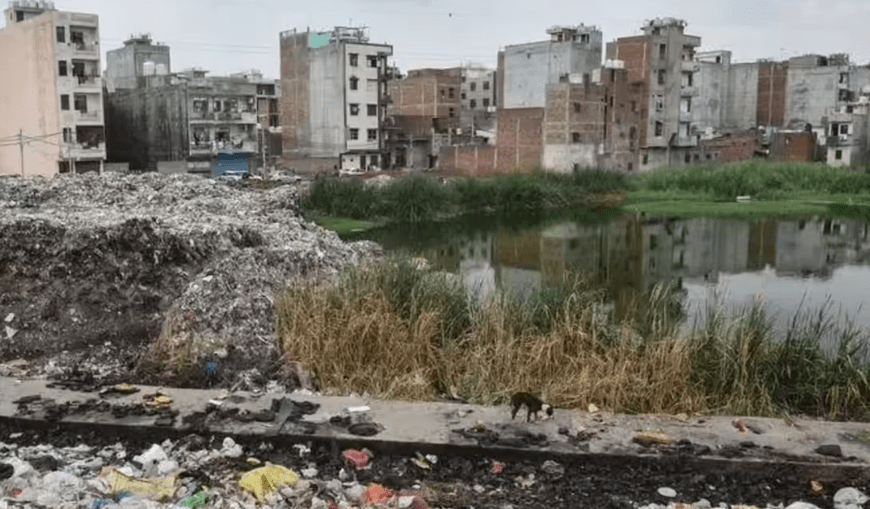
(Feature Image: A wetland near Jharoda in Wazirabad has been destroyed by dumping of municipal waste over past two years. Source)
This overview tracking wetlands related developments in Delhi shows that the plight of water bodies, lakes, village ponds has only worsened over the past year. Of the 1,367 water bodies officially recorded, only 674 are visible on the ground, underscoring the failure of govt departments to protect these vital resources. Even the surviving water bodies are under threat, gradually being lost to brazen encroachments, waste dumping and unregulated construction under the watch of the very agencies responsible for their upkeep. And the systematic destruction is happening amid multiple ongoing judicial interventions particularly in the NGT.
The reports on Najafgarh Jheel, Jharoda Pond, Bhalswa Lake, Tikri Khurd Pond, Okhla Bird Sanctuary and numerous other water bodies reveal a disturbing pattern of denial, delays and blame-shifting among government agencies regarding mapping, protection, and restoration of wetlands. Unless the concerned govt agencies including the DDA, MCD, SWA and DPCC act decisively, the national capital will continue losing its water bodies.
Najafgarh Jheel Survey finds ecological stress Disrupted drainage connectivity, encroachment pressures and the presence of globally threatened raptor species across the transboundary wetland spanning Haryana and Delhi – Najafgarh jheel is under ecological stress. The findings are part of a preliminary scientific assessment of Najafgarh jheel by a two-member team from National Centre for Sustainable Coastal Management (NCSCM). The findings emerged from a two-day reconnaissance survey conducted on Nov 19 and 20, 2025, by the NCSCM team, comprising Dr Subbareddy Bonthu and Dr Hariharan G, along with officials from Delhi’s irrigation and flood control department and Haryana’s GMDA.
NGT on Jan 19 granted the MoEF&CC time until Mar 2026 to submit the final boundary delineation & ecological assessment. MoEF&CC told the NGT that interim reports prepared by Wetlands International South Asia (WISA) and WWF India are being revalidated by NCSCM. Next hearing on Apr 8, 2026.
NGT allows time to MoEF to submit final report The NGT on Nov. 26, 2025 noted in a submission by MoEFCC that an interim report on Najafgarh Jheel has been prepared by the WISA and the WWF India for the lake’s demarcation and its notification as a wetland. The report, MoEFCC stated, comes after a detailed field survey in Aug 2025, and needs to be revalidated by the NCSCM. The final report will then be submitted by Feb-Mar 2026.
11 years on, no wetland tag Najafgarh jheel’s wait for a wetland tag gets longer. On Sept 4, 2025 NGT gave the environment ministry another eight weeks to finalise a joint report on the wetland. The ministry told the bench that WISA and WWF recently conducted a ground survey after a joint meeting of the two state wetland authorities and their draft report is now being “revalidated.” This latest extension comes months after a May 1, 2025 hearing, when the tribunal directed National Wetland Authority to independently ascertain the exact wetland area of Najafgarh on the Haryana side and submit its findings by the end of Aug.
The order followed sharp discrepancies in submissions – while Haryana’s Wetland Authority claimed only 75 acres along the Najafgarh drain on Delhi-Haryana border qualified as wetland, INTACH presented satellite imagery and flood data showing water coverage ranging from 2,000 to 5,300 acres, with an average of 3,800 acres submerged.
NGT curbs construction by DTC on Najafgarh pond area The NGT has directed the Delhi Transport Corp (DTC) to not carry out any fresh construction in southwest Delhi’s Najafgarh, where a bus terminal presently stands. The directions were issued during hearing of a plea that alleged that the structure has been built by DTC by encroaching upon land belonging to a village pond (johad). The plea was filed by local resident Kartar Singh, who said that DTC had encroached upon 30 bigha and 5 biswa from part of a water body in the village.
The order, uploaded on Jun 6, 2025 states the allegation was later confirmed by the district magistrate, who said that the land was a water body, with no legal clearance given for any construction upon it. The bench asked DTC to not carry out any fresh construction, seeking explanations from other govt depts within two weeks on how such construction was allowed.
Map Haryana side of lake area: NGT The NGT on May 1, 2025 directed the National Wetland Authority (NWA) to ascertain the exact area of Najafgarh lake on the Haryana side and submit its report by Aug last week. The directive came while the tribunal was hearing a petition seeking restoration of the lake that lies on the Delhi-Haryana border.
During the hearing, the tribunal examined inconsistencies between the area that Haryana plans to mark as wetlands and information presented by INTACH, which seeks compliance with NGT’s Feb 2017 order to designate Najafgarh jheel as a wetland.
The Haryana SWA reported that 75 acres along the Najafgarh drain could qualify as wetland, contingent upon future projects which would prevent the flow of dirty water and utilise treated water instead. INTACH contested this, presenting satellite imagery and flood data showing water coverage ranging from 200 to 5,300 acres recently, with an average of 3,800 acres submerged over 16 years.
South Delhi How 6 forest water bodies disappeared from Map Forest & Wildlife Department in its report on Oct. 26, 2025 informed the NGT that 6 of the 28 waterbodies under its jurisdiction no longer exist. The 6 vanished sites together once covered roughly 40,000 square metres. They ranged from small village ponds to mid-sized wetlands. The Maidan Garhi and Shahurpur ponds measured around 1,500 sq m each, while the largest, in Asola, spanned nearly 20,000 sq m. The forest department said five of these lost sites lie in the South Forest Division, in areas such as Asola, Maidan Garhi, Shahurpur, and Chhattarpur, while one falls under the Central Division at Shastri Park.
The tribunal had taken suo motu cognisance of a media report last year, flagging missing water bodies in the Capital. In its order issued on Feb 14, 2025 the NGT had directed all agencies, including the forest department, to disclose the current status and area of water bodies under their management as well as steps taken to remove encroachments and restore them. The forest department, in its latest report, said it manages 28 water bodies — 21 in the south division, three in west, and two each in the central and north divisions.
Delhi’s State Wetland Authority (SWA) had told the NGT in Dec. 2024 that out of 322 water bodies identified by Geospatial Delhi Limited (GSDL) using satellite imagery in the city, only 43 were found during ground truthing. Further, out of 1,045 water bodies identified through revenue records, only 631 were detected on the ground. Thus, only 674 out of Delhi’s 1,367 water bodies were found on the ground, with the remaining all encroached upon.
Satpula lake water quality improved: DPCC After reporting that water at south Delhi’s Satpula Lake was failing quality norms due to eutrophication (high algal bloom), the DPCC has now told the NGT that fresh samples from both the lake and the adjoining STP largely meet the standards for propagation of wildlife fisheries. The committee added that the STP is operational and treating sewage before it enters the lake.
This follows NGT’s Aug 2025 directive asking the DPCC to conduct a fresh inspection of the lake after receiving conflicting accounts on sewage discharge into the water body. NGT noted that while the DPCC had flagged poor water quality and said the STP next to the lake was non-functional, a DDA claimed the lake was in good condition & receiving only treated water.
South West State responsible for wetlands’ maintenance: MoEF The reply dated Apr 2, 2025 from the ministry came after the tribunal in 2024 took suo motu cognizance of a Sept 2024 TOI report titled “NHAI has made highway at protected pond site in Delhi: Activists”. The article pointed out that NHAI built Urban Extension Road-II over the pond in Goyla Khurd village in Delhi’s sw district. The pond was among the list of over 1,000 ponds meant to be protected. The ministry said it identified over 2.3 lakh wetlands nationwide in 2021, and their safeguarding is responsibility of the respective state govt, which in this instance, is the Delhi govt. Earlier in 2025, the DPCC and Delhi SWA held DDA answerable for handing over a listed pond to NHAI, over which a highway was constructed, impacting the water body.
Extra funds spent to build flyover over village pond: NHAI National Highways Authority of India (NHAI) told NGT that it followed all rules while building Urban Extension Road (UER) over a village pond near sw Delhi’s Goyal Khurd. NHAI stated that the land was acquired by DDA and handed over to it, after which all necessary environmental clearances were sought and received from the MoEF.
NHAI also clarified that it did not build the UER at grade by filling up the pond, which would have cost Rs 15 crore. Instead NHAI built a 1.2km-long flyover to go over the waterbody, spending around Rs 75 crore, five times more. In March 2025, Delhi SWA submitted a report to NGT, stating that a pond in SW Delhi was proposed to be listed, but was destroyed due to the construction of a highway.
Pond in Naraina turns concrete dumpyard Despite the allocation of Rs 50 cr for the revival of the capital’s water bodies, the depletion and misuse of these bodies remain as rampant as ever. In Naraina village, residents say that a local pond has been systematically destroyed over more than a decade through unchecked construction activities, with full complicity and negligence of authorities.
NGT directs DDA, MCD resolve dispute The NGT on March 24, 2025 directed the Delhi Development Authority (DDA) and the Municipal Corp of Delhi (MCD) to coordinate and commence the cleaning of a pond in Ayanagar village, ruling that its maintenance cannot be delayed due to inter-agency disputes. The tribunal was hearing a plea by a local resident, who in Nov. 2023 alleged that the village pond (johad) on Khasra number 1706 was being filled with municipal solid waste and debris, causing it to dry up and “lose its identity”.
In their March 21, 2025 reports, both agencies denied responsibility for rejuvenating the pond. DDA argued that the water body was part of Khasra number 1704, not 1706, and had been handed over to the erstwhile South Delhi Municipal Corp (SDMC), which has since merged with MCD. However, MCD stated that DDA is the land-owning agency, and its role was limited to developing a park, as the pond had never been transferred to MCD.
“The issue of maintenance of the pond cannot be kept pending on account of any dispute between the DDA and MCD without action to clean it,” said an NGT in its Mar 24, 2025 order. The Delhi Pollution Control Committee (DPCC), which convened a March 13, 2025 meeting, had already directed DDA and MCD to coordinate on the issue. Noting that both agencies were now working together, NGT directed MCD to continue the pond’s cleaning, while DDA must extend full cooperation. The DPCC was instructed to inspect the pond within 6 weeks and submit a water sample report.
North Delhi A dispute at the heart of depleting wetlands A long-running tug of war between two government agencies in Delhi over Tikri Khurd lake, which spans over 40 acres in Narela, is symptomatic of why wetlands and water bodies are depleting in the national capital. Over six years have elapsed since the NGT directed authorities to conserve Tikri Khurd lake. No action has been taken, and the DDA, which owns the lake, continues to deny that it is a water body. Meanwhile, the govt agencies in charge of water bodies have reportedly requested SWA for the ‘deletion’ of 232 out of 1,045 water bodies from the official records.
The DDA describes Tikri Khurd lake as a “low-lying land” where sewer water has accumulated. “It is hereby requested to kindly not issue the notification declaring the Tikri Khurd lake under the Wetlands Rules, 2017 since the said area is the acquired land of DDA,” the DDA told SWA ON Nov. 29, 2024. SWA officials say such obstacles are causing the delay in notifying water bodies as wetlands in the Capital. However, a SWA official asserted that the lake is a water body and they have done a ground-truthing exercise. “A technical committee of the SWA had in 2021 recommended to notify the lake as a wetland after its assessment. We will push for notifying it as a wetland,” the official said.
Jharoda Pond Buried under Municipal Waste Once a large, functional wetland in the Jharoda area near Wazirabad – home to a diverse range of aquatic flora and fauna—is now lost. Over the past two years, the pond has been filled with municipal soil waste, transforming the flattened wetland into a large plot of land.
Earlier in 2023, TOI reported that garbage from the Bhalswa landfill site was being used to fill some wetlands in the Wazirabad and Timarpur areas, parts of which historically belonged to the Yamuna catchment. The pond next to the upcoming Jharoda Majra Metro Station is located about a kilometre from the Yamuna Biodiversity Park.
When TOI first reported the issue, the pond was only partially filled. However, on a recent visit, the entire area had been dumped and levelled, with no visible signs of the wetland except for a few patches of Kusha grass. Local residents said the pond, which had existed for decades, was being filled over the last two years.
Jharoda wetland needs attention Reports of ponds and waterbodies being polluted or filled have surfaced regularly. In a similar case, a village johad (pond) in west Delhi’s Budhela was filled, and a community centre was being constructed by the Delhi govt. The matter is currently sub-judice in the high court, and construction has been halted.
Agencies continue blame game Five months since being pulled up by the NGT over the disappearance of the Jharoda pond, in Wazirabad, central and state agencies continued to play the blame game over dumping of inert material at the functional wetland.
The MCD, which oversees Delhi’s landfills at Okhla, Bhalswa and Ghazipur, sought to blame the private concessionaire involved in the bioremediation process and the DDA. Meanwhile, the Central Pollution Control Board (CPCB) told NGT that it was the DPCC’s responsibility to ensure adherence to Solid Waste Management Rules, 2016.
On July 23, 2025, the NGT took suo motu cognisance of the matter Jharoda pond and issued notice to MCD, CPCB, DPCC and other agencies, seeking detailed reports. Until Aug 2023, the site had showed signs of biological activity, including the presence of grass and bird species, NGT noted. Next hearing on Jan. 28, 2026.
Jharoda pond not a wetland: DDA Jharoda was not a wetland, DDA on Jan. 31 submitted in NGT. DDA said it had bought the land from a private owner. The possession of two land parcels near Jharoda Majra metro station was taken by DDA from the land & building department of Delhi govt on Feb 14, 1983, the authority stated in its reply.
West Delhi Listed as wetland, this pond is now a public health hazard The pond, located in Budhela village in west Delhi’s Vikaspuri, is among the 1,040 waterbodies listed by SWA for notification and protection. Over the years, it was gradually neglected and encroached upon. Although recorded in govt documents as gram johar (village pond) and measuring around 0.6 ha, the land was allotted in 2002 to Sahitya Kala Parishad, a Delhi govt body for arts and culture. The parishad later asked Delhi Tourism and Transportation Development Corp (DTTDC) to construct a cultural complex on the site. Construction began in early 2024, triggering protests from residents & activists who pointed out that the plot was a listed wetland.
OBS Decline of Okhla Bird Sanctuary The drop in bird populations at OBS has disrupted key ecological processes, threatening biodiversity. At the core of all troubles is the river Yamuna which has been reduced to what conservationists now call a “lifeless nallah.” Polluted with untreated sewage and industrial effluents, the river’s water at Okhla Barrage has become so toxic that its BOD levels reached 58 mg/l, about 20 times the acceptable 3 mg/l in 2020.
Besides water pollution, human activity poses another threat to OBS. The sanctuary is surrounded by highways and bridges, contributing to incessant noise pollution. Honking vehicles and loud visitors disrupt the bird habitat. In 2015, MoEF declared ESZ around the sanctuary. But instead of the standard 1-km buffer, the boundary was reduced to a few meters.
Dry days at Okhla Bird Sanctuary Okhla Bird Sanctuary is stark dry after an abundant monsoon even as migratory birds have started flying in. It is one of Delhi-NCR’s prime wetlands, and among the 466 Important Bird Areas (IBAs) of the country. There is no food stock for the birds.
The excess water in the Yamuna – which had flooded parts of Delhi and Noida – during monsoon had necessitated repair of Okhla barrage. Usually, repair and maintenance work happens once a year, after the birds leave, at the onset of summer when water flow is low.
Clear water a far cry in lakes From grand announcements and crores in public funding to broken promises and green scum, the story of Delhi’s lakes is one of ambition undermined by indifference. If the city is to truly become a “City of Lakes,” officials, ecologists, and local communities must step up together—not just to build lakes, but to keep them alive.
NGT directs SWA to standardise waterbody reports The NGT has directed Delhi SWA to compile and circulate a comprehensive report format to all land-owning agencies for details of every waterbody under their control. The NGT is concerned about the fast disappearance of wetlands and waterbodies in the capital. The tribunal bench noted that reports submitted by various agencies had revealed an alarming picture. Several waterbodies had vanished or dried up. Others were encroached upon. It said in an order dated Dec 15, 2025 which combines three different cases on wetlands based on media reports. The NGT directed the SWA to initiate action against violators and submit a detailed action-taken report at least a week before the next hearing. The matter has been listed for March 10, 2026. Meanwhile, following a plea by a resident, DDA has carried out mapping of a 4.7-hectare waterbody in Narela, which will be revived following the removal of encroachments, the NGT noted.
Govt Efforts Neeli Jheel could be first Ramsar site The govt is planning to get the 5.16 ha Neeli Jheel at Asola Bhatti wildlife sanctuary notified as Delhi’s first Ramsar site, environment minister Manjinder Singh Sirsa said on Feb 2, 2026 the ministry is in talks with the Centre on the matter. The minister also said that the process to identify and demarcate boundaries of 856 water bodies in Delhi is complete, another 174 have seen revival and rejuvenated. The tender to protect & revive another 22 water bodies had recently been floated and detailed estimates are being prepared for 20 more such water bodies in Delhi, Sirsa said.
Naini lake revamp starts The project was announced in June 2022 as a part of the Amrit Sarovar Mission of the Union government, under which 21 waterbodies in the city were to be rejuvenated. The mission was scheduled to be completed by March 31, 2023, but work on Naini lake never started. A total of ₹10 crore was allocated for revamp of Naini lake.
An MCD official said they will look into the delay but a large number of projects have been delayed over the last two years due to non-formation of standing committee, which is a key panel whose permission is required for projects above the financial implication of ₹5 crore.
The consultancy will be responsible for developing the infrastructure to carry treated waste water from Coronation Pillar STP near Mukundpur metro depot to Model Town. Besides, the firm will also design a mechanism to provide water for irrigating parks in the region using the lake water, thereby reducing the groundwater consumption. Currently, the waterbody is fed by the ground water using borewells.
Plan to revive Naini Lake Announcing the redevelopment plan, tourism minister Kapil Mishra on July 30, 2025 said the revamp decision was taken in a planning meeting he held with officials from Delhi Tourism and the Delhi Tourism and Transport Development Corp (DTTDC).
DDA plans to start Bhalswa lake conservation DDA has floated a tender for a specialised project focused on soil investigation and structural designing of a reinforced cement concrete (RCC) wall along the lake to demarcate it from the landfill site. The project aims to create a structural blueprint that would support long-term protection of Bhalswa Lake from further erosion and encroachment,” said a DDA official. The estimated cost of the project for initial soil investigation is ₹2.54 lakh, to be completed in two months.
Bhalswa Lake was formed from a meandering loop left behind by the Yamuna. The lake has now been encroached by landfill, settlements and the sprawling Bhalswa Dairy colony. In a spot check in May 2025, HT had found that while garbage dumping on the eastern edge near the Bhalswa golf course has been reduced, the lake’s western flank is a toxic mess. Dairy waste, plastic, and household sewage continue to be dumped directly into the lake, turning it into a foul, semi-solid mass. Cut off from the Yamuna by an embankment built in 1964, Bhalswa Lake has since lost its primary natural water source.
SANDRP

 SANDRP