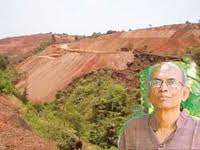
“At the ground level people are really interested and they want to get involved and our report if nothing else, seem to have served the purpose of triggering such kind of an interest” said Dr Madhav Gadgil while delivering a lecture on “Democracy and ecology in contemporary India” in Delhi in July 2013. He was referring to the 2010-11 report of the Western Ghats Ecology Expert Panel (WGEEP), which he chaired and which was one of the major contributions of Dr Gadgil to India’s environmental governance. One of us accompanied him during some of his travels which mainly consisted of back to back and often heated meetings in some of the remotest corners of the Western Ghats. The meetings were not only about plants, trees and rivers, but about what the villagers feel about development and how it should happen. No one had asked such questions before. It was democratisation of Environmental Governance at its messiest and the most beautiful. Something that was rarely attempted before. Or since.
No wonder the report produced after such a radically different approach, trusting the people of the land was not acceptable to the vested interests. In Maharashtra, Karnataka and Kerala, politicians twisted the report, made false claims, did what they knew best: spreading fear amongst people. The report was rejected and Govt set up the High Level Working Group headed by Dr. Kasturirangan, essentially to dilute the recommendations of the WGEEP Report, but the Kasturirangan Committee ended up with a report that was at odds with facts and science. Under the leadership of Dr. Gadgil Western Ghats saw a brief period of tender hope.
Gadgil report is a veritable textbook about managing rivers in ecologically important places. Not a wonder because One of the initiators of the Movement against Athirapally Dam in Kerala, late Dr Latha Anantha worked with Dr Gadgil on this section. Dr. Gadgil was an important figure in Kerala’s landmark Silent valley struggle against a hydropower project, which led to the cascade of environmental laws in the country. He also supported the movement against the Athirapally dam, led by the local communities. He was a vocal supporter of Narmada Bachao Andolan’s epic struggle against the Sardar Sarovar project on the Narmada River.
He hailed the Plachimada struggle against Coca Cola as a ray of hope since this was a struggle led by a Panchayat, which brought a multi-national company to its knees. The stance he took against chemical pollution in Lote Parshuram region of the Western Ghats was so decisive and people-centred that his work is used by the people till date.
He stressed the need to engage local people in the decision making process and increase dissemination of information. He took the example of ‘Australian River Watch’ programme where the citizens are trained to monitor the health of a river just by looking at the bio-logical indicators. He opined that India should take lessons from this and should initiate such programmes. He added that for India to progress, we should take bottom up approach and strengthen democracy, rule of law, scientific temperament and traditional ecological knowledge. To indicate how forward thinking he was, one of the key recommendations of the WGEEP report was to initiate policy and legal steps towards decommissioning of dams in India when India has no policy or laws in this regard.
Dr Gadgil played an important role in drafting National Biodiversity Act of 2002 and also helped set up Centre for Ecological Sciences at the Indian Institute of Science, Bangalore.
As former Environment Minister Jairam Ramesh said, “Nation builders come in many forms. Gadgil was definitely one of them.”
When questioned as to how scientific are the local perceptions about natural resources, Dr Gadgil emphasised that the local communities know the local environmental aspects better than anyone else and hence they must have key role in any decision making process about the use of the local resources. Even in the context of climate change, he underlined the need to protect the local natural resources to allow greater adaptation and resilience for the local communities.
In forward to a book published by the South Asia Network on Dams, Rivers and People in 2014, Dr Gadgil wrote in the context of Large Dams being built for Mumbai: “Such lop-sided development is clearly against broader national interests and since it is people at the grass-roots that are best aware of what is happening to the natural, human and social capital, their inputs are critical to arriving at a development strategy that will promote harmonious, balanced development… What we need to concentrate on is implementing that which by all rights must be implemented, namely, the constitutional provisions for protecting the environment and empowering the people. It is this vital service that this report on ‘Multiple Dams in tribal belt of Western Ghats for the Mumbai Metropolitan Region’ performs, and therefore deserves to be read by concerned citizens.”
Dr. Gadgil was the recipient of Padma Shri and Padma Bhushan and several international accolades. He played a role in moulding the research direction of stalwart institutions like the Botanical and Zoological Survey of India. A rigorous scientist and ecologist, he was equally, possibly more at home in the forests and villages, partaking food with the villagers, talking with them about their community-conserved spaces, writing about them and helping protect them. He did not differentiate environmental governance and conservation from the people of this land. So unflinching was his faith in the communities that some of his opinions seemed radical in conservation circles. But when Kerala was drowning in the 2018 floods, or when the Wynand landslides struck in 2024, when Maharashtra saw multiple casualties in the Western Ghats landslides in 2023 and when polluting companies in Lote Parshuram made world news, one knew how correct he was. Dr. Gadgil will be sorely missed during this time when he is needed the most.
Parineeta Dandekar and Himanshu Thakkar
Note: An edited version of this was published in The Tribune on January 14, 2026, see: https://www.tribuneindia.com/news/comment/listening-to-the-land-and-its-people-the-gadgil-way/

 SANDRP