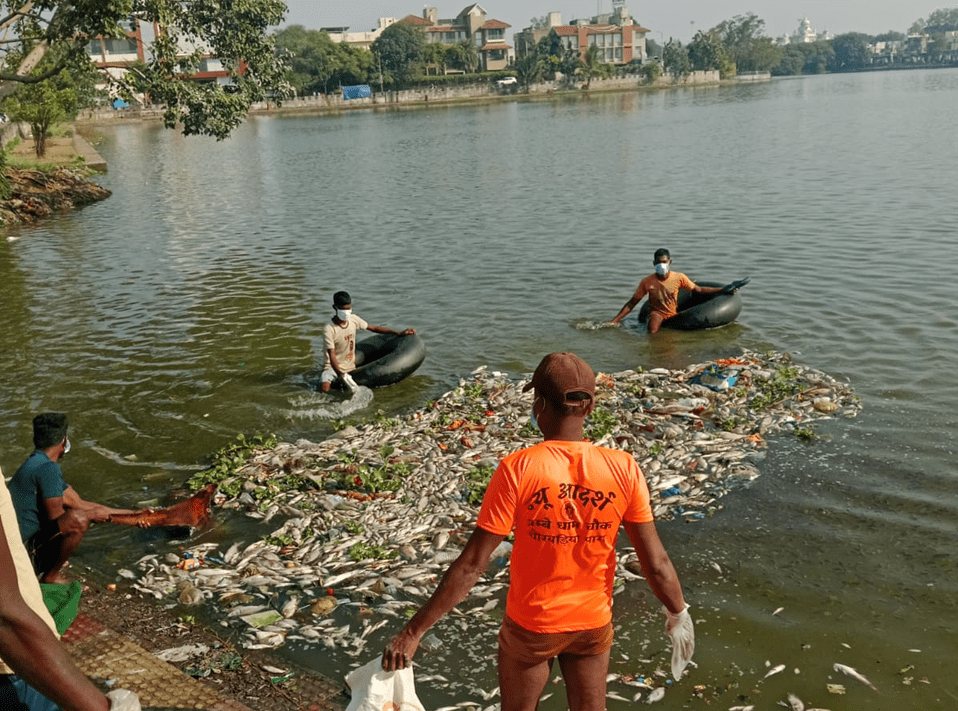
(Feature Image: Dead fish being removed from Budha Sagar pond in Rajnandgaon, Chhattisgarh in 1st week on Nov. 2025. Source)
This compilation documents over three dozen incidents of mass fish death that occurred in water bodies including lakes, ponds, tanks and Ramsar wetlands located in Urban and Rural areas across India so far in 2025. Interestingly, most of these incidents are reported just before or after south west monsoon. In urban water bodies sewage contamination, water stagnation, dumping of solid waste have become common reasons for sudden fish mortality. These incidents are quite frequent even in the historic lakes and religious ponds in many cities despite crores of rupees spent in their maintenance by local agencies which is mainly limited to their beatification.
In rural areas it is sewage discharge, industrial effluents, deliberate poisoning (mostly in Bihar) which are resulting in mass fish kill incidents and causing financial losses to fishermen. These water bodies are important water sources offering multiple cultural, economic benefits and valuable environmental services specially in terms of rainwater harvesting and groundwater recharge. However, the large-scale pollution and fish deaths show sheer negligence in their maintenance by responsible government departments including Pollution Control Boards.
This is the seventh part of our annual overview on the subject to mark World Fisheries Day (WFD) 2025. In the first five parts we have covered the positive developments on fisheries, impact of dams on fish diversity and habitats, important studies, new fish species discovered in India, ongoing resistance of Indian fisherfolks against destructive developmental projects and mass fish death in Indian rivers during past one year.
Urban Water Bodies
Mumbai: Mass fish death in Banganga Tank Following Pitru Paksha, the Brihanmumbai Municipal Corporation (BMC) cleared truckloads of dead fish, floral and other waste items amounting to at least 10,000 kg from the Banganga Tank, civic officials said Sept. 23, 2025. As part of the Pitru Paksha ritual, devotees make floral and other offerings in the tank, which led to rise in water pollution levels causing the death of fish.
“Such a sight is common during the months of Sept or Oct when devotees give offerings to the water during Pitru-Paksha,” said a senior official. The official also said that waste items including dead fish were recovered in 7 dumper trucks. In total, the BMC removed 10,000 kg of waste which includes carcasses of dead fish between Sept. 21 and Sept. 23 from Banganga Tank. The official also said that the BMC has now set up aerators as well as dewatering pumps to pump fresh water into the tank aiming to increase the oxygen level of the water.
Located in the upscale Malabar Hill neighbourhood, Banganga is a fresh-water stepped tank that is also one of the last remaining natural water bodies of the city. The lake has been identified as a heritage precinct by the state government and is owned and managed by GSB Temple Trust. Members of the Trust stated that the tank is home to more than 220 different species of fish.
On Sept 17, the Yeoor Environmental Society (YES) had filed a complaint to the BMC, MPCB, and the district administration over the authorities’ failure to prevent pollution of Banganga Lake and other natural water bodies during such rituals. “Despite repeated incidents of mass fish deaths at Banganga Lake for several consecutive years following ritual waste immersion, authorities have not enforced a clear ban, even though multiple court orders explicitly prohibit dumping of ritual waste into natural lakes, creeks, and rivers. Even the Banganga Temple Trust has now engaged bouncers to stop devotees from immersing ritual waste, but shockingly the civic and pollution control authorities remain inactive,” the YES complaints state. “The pattern of neglect year after year cannot continue. Protecting our lakes is not only an ecological duty but also a constitutional mandate under Article 21, the Right to a Clean Environment” said Rohit Joshi from YES.
Local residents claimed that even though the problem persists each year, there is no clear policy from the BMC to streamline the rituals and protect aquatic life and quality of the water. Sneha Visaria, an animal rights activist, said, “The BMC needs to come up with a clear policy to enable successful completion of these rituals in a way does not harm aquatic life. Similar to the time of Ganesh visarjan, separate artificial tanks can be created for the ritual offerings, and the water and ‘nirmalya’ can be disposed of scientifically later. Or a separate area can be demarcated, which is separate from the tank, where prayers can take place.” Another report of mass fish death in Banganga tank in Walkeshwar in Oct. 2018.
Bengaluru’s Gangashetty lake faces fish deaths Gangashetty lake in KR Pura is facing severe distress with multiple fish-kills being reported barely two years after its Rs 4-cr rejuvenation in 2023. Both locals and BBMP officials attribute fish-kills reported since July 31, 2025 to untreated sewage flowing into the lake through a stormwater drain. Lake activist Raghavendra Pachhapur, who has been raising the alarm on social media, blamed the crisis on poor planning of rejuvenation projects. He said lakes are naturally situated at lower altitudes, allowing rainwater from surrounding areas to flow in, maintaining water quality. “Instead, BBMP connects lakes to polluted rajakaluves carrying sewage, plastic, and waste throughout the year. Without a steady inflow of clean rainwater, lake ecology collapses,” he said. BBMP lake dept admitted that the inflow system is a major concern at Gangashetty lake.
Dead fish found in Mylasandra Lake Mylasandra Lake, located near Rajarajeshwarinagar, reported sudden death of fish in April 2025. Spread across several acres, the lake has long been a haven for migratory birds and butterflies. However, residents and lake activists alleged it has increasingly fallen prey to political neglect and unchecked pollution. Resident Ravi K alleged that untreated sewage from nearby sources is contaminating the water. Activist Ajay V said stench from the lake has become unbearable, thanks to steady inflow of sewage from surrounding educational institutions and residential complexes.
Mangaluru: Gujjarakere stinks again With the five fountain aerators installed by Mangaluru Smart City Ltd., in July 2022 to oxygenate the water body and remove dissolved organic compounds becoming non-functional, the historic Gujjarakere has begun to stink again with fish deaths even as Mangaluru City Corp (MCC) has failed to plug sewage seepage into the lake in the heart of the City.
After rejuvenating the lake in March 2022, MSCL handed it over to the MCC, said a senior Smart City official. MSCL has impounded about ₹1.5 lakh security deposit from the contractor for his failure to properly operate the fountains. The same would be handed over to the MCC to undertake repair works, he said.
Hampi: Hundreds of fish found dead in Kamalapur lake Hundreds of fish were found dead in the historic Kamalapur Lake in Vijayanagara district on June 20, 2025, causing alarm among local residents and fishermen. The lake was constructed during the Vijayanagara kingdom. It is believed that the fish succumbed to contaminated water mixed with rainwater, and this mass mortality could also be attributed to chemical runoff from agricultural practices.
“The death of these fish may have resulted from contamination released into the Tungabhadra Reservoir by industries and sewage from Kamalapur. The govt must focus on maintaining the cleanliness of the lake,” urged HG Mallikarjun, a local resident and president of the taluk unit of Karnataka State Farmers’ Union and the Green Army.
The water of Kamalapur Lake irrigates hundreds of acres of farmland. The Raya Canal, which flows from the Tungabhadra Reservoir, feeds into this lake. There is significant demand for the fish in this lake, with wholesalers from across the state coming to purchase them. Fish of different species, weighing between 1kg and around 3kg, are commonly found in this lake.
Chennai: Scores of fish found dead at Arafath lake Foul stench and hundreds of dead fish floating on Arafath lake in Thirumullaivoyal on Oct 7, 2025, left residents fuming. They complained that unchecked sewage discharge from illegal settlements choke the waterbody. Falling under the ambit of the Avadi corporation, Tiruvallur district, the Arafath Lake connects most of the areas in Thirumullaivoyal and shares a boundary with Avadi-Tirupathi main road.
Ten years ago, the lake spanned about 80 acres. “Today, it has shrunk to less than 40 acres, thanks to several homes built along the lake. They have illegal sewer lines that discharge into the lake, polluting the environment and fauna,” said Sundaramoorthy, president, Arafath and Puzhal lake protection organization. Though officials say the issue has not been recurrent, they confirm that the lake faces pollution issues. Tiruvallur collector M Prathap said eutrophication was the reason for the deaths of the fish. “Now, the corporation is cleaning the area. We are also getting a DPR ready to renovate the lake at a cost of 2 crore to carry out comprehensive improvement,” he said.
After nearly a decade-long struggle by residents and citizen groups, the Arafath Lake – a major groundwater source for Thirumullaivoyal – is set for restoration at a cost of ₹2 cr, under a scheme launched on Nov 12, 2025. Spread over 26.4 acres, the lake abutting Chennai – Tiruvallur High Road on the eastern side belongs to the chain of waterbodies on the city’s western fringes. Its surplus water drains into the Ambattur lake. Like many urban waterbodies, Arafath Lake too is plagued by various issues, including sewage pollution & dumping of solid waste.
Bhopal: Dead fish float in Ramsar lake On May 17, 2025 large dead fish were seen floating along Bhopal’s Lower lake’s edge, right in front of the Police Headquarters and several government colleges. The worst-affected area is Khatlapura Ghat, a popular public spot. The Bhopal Municipal Corporation (BMC) cleans this area regularly, but dead fish keep appearing.
Meanwhile, the BMC has doubled the lake conservation budget. In the 2025–26 budget, funds for lake management increased from ₹21 cr to ₹46 cr. This comes as part of the city’s ₹3611 crore budget, which is ₹258 crore higher than the previous year. The Centre and state jointly run the National Plan for Conservation of Aquatic Ecosystems, under which ₹432.03 lakhs were sanctioned for Bhoj Wetland since 2018, with ₹200 lakhs already released.
Fish found dead in Lower lake On April 19, 2025, fish were found dead in Khatlapura Ghat (Lower Lake), Shahpura Lake, Munshi Hussain Khan Talab etc. Dead fish were also spotted in Lower Lake, one of two lakes in Bhoj wetland a Ramsar site. MPPCB prima facie attributes it to increasing temperature which reduces dissolved oxygen which is one of the major causes of death of fish in water bodies. However, MPPCB assures for testing water sample to know other factors of deaths like pollution or chemicals.
Fish death in Shahpura pond Mass fish death incident occurred in Shahpura pond in March 2025 after which local people alleged that the condition of the pond is deteriorating due to the negligence of the BMC. Regional Director of Pollution Control Board, Brijesh Sharma said that reason behind will be known only after the test report. Social worker Rashid Noor said that many drains from the nearby residential areas are polluting the pond. The MP Pollution Control Board in its Jan-April. 2025 report had found the Chhota Talab and Shahpura Lake among the most polluted lakes in the city.
Lucknow: Dead fish resurface at city wetland Dead fish resurfaced on Jun 6, 2025 in the CG City wetland in the state capital, highlighting concerns over the Lucknow Development Authority’s (LDA) negligence, despite an investment of approximately ₹2.46 cr in developing the 37-acre area. The residents and activists raised the alarm on social media, drawing attention to the recurring fish deaths in the man-made wetland and sparking fresh concerns.
An official confirmed that the wetland is primarily sustained by rainwater and groundwater recharge but admitted that no recent efforts have been made to maintain or improve water quality. This is not the first such incident at the CG City wetland. With repeated fish deaths and no corrective measures in place, questions are mounting over LDA’s commitment to ecological conservation and the proper upkeep of the wetland facility.
Mass fish death in Lucknow temple pond Thousands of fish were found dead in a pond in the Buddhaeshwar Temple complex in Lucknow’s Para police station area on July 7, 2025. It is alleged that a toxic substance in the pond caused incident. Locals removed the dead fish and buried them. Around 5 quintals of fish died in this incident.
Nainital: Dead fish in Naini Lake The picturesque Naini Lake, the very heart of Nainital’s tourism industry, is currently grappling with a disturbing and pervasive problem: a strong, foul odour emanating from a significant number of dead and partially eaten fish (July 2025). This unwelcome stench is threatening to mar the serene experience for visitors, raising urgent concerns for the hill station’s critical tourism economy.
One prevalent theory attributes the deaths to the presence of the carnivorous ‘Mangura’ (catfish), which was reportedly sighted in the lake on June 27, and, according to sources, has not been removed since. Another hypothesis suggests the natural lifespan of the lake’s common Silver Carp and Grass Carp may have simply come to an end, leading to a wave of natural deaths. It’s not the first time the lake has faced such an issue; in July 2010, 39 Mangura fish were swiftly removed by the Lake Development Authority after certain individuals reportedly introduced them. Dozens of dead fish have reportedly been recovered from the lake in recent weeks.
Bandipora: Mass fish deaths reported in Wular lake In first week of Nov. 2025, large numbers of snow trout or Kashir Gaad, the most prized fish species in Wular and Jehlum Lake, have been found dead along their shores and shallow stretches. Fishermen say the die-off began suddenly and has since spread to multiple parts of the lake. Fishermen believe that the recent fish deaths are caused by illegal fishing practices involving electric shocks. They allege that some people have been using electric currents to catch fish in the lake, a method that instantly kills smaller species and severely damages the aquatic ecosystem.
Ghulam Hassan, a fisherman from Nichyari, a village largely dependent on fishing, said the mass fish mortality has dealt a severe blow to their livelihoods. There are more than 5,000 registered fishermen in the twin north Kashmir districts of Bandippora and Baramulla with over 30,000 families living around rely on the lake for their livelihood.
Field teams from the NCA and local fisher associations reported the first wave of fish deaths in late October 2025, concentrated around Zurimanz, Banyari, and Watlab. Thousands of dead fish, mainly Schizothorax, Cyprinus carpio, and Gambusia affinis, were found floating or washed ashore. According to Ghulam Hassan Bhat, President of the Fisherfolks Association Wullar, “The pattern of fish deaths shows clear signs of electric shock and chemical burns. Fish are dying with internal haemorrhage, and many are covered in fungal layers. This is not natural mortality, it is systematic destruction enabled by negligence and corruption.”
Surat: Dead fishes found in Saniya Hemad lake In last week of Sept. 2025, several dead fishes were found floating in the lake at Saniya Hemad village in the East Zone A of Surat Municipal Corporation (SMC), prompting local residents to alert civic authorities. SMC teams inspected the lake and removed the dead fish, while also notifying the Gujarat Pollution Control Board (GPCB), which collected water samples for testing. Villagers alleged that the deaths could be due to untreated industrial waste entering the lake from cottage industries in the area. During rainfall, wastewater from nearby creeks reportedly mixes with the lake water.
Bhilwara: Fish death in city pond Dhandolai pond, also known as Nehru Talai or Dharma Talai, located in the heart of Bhilwara city witnessed fish death in large number in May 2025. The rotten fish smell raised alarm among local people living in two nearby colonies. The City Development Trust has spent crores on the beautification and preservation of the water body.
Pali: Fish died in one more pond Following the mysterious deaths of hundreds of fish in the pond of Mandali Darjian village in Pali district, a similar situation was observed in the Lakhotia pond in Pali city in June 2025. After information, the Municipal Corporation team visited the pond and found that dirty sewage water had entered the pond, causing a lack of oxygen in the water. The corporation immediately stopped the dirty water and had fresh water supplied to the pond through a fire brigade to stop further death of fish.
Earlier in the month, fish in large number were found dead in Mandali Darjiyan village pond located near Pali city. Villagers depended on this pond for potable water supply and now are forced to source it from tanker costing about 1000-1500 rupees per tanker. Villagers claimed the pond water has turned unfit even for cattle. They demanded administration to look into the reasons and take remedial steps.
Deeg: Protest against fish death in ponds Led by former district vice president Girish Sharma, residents staged a strong protest against the dirty water and fish deaths in the city’s ponds on Nov. 01, 2025. The protesters warned the administration to clean the ponds in next five days and take concrete measures to stop the sewage pollution otherwise they would be forced to go on a hunger strike.
Vidisha: Fish died in Vidisha pond The hundreds of fish were found dead in the Madhav Udyan pond, located in the heart of the city on Oct. 20, 2025. Local resident Arpit Upadhyay said, “The pond’s water has been polluted for a long time and hasn’t been cleaned regularly. Sewage and plastic waste from the surrounding area is constantly being dumped into the pond, affecting its water quality. A vegetable market, colony, bus stand, medical college, and market are adjacent to this pond.”
Bhind: Mass fish death in Gauri Sarovar Gauri Sarovar, a historical lake with religious significance in the heart of the Bhind city, has become a lake of death for fish due to administration’s negligence. Thousands of dead fish were seen floating on its surface creating unbearable stench throughout the area in first week of Sept. 2025. The lake’s water has become extremely polluted and oxygen-deficient resulting in death of fish during the breeding season. Despite crores spent on its beautification sewage water is still reaching and polluting the lake. The question arises: why is the situation so dire when the administration has spent crores of rupees? Were only cosmetic measures taken and the real problems ignored?
Bhilai: Mass fish death in Dau Bada pond In first week of Nov. 2025, hundreds of fish were found dead in the Dau Bada pond in Ward 7 Chandra Nagar of the Bhilai. After complaints from local residents the Bhilai Municipal Corporation administration and the Fisheries Department started removing the dead fish. The municipal corporation team reported that the fish died due to high ammonia levels in the water. As per local resident the municipality had cleaned the pond and sprayed some chemicals for the Chhath event raising concerns. Idol immersion for months was also suspected a cause behind the incident.
Dead fish removed from Budha Sagar pond Lack of maintenance and water pollution caused mass fish death in Budha Sagar pond in Rajnandgaon of Chhattisgarh in first week of Nov. 2025. In fact, 17 crore rupees have been spent on the beautification of the Budha Sagar pond. The plan was to develop Budha Sagar like a marine drive, where people would come for evening walks. However, despite this expenditure, the pond remains filled with filth. There were plans to build a STP at a cost of Rs 2 cr to control the dirty water, but this work has not even begun.
Bokaro: Fish death in Bokaro pond Hundreds of dead fish were found in a pond in front of the DIG’s residence in Bokaro in May 2025. As per the contractor the pond water is completely polluted due to sewage pollution.
Rural Water Bodies
Tamil Nadu: Dead fish found floating in Kanirowther lake More than 100 fish were found dead in Kanirowther Lake on June 12, 2025, with residents alleging that the deaths were caused by the discharge of industrial effluents. Residents suspect that the recent rains prompted textile processing units in the area to release untreated effluents into the inlet canal, leading to the fish deaths. They also alleged that plastic and other waste continue to be dumped into the lake by some shopkeepers and individuals. Locals urged the Erode Corporation to take strict action to stop the pollution and restore the lake to its former condition.
Once spread across 40 acres, the lake has now shrunk to 14.4 acres due to encroachments. It was previously used to irrigate over 100 acres of farmland and served as a key source of groundwater recharge. However, sewage from nearby residential and commercial areas has severely polluted the water body. In response, the city’s civic body has constructed a drainage channel along the lake to prevent further contamination.
Dead fish found floating in farm well in Erode Hundreds of fish were found floating in a farm well at Villarasampatti in Erode district, after the farm owner alleged that the deaths were caused by the discharge of industrial effluents into a nearby stream. On Nov 4, 2025, the owner, T. Senthilvel, noticed the dead fish in the well and alerted officials of the Tamil Nadu Pollution Control Board (TNPCB). He claimed that a textile processing unit, located about 800 metres away, had reportedly discharged effluents into the stream on Nov 2 night, leading to water contamination, which in turn affected the well.
Senthilvel said this was the fifth instance of water contamination, the last one occurring in 2024, when fish had also died due to oxygen depletion and pollution. The stream carrying the contaminated water eventually flows into the Karuvilparai lake within the Corporation limits. The farmer demanded stringent action against the textile unit for releasing effluents into the open stream.
Fish die in Ponneri Lake The fish deaths in Ponneri Lake near Salamedu village in Villupuram district on May 27, 2025 have raised serious environmental concerns. Fishermen who lease the lake for fish farming alleged that polluted waste from nearby industries has poisoned the water, killing hundreds of fish. They claimed to have reported the issue to authorities, but no action has been taken yet. Fishermen estimated they have suffered losses worth lakhs of rupees due to the pollution and are demanding compensation. They have warned that if the district administration does not take immediate action, the rotting fish in the pond could cause health problems for people living nearby.
Maharashtra: Mystery of mass fish death Thousands of dead fish were seen washed ashore at a lake in Kudan village, Palghar on the morning of Mar 9, 2025. The villagers were puzzled due to the sudden death of the entire lot of fish in the lake as there are no industrial units around negating the possibility of water contamination due to disposal of chemical waste. In the past there have been instances of fish dying on a huge scale due to water contamination in and around Boisar – Tarapur.
Bihar: Mass fish death in Gaya pond A large number of fish died in the Korma pond in the Belagnj block of Gaya district on Aug. 24, 2025 due to lack of oxygen. The loss is estimated to be around 8 quintals. A similar incident was reported from Rewada village pond some days ago. Various govt ponds in the block have been leased to fish farmers, who earn livelihood from this. The average cost of seeding a pond is Rs 70,000-80,000. Fish feed, lime, & medicine also cost 25,000-30,000 rupees. After this, an average of 8 to 10 quintals of fish are produced.
Mass fish death in Rohtas pond Thousands of fish have mysteriously died in the pond of the Sher Shah Suri Tomb in Sasaram, Rohtas in July 2025. Fisherman Dina Chaudhary, who had taken the tender for Rs 35 lakh, is now demanding an investigation. He claims that fish worth Rs 18 to 20 lakh have died. Dina’s concern is not just this incident, but also the current condition of the pond. Once, the pond received clean water from a canal on one side and had a drainage system on the other. This kept the water fresh. However, for the past several years, both the inlet and outlet have been blocked. Gradually, the pond has become like a closed well, making it difficult for fish to survive. The water has turned green due to the filth.
Fish death in Kushhari temple pond of Nawabganj Hundreds of fishes were found dead on in first week of Oct. 2025 in Kushhari temple pond of Kusumbhi village. As per the care taker during Navratri, devotees had put flour and other puja materials in the pond which has reduced oxygen level in the pond killing the fish. Devotees believe that putting flour in the pond maintains its purity, but this time the practice has damaged the fish life in the pond.
Mass fish death in Katihar pond Fish in large number died Bholatari village pond in Kursela in second week of Sept. 2025 due to pesticide contamination causing financial losses worth 25-30 lakh to the contractor. As per the report due to collapse of a nearby ware house wall, thousands of sacks filled with maze got submerged in the pond. The pesticide used to preserve the maze got dissolved in the pond water and resulted in death of the fish. The report also mentioned solutions worth 6 lakhs rupees were used to neutralize the pesticide impact and the ware house owner would be asked to compensate the fish contractor.
Mass fish death in Madhubani pond Lakhs of fish died due to suspected case of poisoning in a pond located in Bhandari area of Jhanjharpur in Madhubani district, Bihar on Oct. 30, 2025. A farmer in Chanavath village of Navanagar area of Buxar suffered losses worth Rs 90 thousand due to poisoning of fish in his pond by unidentified persons.
Uttar Pradesh: Fish death in Deoria pond More than three quintals of fish died after a poisonous substance was sprayed near the pond of Chhath Ghat in Padri Jhillipar village of the area on Oct. 23, 2025. The fish farmer has filed a complaint and police is investigating the matter. The pond is leased to Chandrakesh Rajbhar, a resident of Padri Jhillipar village.
Mass fish death in Banda pond The govt spent lakhs of rupees to beautify the Bamba pond in Naraini but now the same pond has become a source of trouble for the people. For the past 15 days (Oct. 27, 2025), fish have been dying in the pond daily, causing a foul smell and filth to spread throughout the area. Locals are tired of complaining, but the Nagar Panchayat administration has taken no concrete action. The filth, rotting dead fish, and mosquito infestation have increased the health risks for families living nearby.
Fish in large numbers were found dead in Umaria village pond under the Jaria police station area of Hamirpur district in the first week of Oct. 2025. The dead fish piled up along the edge of the water body causing foul smell and making it difficult for villagers to live in their homes. The villagers submitted a written complaint to the Sarila SDM, demanding immediate action.
Thousands of fish were found dead in Paniwali Dharamshala pond in Jhansi in July 2025 due to lack of oxygen causing a foul smell in the area after which municipal workers started cleaning the water body. Lack of maintenance and water pollution caused a mass fish death incident in Surya Kund Dham pond in Gorakhpur on Oct. 31, 2025.
Haryana: Fish death in Kaithal pond The death toll of fish and other aquatic life in the pond in the village of Khedi Sherkha continues unabated in first week of Oct. 2025. The situation has become so severe that a foul stench has spread around the pond, making it difficult for the villagers to live there. Furthermore, a drinking water crisis has arisen for the livestock. The pond is the primary water source for the village’s livestock. Villagers say they have been grappling with this problem for several years and have repeatedly informed the Panchayat and Panchayati Raj Department officials, but no solution has been found. Villagers cite the primary causes of fish deaths in the pond as water pollution, lack of drainage, and chemical pollution.
Himachal: Fish death in ancient lake Fish in an ancient lake in Hamirpur district of Himachal Pradesh starting dying due to over feeding and pollution on Nov 1, 2025. Before this, fish in large number died in Thana Khas village pond under Thanakalan panchayat of Bangana subdivision in Una in Oct 2025 raising alarm among the locals. The exact cause of the fish deaths is unknown. Villagers say the pond is deep & the floating dead fish have created a foul odor.
Arunachal: Trout mortality in Dirang Mass mortality of rainbow trout (Oncorhynchus mykiss) was reported in Rungja village in West Kameng district. After this, KVK fisheries specialist Satyendra Kumar advised affected farmers to shift their remaining healthy fish to other raceways or tanks to minimize losses. He further advised the farmers to clean tanks every fortnight, use disinfectants like lime solution or potassium permanganate, and wash the raceways properly. Kumar opined that trout fish growers in the district suffer heavy losses due to poor management practices of raceways.
Other Relevant Reports
Reason behind mass death Fish deaths are sure indicators of deterioration in the water quality of the river indicating that the water is unsafe for use, consumption and even survival of aquatic animals living in it.
NGT pulls up KSPCB The NGT has criticised the Karnataka State Pollution Control Board (KSPCB) and other agencies for not filing reports on fish kill incidents between 2017 and 2023 in Bengaluru’s lakes. The Southern bench of the Tribunal said in its Jun 4, 2025 order that the report by KSPCB and other official respondents in a suo motu case has not been filed despite several opportunities.
The suo motu case was filed by the principal bench of NGT in May 2024, following the BM article that was published in March. The report highlighted an analysis of fish kill incidents in Bengaluru’s lakes conducted by a city-based NGO, ActionAid Association. The article published in BM highlighted that between 2017 and 2023, Bengaluru witnessed 61 fish kill incidents. Moreover, in 2023 alone, 20 fish kill episodes were observed in 15 waterbodies.
Fish kill, foul air: People want waste plant to be closed Thousands of residents from Electronic City in Feb. 2025 staged a protest demanding the immediate closure of the Bruhat Bengaluru Mahanagara Palike (BBMP) Municipal Solid Waste Processing Plant at Chikkanagamangala. Pranay Dubey, president of Electronics City Rising, a resident welfare association, stated that leachate from the plant has been contaminating nearby water bodies, leading to environmental hazard. “Due to leachate entering the water and air pollution, we have witnessed mass fish kills in Chikkanagamangala Lake. “Despite the NGT’s penalties and High Court directives to contain leachate leakage, odour, and pollution, the issue remains unsolved,” said Dubey.
SANDRP

 SANDRP