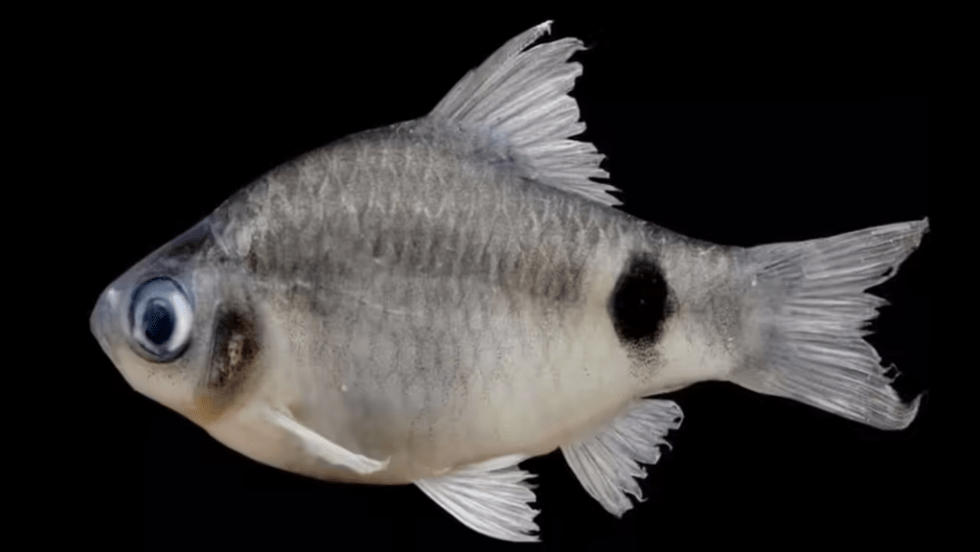
(Feature Image: The new species of cyprinid from the Brahmaputra River. Source)
Amid rising threats, the researchers continue to discover new freshwater fish species in India mostly from North East and Western Ghats as shows this overview, prepared on the occasion of World Fisheries Day (WFD) 2025. This is fourth overview and we have covered positive developments, impact of dams, important studies on the subject taking place during the past one year in first, second and third parts of the series.
Arunachal Pradesh: Swamp eel rediscovered after a century The elusive fish species swamp eel (Ophichthys hodgarti) and the velvet worm (Typhloperipatus williamsoni) have been rediscovered in Arunachal Pradesh after over 100 years. A team of researchers discovered the eel in the Siang valley in 2022. The discovery of the fish species was published in the latest edition of the journal Zootaxa.
Further, researchers have discovered several species of freshwater crabs, damselfly, fish, frogs, insects, mammals, plants and birds which are new to science. While freshwater crabs – Abormon praecalvum and Abormon capillosum – were discovered in Upper Siang in 2021, the damselfly golden grisette (Devadatta adii), the shadow damsel (Yunnanosticta siangi) and the bearded bronzeback (Caliphaea sinuofurcata) were found in Upper Siang and Shi-Yomi districts.
Arunachal Pradesh: New species of cyprinid fish from Brahmaputra drainage Abstract Garra magnarostrum sp. nov. is described from the Ranga River, Brahmaputra River drainage. It is distinguished from congeners in the Indian sub-continent, Myanmar and China in having (vs. lacking) many small and budding tubercles on the ventral side of the transverse lobe of the snout. It further differs from congeners in having a combination of the following characters: a multilobed proboscis on the snout, a long head, a long snout, small eye, a deep caudal peduncle, a small gular disc, 14½ branched pectoral-fin rays, 33 lateral line scales, 11 predorsal scales, 13 circumpeduncular scales and presence of multicuspid tubercles on the snout.
Assam: A New Species of the Genus Pethia from Brahmaputra Drainage Abstract Pethia dibrugarhensis, a new species of cyprinid from the Brahmaputra River, Dibrugarh is described here. The new species is distinguished from its congeners based on the combination of following characters: an incomplete lateral line; a black blotch with more or less distinct extension to dorsal and ventral sides of caudal peduncle; 10 circumpeduncular scales; ½4 scales between dorsal-fin and lateral line, and 4½ between lateral line and pelvic-fin origin; absence of humeral mark and barbels.
Meghalaya: New species of snakehead found When Farham Sangma, a fish hobbyist from Meghalaya, collected a peculiar-looking fish from a remote stream in South Garo Hills four years ago, he had no idea that he was holding a species unknown to science. Now, the fish has been officially recognized as Channa nachi, a new species of snakehead, highlighting the incredible biodiversity of Meghalaya’s freshwater ecosystems.
Channa nachi was found in a shallow, slow-flowing stream that feeds into the Simsang River system near Chokpot village, a waterbody with a substrate of sand, leaf litter, and pebbles—an ideal habitat for lesser-known aquatic species. The stream is also home to other freshwater fish species such as Schistura reticulofasciata, Dario kajal, Pseudolaguvia sp., and Barilius bendelisis, but Channa nachi stands out for its striking appearance and distinct characteristics.
The scientific name Channa nachi is also deeply connected to Meghalaya’s indigenous culture. The name “nachi” comes from the Garo language, where it is used as a vernacular term for the fish. This choice reflects the deep relationship between the Garo people and their aquatic biodiversity, reinforcing the significance of local knowledge in scientific discoveries.
As more snakehead species are being discovered in the mountain streams of the Eastern Himalayas, scientists emphasize the need for standardized species descriptions using both morphological and molecular data, ensuring that future identifications are scientifically robust and well-documented.
Cave-dwelling fish that can survive on surface found A team of zoologists from Gauhati University, Lady Keane College in Shillong, and the ICAR-National Bureau of Fish Genetic Resources in Lucknow discovered Schistura densiclava – a new species of fish that thrives underground but can adapt to surface conditions as well – in Krem Mawjingbuiñ, a cave in Meghalaya. “This discovery highlights the untapped biodiversity thriving in Meghalaya’s underground ecosystems. It’s the ninth new fish species we’ve described from Northeast India, and the sixth known cave-associated fish from Meghalaya” said Professor Dandadhar Sarma, head of Zoology department at Gauhati University.
Inside the fascinating world of cave-dwelling fish Over the past five years, a team of researchers, funded by the federal government, have been systematically exploring Meghalaya’s vast network of caves to locate and document new species of fish living inside them. In 2019, the research team discovered Neolissochilus pnar, the largest cave-dwelling fish species in the world, Mr Sarma says. The fish was found inside the Krem Umladaw cave in the western Jaintia Hills in a deep pond hundreds of metres below the ground.
Manipur: A New Species of Danioid Fish from Imphal River Abstract Barilius imphalensis sp. n. is described from the Imphal River, a main head-water tributary of Chindwin River basin in Manipur, a hill grit state of North-Eastern India. It is distinguished from all its congeners in having the following combination of characters: absence of barbels, presence of tubercles on the tip of snout, presence of dentary tubercles, presence of complete lateral lines with 41 scales, pre-dorsal scales 18, head depth at supra-occipital 20.2–23.4 % SL, body depth at dorsal fin origin 25.0–28.1 % SL, pre-anal length 65.1–68.5 % SL, height of dorsal fin 22.9–24.8 % SL, height of anal fin 26.1–28.9 % SL, eye diameter 6.3–6.9 % SL and 26.2–26.8 % HL, inter-orbital width 32.3–38.5 % HL and short blue vertical bars along the body 15–17. Key to species of the genus Barilius of the north-eastern India and their distribution pattern in the six different river drainage systems are provided.
Uttarakhand: 2 new catfish species discovered in Ganges River The two new species were uncovered while examining specimens after a routine biodiversity survey conducted by researchers, V. Balaji and Gaurav Shinde. One species has been named Glyptothorax bhurainu, from the Garhwali word bhurainu, in reference to the brown live colouration of this species, and the other has been named Glyptothorax himalaicus, in reference to the mighty Himalayan mountains.
A third species, Glyptothorax dakpathari, originally described from the Dakpathar Barrage near Dehradun in 1976, has also been redescribed in this study after being found to be a valid species. The researchers speculate that these species may have remained undetected for so long due to their cryptic colouration and elusive habitat preferences, dwelling primarily under rocks and pebbles in swiftly flowing hill streams.
According to Vijayakrishnan, the Ganga river holds “more treasures than most people understand.” “So far, the number of fish species in the Ganga is known to be anywhere between 100 and 200. But it is severely underreported, in my opinion,” he said. The Brahmaputra river, in comparison, sees constant research activity, with “at least a dozen new fish species described on an annual basis.” “The Ganga is at least as biodiverse as the Brahmaputra or other rivers in northeast India,” Vijayakrishnan said. “In addition to new species, there’s a lot of obscure or lost species like G. dakpathari. But no one has bothered to revalidate them when the material is very much evident,” he added.
As an independent researcher, Vijayakrishnan is met with numerous stumbling blocks in his efforts to spotlight the freshwater fish diversity. A major deterrent is a lack of institutional backing. Even though there is published research under his name, without an official letterhead or email address, it is hard to access museums. “I can’t write a letter and say I want to examine these specimens. It doesn’t sell, unfortunately,” Vijayakrishnan said. “I don’t think it is a flaw in the Indian system, I think it is a flaw with the system in general, globally.”
Western Ghats: New fish species discovered Researchers at the Centre for Peninsular Aquatic Genetic Resources, Kochi, of the National Bureau of Fish Genetic Resources claimed to have discovered two new species of freshwater fish from the Western Ghats – Labeo uru and Labeo chekida, resolving the taxonomic identity of Labeo nigrescens, a species first described in 1870 but shrouded in confusion for over a century.
The team led by V.S. Basheer used morphological analysis with historical specimens and fresh samples from Kerala and Karnataka rivers to clarify identities. Labeo uru, named after the traditional wooden dhow for its sail-like elongated fins, was found in the Chandragiri river, said a press release on Apr 23, 2025. The team had researchers RG Kumar & R Charan as members.
Kerala: Rare subterranean fish sighted in Kozhikode The rare subterranean fish Pangio bhujia, locally referred to as ‘paathaala poontharakan’, has been sighted for the first time since it was designated as the ‘official fish’ of Kozhikode district. The fish emerged from the pipe while pumping water from the well at the house of Shijil at Kannankandy, Kallangadithazham in Nanmanda. Two specimens were found by the residents of the house, one of which died soon after. The one which survived has been kept by the residents as per the instructions given by authorities at KUFOS.
Another specimen was earlier obtained from the house of Rajendran at Kannankandy. A blind species of very small size, the fish is seen very rarely by humans. The fish inhabits deep sources of very pure water. A striking red appearance is another attraction of the species. The first identified specimen of the species was collected from Cherinchal in 2019. An endangered species, ‘paathaala poontharakan’ travels along the deep subterranean springs, through which it reaches the wells of houses.
Some Relevant Reports
Goa: Checklist of fish diversity in selected rivers using exploratory studies Abstract The Western Ghats the ‘biodiversity hotspot’ traversing the maritime state of Goa, have the origin of many rivers of peninsular India. Our understanding of Goa’s freshwater faunal diversity is poor, and as far as the state’s fresh water ichthyofauna is concerned, there are critical gaps that await to be addressed. This study spanning over a timeline of two years is an attempt in that direction. Sampling in Goa’s freshwater ecosystems revealed a total of 84 species of fish belonging to 59 genera, 26 families and 12 orders. The species contribution hierarchy of major fish families in Goa’s freshwaters as revealed from the sampling effort is Cyprinidae (n = 28), followed by Nemacheilidae (n = 6) and Oxudercidae (n = 6). We report two exotic species; namely Oreochromis mossambicus, and Clarias gariepinus, and eight threatened species from Goa’s riverine ecosystems. This data is vital to envision immediate and long-term conservation policies for this faunal group.
Kaziranga: Survey finds 77 fish, 108 reptile & amphibian species Kaziranga National Park and Tiger Reserve (KNPTR) Director Sonali Ghosh on Nov. 06 said that a rapid survey conducted by the Kaziranga Park authority has revealed a rich assemblage of 77 species of freshwater fish, forming a major share of Assam’s 216 indigenous fishes and contributing to the Northeast’s remarkable diversity of 422 native fish species. The park also supports 108 species of amphibians and reptiles, far exceeding the 70-plus herpetofauna recorded from other parts of the state and adding to the 274-plus herpetofaunal species known from the northeast. The survey was conducted between July and September this year in collaboration with scientists and researchers from the Wildlife Institute of India (WII), Ghosh said.
10 popular fishes of Indian rivers Barramundi, also known as Asian sea bass, is a fish found in the salt water of Indian rivers. It is known for its taste and hence it is quite expensive and a popular choice in local dishes. Butterfish is also a popular fish found in rivers. It is also called Indian mackerel, which migrates to rivers for breeding. This small, fat-rich fish is liked for its taste. Gooch, a large catfish, is a predator that is found in Indian rivers. It is a very large fish with a strong reputation of being strong at times shocking folklore.
Hilsa is a riverine fish that is the Bangladesh national fish that enters Indian rivers migrating from the Bay of Bengal. It is the most favored by the Bengali culture people because of the extremely delicious taste of the fish. Katla is a large carp fish that is mostly found in Indian northern rivers. It is best consumed in traditional meals because of its fast-growing pace and extremely delicious flesh. Popular in India, the Golden Mahseer is another strong fish that is present in the freshwater of the Himalayan rivers. It is well known among fishermen due to its strength and size.
Mrigal is also a highly recognizable river fish that thrives in Indian reservoirs and streams. It is highly recognizable due to its price range and is a highly recognizable Indian species of fish sold at Indian markets. The fish species known as Pangasius is a multi-purpose Indian riverine species of fish. It is much valued due to its flavor and is a highly-preferred species to raise and consume. Rohu is also a very common Indian carp that is mostly distributed within the Brahmaputra and the Ganges river systems. It is very palatable to many people and that is the very reason that this species is a major ingredient of many regional meals. Due to its aggressiveness, the snakehead is widely distributed across Indian rivers. It is a highly adaptable species with the added unique quality of being able to breathe air.
SANDRP

 SANDRP