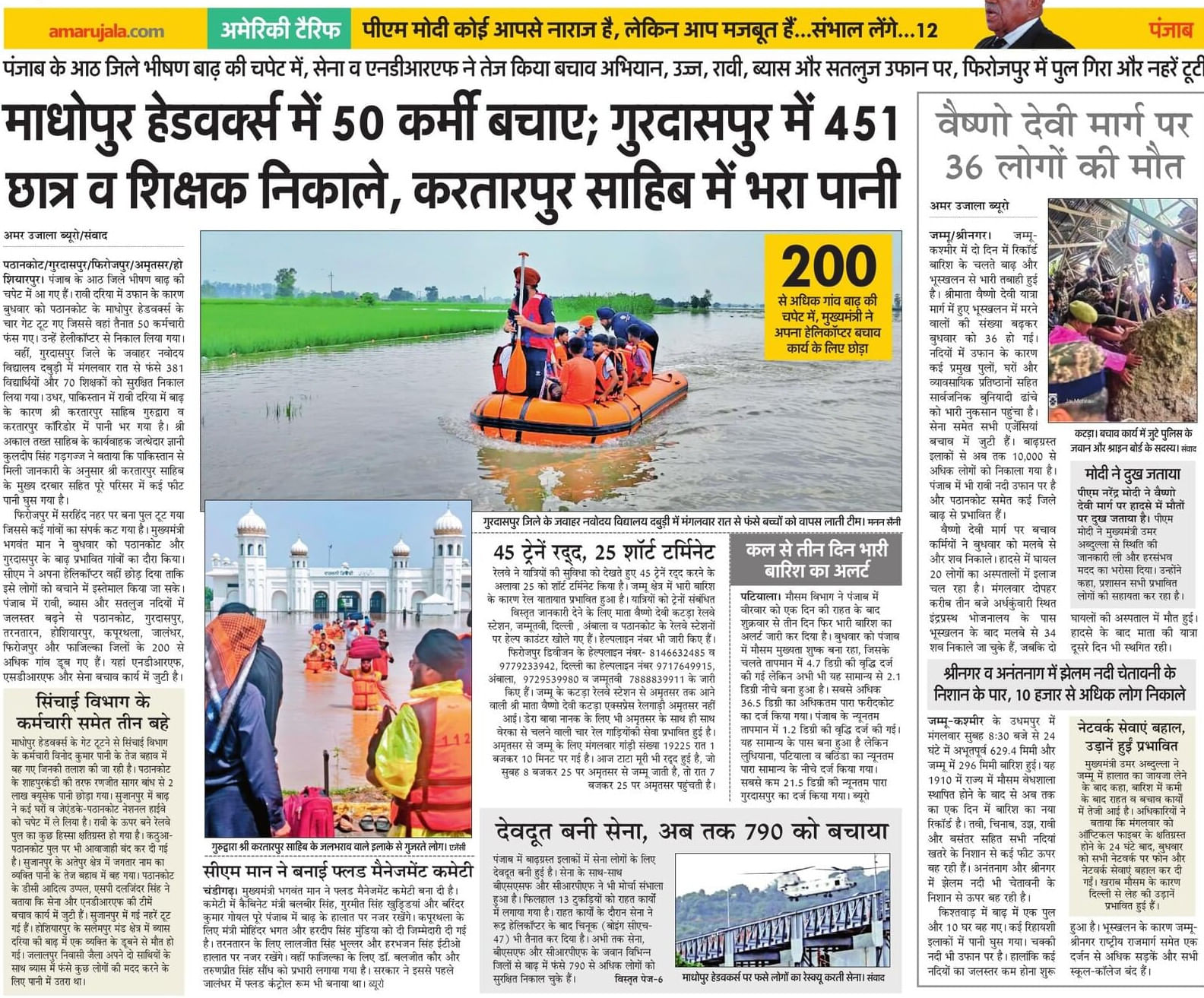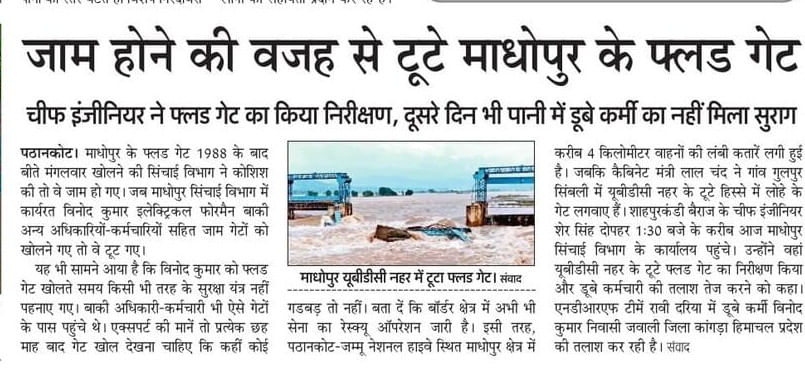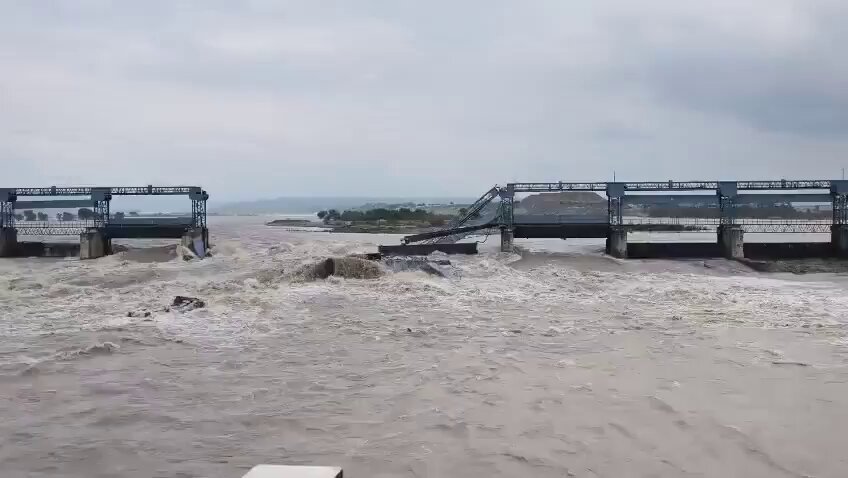
(Feature Image: 2 gates of the Madhopur Barrage washed away on Aug 27, flooding parts of Pathankot & Gurdaspur.)
A severe flood spell in Ravi river has damaged at least three flood gates of Madhopur barrage in Pathankot district of Punjab. The incident occurred in the evening of Aug 27, 2025 amid an effort to open the jammed gates of the barrage. The situation became critical after 2.12 lakh cusecs of water discharged from the upstream Ranjit Sagar Dam (RSD) dangerously increased the flood level at the barrage on Aug. 26.
The flood spell brought silt in huge amount resulted in jamming of several gates of the barrage and overflowing of the flood water from the structure. The flood level at the barrage was just 2 feet below the historic floods of 1988. It almost spilling out of the barrage near main head of Upper Bari Doab Canal (UBDC). The basic details of UBDC can be seen here.
On the day, the staff was able to open only 7 of the 28 gates. (Reports mention the barrage has 54 gates.) Next day, a team of 50 officials and workers from Punjab reached the barrage site and during noon hours again attempted to open the jammed gates when one the gates got washed away in the flood. Three members of the staff also fell into the flooded river. Of which two were rescued and one remained missing.
The rest of staff stranded at the threatened structure was later airlifted by the army before any further untoward incident. Around the same time, one more gate of the barrage washed away in the flood and a third one was damaged. A report claims damage to four gates of the barrage.
This post shows the situation of damaged gates of the barrage and flood rushing downstream in free-flowing manner. In second rescue operation, about 22 CRPF personnel and 3 civilians were airlifted by army from a building near the Madhopur headworks which collapsed due to the flood in morning of Aug 27.
Why Gates Were Jammed Sher Singh, Chief Engineer, Shahpur Kandi project reached there to inspect flood impact on the barrage and UBDC on Aug 28. Without any official information, the report suggests that the jamming of the gates resulted in their breaking away. It also states the operators were not given any safety equipment and the search was going on for the missing staff Vinod Kumar a resident of Kangra, Himachal Pradesh.
There is no official statement from Irrigation Department, Punjab on what led to the failure of gates. Citing sources and experts, this report shares that delay in opening of the gates and lack of their maintenance could have triggered the failure. In addition, the improper operation of barrage and poor coordination between irrigation and flood-control departments could also be reason behind the damage.
Lack of Monitoring, Information: Despite reoccurring dam induced flood disaster in Punjab, there is no monitoring being done by Central Water Commission (CWC) of the Ranjit Sagar, Shahpur Kandi dams and Madhopur barrage projects during monsoon period. Similarly, the Punjab Irrigation Department has not put any hourly discharge data from these projects in public domain.
Monitoring of the dam and putting their flood discharge data in public domain is crucial for independent and official analysis to draw essential lessons from the incident. In absence of this, media reports have quoted varying and confusing figures from over 4 lakh to 2 lakh cusecs discharged from for RSD on Aug 26-27 without mentioning the time of the discharges.
The second power house of the Shahpur Kandi Dam (SKD) is located just upstream the Madhopur barrage. The scale of flood this time has certainly submerged the powerhouse. However, there is no information whether the power house has faced any damages. This is also true for the Shahpur Kandi dam structure located about 7 km upstream of the Madhopur barrage.
This only shows that the both key central and state agencies are functioning in nontransparent and also possibly unaccountable manner. Unless, this changes the river infrastructures and people of Punjab are bound to suffer from avoidable dam induced flood disasters and the Madhopur barrage failure is just the latest example of this.
Dam Releases, Canal Breaches Worsen Ravi Flood Impact: The damage to flood gates of the barrage and overflowing of UBDC worsened flood situation in Pathankot and Gurdaspur districts as there is no structure to control discharges from upstream Ranjit Sagar dam.
Overflowing of Ravi, Ujh and Jalalian rivers after heavy rains in hill catchment and the releases from Ranjit Sagar Dam has inundated large areas in Pathankot district. Ravi river has also breached embankments and reached several km inland in Gurdaspur and Amritsar districts flooding villages and farm lands.
The Jawahar Navodaya Vidyalaya at Daburi in Gurdaspur was flooded severely trapping around 400 students and 40 staff members in the school building who were finally rescued after a day-long operation. Ravi floods entered about 40 villagers after breach in Dhussi embankment at three locations in the Ajnala and Ramdass areas of Amritsar district.
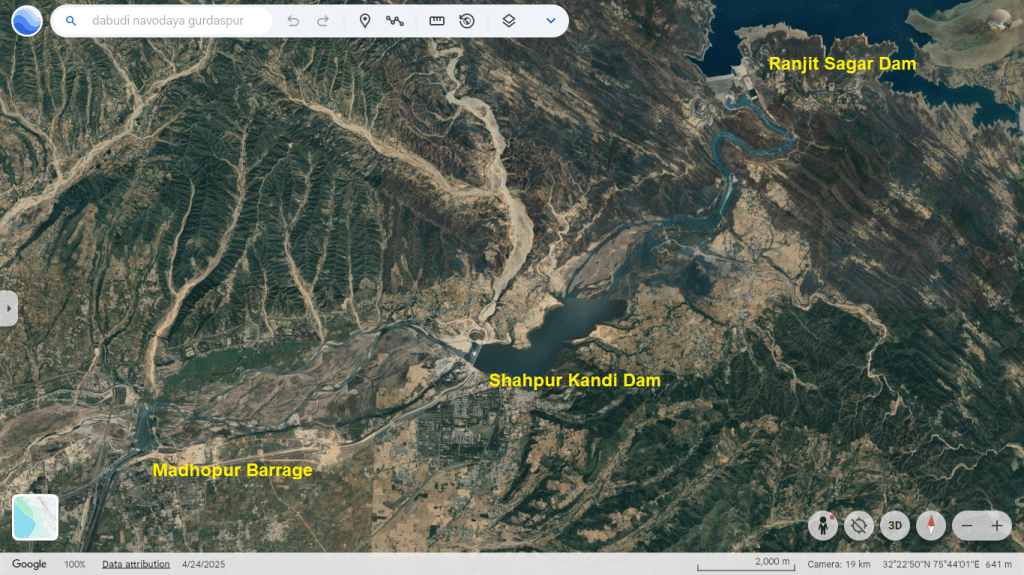
About Madhopur Barrage: The barrage is located on the Ravi about 14 km away from Pathankot district of Punjab sharing its border with Jammu & Kashmir (J&K). The Madhopur headworks diverts water into the UBDC for irrigation in Punjab. It supplies water to Gurdaspur, Amritsar, Tarn Taran, and nearby regions through canals.
The 773.48 m long structure with 17,750 cumces flood discharge capacity was built in 1959. The barrage has 28 spillway gates, 26 under sluice bay and 26 under sluice gates. The other salient feature of the barrage can be seen here.
Madhopur-Beas Link: This link was created under the Indus Waters Treaty (IWT) to transfer surplus water of the Ravi to the Beas before Ravi river enters Pakistan. It diverts water from the Ravi at Madhopur headworks into a link canal that flows into the Beas River upstream of Harike.
Shahpur Kandi Dam: The medium irrigation project with 55.5 m high concrete dam is built on Ravi River about 12 km downstream RSD. The objective of the project is to provide a balancing reservoir to have uniform water releases for UBDC, Kashmir canal off taking from Madhopur Head Works and high-level Ravi Canal (J&K) and to ensure optimum power generation during peaking hours from RSD Project. SKD is located about 7 km upstream of Madhopur Barrage.
The project has two powerhouses with a total capacity of 206 Mw, a 7.7 km long hydel channel, and two head regulators. A key objective is to utilize India’s share of the Ravi River water under the IWT, supplying 1,150 cusecs to irrigate approximately 5,000 ha in Punjab and 32,173 ha in J&K. The salient features of the project can be seen here.
The construction of the project was completed in February 2025. The filling of reservoirs which started in Nov 2024 was in final stages in March 2025. The project was being assessed by a panel of experts under Dam Safety Act, 2021, before it is filled to capacity.
Ranjit Sagar Dam: RSD also known as the Thein Dam, is part of a hydroelectric project constructed on the Ravi River in Pathankot district Punjab bordering J&K. It is located upstream of the Madhopur Barrage and Shapur Kandi Project. A large portion, up to 60%, of the reservoir falls within J&K. The project is used for both irrigation and power generation. The project is the largest hydroelectric dam in Punjab with a capacity of 600 MW. Also, the dam is amongst the highest earth-fill dams in India and has the largest diameter penstock pipes in the country. The salient features of the project can be seen here.
SANDRP
Postscript: Why Madhopur barrage gates collapsed? The Madhopur barrage is one of India’s oldest barrages, built during the British era for irrigation purposes. It diverts water through the Upper Bari Doab Canal to irrigate farmlands across Punjab’s Gurdaspur, Amritsar, Pathankot and Tarn Taran districts.
–The official said that under the NDSA Act, dam owners of structures like the Madhopur barrage are mandated to conduct regular maintenance according to dam safety guidelines and submit their report to the State Dam Safety Authority before every monsoon. “Please find out if it was done. If it was done, how did the barrage gates get stuck? Fifty percent of the barrage gates not opening in itself is an example of extremely poor upkeep,” the official said.
-A senior BBMB official, said that ideally the barrage gates should have been opened before monsoon for testing to see if they are functioning properly. The gates should be greased properly. “None of this seems to have happened. Lack of proper maintenance can result in the gates getting rusted and becoming structurally weak over a period of time,” the BBMB official added.
– Punjab irrigation department officials, however, said that it was an unprecedented situation this year. The Madhopur barrage, one of the officials said, has never received such a large volume of water before. On 27 August, 2.21 lakh cusecs was released from the Ranjit Sagar dam. “The Madhopur barrage did not receive this much water even during the1988 floods. The situation was beyond manageable,” said another senior irrigation department official, who was monitoring the situation last Sunday at the barrage.
-Dam safety experts also said that it’s not just Madhopur barrage. Most of the barrages are very old in Punjab and upkeep is very poor as they are under the irrigation department, he added. “They are not maintained regularly, and probably the Madhopur collapse was due to the lack of maintenance as its base structure is centuries old,” Virender Prasad Sharma, a dam expert empanelled by the CWC, told.
-The second irrigation department official, who did not want to be named, said that heavy silt and uprooted trees came with the water, jamming the barrage gates. “Water was overflowing from the barrage structure.” The irrigation department started opening the barrage gates, but it took a long time because the process is manual.
-“To open one gate, it takes around 45 minutes. The release was heavy. The opening process has not been updated since its inception. Our staff was at the barrage and opening the gates, but the heavy flow washed away the three gates,” he said, adding that one of their staff was also swept away. According to one of the officials quoted earlier, the Madhopur barrage has a maximum flood discharge capacity of 17,750 cusecs. But the discharge was much higher this year.
Minister blames private firm WRD minister Barinder Kumar Goyal said a company (Level9 Biz) was hired on March 13, 2024, for Rs 22.72 lakh to review the headworks’ floodgates. The report, submitted by the company on Dec 12, 2024, claimed that the headworks could handle a water flow of up to 6.25 lakh cusec. However, the minister noted, the gates collapsed under a flow of less than 2 lakh cusec. As a result, the govt has sent a notice to the company for submitting an incorrect report that led to human loss and damaged the department’s reputation, said the minister on Aug 30. Asked why the Madhopur headworks were not opened before an alarming increase in water levels, Goyal said the decision was taken on the basis of the report submitted by the private company.
Inquiry into Madhopur floodgate collapse The state govt ordered an inquiry into the collapse of three floodgates at the Madhopur Headworks on Aug. 27 2025 and placed three of its officers posted at the barrage under suspension. The State Dam Safety Organization has constituted a five-member expert committee – headed by AK Bajaj, a hydromechanical expert, with Pradeep Kumar Gupta, Sanjeev Suri, NK Jain and Vias Dev as members – to hold an inquiry.
The committee will investigate the structural, mechanical, hydrological, geotechnical and operational causes that led to the washing away of the gates at the barrage. It will also examine the condition and performance of the gates, the embedded parts, hoisting arrangements and stability of civil structures. The committee will suggest immediate and long-term remedial and rehabilitation measures. The upkeep of the barrage has come under scrutiny with experts alleging that the floodgates had corroded and jammed. The working of the floodgates had also not been tested frequently, it is alleged.
MP calls for Probe Gurdaspur member of Parliament Sukhjinder Singh Randhawa called for a high-level investigation into the matter. In a letter to CM on Sept. 21, 2025, Randhawa questioned the decision to suspend three officials, including an executive engineer and SDO, and demanded that accountability be fixed at the highest level. In his letter, Randhawa raised several key concerns, including the absence of senior officials at Ranjit Sagar Dam during the critical hours when water levels peaked. He also questioned why there was no prior coordination with downstream structures like Shahpur Kandi Dam and Madhopur headworks before the gates were opened. Additionally, he asked why the gates at Madhopur were not opened in advance or in sync with the release from Ranjit Sagar Dam.

 SANDRP