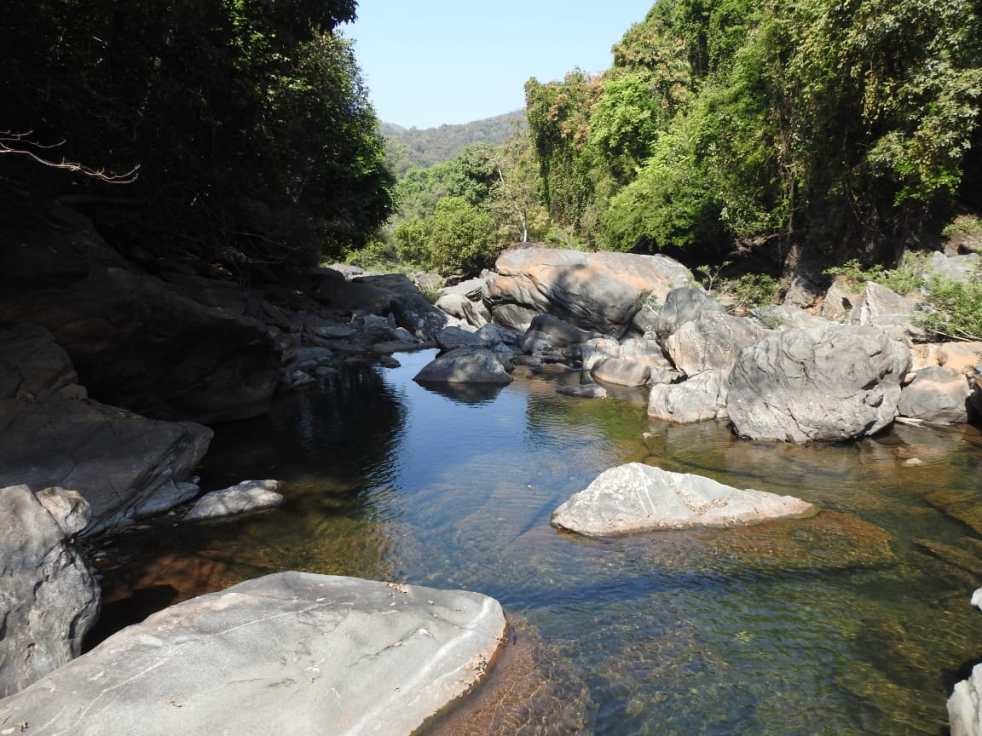
At the window of his new house, in a crowded suburb of Pune sits Aba Gawas. He looks out at the traffic and talks of his river Dabhil, more than 400 kms away from him. For years, Aba has fought hard to protect the river. He calls it Dabhil Mauli, a term of endearment reserved for mothers and deities. He is not keeping very well and longs to return to Dabhil Mauli. I realize with a sudden pang, rivers are home.

Dabhil is a tiny west-flowing river, barely 25-30 kms long. A drain that flows along my home in Pune is longer than Dabhil. But then, the length of a river is no measure of the stories it can tell, the histories it can hold, the communities it can serve or the animals it can shelter. Dabhil has seen the evolution of Western Ghats with its steep escarpments and gentle steps, its interaction with the moist monsoon winds, it has seen tigers and elephants and slender loris and small-clawed otters along its banks, it has sheltered massive Mahseer in its pools. It has been worshipped and sung to, it has also been ravaged and dammed. It has raved and ranted in the floods and has flowed serenely past scented sacred groves. It has seen forest deities in shaded villages and the JCBs of mining contractors, eating away at hills. It has seen an old woman, Akki, sit by its banks for hours, and it has also seen young researchers set up camera traps, measure tiger pugmarks and secretly pray that the river is saved. Length is no measure of a river.
Dabhil flows down the steep western slopes of the Western Ghats, flirting with Goa’s border and through the heart of some of the most biodiverse and densely forested regions of this global biodiversity hotspot. The river originates from the crestline of Western Ghats at an elevation of 800 mts and like so many rivers that emerge from this crestline but flow in opposite directions, headwaters of the Dabhil and the mighty Ghataprabha are within a few kms from each other.
Its headwaters form waterfalls cascading down to Konkan, that narrow coastal strip of Maharashtra and converge at a village called Fansawade. Dabhil then flows onwards to villages like Dabhil, Saramale, Newli and Bhalawal, through groves of fragrant Surangi (Calophyllum inophyllum) and Kewda ( Pandanus fascicularis) and at the end of its short run, it meets Terekhol, a swift and abundant river forming the border between Maharashtra and Goa.
West Flowing rivers of the Sahyadris are characterized by their short lengths, steep slopes, extremely heavy rainfall and incised channels. They exhibit high biodiversity and endemism, with the forests supporting “at least 325 globally threatened flora, fauna, bird, amphibian, reptile and fish species”.[1] Each of these rivers has a story to tell, but the Water Resources Department (WRD) of Maharashtra groups all of them together as West Flowing Rivers and laments that although west flowing rivers constitute 45% of the average annual yield of Maharashtra, there no suitable dam sites here because of narrow valleys and steep slopes. This does not stop the WRD from initiating several dangerous and futile dams in the region.[2]
A small river like Dabhil with its kaleidoscopic stories inherently negates such lazy classification.
Dabhil’s journey from the headwaters to the confluence
Well of the Seven Sisters
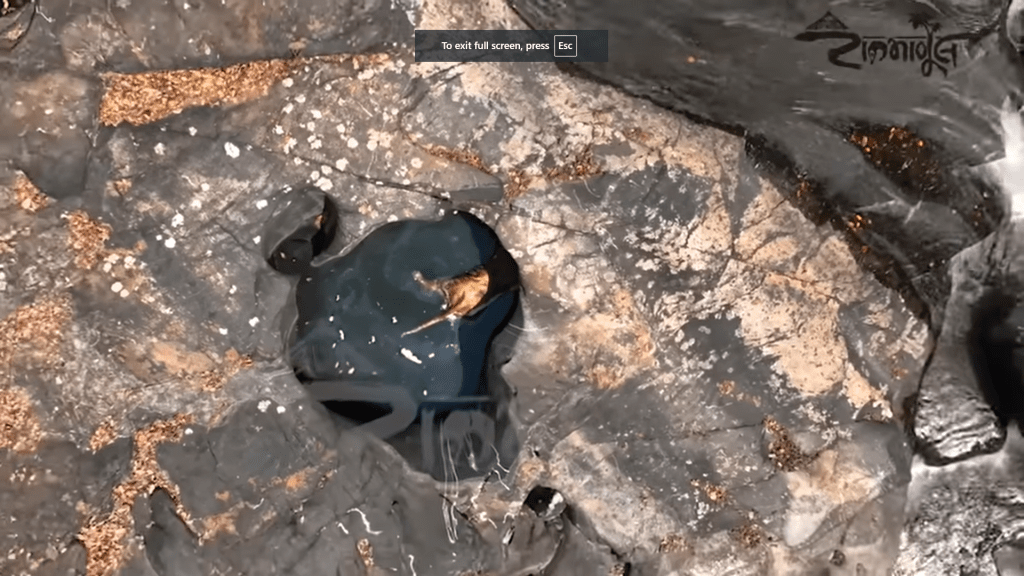
The stoic wall of Sahyadris, the benevolent mountain, arrests heavily laden monsoon clouds and results in rainfall to the tune of 4200 mm in the headwater regions of Dabhil. This pulsating flow, that can move boulders the size of elephants, is the sculptor of the river channel in the headwaters. It has sculpted seven perfectly round cascading pools in the diamond-hard basalt, a relic of the basaltic lava flows of the late cretaceous period. Villagers call them Saat Baay Vihirs or Wells of the Seven Sisters. Lore of the seven sisters is an abiding motif finding mentions across India’s rivers. Anil Gawas from Dabhil village tells me, “Every three years, just before the onset of the monsoon, we trek up to the Saat Baay Vihir, worship the wells where the river starts, and cook a meal together. We return in groups before the night falls.” Because the emerald- green forest here is a known habitat of Tigers.
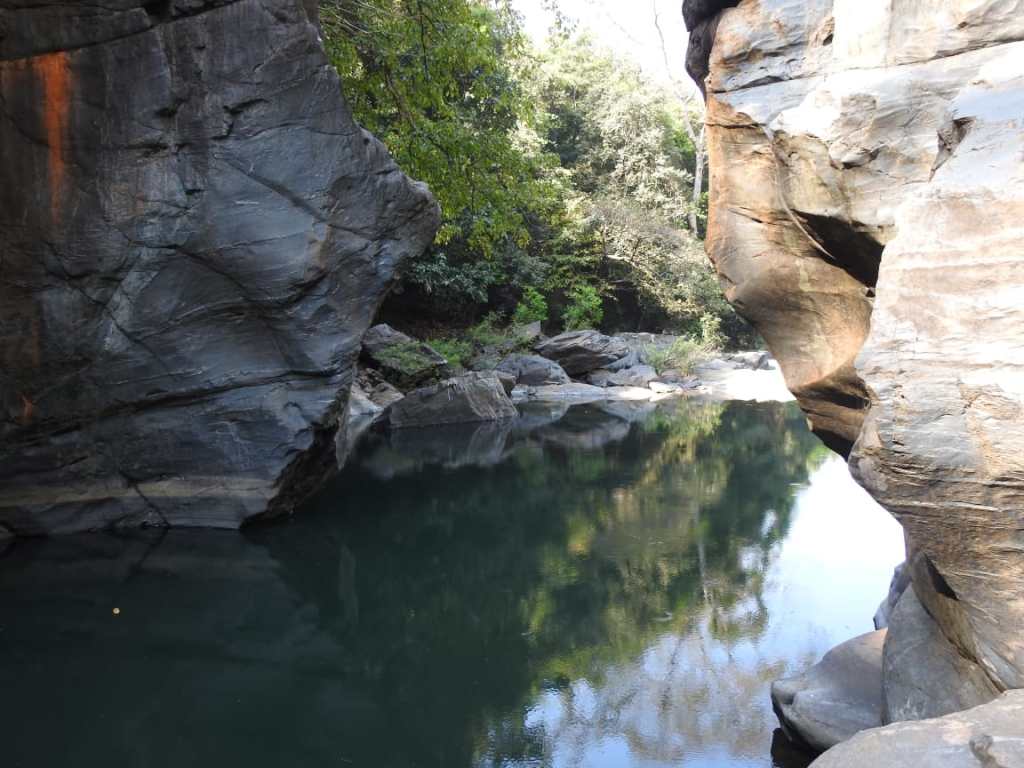
When I visited Dabhil for the first time in 2012, Aba showed me a photo of tiger pugmarks on his phone. State Forest Department was reluctant to accept the presence of tiger in the region then. It is established beyond doubt now and there are recent reports of at least 8 tigers roaming around these forests.[3]

Tragically, a healthy adult tigress was found dead in one of the Seven Sister Wells in March of 2025. Sachin Ghadi from Dabhil and Local Ecologist Prasad Gawde with whom I have once traveled along the Terekhol River, witnessed this and was visible shaken at his discovery.[4] Death of an apex predator in a community-conserved river is the sad indictment about the pressures on this tiny patch. Check him video here: https://www.youtube.com/watch?v=IDS-KBYgop0
Sacred Groves along the River
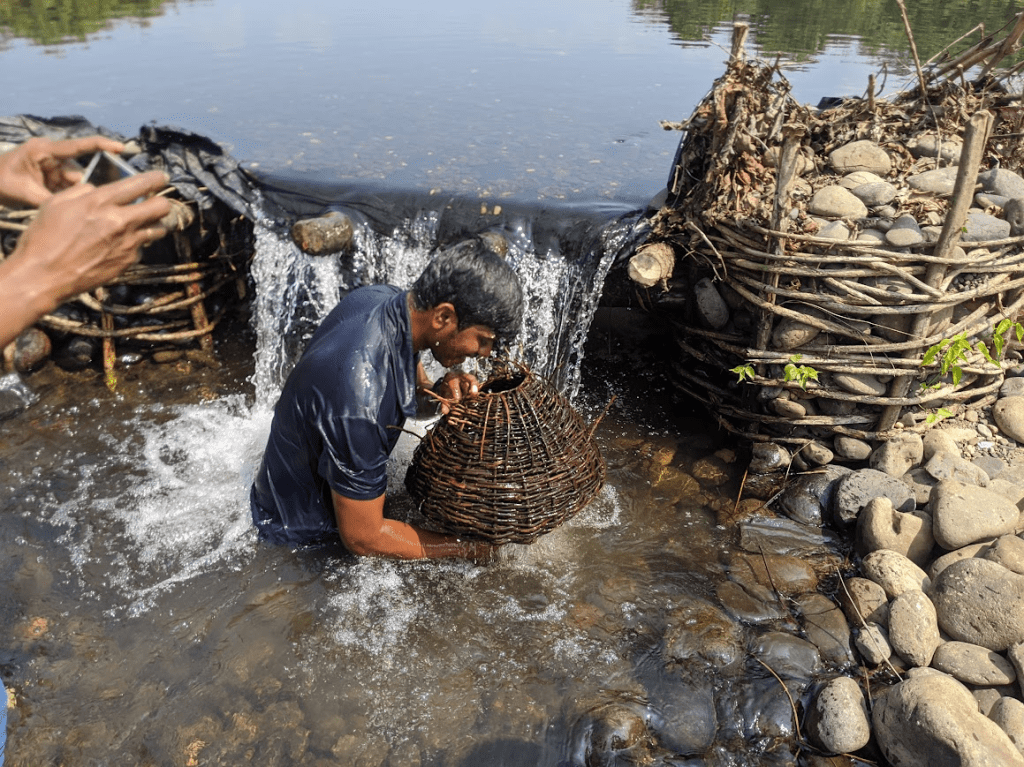
As we come down from the headwaters, we cross several peculiarly dense patches of riparian forests shading the river. These Sacred Groves are an abiding feature of the Western Ghats and are fiercely protected by the community in Dabhil. Experts like Prof. Madhav Gadgil believe that this custom of conservation in Western Ghats finds roots in hunter gatherer societies[5]. Hundreds of sacred groves dot the Western Ghats, most without any formal protection and although they stand testament to timeless community conservation, they are rapidly falling prey to destruction. They are called Kans or Devarakadus in Karnataka, Kavus in Kerala and Devrai (God’s Forest) in Maharashtra. In Dabhil, they are simply called Raay or Groves. Along the river are Bhuikand Raay, Juna Deool Raay, Jalmachi Raay, Saat Kapyachi Raaay, Bhomlaachi Raay, Bhajkachi Raay and a sacred grove around the crematorium ground. No tree here is ever cut and each grove is home to a unique local deity linked to the ecosystem. Raays of Dabhil are riparian, linked as much to the river, as to the land.

River as the body of the deity
Further down we reach the tiny village of Dabhil eponymous with the river, with its 100-odd homes. Malhar Indulkar, a Wildlife Researcher and Ecologist specializing in Otters asks me, “Do you know, they never sink a well in Dabhil. Not a shallow well, not a bore well.”
That is very strange indeed. It shakes my belief that groundwater and bollywood music are the common threads holding the country together. Dependance on groundwater water in rural areas across the country goes as high as 85%.[6]
But in Dabhil village, there are no wells. Drinking water comes from a crystal mountain spring and reaches individual homes through a simple but effective gravity supply. Anil Gawas explains, “Not sinking wells is a form of love and respect for the river. Ancient temple of our Gramdevata (village deity) Mauli was on the banks of Dabhil. Several generations ago, a massive flood washed away the temple, taking the statue of Mauli with the flow. From that time, the entire river is Mauli for us. She provides us with ample water and we do not need to dig wells. Some people tried sinking borewells, but they did not yield water. We depend entirely on Dabhil Mauli and have never gone thirsty.”

Rivers in Konkan are notorious for going dry immediately after monsoons, but Dabhil is perennial and an exception to this rule too. Whether it is so because of the dense forest cover, low population and modest water use, it is rare and special for Konkan.
The belief that the river is the body of Mauli is so strong that villagers do not mine gravel or pebbles from the riverbed. “Outsiders” are not permitted to take any river pebbles with them either.


Mauli as Gajalaxmi: Goddess of rains and abundance
Old Mauli temple of Dabhil overlooks the river and is a modest abode of local deities like Rawalnath and Mauli carved in basalt. The temple has no walls. Statue of the goddess is not aniconic, but in the form of the resplendent Gajalaxmi, an ancient symbol of auspiciousness and fertility dating back to the 2nd Century BC, shared by Hindu, Buddhism and Jainism. It depicts Goddess Laxmi flanked by two elephants, showering her with water. In the neighboring state of Goa, 18 panels of Gajalaxmi, also known as Kelbai dated between 12-15 Century CE have been recently discovered.[7] Veteran Ecologist Rajendra Kerkar calls Gajalaxmi the Goddess of rivers and the rain. [8]


Kukkur Kond fish sanctuary
Downstream from the village, a shaded deep pool known as Kukkur Kond is home to massive Mahseer fish. Mahseer, Tor species, once found abundantly in Indians rivers, are all but wiped out in the wild. Mahseer need a flowing river, high dissolved oxygen, nutrient rich waters, excellent riverbank connectivity and an undammed river reach to migrate up the river for laying eggs. These conditions are unthinkable in a state obsessed with dams.
Mahseer in Kukkur Kond receive sanctuary from the community, like a riverine sacred grove. Fishing or disturbing the river is prohibited at Kukkur Kond. Western Ghats are home to several such fish sanctuaries protecting fish and rivers, most of which receive no formal protection. We have documented several such sanctuaries.[9]
A dam to submerge all of this
In 2007, Water Resource Department (WRD) swooped down on this region, cut thousands of trees and started piling mounds of mud on the river downstream of Dabhil. The villagers were aghast. No Forest Clearance or Environmental Clearance has been secured for this destruction. Then land acquisition notices started pouring. WRD wanted a dam at Dabhil to supply water to the places that already were pegged to receive irrigation! Locals realized that the dam was meant for the mining industry. In a weird chain of mistakes, this dam is called Sarambale Project, which means nothing to anyone here.

The 70 mts high dam is set to submerge an area of about 753 hectares in Dabhil basin: the villages, their temples, sacred groves, forests and fish sanctuaries.
Aba Gawas filed a case in the Bombay High Court against the dam along with Vanashakti organization from Mumbai[10]. Vanashakti was also fighting long and tough legal battle, along with Awaaj Foundation[11] to have the entire Sawantwadi-Dodamarg Corridor declared as eco sensitive area and no tree felling zone. 49 mining leases were ready to be signed in this region and the corridor was on the precipice of destruction.
Despite very clear High Court Orders declaring the corridor as Eco sensitive and banning all tree felling, the lease of one of the mines in Kalne was renewed in 2019. This was also the year of massive landslides.

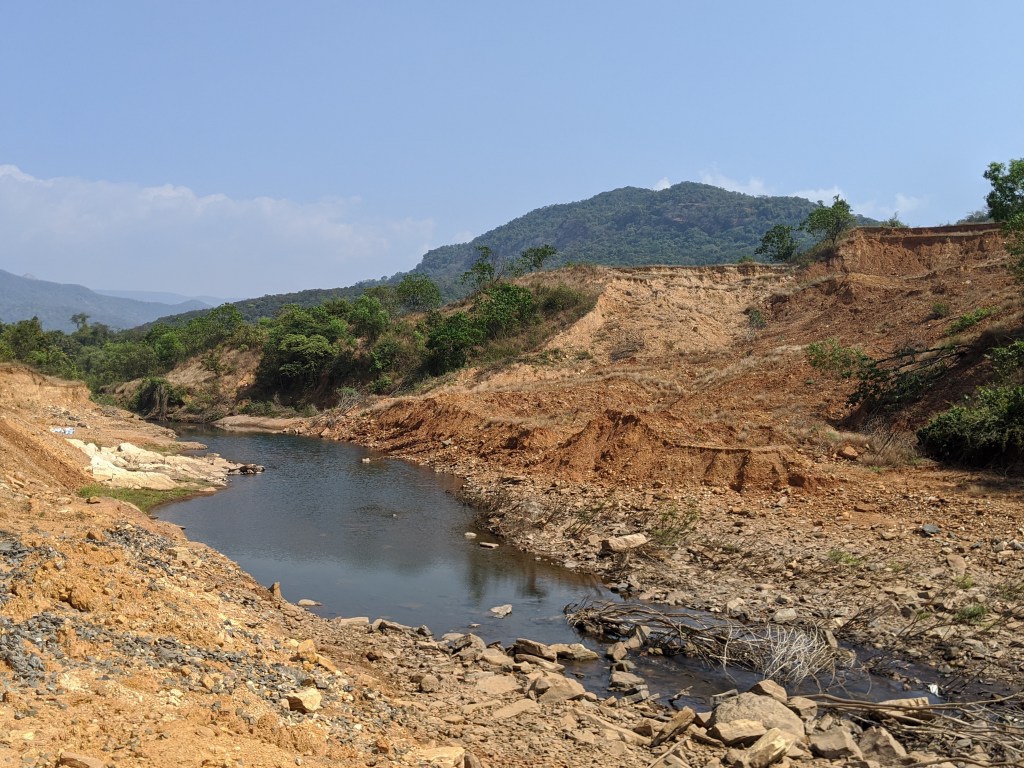
WRD continued the construction of Sarambale Dam. It had no clearances, there was very strong local opposition, the area was an eco-sensitive zone, locals were not demanding water, the matter was subjudice. But such inconveniences did not matter to the WRD. They went on dumping mud on the riverbanks, cutting trees in this sacred, fragile region and left the work incomplete, as they have done in case of several dams in Konkan. (Read SANDRPs work on Saramable Dam Here)[12]
After heavy rains in 2019, the docile river raved and ranted. It broke the half-built dam encroaching its left bank, and in its fury, swerved to its right, eating away at the road that connected Dabhil and other 4 villages to the outside world. For more than 15 days, the villages were isolated, ill and injured people could not reach the highway, supplies could not reach the villages.
This episode highlights the callousness of Maharashtra WRD several times over. No one in the WRD was held accountable for the disaster. Even now, when the matter is subjudice and clearances have not been issued, WRD has been prioritizing this project! In its Irrigation Status Report of June 2023, Konkan Irrigation Development Corporation lists Sarambale is an “On-going Project”, that its costs stands at 184.7 Crores (2017-18 prices) and remaining work stands at 66.1 Crores. This means that Rs. 118.6 Crores have been spent already! A damaged road and bald spots in an otherwise beautiful forest are all that remain to show for this expenditure.
Incidentally, White Paper on Irrigation Projects stated that the cost of Sarambale Dam according to 2003-04 prices was 184.7 Crores, the same figure quoted in 2023, 14 years later. 85th meeting of KIDC Board in December 2023 unanimously passed a resolution to “prioritise” this project.
These decisions do not respect the legal framework of the country.
We strongly urge the WRD and MoEFCC to immediately scrap Saramabale Dam project on the Dabhil River.
Fight to save the Ecologically Sensitive Area
Organizations like Awaaj Foundation (Petition filed in 2012) and Vanashakti (Petition filed in 2014) fought and are still fighting strong legal battles to include Dabhil and the surrounding 24 villages as an Eco-sensitive Area to stop rampant tree felling and menacingly large mining proposals (49 mines including iron ore).

Wildlife Biologists like Girsh Punjabi set up camera traps in the region to prove the existence of Tigers and sure enough, cameras proved the villagers right. Vanashakti fought along with the villagers in the face of increasing pressure. Wildlife Institute of India and a Report from Critical Ecosystem Partnership Fund established the importance of this ecosystem and the need for it to be declared as Eco sensitive Area. Young researcher Nisarg Prakash wrote about the presence of Oriental Small clawed Otter (Aonyx cinera), Schedule I endangered species in the Dabhil catchment, a first record in Maharashtra. Western Ghats Expert Ecology Panel (WGEEP) headed by Prof. Madhav Gadgil recommended protection to this area. These suggestions were not appreciated, and shockingly, newly appointed Kasturirangan Committee (HLWG) omitted the entire Dodamarg Block from its ESA recommendations! Economic considerations of mining trumped the critical importance of this area.
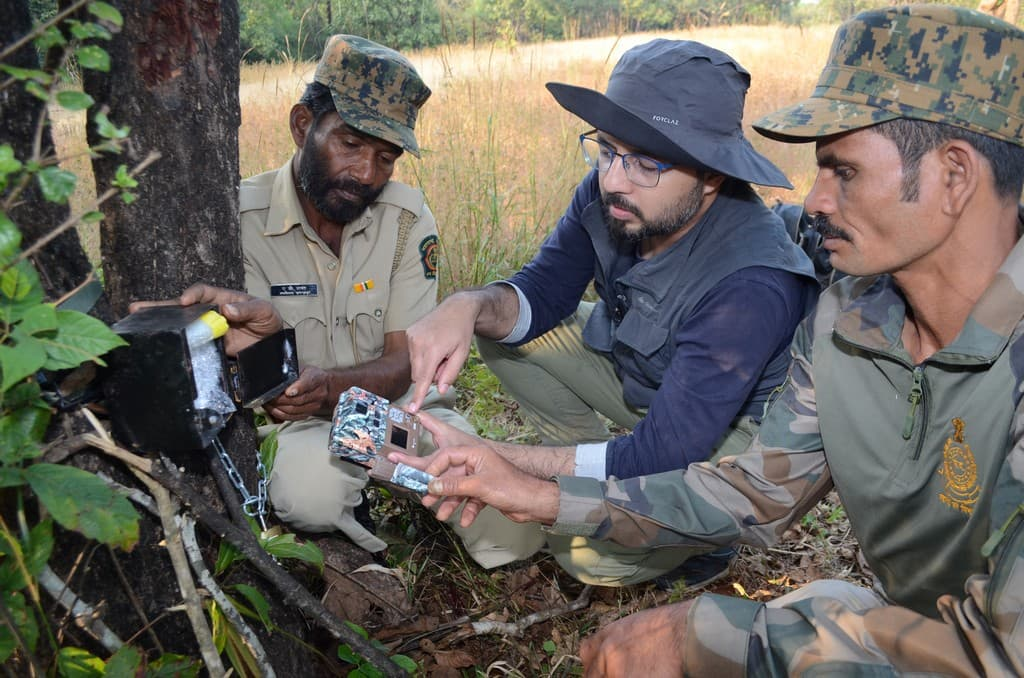
Thankfully, again due to unflinching efforts of the villagers and Stalin Dayanand from Vanashakti and the ruling from Bombay High Court, [13]MoEF and CC has grudgingly issued a revised Draft Notification for Declaration of Sawantwadi-Dodamarg Corridor as ESA, protecting 212.9 sq kms area in 25 villages. In addition, the area is under a separate Draft ESA Notification for the entire Western Ghats issued by MoEF and CC in July 2024.


Expanding monoculture and water pumping
Dabhil River faces newer challenges like rapidly expanding rubber, banana and pineapple plantations right up to its headwaters. These plantations are operated by contract farmers who are not locals and who lease the lands from local farmers. Ganesh Parab tells me that these operators clear standing forests, use large amounts of insecticides and pesticides and continuously lift water from the river, using powerful pumps. Sacred pools at the origin are used to pump out immense amounts of water for the thirsty crops. This is affecting the water levels of Dabhil and has resulted in repeated electricity failures. If we wish to maintain the ecological and social services of free-flowing rivers, their governance has to be looked at closely.
At the end of her small journey, Dabhil meets Terekhol, a larger free-flowing river near the village of Vilavade. By now the forest is cleared and banana plantations crowd the river banks. Dabhil is unrecognizable without its forests, as if it is in an alien land. The river reminds me of Aba, sitting by his window in Pune. In its small run, the river has not only supported myriad life forms, it has also brought hundreds of people together. We hope all of us will join hands in protecting this invaluable treasure. Dabhil River should be declared as a Heritage River.
Long live Dabhil Mauli and the people who call her home.
Parineeta Dandekar, SANDRP
parineeta.dandekar@gmail.com
[1] https://whc.unesco.org/en/list/1342/#:~:text=It%20also%20has%20an%20exceptionally%20high%20level,world%27s%20eight%20%27hottest%20hotspots%27%20of%20biological%20diversity.&text=In%20particular%2C%20the%20level%20of%20endemicity%20for,the%20Western%20Ghats%2C%20352%20(54%25)%20are%20endemic.
[2] https://sandrp.in/2016/02/09/large-dams-in-konkan-western-ghats-costs-benefits-and-impacts/
[3] https://timesofindia.indiatimes.com/city/kolhapur/eight-tigers-spotted-in-sawantwadi-dodamarg-transit-corridor-a-wildlife-breakthrough/articleshow/114154565.cms
[4] https://timesofindia.indiatimes.com/city/goa/trekkers-find-tigress-carcass-in-dabhil-reserve-forest/articleshow/118941609.cms
[5] https://wgbis.ces.iisc.ac.in/biodiversity/sdev/mg/pdfs/mg176.pdf
[6] https://www.worldbank.org/en/news/feature/2012/03/06/india-groundwater-critical-diminishing#:~:text=More%20than%2060%25%20of%20irrigated,supplies%20are%20dependent%20on%20groundwater.
[7] Nalini Nayak, Recently Reported Gajalakshmi Panels from Goa, 2023
[8] https://www.gomantaktimes.com/my-goa/art-culture/stories-that-goas-rivers-tell, https://timesofindia.indiatimes.com/city/goa/unique-gajalaxmi-stone-sculpture-found-at-veluz/articleshow/118428821.cms
[9] https://sandrp.in/2016/03/31/fish-sanctuaries-in-western-ghats-of-maharashtra/, https://sandrp.in/2024/09/25/adani-energy-dams-defiling-sacred-pools-and-fish-sanctuaries-in-western-ghats/, https://sandrp.in/2024/09/25/adani-energy-dams-defiling-sacred-pools-and-fish-sanctuaries-in-western-ghats/
[10] https://www.vanashakti.org/success-stories/sawantwadi-dodamarg-wildlife-corridor
[11] https://timesofindia.indiatimes.com/blogs/voices/time-to-speak-up-to-protect-sawantwadi-dodamarg-wildlife-corridor/
[12] https://www.thehindu.com/sci-tech/energy-and-environment/the-debatable-dam/article4372756.ece, https://sandrp.in/wp-content/uploads/2015/01/dams_kidc_westernghats_pd-0216.pdf
[13] https://indianexpress.com/article/cities/mumbai/bombay-hc-asks-centre-to-declare-sawantwadi-dodamarg-ecologically-sensitive-area-9268057/, https://timesofindia.indiatimes.com/city/goa/esa-draft-notification-on-sawantwadi-dodamarg-corridor-to-ease-flow-of-2-goa-rivers/articleshow/120652957.cms , https://www.hindustantimes.com/cities/mumbai-news/hc-orders-centre-to-declare-sawantwadi-dodamarg-wildlife-corridor-as-esz-101713037380596.html#google_vignette
A Fantastic report on Sahyadri Konkan Corridor: https://science.thewire.in/politics/rights/securing-wildlife-corridor-sahyadri-konkan-landscape-land-use-matrix-challenges/

 SANDRP