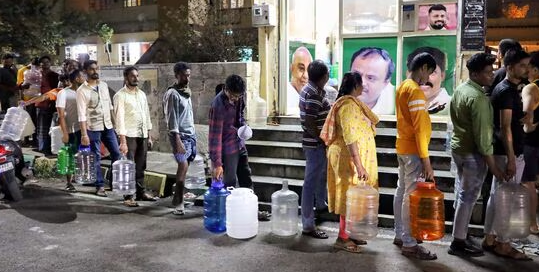
(Feature Image: People stand in a queue with water cans to get drinking water at Jnana Jyothi Nagar, in Bengaluru. Image Source: PTI/Live Mint, 10 March 2024)
This annual overview complies the top ten reports regarding the continual depletion in groundwater levels in Bengaluru, the factors responsible for it and its impact on the citizens. It also highlights relevant steps taken by government agencies and some cost-effective sustainable alternatives suggested by experts and civil society groups.
Continual Depletion & Reasons
1. Groundwater levels set to plummet Groundwater levels in Bengaluru are projected to decline sharply, with some areas facing a drop of up to 25 metres, according to a study by the Bangalore Water Supply and Sewerage Board (BWSSB) and the Indian Institute of Science (IISc). The report highlights that 80 wards, including 110 villages, are heavily reliant on groundwater and are at high risk of acute shortage during the 2025 summer.
“This is the first time in India that a city-specific scientific study has been undertaken to address water scarcity. The findings have sparked off an urgent call for action to mitigate the looming crisis,” said V. Ram Prasath Manohar, Chairman, BWSSB. https://www.thehindu.com/news/cities/bangalore/groundwater-levels-in-bengaluru-set-to-plummet-especially-in-outer-zones/article69140330.ece (25 Jan 2025) The findings indicate a significant drop in groundwater levels across Bengaluru, which relies heavily on borewells for water, with an estimated extraction of 800 million liters per day (MLD). In central Bengaluru, the groundwater level is predicted to decline by 5 meters, while areas under the City Municipal Corporations (CMC) may experience drops of 10-15 m. In the 110 villages under Bengaluru’s jurisdiction, the decline could be 20-25 m. https://www.hindustantimes.com/cities/bengaluru-news/water-crisis-likely-to-be-back-in-bengaluru-study-finds-decline-in-ground-water-level-ahead-of-summer-101737881376608.html (26 Jan. 2025)
2. Groundwater extraction hits 100% Bengaluru’s groundwater levels have reached a critical stage, with both urban and rural areas extracting 100 per cent of available reserves in 2024, according to latest report by Central Ground Water Board (CGWB). The city’s reliance on groundwater has led to severe depletion, raising concerns about long-term sustainability. Experts highlight that without immediate conservation efforts, Bengaluru’s long-standing groundwater depletion could lead to severe urban water shortages, affecting millions of residents. Sustainable water management policies, coupled with large-scale awareness programs, will be critical in addressing the crisis. https://www.thehansindia.com/news/cities/bengaluru/bengalurus-groundwater-depletes-as-extraction-hits-100-942949 (06 Feb. 2025) Data from the Karnataka Groundwater Directorate confirms that the city’s reserves have been in the “over-exploited” category for several years. The state’s dependency on groundwater has been steadily rising, with extraction levels increasing from 66.3 % in 2023 to 68.4 % in 2024. https://www.hindustantimes.com/cities/bengaluru-news/bengalurus-groundwater-crisis-deepens-with-100-extraction-in-urban-and-rural-districts-report-101738569820241.html (3 Feb 2025)
3 Low holding capacity of aquifers “South India has a very different kind of aquifer system. It is very rocky. The aquifers don’t hold a lot of water. They empty out quickly, and they also get recharged pretty quickly. What this means is that groundwater resources are not able to sustain for very long in the event of a prolonged dry spell. This is very different from the aquifers in north India, which have a much better capacity to hold water. This is why Bihar and Uttar Pradesh, which got even less rainfall last year than Karnataka, have not seen similar water scarcity,” Prof VImal Mishra of IIT Gandhinagar, the Vikram Sarabhai Chair professor at IIT Gandhinagar, said. “Aquifers in north India, once full, can hold enough water to sustain the demand for a couple of years,” he said. [Not entirely accurate analysis? If Bellandur and Varthur lakes were not empty for last four years, GW situation may have been different. Same if RWH were done and lakes were preserved, treated water was reused and more groundwater recharge efforts were made.] https://indianexpress.com/article/explained/explained-climate/what-caused-the-water-crisis-in-bengaluru-9223131/ (20 March 2024)
4. Only 1 out of every 5 homes harvests rainwater With only about 2 lakh of the 10.8 lakh homes in Bengaluru having installed rainwater harvesting (RWH) systems, BWSSB believes the water situation wouldn’t have been as dismal as it is now if everyone had opted for RWH. On its part, BWSSB has imposed penalties totalling nearly Rs 2 crore on 40,000 households for not installing RWH systems, hoping that might push people into embracing the sustainable solution. Suresh B, engineer-in-chief of BWSSB, said that since Dec 2011, RWH has been mandatory for houses built on plots larger than 60x40ft. In 2020, it was also made mandatory for houses on plots measuring 30x40ft, with penalties for violations. For domestic connections, BWSSB imposes a 50% penalty on water consumption bill for the first three months and 100% thereafter. For commercial connections, it is 100% for three months and 200% afterwards. https://timesofindia.indiatimes.com/city/bengaluru/bengaluru-rainwater-harvesting-only-1-in-5-homes-embrace-sustainable-solution/articleshow/108598844.cms (19 March 2024)
Government Efforts
5. Smart sensors keep track of city’s groundwater level In collaboration with the IISc, the CGWA and the Karnataka Ground Water Authority (KGWA), the BWSSB has allocated ₹22 lakh for this initiative. The system employs IoT (Internet of Things) and smart sensor technology to collect and analyse data on groundwater levels and fluctuations throughout the year. IISc will oversee the installation and data analysis, enabling real-time insights into groundwater conditions. Last summer, a pilot implementation of this system in Chinnappa Garden demonstrated its effectiveness. Encouraged by the results, BWSSB plans to expand the system across the city to provide a comprehensive picture of groundwater availability. https://bangaloremirror.indiatimes.com/bangalore/civic/smart-sensors-keep-track-of-citys-groundwater-levels/articleshow/117245654.cms (15 Jan 2025)
As part of the study, a portal and dashboard are also being created for real-time monitoring of data, where a balance sheet of groundwater will be maintained. The instruments near borewells and at designated places measure groundwater usage in a scientific manner. The study will tell how much is used and where it is going. It started in Jul & so far, ground truthing of the wards has been done. BWSSB Chairman Ram Prasath Manohar said, “Now a base line and critical level of each region is being created for comparison. Around 400 sensors will be put up in the city. The study will be completed before Mar 2025 and ready for the summer,” he said. https://www.newindianexpress.com/cities/bengaluru/2024/Nov/05/bengaluru-to-get-groundwater-data-real-time (5 Nov 2024)
6. BBMP to dig 1500 RWH wells in 306 parks Bengaluru’s annual rainwater harvesting (RWH) capacity through recharge wells will reach 543 million litre per year by the end of Oct 2025. Between January and October, Bruhat Bengaluru Mahanagara Palike (BBMP) in association with United Way Bengaluru (UWB) plans to dig nearly 1,500 wells across 306 parks. This will take the total recharge wells dug by BBMP in its 510 parks in the city to 4,239.
According to UWB every well being dug under this initiative since 2021 has a water conservation capacity of 1,28,100 litre per annum. “We have renewed our MoU with BBMP and as per the agreement, we are supposed to dig 1,632 percolation pits between January and October. We have dug 162 wells in 26 parks and the remaining will be completed by October,” said Radhakrishna Pradeep, lead, environment projects at UWB.
While the initiative is a step in the right direction, Bengaluru still needs to ensure sufficient groundwater recharge through recharge wells. According to a rough estimate, the total demand for freshwater in Bengaluru is 2,632 MLD. Even if nearly 40% of this demand is met through groundwater, Bengaluru is extracting a little over 1,000 MLD. It shows that 4,239 recharge wells are a drop in the bucket. According to Shubha Ramachandran, water team lead at Biome Environmental Trust, Bengaluru requires at least 10 lakh recharge wells to meet its current demand for fresh groundwater. Biome has so far dug nearly 2.5 lakh recharge wells in the city. https://bangaloremirror.indiatimes.com/bangalore/civic/recharge-plan-bbmp-gears-to-catch-more-rain-in-pits/articleshow/117926926.cms (05 Feb. 2025)
BWSSB plans community RWH program After urging residents to set up RWH systems and planning initiatives to implement it in public spaces such as schools and colleges, the BWSSB is now preparing for a community rainwater harvesting. In the first phase, the board plans to utilise areas in apartment complexes excluded from previous RWH systems. The community RWH systems will divert the collected rainwater to nearby lakes, helping recharge groundwater levels. https://www.deccanherald.com/india/karnataka/bengaluru/bengaluru-water-supply-and-sewerage-board-plans-community-rainwater-harvesting-programme-3109958 (18 July 2024)
RWH: 2.5 cr penalty collected in January 2025 -According to the latest data from BWSSB, of the 11.1 lakh water connections in Bengaluru, about 2.5 lakh are required to have RWH but only 2.1 lakh have complied, leaving approximately 42,000 properties liable to be penalised. In Jan alone, the authorities collected Rs 2.7 crore in fines from such properties. The report also highlights that while 267 govt buildings are yet to comply with the RWH mandate, a majority of the defaulters are private properties. BWSSB officials told TOI inspections will be intensified in the coming months to push for greater adoption of RWH systems. https://timesofindia.indiatimes.com/city/bengaluru/rainwater-harvesting-rs-2-7-crore-penalty-collected-in-january-2025-in-bengaluru/articleshow/118717272.cms (05 March 2025)
7. BWSSB to fill 30 lakes using treated water in 2025 summer to recharge GW Buoyed by the success of filling up 14 parched lakes with tertiary treated water from its sewage treatment plants (STPs) to tide over the summer water crisis of 2024, BWSSB says it will now fill up over 30 lakes across the city by drawing treated water from nearby apartment complexes. The ambitious plan announced last year to facilitate diversion of treated water to industries hasn’t made any headway. BWSSB would lay dedicated pipelines from these apartments to nearby lakes. BWSSB officials said they have already rolled out tenders in south zone for laying pipelines to fill up Begur Lake (at a cost of Rs 1 crore) and Chikkathogur Lake and Yelenahalli-BTM Residency Lake (at a cost of Rs 1.7 crore). According to BWSSB, most apartments are reusing up to 50% of their treated water for non-potable purposes while releasing the rest into stormwater drains as they have no storage space. BWSSB engineers would keep tabs on the quality of treated water on a daily basis. BWSSB’ll be filling up lakes with treated water from apartment complexes which are within a radius of 3-4 km. There is availability of 500-600 MLD of treated water every day from all the apartment communities. https://timesofindia.indiatimes.com/city/bengaluru/treated-water-from-apartments-to-fill-30-lakes-in-bengaluru/articleshow/118717279.cms (05 March 2025)
Filling lakes with treated water BWSSB has decided to tap into the city’s groundwater resources by filling the drying lakes with 1,300 MLD of treated water. This initiative has been taken up in association with IISc. https://www.thehindu.com/news/national/karnataka/bwssb-to-tap-into-groundwater-resources-in-bengaluru/article67932941.ece (09 March 2024) https://www.newindianexpress.com/cities/bengaluru/2024/Mar/10/bengaluru-water-crisis-treated-water-to-be-filled-in-drying-lakes-to-replenish-groundwater-2 (11 March 2024)
Concerns Experts against use of treated water to fill lakes Experts, including Prof T V Ramchandran of IISc and Shubha Ramchandran of Biome Trust have cautioned against indiscriminately using secondly treated water from STPs to fill up lakes in Bangalore as 18 of the 34 STPs of Bangalore do not comply with the new NGT treated sewage standards and only provide secondary treated water. BWSSB has been thinking of using secondary treated water to fill up Bangalore lakes. But Prof Ramchandran pointed out that such action has led to contamination of groundwater in Kolar and Chikballapur districts. Bangalore sewage also contains heavy metals from industrial effluents that cannot be removed during secondary treatment and since the main use of groundwater in Bangalore is for drinking water/ domestic use. https://www.deccanherald.com/india/karnataka/bengaluru/experts-against-use-of-treated-water-to-fill-lakes-2945746 (21 March 2024)
8. BWSSB mandates tap aerators for bulk consumers The BWSSB on Mar 19 made aerators compulsory in taps used by bulk users by the end of the month. The chairman of the BWSSB said commercial establishments, apartments, restaurants, luxury hotels, industries, and other public areas will compulsorily have to install aerators in their taps. Aerators can save 60-85% water. https://www.hindustantimes.com/cities/bengaluru-news/bengaluru-water-management-body-mandates-tap-aerators-for-bulk-consumers-installation-drive-to-begin-march-21-101710926923579.html (20 March 2024) https://www.moneycontrol.com/news/technology/bengaluru-water-board-mandates-installation-of-aerators-in-taps-12489651.html (19 March 2024) BWSSB may soon recommend to the state govt changes in building byelaws to ensure that individual water meters are compulsory for all houses in newly constructed apartment complexes. This can help save upto 30% water consumed. https://www.deccanherald.com/india/karnataka/bengaluru/new-apartments-may-need-to-get-their-own-water-meters-soon-2950203 (24 March 2024)
Concerns & Alternatives
9. 1000s recharge wells may not make a summer Vishwanath Srikantaiah, popularly known as the Rain Man of Bengaluru, said that in some areas, it might take as long as 5 years to see the difference in groundwater levels. “Locations are immaterial for recharge wells. Every house, every apartment, all gated communities can have them. But they should be designed to take rainwater from a clean catchment,” he said, adding that the function of a recharge well is to place excess rainwater into the aquifer.
Shashank Palur, Senior Hydrologist at Water, Environment, Land and Livelihoods (WELL) Labs, said that ideally, recharge wells are a long-term solution for groundwater recharge and digging them during the crisis may not see immediate results. He said that an aquifer in earth’s crust is like a sponge — a mixture of soil and water, which determines the water-holding capacity of a region. “When you dig a well, you excavate that area and water starts coming out. Recharge wells are usually dug up to 20 feet. If there’s a borewell nearby, which may go up to 900 feet, you will be tapping into a different source of water. While you may think that your borewell will be recharged, it may not always be the case,” he explained.
Vishwanath said that recharge wells are one way everybody can participate to solve Bengaluru’s water challenge. “It is not the only solution,” he noted. “If we build a million recharge wells and transfer one third or one half of Bengaluru’s rains to aquifers, we are better off than if we did not,” he said. https://www.deccanherald.com/india/karnataka/bengaluru/1-000-recharge-wells-may-not-make-one-summer-in-bengaluru-3420043 (25 Feb. 2025)
10. Call for aggressive GW management Lack of effective groundwater management strategies such as active recharge methods and demand managementhas led to the current water crisis in Bengaluru, say city-based groundwater experts. They say groundwater management can avert similar water crises in the future and go a long way if supplemented with measures such as wastewater reuse, demand management, etc. “Groundwater mismanagement has a major role to play in the ongoing water crisis. While for this summer we might have to tide over by managing demand, in the longer run, knowing that the city is heavily dependent on this resource, we need to look at aggressive groundwater recharge methodologies and better monitoring of the city’s groundwater table,” said Shubha Ramachandran of Biome Environmental Trust.
While multiple rules and laws govern this precious resource, experts say there is a lack of implementation and strict adherence. https://bangaloremirror.indiatimes.com/bangalore/civic/drought-calls-for-aggressive-groundwater-management/articleshow/108408318.cms (12 March 2024) A document shared by BIOME Environmental Solutions claims that even if only 25% of the runoff from public parks could be captured, it can provide the city with more than 450 million cubic meters annually. https://www.deccanherald.com/india/karnataka/bengaluru/experts-suggest-measures-to-tap-into-water-from-streets-open-spaces-2950207 (24 March 2024)
‘Drilling borewells not a solution’ Dr. TV Ramachandra said, “The city receives 700 to 850 mm of rainfall per year. That is an average of 15 TMC. Bengaluru requires about 18 TMC of water and rainwater alone provides 70 per cent of that requirement. The best solution is to harvest the rainwater. We must catch the rain. This will give us additional water for 4-5 months. We can do it using the lakes, too. It helps in recharging,” the professor said.
The second solution, he said, is to develop mini forests of two hectares of native species in as many places as possible. “We need heat sinks such as waterbodies and vegetation in the city,” he said. Ramachandra termed the government’s recent plan to allocate funds for drilling borewells as an “ad hoc” measure. “When there is no water even after drilling 1,800 feet deep, what is the point in pumping more funds? There should be a limit to irresponsible decision-making. https://www.deccanherald.com/india/karnataka/bengaluru/bengaluru-as-bad-as-cape-town-drilling-borewells-not-a-solution-iisc-professor-2928800 (08 March 2024)
Some More Relevant Reports
BWSSB to expand treated water capacity By June 2026, Bengaluru will have 26 new STPs managed by the BWSSB, adding 470 MLD of treated water to the city’s capacity. This expansion will take Bengaluru’s total treated water generation capacity to nearly 2,200 MLD. The city currently generates 2,300 MLD of sewage, of which 1,348.5 MLD is treated by the BWSSB’s 33 STPs, while 370 MLD is processed by private STPs— leaving 580 MLD untreated. Half of the under construction capacity is expected to be completed by Dec 2025 and the rest by June 2026, BWSSB Chairman V Ram Prasath Manohar said.
As part of a larger effort to generate 583 MLD of treated water, the BWSSB has sought a Rs 1,000-crore loan from the World Bank to set up 9 STPs with a combined capacity of 148 MLD. This project will also include a 400-km sewer pipeline network and Rs 200 cr for operations and maintenance. A senior BWSSB engineering official said the work is expected to begin in the 2025-26 and will take 4 years to complete.
To meet Bengaluru’s future water needs, the BWSSB has submitted proposals for 15 additional projects to generate 435 MLD of treated water. The board has requested Rs 2,550 crore to fund these projects. A senior official said 25% of the funding will come from government grants, 25% from the BWSSB’s budget, and the rest from loans. “We have submitted the proposals, and the government is considering them,” the official added. In addition to setting up new STPs, the BWSSB has also allocated Rs 1,000 crore for the rehabilitation of 24 existing STPs. “This project aims to upgrade treated water quality to meet NGT guidelines. Until now, they only complied with SPCB norms,” BWSSB Chairman noted. https://www.deccanherald.com/india/karnataka/bengaluru/bengaluru-to-add-26-more-stps-by-june-2026-to-expand-treated-water-capacity-3397653 (10 Feb. 2025)
Ignore groundwater at your own peril One lesson of the Bangalore water crisis is that ignore groundwater sustainability at your own peril. The surface water availability in Bangalore has not decreased, it is the groundwater depletion that is leading to crisis. There is of course the expansion of the city both horizontally and vertically that is increasing demands, but if groundwater levels are sustained, it can take care of these increased demands.
It means ensuring that groundwater extraction does not go past the annual recharge through credible regulation of new borewells. Some of the pressure on groundwater can be reduced by ensuring that recycled water is used for a number of non-potable uses. Failure here is apparent from the fact the BWSSB has only now (on Mar 10, seems like a knee jerk reaction) come out with requirements for getting online permission from BWSSB for any new borewell.
Unfortunately, the governments, managers and concerned organizations have all been ignoring these groundwater sustainability requirements even though we know for over 4 decades that groundwater is India’s lifeline: across the country, for all regions and sectors. More we ignore this reality in our policies, programs, practices and regulations, more perilous will be our water access in present and future. https://sandrp.in/2024/03/11/drp-nb-110324-bangalore-reminds-us-ignore-groundwater-at-your-own-peril/ (11 March 2024)
Over 2,50,000 gw recharge wells built Over 2.5 lakh groundwater recharge wells have been built in Bangalore. The movement for this has been led by Vishwanath Srikantiah over the last decade. Raghuram CG of Vidyaranyapura says he faces no groundwater scarcity since he built recharge well in 2018. The recharge well construction is also giving employment to hundreds of people. https://www.deccanherald.com/india/karnataka/bengaluru/more-than-250000-groundwater-recharge-wells-have-been-built-in-bengaluru-2929887 (09 March 2024)
Rework water plan The road ahead asks Bengaluru, after factoring in water from the Cauvery, to respect its unique hydrology and water network, implement rainwater harvesting, use treated wastewater to revive lakes, ensure recharging of groundwater and replenishing of wells, and enlist the skills of traditional well diggers like Mannu Vaddars. Else, water will remain a pipe dream. (S Vishwanath) https://questionofcities.org/how-bengaluru-once-the-land-of-a-thousand-lakes-can-rework-its-water-plan/ (22 March 2024)
Need for wastewater policy Vishwanath Srikantaiah said there is an immediate need for a wastewater policy and an integrated water management system. https://www.newindianexpress.com/states/karnataka/2024/Mar/17/integrated-water-mgmt-needed-to-avoid-crisis-in-bengaluru-vishwanath-srikantaiah (17 March 2024)
Way forward Vishwanath Srikanthaiah speaking on Bangalore water issue. https://www.youtube.com/watch?v=Qc6TTbJWvW8 (9 Mar 2024)
Key challenges Various factors have contributed to this crisis. The Urban Water Balance Report for Bengaluru, released by WELL Labs highlights some of these concerns. Key aspects include reliance on over-exploited groundwater, limited access to BWSSB pipelines, neglected lake maintenance, and underutilisation of water treatment facilities. https://www.indiaspend.com/earthcheckindia/bengalurus-water-crisis-key-challenges-in-water-management-900523 (20 March 2024) https://welllabs.org/bengaluru-urban-water-balance-report-well-labs/ (11 Oct. 2023) WELL Labs has partnered with the Swiss Federal Aquatic Institute of Science & Technology to research decentralised wastewater treatment and reuse and enable their adoption in Bengaluru. https://welllabs.org/bengaluru-water-systems-cost-effective/ (22 Dec. 2023)
Harvest rain, treat sewage According to Dr T V Ramchandran of IISc, Bangalore needs about 18 TMC of water annually and over 70% (about 15 TMC) of it can be satisfied by proper Rainwater Harvesting. Treated sewage can also be a big part of solution. https://www.deccanherald.com/india/karnataka/bengaluru/rainwater-harvesting-can-meet-over-70-of-bengaluru-s-water-needs-2950193 (24 March 2024)
Water geography Raj Palanichamy https://www.hindustantimes.com/analysis/bengalurus-water-crisis-the-geography-of-the-problem-101710676859926.html (12 March 2024)
What data tells us about water crisis https://citizenmatters.in/webinar-bengaluru-water-crisis-open-city/ (11 March 2024)
Problems & solutions https://citizenmatters.in/water-crisis-bengaluru-water-tankers-dk-shivakumar-bbmp-bwssb/ (07 March 2024)
City busy squeezing earth dry There’s no clarity on laws governing groundwater usage or tools to enforce such rules: Activists call for urgent groundwater management plans. https://bangaloremirror.indiatimes.com/bangalore/others/no-plan-b-but-city-busy-squeezing-earth-dry/articleshow/116862507.cms (2 Jan 2025) https://www.dw.com/en/silicon-desert/a-71300104 (12 Feb 2025)
Warning for other cities Such warnings have been served by studies. But like Bengaluru, most Indian urban centres continue to neglect water management. The governance deficit at the municipal level in India means that solutions such as RWH, reviving water bodies and cleaning & reusing wastewater remain on paper. https://indianexpress.com/article/opinion/editorials/the-water-warning-9216862/ (16 Mar 2024)
‘6,900 of 13,900 city borewells are dry’ Deputy CM DK Shivakumar said drying up of borewells has triggered the prevailing water crisis in the city and the govt has taken steps to address the situation. He said that 6,900 of the 13,900 borewells in the city have dried up. He said there is no water shortage in areas served by Cauvery water. The state is witnessing its worst drought in 30 years. https://www.deccanherald.com/india/karnataka/bengaluru/6-900-of-13-900-city-borewells-are-dry-says-dks-2932192 (11 March 2024)
Groundwater level plunging in Urban taluks The groundwater levels in all five Taluks (Anekal, Bengaluru North, Bengaluru South, Bengaluru East, and Yelahanka) under Bengaluru Urban district have gone down significantly owing to the poor rains, the recent report by the Minor Irrigation dept said. According to the data by the dept, the groundwater levels have gone down by nearly 7.42 metres in Anekal, 7.31 metres in Yelahanka, 5.81 metres in Bengaluru East, and less than a metre in Bengaluru South and Bengaluru North, compared with the mean groundwater levels over the last ten years. https://www.deccanherald.com/india/karnataka/bengaluru/groundwater-level-plunging-in-bengaluru-urban-taluks-2871830 (31 Jan. 2024)
93% of city is concrete jungle: IISc study There has been a sharp 1055% rise in built up areas in Bengaluru over the last few decades. There has been 79% fall in the water spread area and 88% loss of vegetation in last 50 years, as documented by IISc. According to Prof T V Ramchandra of IISc”s Centre for Ecological Sciences, the water spread area has decreased from 2324 ha in 1973 to 696 ha in 2023. Of the remaining water bodies 98% of lakes are encroached and 90% are fed with untreated sewage. The city’s built area in 1973 was 8%, going upto 93.3% in 2023. https://timesofindia.indiatimes.com/city/bengaluru/93-of-bengaluru-is-concrete-jungle-how-unplanned-urbanization-led-to-severe-water-crisis/articleshow/108478908.cms (14 March 2024)
From 100 to 1,800 feet: Depleting GW level When there were many lakes in Bengaluru, drilling to 100 feet would result in striking water, but now it has gone down to 1,800 feet and there is still no water, said T.V. Ramachandra from IISc.’s Energy and Wetlands Research group. Speaking at a press conference to discuss the future of the Aghanashini Wetlands, he said: “My studies show when lakes were there (in large numbers) people were getting water at 100 feet. When we removed the lakes in the name of development in the five or six years it went down to 600 feet. Today they have gone down to 1,800 feet and there is no water.” https://www.thehindu.com/news/cities/bangalore/from-100-to-1800-feet-bengalurus-depleting-groundwater-level/article67946628.ece (13 March 2024)
Water tanker prices soar due to depleting GW Citizen activists have constantly spoken of the need for making Bengaluru’s tanks and lakes capable of collecting rainwater and devising other methods of rainwater harvesting. According to them, with effective rainwater harvesting measures and recycling of sewage water, the city’s water woes can be eradicated.
“We receive good rainfall every year and Bengaluru requires only 20 TMC of water. If we put our efforts into harvesting this rainwater and not let it drain, we can become a water sufficient city. Unfortunately, due to lakes being dried up intentionally and connecting channels being encroached, the lakes are unable to catch the rainwater efficiently,” Varthur Rising’s Jagadish Reddy added. https://www.thenewsminute.com/karnataka/water-tanker-prices-soar-due-to-depleting-groundwater-residents-say-bbmp-failed-them (5 Mar 2024) The water scarcity in the IT city has proved to be a blessing for private water tankers, which are charging anywhere between ₹500 and ₹2,000 per tanker. https://www.hindustantimes.com/india-news/bengaluru-water-crisis-grim-as-3-000-borewells-dried-up-tankers-prices-skyrocket-10-points-101709649731491.html (05 March 2024)
Govt Efforts BWSSB bans borewell drilling Alarmed by the plummeting groundwater table across Bengaluru for the third consecutive year and a red alert sounded by IISc scientists a few weeks ago, BWSSB has banned drilling of borewells in the city. While the imminent harsh summer prompted the utility to impose a ban on digging borewells, BWSSB clarified it would continue to regulate borewell digging during the rest of the year too, considering the steep fall in the groundwater table of the city. https://timesofindia.indiatimes.com/city/bengaluru/as-groundwater-levels-plummetbwssb-bans-borewell-drilling/articleshow/118566282.cms (26 Feb 2025) In March 2024 also the BWSSB had issued an order reiterating prohibition of digging of new borewells in the city limits without obtaining prior permission from March 15. https://timesofindia.indiatimes.com/city/bengaluru/from-march-15-get-nod-for-digging-borewells-or-face-legal-action-bwssb/articleshow/108377894.cms (11 March 2024) The BBMP has got three people booked by police for digging a borewell in the middle of a road. Om Sai Main Road in Bengaluru’s Veerabhadreshwara Nagar area was dug up on Oct 3-4, according to the FIR registered at the Byadarahalli police station. https://indianexpress.com/article/cities/bangalore/bengaluru-three-people-booked-for-digging-borewell-in-the-middle-of-a-road-9608591/ (07 Oct. 2024)
BWSSB to take over borewells at construction sites BWSSB has banned use of drinking quality water at construction sites and have decided to take over borewells at such sites. BWSSP will soon launch a web portal to allow consumers to book treated water from BWSSB. https://www.moneycontrol.com/news/technology/bengaluru-water-board-to-take-over-borewells-at-construction-sites-says-will-instead-provide-treated-water-12448751.html (13 Mar 2024)
Govt to allow apartments to sell treated water “Big apartment complexes in Bangalore have excess treated water which can be used for non-potable purposes. The govt will issue guidelines and norms within a week for safe treated water”, said Karnataka Forest Ecology and Environment Minister. The apartment complexes are awaiting the details of logistics, costs and quality norms and safety norms. Bangalore Apartments Federation has been urging. the govt to mandate STPs for apartments with 100 or more units. For areas outside BBMP limits, the govt. has made it mandatory STP for apartments with 20 or more units. A circular will soon be issued for this. https://www.deccanherald.com/india/karnataka/bengaluru/as-crisis-looms-karnataka-government-to-allow-apartments-to-sell-treated-water-2924618 (6 Mar 2024)
BWSSB to soon launch web portal to sell treated water Research shows that efficient use of treated water could help meet nearly 40% of the city’s water demand. According to an analysis by WELL Labs, the city produces close to 2,000 MLD of wastewater, and only close to 655 MLD, a mere 32%, is being reused. Of the 2,000 MLD, the BWSSB treats close to 1,240 MLD. https://www.deccanherald.com/india/karnataka/bengaluru/bwssb-to-soon-launch-web-portal-to-sell-treated-water-2929889 (09 March 2024)
BBMP gives BWSSB Rs37.5 cr to drill new borewells The BWSSB has received Rs 37.5 crore from the civic body to dig more borewells and repair ones that are dysfunctional to take care of the water shortage in core areas where BWSSB supplies Cauvery water through pipeline. This is in addition Rs 32.6 Cr that BBMP plans to spend for the same purpose in the outskirts. This will have adverse impact on groundwater that is already at all time low. Instead, it may be good idea to dig open wells that can also act as recharge wells. https://www.deccanherald.com/india/karnataka/bengaluru/bbmp-gives-bwssb-rs-37-5-cr-to-drill-new-borewells-2933902 (12 March 2024)
BWSSB seeks CSR funds to implement RWH BWSSB is now looking at CSR fund option to implement RWH systems on large scale at public places, ensuring prevention of sewage into lakes and such other initiatives. Four years ago, too it tried, but did not go far. https://www.deccanherald.com/india/karnataka/bengaluru/cash-strapped-bwssb-seeks-csr-funds-to-implement-rwh-in-public-spaces-2943954 (20 March 2024)
Govt mandates Cauvery water connection for all apartments In order to curb commercial exploitation of the city’s groundwater table by the tanker mafia, the govt has made it mandatory for all apartments to obtain Cauvery water connection. Reviewing the project status of Bengaluru’s civic bodies, deputy chief minister DK Shivakumar said directions have been issued to BWSSB for this, they will be conveyed water rates. https://timesofindia.indiatimes.com/city/bengaluru/government-mandates-cauvery-water-connection-for-all-bengaluru-apartments/articleshowprint/117651927.cms (30 Jan 2025)
₹5k fine to be imposed for wasting water BWSSB has imposed ban on the use of potable water for non-drinking and non-cooking activities, including gardening, washing vehicles, swimming pools, and construction work. The board has warned that violators will be fined ₹5,000, with an additional ₹500 penalty per day for repeated offenses. To prevent another severe water crisis similar to last year, BWSSB issued an order on Feb 17 to all housing societies and residential welfare associations, urging them to comply with the restrictions. https://www.hindustantimes.com/cities/bengaluru-news/usage-of-potable-water-for-non-drinking-purposes-banned-in-bengaluru-rs-5k-fine-to-be-imposed-101739797691583.html (17 Feb. 2025) BWSSB booked 112 cases of water misuse and collected fines amounting to Rs 5.6 lakh from violators as it intensified its crackdown on wastage of drinking water. This directive is in accordance with Sections 33 and 34 of the BWSS Act-1964. https://timesofindia.indiatimes.com/city/bengaluru/112-cases-lodged-rs-5-6-lakh-fine-collected-for-water-misuse-in-bengaluru/articleshowprint/118511186.cms (24 Feb. 2025) BWSSB booked over 400 cases and collected ₹21 lakh in fines in 2024 for usage of potable water for non-essential purposes. https://www.thehindu.com/news/national/karnataka/bwssb-collected-21-lakh-in-fines-in-2024-for-improper-usage-of-potable-water/article69234386.ece (18 Feb 2025) https://timesofindia.indiatimes.com/city/bengaluru/bengaluru-water-crisis-govt-bans-use-of-drinking-water-for-swimming-pools/articleshow/108451897.cms (13 March 2024)
Activists concerned about borewell drilling near lakes With incidents of rampant drilling of borewells near lakes and BBMP officials turning a blind eye to the drilling of commercial borewells in lake buffer zones, lake activists are concerned about the water bodies potentially drying up. Medahalli residents highlighted the alleged drilling of borewells at Yele Mallapa Shetty Lake and asked officials to look into it. Similarly, activists have alleged that a person, identified as Srinivas, is allegedly extracting water from the Vibhutipura Lake buffer zone, without any permission and ward engineers have deliberately not filed any case against him. https://www.newindianexpress.com/states/karnataka/2024/Feb/29/activists-concerned-about-borewell-drilling-near-lakes (28 Feb. 2024)
Supply treated water for non-potable needs Citizen activist and founder of Bengaluru Praja Vedike NS Mukunda empahsised that instead of exploring costly alternatives like bringing water from Yettinahole, the government should focus on supplying treated water for non-potable needs through dedicated pipelines–just as it does for drinking water. Mukunda estimates that laying a separate treated water pipeline could cost over Rs 6,000 crore but insists that this is inevitable. “Given Bengaluru’s growing population and increasing pressure on Cauvery River water, supplying treated water will curb groundwater exploitation and reserve raw Cauvery water for agriculture.” https://www.newindianexpress.com/cities/bengaluru/2025/Feb/20/supply-treated-water-for-non-potable-needs-activists (20 Feb. 2025)
Complied by Bhim Singh Rawat (bhim.sandrp@gmail.com)

 SANDRP