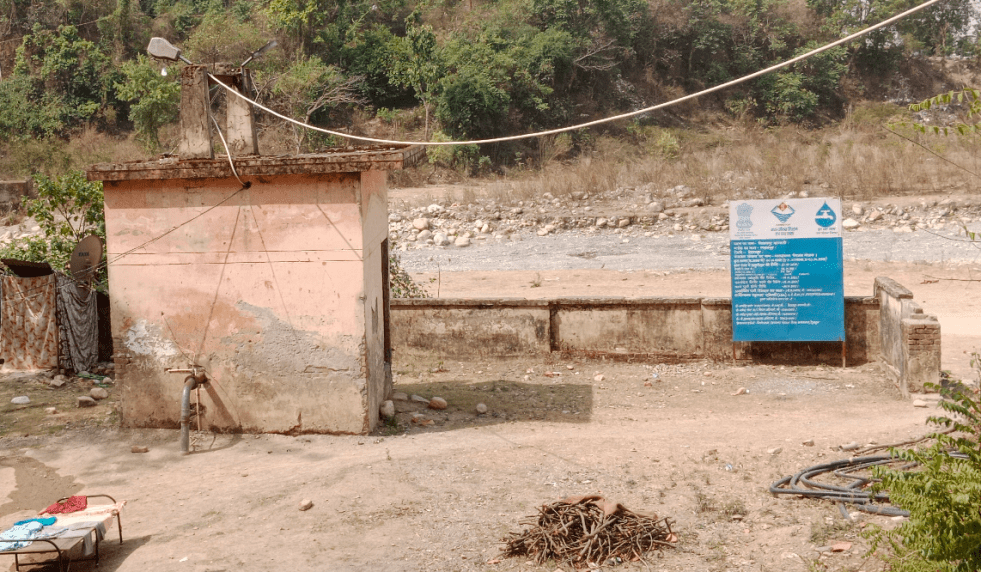
(Feature Image: A tubewell installed under JJM scheme along dried up Tons river bank in Sahaspur, Dehradun. B. S. Rawat/SANDRP/May 2024)
This annual overview covers relevant media reports from ten cities, highlighting the groundwater management and recharge efforts made by the governments during 2024. The earlier overviews on the subject of Groundwater in India have focused on important studies done in 2024, general scenario on groundwater contamination & depletion, relevant government actions, significant judicial intervention and groundwater issues in urban India.
1. Hyderabad RWH made mandatory for all houses To recharge depleting groundwater table and prevent rainwater from going into storm water drains, Rain Water Harvesting Structures (RWHS) have been made mandatory for all houses in Hyderabad. From Jan 2025, houses that do not comply will be charged double for water tankers. The timeline fixed to implement these measures is from Oct-Dec 2024, with a special drive by the Hyderabad Metropolitan Water Supply and Sewerage Board (HMWSSB) starting on Oct 2.
The Water Board will gather data on water tanker users from February to May, targeting those households to ensure RWHS construction. Eighteen NGOs will assist in surveying homes for RWHS pits, focusing on residences of 300 sq yards and above, entering the data into a dedicated app. https://www.newindianexpress.com/states/telangana/2024/Sep/22/rain-water-harvesting-pits-made-mandatory-for-all-houses-in-hyderabad (22 Sept. 2024)
SAM pilot models Under SAM (Shallow Aquifer Management), as part of Atal Mission for Rejuvenation and Urban Transformation (AMRUT) scheme of the Ministry of Housing and Urban Affairs, the GHMC has identified five municipal parks in the year. On a pilot basis, the National Institute of Urban Affairs, the nodal implementation agency, will oversee works at two parks in the LB Nagar zone: Kakatiya Park at Habsiguda and E-sector park at Sainikpuri.
The concept is to drill shallow water injection borewells to a depth of 100-120 feet and pump out water in the shallow aquifers, so that the layers underneath get recharged whenever there is rainfall, while collecting water from the surrounding watershed and channelling it through recharge pits. Thus, the underground layers are recharged, and water table rises. https://www.thehindu.com/news/national/telangana/shallow-aquifer-management-pilot-models-at-habsiguda-and-sainikpuri/article68201060.ece (22 May 2024)
GHMC selects 5 parks to recharge GW Commissioner Ronald Rose has directed GHMC to undertake the Shallow Aquifer Management (SAM) model on a pilot basis. For the project, five municipal parks have been selected to recharge the groundwater in Hyderabad. It not only solves the issue of groundwater depletion but also resolves waterlogging problems due to rainfall. https://www.siasat.com/ghmc-selects-five-parks-to-recharge-groundwater-in-hyderabad-3030496/ (22 May 2024)
2. Noida Checks for GW level must for basement digging now The district administration has directed the three industrial authorities — Noida, Greater Noida and Yamuna —to check the groundwater level for each land parcel before giving approval for digging basements to developers. The height of basements for each project will be determined on the basis of the groundwater study report, a letter issued by the administration said. If permission for a basement was issued in the past, but work was yet to start, then the development authority concerned will have to undertake a groundwater level study and make changes in the approval plan accordingly, it stated.
The letter comes after the groundwater department imposed on Jul 16 a cumulative penalty of Rs 35 lakh on six builders —Uniexcel Developers, Montree Attire, Jam Vision Tech, King Pace Information, Vextec Condominium and Motherson Sumi Infotech & Design Ltd — for illegally dewatering plots, allotted by the Noida Authority in sectors 153, 154 and 129, using pumps. De-watering has been noted in several projects across the district. It means water, oozing out of the ground during digging for basements, is pumped out. https://timesofindia.indiatimes.com/city/noida/new-regulations-for-basement-digging-in-noida-require-groundwater-level-checks/articleshowprint/111846940.cms (19 July 2024)
Admin stalls basement project Groundwater officials stopped work on a commercial project in Sector 153 for discharging groundwater into a nearby plot using large pumps for dewatering operations on Nov 6. Officials had initiated checks after photos and videos of dewatering at the site began to circulate on social media. During a visit to the site on Nov 5, it was found that an 11m-deep basement excavation caused water to rise to the raft (concrete slab), necessitating pump usage to prevent structural damage, groundwater officials said. Officials noted that the Noida Authority had previously granted permission to the builder for a 15m-deep basement excavation. However, the current development has raised concerns about the Authority’s decision-making process, particularly regarding the absence of proper groundwater level assessment for the plot.
The dept also held a meeting with the Authority on checking the groundwater level before giving approval for the basement digging on Nov 6, Ankita Rai, hydrologist, groundwater dept said. When asked about the process to get approvals for basement digging, Noida ACEO Satish Pal said, “It is a decision to be taken at a policy level. We need to write to the govt and also need to put it up in the board meeting. We are going to discuss this issue further. In some sectors near Yamuna, the water level naturally goes up after the rain. We need to check such areas to avoid any issues, for which we will take up the matter with the higher level.”
Previously, in July, the district magistrate instructed the three industrial authorities—Noida, Greater Noida, and Yamuna—to assess groundwater levels of each plot before approving basement excavations for developers. However, a subsequent RTI inquiry revealed that no action has been taken on these directives thus far. Activist Vikrant Tongad had recently filed an RTI asking the Noida Authority, “De-watering has to be done for digging the basement. Therefore, depth of basement should be reduced so there is no problem in extracting groundwater. Provide a copy of the order in which the authority has decided to reduce the depth of the basement?” https://timesofindia.indiatimes.com/city/noida/up-government-halts-commercial-project-due-to-groundwater-concerns/articleshow/115063472.cms (8 Nov 2024)
3. Pune PMC to survey all wells, natural springs for better GW management The survey intends to gather detailed information on each well and spring, including the location (latitude, longitude, and address); type of well (whether it’s a dug well, step well, or natural spring); and its operational status (whether the well is operational, non-operational, or functional only during certain seasons). Dimensions such as the size and depth of the well in metres will be measured, and the purpose of any installed pumps, whether for domestic, irrigation or industrial use will be noted. The data collected will be used to identify critical recharge areas that need protection, and to plan for future improvements in water infrastructure.
Additionally, the survey will assess the water quality, determining whether it is clear, smelly, or turbid. Ownership details will be recorded, whether the well is private or belongs to a society; and is managed by the PMC or government or is a community resource. Lastly, the year of construction will be documented along with any recharge infrastructure in place such as rainwater harvesting tanks, spring recharge systems, percolation pits, or borewell recharge systems. https://www.hindustantimes.com/cities/pune-news/pmc-to-survey-all-wells-and-natural-springs-for-better-groundwater-management-101725041654988.html (31 Aug. 2024)
PMC launches ₹248cr water management project In a bid to address the recurring flood-like conditions during the monsoon and the looming threat of water scarcity, the Pune Municipal Corp (PMC) has unveiled an ambitious water management project. The initiative, under the theme ‘Save Water, Recharge Water,’ aims to increase rainwater harvesting and groundwater recharge across the city. The central govt has approved Rs. 248 crore for this three year project. The initiative comes in response to the persistent flooding problems Pune faced during the monsoon, particularly in the past few years. As a solution, the PMC has developed a comprehensive plan to install monsoon drainage systems in the city’s older boundaries and 23 surrounding villages, as part of a larger strategy to ensure the city can better handle heavy rains and recharge its groundwater.
The PMC has identified 1,200 locations across Pune where rainwater will be harvested and recharged into the ground. These locations include schools, government buildings, roads, and other public spaces. The initiative aims to improve the water supply situation, which has become increasingly precarious due to fluctuating rainfall levels and rapid urbanization. The project will focus on creating a robust infrastructure to divert rainwater to recharge wells and underground water tables. This will be done through the installation of monsoon drainage systems, which will collect rainwater and funnel it into designated recharge shafts. In addition to installing these systems, the PMC will also integrate rainwater harvesting mechanisms into the rooftops of municipal buildings, schools, and other government properties. These structures tend to collect large amounts of rainwater, which will now be directed into borewells for groundwater recharge. This move is expected to significantly increase the amount of water being absorbed into the city’s aquifers. https://punemirror.com/pune/civic/pmc-launches-inr-248-crore-water-management-project-to-combat-flooding-and-water-scarcity/cid1733207101.htm (03 Dec. 2024)
4. Mumbai Act against groundwater thefts: State to collectors The state water supply and sanitation department has refused the demand of Mumbai collectors to appoint BMC and its officers as authority to take actions against those indulging in illegal well water extraction and its selling. According to groundwater activist Sureshkumar Dhoka this directive is thus a clear indication that collectors and their designated officers appointed by CGWA will have to pull up their socks and not pass on the same responsibility of penalising and seizing tankers of those carrying illegal sale and extraction of groundwater to the civic bodies such as BMC.
In order to decentralise and strengthen monitoring and compliance mechanisms as per CGWA guidelines, the officials of revenue and industries department of the state are appointed as authorised officers, and NOCs issued for groundwater use by CGWA are forwarded to magistrates and collectors. In case of any violation of CGWA directions and non-fulfilment of conditions laid down in the NoCs, the authorised officers can then file an appropriate petition for action against scamsters, Dhoka pointed out. As per the delegation of powers against illegal groundwater withdrawal the CGWA has already appointed the district magistrate/district collector/sub divisional magistrates and authorised officers in each revenue district by empowering them to seal illegal wells, disconnect electricity supply to pumps, launch prosecution against offenders including grievance redressal. https://timesofindia.indiatimes.com/city/mumbai/not-bmc-you-act-against-groundwater-thefts-as-directed-by-cgwa-state-to-collectors/articleshow/109411134.cms (18 April 2024)
5. Ranchi RMC tightens regulations for WTPs to save GW Ranchi Municipal Corp (RMC) has implemented strict guidelines for operating and renewing licences of over 400 RO (reverse osmosis) water treatment plants under the Jharkhand Municipal Act, 2011, aiming to control groundwater extraction. Plant operators must now submit comprehensive applications including Aadhaar cards, firm registration certificates, current electricity bills, holding tax receipts, and a NOC from the CGWA. Additionally, RWH plans are mandatory.
The city has been categorized into four zones based on groundwater exploitation levels: safe, semi-critical, critical, and over-exploited. Some zones are completely restricted from groundwater extraction to protect depleting reserves. The new framework requires operators to pay an initial licence fee of Rs 5,000 and an annual fee of Rs 20,000. Annual renewal is mandatory, with penalties for non-compliance. The deadline for applications is April 2 after which erring plants may face closure. “Operators must install water meters before applying for a licence,” RMC commissioner Sandeep Singh explained. “The process includes water quality verification and assessment of extraction permissibility in the area.” https://timesofindia.indiatimes.com/city/ranchi/rmc-tightens-regulations-for-water-treatment-plants-to-protect-groundwater-resources/articleshow/116924920.cms (04 Jan. 2025)
6. Indore Piezometer installation launched In a step aimed at groundwater conservation and management, mayor Pushyamitra Bhargav and municipal commissioner Shivam Verma inaugurated drilling work for the installation of piezometers under the Public Investment Board (PIB) project on Nov 16. The CGWB is spearheading the initiative. This project includes the installation of Digital Water Level Recorders (DWLR) at 23 selected locations across the city. https://www.freepressjournal.in/indore/indore-launches-piezometer-installation-project-to-monitor-groundwater-levels-across-23-locations (17 Nov 2024)
20 places identified for 200 groundwater recharge shafts Indore Municipal Corp (IMC) has identified 20 places, which have been witnessing accumulation of rainwater leading to flood-like situation, to develop at least 200 groundwater recharge shafts. “The groundwater recharge shafts will not only solve the issue of waterlogging after rain, but they will also help in increasing the groundwater level” IMC additional commissioner Abhilash Mishra said, adding that the shafts would be developed with public participation as many individuals and organisations have also come forward for it.
He mentioned that illegal structures, which are obstructing natural flow of rainwater and leading to flood-like situation, will be removed. Efforts are also on to increase roof-water harvesting system by urging people to install it and help in increasing groundwater level, he said. In 2022, RWH system was made compulsory in Indore. The new rules had come into effect after Madhya Pradesh govt on Apr 4, 2022, notified IMC (RWH) Bylaws, 2022. https://timesofindia.indiatimes.com/city/indore/20-places-identified-for-200-groundwater-recharge-shafts/articleshow/109229762.cms (12 April 2024)
7. Faridabad FMDA unveils plan to monitor groundwater The Faridabad Metropolitan Development Authority (FMDA) is set to launch a Rs 9.5 Cr project to install 100 piezometer to monitor the groundwater. Claimed to be a part of the pilot project being launched simultaneously in the metropolitan cities of Faridabad and Gurugram, the state govt has entered an MOU with the APCOS Limited, earlier known as Water and Power Consultancy Services (India) Ltd, a consultancy service provider under the Ministry of Jal Shakti recently. https://www.tribuneindia.com/news/haryana/development-body-unveils-plan-to-monitor-humidity-groundwater-levels-in-faridabad/ (04 Oct. 2024)
Study for groundwater potential, quality in floodplains An agreement was signed between the CGWB and the FMDA for a study to address Faridabad’s projected water supply gap by 2031. This MoU marks a step in enhancing the city’s water resources, according to a statement by the jal shakti ministry. The agreement outlines the study to evaluate groundwater potential and quality in the Yamuna floodplains. This assessment will lead to a groundwater management plan including strategies for artificial recharge and resource development within Faridabad dist. The study is to conclude by March 31, 2025. https://theprint.in/india/faridabad-govt-study-groundwater-potential-quality-in-yamuna-floodplains/2223819/; https://pib.gov.in/PressReleaseIframePage.aspx?PRID=2045434 (14 Aug 2024)
Rs 2600cr project approved for drinking water CM Nayab Singh while chairing the 5th meeting of the FMDA accorded approval to a Rs 2600 Cr project for Faridabad drinking water & drainage issues. Under this project, 22 Ranney wells, 70 tube wells using reverse rotary technology, and 8 boosting stations will be constructed. Subsidiary boosting stations will be built to supply water to other boosting stations, and about 500 km of pipeline will be laid.
With the execution of this project by 2028-29, the water supply capacity will reach 450 MLD, the number of Ranney wells in Faridabad will increase to 56 and there will be 220 tube wells. A Rs 17 Cr project to develop water bodies along the Yamuna river was also approved. https://www.yugmarg.com/news/27963-rs-2600-crore-project-approved-to-resolve-drinking-water-and-drainage-problems-in-faridabad (11 July 2024)
FMDA project to recharge groundwater The FMDA has identified around 300 acres for setting up the project and submitted a proposal to the Union Ministry of Defence and the state’s Dept of Panchayats to get permission to use land for setting up reservoir-like structures in Tilpat and two villages located in the vicinity of the Yamuna river in the dist,” according to officials. The reservoirs with the depth of 5-6 feet, will be used to harvest the surplus flood or rainwater to recharge the groundwater.
Recharging the water table will help in ensuring the supply of drinking water through Ranney wells that were already functional and meeting around 60-70 % of the water supply needs of the city at present. Around 12 Ranney wells have been supplying up to 310 MLD of water, the FMDA is working on the construction of another 12 Ranney wells on the Yamuna banks to boost the water supply. The city is currently faced with a shortage of around 130 MLD. https://www.tribuneindia.com/news/haryana/fmda-project-to-recharge-groundwater-630741/ (14 June 2024)
8. Ghaziabad 5 RO plants extracting GW illegally to be sealed The dist groundwater committee will seal five unauthorised RO plants in Loni & impose Rs 2 lakh fine on each unit. The decision was taken during a meeting chaired by the dist magistrate, where officials reviewed complaints against groundwater violators on Jan 3. The dist has been grappling with rapid depletion of groundwater, which, according to the latest reports, dropped by nearly 7 mts between the pre and post-monsoon. Earlier in Dec, notices were issued to over 61 residential societies for operating unauthorised borewells, demanding a comprehensive status report within 30 days.
During the meeting, the committee processed 32 applications under the Uttar Pradesh Ground Water (Management and Regulation) Act. “These included requests for registration of wells, NOC renewals for domestic, agricultural, industrial & commercial use, registrations of drilling agencies. Of these, 23 applications were approved, while nine were rejected,” said Jaiswal.
Dist magistrate Indra Vikram Singh directed officials to allocate funds for water harvesting and Jal Shakti Center projects through the rural engineering dept. “We will inspect district ponds to assess their role in groundwater recharge. The external beautification of ponds should be secondary, while their role in groundwater recharge is of more importance,” the DM said. https://timesofindia.indiatimes.com/city/noida/5-ro-plants-found-extracting-groundwater-illegally-to-be-sealed/articleshow/116946769.cms (4 Jan 2024)
9. Surat SMC expands groundwater recharge plan, approves rates As part of the ‘Catch the Rain’ campaign, Surat Municipal Corp (SMC) plans to develop a network of bore wells across the city to recharge the groundwater. As part of it, SMC on Aug 31 approved unit rates for new bore well development or restoration of existing bore wells. Till now, the GW recharge project through bore wells was on a smaller scale. Now, it will cover a larger population.
The standing committee approved the cost of development and also the agency that will carry out the work. The minimum cost of a bore well will be Rs 15,000. “The unit rates have been approved, and as per the work required to develop a bore well, the cost will be different for each bore well. The basic idea is to improve the groundwater levels so that we can reduce dependency on the Tapi river for water,” said an SMC official.
At present, the Tapi is the main source of water for drinking, household use, and commercial purpose. There are no alternatives for water at present for the city. The bore wells will be developed in private places as well. “If the groundwater level goes up, it will also stop salinity ingression. It will ensure that with the growth of the city’s population, we will have enough water to meet the demand,” the official added. https://timesofindia.indiatimes.com/city/surat/smc-groundwater-recharge-plan-expansion-and-rate-approval/articleshow/112959511.cms (01 Sept. 2024)
10. Chennai GCC to start building recharge wells to improve shallow aquifers The Greater Chennai Corp (GCC) will start constructing recharge wells and other structures to improve the management of shallow aquifers in the city. The pilot project will be implemented by the civic body at five locations in the city through Rain Centre, a nodal agency, with funding from the Govt of India. The GCC has constructed cast-in-situ silt catch pits of dimension 600 x 600 x 600 mm at 7,072 locations along 397 km of storm-water drains. However, many of the pipes have been clogged. Sunken wells have also been constructed at 208 locations. https://www.thehindu.com/news/cities/chennai/greater-chennai-corporation-to-start-building-recharge-wells-to-improve-shallow-aquifers-in-city/article67769696.ece (23 Jan. 2024)
11. Noida Admin issues notice on illegal GW connections A show-cause notice was issued to Ace Group after a govt team found 60 borewells at one of its project sites off Yamuna Expressway. At least 10 of the borewells at the site of YXP township in Sector 22D were found fitted with motors, which augmented their capacity to draw water. The inspection was carried out by the groundwater wing of the district administration on Mar 20 after a video circulated on social media purportedly showed dirty water being drained out of the project site. While examining the area, the team found that much of the land had been dug up, causing water to come out. https://timesofindia.indiatimes.com/city/noida/one-borewell-is-illegal-but-this-housing-project-has-60/articleshow/108718992.cms (23 March 2024)
Authority warns of action over groundwater wastage Taking note of the wastage of water by residents despite depleting groundwater levels in the city, the Noida authority has said that action could be initiated against those indulging in activities like sprinkling water on roads and in by-lanes or washing private vehicles.
Despite the decreasing level of groundwater in the city, residents of Noida are doing precious little. Environment activist Vikrant Tongad said, “Several developmental projects are ongoing at present around Sector 150 and misuse of groundwater is rampant at several sites. Dewatering is being done even though groundwater levels are constantly decreasing. The authority has, for the first time, issued such a guideline officially where residents are being sensitised”. https://www.hindustantimes.com/cities/noida-news/noida-authority-warns-of-action-over-groundwater-wastage-101716058847513.html (19 May 2024)
6 developers fined ₹5 lakh each for illegal GW use The Groundwater dept has fined six major developers ₹5 lakh each for allegedly engaging in the illegal use of groundwater for construction purposes in Noida, officials said on Jul 10. The Noida authority filed a complaint against the developers for extracting groundwater and a case was registered under the Uttar Pradesh Groundwater (Management and Regulation) Act, 2019. The sites where developers were identified to be extracting groundwater illegally are in sectors 153, 154 and 156.
“Just imposing penalties will not serve as a deterrent. The Noida authority has the right to cancel allocations of builders who continue to exploit groundwater. The authority must file a petition against the erring builders if they do not stop dewatering activities. A high-level committee involving all stakeholders and environment activists should be convened, in the presence of CEO and DM, to address the issue,” said VIkrant Tongad, founder, Social Action for Forest and Environment (SAFE). https://www.hindustantimes.com/cities/noida-news/noida-six-developers-fined-5-lakh-each-for-illegal-groundwater-use-101720636109264.html (11 July 2024)
Borewell, 2 RO plants sealed for illegally extracting GW Officials from Noida Authority, the ground water dept and the district magistrate’s office sealed an illegal borewell and shut down two unauthorised reverse osmosis (RO) plants during inspections on Nov 29. The team conducted the inspections after a complaint was filed online about illegal groundwater exploitation.
“During the operation, an illegal borewell on a land near the Hindon river was sealed & two RO plants operating without authorisation in FNG Vihar were shut down,” said Vivekanand Mishra, city magistrate, Noida. “Penalties will be imposed on those running unauthorised borewells and RO plants. We will continue to conduct joint inspections and ensure that such illegal activities are curbed,” he said. https://timesofindia.indiatimes.com/city/noida/noida-authorities-crack-down-on-illegal-borewells-and-ro-plants-amidst-severe-groundwater-depletion/articleshow/115851978.cms (01 Dec. 2024)
Compiled by Bhim Singh Rawat (bhim.sandrp@gmail.com)

 SANDRP