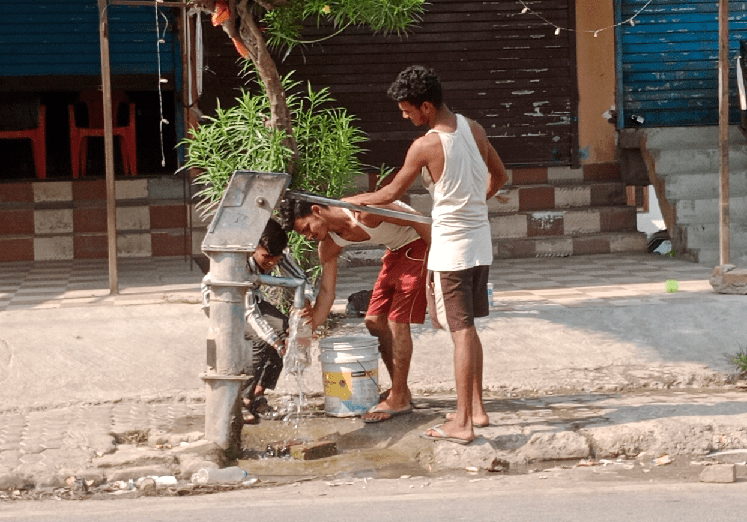
(Feature Image: Children extracting groundwater from a handpump in Dehradun. B. S. Rawat/SANDRP/May 2024)
This overview complies top ten reports from 2024 to highlight the growing concerns over groundwater depletion and contamination in various Indian cities. Though several cities in India are already being supplied surface water from dams and rivers, groundwater use is increasing to meet significant portion of potable water demand. The unabated unplanned urbanization on one side has been damaging the groundwater recharge functions, sources and on the other putting more pressure on surface and underground water resources. At the same time the cities have been failing to adequately treat wastewater and harvest rainwater. The situation is only deteriorating fast in absence of a National Urban Water Policy.
1. Pune Study links parched villages to gw use in urban areas The joint research by the Indian Institute of Science, Education and Research (IISER), Pune, the Society for Promoting Participative Ecosystem Management, Pune (SOPPECOM) and the International Institute for Applied Systems Analysis (IIASA) in Austria said that water scarcity is due to high urban use of groundwater, poor irrigation facilities and biodiversity reduction in the upper Bhima sub-basin affecting the livelihood of local communities. The scientists primarily suggested that water, forests as well as agriculture in the Upper Bhima Basin have to be looked at in an integrated manner when forming policies and projects relating to the area.
Due to a lack of infrastructure for the adequate supply of water, urban areas as well as industries depend excessively on groundwater for their requirements. “There has been an increased dependency on groundwater by farmers, which has been the cause for the level of groundwater to decrease so rapidly,” Bejoy Thomas, the co-author of the study and associate professor at IISER Pune, said.
Over the years, rapid changes have resulted in loss of forest cover and led to surface water run-off, decrease in groundwater recharging systems and water availability. “The increase in paved surfaces or concreting in our cities has led to more surface run-offs in urban areas without any water percolation and this will, in time, be the cause of flash floods. Diversion of water from irrigation for urban areas also leads to this conflict,” KJ Joy said. https://timesofindia.indiatimes.com/city/pune/study-links-groundwater-use-in-urban-areas-of-pune-dist-to-parched-villages/articleshow/107807467.cms (19 Feb 2024)
Groundwater depletes in several areas Groundwater levels, in an alarming situation, have depleted to 400 feet and more in several pockets of the city, rendering existing borewells almost dry and making a deeper dig necessary for the new ones, borewell drilling firms and groundwater detectors said on Mar 30. “Barring the central Pune, that is the 5-10km area surrounding Shivajinagar, groundwater is on the verge of exhaustion,” said Ramesh Gaike, owner of a firm involved in rainwater harvesting and groundwater surveys.
The rapid depletion has led to a spike in demand for private water tankers, especially in newly developed suburbs surrounding central PMC areas. “Nobody is doing rainwater harvesting, that’s why the water table cannot be maintained. In Lohegaon, groundwater was found at 150 feet earlier, but it’s 250-300 feet in some locations now. Vimannagar, meanwhile, has hard rock and it is difficult to find groundwater in several areas here. In Wagholi too, one has to drill deeper than 200-300 feet as against 100-150 feet earlier (the last couple of years),” said Homesh Rawal, the owner of a borewell drilling firm. https://timesofindia.indiatimes.com/city/pune/pune-digs-deeper-as-groundwater-depletes-to-450ft-in-several-areas/articleshow/108909352.cms (31 March 2024) What is more adding to the crisis is water storage in Khadakwasla, Panshet, Temghar & Varasgaon — 4 major dams that provide drinking water to the city. The water level in these dams and also in Ujjani dam is low or zero. https://www.india.com/maharashtra/after-bengaluru-pune-faces-water-crisis-as-groundwater-level-declines-residents-express-concern-6813345/ (26 Mar 2024)
Borewells begin to dry up https://timesofindia.indiatimes.com/city/pune/citizens-stare-at-water-crisis-as-borewells-begin-to-dry-up/articleshow/108741933.cms (24 March 2024)
2. Ghaziabad City extracted 123% of water it recharged last yr This was the highest among 75 districts in the state, where the average was way below at 70.8%. On the points table, Ghaziabad was followed by Noida and Firozabad, where the annual average extraction rate was 104.8% and 104.7%, respectively.
With a population of 48.6 lakh, Ghaziabad is home to over 56,000 micro, small, medium and heavy industries. The city, the study showed, extracted 46,191 hectare-metre (HAM) — 1 HAM is equal to 100 lakh litres or 0.01 Million Cubic Meters — of groundwater last year. While 2,246.1 HAM was extracted for industrial use, a major chunk — 36,881.8 HAM — was used for irrigation & 7,063.5 HAM for household use. The district has 52,000 ha agricultural land.
In comparison, its water table was replenished by 41,675.3 HAM from various sources, 37,507.7 HAM was left for extraction. The city ended up using 23% more than that. https://timesofindia.indiatimes.com/city/ghaziabad/ghaziabad-extracted-123-of-groundwater-recharged-last-year-highest-in-uttar-pradesh/articleshow/111044877.cms (17 June 2024)
City declared ‘Red Zone’ as groundwater level declines As per the survey of the Dist Geological Management Committee, which started in January, more than 30,000 small and big industrial units have been involved in exploiting the groundwater illegally for many years. After the report about the water crisis came to limelight, the Ghaziabad district administration started surveying the industrial units that are illegally exploiting groundwater. https://www.india.com/uttar-pradesh/after-bengaluru-water-crisis-hits-ghaziabad-city-declared-red-zone-as-groundwater-level-declines-6788758/ (15 March 2024)
High rise residents suffer as level dips A failed pumping set has led to many high-rise inhabitants queuing up for water tankers. In Crossings Republik of Ghaziabad, all the societies are dependent on groundwater as the agencies have failed to provide water supply. “The authorities have sealed the pumping sets of societies and are providing groundwater from their pumping sets. This is doing the same thing but officially. We have been waiting for Ganga water supply for over a decade. The high-rise residents are just a vote bank”, said Abhishek Kumar, president, New Era Flat Owners Welfare Association.
Ujjwal Mishra, president, Federation of Crossings Republik Apartment Owners Association, said “The societies have to re-bore for water as the groundwater is depleting at an alarming pace. We have rainwater harvesting, but in the absence of any water supply from the government, we have been forced to draw groundwater since last decade. The re-boring was done four years back when the submersible pump was at 200 feet, now its at 300 feet and this summer, water supply is feeble”, Mishra added. https://www.indiatoday.in/india/story/dependent-on-groundwater-ncr-high-rise-residents-suffer-as-level-dips-further-2558135-2024-06-26 (26 June 2024)
3. Delhi Tanker mafia profiting from govt borewells—pipes Flourshing illegal water tanker business in Sangam Vihar, Okhla & Dwarka in Delhi: Private tanker operators are seizing control of govt-authorised borewells, diverting water from pipes, and illegally drilling into the ground. They are selling govt water that would otherwise be freely available to residents, all while environmentalists raise alarms about Delhi’s rapidly depleting groundwater levels.
“The tanker mafia business operates at multiple levels. They receive support from politicians, police, and lower-ranking officials in the Jal Board,” alleged Puneet Singhal, an activist working with the people of Sangam Vihar. He added, in return, these influential people sponsor election campaigns & bribe officials to look the other way. https://theprint.in/ground-reports/delhi-water-tanker-mafia-jal-board-borewells-pipes-profits-politics/2149003/ (27 Jun 2024)
Residents battle scarcity amidst tanker mafia monopoly While residents of Sangam Vihar struggle to meet their water needs, the private tanker mafia thrives due to a monopoly. During peak demand, the tanker operators raised prices by 200-300 %. A 2,000-litre tanker that costs Rs 600-700 in Feb-Mar costs around Rs 1,800 to 2,000 this summer.
These tanker mafias have connections to every political party. When power shifts, they switch sides and continue operating through collusion. The tanker mafias run a number of illegal borewells in Sangam Vihar & Deoli. https://www.downtoearth.org.in/news/water/tanker-economy-revealed-in-delhi-sangam-vihar-residents-battle-scarcity-amidst-tanker-mafia-monopoly-96870 (26 June 2024)
Groundwater has very high salt content Delhi’s groundwater is high in salt content, according to a report by the Central Ground Water Authority. One out of four groundwater samples taken from the capital city had very high electric conductivity (EC), and more than 25% of water samples analysed in Delhi are saline. This is second only to Rajasthan, where 30% of the samples were found to be saline. The national electric conductivity average is 6%, representing conductivity higher than 3,000 micro siemens per centimetre. The permissible range of electric conductivity for groundwater is between 750 and 3,000 units at 25 degrees C. When the EC is more than 3,000 units, then it becomes unsuitable for drinking, causing several diseases, including kidney-related problems. https://www.indiatoday.in/health/story/delhi-groundwater-very-high-salt-content-saline-kidneys-problems-report-2601805-2024-09-18 (18 Sep 2024)
4. Faridabad Majority of RWH ‘defunct’ The majority (75%) of over 200 rainwater harvesting systems installed under the Jawaharlal Nehru Urban Renewal Mission (JNNURM) many years ago in the city have become defunct due to lack of maintenance and upkeep. This poses risk of waterlogging and loss in terms of recharging the underground water table.
As the city has been in the over-exploited zone as per the report of CGWB, the water level has depleted from 300ft to 500 ft in the past two decades. The Haryana Building Code (byelaws) 2017 envisages installation of roof rainwater harvesting in any building having a rooftop area of 100 sq metres or more, this has been mandatory for the buildings having a plot area above 500 sq metres. https://www.tribuneindia.com/news/haryana/majority-of-rainwater-harvesting-systems-defunct-in-faridabad-629993 (12 Jun 2024) https://www.tribuneindia.com/news/haryana/75-rainwater-harvesting-systems-in-faridabad-defunct-571708 (14 Dec. 2023)
5. Gurugram City extracted double of what it recharged last year While the Gurugram city’s sustainable annual groundwater extraction limit is 20,333 HAM, it ended up withdrawing 43,262 ham in 2024, data from the National Compilation on Dynamic Groundwater Resources of India showed. This extraction rate was the third highest in Haryana, following Kurukshetra (228%) and Panipat (222%). Kaithal (190%) and Faridabad (180%) were close behind.
Gurgaon currently receives 570 MLD of fresh water from rivers, falling short of its peak summer demand of 675 MLD. With a growing population and insufficient surface water supply, the residents rely on GW. https://timesofindia.indiatimes.com/city/gurgaon/guzzling-groundwater-gurgaon-extracted-from-aquifers-double-of-what-it-recharged-last-year/articleshowprint/117341621.cms (18 Jan. 2025)
Toxic leachate damaging Aravalis Leachate specimens collected from the Aravalis just outside Bandhwari landfill and near a farmhouse contain noxious substances and chemicals, substantially higher than the permissible limits, SPCB has said. The findings suggest that untreated leachate may be percolating into the environment, potentially causing severe ecological deterioration.
There are multiple supporting HSPCB lab reports (Mar 2023, May 2023, June 2023 and July 2023, among others) to show that the toxic liquid is being discharged into the forest and now nearby villages too. The HSPCB also mentioned in the RTI report that so far Rs 2.8 crore has been deposited by MCG against Rs 5.6 crore environmental compensation imposed by it for damaging the eco-sensitive of Aravalis. https://timesofindia.indiatimes.com/city/gurgaon/toxic-leachate-from-bandhwari-poisoning-aravalis-says-pollution-board/articleshow/118155625.cms (12 Feb. 2025)
Illegal mining eroding Aravalli barrier Illegal mining in the Aravalli range threatens biodiversity, groundwater, and local communities, leading to severe ecological & economic consequences. https://www.hindustantimes.com/cities/gurugram-news/illegal-mining-in-gurugram-starts-eroding-protective-aravalli-barrier-101737220465679.html (18 Jan 2025)
6. Lucknow City spending future GW The abundance of underground water made Lucknow a city of gardens. Helped the city grow and build the city across the Gomti river. However, the city’s groundwater levels are towards a decline in most parts.
According to 2015 assessment, the Lucknow Water Institute was supplying over 400 MLD from groundwater in the city. Also 350 MLD or more groundwater was being carried out daily through private-govt tubewells and small-large boring. In 2021 only Lucknow Water Institute was supplying about 404 MLD from groundwater and 400 MLD-canal waters. This report does not include assessment of tubewells in private-govt buildings. There was a difference of 6 MLD in demand and supply.
These statistics are of Lucknow Water Institute, whereas countless submersible pumps are installed to meet the need of water in the city. https://indiaspendhindi.com/cover-story/lucknow-city-is-spending-future-groundwater-right-now- (16 Oct. 2024)
7. Jaipur 16 blocks ‘overexploit’ groundwater: Report Sixteen blocks in Jaipur district have been categorised as ‘overexploited’ in terms of groundwater resources, with Govindgarh and Jhotwara blocks showing an alarming water table depletion level by 25m between 2020 and 2023. This was revealed by a report by CGWB to the jal shakti ministry. The report said the district can suffer from a severe water crisis after just one bad monsoon.
The uncontrolled proliferation of illicit borewells at industrial units and those for irrigating agricultural land has led to the rapid depletion and desiccation of groundwater aquifers. The report stated that the district used 2.25 litres of groundwater against a recharge of 1 litre in 2023. It also highlighted that 99% of the total irrigated land of 2.80 lakh ha relied on groundwater. https://timesofindia.indiatimes.com/city/jaipur/16-blocks-in-jaipur-overexploit-groundwater-resources-report/articleshow/110520451.cms (29 May 2024)
8. Ahmedabad Salinity, fluoride, iron and lead levels high in groundwater Data from the Union Ministry of Jal Shakti shows that more than half of Gujarat districts are affected by salinity, fluorides and nitrites in their groundwater. Groundwater in Ahmedabad was found to have excessive levels of salinity, fluoride, nitrate, iron and lead.
The CPCB using National Water Quality Monitoring Program (NWMP) data for 2023 including data from 88 monitoring wells in Gujarat stated that 73 of these wells were monitored in 2023 and the water in 52 of them were found to have fluoride content within safe limits, while the other 21 were ‘non-complying’. The data shows that of the 33 districts in Gujarat, 28 have relatively high salinity levels, 30 have high fluoride levels, 32 nitrites, 12 arsenic, 14 iron and one has excessive lead. https://timesofindia.indiatimes.com/city/ahmedabad/salinity-fluoride-iron-and-lead-levels-high-in-abad-groundwater/articleshow/107644414.cms (13 Feb. 2024)
9. Hyderabad Groundwater crisis fuels tanker demand The HMWS&SB has attributed the surge in water tanker bookings to the rapidly depleting groundwater level. K. Ashok Reddy, MD of HMWS&SB, said, “Bore wells in many areas have dried up nearly a month earlier than last year, leaving residents more reliant on water tankers. The situation has been worsened by the lack of rainfall in Nov-Dec 2024, which typically helps recharge groundwater levels.” The problem is compounded by the absence of rainwater harvesting (RWH) structures in most households. Without proper GW recharge systems, rainwater is simply flowing away.
Despite repeated efforts to create awareness about RWH, many residents have been reluctant to implement them. The water board has even issued notices to encourage compliance. To address the issue, officials are planning to increase the tanker charges for households that do not have RWH systems in place. Last Dec, the water board warned that it would collect double fees for water tankers booked by buildings that don’t have RWH pits. It served notices to 17,000 buildings. https://www.deccanchronicle.com/southern-states/telangana/hyderabads-groundwater-crisis-fuels-tanker-demand-1855057 (18 Jan 2025)
Commercial Project Violates Norms A mega commercial complex that is also expected to house swanky hotels, coming up next to Road No. 45 in Jubilee Hills, not far from the KBR National Park, has been found to have violated several rules and laws with the Vigilance and Enforcement (V&E) wing recommending serious action against GHMC officials who facilitated the project’s progress.
In addition to violation of several norms, CGWB has warned that the complex, once constructed, might well be unstable and could experience subsidence as the builders have dug deep and, in the process, exposed the water table. The CGWB report said that the excavations at the site removed granite gneiss rock to a thickness of about 24 metres. The builders shored up the loose formation using shotcrete “as a measure of slope stability.” The CGWB report also found that the “excavation had removed a highly eco-sensitive water holding portion of the aquifer, which may lead to rapid decline in the water level.”
The site where the project is being built is a recharge area for two drains, and the report warned that “the ground water potential of the area may be affected soon.” In the end, the CGWB report declared that “the geological structures are mainly steep joints/fractures and dewatering of the fractured/joint aquifers would cause slope instability that would lead to slope failure/ ground subsidence of high elevated regions.” https://www.deccanchronicle.com/southern-states/telangana/huge-commercial-project-violates-norms-ghmc-officials-implicated-1823653 (15 Sept. 2024)
2 to 7 mtr drop in water level Officials also underlined how the over dependence on groundwater among apartment complexes, gated communities, group housings, and commercial units began from Jan 2024 due to lack of adequate piped water network leading to a further dip in water table. Officials, however, maintain that the city will not face a severe water crisis like Bengaluru, as the water board’s piped water and tanker supply are compensating for the GW. https://timesofindia.indiatimes.com/city/hyderabad/greater-hyd-records-2-to-7-mtr-drop-in-water-level/articleshow/109115485.cms (08 April 2024)
10. Chennai Greed for groundwater killing city aquifers In 2023, the city extracted 127.5% of its groundwater, against the national extraction average of 59.3%. Since 2009, the city has always drawn more groundwater from deep aquifers than the recharge. The rate of exploitation has, however, been falling. In 2009, 400% of the potential recharge was extracted and 226% was extracted in 2011. This has decreased to 133% in 2022, 127.5% in 2023, say the CGWB.
The CGWB’s 2023 National Compilation on Dynamic Ground Water Resources of India said over-exploitation was more in core areas of Chennai than added areas. “This is because the density is higher in core areas than added areas, hence the water demand is also high. There are around 26,000 people per kilometre in the core city,” said former Anna University urban engineering professor K P Subramanian. https://timesofindia.indiatimes.com/city/chennai/greed-for-groundwater-killing-city-acquifers/articleshow/107271279.cms (31 Jan. 2024)
Residents oppose sewage pumping plant work The construction of a sewage pumping station in Pammal came to a grinding halt on Jan 28 after the local residents opposed the move following concerns of probable groundwater pollution. https://www.newindianexpress.com/cities/chennai/2024/Jan/30/opposition-from-residents-throws-a-spanner-in-the-works-of-sewage-pumping-plant-in-chennai (30 Jan. 2024)
Residents oppose sewage pumping station fearing gw contamination Residents of Jalladianpet in Pallikaranai under Zone XIV oppose a sewage pumping station planned in Raghavendra Colony, fearing GW contamination leading to drought and health issues. Krishnaswamy K.N., a resident there for nearly 30 years, claimed, “Trenches that were dug by GCC few years ago used for freshwater storage and groundwater recharge, may hold wastewater instead when the Metrowater Dept project is implemented. Poor maintenance of a suction well could contaminate groundwater. While the Dept promises an odour control mechanism, there are no assurances against mosquitoes or rodent infestation due to the accumulation of wastewater.” https://www.thehindu.com/news/cities/chennai/jalladianpet-residents-oppose-sewage-pumping-station-fearing-groundwater-contamination/article69077274.ece (09 Jan. 2025)
Some Relevant Reports
Delhi Network of hauz, baoli & nullah that once fed the capital The decline of Delhi’s hydraulic system (hauz, baoli and nullah) started during the British colonial period. The British, unfamiliar with the city’s ancient water management techniques, opted for a more modern approach to water supply. The colonisers replaced the network with a piped water system. They heavily relied on the Yamuna River as the primary source of water. But with time, the Yamuna turned foul.
-While the piped water system provided a convenient and efficient means of water distribution, it also led to the neglect of Delhi’s old hydraulic system. The nullahs, baolis, and bundhs, which had sustained the city for centuries, were gradually abandoned and left to decay. Sure, those old water structures couldn’t have alleviated Delhi’s summer distress, but they could have helped recharge the groundwater, the levels of which have fallen precariously low. (Sushim Mukul) https://www.indiatoday.in/india/story/delhi-temparature-summer-alert-hauz-baoli-nullah-once-fed-hydraulic-structures-ancient-medieval-history-2555143-2024-06-19 (19 June 2024)
Mumbai A tunnel through city’s green heart On July 13, PM Modi laid the foundation stone for the Rs 16,600 crore Thane-Borivali Twin Tube Tunnel project in Mumbai, in the run up to elections to the state assembly due later this year. But its impact on Mumbai’s only national park will be known only after the project is well on its way to completion, contrary to a condition laid down by the National Board of Wildlife (NBWL) while granting permission for the project.
Over the years, environmentalists have raised concerns over the proposed project and how it will affect the biodiversity, aquifers, ecology and other natural elements of SGNP. In the absence of an environment impact assessment, the study can bring to the fore crucial information on the same. However, the study will take at least two years to complete, whereas construction of the tunnel is slated to begin after the monsoon season, officials told us. https://www.indiaspend.com/infrastructure/thane-borivali-tunnel-a-shortcut-through-mumbais-green-heart-922107 (30 Aug. 2024)
Noida Ganga water supply for housing societies soon These societies, located in Sector 128, 129, 130, 131, 132, 134 and 135 among others, fall between the Yamuna, and Noida Expressways depending upon the ground water for drinking water needs. As per the Noida authority, the city needs 400 MLD water to meet the water needs out of which 240 MLD water is delivered by Upper Ganga canal and rest is procured from GW. The authority’s water works department has laid 5.50 km long pipeline from sector 69 UGR (underground reservoir) to sector 137 and 132 so that the Ganga water can be delivered in these housing societies.
According to the authority’s water dept their 5 out of 11 Ranney wells are completely shut. And 126 tubewells out of 431 are not functional due to some technical issues. As a result the supply of groundwater also gets affected during the festival season. The authority has planned to repair these 5 Ranney wells so that the water supply remains smooth even when the Ganga water supply is disrupted in Nov-Dec, when the Upper Ganga canal is de-silted annually.
Gautam Budh Nagar district development residents’ welfare association chairman NP Singh said, “The Noida authority should also work on RWH during the rainy season so that we can store and recycle this water for drinking purposes. By doing this we can stop extracting the groundwater for drinking purposes. We have suggested that the authority must use only Ganga water and the stored rainwater through better management without exploiting the GW that needs to be conserved.” https://www.hindustantimes.com/cities/noida-news/noidaganga-water-supply-for-housing-societies-soon-101738523432706.html (03 Feb. 2025)
Vadodara Experts stress integrating water efficiency in urban planning Talking about water-secure cities, D Thara, additional secretary and mission director of the Atal Mission for Rejuvenation and Urban Transformation (AMRUT), commonly known as Water Amrut under the Union urban affairs ministry, advocated for an integrated approach here. Thara was addressing a seminar organized by city-based SOCLEEN. “Education about water is needed,” she said, adding that better urban planning is necessary, incorporating deep gardens to hold water in case of excess rain and making efficient use of treated water in industry or gardening. “Water is a resource, and new methods of its management are to be discovered and utilized,” she said.
During the seminar, Professor Meera Mehta, emeritus professor from CEPT University, said it is time to have a water audit and plug leakages. Raising concerns about the declining green cover in Vadodara, she said lakes like the one in Bhayli have vanished. While Chirayu Pandit from MSU’s Polytechnic College talked about the floods in Vadodara, Biren Dalal, an expert in designing large structures, stressed that the capacity of ponds should be increased through recharging. https://timesofindia.indiatimes.com/city/vadodara/experts-stress-integrating-water-efficiency-in-urban-planning/articleshow/118073634.cms (08 Feb. 2025)
Study Urbanisation responsible for water-quality deterioration A new analysis of 625 studies from 63 countries shows that the global expansion of built-up areas has fundamentally degraded water quality across the globe and suggests increases in forest cover can help reduce water pollution risks. Overall, the study indicates that the impact of land-use change on water quality has been intensifying since the 1990s and that negative effects from contamination and pollution are driven by urbanisation and agricultural land changes. https://environment.ec.europa.eu/news/global-urbanisation-identified-landscape-change-most-responsible-water-quality-deterioration-over-2025-01-16_en (16 Jan. 2025)
Compiled by Bhim Singh Rawat (bhim.sandrp@gmail.com)

 SANDRP