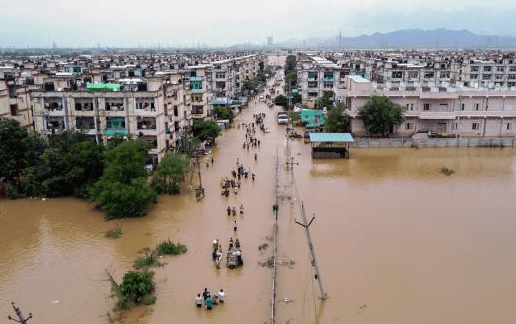
(Feature Image: A drone visual of the flood-affected areas of Vijayawada city on Sept. 6, 2024. Credit: ANI Photo/Source: Rediff.com)
Having covered dam induced flood incidents and embankment breach flooding events in part 1 and part 2, this third part on annual overview compiles media reports on manmade Urban flood disasters in India during the year 2024. While the cities of Pune, Nasik, Nagpur, Vadodara and Bharuch were affected by dam induced floods, the high discharges from Prakasam barrage and multiple breaches in Budameru river deluged the Vijayawada city. Interestingly, these urban flood episodes coincided with heavy rainfall events giving a reality check to dam and city managers.
In addition to failure in dam management, the deluge in Pune, Vadodara and Vijayawada city were particularly worsened by river front development projects and encroachment on river floodplains putting question marks on the urban planning and development works in these cities. Similarly, the breach in embankment of Munak canal in Delhi flooded several homes Bawana area during the monsoon season.
Dam Induced Urban Floods
Pune Khadakwasla dam release excess water A heavy inflow of water at the catchment area of Khadakwasla dam on Jul 24 night saw authorities releasing a large amount of water into the Mutha River early on Jul 25, adding to Pune’s flooding woes. Deputy CM Ajit Pawar directed the water resources dept to keep the dam only half full, to avoid a repeat of Jul 25 scenario. There are four dams upstream of the Mutha River – Khadakwasla, Panshet, Varasgaon and Temghar. The latter three, however, are larger in size and were not filled so no water was released from them. Water was released from Mulshi dam, which is upstream of Mula River, and this water added to the Mutha River, further swelling it downstream of Bundgarden. https://indianexpress.com/article/cities/pune/pune-khadakwasla-dam-capacity-release-excess-water-ajit-pawar-9475453/ (25 July 2024)
Dams flood in Pune Heavy rainfall in the dam areas and urban regions of Pune dist led to the release of water from Khadakwasla and Pavana dams, causing widespread flooding in Pune & surroundings. The Mula & Mutha rivers overflowed. All societies & settlements along the riverbanks were inundated. To ensure the safety of residents, help from the NDRF and the army was sought. Minister Muralidhar Mohol said that the large volume of water released from the dam created the flood situation in the city, highlighting the lack of coordination between the WRD & the Municipal Corp. https://punemirror.com/pune/civic/murlidhar-mohol-blames-water-resources-department-for-the-flood-says-prior-notice-should-have-been-given-before/cid1721987044.htm (26 July 2024)
RFD work aggravates dam flood The proposed Mula-Mutha Riverfront Development Project (RFD) in Pune is making headlines again as trees planted near the river belt and soil kept for filling the underway embankments were swept away due to the floods on July 25. Activist Sarang Yadhvadhkar pointed out, “Due to construction near the riverbed, the rivers have become narrow. When water from major dams like Khadakwasla is released into these rivers, they start overflowing, creating floods. The construction of embankments has decreased the cross-sectional area of the river, which is the main cause of the floods. We never heard of floods in Pune until recent years, mainly because of the RFD.” https://www.freepressjournal.in/pune/pune-did-riverfront-development-project-flood-the-city-heres-what-administration-and-activists-have-to-say (28 July 2024)
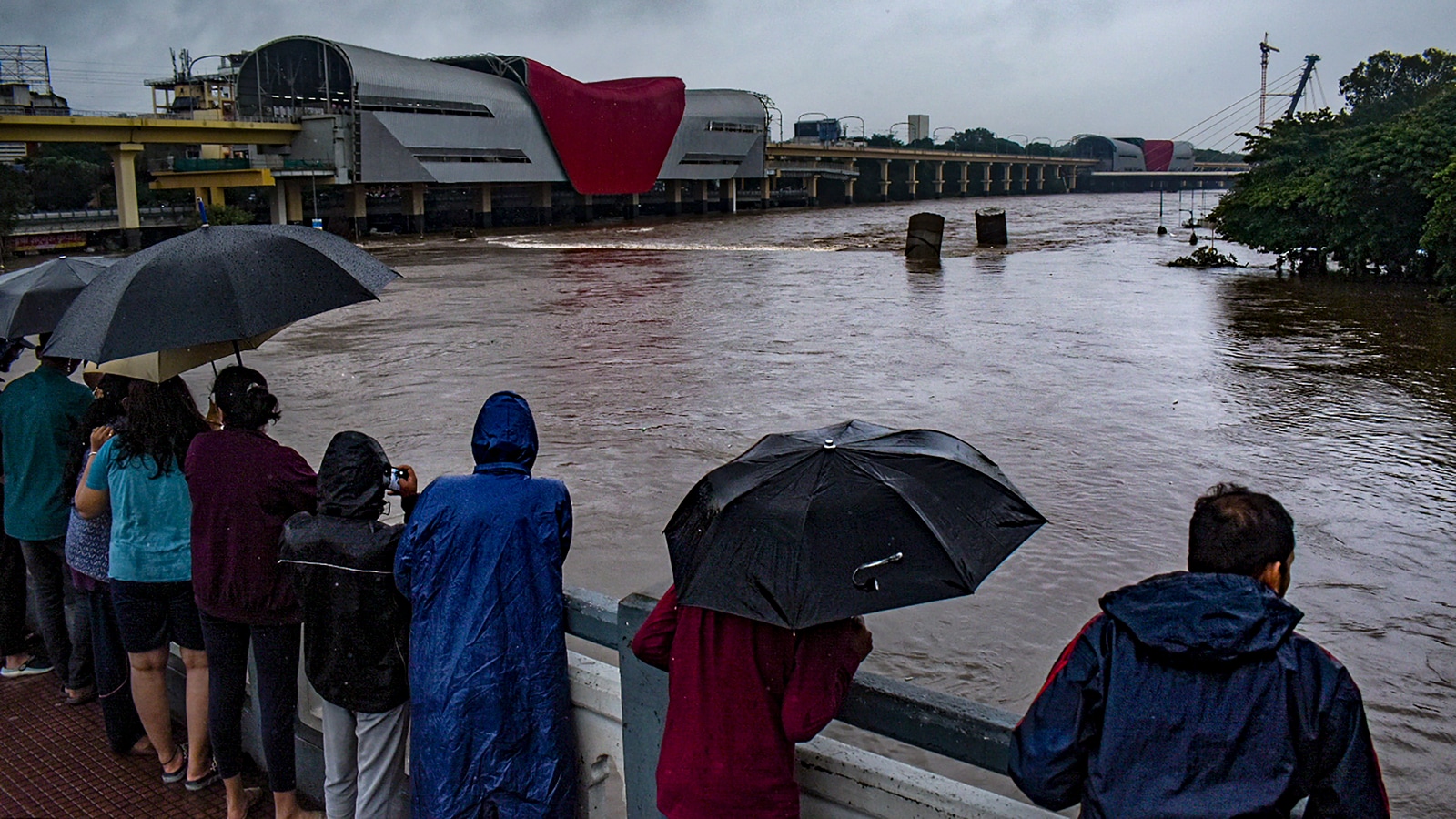
When river rises in city Sarang Yadwadkar, Pune-based environmentalist and architect, shares that this year, Mutha River’s discharge from the Khadakwasla dam was 35,570 cusecs, while its blue line is defined for 60,000 cusecs. Although the discharge increased due to rainwater runoffs from the free catchment area, it remained below 60,000 cusecs. The blue line was crossed due to two main flaws in the flood line defined in 2011: they did not account for flows from the free catchment area and the confluence effect, where merging rivers slow down and create upstream pressure. Secondly, narrowing of the river by channelisation for the RFD project caused the blue line to be breached.
-Historically, even higher flows (67,000 cusecs in 2014 and 90,000 cusecs in 1997) did not cause significant flooding. However, the 2024 floods with lower discharges raised concerns about increasing encroachments in the riverbed — both legal and illegal — that restrict river flow. “Encroachments include debris dumped to expand land and riverfront developments that have narrowed the river significantly. Just like traffic slows down at a busy junction where two roads meet, the velocity of the water reduces when two rivers meet. This causes back pressure on the upstream leading to rise in flood levels. This is how all the areas flooded this year were upstream of the RFD, highlighting the failure of RFD to manage water flow effectively,” he explained.
-Experts believe that repeated flooding in these areas will not stop unless the carrying capacity of the river is increased. Shailaja Deshpande of Jeevitnadi says, “Regulations prohibit construction in the blue flood zone and between the blue and red zones, allowing building only beyond the red line. However, this information hasn’t reached the public, leading to extensive construction in flood-prone areas. A wall won’t stop floodwaters; there must be proper drainage. The solution lies in increasing the flood-carrying capacity of rivers, streams, and tributaries, along with rainwater harvesting and borewells. Rehabilitation of those in flood zones as per regulations is essential.” https://india.mongabay.com/2024/12/when-the-river-rises-in-the-city/ (20 Dec. 2024)
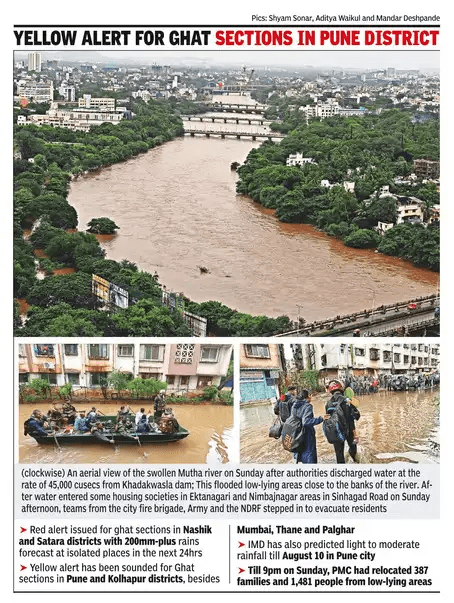
Urban expansion meets monsoon fury The recent flooding in Pune has been worsened by uncoordinated and untimely releases from upstream dams. Himanshu Thakkar of SANDRP said. Thakkar pointed out systemic issues in dam operations across India.
“There is no systemic approach, and the Dam Safety Act fails to address operational issues. Dams can create disasters even without structural failures due to uncoordinated releases. We need accountable, transparent, and credible mechanisms for dam operations,” he said. (By Badri Chatterjee) https://www.hindustantimes.com/environment/punes-struggle-with-floods-urban-expansion-meets-monsoon-fury-101722108356995.html (28 July 2024)
Dam Floods need urgent attention Deputy CM directed the WRD to keep the Khadkwasla Dam only half full to avoid repeat of the floods. While this is welcome and needs to be implemented, it also raises a number of questions. This kind of steps are required on systemic level for all dams across Maharashtra and India, and whenever this is violated in case of any dam, consequences must follow for those responsible, holding the responsible persons accountable. Such systemic governance needs to be completely transparent with all information about dam operations and their rule curves in public domain. CWC has been pathetically, regularly failing in this regard. In the context of climate change, such steps are even more urgently required. https://sandrp.in/2024/07/29/drp-nb-290724-dam-floods-need-urgent-attention/ (29 July 2024)
PMC responsible for flood woes in Pune Floods caused by water discharge from the Khadakwasla Dam in July last week swamped the city, causing considerable damage to those living near the riverbanks. Following citizens’ pressure, the PMC formed a three-member committee to investigate the causes of flooding. While the committee has yet to submit its report, activists have accused the civic body of being responsible for the floods, claiming that unauthorised constructions on the riverbed’s blue flood line have exacerbated the issue.
They also raised doubts over the impartiality of the report, saying that since the PMC itself is responsible for allowing construction on the riverbed, the report may not reveal the true cause of the disaster. According to the insiders, the report has been submitted by some officials, but the commissioner has stated that he has not yet received it. This has raised concerns among Pune residents, who are questioning whether the report will be made public or kept under wraps as usual. https://punemirror.com/pune/civic/pmc-responsible-for-flood-woes-in-pune/cid1725614591.htm (06 Sept. 2024) While it is true that the committee requested an extension, the preliminary draft of the report was reportedly accepted, and the final report has been sent, according to sources. However, PMC commissioner Rajendra Bhosale said: “The report of the committee appointed to ascertain the cause of the flood is not yet received. The committee has sought an extension to submit the report. The extension will be reviewed for how many days and why it has been sought.” https://punemirror.com/pune/civic/pune-news-committee-delays-flood-investigation-report-amid-questions-over-pune-floods/cid1725513697.htm (05 Sept. 2024)
Nasik Continuous rainfall and water release from Gangapur Dam have caused severe flooding in Nashik’s Godavari River, submerging key temples. https://x.com/ians_india/status/1827542357383815484 (24 Aug. 2024) -Nine dams in Nashik district filled to the brim following incessant rains over the last three days, sending the Godavari river which flows through the city in spate, prompting the evacuation of some residents of areas located near its banks to safer places. https://indianexpress.com/article/cities/mumbai/godavari-river-in-spate-as-rains-lash-nashik-district-9534042/lite/ (26 Aug 2024)
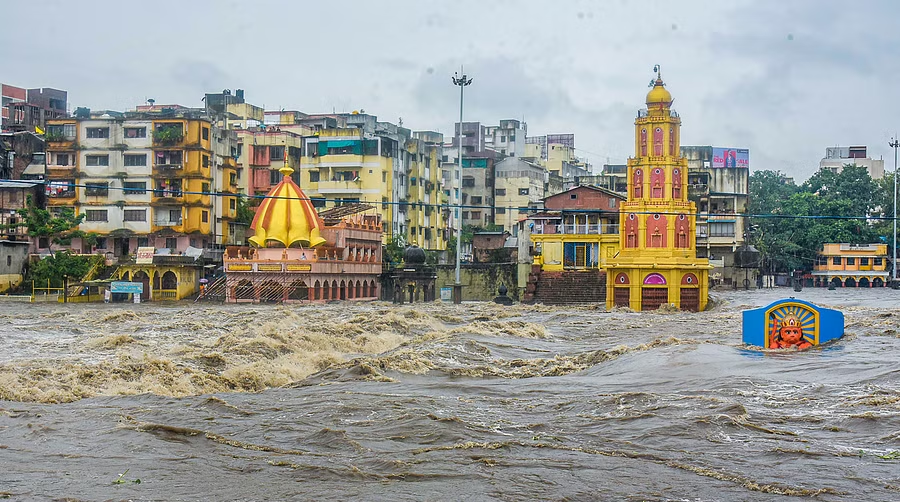
After heavy rains lashed Nashik for the past 24 hours, the Gangapur dam overflowed. Thousands of cusecs water was released in the Godavari River. https://www.indiatvnews.com/maharashtra/nashik-temples-flooded-after-water-released-from-gangapur-dam-amid-day-long-incessant-rains-goda-ghat-imd-weather-update-2024-08-04-945170 (04 Aug. 2024)
Nagpur Gates of many dams opened, flooding rivers & roads Another cause of concern for the Gadchiroli district administration is the opening of the gates of Medigadda dam, just across the state border in Telangana, on Godavari river. Officials of WRD are in constant touch with their counterparts in Telangana to monitor the situation. The opening of the gates of Medigadda dam has prompted the Mah govt to request the Telangana govt to ensure that the gates, especially from Elampally and Kandem areas on their side, are opened in coordination with Mah. https://timesofindia.indiatimes.com/city/nagpur/heavy-rains-cause-flooding-in-eastern-vidarbha/articleshow/112092274.cms (29 July 2024) This is strange. Mah Deputy CM & WRD Minister have asked Telangana to share information in advance about water release from Medigadda dam, but they should know that all gates of Medigadda dam are open, and it cannot do anything further to release any water from the dam. All the inflows are flowing downstream. https://timesofindia.indiatimes.com/india/telangana-asked-to-alert-maharashtra-about-discharge-from-medigadda-dam-fadnavis/articleshow/112084352.cms (28 July 2024)
Vadodara Man made floods The Pratappura reservoir that collects rain water from Halol and Pavagadh was meant to supplement the Ajwa dam during scant rainfall years. Both Pratappura and Ajwa dams were commissioned by Maharaja Sayajirao Gaekwad III, her great grandfather-in-law. The royal scion recalled how the city saw an annual rainfall of 1,955 mm in 1878, 1,752 mm in 1917 & 2,336 mm in 1927. She also mentioned the flood of 2005, when the city saw 2,280 mm of rain submerging the horse of the statue of Maharaja Sayajirao at Kala Ghoda circle, earning it the name of “Ghoda poor” and was compared to the 1927 flood. Gaekwad’s post claimed that the rain caused an estimated damage of Rs 56 cr to Ajwa & Pratappura reservoirs, which she said illustrated “the consequence of neglecting historical lessons in flood management”.
Research by Udit Bhatia, Associate Professor at IITGN team pointed at the flooding in Vadodara as the likely outcome of “extensive urban development in flood-prone areas, altered elevations and drainage patterns compromised due to rapid urbanisation and clogged drainage systems”. “Analysis of urban land use shows rapid expansion near riverbanks, particularly downstream in Vadodara, where developments are vulnerable to persistent flooding. Intense rainfall poses a significant challenge to drainage systems, and without integrating urban basin management, even routine rainfall events could have unexpectedly severe consequences,” he told Indian Express. https://indianexpress.com/article/cities/ahmedabad/gujarat-heavy-rain-vadodara-vadodara-waterlogging-power-outage-cellphone-network-collapse-vishwamitri-river-9557252/ (9 Sep 2024)

Following the floods, Gaekwad’s wife Radhikaraje Gaekwad had taken to the social media to say that the deluge was a “consequence of neglecting historical lessons in flood management”. She had said, “Flooding has a long history in Vadodara… historical peaks reached 77 inches in 1878, 69 inches in 1917, and 92 inches in 1927… Baroda inherits a legacy of impeccable administration under the Late Maharaja Sayajirao Gaekwad III. The infrastructure, including separate sewage and rainwater drains and the Ajwa and Pratappura dams was well-designed to handle floods; the city then maintained good drainage systems through abundant nalas, tanks, and open spaces for natural water to flow…” https://indianexpress.com/article/cities/ahmedabad/vadodara-royal-family-seeks-govt-action-to-solve-problem-of-flooding-9555922/ (08 Sept. 2024)
Environmental activist Rohit Prajapati, in a letter sent jointly to the central and state government as well as senior officials of the local administration including the Municipal Corporation, said that no lessons have been learned from the incidents of floods and waterlogging last year. Also, ill-advised and ill-thought-out efforts were made to “revive” the Vishwamitri river, which could not provide a concrete solution to the floods and waterlogging. The letter sent to the officials demanding concrete action said that the intensity and extent of floods and waterlogging incidents in Vadodara have worsened in the last 20 years. https://hindi.downtoearth.org.in/river/vadodara-floods-environmentalists-say-big-projects-and-dumping-of-debris-in-river-area-ruined-water-system (05 Sept 2024)
City deluged as Vishwamitri breaks its banks Vadodara was grappling with its worst-ever floods in recent history after the flooding Vishwamitri River, passing through the heart of the city, overflowed into the city, leaving every nook and corner of the city deluged. The river breached the 35.25-foot mark, nine feet above the danger level, breaking the 19-year record when the city had recorded one of its worst-ever floods in 2005. But the spread of the water in the city on Tuesday (Aug. 27) was much greater compared to the 2005 floods, which were caused by a breach in Pratappura.
On the face of it, the level remained the same for several hours, but Vadodara Municipal Corporation (VMC) stated that this was because after this level, the water starts spreading horizontally, inundating various areas. The areas affected due to floods in the river included Sayajigunj, Sama, Akota, Mujmahuda, Vadsar, Kalali, Karelibaug, Harni, Jetalpur and Pratapgunj, among others. The water kept spreading to newer areas throughout the day as the discharge from Ajwa reservoir did not stop till Tuesday night. A VMC official said that water from storm water drains had also started entering some areas like Nizampura. These discharged water in Vishwamitri, which was not accepting more water. https://timesofindia.indiatimes.com/city/vadodara/vadodara-flooded-as-vishwamitri-river-overflows/articleshow/112850108.cms (28 Aug. 2024) -Although the rain has paused today Aug 27 in Vadodara, water continues to be released from the upstream Ajwa Dam into the Vishwamitri River, keeping the river level at 35 feet. Residents living along the riverbanks are facing severe flood conditions. So far, around 3,000 people have been relocated within the city. https://deshgujarat.com/2024/08/27/vadodara-flooded-as-vishwamitri-flows-9-ft-above-danger-mark-waist-deep-water-in-several-areas/ (27 Aug 2024)
City still under water, Army called in “The Vishwamitri river crossed the danger mark of 25 feet on Tuesday (Aug. 27) morning, following heavy rain and the release of water from Ajwa dam,” Health Minister Rushikesh Patel told media persons after a review meeting with senior officials. “Water level of Ajwa Dam is 213.8 feet at present. We have closed the gates so that no additional water goes into Vishwamitri river. The river is currently flowing at 37 feet, well above the danger mark. Water has spilled into the city and many areas are flooded,” he added.
As a long-term solution, the government is considering a proposal to divert floodwaters into the Narmada canal instead of releasing it in Vishwamitri, he said. “Such a situation has arisen after nearly 20 years. The Vishwamitri gets water from Ajwa, Pratappura and three other non-gated reservoirs a long-term solution to flooding, we are considering diverting the dam water into Narmada canal instead of releasing it into Vishwamitri. The plan has been discussed with CM Bhupendra Patel,” he said. https://indianexpress.com/article/cities/ahmedabad/vadodara-city-still-under-water-army-called-in-9538580/ (29 Aug. 2024)
Vadodara is experiencing a food-like situation as the Vishwamitri River’s water level has surged to 35 feet, according to authorities on Tuesday (Aug. 27). The rising water has flooded nearby areas, prompting immediate action. To address the situation, the gates of the Ajwa and Pratappura dams, which contribute to the Vishwamitri River, have been temporarily closed to prevent further water level increases and to reduce the impact on the affected areas. https://economictimes.indiatimes.com/news/india/vadodra-floods-weather-update-gujarat-rain-floods-vishwamitri-river-water-level/articleshow/112852419.cms (29 Aug. 2024)
“There was no warning…It began in the dead of night,” rued Bhavan Vasram Bharwad, a resident of Dena village in Vadodara which is among the worst flood-hit districts in the state. Since Monday, parts of Vadodara city along with the district have been reeling under the impact of the downpour even after the authorities stopped releasing excess water from Vishwamitri River. On the reasons for the flooding, locals blamed “development and encroachment of the river banks”. To the left of Dena village, flows the Surya river and to its right is the Vishwamitri river. They converge under the Dhara bridge.
Once a lively village, Dena now paints a sorry picture with dead cattle, homes strewn with trash, ruined grains and rotting furniture — all revealing the aftermath of staying under 8-12 feet of water for three days. “The rain and floods have damaged over 90% homes with a couple of them even collapsing. This level of flooding is not normal. This happened six years ago and even then, it wasn’t so bad. Our elders say that there hasn’t been such a bad flood in more than 70 years,” said Qureshi.
Dena village Sarpanch Waheedkhan Pathan told The Indian Express, “Due to the confluence of these rivers, at least 12 feet of water battered our village. No place was safe. While the Vishwamitri river was already at the point of overflowing due to the heavy rains. The administration opened 22 gates of the Ajwa sarovar, bringing more water into the river. That water had not even subsided when the Vishwamitri brought waters from Pavagadh leading to this extent of flooding and causing such mayhem.” However, it is not just the immediate damage, but also the long-term impact that has the villagers worried as they attempt to refurbish their lives with leftovers from the flood. https://indianexpress.com/article/cities/ahmedabad/vadodara-villages-battle-flood-aftermath-9540634/ (30 Aug. 2024)
Bharuch The Narmada River in the city is experiencing continuous inflow, with a discharge of nearly 4 lakh cusecs of water from the SSD. https://deshgujarat.com/2024/08/26/narmada-river-crosses-danger-mark-of-24ft-at-golden-bridge-in-bharuch/ (26 Aug 2024) Narmada river crossed the danger mark of 24 feet and went upto 27 feet at Golden Bridge on Aug 27, 2024. 280 people were evacuated from riverbank areas on Aug 26, 2024. https://www.deccanherald.com/india/gujarat/narmada-river-crosses-danger-mark-at-golden-bridge-in-bharuch-low-lying-areas-flooded-3166099 (28 Aug. 2024)
Vijayawada Prakasam barrage floods city In an unprecedented situation in the history of 170-year-old Prakasam barrage on Krishna river in Vijayawada, the state irrigation dept on Sep 2 released 1.18 million cusecs of water from the barrage, which resulted in inundation of a large number of residential colonies in the low-lying areas of the city and several villages downstream of the river in Krishna district. https://www.hindustantimes.com/india-news/118-million-cusecs-of-water-released-from-barrage-inundates-parts-of-vijaywada-101725305061811.html (03 Sept. 2024)

Vijayawada floods man-made The primary cause of flooding in Vijayawada is the overflowing of the Budameru, not a breach. (breach happened on Sep 3, not before). Whatever the reason, when the decision was made to open the gates at midnight, there was more than enough time to evacuate people from the affected areas. It’s shocking to think why no evacuation took place. It was obvious that the Budameru would overflow, as it can only accommodate <10,000 cusecs at best, but that day it was flowing at > 30,000 cusecs. Common sense dictates that it would inevitably overflow. https://threadreaderapp.com/thread/1831204773548208601.html (Gordon Gekko 4 Sep 2024) https://x.com/KiranWeatherman/status/1831539059245613476 (Vizag Weatherman, 5 Sep 2024) The floods in Vijayawada, caused by the Budameru Canal and Krishna River, have reached unprecedented levels, affecting Ajith Singhnagar, New Rajarajeshwaripet, Nunna, Payakapuram, and now Ramalingeswaranagar and Bhavani Puram. On Sep 2, these areas were submerged, displacing thousands of residents. At dawn on Sep 2, floodwaters from the Krishna River breached retaining walls and inundated homes in Ramalingeswaranagar. The water rising to 6 ft, flooded the Police Colony & surrounding roads. https://www.deccanchronicle.com/southern-states/andhra-pradesh/floods-ravage-more-parts-of-vijayawada-1821026 (03 Sept. 2024) The fury of Budameru has brought power generation at Narla Tatarao Thermal Power Station (NTTPS) in Kondapalli to a grinding halt. All units in the power station were tripped following the inundation of the conveyor belt, coal yard, and wagon yard. Water from Budameru and neighboring hill slopes entered the power plant. https://timesofindia.indiatimes.com/city/vijayawada/water-woes-halt-thermal-power-generation-at-nttps-in-kondapalli/articleshow/112977359.cms (02 Sept. 2024)
Tracing causes of catastrophe Decades of political neglect and unchecked encroachments have exacerbated the Budameru flood crisis, with a stalled ₹500-crore modernisation project and political parties engaging in blame game. As residential developments encroach on floodplains and flood management efforts falter, Vijayawada faces recurring disasters with no lasting solutions in sight.
The devastating floods in Vijayawada city, caused by breaches in the Budameru rivulet, has highlighted a multitude of issues ranging from government neglect and lack of commitment on the part of successive governments to finding a permanent solution. What is most telling is the fact that the State government still lacks comprehensive data on the encroachments along the drain, despite a recurring pattern of the rivulet inundating entire swathes of farmland and residential areas along its course over the years. https://www.thehindu.com/news/cities/Vijayawada/budameru-flood-crisis-tracing-the-causes-of-a-catastrophe/article68638554.ece (14 Sept. 2024)
Interesting statement by Union Agriculture minister Shivraj Singh Chauhan: “The illegal mining during the previous regime is one of the reasons for the breach of Budameru.” https://www.newindianexpress.com/states/andhra-pradesh/2024/Sep/06/army-to-step-in-to-plug-budameru-canal-breach (06 Sept. 2024) Pictorial report on Vijayawada floods. https://www.sakshi.com/photos/news/vijayawada-floods-2024-photos-2170587 (03 Sept. 2024) An Aerial view of flood-affected area of Vijayawada. https://www.prokerala.com/news/photos/an-aerial-view-of-flood-affected-area-of-vijayawada-3711591.html (03 Sept. 2024) Budameru Canal Breach Drone Visuals. https://www.etvbharat.com/te/!videos/drone-visuals-of-budameru-canal-breach-works-vijayawada-aps24090705371 (07 Sept. 2024)
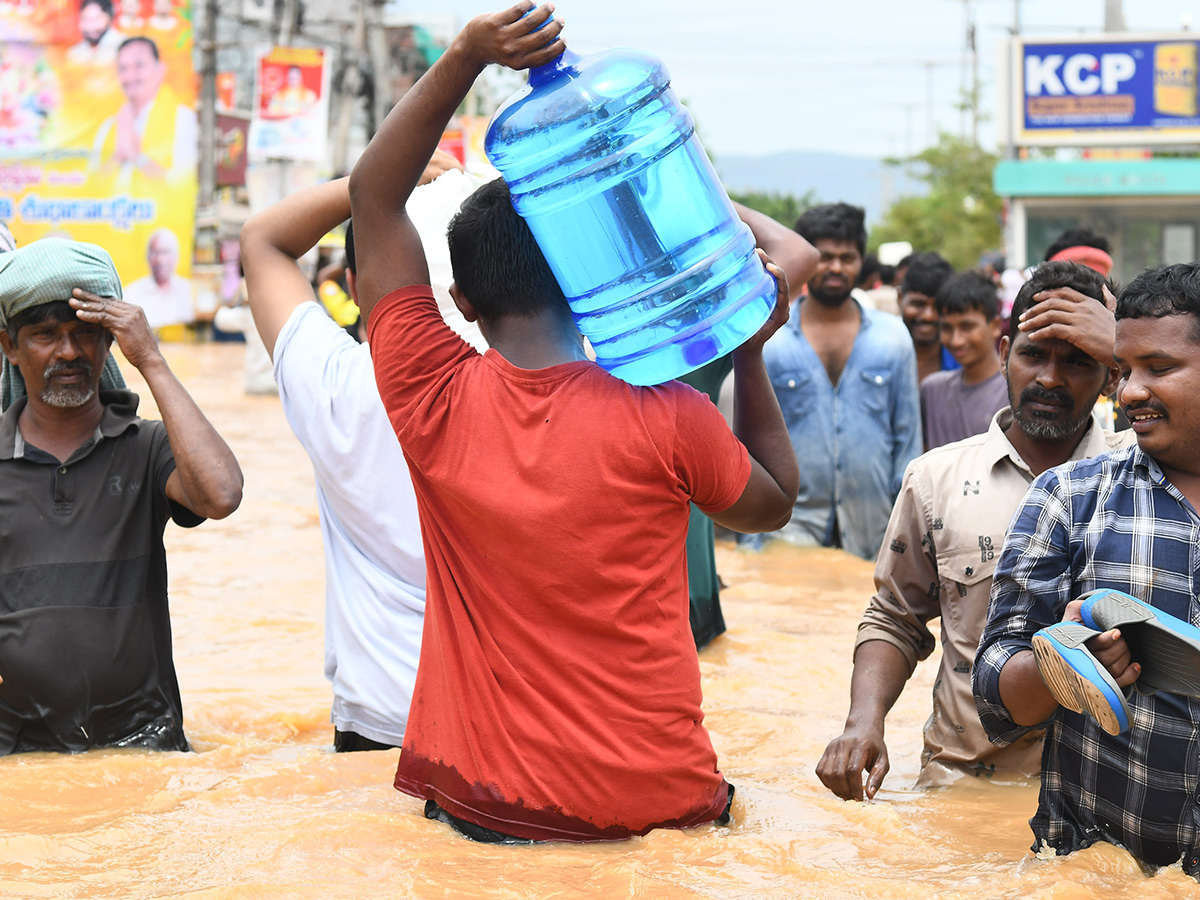
The flood-hit parts of Vijayawada remained marooned for the fourth day even as authorities continued rescue and relief operations. The water level at Prakasam Barrage continued to recede, averting flood threat to villages downstream but the misery of people in inundated areas of the city has not ended. Dozens of colonies were inundated following heavy rain and the breaches to the Budameru Rivulet. Though the intensity of flood in the rivulet has come down, water from flooded areas is not flowing out. https://www.socialnews.xyz/2024/09/04/flood-hit-areas-of-vijayawada-remain-marooned-for-4th-day/ (04 Sept. 2024) https://www.etvbharat.com/en/!state/vijayawada-floods-update-power-cuts-traffic-disruption-throw-life-out-of-gear-enn24090201353 (02 Sept. 2024) As many as 2.76 lakh people in 17 wards, including Sundaraiah Nagar, Rajiv Nagar, Prakash Nagar, Kandrika, Gollapudi, Singh Nagar, Payakapuram, and Nunna, were hit by the deluge following the breach to the Budameru Rivulet. People were stranded in their homes with no power, water and food. https://www.newindianexpress.com/states/andhra-pradesh/2024/Sep/02/vijayawadas-worst-nightmare (02 Sept. 2024) Flood waters have largely receded from several affected places in Vijayawada but fresh rainfall and the third breach in Budameru rivulet resulted in flooding again in parts of the city. https://m.rediff.com/news/report/vijayawada-faces-flood-threat-after-rain-breach-in-budameru-rivulet/20240906.htm (06 Sept. 2024)
Urban Flood lessons Vadodara and Vijayawada have got the media attention more than any other city for urban floods this year. In both cases a number of factors are common: role of upstream dams, encroachment on water bodies including rivers, lakes, streams, role of illegal sand mining particularly in Vijayawada, not having learnt any lessons from past flood disasters.
There is also need for better rainfall monitoring, reporting and forecasting system in place along with a disaster management system that can effectively use such information. We need better flood forecasting for urban areas urgently. Urban areas also need a National Water Policy as today there is nothing to guide the water, including flood management in urban areas. https://sandrp.in/2024/09/16/drp-nb-160924-urban-flood-lessons-from-vadodara-vijaywada/ (16 Sept. 2024)
Delhi Bawana flooded after Munak canal breach A breach in the Munak canal, which channels water from Haryana to Delhi, led to severe waterlogging in north-west Delhi’s Bawana, leaving residents stranded in their homes. Early Jul 11, water from the canal’s barrage inundated the J, K, and L blocks of the colony, forcing residents to wade through waist-deep water. https://www.newindianexpress.com/cities/delhi/2024/Jul/12/bawana-flooded-after-yamuna-canal-breach (12 July 2024)
Water entered about 1300 houses and people were forced to leave their homes and spend the night on the road. 70-year-old Kaushalya Devi died during this incident. Local people claim that they had reported water leakage from the canal 15 days ago. But it was ignored. Minister Atishi Singh, said that the responsibility of repairing the Munak canal lies with the irrigation dept of the Haryana. The Delhi govt is helping the Haryana irrigation dept to repair the canal. https://www.youtube.com/watch?v=wihhXTGJL2A (12 July 2024)
Compiled by Bhim Singh Rawat (bhim.sandrp@gmail.com)

 SANDRP
One thought on “2024: Dam Induced Floods in Urban India”