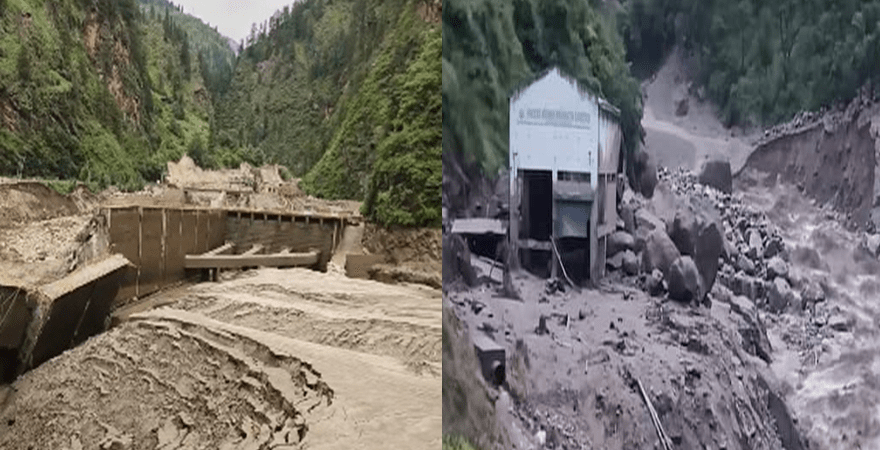
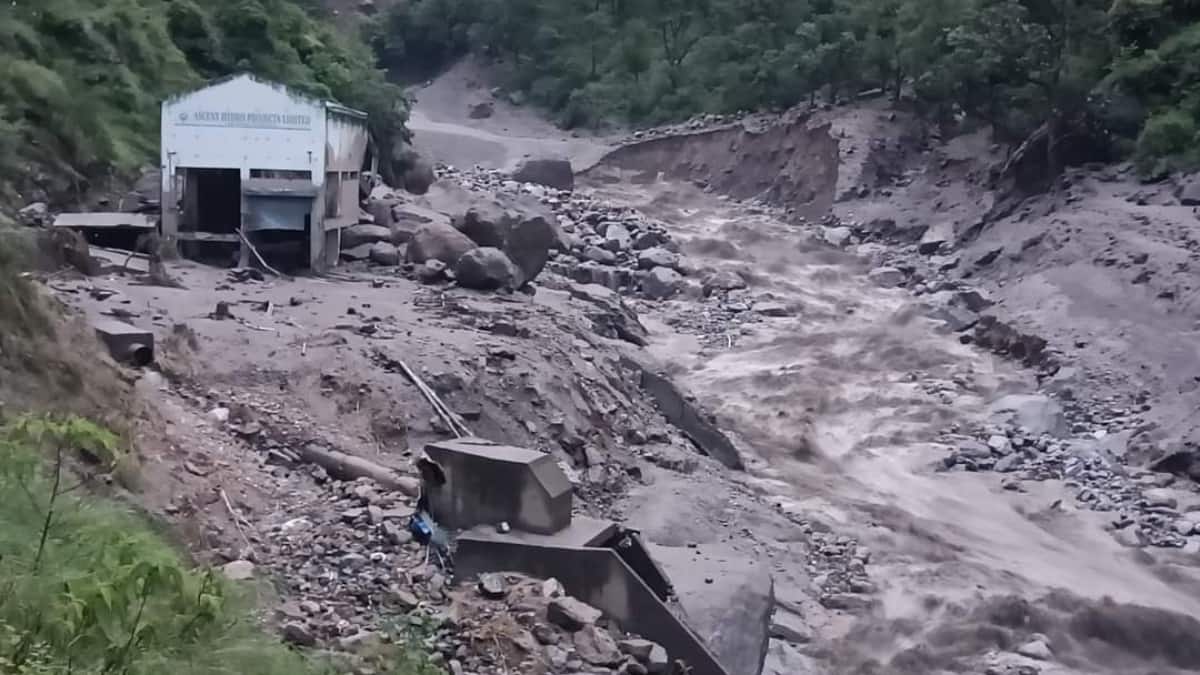
(Feature Image: Flashflood damaged Malana I HEP dam site & Sechi HEP powerhouse in Beas & Satluj basin. Image source: Social Media.)
The multiple cloudburst incidents between July 29 and August 01, 2024, has caused large scale devastation in Kullu and Shimla districts of Himachal Pradesh. The initial media reports in brief have mentioned that two hydro electric-power (HEP) projects namely 85 Mw Malana-I and 14 Mw GreeenKo Project being damaged by the flashfloods. The follow up reports have extensive coverage on rescue and relief works, but not much is revealed about scale of damages to the HEP projects.
Looking for more details, SANDRP contacted concerned government departments and HEPs officials in flashflood affected areas and tried to find out more about exact number of HEPs impacted by the disaster. Based on information provided by the government and project officials, a river basin and project wise description of these HEPs and flashflood impact on them is given below.
Beas Basin, Kullu District
1 Jirah SHEP: The 4 Mw small HEP is built and run by a private company Kapil Mohan Hydro Private Limited (KMHPL). The project is in Parbati valley upstream Manikaran and it taps Tosh nullah a tributary of Parbati river. The project was commissioned in January 2011.
The cloudburst induced flashflood in Tosh nullah on the intervening night of July 29-30, 2024 washed away the weir site, intake channel and diversion structure of the project apart from causing damages to transformer, diesel generator set at powerhouse site. As per the officials, the project has suffered losses worth Rs 1 crore and restoration work might take about a month. The weir site of the project had also faced damages in 2022 monsoon.
2. Raskat Mini HEP: The 800 Kw project is built by Indushree Power (P) Ltd. opposite Shilha village along Barshani road near Manikaran in Parbati valley. The project was commissioned in Aug 2001.
As per Amar Ujala report (July 30, 2024), the penstock of the project had burst due to overflow causing damages to power house. It is reported that the penstock of the project was blocked with debris due to flash flood. The project was out of operation by the time of filing this report.

3. Brahmaganga HEP: The 5 Mw project is located along Brahmaganga stream at Manikaran in Parbati valley. It was commissioned in April 2008 and is being run by Harisons Hydel Power Project company.
There were two flashflood spells in Brahmaganga stream first on July 29 night & second on July 31 night. The project structures including trench weir site, desilting chamber, intake structure & feeder pipe were filled with debris in the first flashflood incident itself. The deluge also washed away two RCC walls, wire crate structures & other retaining walls around the weir site. The second spell also impacted the already damaged structures. Before this, the project has suffered similar damages in July 2023 and August 2021.
4. Malana II HEP: The 100 Mw project is built on Malana stream a tributary of Parbati river in Malana valley under Kullu tehsil. The 45-meter-high concrete gravity dam of the project is located about 3km upstream Malana village. The project has 5km long power tunnel & an underground powerhouse on left bank of river just upstream the Malana I HEP dam site. The project was commissioned in July 2012. The project run by Everest Power Private Limited had applied for CDM fund and its catchment area treatment (CAT) plan prepared by WAPCOS.
The project has suffered significant damages due to cloudburst induced deluge hitting the project site in intervening night of July 31 and August 01, 2024. The approach road of the project has been washed away apart from three 132 Kv transmission towers. The switchyard site of the project has also been affected.

The flashflood turned a nightmare for 33 workers who were trapped at the project site. As per reports, 29 of them were rescued from hills close to dam site and 4 from the tail race tunnel of the project. The rescue operation went for two days on August 01-02, 2024. The video clips from the rescue site show severe impact around powerhouse site of the project.
The officials have not been able to visit the project site to assess the full-scale damage but claimed that the dam of the project is safe. They also feel making the project operational could take about a year.
The project has been facing accidents and disasters frequently. In July 2023, the gates of the project dam got stuck for over two months creating flashflood threats for downstream areas. Before this, the HEP faced damages due to a cloudburst incident in July 2022.
5. Malana I HEP: The 86 Mw HEP is built downstream Malana village by Malana Power Company Ltd. The RoR project has 20-m-high dam with 2.50 lakh cumecs storage capacity and 3.3 km long head race tunnel, 915-m-long penstock pipe & a surface powerhouse by the Parbati river. Its construction work started in Jan 1999 and it was commissioned in July 2001.
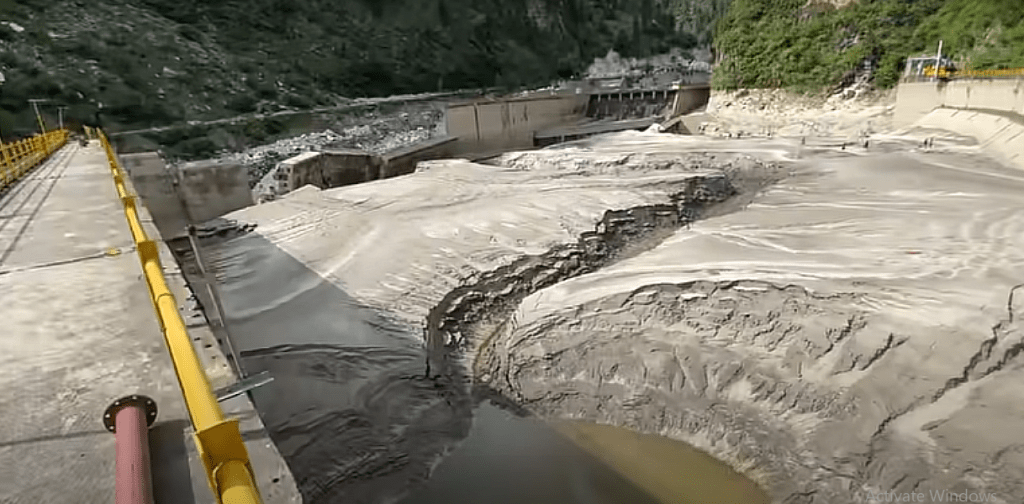
The flashflood in early morning of Aug 1, 2024, has massively damaged the dam site of Malana I HEP. The news reports and social media videos show part of dam structure in collapsed condition. The desilting chambers, intake structures have reportedly been damaged. Debris, boulders have occupied the riverbed and dam pondage has been heavily silted up. The powerhouse of the HEP is reportedly safe.
Since the beginning, the reservoir of the project has been suffering from reoccurring seepages and failure of foundation problems. As part of the main road and approach road to the project site have been washed away, the project officials have not been able to reach the site to assess extent of damages to the project structures. However, the scale of destruction to the project and around the project site as shown in media reports and video blogs, suggest that the restoration works could take more than a year.
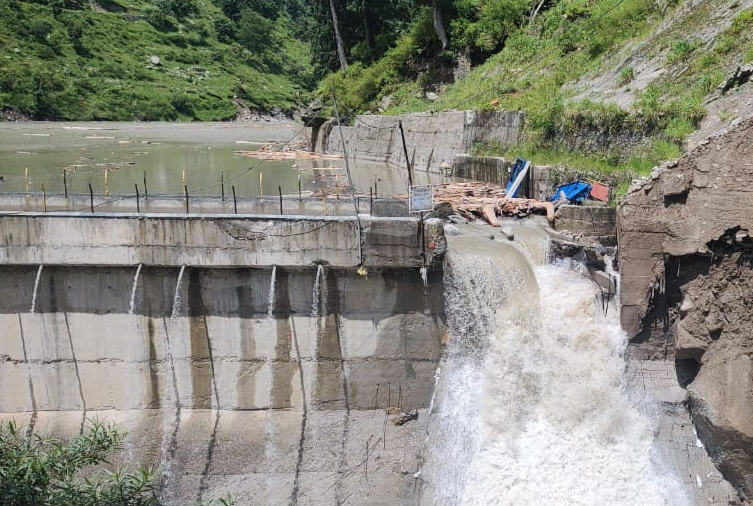
Malana I & II HEPs have been facing accidents & disasters time & again. The present disaster has left many unanswered questions regarding fixing of jammed gates and dam operations of Malana II HEP. Similarly, the flood spell has exposed the faulty design of Malana I HEP dam structures raising questions over its structural safety. See a detailed and informative thread on this by Sankar Anand, a Social Entrepreneur in Tons Valley, Uttarakhand.
Sutlej Basin, Shimla
The flashfloods have also impacted at least 7 HEP projects in Ghanvi khad and Samej khad of Sutlej basin in Rampur tehsil of Shimla district. The area has been affected so badly by the deluge that officials of private HEPs have not been able to reach the project sites and carry out damage assessments. However, based on contact with project officials, we have got some information on damages to these projects.
1 Upper Nanti HEP This is upper most HEP project on Nanti khad a glacial fed stream also known as Kurmi khad in middle and Ghanvi Khad in lower segment. Nanti is right bank tributary of Satuj river. It joins the Sutlej near Jeori.
The 13.5 Mw HEP project is built by Nanti Hydro Power Private Limited near Nanti village. It was commissioned in 2018. Presently, Greenko is running the HEP. The CAT plan mentions the capacity of the HEP as 12 Mw, the project had also applied from CDM fund.
As per project officials the disaster has affected about 70 percent of the project. The flashflood hit the project site around midnight on July 31, 2024, washing away the weir site, approach road, forebay penstock, a steel bridge, two staff quarters along with the kitchen and toilets of the project. The underground desilting tank has been filled with debris and structures around switch yard have been damaged. The powerhouse of the HEP is claimed to be safe.
Senior officials still have not estimated overall financial losses incurred to the project. The project has suffered estimated financial losses wroth ₹30 to 40 crore and restoration of the project could take at least a year, assume the staff present at the site. The project was impacted by flashfloods in 2022 too, but the scale and intensity of deluge this year is unprecedented according to them.
2 Kurmi HEP The 8 Mw Kurmi is second hydro project on the Nanti khad. It is owned by Kurmi Energy Pvt Ltd and was commissioned in March 2014.
The flash flood has fully damaged the weir site of the project apart from partially damaging trash rack, intake gate of the project. The flood protection structures of powerhouse, switch yard and approach roads to the project have also been washed away in the deluge. The power tunnel, gravel flushing tunnel and desilting tank have been filled with debris and silt.
A landslide at project site has exposed the penstock anchor and tail race tunnel of the HEP. The officials have still not estimated the financial losses. As per them the project is in critical condition and restoration would not be possible before six months.
3 Lower Nanti HEP: The 14 Mw Lower Nanti is third HEP built on Nanti khad near Runcha village. The project is being run by Suryakant Hydro Energy Pvt. Ltd. and it was commissioned in 2013. The CAT plan document mentions the capacity of the project as 10 Mw.
The disaster has also affected the Lower Nanti HEP severely making it non-operational and repairing the damages will take months. In an official statement, the company has informed the administration that flashflood caused by heavy rainfall/ cloudburst has damaged the civil work of weir site, trash rack, conveyance channel, protection work of flushing channel and main channel upto desilting tank.
As per the statement the deluge has washed away RCC protection work of powerhouse and tail race area besides damaging two tubular structures. The statement does not reveal overall monetary losses and time the restoration work would take.
4 & 5 Ghanvi I & II HEPs: The 22.50 Mw Ghanvi I and 10 Mw Ghanvi II hydro projects are owned and operated by Himachal Pradesh State Electricity Board Ltd. (HPSEBL) on Ghanvi khad (Shrikhand Dhar) near Ganvi village of Rampur tehsil.
The Ghanvi I HEP became operational in December 2000. The construction work of Ghanvi II HEP started in 2004 with March 2007 as completion target. However, after the eight years delay the project was commissioned in November 2014 and its construction cost also increased from ₹49 crore to ₹173 crore.
Regarding the impact of disaster, the HPSEBL has officially mentioned that the flashflood in Ghanvi khad during night hours of July 31, 2024, has caused extensive damages to components of powerhouses and intake channels of both the HEPs.
The official statement of the HPSEBL shows that part of approach road to powerhouse of Ghanvi I HEP has been damaged and washed away at several locations. Debris have filled up weir site of the project causing damages to trench weir, trash rack and other structures. Similarly, major impacts on Ghanvi II HEP includes damages to weir site, approach roads to access weir site and switchyard site, deposition of debris in desilting tank.
Cumulatively, both projects have suffered financial losses worth ₹2.78 crore and fixing the damages would cost around ₹3.37 crore. The destruction has rendered both projects non-operational causing huge generation losses.
Samej Khad: Samej is a glacial fed perennial stream. It merges into Sutlej river near Jhakri. The river is formed by confluence of Sechi and Muhali khads and it divides Kullu and Shimla district. The flashflood in Samej khad has impacted 2 hydro projects. While 14 Mw Sumez HEP is in Shimla district, the 4.5 Mw Sechi HEP falls under Kullu district.
6 Sumez HEP: The 14 Mw Sumez HEP is built on Sechi khad near Samej village of Rampur tehsil. The project also taps Muhali khad which joins Sechi khad near the powerhouse site of the project. The CAT plan of the project can be seen here.
The HEP, developed by Ranga Raju Warehouse Private Ltd, was commissioned in early 2012. In May 2012, the Greenko group acquired the project and formed Greenko Sumez Hydro Energy Private Ltd.
The July 31-August 01, 2024, disaster has killed at least eight workers of the project. The workers were living in a project building near Muhali khad which was washed away by the deluge. The details of seven workers can be seen here.
The flashflood has also severely damaged the weir site, approach roads, switch yard, operation and maintenance store of the project apart from washing away a project bridge, several of project assets. The underground powerhouse of the project has been facing seepage problems.
The disaster has rendered the project site unapproachable. Hence, the officials have not been able to estimate overall damages and financial losses incurred. They feel restarting the project is a challenge and could take about a year time. It is worth to mention that the project faced damages due to a cloudburst incident in last week of June 2023 also.
7 Sechi HEP: The 4.5 Mw SHEP is built on Sechi Khad by Ascent Hydro Projects Ltd. It was commissioned in February 2011 and seems to have benefitted under CDM fund.

As per sources, the flashflood has severely impacted the entire project. The weir site, machines in powerhouse have been washed away and the powerhouse building has also suffered damages. There is no official information available on overall financial losses and time the project would take to be operational again.
Summary Table on Hydro Projects Affected by Cloudburst/ Flashflood Disaster on July 31- August 01, 2024.
| SN | Project Name | Capacity | COD | Company Name | River Basin |
| 1 | Jirah HEP | 4 Mw | Jan. 2011 | Kapil Mohan Hydro Pvt Ltd | Tosh nullah, Parbati river Beas Basin |
| 2 | Raskat Mini HEP | 800 Kw | Aug. 2001 | Indushree Power (P) Ltd. | Raskat nullah, Parbati river, Beas Basin |
| 3 | Brahma-ganga HEP | 5 Mw | April 2008 | Harisons Hydel Power Project | Brahmaganga nullah Parbati river, Beas Basin |
| 4 | Malana II HEP | 100 Mw | July 2012 | Everest Power Private Ltd | Malana stream, Parbati river, Beas Basin |
| 5 | Malana I HEP | 86 Mw | July 2001 | Malana Power Company Ltd | Malana stream, Parbati river, Beas Basin |
| 6 | Upper Nanti HEP | 13.5 Mw | 2018 | Greenko Hydro Energy Pvt Ltd. | Nanti stream, Sutlej basin |
| 7 | Kurmi HEP | 8 Mw | March 2014 | Kurmi Energy Pvt Ltd | Nanti stream, Sutlej basin |
| 8 | Lower Nanti HEP | 14 Mw | 2013 | Suryakant Hydro Energy Pvt. Ltd | Nanti stream, Sutlej basin |
| 9 | Ghanvi I HEP | 22.5 Mw | Dec. 2000 | HP State Electricity Board Ltd. | Ghanvi stream, Sutlej basin |
| 10 | Ghanvi II | 10 Mw | Nov. 2014 | HP State Electricity Board Ltd. | Ghanvi stream, Sutlej basin |
| 11 | Greenko Sumez HEP | 14 Mw | 2012 | Greenko Sumez Hydro Energy Pvt Ltd | Sechi stream, Sutlej Basin |
| 12 | Sechi HEP | 4.5 Mw | Feb. 2011 | Ascent Hydro Projects Ltd | Sechi stream, Sutlej Basin |
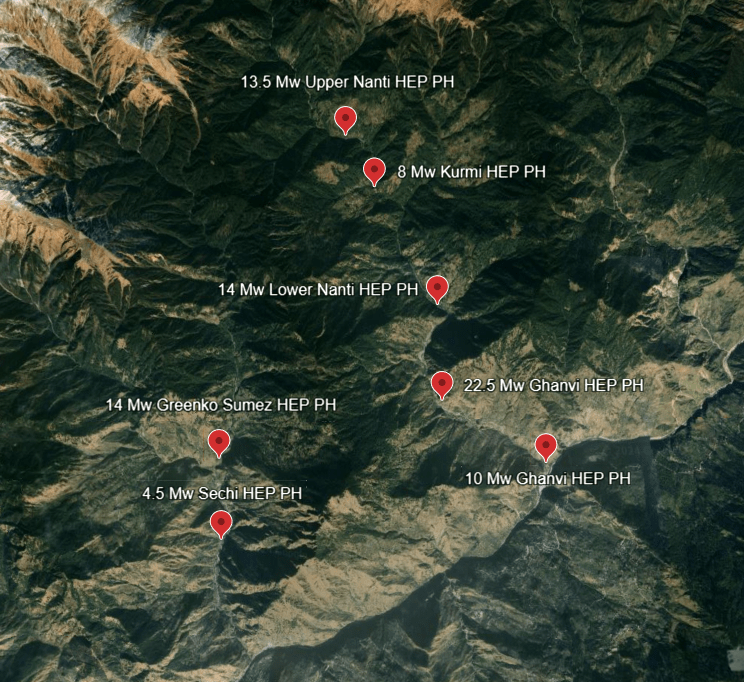
Google Earth interactive map showing locations of flashflood impacted HEPs and other hydro projects mentioned in the blog.
The information available with the government and project officials, reveals that the flashflood episode in Kullu and Shimla districts has affected at least 12 small and big HEPs in Beas (5 HEPs) and Sutlej (7 HEPs) rivers basin in lesser or greater degree. The disaster has rendered all these HEPs non-operational thus they are facing huge generational losses in addition to the significant structural damages.
The calamity has proved a life-threatening experience for the workers of several HEPs. While about 33 stranded workers of Malana II HEP got rescued by NDRF team, about 8 workers of Greenko Sumez HEP have lost their lives in the deluge.

The intensity of flashflood appears higher in Samej and Ghanvi khads affecting almost all the HEPs located along these streams. The deluge in Malana has also affected both the HEPs built along the river.
So far only HPSEBL has made full assessment of damages to Ghanvi I & II HEPs, financial losses incurred and restoration cost. Similarly, we could access official statement of Suryakant Hydro Energy Pvt. Ltd revealing the flashflood impact on 14 Mw Lower Nanti HEP.
Due to severe damages to main and approach roads, most of the private operators have not been able to visit project sites to figure out extent of damages and financial losses to their respective HEPs particularly along Ghanvi, Samej and Malana rivers.
The official reports of State Disaster Management Authority (SDMA), Directorate of Energy (DoE) and other concerned departments assessing cumulative impact of the disaster on these HEPs are still awaited in public domain.
It is noteworthy that only a week ago, the Palchan flood disaster had damaged 2 HEPs namely 2 Mw Serai HEP by Pinnacle company and 9 Mw Beas Kund HEP of Kapil Mohan group in upper Beas basin of Kullu district.
Dam Safety & Operational Issues The disaster has again raised questions on safety and operational issues of HEP dam projects. A field visit report to affected areas by Himalaya Niti Abhiyan (HNA) during August 2-4, 2024, mentions that the Malana I HEP dam failed to open its gates in time, resulting in dam failure. As per the report, the gates of the dam were jammed by debris and muck causing severe erosion of the soft sediment valley on its right end and a subsequent burst of water from the dam.
The HNA report further finds that the sudden releases from the 100 Mw Sainj HEP dam at Niharni and 520 Mw Parbati III HEP dam located about 10km downstream from Niharni aggravated the flood situation in Sainj market area. These projects are managed by Himachal Pradesh Power Corp Ltd (HPPCL) NHPC Ltd respectively.
According to the HNA report, the dam operators learnt no lesson from July 2023 flood disaster as the sudden and massive discharges from these two upstream dams in night hours again flooded Sainj market area washing away portion of road, rebuilt after last year’s deluge. It is worth mentioning that even in July 2023, locals had blamed wrong operation of these dams for causing flood destruction in Sainj market area.

The debris already dumped by dam, road projects and unattended riverbed material after recent dredging work has proved important factor in turning flood into a disaster in Sainj valley, finds the report. It also reveals that the debris dumped along Sutlej river by under construction Luhri I HEP project was washed away during this flood event. In addition to violations of muck dumping and blasting norms, the 210 Mw HEP by SJVNL has also been facing flood and land sinking threats as documented in SANDRP’s July 2024 report.
About the Disaster: Quoting SDMA’s initial findings, a detailed report by The Indian Express dated Aug 9, 2024, mentioned that the flashflood disaster was a result of 5 cloudburst incidents 3 in Kullu, 1 in Shimla, and 1 in Mandi districts taking place between 11.30 pm on July 31 and 01.15 am on August 1, 2024.
“While 27 bodies have been recovered so far, around 55 people are still reported missing, and more than 2 dozen structures, including houses, 2 hydro project buildings, a school, and 9 small bridges connecting hills at various locations, were among the approximately ₹760-crore worth of properties damaged in the devastation”, reads the report.
The report further mentions that the Samej khad was most affected by the deluge as 33 people were washed away from the Samej and Kanradar villages along the khad and the area is within the catchment of the 1,500 Mw Nathpa-Jhakri HEP.
As per the report, the SDMA team field inspection claims that flood level in Samej khad rose about 35 to 45 metres, its width increased from 35-40 meters to 155-185 meters and the khad carried giant boulders unseen in it before. About 15 bodies washed away in the khad were found 50 to 85 km away from Samej village and 6 of these bodies were discovered in the Sunni dam reservoir area buried under debris.
Bhim Singh Rawat (bhim.sandrp@gmail.com)

 SANDRP